« November 2009 | Main | January 2010 »
December 31, 2009
using capitalism to save the planet?
In the light of the failure at Copenhagen to halt and reverse the growth of carbon dioxide in the air and the Coalition's forthcoming green light approach to reducing greenhouse gas emissions without cost we have this insight from John Bellamy Foster and Brett Clark in their The Paradox of Wealth: Capitalism and Ecological Destruction. Their argument is that:
Today orthodox economics is reputedly being harnessed to an entirely new end: saving the planet from the ecological destruction wrought by capitalist expansion. It promises to accomplish this through the further expansion of capitalism itself, cleared of its excesses and excrescences. A growing army of self-styled “sustainable developers” argues that there is no contradiction between the unlimited accumulation of capital — the credo of economic liberalism from Adam Smith to the present — and the preservation of the earth. The system can continue to expand by creating a new “sustainable capitalism,” bringing the efficiency of the market to bear on nature and its reproduction.
They add that in reality, these visions amount to little more than a renewed strategy for profiting on planetary destruction.
James Hansen in How to Solve the Climate Problem in The Nation says that there is no "silver bullet" solution for world energy requirements and that the problem demands a solution with a clear framework and a strong backbone.
Hanson adds:
Let's define what a workable backbone and framework should look like. The essential backbone is a rising price on carbon applied at the source (the mine, wellhead, or port of entry), such that it would affect all activities that use fossil fuels, directly or indirectly.Our goal is a global phaseout of fossil fuel carbon dioxide emissions. We have shown, quantitatively, that the only practical way to achieve an acceptable carbon dioxide level is to disallow the use of coal and unconventional fossil fuels (such as tar sands and oil shale) unless the resulting carbon is captured and stored. We realize that remaining, readily available pools of oil and gas will be used during the transition to a post-fossil-fuel world. But a rising carbon price surely will make it economically senseless to go after every last drop of oil and gas--even though use of those fuels with carbon capture and storage may be technically feasible and permissible.
Hanson goes on to say that a successful new policy of “sustainable capitalism,” cannot include any offsets. We specified the carbon limit based on the geophysics. The physics does not compromise--it is what it is.
And planting additional trees cannot be factored into the fossil fuel limitations. The plan for getting back to 350 ppm assumes major reforestation, but that is in addition to the fossil fuel limit, not instead of. Forest preservation and reforestation should be handled separately from fossil fuels in a sound approach to solve the climate problem.
Fossil fuels continue to provide most of our energy because we do not take into account their true cost to society in that the effects of air and water pollution on human health are borne by the public. So the expansion and accummulation of capital trumps actual public interest in protecting the vital conditions of life.
Hanson says that in the end, energy efficiency and carbon-free energy can be made less expensive than fossil fuels, if fossil fuels' cost to society is included. The question is will this succeed in reducing emissions? Or will it simply result in capitalism continuing to profit on the destruction the planet?
Posted by Gary Sauer-Thompson at 9:35 AM | Comments (2) | TrackBack
December 30, 2009
tough on crime
Over the last 30 years conservative state politicians in Australia have adopted the US approach to crime in the 1980s and 1990s. This was the "tough on crime" era when incarceration was touted as the simple solution to our crime problem--which was sold as either the 'three strikes law" approach-- or "do the crime do the time" in Victoria and South Australia.
The conservative's punitive approach stands for longer and harsher penalties and the elimination of rehabilitation. Under this system, offenders who could be more cheaply deterred or rehabilitated instead incurred the most expensive -- and, from the perspective of its effect on the community, damaging -- form of punishment possible. These conservative populists have taken their policies and rhetoric from the harsh American penal system.

Incarceration was the solution to social problems, urban decay and the public fear about unsafe and disordered neighbourhoods. It emerged as a critique of the social democrat approach to crime, which held that crime was the result of "root causes" such as poverty and poor education. Law and order conservatives labelled this as being "soft on crime" and made crime a political (law and order) issue to make the streets safer by "cracking down on crime". Consequently, the number of people incarcerated in the prison system has increased dramatically.
For state politicians in Australia there can be no such thing as not being tough enough on crime. They assume that breaking the law was an individual decision, not the product of social circumstances. Therefore, the only way to reduce crime was to make sure crime didn't pay. Incarceration was the means to ensure crime didn't pay. These political elites were not simply responding to popular opinion about crime and punishment as these conservatives played a large role in shaping the public's perceptions about crime.
In this they follow James Q. Wilson, who argued that government is ill equipped to remedy the root causes of crime, even if they could be identified with certainty; that people make rational choices to commit crime based on the relative risk and reward offered; that public policy decisions regarding crime should increase the risk and lower the relative reward of crime thereby helping to deter it.
The argument is that serious street crime flourishes in areas in which disorderly behavior (graffiti, a mugging, vagrancy or drunkenness) goes unchecked.This is the broken window theory behind the conservative's punishment regime.
A problem with the "tough on crime" approach to curbing offending behavior by relying solely on incarceration is the recognition that something is deeply wrong with a modern industrialized nation imprisons a large percentage of its population; and, secondly, the problem of recidivism in that the prison system itself is criminogenic.
Thirdly, mass incarceration (including persons with mental illness, cognitive disability, dual diagnosis, Indigenous women and remandees, a significant number of who do not end up receiving a custodial
sentence at the end of their remand period) plays havoc with state budgets.Tough on crime can mean becoming bankrupt on crime. The neo-liberal solution to bankruptcy is to invest in mass incarceration as a business model--the privatization of the prison system.
Posted by Gary Sauer-Thompson at 12:21 PM | Comments (7) | TrackBack
December 29, 2009
after Copenhagen: the fallout
As we know very little progress was made in Copenhagen despite all the effort of all the nations, leaders and all the political capital invested. So what happened? Well, the post-conference blame game is well underway.
It was China who wrecked Copenhagen says Mark Lynas. China was able to block any proposal that threatened its capacity to expand as a superpower and its negotiators shot down all attempts to make emissions cuts legally binding or to set long-term goals for reducing greenhouse gases.

The last days negotiations were probably more complex than this because India was also determined to block any proposal that might constrain its future economic growth.
The Guardian's Jonathan Watts offers a more complex account:
There was a gulf in the expectations of the different parties. It soon became apparent that the BASIC group (Brazil, South Africa, India and China) were playing for a 0-0 draw. They did not want to sign up to anything that would constrain their future economic growth. Europe wanted ambitious, legal targets for 2020 and 2050. The US was most concerned about ensuring China made its emissions data more transparent and avoiding criticism for its dismal record in recent years. Europe was the furthest from achieving its goals, which is depressing as I think its targets werethe best way to keep the rise in temperature below two degrees celsius.
The consequences is that China and the US, the world's two biggest emitters, can now continue emitting without legal constraints for a longer period of time, perhaps indefinitely.
Underlying the blame game and the finger pointing China is the shift in geopolitical power, the decline of American power and the beginning of the end of the western ascendancy.
Posted by Gary Sauer-Thompson at 2:09 PM | Comments (2) | TrackBack
December 28, 2009
dreams and reality
Our dreams and reality? Or maybe scientific rhetoric and reality? Or capitalist dreams of ever expanding growth versus ecological reality?
Maybe in 2010 we can come to realize that we human are not apart from the natural world, that we do not have dominion over it, and that our mastery over nature through science and technology coupled to the deregulated free market can have destructive consequences.

Maybe we will realize that life on earth is linked by a delicate web of connections that are easily broken. Or recognize that the economy's negative impact on ecology through the exploitation of natural resources (eg., water) or pollution (eg., greenhouse gas emissions ) also affects the economy in a negative way---- eg., the decline of irrigated agriculture from the lack of water).
This two way process provides a critical point to question the evolutionary adaptationists, who take it as:
securely established that organic change proceeds through the natural selection of individual traits, each of which improves the organism’s reproductive chances, that each trait’s evolutionary end-point represents an optimum, and that no other process is needed for an evolutionary lineage to move along through time.
Human beings in a capitalist economy do not just adapt to changes in nature; they also transform nature through technology and our economic practices. Haven't we done that in the Murray-Darling Basin?
Update
The continuing commitment to economic growth through the deregulated market and new levels of technological capability has produced a historical crisis. Our public debates about this are still contained between two options: ‘let the market rule’ with minimum regulation as advocated by the free market think tanks and Murdoch press and the recognition that regulation is indispensable.
Within the mainstream it is clear that the latter has prevailed due to the global financial crisis and global warming. This is the position of the Rudd Government-- a return to rapid growth with a more active regulation of the economy.
Posted by Gary Sauer-Thompson at 5:15 PM | Comments (4) | TrackBack
December 27, 2009
playtime
It is slow time between Xmas and New Year. We forget about the worries and anxieties of paid work and allow ourselves to unwind and relax, generally at the beach. We turn off from, forget about, national politics, global warming, the destruction of old media, and the global economy.
We allow ourselves some playtime. It's a time of festival that has little to do with celebrating the birth of Jesus.

The Christian conception of Xmas is fading. Xmas now means time spend with family. It is a secular holiday. A festival of feasting and play. The perspective provided by this highlights how Christianity is a mythology and how its highest values have been devalued. Despite the resurgence of a young earth creationist Christian fundamentalism deeply hostile to science and evolutionary theory, Australia is a secular society, and many Australian's do not live their lives according to the values of Christianity.
Posted by Gary Sauer-Thompson at 8:30 PM | Comments (8) | TrackBack
December 26, 2009
federalism + water
I've always defended federalism in Australia as a way to counterbalance the centralizing power of the commonwealth. But it has become dysfunctional over water, especially in the Murray-Darling Basin, and the states are to blame. They have allowed, and encouraged, the exploitation of the natural resources of the fragile Basin and pushed it to the edge of a long term viability crisis.
Possibly over the edge. The cause has been short-term state interest; cross border rivalries, vote buying, and commerce. The states, captured by the irrigator agricultural lobby, have never been able to manage the basin in terms of the long-term national interest. Even today, state interests override the national interest of CoAG to reduce the over allocation of water drawn from the basin's dying rivers by agricultural irrigation.
The states are even unable to co-operate on CoAG's plans to establish water trading across the basin.Victoria's 4% cap on water to be acquired for environmental purposes undermines the federal plan to rescue the basin, and it can be seen as an act of sabotage to protect its inefficient and creaky irrigated agriculture.
Federalism in Australia is dysfunctional.
Posted by Gary Sauer-Thompson at 4:30 PM | Comments (2) | TrackBack
December 25, 2009
Xmas Day: red rose
Merry Xmas everybody:
 Gary Sauer-Thompson, red Solway rose, Encounter Bay, Victor Harbor, 2009
Have a lovely, relaxing break
Posted by Gary Sauer-Thompson at 7:26 AM | TrackBack
December 23, 2009
a multipolar world
By the end of 2009 people have become aware that the geopolitical tectonic plates had shifted during the global financial crisis to the extent that the world of nations is now a multipolar one. Copenhagen is the moment that defines the new multipolar world. Europe was sidelined and the US could no longer call the shots as it once did. They had to sit down and deal with India and China.
The US, which once saw itself as the "indispensable nation," is no longer capable of "establishing and enforcing" a unipolar world, even if it desires to. The days of unchallenged US hegemony have passed:

So we have to must face the world as it is and the fact that the strong do what they can, while the weak suffer what they must is hardwired into the anarchic international system. So, who will take the lead on building a new global financial architecture that reflects 21st century realities? Who will take the lead on multilateral efforts to address climate change? Who will create a new (and more credible) nonproliferation regime?
Mainstream media and analysts incessantly repeated for more than 15 years that the world was unipolar, that globalization dynamics had replaced geopolitical ones, and that U.S. power was unassailable. Now it has become almost “conventional wisdom” that the U.S. is in irreversible decline and that a multi-polar world is rapidly taking shape.
However, if the neoconservative vision of unilateral US global hegemony is history, Copenhagen showed that "China as the world leader" or as the savior of the world is misplaced. China, like the US, need to learn to operate in a multipolar world. That means the Americans need to accept that they are prone to demonizing their supposedly "evil" adversaries and that they find it hard to admit that sometimes their own behavior isn't so very different from their "evil" adversaries.
Posted by Gary Sauer-Thompson at 7:29 AM | Comments (1) | TrackBack
December 22, 2009
selling out Australia's national interest
The Australian has increasingly become ever more hostile to the Rudd Government. Its standard line of attack is that Rudd + Co can do no good, that the Rudd Government is on the slide electorally, the dynamic Coalition under Abbott and Joyce is spoiling for a fight, and the populist movement is on the march against Canberra. The Australian has become the equivalent of Fox News in Australia.
Consequently, it now adopts odd positions to sustain its angry oppositional stance. For instance, the latest editorial on Copenhagen---Put Australia's interests first--equates Australia's national interest with the miners and heavy industry who have long opposed an emissions trading scheme.
Australia's policymakers need to protect the national interest by guarding against carbon leakage and the export of jobs to developing nations. Such an approach will also be in the best interests of the global environment, as few developing nations have enforced the strict anti-pollution standards that apply in Australia and other advanced economies....Aside from heavy job losses and economic meltdown, there would be much to lose environmentally by Australia scaling back mining, minerals processing or heavy industry through overly punitive measures.Shortfalls in production would be made up quickly by rapidly industrialising nations and rival raw material exporters.
These are the talking points of the fossil fuel industry that opposes any shift to a low carbon economy. True, the editorial does mention "giving the planet the benefit of the doubt" (Rupert Murdoch's position), but there is no consideration of what that actually means, other than selling more coal and using cheap power from coal-fired stations.
The position is that climate change is crap and that the Rudd Government is selling out Australian's longterm national interest as it is acting to undermine our export competitiveness.This is also the position of the IPA. The implication of the fossil fuel position is that this industry is telling us citizens to get used to living in a warmer world. That is the price to be paid for the benefits of economic growth based on the dominance of fossil fuels in Australian life.
What is problematic about those ideologues who defend the fossil fuel industry position is that there is no mention, or even recognition, that Australia is already suffering the impacts of climate change and this is simply going to get worse until the rest of the world gets its act together. Hence it is in Australia's national interest that it should be concerned at both the failure of Copenhagen, and our failure to substantially invest in renewable technologies in energy and transport. It is this failure that signifies a political crisis.
Posted by Gary Sauer-Thompson at 10:32 AM | Comments (5) | TrackBack
December 21, 2009
Copenhagen: politics-as-usual
One inference we can draw from the UN COP15 conference at Copenhagen is that politics-as-usual was in charge. A second inference is that politics-as-usual will not prevent climate change, as there are formidable forces pushing to maintain the status quo.
At Bonn in May and Mexico in December 2010 (COP16) that means a refusal to make a deal to limit our emissions of warming gases. Consequently, much will have to be sacrificed to ensure the defence of national self-interest and sovereignty as defined by the fossil fuel industries. We must go for growth.
 Martin Rowson
Inaction on climate change means that the long shadow of the future is already forming behind us as Australia’s coal and electricity industries get back to business as usual. Short-term profit making.
The warming trajectory is now one of 3-4 degrees. So we will have the tipping points of the warming gases stored in the Siberian permafrost melting at 2C and being released into the atmosphere; the world's humid rainforests, which store huge amounts of warming gases in their trees, will they lose their humidity beyond 2C and begin to burn down. So the world gets warmer and warmer beyond 2C.
So why not business as usual with protesters chaining themselves to coal fired stations and coal trains? Direct action is needed not in the trivial fig leaf sense of the Coalition owned by the fossil fuel industry; but non-violent direct action to putt pressure to stop new coal-fired power stations from being built; non-violent direct action to put pressure to close down the old coal fired power stations; and non-violent direct action to put pressure to block the coal trains.
If politics-as -usual in Australia is dedicated to entrenching Labor in power, and only secondarily to achieving real reform, then direct action is needed to ensure a technological transformation from lots of money poured into the new energy industries.
Posted by Gary Sauer-Thompson at 4:00 PM | Comments (6) | TrackBack
December 20, 2009
digital magazines + tablets
This conceptual video about digital magazine is a corporate collaborative research project initiated by Bonnier R&D into the experience of reading magazines on handheld digital devices. It illustrates one possible vision from Bonnier's design partners at BERG and is similar to that of Sports Illustrated.
As digital is becoming an alternative to paper and the digital magazine prototypes on tablets are important for media publishers, such as Condé Nast. We can envision a free magazine application that offers one sample issue and the ability to purchase future issues afterward. Or a newspaper application that only displays text articles with pictures, but paying a fee within the app unlocks an entire new digital experience packed with music and video.
This is an example of the “freemium” model that Wired magazine’s Chris Anderson explains in his book Free. Would a freemium strategy would be much more effective through a tablet app than a website?
We know that once readers switch on their computer terminals they have almost no loyalty when seeking out news as reporting or comment and analysis journalism. As readers we jump around exploring a wide variety of news resources including blogs that are increasingly being run by media professionals.
Will these blogs and online publications provide the quality news and analysis that newspapers and magazines have provided for more than a century? Will devices like the tablets help to halt the great media collapse?
Posted by Gary Sauer-Thompson at 10:03 AM | Comments (1) | TrackBack
December 19, 2009
the Copenhagen Accord
The circulating text of the Copenhagen Accord---there is some anlaysis here. It is a political agreement reached after a meeting among President Barack Obama and Chinese Premier Wen Jiabao, Indian Prime Minister Manmohan Singh and South African President Jacob Zuma.
This green gloss on a distinctly brown political accord still needs to be approved by the 193 nations gathered at COP15. Many of them are unhappy about how the deal went down.
No doubt the US and its friends will spin "the agreement" as an historic success. However, this political fudge is more or less an inglorious ending: a grave disappointment if not failure, since the conference failed to agree on measures to stabilise global temperatures below a rise of 3C and the accord was neither accepted or rejected, it was merely "noted".

The accord is a work in progress as it drops the goal of concluding a binding international treaty by the end of 2010, which leaves the implementation of its provisions uncertain. It is little more than a general commitment to the idea that “climate change is one of the greatest challenges of our time” and that “deep cuts” in global emissions are required. If the best that can be said is that it leaves the door open for a proper agreement, then consensus ended where action should have begun.
So the process is likely to undergo many months, perhaps years, of additional negotiation over the core issues (what targets to set, how to include both developed and developing countries within the same framework, and what financing would be available for international programs to help poorer nations contend with climate change) before it emerges in any internationally enforceable form. Will It?
If the big sticking point still seems to be the Chinese refusing verification involving some form of inspection, then the China-friendly verification provision rests on the "vague international consultations and analysis" clause. There is also a legacy of mistrust of the United States, which has long refused to accept any binding limits on its greenhouse gas emissions and the US Senate has not yet acted on a climate bill. All America is offering is an emissions reductions target of a 17% reduction over 2005 levels by 2020 conditional on Congress passing climate change legislation.That represents just 4% emissions cuts on 1990 levels from a country that has not and will not ratify the Kyoto protocol.
So where to next after this exercise in saving face? The world's worst polluters – the people who are drastically altering the climate – gathered in Copenhagen to announce they were going to carry on emitting and heating the planet, in defiance of all the scientific warnings. If the US has sacrificed the low-lying islands, glaciers and North Pole, then by bringing China and India into the tent he has improved the prospects for the climate change legislation passing in the Senate.
It doesn't look promising, given the systematic campaign of sabotage by certain industrial state governments, which was driven and promoted by the energy industries and supported by the political expediency of nations-states protecting corporate profits. As Hugo Chavez of Venezuela remarked these developed nations acted decisively to save Wall Street and the banks, but they could not act to save the planet.
A willingness to commit to climate actions in the national arena is not the equivalent with a readiness to sign up to a new, international climate treaty. The grim reality is that the national politics of the sort at work in most big economies (Australia being a prime current example) trumps internationalism every time.
If there is any movement, then there needs to be a way to find the most effective means of monitoring whether a nation is cutting its emissions without intruding on its sovereignty - a major stumbling block in this week's negotiations. Presumably, further negotiations t will work out what "international consultations and analysis"—means.
Update
The idea that there is an invisible hand that will sweep up self-regarding actions into a coherent set of climate policies is a chimera. The climate is a commons, and we have forgotten how to look after anything properly that is held in common.Over forty years ago Garrett Hardin identified the result of individuals pursuing their self-interest in the context of a finite resource, even when it is obvious that it is no longer in their interest to do: the “tragedy of the commons”. This is exactly what is happening with climate change.
Robert N. Stavins observes in the Financial Times:
Climate change is the ultimate common global problem, because greenhouse gases uniformly mix in the atmosphere. Therefore, each country incurs the costs of its emission-reduction actions, but the benefits of its actions are spread worldwide. Hence, for any individual nation, the benefits it receives from its actions are inevitably less than the costs it incurs, despite the fact that globally the total benefits of appropriate co-ordinated international action would exceed the total costs (and for many countries the national benefits of co-ordinated international action would exceed their national costs of action).
This creates a classic free-rider problem, and is the reason why international co-operation – whether through an agreement under the United Nations Framework Convention on Climate Change or through some other multilateral or bilateral arrangements – is necessary.
So what to do? Privatise the commons (Hardin’s preferred solution), or create a Green Leviathan that forces individuals and countries to keep their greenhouse-gas emissions to around 450 parts per million (ppm)? Or show that carbon technology is commercially viable by providing capital to encourage private investors to back low-carbon technologies; supporting training programmes; providing infrastructure to support new industries.
Posted by Gary Sauer-Thompson at 10:07 AM | Comments (7) | TrackBack
December 18, 2009
Greening the Reseve Bank
The Reserve Bank of Australia is an independent institution in control of monetary policy. Currently it's monetary strategy is one of raising interest rates to shape economic growth to prevent inflation whilst reducing unemployment. It's primary focus is low inflation and, like the Treasury, it is GDP growth, reducing unemployment and raising productivity. It is not facilitating shifting the Australian economy to a low carbon one.
Carbon reduction is a distraction, or side issue. You can see this from this recent Monetary Policy in Open Economies conference---not one of the papers dealt with monetary policy and carbon reduction! Not one! Nor did any of the Research Discussion papers in 2009. Similarly with its statement on monetary policy in November:
The global economy is growing again after contracting sharply late last year and in the early part of 2009. here has been some recovery in world trade and most of the major economies now look to be expanding. The risk aversion that was so evident earlier in the year, particularly in financial markets, has abated and confidence is gradually returning.Asia is at the forefront of the global recovery. The region’s financial systems have not experienced the same dislocation as elsewhere, and the economies are benefiting from a recovery in domestic demand, underpinned by stimulatory settings of both monetary and fiscal policy. Growth in China and India has been particularly strong.
There is no mention of the UN conference at Copenhagen where all nation states are grappling with issue of economic growth and reducing greenhouse gas emissions; or even the effects on the economy of Australia's attempt to introduce an emissions trading scheme
The monetary policy statement goes on to say:
Economic conditions in Australia have also been stronger than expected. In contrast to other developed economies, the Australian economy is estimated to have expanded, albeit modestly, over the first half of the year and recent data suggest that this expansion has continued into the second half. Confidence has improved and spending has been supported by stimulatory settings for both monetary and fiscal policy. The Australian economy has also benefited from the strong bounce-back in Asia, particularly in China, with export volumes remaining broadly unchanged during a period in which global trade fell markedly.
The inference? The economic mandarins (monetarists?), who are concerned with stable money supply and low inflation, are basically out of touch with the long term transformation of the Australian economy. Do the understand the tragedy of the global commons? Doesn't Australia need to invest in home-grown energy to accelerate the development of green technology whilst boosting the economy and reducing unemployment? What if the Reserve Bank's monetary policy is used to push for less sustainable patterns of growth?
The statement on monetary policy ends thus:
Conditions in the global and Australian economies are significantly better than was expected when the Board lowered the cash rate to 3 per cent earlier in the year. The Australian economy is operating with less spare capacity than earlier thought likely, and the outlook for the next few years has improved. Given this assessment, the Board has judged it prudent to lessen the degree of monetary stimulus that was put in place when the outlook appeared much weaker, increasing the cash rate by 25 basis points at both its October and November meetings. The cash rate remains at a low level, and a further gradual lessening of monetary stimulus is likely to be required over time if the economy evolves broadly as expected. The Board will continue to monitor developments closely and set monetary policy so as to promote sustainable growth in the Australian economy and keep inflation consistent with the medium-term target.
If the aim of monetary policy is to promote sustainable growth in the Australian economy --the Reserve Bank's own goals--then shouldn't 'sustainable growth' include cutting greenhouse gas emissions? Or is the Reserve Bank's assumption that if climate change is real, then we should let pure markets operate to solve it, even though climate change has shown how spectacularly impure markets can be. It is the market failure par excellence.
If high unemployment is to high price to achieve low inflation, then so is a heated up world.
Posted by Gary Sauer-Thompson at 11:58 AM | Comments (5) | TrackBack
December 17, 2009
South Australia at COP15
Mike Rann, the Premier of South Australia, has been attending and co-chairing the Conference of State and Regional leaders at Copenhagen They have been brought together by the Climate Group, an international non-government organisation with great links to business as well as governments. South Australia is a member of the group and it sees itself as a bit of a laboratory for change.
According to Rann what came from their meeting in Copenhagen was:
For a start, we collectively committed to planting one billion trees by 2015. This will remove hundreds of millions of tonnes of CO2 from the atmosphere. Rapid deforestation is a cancer on the lungs of our planet. We must do more than slow it down. We have to commit to re-afforestation.It’s still not enough, but such a commitment would be a tangible endowment - or “green dividend” - from the Copenhagen COP15 summit.We also dealt with issues ranging from building efficiency to the rollout of electric vehicles, clean energy technologies and, of course, renewable energy...Every new State Government building will be mandated to have solar power systems plugged in from the middle of next year. In an Australian first, we will also rebate payroll tax for new renewable energy projects that are established in South Australia.
Rann's position is that SA leads Australia in making the shift to renewable power. It is committed to matching California’s target of producing 33 per cent of our power from renewables by 2020. He says:
That’s a big, but achievable, ask for a State that has no hydro-electric power. We are well on our way, with SA home to around 50 per cent of Australia’s wind power, 93 per cent of the nation’s geothermal development, and a clear lead in solar power.We were the first to introduce solar feed-in laws to increase the take-up of rooftop solar panels, and in 2007 we passed greenhouse gas reduction legislation that includes voluntary agreements with industry sectors that are committed to reducing their carbon footprints.Rann is right we need to just start making the shift to a low carbon economy at state, city, local levels. As Arnold Schwarzenegger pointed out in his address to the UN delegates at Copenhagen international agreements are useful but that countries alone cannot combat global warming. They must have the help of local governments.The world's governments alone cannot make the progress that is needed on global climate change. They need the cities, the states, the provinces, the regions. They need the corporations, the activists, the scientists, the universities.
Though SA was the first to introduce solar feed-in laws to increase the take-up of rooftop solar panels but, unlike the ACT, it has backed away from gross feed-in tariffs for rooftop solar panels. Secondly, unlike California, there are no solar farms even though South Australia is an ideal place to establish large scale solar facilities, because of the climate and the number of large scale resource projects requiring power. Only the foundations of the demonstration solar power plant in the industrial City of Whyalla have been laid. It will be operational mid next year.
Thirdly, though SA is at the forefront of geothermal energy exploration the technology is still at "proof of concept'' stage . So geothermal power is still at an experimental stage with minimal government subsidy, and still disconnected from the national electricity grid.
That leaves wind power. Is there an interconnector that allows SA to export excess wind power to the eastern states?
Posted by Gary Sauer-Thompson at 7:51 AM | Comments (5) | TrackBack
at COP15
I started monitoring proceedings of COP, the UN climate change conference, on the web last night. Since my bandwidth quota is close to full--its the end of the month--I could only watch for an hour or so. Many who have been registered as delegates are unable to gain access to proceedings and spend most of their day waiting in the queue.
What I saw was the proceedings bogged down by procedural wrangles --points of order. What I saw at the conference of the parties was unhappiness by Brazil, China and India about the failure of the Danish Presidency to present the text designed to establish consensus.The proposal, which involves keeping elements of the Kyoto Protocol structure, is said to form the basis for further negotiations which are now entering into a crucial final phase.
The impression I got was that they are getting nowhere, there are many unresolved issues and there is a growing frustration amongst the developing countries continues to build. Presumably, there is an intense power play going on behind closed doors. Some has to start giving ground somewhere.
Al Gore turned up and applied the pressure. He needs to because the average global temperatures rise by no more than two degrees now looks to be closer to 3.5 degrees with the current offers for greenhouse gas emissions on the table. You can kiss some island states goodbye.
I have no idea what is happening around the negotiations on the two track process (extending Kyoto and a forging new agreement to replace Kyoto). We do know that the rich states complain that Kyoto makes no demand on developing countries, particularly China and India, whose carbon emissions have risen fast and will dominate future growth. The rich nations want a fresh treaty, arguing the world has changed and the major emerging economies such and China and India must commit to curbing their huge and fast growing national emissions. However, the issue is that Kyoto is the only legal treaty compelling rich nations to slash their greenhouse gas emissions. Does that mean two draft treaties or one? It Depends on the balance of power I guess.
I do not know what compromises have been reached (if any) on the key issues: real reduction commitments from the industrialised world with targets and timetables, corresponding commitments to meaningful action by the large developing nations like China, India and Brazil, and money on the table to manage the transition to clean energy in the Third World. From what I can gather the draft text has not been made public. So it is safe to assume that there is still no agreement on a basic framework on which world leaders can negotiate.
Giles Parkinson at Business Spectator says that:
One of the working parties focused on creating an alternative to the Kyoto Protocol met until 7am on Wednesday, formulating a text that included so many brackets – following tit-for-tat gamesmanship between the US and G77 nations – that it was as good as useless as a document for the leaders. When the Danish hosts proposed their own text, minus a bunch of brackets, in an attempt to find a path forward, the representatives of China, India, and Sudan voiced their protests, accusing the hosts of imposing their own ideas. The ambassador from The Maldives rose to tell them to get over it, all to no avail.
Apparently, the Danish hosts had put the finishing touches to what they hope will be a compromise text, and were consulting a group of 25 ministers, including Wong. But even this was proving difficult, as ministers were hard to corral and appointments were not kept
Posted by Gary Sauer-Thompson at 6:18 AM | Comments (8) | TrackBack
December 16, 2009
Iraq: it was regime change
Unlike Australia the British are conducting an actual public investigation (The Chilcot Inquiry) into the Iraq war. The inquiry will consider the period from the summer of 2001 to the end of July 2009, embracing the run-up to the conflict in Iraq, the military action and the aftermath. Hopefully it will address some of the more pressing questions about this period.
What has surfaced so far are the many false claims made by their government (along with the US and Australia) to justify their attack on Iraq. The false claims indicate the deceit and subterfuge that was used by Tony Blair to persuade parliament and the British people to support war in Iraq; a war they did not want.
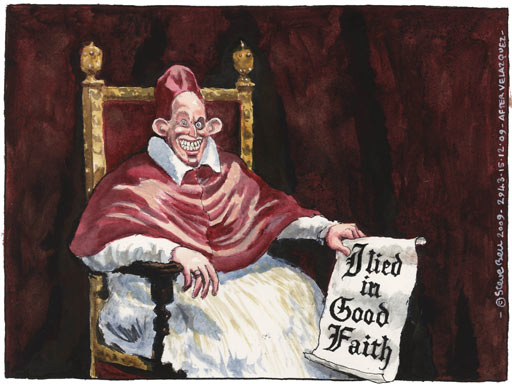 Steve Bell
Tony Blair, the former British Prime minister, has said that he would have invaded Iraq even without evidence of weapons of mass destruction and would have found a way to justify the war to parliament and the public.
It was regime change that was the basis for military action. But, as was suspected at the time, Blair like John Howard in Australia, needed to make to make a convincing case. So the WMD threat was invented as an excuse because using force to produce regime change on humanitarian grounds is not permissible under international law.
And, as we suspected, Washington called the shots and Britain, just like Australia, fell into line with th beat of Washington's war drums.
Posted by Gary Sauer-Thompson at 10:06 AM | Comments (10) | TrackBack
December 15, 2009
Australia 2.0: from cyber-safety to 'clean feed'
The Rudd Government sure is schizophrenic about the internet.
On the one hand, we have the commitment to open government, the public sphere initiative, and building the national broadband network that promises greater democratization. This is Internet as a new public sphere (Gore's agora idea). On the other hand, we have the introduction of mandatory internet censorship through the proposed legislative amendments to the Broadcasting Services Act for material that is deemed to be "harmful to minors" (eg., cyberporn) based on suburban families interpretation of "contemporary community standards".
This schizophrenia undercuts the Australian Government's policy of promoting "a civil and confident society online", since the plans to censor the internet go far further than purging it of child porn. Those dreams of cyberspace as a utopian commercial space are long gone. The future has arrived as the past as the coupling of paranoid control with freedom.

There is a need to broad the issue out to questions about the complex interplay between control and freedom in the digital age in the context of the repressive tendency Australian political culture that sees censorship and banning as a panacea to moral panics. This discussion paper can be interpreted as one step towards this.
The ALP's conception of “cyber-safety” has shifted away from a liberal policy of providing tools to shield minors plus education on the web to a Conservative one of disciplinary power in the form of a mandatory black list of “almost exclusively RC (Refused Classification)” content aimed at adults.
The pro-censorship Rudd Government will proceed with its controversial plans to censor the internet after Government-commissioned trials found filtering a blacklist of banned sites was accurate and would not slow down the internet.
Conroy announced that legislation will be introduced before next year's elections to force ISPs to block a blacklist of "refused classification" (RC) websites for all Australian internet users.
So who decides the blacklist, which the government says provides cyber-safety for families from material such as child sex abuse, sexual violence and instructions on crime and or drug use? It would be compiled using a public complaints mechanism, Government censors and URLs provided by international agencies.
Relying on public complaints from the conservative Christian Lobby indicates that the scope of the filtering would extend significantly beyond child porn to include naked bodies and sexuality. Will it include online gambling? Or “R” rated computer games? Or anti-abortion websites? Or Wikileaks? The pool of material is going to be large.
So exactly what will be blocked and who will decide? We don't know, as the list will be secret and the reasons for any ban will be secret. An example of what can happen. Not only are the URLs censored, but the list of censored URLs is itself censored. So much for an open Australia.
The Rudd Government's rhetoric about cyberspace is that it is protecting us from pedophiles, stopping terrorists, and all that blacklisted bad stuff on the big bad internet. Since internet filtering is about what information may or may not flow through the public internet, it's heavy Nanny state--authoritarian--foot enters the freedom of speech and individual freedom territory of liberalism.This is a conservatism that is anti-liberal. Some references for this control v freedom debate.
Update
Catherine Lumby makes a good point in The Punch. She says that according to Minister Conroy’s announcement yesterday the mandatory filtering of internet content in Australia will proceed according to a list drawn up on the basis of the RC classification, and that her concern is about the a wide scope of content that could be prohibited under the proposed filtering regime. She says that the RC classification is:
a category that doesn’t just deal with abhorrent material like child pornography, bestiality and active incitement to violence. Given the current broad terms under which material is slotted into the category it would also potentially embrace sites where people talked therapeutically about child sex abuse experiences, accessed information about safe sex and drug injecting practices, or engaged in serious political dialogue about what motivates terrorist groups.
ACMA has form in blocking social advocacy sites that are not pornographic. As Mark Newton says on Unleashed:
The vocal minority has always known that censorship quells robust dissenting speech by projecting doubt and fear of prosecution onto the fringes of legality. Our classification system is so broad that it cannot help but hoover-up political expression on the margins, and it inevitably influences and shapes political debate in this country.
So it is a freedom of expression issue. Is it the role of the government to decide what people can see and do on the Internet? Or are these personal decisions that should be made by individuals and their families?
But it is more than that, since sex's re-emergence as a "new" public concern exposes failures in traditional forms of disciplinary power and the emergence of control-freedom.
Update 2
The ALP claims that it took a mandatory election filtering policy to the election in 2007 and that it is just delivering on that election committment. However, there has been a shift since what was actually proposed is different.Thuss On page 2, the document states that Labour intends to:
Provide a mandatory ‘clean feed’ internet service for all homes, schools and public computers that are used by Australian children. Internet Service Providers (ISPs) will filter out content that is identified as prohibited by the Australian Communications and Media Authority (ACMA). The ACMA ‘blacklist’ will be made more comprehensive to ensure that children are protected from harmful and inappropriate online material.
The word mandatory is there, but it is qualified with “for all homes, schools and public computers that are used by Australian children.” So the mandatory nature of the policy could well be interpreted as applying only to those computers being made available to children. This implies that it will not apply to those of us who live in a child-free household? So it is not mandatory for all Australians.
Secondly, on page 5, under the subheading Mandatory ISP filtering the ALP document states:
A Rudd Labor Government will require ISPs to offer a ‘clean feed’ internet service to all homes, schools and public internet points accessible by children, such as public libraries. Labor’s ISP policy will prevent Australian children from accessing any content that has been identified as prohibited by ACMA, including sites such as those containing child pornography and X-rated material. Labor will also ensure that the ACMA black list is more comprehensive. It will do so, for example, by liaising with international agencies such as Interpol, Europol, the Federal Bureau of Investigation (FBI) and the Child Exploitation and Online Protection (CEOP) Centre and ISPs to ensure that adequate online protection is provided to Australian children and families.
The word “offer” is used here in relation to internet points accessible by children. Offer implies optional in that we adults can take up the offer or not. It does not imply mandatory internet filtering for all adults in Australia.
Conroy's policy, therefore has shifted to a mandatory filtering regime for all Australians and so goes beyond protecting children from child pornography and X-rated material. The ALP is now "protecting" adults from bad things, and the rhetoric of “protecting the children” is now being used as a cover for the implementation of a censorship regime on the internet.
Posted by Gary Sauer-Thompson at 3:36 PM | Comments (20) | TrackBack
December 14, 2009
economic growth and green innovation
Now that the reality of climate change no longer a contentious issue, the debate has shifted towards the growth consequences of climate change mitigation and adaptation. How well are we doing on this economic governance?
As Copenhagen is currently showing, developing countries do not want to engage in environmental policies which they see as constraining the process of catching up with more developed countries. For their part, the US and other developed countries such as Australia are reluctant to take any steps which would jeopardise their own growth potential.

The governance pathway forward is not rocket science, and we know what should be done. Government intervention needs to be designed in order to effectively facilitate and encourage on the private green innovation regime thus paving the way for ‘green growth’: the optimum tradeoff between ‘reducing’ climate change while maintaining a reasonable rate of growth.
There are there are two problems to deal with, namely the environmental one and the innovation one. The optimal policy involves using (i) a carbonprice to deal with the environmental externality and, at the same time, (ii) direct subsidies to clean R&D (or a profit tax on dirty technologies) to deal with the knowledge externality.
As soon as the clean technologies have gained sufficient productivity advantage over dirty fossil fuel technologies, the private innovation regime for these clean technologies can be left on its own to generate further, even better and more efficient, clean technologies.
Sceptics offer two counter-arguments to this: first, that the science underlying climate change is highly uncertain; second, that costs exceed benefits. The science may be uncertain but it is not wrong and climategate---the CRU scandal--- does not disprove this. Few politicians and pundits are willing to to bet the planet on the claim that climate scientists are talking through their hats, since this involves the larger claim that they have managed to assemble an enormous conspiracy to perpetrate a hoax
Do the costs outweigh the benefits? This--it is too expensive, we can’t afford it,and it results in economic ruin--- hasn't been shown to be the case. The Treasury arguments and those of Stern< Review /a> and the Garnaut Review still stand.
What these objections have been cleared away we can see that the current governance approaches in Australia leave a lot to be desired. Therein lie the problems. The carbon price is too low to address environmental externality, and drive green investment and innovation; whilst the public R&D spending targeted at the renewable energy and energy efficiency constitutes a very minor share of total public R&D spending.
Posted by Gary Sauer-Thompson at 2:43 PM | Comments (2) | TrackBack
December 13, 2009
Copenhagen: just another political problem?
A group of scientists issued an update on the 2007 report of the Intergovernmental Panel on Climate Change and their conclusions in their report--“The Copenhagen Diagnosis” —were that ice at both poles is melting faster than predicted. The climate change sceptics and the fossil fuel industry, who have been trying to cover up the fact that human activities are warming the planet and then to derail the Copenhagen summit, are not listening:
 Martin Rowson
Elizabeth Kolbert says that “The Copenhagen Diagnosis”:
report points to dramatic declines in Arctic sea ice, recent measurements that show a large net loss of ice from both Greenland and Antarctica, and the relatively rapid rise in global sea levels — 3.4 millimeters per year — as particular reasons for concern. Sea-level rise this century, it states, “is likely to be at least twice as large” as predicted by the most recent IPCC report, issued in 2007, with an upper limit of roughly two meters.
The bottom line is that any value of carbon dioxide (CO2) in the atmosphere above 350 and, sooner or later, the ice caps melt, sea levels rise, hydrological cycles are thrown off kilter, and so on. Every year we don’t deal with it, it gets much, much worse.The current level of CO2 in the atmosphere is already at 390 parts per million.
David Corn reports that: the debate:
over process has become a battlefield for the major clashes of Copenhagen. The Obama administration is pressing China and other emerging nations to commit to significant action, noting that these countries will be responsible for 97 percent of the future growth in emissions. (Also, Obama administration officials know that the US Senate will not approve any treaty that goes easy on China; in such an event, the Senate might even kill the pending climate change legislation.) Meanwhile, the developing nations want the historic polluters to go first with deep cuts, and they are demanding big bucks out of the North for clean energy technologies. (The United States and Europe are currently talking about making $10 billion available annually as a start; Di-Aping declared that the US Congress alone should appropriate $200 billion.)
Bill McKibben argues that the politicians are treating the problem of climate change as a normal political one, where you halve the distance between various competing interests and do your best to reach some kind of consensus that doesn’t demand too much of anyone,
Posted by Gary Sauer-Thompson at 8:33 PM | Comments (3) | TrackBack
December 12, 2009
Murray Darling-Basin: blocking water reform
Sooner, rather than latter, the flows in the chopped up River Murray will become less and less. The river, in its climate-change-driven decline, will strangle many of the irrigation projects in the arid landscape around it, as there is not enough water to support the heavily subsidised agribusinesses.
The junk science of the industry --the rain will follow the plough!--and that of their state government boosters who based their projections on what we now know was the unusually wet 20th century will become ideological relics of cultural history as many of the towns along the river become ruins. Aridity will kill off much of the agriculture whilst the water to sustain the towns is already vanishing. The waters are insufficient for this kind of desert civilisation.
The way chosen by CoAG to adjust to this new arid reality is the market in the form of water trading, which is designed to facilitate water being traded to its highest value use. These market instruments are opposed by Victoria, who has imposed a 4% cap trading cap on permanent water rights in any irrigation district in its state. Only 4% can be sold in a financial year, and this is to remain in place until at least 2014.Victoria is anti-reform.
Consequently, South Australia has launched a High Court action to force the Victorian government to lift the cap on water trading along the River Murray on the grounds that it is unconstitutional imposition on trade and is therefore invalid.
Vicotria is anti-reform because in cap is done is designed to protect the vulnerable, drought-stricken communities from being destroyed by huge volumes of water being traded out of their area. As irrigated areas shrink, northern Victoria becomes even more important as the state's food production centre. The Victorian state government has no inclination to buy back water entitlements from its irrigators. Such purchases are left to the Commonwealth, and so there is no fundamental change in the Victorian allocations regime, despite the widespread recognition that some of the Basin’s water resources need to be redirected to the environment.
The Victorian approach is to obtain water for the environment is by subsidising the cost of upgrading infrastructure in its food bowl region by reducing losses to leakage and evaporation in exchange for the rights to some of the water ‘saved’. This is designed to ease irrigators’ transition to lower levels of water availability; to recover water for the environment; and to protect viable irrigation communities by ‘securing’ a long-term future.
The Productivity Commission says that it has examined the experience of Australian programs for recovering water through subsidising infrastructure and concluded that they tend to be slow, cumbersome, and generally much less cost effective and efficient than buybacks.
For example, the buyback has obtained high reliability entitlements in Victoria for approximately $2400 per megalitre (ML). In comparison, an investment of $1 billion planned for the Stage Two Food Bowl project in Victoria is expected to yield water for the environment at a cost of up to $10 000 per ML. Subsidising irrigation infrastructure projects that benefit private irrigators is a poor use of taxpayer funds, relative to buybacks, and is inconsistent with the cost recovery principles agreed to by governments under the NWI. It can also impede rather than facilitate structural adjustment, and it is inequitable for those who have
already made such investments privately at full cost.
This infrastructure modernisation is not about achieving a permanent reallocation of available water to the environment. It is about subsidising and protecting the state's irrigation industry in an era of climate change at the expense of South Australia.
Posted by Gary Sauer-Thompson at 3:55 PM | Comments (6) | TrackBack
December 11, 2009
Realizing Our Broadband Future
Over the last couple of days I've been dipping into the Realizing Our Broadband Future conference being held at the University of NSW. The speeches are online, and some of them go beyond the technology of pipes and connectivity to explore how it will be incorporated into our everyday lives and how we will make use of a high speed broadband over and above e-business, e-health, e-education. If the Internet is profoundly changing society, and is likely to have impacts beyond what can be imagined today, then the future delivered by a national highspeed broadband network is a geek heaven.
The significance of high speed broadband was outlined by Jeffrey Cole, Director USC Annenberg School, yesterday. This keynote speech, with its roots in the work of the Centre for Digital Future, was historically informed.
Cole argued that we have come a long way since dial-up with Web 2.0 and the emergence of social media. It was kinda sobering to realize just how fast we have travelled in 5 years. We are standing on the threshold of something new. This is the ABC's interpretation of the something new.
I've just heard David Bartlett, the Premier of Tasmania, give an excellent speech on the potential for Tasmania connected by high speed broadband currently being built under the auspices of the wholesale national broadband network. This will make Tasmania one of the most connected place on the planet and it enables Tasmania to shift away from the old resource based economy to a knowledge-based, creative digital economy. His argument was that this infrastructure investment is going to pay off in terms of GDP development, entrepreneurial opportunity and innovation.
To its credit the ALP and the Rudd Government, have grasped the significance of this 21st century technology--hence the regional backhaul project to provide wholesale competition to overcome Telstra's regional price gouging and blackspots.
In contrast, the Coalition opposition, or more accurately the Liberal Party, views broadband reform through the window of small government and continued Telstra dominance (Minchin continually attacked the move to force Telstra's separation to ensure greater competition). Under Minchin, the Liberal strategy was to undermine the National Broadband Network (NBN) rather than making a constructive contribution to the policy. It was based on an indifference to both the ICT industry and to a knowledge-based digital economy.
The Liberal Party doesn't seem to realize that the argument about infrastructure is over.There is widespread public support for government to invest more in internet infrastructure (the NBN), better regulation of telecommunications companies, and more incentives for businesses to improve the Internet. Now that we are building a national broadband network, the question becomes, 'What are we going to use it for?
This applies to the government. What is the education department going to use it for? What is the health department going to use it for? What is aged care department going to use it for? What is the environment department going to use it for?
Posted by Gary Sauer-Thompson at 10:14 AM | Comments (7) | TrackBack
December 10, 2009
beyond retail politics
It is time to turn away from the hype and noise surrounding the politics of greenhouse and shift beyond where things have got stuck with mitigating greenhouse emissions. Copenhagen is going to impact on Australia.
Let us put to one side the retail politics talk about climate change advocates becoming the bullies of policy-making; or the aggressive political street fighters and their "weather-vane" leader taking the battle up to Labor with Abbott's army (Rudd's working families) by firing lots of arrows on energy tax, industrial relations (Workchoices), and wars overseas.

The Rudd Government's attempt at a cap and trade system --the CPRS-- is a dud. It gives too much to the polluters, doesn't do much by way of mitigation and won't help to make the transition to a lower carbon economy. Why defend it?
Stuart Rosewarne and James Goodman make the case. On the first point they state that:
In agreeing to increase compensation for the energy-intensive, trade-exposed industries, maintaining the addition of the LNG industry to the list of deserving polluters, incorporating the coal-mining sector into the compensation package, and increasing the assistance to electricity generators, the cost of the CPRS has grown beyond all expectations. Add to this equation the cost of including the faux carbon permits, the Kyoto-non-compliant carbon offsets, and we are looking at a budgetary burden that would be carried by all Australians.
The GPRS does little more than reward the big polluters that have invested so little in emissions abatement over the years that have followed the negotiation of the Kyoto Protocol.
Secondly, the proposed "cap-and-trade" system isn't likely to have any real material effect in reducing Australia's contributions to global greenhouse gas emissions. Rosewarne and Goodman say:
To be brutally honest, it is unclear as to how it would do so; in fact, the scheme's design in accepting that economic growth will be sustained presumes that it will not do so. In some respects, expanding the acceptable forms of carbon offsets could actually exacerbate emissions pressures by rewarding polluters. This would be the case, for instance, when agricultural land is cleared, and no penalties imposed, and the land then reforested and the landholders rewarded with carbon permits.
It's a dud. We have to start again. Will our politics allow this? To discuss closing down the high-emitting South Australian station Playford B. T and the Victorian Latrobe Valley generators Yallourn and Hazelwood.Then replace them with geothermal gas fired turbines. Sounds sensible.
Posted by Gary Sauer-Thompson at 6:25 AM | Comments (10) | TrackBack
December 9, 2009
The Drum beats badly
Jonathon Green, ex Crikey editor, promised that the ABC's new online portal The Drum would provide quality and professional commentary-based journalism:
This is not news, this is not opinion, this is thoughtful and thought-provoking analysis. We'll be taking the issues and ideas that count and digging a little deeper into and around them. Looking for a real sense of understanding.
This, he added, would involve analytic takes on the world and events around us by taking a set of facts or known circumstances and holding them up to the light... then having a chat about it.
Well, let's have a chat about a particular piece they published yesterday. This is Kill the IPPC article by Bob Carter on Unleashed, which is part of The Drum's stable and so presumably, falls under its journalistic ethos. Carter asserts or claims that:
the study of climate change, under the aegis of "dangerous global warming caused by human carbon dioxide emissions," has long since been captured by the small group of well connected, well networked and well funded atmospheric scientists and computer modellers who advise the Intergovernmental Panel on Climate Change (IPCC), and whose nearly every utterance confirms their ignorance of the true course of climate history and change on our planet - a topic that is the domain of geologists, not meteorologists and computer jockeys.
It's a big claim: nearly every utterance of IPCC confirms their ignorance of the true course of climate history and change on our planet. There is no argument argument to justify this claim of "nearly every utterance." No facts are given.
We are merely offered an interpretation of the Climategate affair without any attempt to deal with the different interpretations of the significance of these leaked emails that challenge Carter's corruption thesis. The latter implies that science and policy is based on what is said in personal emails from people who are developing some sort of scientific story, rather than the literature that appears in peer-reviewed journals.
This is not holding things up to the light. It is chasing shadows inside the cave. This is more holding things up to the light in the context of thoughtful and informed analysis.
Carter then says this:
Behind the corrupted science of Climategate and the fall of the IPCC, then, lie two things. The first is the degradation, mainly by political interference, of research conditions and practices within modern government-funded research groups. The second is the power and financial clout of the modern, ecoevangelistic Green movement, egged on by crusading media reporters and editors. The world has probably never before seen a propaganda and political machine that is as well oiled, well funded and well organized as this modern army of apocalyptics and their media flag-wavers.
He ends by saying that the siren song of the Greens imperils both our standard of living and, ironically, the state of our natural environment.
The fall of the IPC is the inference! That conclusion merely rephrases the initial assertion that nearly every utterance of IPCC confirms their ignorance of the true course of climate history and change on our planet.
So much for the ABC's "thoughtful" analysis. This is a polemic that belongs on the pages of The Australian appealing to, and stirring up, its populist conservative base. Green knows from his experience at Crikey that this is junk analysis, so they are consciously running the junk under the banner of "thought-provoking" to establish their profile in the digital market place.
Does the ABC need to do tabloid to establish its digital commentary brand and to drum up an audience? My take is that in letting Carter's article through it has undermined the values of professional journalism about objectivity (broadly understood) that it professes to uphold.
Posted by Gary Sauer-Thompson at 3:33 PM | Comments (10) | TrackBack
Medicare Select
In its final report to Government, the National Health and Hospitals Reform Commission introduced the idea of Medicare Select. It represents the introduction of a market mechanism (managed competition) into Medicare without embracing the free market attack on Medicare by market economists and the private insurance health industry in order to introduce a for-profit model that would be driven by the insurance industry.
The purpose is to slow growth in health expenditure, a key or core policy issue for state and commonwealth governments, by introducing a degree of self-regulating capacity within health care systems. Richard Scotton argues that:
The managed competition model offers a framework within which the objective of increased efficiency could be pursued without sacrificing the goal of universal access and without the impairment of health outcomes and social cohesion which the abandonment of this access would involve.
Medicare Select is a universal, tax-funded health insurance scheme based around the purchaser-provider distinction.
It formed part of the National Health and Hospitals Reform Commission's proposal to move towards a single government funder across the care continuum – both inside and outside hospitals .The ‘Medicare Select’ model suggests a transition of the commonwealth government from a funder of services to a purchaser of services.This involves the separation of the government from the functions of the organization and management of care consumption (eg.,explicit rationing of services) and the provision of care or health services. These functions would generally be undertaken by different organisations.
Who then provides the health or care services? Those called 'budget holders'. These would mostly be existing private health insurance funds. Consequently, Medicare Select represents the expansion of the private sector in health care, and it is likely that managed care would be used as a tool in managed competition.
The Parliamentary Library describes this scheme thus:
Under Medicare Select, the Commonwealth Government would become the sole public funder of health services. It would then distribute funds to intermediary bodies called ‘health and hospital plans’. The government would operate at least one plan, which would compete on equal footing with plans operated by not-for-profit or for-profit organisations.By establishing these plans, the Commonwealth Government would separate the funding or purchasing functions in health care from service provision. Economists refer to this as a ‘purchaser-provider split’ and many suggest that it increases efficiency, largely because single funders tend to have lower administration costs and substantial power in negotiations with providers.
Under Medicare Select, membership of a plan would be compulsory thereby ensuring universal access to basic health services. All people would initially be members of a government operated plan but would be free to choose another one after the scheme began. Plans would be required to accept anyone who wished to enrol. There would probably be some restrictions on when and how people could change plans, as there are in other countries with similar systems.
Posted by Gary Sauer-Thompson at 7:21 AM | Comments (3) | TrackBack
December 8, 2009
Open Government + health reform
The Draft Report of the Government 2.0 Taskforce has been released. It makes interesting reading in the light of CoAG stalling on health reform yet again by stating that it will take 3 years to produce a a health reform plan. This reform promises to deliver a new era of federal-state cooperation and to end the buck-passing and blame shifting that has characterised past state-federal relations.
The public service culture is one of secrecy and it instinctively resists becoming more open and transparent by releasing much of the information now kept secret. Reform here means a pro-disclosure culture. So what have the public servants been doing in crafting a response to the National Health and Hospitals Health Reform Commission's report, the draft National Primary Care Strategy, and the National Preventative Health Strategy
The Rudd Government basically accepts these reports. Where are the background papers that the public service has used to craft the government's response to these reports? Is there any indication of greater information disclosure, digital innovation and online engagement?
CoAG gives very little away in terms of openness and transparency. All we know is that state and federal leaders have agreed to work towards developing specific proposals in the first half of next year:
The Prime Minister will correspond with First Ministers by the end of December 2009 recommending a decision-making process on long-term health and hospital reform. In this process the Commonwealth will actively engage with the States on the range of reform proposals canvassed by the National Health and Hospitals Reform Commission and related proposals. The Commonwealth’s intention consistent with this process would be to put specific proposals to the States in the first half of 2010.
Which specific proposals are these? What are the arguments from the working groups? What are the working groups and what are they working on? What is the best available option, taking into account the current and future needs of the Australian community and the political and practical realities of implementing reforms?
We have no idea. The public service culture is one of secrecy not open access government, and the steps being taken to becoming more open and transparent are minimal. Federal and state bureaucrats talk to one another. The powerful lobby groups use their resources to gain insiders information and shape the discussions to protect their interests by blocking reform. Governments, even when in favour of public innovation, are not really comfortable being open with their inner workings on display. As Michael Richardson points out:
Openness can make life tough. Transparency opens the door to criticism; ending secrecy increases risk and exposure; accountability means being held accountable.
It is true that the old ways die hard within government and especially in health, which is run by medical experts within a heavily walled insider culture, despite the overarching policies of openness and transparency, the embrace of Web 2.0 by some government agencies, and the public interest in the quality and safety of our hospitals.
However, as Jennifer Doggett points out at Croakey the Rudd Government spent two years wooing health groups with promises of a partnership approach to restructuring the health system, then COAG has reneged on its obligations at the last minute.
The medical culture, deliberative democracy and Web 2. 0 just don't mix. What we have is the AMA, an anti-reform body, posing as the advocates for health workforce reform According to Melissa Sweet. at Croakey the spin from the AMA is one of:
the AMA as the advocate for health workforce reform, including using nurse practitioners to help alleviate workforce shortages. The AMA advocating for the end of the private health insurance incentives which have helped entrench the unfairness of our health system. The AMA advocating for a rebalancing of power within the profession and its structures, to give supremacy to the primary care end of town. The AMA advocating for doctors to work in areas of need, rather than in areas of comfort…
Web 2.0, plus openness and transparency, would help to break the stranglehold the AMA has over health policy and provide a space for other voices.
Posted by Gary Sauer-Thompson at 9:10 AM | TrackBack
December 7, 2009
media: Copenhagen + critical engagement
The Guardian has teamed up with more 50 papers worldwide to run the same front-page leader article calling for action at the climate summit in Copenhagen, which begins tomorrow. Guess what? The Guardian reports that:
Two Australian papers, the Age and the Sydney Morning Herald, pulled out at a late stage after the election of climate change sceptic Tony Abbott as leader of the opposition Liberal party recast the country's debate on green issues.
So much for political courage. True to form the Australian raves on about Copenhagen's shift to a low-carbon society meaning that Australia must radically reduce its own domestic energy use; an attack on the right to our existing standard of living, and Australians cutting their energy use to Depression levels.
The Fairfax press's lack of courage is in marked contrast to that of Malcolm Turnbull---his willingness to stand up and fight on cutting greenhouse emissions and emissions trading.
Australia's mainstream broadsheet newspapers are in flight from the following statement:
The science is complex but the facts are clear. The world needs to take steps to limit temperature rises to 2C, an aim that will require global emissions to peak and begin falling within the next 5-10 years. A bigger rise of 3-4C — the smallest increase we can prudently expect to follow inaction — would parch continents, turning farmland into desert. Half of all species could become extinct, untold millions of people would be displaced, whole nations drowned by the sea...At the deal's heart must be a settlement between the rich world and the developing world covering how the burden of fighting climate change will be divided...The transformation will be costly, but many times less than the bill for bailing out global finance — and far less costly than the consequences of doing nothing.
What is there to be fearful of, or threatened by, that statement of mainstream views at Copenhagen? In turning away the Fairfax press have dumped their watchdog for democracy role as the fourth estate and embraced infotainment.
At a time when Australia, which has some of the cheapest power in the world, is also the largest per capita carbon pollution emitter in the world, the Fairfax press refuses to engage with this issue. They've ducked for cover on Australia needing to finally do something about our reliance on coal for electricity, especially brown coal.
Fairfax are interpreting Abbott as blocking any substantive moves to achieve sharp reductions in emissions, and in doing so they ignore the following insight from the common editorial, which says that:
the shift to a low-carbon society holds out the prospect of more opportunity than sacrifice. Already some countries have recognized that embracing the transformation can bring growth, jobs and better quality lives. The flow of capital tells its own story: last year for the first time more was invested in renewable forms of energy than producing electricity from fossil fuels.
In refusing to enghage Fairfax, like The Australian, are turning their backs on this future in favour of Australia keeping on producing electricity from fossil fuels.
Into the vacuum of the online democratic public sphere strides the ABC presenting us with the The Drum --more informed diversity in critical online commentary that engages with the ideas, issues and concerns of the day. The Australian, as to be expected, is critical of this platform for what Jonathan Green is calling thought-provoking analysis:
This is not news, this is not opinion, this is thoughtful and thought-provoking analysis. We'll be taking the issues and ideas that count and digging a little deeper into and around them. Looking for a real sense of understanding.
This considered analysis by ABC journalists and experts is contrasted with the opinions of the voices on the ABC's Unleashed, which is now part of The Drum stable. Where does commentary sit? What is the difference between analysis, commentary and opinion?
Green is unclear what the purpose of the thoughtful analysis (quality journalism?) in this online space is, or how it relates to the other online voices in the public sphere? Mark Scott's "townhall concept" is not mentioned, the word democracy is notable for its absence and the emergence of user generated content on the blogs is ignored. What we are given is a defence of good journalism with nothing about the importance of good professional journalism; or the justification of this new role of the ABC is the new digital mediascape.
Is it telling the truth when the powerful commercial media are interested in profit, cutting costs, advertisements and their content, driven by commercial pressure is largely a recycling material from the wire agency and the publicity industry. Consequently, the commercial media present deception, distortion and falsehood rather than the truth.
Posted by Gary Sauer-Thompson at 9:19 AM | Comments (22) | TrackBack
December 6, 2009
SA: uranium mining in Arkaroola Wilderness Sanctuary
Marathon Resources Pty Ltd has been talking up the “highly uranium prospective” Mt Gee deposit in the Arkaroola Wilderness Sanctuary near Mount Painter. Arkaroola Wilderness Sanctuary is a private sanctuary located in the northern Flinders Ranges, adjacent to the Gammon Ranges National Park.
The wilderness sanctuary is not a National Park and is known for its harsh and rugged beauty. Marathon Resources wants to develop a uranium mine.
 Quentin Chester, Arkaroola Wilderness Sanctuary
Marathon Resources is a company that has a record of unauthorized waste disposal of its drill samples and systematic breaches of its exploration licence conditions and remains suspended from major exploration activity on its northern Flinders Ranges tenement. It was required to clean up the illegally dumped waste after exploration work in 2008.
Despite this record, and a push to keeping mining out of Arkaroola Wilderness Sanctuary, the Rann Government has granted Marathon Resources a brand new 12 month exploration licence to Marathon Resources and released a draft management Plan for the Northern Flinders Ranges, called 'Seeking in Balance', which allows for mining activity right in the heart of the Arkaroola Sanctuary.
Posted by Gary Sauer-Thompson at 5:35 AM | Comments (5) | TrackBack
December 5, 2009
Copenhagen: climate refugees
Is the Rudd Government on edge about climate change refugees from the Pacific Islands being given legal access to Australia due to rising temperatures and sea levels? Will the Rudd Government argue that the UN should redefine international law to give climate refugees the same protection as people fleeing political repression? Will they create a new visa category to be created for climate change refugees?
Yes, no, maybe is my immediate response without doing much by way of research.
Bangladesh, which is expecting its 165m population to increase by nearly 100m in the next 60 years, is the most vulnerable large country, with 60% of its land less than 5m above sea level.
 The Independent
There is mounting evidence in India and Bangladesh and other low-lying countries that sea levels are rising faster than the global average of 1.2mm a year. Islands and coastal communities in the Ganges delta and the Bay of Bengal have recorded rises of up to 5mm a year. In Bangladesh hundreds of coastal villagers are forced to drink salty water as tides continue to rise and the sea intrudes on fresh water aquifers.
The conservative populists will shortly be saying that the upcoming U.N. summit on climate in Copenhagen designed to begin addressing problems like climate change refugees will mean the end of Australian sovereignty. They deny that the rate of change is significant, and has recently been caused by increased greenhouse gases from human activities, that the rate of change has become alarming and is probably unsustainable in the long-term.
Posted by Gary Sauer-Thompson at 1:35 PM | Comments (4) | TrackBack
December 4, 2009
Canberra Gaze: populist conservatism
One aspect of this weeks events in Canberra, which resulted in Tony Abbott becoming leader of the Liberal Party, was the white-hot fury of the conservative base of the Coalition. It appeared that they reckoned that they were "losing our country", and they were not going to take it lying down.They were not going to be walked on. These were my impressions.
The accumulated grievances of this base (a minority in electoral terms) were expressed in terms of a hostility to an emissions trading scheme and and anger towards Malcolm Turnbull. But the accumulated grievances of this conservative populism are broader and deeper: global warming, government spending, public debt, censorship and moral panic of sexuality/pornography in consumer culture and art, the drought, Asian immigration, refugees and powerlessness.
The populist conservatives want respect and recognition, but it is not forthcoming in the representation of them as climate change denialists, full of ignorance and prejudice, by the ALP and the Turnbull wing of the Liberal Party. They are dismissed as irrelevant and they are being politically displaced. They are furious and angry. They are losing their country --their Australia--and they want to grab back their control of Australian politics
First, they regain control of their Liberal Party, then Canberra, and they will do so by standing and fighting for what they stood for. Once they ran country. Now they have been displaced. They are angry and resentful. The Coalition resurgence begins with Abbott gaining leadership of the Liberal Party, and they hope that the detestable Rudd will implode---a Latham moment---under the relentless pressure of the well directed attacks launched by their warrior leader. This is a e battle for the heart and soul of Australia.
The tone that is being brought to the public discussion of issues is more than folksy ordinariness: it is also one of unyielding partisanship, the culture wars and saying no no no to the direction of the Rudd Government. The latter's conception of Australia is one that is explicitly rejected and their politics is a needling of those they doesn't much care for -- inner city professionals, liberals in general, and the media. The tone is one of scorn. It's a "love my friends and hate my enemies" sensibility.
What is missing from this defining their identity by their enemies in politics is a more positive vision of the country they want to create; some conception of what they want to do and who they are, other than "not what Rudd is doing" and "not where those rotten Labor and liberal types are taking the country" by adapting to the dynamics of global capitalism, the shiny spectacles of global culture and their enticing market pleasures.
Update
The ALP did not run candidates in Higgins (Victoria) and Bradfield (NSW) on the grounds that these very safe Liberal heartlands would not return a Labor member even in a by-election. The spin from the conservative noise machine has started is being rolling out.The talking point is that the reinvented Liberal Party is back in business as a Conservative party and it is now making ground on the Rudd Government. So they were right to dump Turnbull.
Glenn Milne, one of the voices of the Liberal party in News Ltd, interprets the results of the weekend by-elections in Higgins and Bradfield in terms of the Liberal leader reinventing Howard's battlers as Abbott's army:
The point here is that, in the areas of Higgins and Bradfield that most reflect the outer suburban seats of the major cities where general elections are won and lost, voters gave the thumbs down to Rudd and the Greens on climate change. They forgave the Liberals for the destructive soap opera that the party had become until Abbott arrived and they endorsed both him and his stand against the ETS.
Dennis Shanahan concurs --the Liberal Party members and voters who were moving away are now returning. Abbott can win back the Howard battlers by fighting Rudd on the ETS.
For heavens sake, Higgins and Bradfield are Liberal heartland--social liberal heartland at that. Why would you expect lower-income rusted on ALP supporters to embrace The Greens? You would expect Labor's base, when confronted with a choice between Green and Liberal, to fracture. Why would Labor's lower- and middle-income base to be interested in switching to the Greens? If lower-income Labor booths swung to the Liberals, then higher-income Liberal booths swung to the Greens.
The strategy of The Greens is to maximise their performance in the next Senate contest especially if it is a full Senate election.
Posted by Gary Sauer-Thompson at 11:33 AM | Comments (24) | TrackBack
NSW: fighting over the deckchairs
Before he was dumped in favour of Kristina Keneally Nathan Rees, the then Premier of NSW, gave a speech that spoke truth to power:
A malign and disloyal group well known to the NSW community has made the business of government almost impossibleThe presence of such a group within the nation's oldest and proudest political Party is intolerable. Their treachery and disloyalty can be borne no longer....Should I not be Premier by the end of this day, let there be no doubt in the community's mind, no doubt, that any challenger will be a puppet of Eddie Obeid and Joe Tripodi.That is the reality.
The old regime of the Right faction of Obeid and Tripodi beholden to the property developers once again dictates the fortunes of Labor party, and they have regained the levers of control.

The incompetent NSW Labor government is going down big down in the next 14 months yet the Labor factions are engaged in factional power plays over the deckchairs on the Titanic for the spoils of office. The party heavyweights talk about establishing respect, trust and accountability with the community, and the e ALP's "achievements" in health, education and transport.
These are weasel words that have little meaning in the NSW context ----Trevor Cook describes this as looking like another turn in the death spiral rather than a minutes to midnight comeback.
Rees had moved to the only possible strategy to save the Labor base by effectively campaigning against his own party, which had been embroiled in a variety of property rorts and scandal. The party turned against Rees for sacking Tripodi and then cutting the party's ties with property developers finance him in an embittered, destructive, almost suicidal moment of revenge.
Posted by Gary Sauer-Thompson at 6:00 AM | Comments (5) | TrackBack
December 3, 2009
Copenhagen and the global commons
The failure of the Australian political process to deliver a very mangled emission trading scheme, and the Australian's consumer's reluctance to pay more for the energy our lifestyles rely on, has shifted into the background. Despite the context of scientists behaving badly, the debate over the threat of climate change is over. What we have is the twisted disconnect between accepted “political reality” and scientific reality.
What lies in the foreground is the need to move forward with an agreement that will curb carbon pollution and move us to a clean energy future. Here we have the process of nation states once again grappling with the need to find a way to reduce the emission of greenhouse gases that scientists argue drive climate change, and will probably raise the Earth's temperature to higher levels within our lifetimes. Once again there is the gulf between the enormity of the climate crisis and the tepid political response to it.
The aim is to limit global warming to 2C above pre-industrial levels. For this to happen global carbon emissions must start to fall rapidly during the next decade.If countries did not manage to reach agreement, world temperatures could rise by five degrees Celsius by the end of the century, making many parts of the world uninhabitable. It is not likely that political efforts to restrict global warming to an additional 2C — the level will succeed.
Since the Kyoto protocol there has been a series of annual UN climate conferences Buenos Aires, Bonn, The Hague, Marrakech, New Delhi, Milan, Montreal, Nairobi, Bali and Poznan. Copenhagen---COP15 ---will host the highest profile, best attended, most widely publicised and closely scrutinised UN climate talks so far.
The path to a low-carbon economy is through a Copenhagen treaty, that would set new targets for overall pollution levels, and again rely on governments to meet them. The first step is a patch-up accord, or political agreement, then a treaty. The four essentials calling for an international agreement in Copenhagen are:
1. How much are the industrialized countries willing to reduce their emissions of greenhouse gases?
2. How much are major developing countries such as China and India willing to do to limit the growth of their emissions?
3. How is the help needed by developing countries to engage in reducing their emissions and adapting to the impacts of climate change going to be financed?
4. How is that money going to be managed?
These are big issues and big problems that indicate that climate change is the most complicated and complex issue the world has faced. Each nation's plausible choices will depend on what technologies will be available and when.
A lot is at stake for the global commons. The most realistic outcome is an average rise of 4-5C by the end of this century given soaring carbon emissions and political constraints. That means damage limitation.
The BASIC countries (Brazil, South Africa, India and China) are prepared to walk out of the Copenhagen Conference if they are forced to agree to developed nations terms according to the Times of India.
Posted by Gary Sauer-Thompson at 8:47 AM | Comments (8) | TrackBack
Obama's Afghanistan strategy
Despite the decline in support for the war in the American homeland Barack Obama new strategy for Afghanistan couple a short-term escalation of the war with a promise that he will begin US troop withdrawals in July 2011.
In his speech he says that he will send 30,000 more troops to be deployed over the next seven to eight months, bringing the US total to 100,000, close to the number of Soviet troops in the country during its occupation in the 1980s.
 Steve Bell
Obama is betting that escalation will improve conditions enough to permit a rapid U.S. withdrawal in June 2011. In The Guardian Simon Jenkins says that:
Obama's generals are charged with giving the Taliban a "knock-out" blow sufficient to send them reeling back into the mountains. This is supposed to allow the Kabul government to establish its sovereignty over its nation or, more plausibly, at least to give Nato a breathing space to escape.
Afghanistan was a punitive raid to hunt down Al Quaeda that turned into an occupation that was not just mishandled but ill-conceived from the start. The operation now commencing is exit with dignity.
Paul Rogers says that there is a recognition that the war cannot be won in the conventional sense of the total subjugation of the insurgency. The implication is that there needs to be compromise with some oppositional elements in Afghanistan, direct measures to curb the corruption that pervades Hamid Karzai’s regime, and a far greater commitment to civil-development programmes in the country
Posted by Gary Sauer-Thompson at 7:25 AM | Comments (1) | TrackBack
December 2, 2009
If the ETS is scrapped, what then?
Tony Judt, in his What Is Living and What Is Dead in Social Democracy? in the New York Review of Books defends social democracy in the context of the Libertarian critique that the best way to defend liberalism, the best defense of an open society and its attendant freedoms, is to keep government far away from economic life. This classic issue of the role of the state and economy is crucial in the context of global warming, mitigating greenhouse gas emissions and the commons.
Judt argues that if social democracy has a future, it will be as a social democracy of fear. By this he means:
Rather than seeking to restore a language of optimistic progress, we should begin by reacquainting ourselves with the recent past. The first task of radical dissenters today is to remind their audience of the achievements of the twentieth century, along with the likely consequences of our heedless rush to dismantle them.The left, to be quite blunt about it, has something to conserve. It is the right that has inherited the ambitious modernist urge to destroy and innovate in the name of a universal project. Social democrats, characteristically modest in style and ambition, need to speak more assertively of past gains. The rise of the social service state, the century-long construction of a public sector whose goods and services illustrate and promote our collective identity and common purposes, the institution of welfare as a matter of right and its provision as a social duty: these were no mean accomplishments.
This defense of past achievements of the welfare state does not really help us to address the new politics of climate change, given that global heating will have such a big effect on our economy and society--from its impact of the Murray-Darling Basin, or the Great Barrier Reef, or Australia's rainfall patterns.
The science says that if we keep to our present course then we bring about warming well beyond 2 degrees, perhaps 4 degrees or 6 degrees, or more. Since the market by itself, is not doing much to mitigate greenhouse gas emissions, so the necessity for action by the state to introduce an emissions trading stream. However, as James Risbey points out in New Matilda:
While the science of climate change is clear in pointing out the need for rapid action in order to avoid monumental climate change, the politics seem more designed to avoid responsibility than to avoid climate change...Australia has made virtually no progress in reducing carbon emissions from energy and transport to date. Most of the reductions have come about due to a reduction in the rate at which land is cleared....The Australian Government's argument is effectively that it is preferable to adapt to large climate change than to prevent it. Their argument is not usually stated in this form, but that is the inescapable consequence of their policy of postponing meaningful carbon reductions. On the one hand the Government calls for rapid action to prevent climate changes, while on the other hand it has crafted a policy that would guarantee that effective action is not taken
The Government policy of adaptation without effective mitigation is implicit in its actions (its GPRS) and not in its rhetoric.
Those who defend the classical liberal view that the state needs to be held at a safe distance --- ie., politicians should be barred from planning, manipulating, or directing the affairs of their fellow citizens--- appear to have a simple view on how to mitigate greenhouse gas emissions. The ETS should be scrapped.
This is the position of the IPA, for instance, and it basically boils down to a defence of the interests of Australia's energy intensive industry structure, coal based electricity generation industry, and coal and gas exports. An ETS endangers Australia's prosperity because it jeopardizes Australia's international competitiveness. This position is tied up with others: namely dissent from the global warming consensus, criticisms of the science around carbon dioxide pollution and its impact on global temperatures, and critiques of green political ideology.
If the ETS is scrapped, what then? How do we mitigate greenhouse gas emissions? Deferring action until 2020, as advocated by the IPA is a strategy of avoidance. The going nuclear call is at odds with not believing in climate change and opposition to state intervention and subsidy.
The key point here is the logic and legitimacy of market failure analysis, and its public-goods corollary. The notion of public goods is that they cannot be supplied by the market, and instead must be supplied by government and funded through its taxing power.
Posted by Gary Sauer-Thompson at 7:52 AM | Comments (14) | TrackBack
December 1, 2009
the politics of climate change
Malcolm Turnbull speaks truth to power, ends up isolated from his party over the ETS, and is forced out of the leadership. The Minchinites link this campaign to cleaning the Wets out of the fractured party, and they argue that this script will deliver them electoral success. What are to make of this scenario?

A three way contest takes place early this morning in Canberra. The rabble that the Liberal opposition has become has changed leaders three times in its first term in the wilderness. Surprisingly, the talk is still about unity in the Liberal party, even though the leadership conflict is also a battle that involves real, and deeply held, ideological and political differences. The politics of climate change has arrived, and it will be increasingly played out over the next decade.
Dennis Glover in The Australian says:
It's not surprising therefore that climate change is starting to pull apart the Liberal Party. Malcolm Turnbull's flawed personality and Tony Abbott's delusional ambition are part of the problem, but the events of the past week can be fully understood only when placed in a wider historical context: this is the first time global warming has produced a leadership struggle in a main political party. Turnbull's agony is the canary in the coalmine, signalling the beginning of the era of climate change politics.
A majority of Liberal Party members appear to agree with the Nationals that electoral victory next year can be achieved by campaigning against the government's Carbon Pollution Reduction Scheme.Their talk is that Coalition in a 2010 election could say yes to the idea of combating climate change but no to this ETS model.
So what is their alternative model to mitigate greenhouse gas emissions? Silence. Big silence. All we hear is the talking point that a big tax is going send us all broke--a scare campaign, in other words.
An editorial in The Australian rightly points out the core difficulties in the Minchinite conservative's position:
The Liberals have spent more than a week seriously contemplating fighting the Rudd government in a climate change election, with a policy fashioned by people within their ranks whose position is out of kilter with that of the clear majority of Australians...the Liberals will not regain power without a clear direction as a modern centre-right party, drawing on the traditions of liberalism and conservatism while understanding the changes under way in the electorate.
The editorial says that if the Minchinites prevail, the party will be forced to run parallel campaigns at the next election. A split party will require separate strategies -- one for the bush and provincial seats, where the conservative base rejects the need for action on climate change, and another for suburban seats such as North Sydney and Wentworth.
You would have to reckon that the Minchinites have a big problem in persuading the middle ground of the electorate that it is in Australia's national interest to say no to climate change in 2010. Turnbull was dead right on this. Maybe the Minchinites do want a pared-down, pure party that remains in opposition for a decade or so?
Update
Abbott prevails over Turnbull 42 to 41 with Hockey eliminated on first round. Turnbull looks good in defeat. The Liberal Party will now move to kill off the ETS in the Senate. The 2010 election will be a vote on climate change and not an emissions trading scheme, which Abbott dismisses as a giant energy tax.
Abbott says that so they'll keep the greenhouse reduction targets but Liberals will not support any action that causes pain to the economy or to the energy intensive export industries. The mechanism to achieve targets is unclear. In his Battlelines book Abbott says that his position is a sceptical one and not that of a climate change denier:
Natural science has undeniably shown us that global warming is man-made and real. But just as undeniable is the economic science, which makes it clear that a narrow focus on reducing carbon emissions could leave future generations lumbered with major costs, without major cuts in temperatures.
So the issue is is how to achieve this: Abbott, who is a big government conservative and centralist, adds:
It's hard to take climate alarmists all that seriously, though, when they're as ferociously against the one proven technology that could reduce electricity emissions to zero, nuclear power, as they are in favour of urgent reduction in emissions. For many, reducing emissions is a means to achieving a political objective they could not otherwise gain.
He then targets an ETS mechanism:
Another big problem with any Australian emissions reduction scheme is that it would not make a material difference to atmospheric carbon concentrations unless the big international polluters had similar schemes. Australia accounts for about 1 per cent of global carbon dioxide emissions. At recent rates of growth, China's increase in emissions in about a year could match Australia's entire carbon dioxide output. Without binding universal arrangements, any effort by Australia could turn out to be a futile gesture, damaging local industry but making no appreciable dent in global emissions.
If night is always darkest before the dawn, then Abbott now presents the Liberal Party with an opportunity to recover its conservative soul, and to argue that this is the only way forward for the Liberal Party.
Meanwhile we need to appreciate that virtually nothing has been done to transform Australia’s economy, even though its economy is the most carbon intensive in the world and Australia, emits more than many countries on a per capita basis. Not a single substantive solar energy facility has been built as a result of the current federal government’s policies, though some wind farms have popped up because state governments have committed to having renewable offsets for installations such as desalination plants. Nor have businesses properly prepared themselves to embrace the challenge of energy efficiency.
Posted by Gary Sauer-Thompson at 5:58 AM | Comments (27) | TrackBack