« May 2012 | Main | July 2012 »
June 30, 2012
Europe: towards federation?
It looks as if members of the eurozone are starting to move closer to a full fiscal and political union in response to the crisis of a Spanish bailout engulfing the single currency. It was a small step---at the summit EU leaders agreed to use the permanent bailout fund to support ailing European banks.
 Martin Rowson
The European leaders at the summit agreed that a supervisory system for eurozone banks that will form the first step towards full banking union, scrapped the requirement that governments get preferential status over private investors in the event of a default, and eased the stiff terms for future bailouts. However, a banking union cannot work without a eurozone fiscal union.
Slowly the Eurozone is accepting that the core problem is the feckless banks, who no longer need provisional liquidity. They are insolvent and need serious amounts of hard cash. As The Guardian's editorial points out:
The Spanish property market is still in collapse, as are the value of their bank loans. Nothing in the bailout addresses the Spanish economy. The property market may not recover for a decade; if so, the banks will continue to be sick, and Europe's fourth-largest economy will languish.
Up to now it has been the states who borrow money from the centre of Europe in order to give to the banks and banks borrow to give to the state and both banks and states are sort of locked into a deadly embrace with another sinking very fast. That has happened with Greece, Portugal, Ireland, Italy and Spain.
On the ABC's 7.30 programme Yanis Varoufakis, the Greek economist, says that there is a need to break this nexus between insolvent banks and insolvent states. The best way to do this is to unify the banking system, to Europeanise it in the European Union and have it being funded directly not through national governments.
The reality is that the eurozone is still crashing and burning, while the European politicians are steadfastly refusing to adopt a systemic solution. Nor is a New Deal style economic recovery on the policy agenda.
Posted by Gary Sauer-Thompson at 10:18 AM | Comments (2) | TrackBack
June 29, 2012
refugees: the parliamentary impasse
What surprises me about the Gillard Government is that it hasn't done very much to work towards a regional solution to the flow of refugees through South East Asia. It appears to be locked into the frame of border security and deterrence and stuck in its Malaysian solution, and unwilling to put money into helping the UNHCR process asylum seekers or increase the refugee and migrant intake.
So we remain stuck in the parliamentary impasse over the means to ensure order security and deterrence without a regional solution; an impasse in which the debates in Parliament have become circular and cliched with little awareness of the role that Australia's border control policy has played in stranding large numbers of people in transit countries such as Indonesia and Malaysia.

Jessica Irvine reminds us:
The evidence shows, after all, that most people who arrive unlawfully by boat are eventually settled in Australia on protection visas - 83.3 per cent of the ''irregular maritime arrivals'' in 2009-10, according to the latest figures from the Department of Immigration.
So why not increase Australia's humanitarian intake? If asylum seekers were allowed to travel here legally, wouldn't that help to make a dent in the people-smuggling model?
Surely that is better than Australia shouting at Indonesia and the political parties shouting at one another over who is to blame for the parliamentary impasse? It was Gillard herself who identified a workable regional refugee policy as one of the goals of her leadership. So why not take active steps to get the ball rolling?
After all there is a consensus that a regional solution is a good one. Australia, as a wealthy nation with strong economic growth, should be the one making the running on putting a regional solution in place.
Posted by Gary Sauer-Thompson at 10:01 AM | Comments (16) | TrackBack
June 28, 2012
News Corp splits in two?
News Corp is to be split into its entertainment (film and television businesses) and publishing businesses (ie., the papers in the US, UK and Australia together with Harper Collins, News Corp's book publishing company). These will become two separately listed companies both controlled by the Murdoch family.

The papers consume far more resources than any returns they can ever hope to offer and they are declining assets. The print division made a small profit last year. According to Amy Chozick in the New York Times:
In the year that ended June 2011, the publishing unit contributed $864 million in operating profit, compared with $4.6 billion in operating profit from entertainment units including the cable channels, the 20th Century Fox studio and Fox Broadcasting.
The newspaper and books division would generate earnings before interest and tax of only $US542 million in fiscal year 2013 (with roughly $US280 million from Australia) valuing that proposed company at between US$4.3 to $US2.3 billion billion. The entertainment division would generate $US5.6 billion over the same year, valuing the company at $58.8 billion.
With the closing of the News of the World, one of its big newspaper earners, and with the continued fall in newspaper circulation and advertising, those small earnings may be expected to disappear. That would leave the money losers particularly exposed: the New York Post, the London Times, the Wall Street Journal, and The Australian. There will be pressure to close the more marginal or unprofitable magazines and newspapers.
There is a long history of companies splitting off under-performing divisions to allow the more lucrative division to grow. News Corporation has evolved into a successful entertainment company with a newspaper problem. The newspapers are mature industries unlikely to yield great profits as the digital revolution progresses. They are vulnerable whilst the entertainment businesses are strong.
The newspapers, once seen as a tool of political and financial influence, have become a liability in both. What's even worse is that the newspaper division is no longer sturdy enough to finance its own digital investment needs.
News Ltd chief Kim Williams whole narrative and strategy was based on the synergies between all of the media----we build all our future consumer platforms – print, online, tablet, mobile, broadcast and social. The ground appears to have pulled out from under that strategy by the New York decision--unless Australia is exempted from the split.
A split of the Australian assets of News Ltd could force the company's newspapers to cut more costs. The newspapers would have to be accountable and they would have to run on their own profit stream. There would be greater pressure to ensure the costs were cut from the traditional print division.
Posted by Gary Sauer-Thompson at 11:22 AM | Comments (5) | TrackBack
June 27, 2012
AFR: spruiking nuclear power
We are familiar with how the Matthew Warren and other environment editors of The Australian have run a shabby war of misinformation and deception against climate science across the news and opinion pages from Robert Manne's Quarterly Essay “Bad News: Rupert Murdoch’s Australian and the Shaping of the Nation”.
In doing so The Australian has aligned itself against the Enlightenment's defence of reason in opposition to ignorance, myth and superstition. Parts of the Fairfax media--namely the Australian Financial Review--- also have dirty hands. Their hostility to the carbon tax has morphed into a hostility to renewable energy and as part of a defence of nuclear power that is not based on facts.
It is true that some proponents of nuclear energy industry, such as Michael Angwin the chief executive of the Australian Uranium Association, do advocate starting with the facts and make sure those engaged in the public debate around climate change and energy policies they at least get the facts right. So Angwin, in contrast to The Australian, sides with the Enlightenment tradition.
However, some of those who do argue that nuclear power is the reliable low carbon source of energy do not follow Angwin's advice. A good example is Leslie Kemeny, the Australian member of the International Nuclear Energy Academy, who often writes in The Australian Financial Review, spruiking nuclear power.
In his latest op-ed in the AFR entitled The right road to clean energy Kemeny says:
In a carbon constrained world, and especially in a nation which is over 80 per cent reliant on fossil fuels, the clean energy needs and 2020 and 2050 reduction target can only be met by nuclear power.Our nation’s present flirtation with “renewable” energy sources makes little technical, economic or environmental sense. These “dilute” and “discontinuous” energy forms tend to increase energy prices. Their credentials for both environmental acceptability and sustainability need careful re-examination. China is flooding global markets with wind turbines and cheap solar panels, taking advantage of the West’s “green politics”.
These are claims that are not backed up by facts. They need to be because wholesale electricity prices are falling due to investment in energy efficiency and renewable energy. Secondly, the CSIRO has shown how the intermittency of the widespread deployment of solar PV could be supported by the electricity grid.
The Australian Financial Review has dirty hands because it publishes Kemeny's assertions without requiring either an argument or facts to back up his claims. In other words it tacitly sides with ignorance.
Posted by Gary Sauer-Thompson at 1:27 PM | Comments (3) | TrackBack
June 26, 2012
the threat to Murdoch's pay TV interests
The events of the last few days highlight how the shakeup of the media industry from the digital revolution continues to reduce newspaper's circulations and newsrooms. This shakeup is due to the internet destroying the traditional newspapers model because the industry is left with high level printing cots as advertising revenue plunges. The advertisers have shifted to the cheaper internet platforms that charge a 10th of the rate, and they can be more targeted and effective.
If Fairfax is seen as having it back to the wall, then News Ltd was seen as strategically visionary for increasing its control of Fox Sport and Foxtel by buying out James Packers Consolidated Media holdings.

The internet revolution is not just destroying newspapers. The internet revolution is also starting to affect traditional TV, as improved broadband services are developed and the infrastructure is built to handle the soaring bandwidth needs of their customers. Secondly, new TV sets now include an internet connectivity, which changes the way people view films and videos (it does away with the computer) and also provides an incentive for the TV manufacturers to join with IPTV service providers (ISP's) and film on demand services (Fetchtv and Quickflix).
Online TV may not compete with broadcast television but it disrupts Foxtel because its customers pay around $100 a month (on average) whilst Fetchtv offers entry -level film and TV programs for around $10 a month. The latter have a limited product to offer (limited sport), but it means that consumers no longer have to pay an extra monthly fee when pay TV providers decide to add new features like Web integration to their packages.
Presumably, the limited content access to IPTV will change with intervention of the ACCC to ensure competition in access to sport and films. in allowing the Foxtel merger with Austar, the Australian Competition and Consumer Commission foresaw the proliferation of potential rivals and required that Foxtel make content available on commercial terms to facilitate competition.
So the penetration of traditional pay and broadcast television by the internet will continue and this explains Murdoch's hostility the national broadband network. It threatens his pay TV interests --he is paying $2 billion to acquire Fox Sport and 50% of Foxtel--because the NBN's high speed broadband allows consumers to download film and tv on demand programs quickly and easily. Hence the challenges to the long-term value of pay tv.
If Foxtel's current strength lies in its in sport exclusive content in sport (wholesaler access) and Hollywood movies, then how long can it defend that exclusive access? Therein lies the next battleground. Foxtel and Telstra will try to lock up internet broadcast rights and deny access to others.
Posted by Gary Sauer-Thompson at 8:36 AM | Comments (1) | TrackBack
June 25, 2012
Abbott: "bigger government means smaller citizens"
Paul Kelly in The Australian spells out The Coalition's blueprint to decisively change Australia's national policy that goes beyond the attempt to destroy Labor and establish conservative hegemony.

He says that Abbott and the Coalition now stand, above all, for three core ideas.
The first is a deep commitment to the prudent state typified by surplus budgets, debt reductions, dismantling "Labor values" spending and an attack of sorts on the entitlement culture, an idea pushed by economic spokesman Joe Hockey, long seized by the fiscal task he faces.
Second, the Coalition seeks a rebalancing between enterprise and the environment with a sweeping agenda to dismantle Labor "green and red tape", purge regulatory complexity, facilitate development, promote northern Australia as an export food bowl and run environmental policies that are more direct and practical ...
Third, as a social fabric conservative Abbott wants to curb the idea that "government knows best", limit interference in people's lives, cut social engineering and, as a perpetual volunteer in his personal life, promote Edmund Burke's concept of "little platoons"-Abbott's notion of social communities based on individual initiative and much greater personal responsibility.
Interesting isn't it--the traditional commitment to the free market and small government is buried. It has to be because Abbott's conservatism represents big authoritative government in spite of the rhetoric about Edmund Burke's concept of "little platoons".
The small government + free market rhetoric epitomized in Abbott's slogan "bigger government means smaller citizens" mostly refers to the dismantling of the environmental state rather than empowering citizens to deepen the democracy in representative democracy. It is about knifing the environmental state swiftly on behalf of Australia from the United States.
The rhetoric about Edmund Burke's concept of "little platoons"--- which refers to social communities based on individual initiative, social solidarity (traditionalism) and much greater personal responsibility---fills the poverty gap that emerges from the winding back on the welfare state that is covered up by surplus budgets, debt reductions, and ending the entitlement culture. It is more volunteers taking over the legitimate functions of the state rather than ordinary citizens working co-productively with the professionals for solutions to social problems.
This is conservatism not liberalism and the market capitalism that underpins it, a conservatism that is organic-corporate-hierarchical in nature.
Posted by Gary Sauer-Thompson at 9:08 AM | Comments (14) | TrackBack
June 24, 2012
an archaic power grid
The economic reality, as opposed to the negative rhetoric over carbon pollution pricing---those overblown forecasts of imminent ruin--- is that even with putting a carbon price on the current wholesale price still has it is lower than the wholesale price in 2009. Moreover, the wholesale price of electricity is declining due to reduced demand for electricity, and that the reduced demand for electricity is partly due to growth in solar PV and energy efficiency.
The negative rhetoric from The Australian is that Australia’s solar and clean energy industries are the cause for rising power prices. However, clean, green solar power, wind farms, or the one-off increase of the carbon tax, are not the main causes of rising electricity prices. The Australian Government’s draft Energy White Paper forecasts that governments will need to invest $100 billion (twice the cost of the National Broadband Network) to upgrade our electricity grid. It is this cost that is driving up power prices.
According to the Australian Energy Market Commission, electricity prices are likely to rise by over 30 per cent in the next couple of years. Network costs – the building of new power poles and wires – are expected to contribute more than 55 per cent of these costs. Increased distribution costs will mean a further 30% rise. Renewable energy schemes, including the Renewable Energy Target and State solar feed-in tariffs, are only expected to contribute 3 per cent to the cost increases, and the carbon pollution price around 10%.
The national electricity grid does need to be redesigned, rebuilt and enhanced. Redesigned because the current system of centralised and large-scale electricity provision is an historical artefact linked to reap the benefits of economies of scale and monopoly profits from a coal-fired technology. Redesigned because the techno-institutional complex of the national electricity grid is in large part designed to cope with a couple of very hot days each year.
John Grimes points out in Renew Economy:
one quarter of electricity costs come from just 40 hours of electricity consumption – those few days when it is so hot that everyone rushes home to turn on their air conditioning, or finds comfort in cool shopping centres. The proposed $100 billion investment in our power grid will reinforce this situation, and that fails the common sense test..Instead Governments and big power companies should be looking to reduce demand for electricity, thus lowering the $100 billion taxpayer bill and limiting electricity price rises.
So, whilst the cost of producing power is actually falling, Australian families are paying more for their electricity because our power grid is archaic and is not designed for the decentralised power system that is rapidly emerging.
It is relatively cheap and easy to produce power, but it is very expensive to transport electricity over hundreds of kilometres from coal-fired power stations to our big cities, and that cost is driving up power bills. Turning people’s houses and businesses into small power stations through the installation of solar panels is one way of helping resolve this problem of peak demand in hot days.
It is because solar and energy efficiency are starting to threaten the coal industry’s stranglehold on energy supply that there is a proliferation of negative rhetoric and the facts being distorted in the media.
Posted by Gary Sauer-Thompson at 3:22 PM | Comments (3) | TrackBack
June 22, 2012
Greece: crony capitalism
In their The Greek financial crisis and a developmental path to recovery: Lessons and options in Real-World Economics Review, issue no. 60 Nikolaos Karagiannis and Alexander G. Kondeas argue that Greece has become a crony capitalist country with a disproportionately large state bureaucracy. The resulting governance system has encouraged corruption, discouraged wealth creation, and affected popular ideologies
 Martin Rowson
They say that one scenario is that EU leaders having failed to learn from their previous policy mistakes will insist on austerity, and other half measures which will prove to be grossly insufficient to stabilize the Greek economy. Greece will be in effect pushed out of the Euro- zone and forced to default on its debt.
Their other scenario is that the EU leaders, having learned from the policy mistakes of 2010- 2011, will aim to bring stability and growth back to the Greek economy. The Greek economy will be revived, the monetary union will be saved, and the dream of a political union will remain intact.
Update
According to Yanis Varoufakis the next step after the election is a Bailout Mk3 which will represent a “relaxation of the terms of conditions of Bailout Mk2-----the Bailout Mk2 ‘rules’ require Greece to cut public spending within a month by a further 11.5 billion. His judgement is that the loosening of bailout conditions--a Bailout Mk2-lite--- is just prolonging the slow water torture of watching the Greek economy and society go down the drain.
His argument is this:
The Greek economy is well and truly broken. The circuits of credit are so badly damaged that even efficient, profitable firms have been cut out of the capital markets but also out of the international markets (as their suppliers will no longer accept the Greek bank guarantees without which Greek firms cannot import raw materials). These credit circuits will remain broken even under new terms and conditions, as I described them above. Neither the extension of repayments of the new loans to the insolvent state (which everyone knows will be defaulting again – this time to official creditors) nor the new loans will change this. Moreover, the new spending cuts, even if they are less than what was envisaged under Mk2, will give the forces of recession another boost.
When in December, it becomes, yet again, clear that another, more relaxed, Greek bailout has failed, that realisation will add to the strains and tensions in Europe, accelerating further the centrifugal forces tearing the Eurozone apart.
Posted by Gary Sauer-Thompson at 8:57 PM | Comments (3) | TrackBack
June 21, 2012
media shakeup
As we know the structure of the media industry is rapidly changing as the shift from print to the internet due to the digital revolution deepens, and the long term shift from newspapers to pay television continues. The good days for mass circulation newspapers are over, and they are never coming back.
The Fairfax news about shrinking and staff cuts, highlights the decline of print media whilst News Ltd moving to increase its shareholding of Fox Sport and Foxtel (cable television) highlights the shift to pay television by buying out Consolidated Media Holdings.

News Ltd remains bullish about its tabloid newspapers even as they cut costs through consolidation (its divisions in eastern Australia will shrink from 19 to five) and it snap up the independent voice of Business Spectator to remove competition to the paywalls. This concentrates more media ownership in fewer hands--Australia has some of the most concentrated media ownership in the Western world--- and is another step in News Ltd's desire to dominate.
Murdoch is considered foreign, so News Ltd's proposal to buy James Packer's Consolidated Media Holdings is subject to Foreign Investment Review Board approval. On the strict FIRB criteria it's hard to see how it could be knocked back. The deal would also require regulatory approval from the Australian Competition and Consumer Commission. But given that News already has 25 per cent of Foxtel and management control it is hard to see how the ACCC would present much resistance.
The chief obstacle facing Murdoch's takover is Kerry Stokes, who owns 25 per cent of Consolidated Media. Will Stokes sell, given his attempts to create his own pay television operation many years back?
If digital is the future of news media, then how do Fairfax and News Ltd make money from their growing digital audience? It's a more pressing question for Fairfax than News Ltd, which is more of a multimedia company with lots of synergies and part of a global media empire. Lifting its stake in Foxtel brings News Corp's Australian business into line with its global businesses, where News Corp is primarily a television business. More than 80% of its $5 billion annual profit comes from cable pay-TV) and movie making and its ambition is to create the world's first multi-platform media operator available from paper to web to TV to iPhone to iPad.
In this new media landscape the ABC will continue to provide a comprehensive news service across all media platforms for free, for reasons related to equitable access, national reach, and the information needs of citizens. Since online advertising will not cover the costs of a digital newspaper, the turn to paywalls is seen to be necessary by Fairfax. However, Fairfax will need to provide quality journalism, if they want their paywall-protected sites---The Age and SMH --- to survive.
Unfortunately, the future of the mediascape in Australia looks to be one where the combination of market dominance, power, fear, political influence, inadequate policing and feeble regulation becomes self-reinforcing.
Posted by Gary Sauer-Thompson at 7:54 AM | Comments (16) | TrackBack
June 19, 2012
media: Fairfax's decline
Yesterday Fairfax Media announced that it will change the broadsheets ---The Sydney Morning Herald and The Age--- to tabloid-size, and sack 1900 staff — including about 380 editorial positions — as part of a $235 million cost-cutting drive to cut the media corporations cloth to the steady decline in advertising revenue. It will also introduce digital paywalled subscriptions to the metro masthead websites on a “metered” basis — apparently similar to the New York Times.
 David Pope
A badly managed Fairfax is broke and its print media is declining before our very eyes due to the disruption from the internet, The old model of selling eyeballs to advertisers isn’t going to sustain Fairfax much longer since its revenues are falling faster than it can cut costs for its print media.
They need a viable business model quickly in the context of the radical restructuring taking place in the media world wrought by the digital technologies and the absence of any clearly successful blueprints for change. Greg Hywood, the CEO, is trying to reorient the group from its traditional print base to a digitally-focused future, presumably with new digital content and a growing digital audience.
However, the reality that he is trying to replace high-margin legacy revenues with low-margin digital revenues compounds the degree of difficulty of executing the transition. That means Fairfax is vulnerable to takeover from Gina Rinehart, who now owns 18.67 per cent, and whose current proprietorial demands are for three seats on the board including the deputy chairmanship, and the right to have input into editorial matters.
Her demands are in conflict with Fairfax board protocol that directors not interfere with the editorial direction of the media group and a charter of editorial independence that has been honoured by the board since the early 1990s.The danger here is that Fairfax mastheads become mining industry mouthpieces (a mockup) thereby destroying the remains of what Mike Seccombe calls Fairfax's perceived value.
Fairfax, Seccombe says, has endured years of staff cuts and online mediocrity to the point where it is now questionable whether readers be sufficiently confident of finding something of value behind the wall to justify paying. Therein lies the problem.
Posted by Gary Sauer-Thompson at 6:40 AM | Comments (16) | TrackBack
June 18, 2012
tax reform: ho hum
After July 1 the Gillard Government's policy of trebling of the tax-free threshold comes into effect. This is a big change to the income tax system since the higher tax-free threshold will help those on low incomes and those who choose to return to work part time in lower-paid jobs. It may help increase workforce participation for women and older Australians.
So there is some movement on tax reform by the minority government that is in line with the Henry Review, which had proposed creating a large tax-free threshold of $25,000.

High effective tax rates are caused for low and middle income earners by phasing out welfare benefits as income is earned, combined with tax rates on low and middle earnings. This affects women caring for young children, the long-term unemployed, and older Australians who want to keep working. Women caring for young children especially face a tax-benefit squeeze when they go back to work, usually part-time and at low to middle wages.
We don't hear about this kind of tax reform---tax reform is usually about cutting the tax rates of corporations and high income earners and widening the GST to include education, health and fresh food.This is the tax reform supported by a massive public relations industry.
However, tax reform needs to be more than just encouraging more workforce participation and economic activity since almost 50 cents of every dollar spent by governments in Australia goes on social spending – either social security or health and community services. Increasing workforce participation trebling of the tax-free threshold brings us to the issue of dual income families, childcare and the high cost of child care for working families.
Posted by Gary Sauer-Thompson at 9:51 AM | Comments (1) | TrackBack
Greece: its going to get tougher
Greek voters failed to conclusively back a new government on May 6 to lead them out of a debt crisis that has seen the nation consider default on their debt repayments and shake the euro zone to the core.That failure, which resulted in days of painstaking negotiations as the nation’s main parties scrambled unsuccessfully to form a coalition government, set the stage for the Greeks return to the polls votes on Sunday.
 Gary Sauer-Thompson, travel poster, Adelaide, 2012
The vote on Sunday is seen as referendum on Greece’s current bailout and its strict austerity measures.This election could prove just as inconclusive as the last; or more likely, a coalition will be reached following Sunday’s election because the situation in Greece is now more desperate than it was in May. It is more than likely that the right---ie., New Democracy--- will gain the most votes, forms a coalition, and Syriza becomes the opposition.
Meanwhile the social security system is collapsing, hospitals are suffering dire shortages, one in four workers is unemployed and the rest fear that their turn is coming. Women have been hit hard: not only have they been disproportionately affected by public sector cuts but are also still expected to do the lion's share of care work. People remain unpaid.
Its going to get tougher for Greece. It stays in the eurozone with a weak coalition government mandated to go along with a long and brutal process of austerity that reduces the cost base of a weak Greece. From Berlin's perspective Greece is a lost cause, but the sole reason for it not being abandoned is that it may make a bad situation a lot worse.
The harsh economic reality is that the drivers of the global economy have shifted to Asia (eg. India and China) and that Europe faces a decade of low growth. The 21st century is an Asian century.
Posted by Gary Sauer-Thompson at 12:13 AM | Comments (7) | TrackBack
June 16, 2012
an old media debate revisited
Martin McKenzie-Murray in Democracy running low on ink in the Fairfax Press's National Times says that one of the curious demarcations in the culture wars is that between "mainstream journalists" and independent writers.
He says that the battle goes like this:
independent writers charge that Canberra's press gallery has squandered their readers' goodwill with a mindless focus on trivia. With some, you detect a gleeful anticipation of the collapse of mainstream newspapers. The other side derides the bloggers' smug detachment from journalistic and political realities, arguing they know nothing of "shoe-leather endeavour".
The gleeful anticipation of the collapse of mainstream newspapers is a red herring. It is the low quality analysis of policy issues by the Canberra media gallery that is the problem.These journalists have not covered themselves in glory over the policy shift to carbon pricing--they have mostly written junk.
 Alan Moir
McKenzie-Murray states that both sides have points. Many independent writers and bloggers provide commentary rather than reporting, depending on mainstream journalists' facts for their analysis. Much of our political reportage is dross, the web versions of our major newspapers are disheartening and publishers seem increasingly confused or cynical in their response to a haemorrhaging model.
He adds that high-end journalism is being eroded the world over, and the democratisation of micro-publishing isn't an antidote. High-end journalism for McKenzie-Murray appears to be investigative journalism of the Watergate model of Woodward and Bernstein at the Washington Post. Australian bloggers, in contrast, are given to repetition and apoplexy in their commentary.
I wouldn't argue that the democratisation of micro-publishing is an antidote to the erosion of high-end investigative journalism of the ABC's the Four Corners. It is an antidote to the mass deception by the Murdoch Press over issues such as NBN, climate change, renewable energy etc though. It is also an antidote to those trolls who use the freedom of the internet voice to insult, hassle, bully or abuse others; or those who use it to voice their hatred of their political opponents, liberally sprinkled with profanities and libellious rhetoric.
It is an online space to point out the weakness of the Canberra media gallery's arguments and to provide a voice for those who have been excluded from ongoing access to our national media.
Update
Fairfax Media has announced that it will change the broadsheets ---The Sydney Morning Herald and The Age--- to tabloid-size and sack 1900 staff — including about 380 editorial positions — as part of a $235 million cost-cutting drive to cut the media corporations cloth to the steady decline in advertising revenue. It will also introduce digital paywalled subscriptions to the metro masthead websites on a “metered” basis — apparently similar to The New York Times.
Fairfax is broke and declining before our very eyes. The old model of selling eyeballs to advertisers isn’t going to sustain Fairfax much longer since its revenues are falling faster than it can cut costs.
They need a viable business model quickly in the context of the radical restructuring taking place in the media world wrought by the digital technologies and the absence of any clearly successful blueprints for change. Greg Hywood, the CEO, is trying to reorient the group from its traditional print base to a digitally-focused future. However, the reality that he is trying to replace high-margin legacy revenues with low-margin digital revenues compounds the degree of difficulty of executing the transition. It is vulnerable.
Posted by Gary Sauer-Thompson at 9:34 AM | Comments (8) | TrackBack
June 15, 2012
under pressure
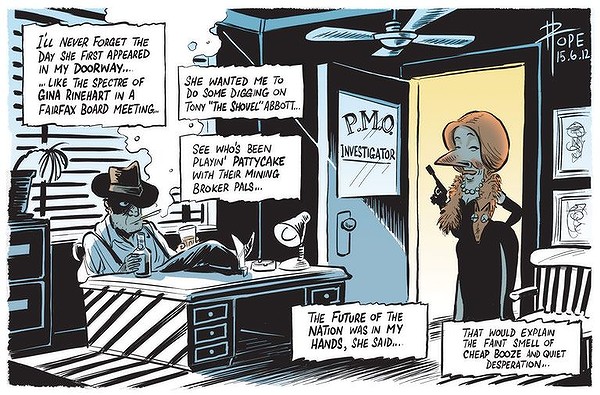
In his article entitled Government must lower our great expectations in The Australian Paul Kelly says that the Gillard Government:
fights something more ugly than winning acceptance of carbon pricing - it confronts a structural shift in which wealth per person has been static for five years, making people cautious, frustrated and angry. This shift defines the mood of the nation, and resentment towards Julia Gillard as PM. It is tied to a paradox that makes people agitated about the public debate. Australia's economy is growing strongly but households feel anxious because wealth (not income) is under pressure.
Kelly finishes by saying that in retrospect, Labor should have used the global crisis, the deepest downturn since the 1930s, to transform public expectations about entitlements instead of telling the nation nothing would change and its entire program would be delivered. Labor has a good economic story to tell today, but it can be sold only in a climate of reform that is tied to lower expectations.
 David Pope
Two quick points. The proper response to the global financial crisis was Government intervention in the economy that boosted spending. Secondly, with the return to modest growth the Gillard Government is taking modest steps to lowering expectations with its 2012 budget surplus (eg., cutting back on defence), trimming middle class welfare (eg., means testing the private health insurance rebate), and making the fossil fuel polluters pay for their greenhouse gas emissions.
This is the right time to start trimming the culture of entitlement. Australia is the middle of the biggest capital expenditure boom in history, and this has coincided with the highest terms of trade in our history. The coincidence of increased jobs, low inflation and successive rate cuts is rare.
Kelly however, is using Laura Tingle Great Expectations: Government, Entitlement and an Angry Nation Quarterly Essay to push for the politics of austerity during the global financial crisis. It's the neo-liberal position of using the financial crisis to wind back the welfare state. What Kelly doesn't say is the Gillard's attempts to trim middle class welfare and change its culture of entitlement is opposed by the Coalition, which supposedly stands for small government and free markets.
Posted by Gary Sauer-Thompson at 11:13 AM | Comments (3) | TrackBack
June 14, 2012
getting debt down
Glenn Stevens, the Governor of the Reserve Bank, Glenn Stevens, in a speech titled, "Glass Half-full" last week has observed that the nature of public discussion is unrelentingly gloomy despite reasonable growth, low inflation and unemployment.
This gloom and negativity has intensified over the past six months. even before the recent turn of events in Europe and their effects on global markets, Australian's were grimly determined to see their glass as half empty. This is in the context of the multi-speed economy undergoing structural change due to the mining boom.
 David Pope
Why the gloom? Steven's says that one reason is that the period of real household assets per person rising at 6 per cent or more per annum and households actually to withdraw equity from their houses, to use for other purposes came to an end in 2007. Households began to save to reduce debt levels and their consumption patterns have shifted from goods to services. That impacts on the retail industry.
Stevens adds:
the key message for today is that the multi-speed economy is not just about the mining sector squeezing other sectors by drawing away labour and capital and pushing up the exchange rate. It is doing that, but slower growth in sectors that had earlier done well from unusually strong gains in household spending would have been occurring anyway, even if the mining boom had never come along. It is these changes in behaviour by households, in asset markets and in credit demand, that I think lie behind much of the disquiet – dissatisfaction even – that so many seem to have been expressing.
This post-boom depressive public mood is in flight from the structural adjustment currently happening behind our backs in the sense that is expresses an unwillingness to adapt to the changes.
You can see the negativity in the fears that fears that widespread deployment of solar PV and wind could not be supported by the national electricity grid. Behind the fear of fluctuations is the resistance to the development of a highly flexible electricity grid and one that is designed or adapted for renewable energy sources. Behind that resistance stands a refusal to change, let alone end, the dependence on centralised fossil fuel generation (ie coal) and shift to to renewable energy based society.
Posted by Gary Sauer-Thompson at 10:20 AM | Comments (5) | TrackBack
June 13, 2012
Eurozone: beyond bank bailouts?
The eurocrisis as Paul Krugman points out now has a familiar pattern. The economy slides, unemployment soars, banks get into trouble, governments rush to the rescue — but somehow it’s only the banks that get rescued, not the unemployed.
The European policy elite always ready to spring into action to defend the banks, but otherwise completely unwilling to admit that its policies are failing the people the economy is supposed to serve. So a crisis of the market has been transformed by free market ideologues into a crisis of public spending.
Across Europe, the biggest slump since the 1930s has been used to push through policies straight out of some neo-liberal playbook: the slashing of taxes on the rich and major corporations; the selling off of public services; and a bonfire of workers' rights.

So a crisis of the market was cleverly transformed by free market ideologues into a crisis of public spending. Across Europe, the biggest slump since the 1930s has been used to push through policies straight out of some right-wing dream: the slashing of taxes on the rich and major corporations; the selling off of public services; and a bonfire of workers' rights.
Will there be any real policy action that goes beyond bank bailouts?
Charles Grant in Germans, the Euro and the Painful Truth in the New York Times says that:
German officials know that a healthy euro requires deeper euro-zone integration. They recognize the need for some sort of “banking union.” They accept that they will have to talk about “euro bonds” — pooled borrowing for the euro zone — but say that a fiscal union enforcing budgetary discipline must come first. They want an “economic union” that would push the euro zone’s weaker members to become more competitive. That would mean giving the European Commission the means to cajole governments to alter policies in areas such as pensions, labor markets, privatization and company taxation.
Meanwhile the backlash against austerity is emerging for good reason: the politics of austerity has sucked growth out of the economies in Greece , Ireland, Spain failed to tackle debt, dramatically increased unemployment, and devastated living standards.
Posted by Gary Sauer-Thompson at 10:48 PM | Comments (4) | TrackBack
June 12, 2012
carbon pricing not carbon tax
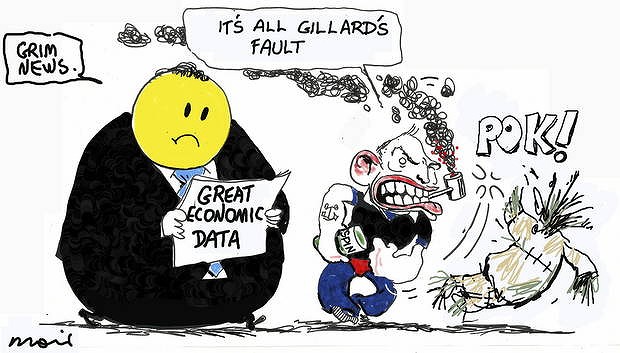
Why isn't there some sort of questioning of the misleading and deceptive campaign being run by News Ltd and the Liberal Opposition that the carbon pricing, which will be introduced on July, will see increased power bills to small businesses and households of around 25%. Secondly, why does the Canberra media gallery continue to call the pricing of carbon a carbon tax?
 Alan Moir
The policy is to put a price on carbon because it is the most environmentally effective and cheapest way to cut pollution. It is putting a price on the carbon pollution that Australia’s largest polluters produce. Such a policy aims to create a incentive for all businesses to cut their pollution, by investing in clean technology or finding more efficient ways of operating.
It is not a tax on households or small businesses. The emitters of carbon pollution, which is caused by the burning of fossil fuels, including coal and petroleum, will pay per tonne of carbon they release into the atmosphere.
News Ltd’s coverage of the Government’s carbon price policy has been so negative and one-dimensional that some papers in the stable are misleading the public by doing partisan campaigning.There is a deep and pervasive reluctance amongst the Canberra media gallery to critique their own power to influence public opinion and debate and to criticize the way that many of these journalists use their power to engage in systematic deception.
So where is that Finkelstein review of our media, which recommended much tougher regulation for the print media. Tougher media standards is needed, since newspaper self-regulation is an utter failure in ensuring the media is accountable and responsible for its abuse of power.
Posted by Gary Sauer-Thompson at 9:40 AM | Comments (12) | TrackBack
June 9, 2012
Eurozone crisis: Spain
The Eurocrisis continues to deepen---it actually grows worse by the week as the bond market continues to yank Europe’s chain. In Greece, the problem is an insolvent government bringing down the banks. In Spain, the problem is now insolvent banks bringing down the government.
The latest episode is that dodgy Spanish banks now need bailing out. The politics of austerity have seen Spain enter a double-dip recession, 4.7 million people unemployed, unemployment at 24%, a million unsold properties; hundreds of housing developments left unfinished by construction companies and real estate promoters,
 Martin Rowson
The cause is a real estate boom that began in the 1998 and ended in 2007---Ponzi Growth. Robert Tornabell in The Guardian says that the consequences of the speculation in real estate are that:
Banks have now discovered that their balance sheets were filled with non-performing loans and toxic assets: urban land, unfinished housing developments, unpaid real estate loans to developers, and so on.The total assets of Spain's banking system amount to about €3tn.
The Spanish government does not have enough funds for a tough restructuring or a bailout to cover the "toxic" assets left over from a burst housing bubble.
There is a fundamental restructuring in Europe.It looks increasingly likely that the troika is moving toward a plan to combine much of Europe’s bad debt into a single fund with the idea of paying it off over 25 years. Is this the first step on a new path forward for the union, one that encompasses fiscal integration, Europe-wide banking supervision, and tighter coordination of economic policies?
A more immediate question is: will Germany allow the periphery to collapse and exit or will Germany try to save the euro? Saving the euro means greater integration in the form of a federalised eurozone. This means a eurozone banking union, which would take on responsibility for propping up failing banks and guarantee depositors' savings across the 17 countries, backed by the financial strength of Germany. The price to be paid is for eurozone governments to surrender sovereignty over their budgets and fiscal policies to a central eurozone authority.
The most likely scenario is that the ECB will reluctantly and haltingly provide funds to other nations – eg., Spain---an on-again, off-again pattern of support — and that simply won’t be enough to stabilize the situation.Then there will be the capital flight from Spain to the German banks. Meanwhile the periphery suffers ever deeper recessions — failing to meet targets set by the troika — and their public debt burdens will become ever more unaffordable.
How far will Germany go to pay for the looming bill to bail out their euro partners?The politics of austerity is now generating miserable unemployment and deep recessions in Ireland, Italy, Greece, Portugal and Spain.
Update
If Germany yields to the pressure from France to pay to save the euro, then Berlin will insist on major steps towards a eurozone federation or political union with budgetary, fiscal, and scrutiny powers vested in Brussels and in the European Court of Justice. That means vast transfers of sovereignty from member states. It's a shift to federalism.
Posted by Gary Sauer-Thompson at 10:32 AM | Comments (11) | TrackBack
June 8, 2012
doing it tough
The link between "the end is nigh" scenario and the booming economy is less the bad economic news from Europe or China's economic growth stalling. It is more the declining house prices in Australia.
Jessica Irvine in the Sydney Morning Herald points out that:
After falls of about 5 per cent last year, figures from RP Data-Rismark show home prices fell 1.4 per cent last month alone across five capital cities - Sydney, Melbourne, Brisbane, Adelaide and Perth. Over the year ended May, the falls range from 8.5 per cent in Melbourne, to 6.5 per cent in Brisbane, with Sydney down by a smaller 3.5 per cent. Sydney's housing boom went bust nearly a decade ago now, giving it a head start on price pain .... Turnover has slumped, with families preferring to withhold properties and not sell into a weak market.
She adds that after a decade long debt binge, spurred by lower interest rates and freer availability of credit, households remain financially stretched.
 David Rowe
Australia had enjoyed housing and consumption booms on the back of cheap credit. The period of asset price inflation has come to an end and Australia's debt-fuelled housing boom is over. Households are paying off the debt on their massive mortgage bill and a markedly reduced rate of home ownership among young Australians.
The recession in Europe doesn't help because Europe faces a lost decade as creditors continue to shift the entire burden of debt adjustment onto debtors. The division between debtor and creditor countries looks to become permanent, with Germany dominating and the periphery (Greece) becoming a depressed hinterland.
Proposals from the Grattan Institute to broaden the GST to include the 40 per cent of spending devoted to things like education, health and fresh food--it would add about $20 billion to GDP and allow significant lower personal and corporate tax rates ---aren't going to help restore consumer confidence. It would be politically difficult--eg., it would be seen as squeezing working Australians to benefit the Big Miners who oppose carbon price and the renewable energy .
This is especially so with a couple of decades of an aging population in front of us and Australian corporations claims that the carbon price will cause huge economic damage---"a carbon tax would be "disastrous" for jobs and industry" and saying that Australia will suffer some kind of investment strike as a result of the carbon tax.
Posted by Gary Sauer-Thompson at 1:17 PM | Comments (4) | TrackBack
June 7, 2012
Queensland: gungho development
It would appear that nothing can stand in the way of the mining boom, not even the Great Barrier Reef. The Big Miners rule. We must do what they say immediately, and give them what we want without dissent. There is no other way to govern the country.
The current Campbell Newman state government in Queensland is all for coal mining development in Queensland’s Galilee Basin in the form of the Alpha Coal mine; the development of Gladstone Harbour to enable liquefaction of CSG and the transfer of LNG to large vessels, and to a strong Coal Seam Gas industry in Queensland.
 David Rowe
If this development impacts negatively on the Great Barrier Reef, then that is the price paid for the rapid coastal development and the economic growth from gas ad coal exports. It doesn't seem to matter to the Newman state government that Great Barrier Reef as one of Australia's leading environmental assets and tourist destinations.The rhetoric is that the rapid extraction of minimal resources in this fashion is needed to pay for hospitals and to keep the lights on.
Although Queensland has jurisdiction over its lands and inshore waters in the case of Gina Rinehart’s Alpha Coal mine the Commonwealth has the final word on development because under the Australian Constitution it has jurisdiction over areas subject to international agreements such as World Heritage sites.
An editorial in the AFR draws the following conclusion:
Whatever the justification the federal government may have for freezing the approval process for the coal project, the message for foreign investors is clear – don’t invest in Australia.... The states are not without blame in these matters as their approval processes have also been allowed to grow unchecked and become overly long. However, the overlap between the federal and state government approvals process is one obvious, very large piece of green tape that should have been ripped up long ago.
That green tape is the Environment Protection and Diversity Act 1999.
Posted by Gary Sauer-Thompson at 1:54 PM | Comments (6) | TrackBack
June 6, 2012
a scare campaign
Australia's economy continues to expand whilst the global economy is in recession. Thanks to the mining boom and China's demand for our iron ore resources.
That doesn't stop the scare campaign against carbon pricing in the form of a carbon tax that is a wrecking ball that will severely damage the Australian economy. The rhetoric, which mines the current of technophobia, holds that the carbon tax is more akin to a python squeeze than a poisonous Cobra bite. The rhetoric is designed to cause panic. We are all going to die.

David Pope
The scare campaign is designed to block the reforms that will shift Australia's economy to a low carbon economy and away from a total energy reliance on fossil fuels. The scare campaign--the lights will go out--- is premised on climate change being a scam from the left. Only nuclear will keep the lights on!
The other assumption of the rhetoric is that coal will continue to be the cheapest and the central source of power for ever and a day and so it will provide the cheap baseload power that Australia needs to be internationally competitive. In other words it is business as usual.
Posted by Gary Sauer-Thompson at 1:46 PM | Comments (8) | TrackBack
June 5, 2012
conserving declining river systems
The central problem in water policy in the Murray-Darling Basin is that the various basin states spent most of the last century handing out water rights like they were manna from heaven and picking up the tab on irrigation projects that failed along the way.
The consequences are well known: there has been increased salinity, algal blooms and loss of native species; plus many of the agricultural products (eg., dairy) not attracting market prices that covered the costs of production, including irrigation.
 Gary Sauer-Thompson, Hindmarsh Island, South Australia
The initial Guide to the Basin Plan and its revision --the Draft Plan which cut the volume of groundwater to be extracted, --- has seen farming communities and environmental interests. Irrigators have continued to claim the new limits would be too severe whilst environmentalists argued that not enough water would be transferred to the environment.
The bad public policies have continued, namely, ongoing taxpayers’ money on irrigation infrastructure based on the idea that irrigation infrastructure can generate water for the environment and miraculously transform the economic malaise of related industries. The better public policy is the buy-back of water rights and it is cheaper for the taxpayer.
Posted by Gary Sauer-Thompson at 9:39 AM | TrackBack
June 4, 2012
"false" democratic choices
Slavoj Žižek in the recent issue of the London Review of Books comments on the Greek crisis and Europe. He says that:
Greece is not an exception. It is one of the main testing grounds for a new socio-economic model of potentially unlimited application: a depoliticised technocracy in which bankers and other experts are allowed to demolish democracy. By saving Greece from its so-called saviours, we also save Europe itself.
The tendency of contemporary capitalism and market ideology, he remarks, is to suspend democracy.
 Martin Rowson
According to the neo-liberal technocrats in Brussels one is free to choose on condition that one makes the right choice.The right choice is the EU-IMF programme of fiscal austerity, structural reform, and financial discipline.
When the wrong choice is made (as it was when Ireland rejected the EU constitution), the choice is treated as a mistake, and the European establishment immediately demands that the ‘democratic’ process be repeated in order that the mistake may be corrected.
And so the old conflict between capitalism and democracy resurfaces. Wolfgang Streeck reminds us that in its earlier manifestation in industrial capitalism this conflict between capitalism and democracy took the following form:
Beginning in the nineteenth and well into the twentieth century, the bourgeoisie and the political Right were afraid that majority rule, being inevitably the rule of the poor over the rich, would ultimately do away with private property and free markets. The rising working class and the political Left, for their part, were fearful of capitalists allying themselves with the forces of reaction to abolish democracy, in a search for protection from being governed by a permanent majority dedicated to the redistribution of economic advantage and social status.
Today under a neo-liberal mode of governance the conflict surfaces around the market-distorting intervention for “social” objectives:
While the right kind of intervention is one that sets markets free from political interference, market-distorting intervention derives from an excess of democracy, or more precisely, from democracy being carried over, by irresponsible politicians, into the economy where it has no business.
In this mode of governance markets are better for citizens than politics. Real justice is market justice under which everybody is rewarded according to contribution rather than to needs redefined as rights.
Posted by Gary Sauer-Thompson at 11:04 AM | Comments (3) | TrackBack
June 3, 2012
those feral beasts
Geoffrey Wheatcroft in What Rupert Hath Wrought! in the New York Review of Books asks an important good question with respect to the phone hacking scandal in the UK:
Why did the News of the World editors and the News International executives persist in a denial they knew to be false when it was obvious that, the longer they persisted, the more damaging the effect would be if the truth emerged?
The denial took the form of the rogue reporter argument. Wheatcroft's answer is interesting:
The answer must be that long experience had conditioned them to think that News International enjoyed special immunity, conferred by politicians and also by the police, and that they could get away with it. After all, they had got away with everything else for so long, thanks to Murdoch’s aura of invincibility and the way that successive governments had been hypnotized by him.
Wheatcroft says that behind this is the great awe, or plain fear, that Murdoch inspires. Politicians (wrongly) believe that newspapers do in fact decide the results of elections, and that it is this belief that empowers Murdoch. This scenario has shaped national life of the UK for a generation.
Hence the politicians in the UK and Australia have thought that they could be elected, and then govern, only with Murdoch's consent. Consequently, the argument runs, if Murdoch has enjoyed the kind of political sway he has, then the reason lies with the democratically elected leaders who have sucked up to him.
This argument---it is one Rupert Murdoch himself presented at the Leveson Inquiry--- downplays the real political power that Murdoch has and uses because of his extensive media empire. The phone hacking affair indicates the reach of that power into both inner circle of the government of the day and the police. That exercise of power to influence policy and buy the police, plus the fear that the politicians would be forever undermined by a hostile media, is why the politicians suck up to the feral beasts.
Therein lies the problem with the media in liberal democracy. It goes beyond the debasement of media standards by the Murdoch press, and it is a source for the desire by many to see the fall of the Murdoch media hegemony in Australia.
Posted by Gary Sauer-Thompson at 9:48 PM | Comments (5) | TrackBack