November 29, 2013
Giorgio Barrera:--motorways
I've always seen motorways or free ways as the "non-places" of modernity, to use an expression created by Marc Augé. By "non-place" Augé means places of transience that do not hold enough significance to be regarded as "places".
He opposes this to the concept of a sociological “place”, which traditionally has been associated with space and time limited in a specific culture. If a place can be defined as relational, historical and concerned with identity, then it is a “place” – the rest would be “non-places”, such as for example highways, airports and supermarkets.
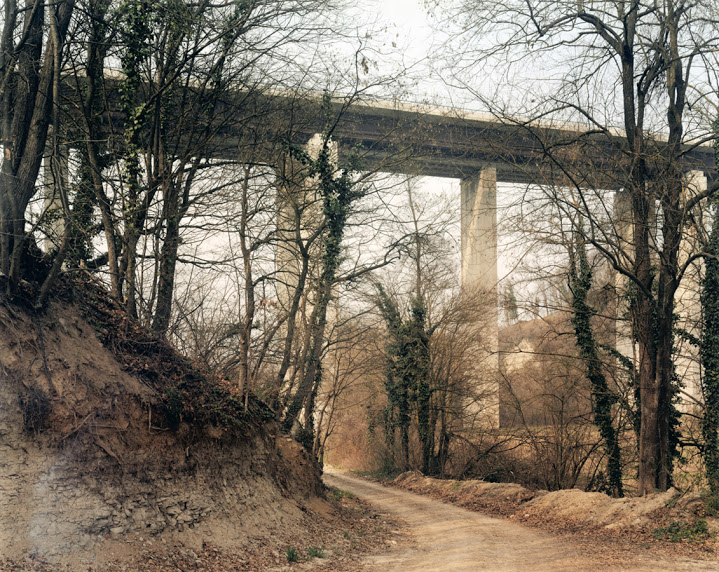 Giorgio Barrera, A6 Autostrada Torino Savona
“Non-places”, were seen by Augé as symptoms for a shift from modernity to supermodernity. Supermodernity for him, does not incorporate elements of the old into the new; it rather leaves the old in its original state and turns it into an attraction. As supermodernity constructs places anew without incorporating former identity, Augé argues that these places become non-places: In them, social interactions and emotional attachment fail and give way to individualism --eg., a supermarket which is devoid of local identity and might be constructed in any place of the world.
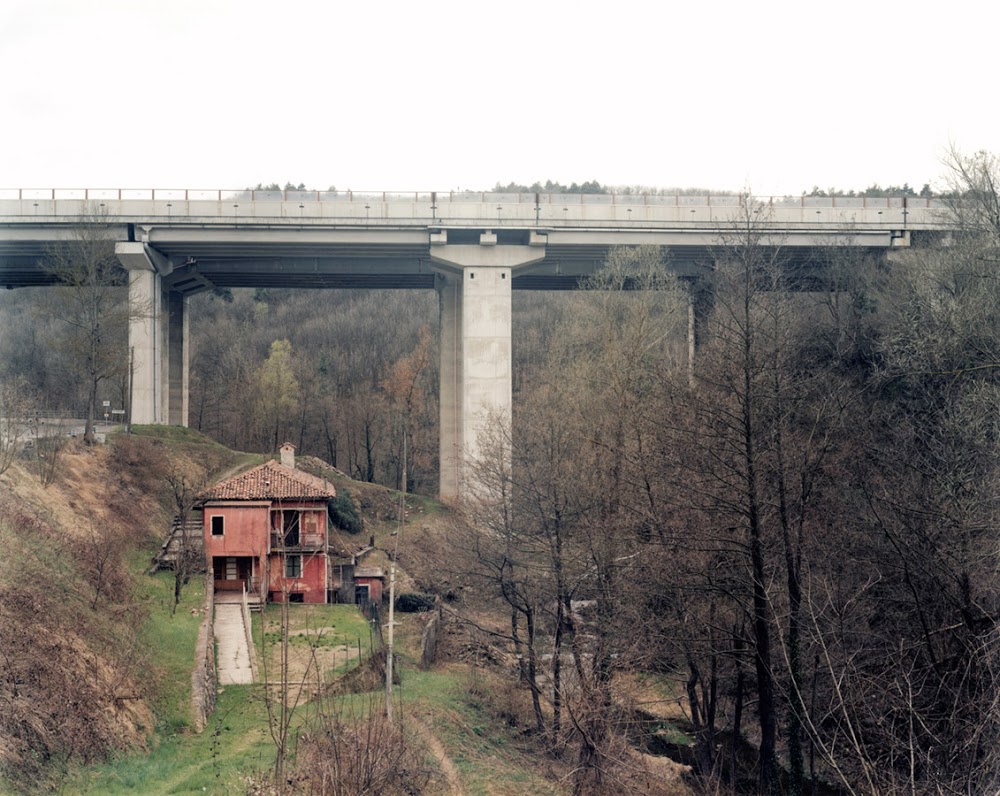 Giorgio Barrera, A6 Autostrada Torino Savona
For Augé places are filled with individual identities, language, references, unformulated rules while non-places are spaces of solitary individuality. Non-place describes a situation where people act fundamentally alone without any particular reference tovtheir common history or similar experience, each occupying a discrete seat in the airplane or lane on the highway.
November 27, 2013
Ron Cowie: using an 8x10 differently
I stumbled on the work of Ron Cowie after my recent experience of using large format cameras at American River on Kangaroo Island when I overexposed some photos of the marshlands, thereby destroying the richness and subtle of the colour.
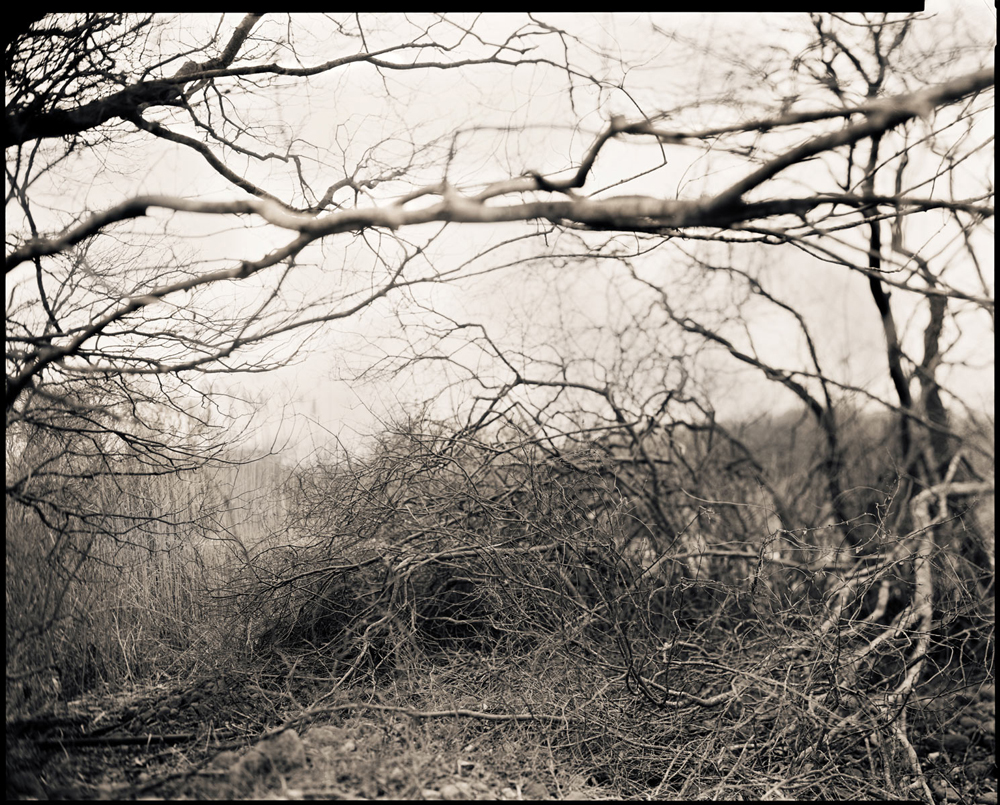 Ron Cowie, Kingdom Of Obviousness, from Leaving Babylon series
 With respect to his Leaving Babylon series Cowie talks about using his 8×10 camera:
One day, when I was between two assignments at Connecticut College. I brought my 8×10 camera along and just set it up along a path to make a picture. It was boring until the idea came “You don’t have to photograph it the way it actually looks to make a successful image.”...I was liberated and able to make images that represented how I felt instead of simple documents of what I saw. Here I was with a camera capable of all sorts of swings, tilts and adjustments, every black and white color filter one could have, and I was always trying to make things look “normal”.... didn’t wait for good light because I assumed all light was good light. My job was to work with the light as it was, not how I wanted it to be. The result was a body of work that got things wrong, broke boundaries, and, once again, blurred lines between an interior and exterior world.Cowie says that he was doing something with his camera that painters had been doing all along: interpreting the land and transforming it into something personal. He could make a world with his camera that didn't exist in any other medium. He found the process exhilarating.

Ron Cowie, Where There Is No Boat, I Will Put A Boat, from the Leaving Babylon series
Cowie makes make high-resolution scans of his negatives, interprets the images as he has seen them, and he makes new digital negatives for the sole purpose of platinum printing, which is a contact printing process.
November 24, 2013
Adelaide photography: Rainshadow
The exhibition ‘Rainshadow’ at the Prospect Gallery in Adelaide features photographs of an escarpment on Greg John's Palmer property in the eastern Mount Lofty Ranges between Mannum on the Murray River and Mount Pleasant. To the east of the escarpment lies the Murray River and a thousand miles of flat country until the western edge of the Great Dividing Range.
The photos in the exhibition were made by five artists---Peter Lindon, Sandra Starkey Simon, Willem Versteegh, Michael Kluvanek and Bill Morrow. The exhibition was curated by Ian Hamilton.
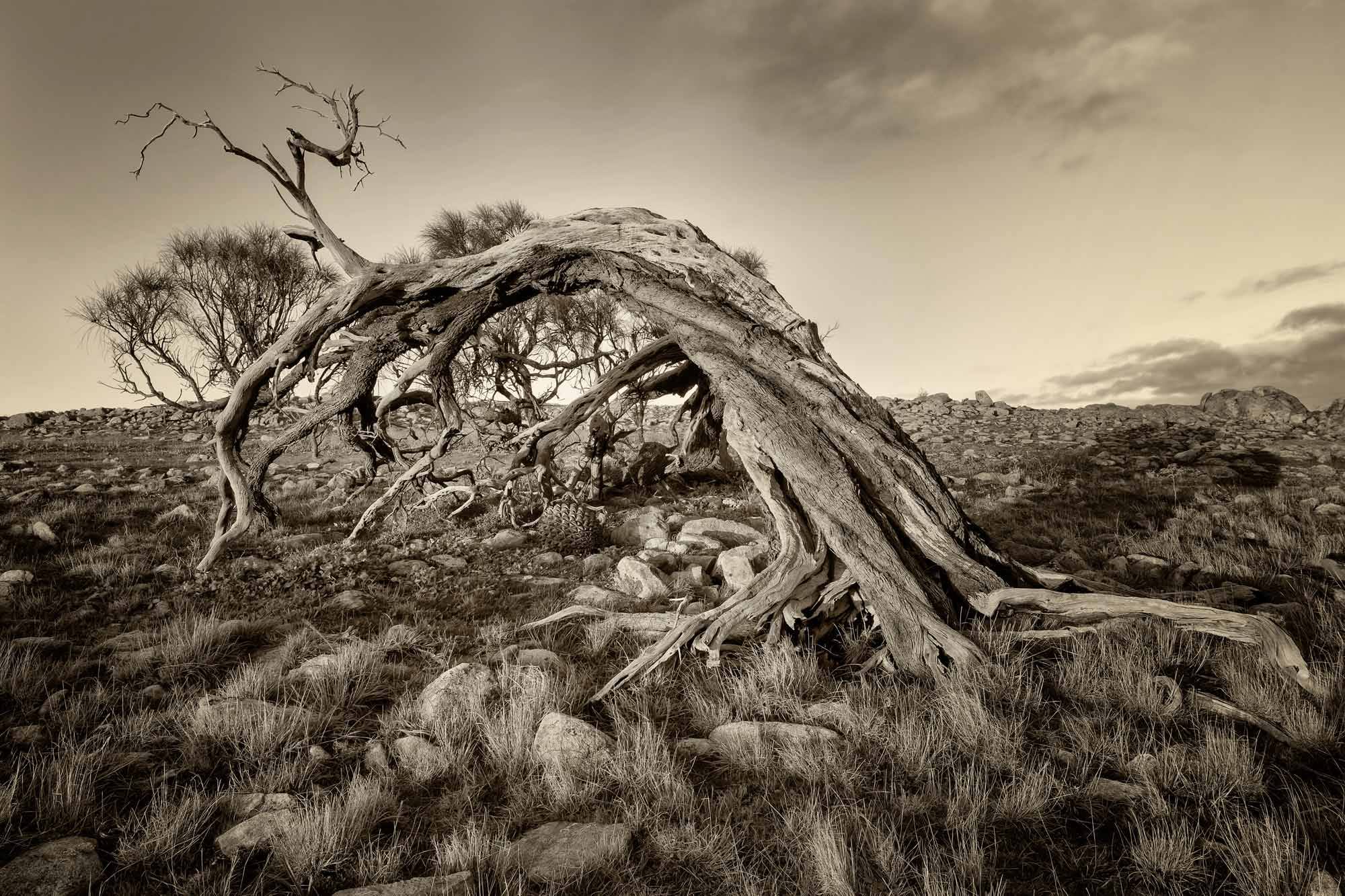 Willem Versteegh, untitled, Rainshadow
This image of a gnarled she-oak suggests survival under difficult climatic conditions: thin soil, strong winds and low rainfall. It is a denuded landscape--one that is stripped bare by European settlement to enable the grazing of sheep and cattle. It's a depressing landscape but an interesting one.
What I found interesting about the exhibition was how the landscape was interpreted in a non-Romantic way ---ie., without the standard contrast between image and symbol.
November 10, 2013
Ragnar Axelsson: Last Days of the Arctic
Ragnar Axelsson has been traveling to the Arctic for almost three decades and his most recent book is Last Days of the Arctic (2010):
 Ragnar Axelsson, Greenland X11, from Last Days of the Arctic: Journeys with the Greenland Inuit.
The book is a photographic portrait of a disappearing landscape and the Inuit people who inhabit it. Their ancient culture is set to become extinct and the probability of these communities continuing to live traditionally is becoming increasingly unlikely. Nowhere are the signs of climate change more visible; here global warming already affects the day-to-day lives of the local people.
 Ragnar Axelsson, Polar bear skin, Ittoqqortoormiit, East Greenland 1996
The Inuit have built their communities based upon a sensitive understanding of the land and the frozen ocean, but rapid social and environmental change threatens their traditional way of life. The hunters of the North are a dying breed. This is the twilight of their society.
November 2, 2013
Australian photography: Carolyn Young
Carolyn Young's photography is concerned with how society engages with the natural environment and the relationship between natural resource management and the visual arts, with particular focus on the photographic medium. Her background is environmental science and her photographic genre is landscape.
She is associated with the Engaging Visions Research Project, which investigates the best way to engage artists with catchment communities in the Murray-Darling Basin to help manage natural resources.
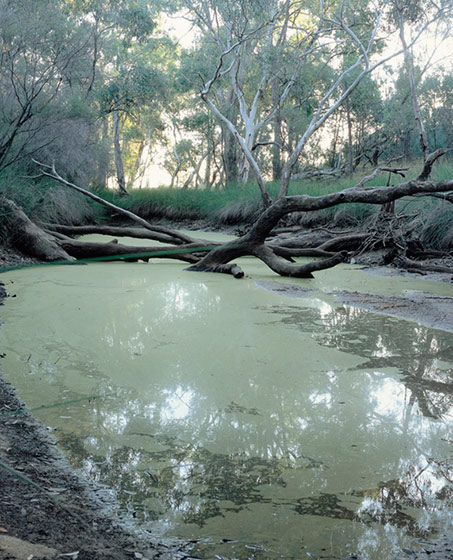 Carolyn Young, Bundock Creek near Gunnedah NSW, 2004, 94.4 x 112.4 cm, Type C digital print, from the Real Rivers series
The focus of the Real River 's project in 2004 was rivers in NSW with a healthy ecosystem. I am pleasantly surprised there were so many healthy rivers during the long drought in the Murray-Darling Basin; pleasantly because a sense of a country violated is at the heart of the Australian environment movement.