|
November 29, 2013
I've always seen motorways or free ways as the "non-places" of modernity, to use an expression created by Marc Augé. By "non-place" Augé means places of transience that do not hold enough significance to be regarded as "places".
He opposes this to the concept of a sociological “place”, which traditionally has been associated with space and time limited in a specific culture. If a place can be defined as relational, historical and concerned with identity, then it is a “place” – the rest would be “non-places”, such as for example highways, airports and supermarkets.
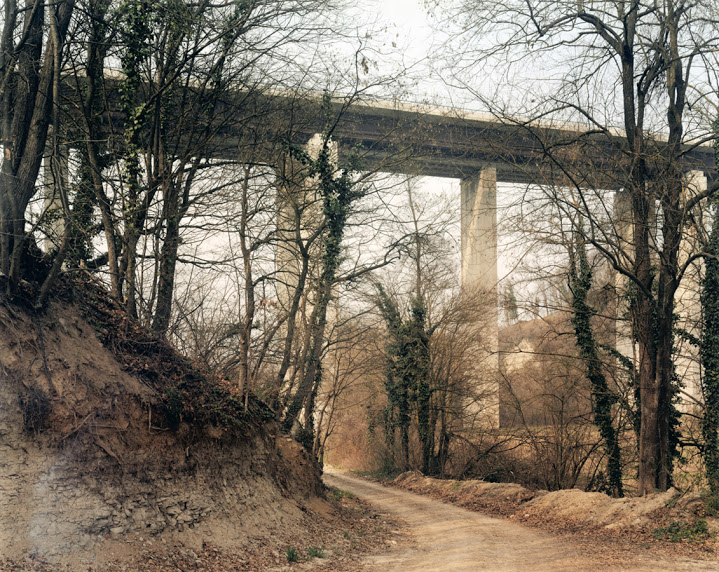 Giorgio Barrera, A6 Autostrada Torino Savona
“Non-places”, were seen by Augé as symptoms for a shift from modernity to supermodernity. Supermodernity for him, does not incorporate elements of the old into the new; it rather leaves the old in its original state and turns it into an attraction. As supermodernity constructs places anew without incorporating former identity, Augé argues that these places become non-places: In them, social interactions and emotional attachment fail and give way to individualism --eg., a supermarket which is devoid of local identity and might be constructed in any place of the world.
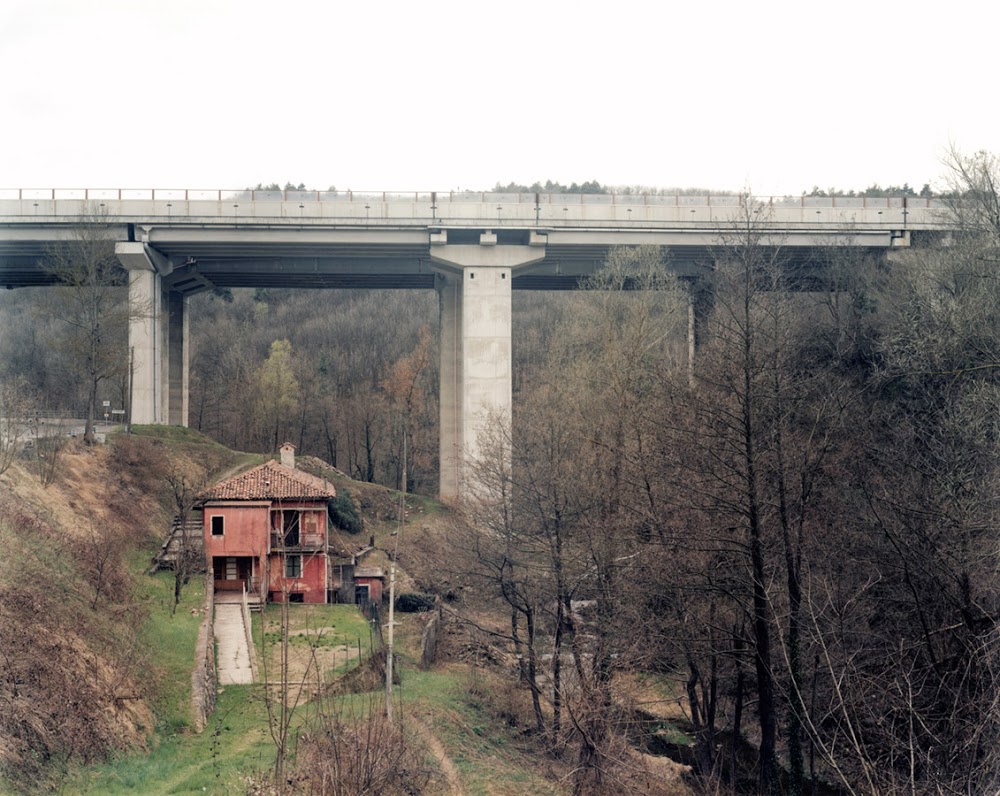 Giorgio Barrera, A6 Autostrada Torino Savona
For Augé places are filled with individual identities, language, references, unformulated rules while non-places are spaces of solitary individuality. Non-place describes a situation where people act fundamentally alone without any particular reference tovtheir common history or similar experience, each occupying a discrete seat in the airplane or lane on the highway.
|


