September 28, 2013
American photography: Todd Hido
Todd Hido (born 1968, Kent, Ohio) is an American contemporary artist and photographer. Currently based in San Francisco, much of Hido’s work involves urban and suburban housing across the U.S., of which the artist produces large, highly detailed and luminous color photographs.
The landscapes were made through shot through the window of a car, which you only see as smudges of rain that blurs parts of the landscapes:
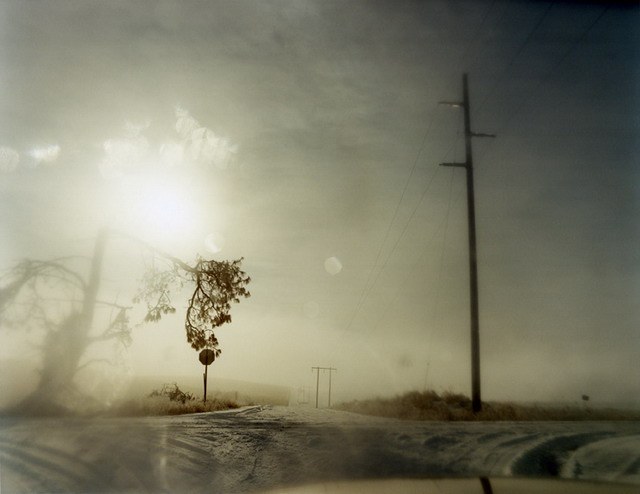 Todd Hido, A Road Divided, 2008, Chromogenic print
The work is sombre and moody. America is an empty place, evidenced by crossroads, dead-end streets, broken trees, and seemingly endless highways. I'm interested in this work as I've recently been taking photos through car windows.
September 27, 2013
US photography: Jeff Rich's Watershed
Jeff Rich's long term Watershed project explores the banks of rivers flowing through Tennessee and North Carolina, an iterate series of waterways that eventually join together to form the Tennessee River, ultimately flowing into the Mississippi. While water does play a large part, the land plays an even larger role by directing the water to a common point, such as a river or ocean. Thus human impact on the land directly affects the water that runs over it.
Rich started work on the project in 2005 and three major criteria: pollution, control, and stewardship had to be present in every image in order for them to fit into the overall project.
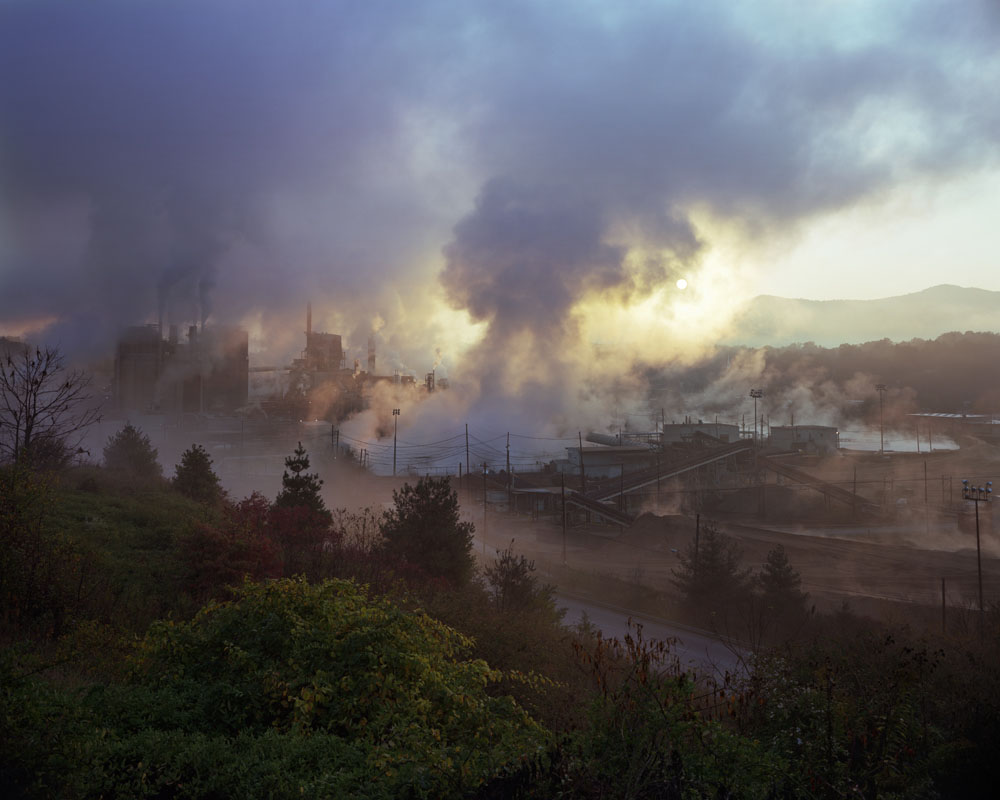 Jeff Rich, Blue Ridge Paper Mill, Pigeon River, Canton, North Carolina, 2008
The French Broad watershed is like many river systems in the United States, at once loved and abused -- a popular recreational destination, and a solution for industry, its waters carrying away a multitude of unwanted waste. Focusing on the environmental issues of a single watershed, Rich's images of the French Broad River and Tennessee River basins offer a compelling narrative about environmental stress. They depict dramatic and often ill-conceived attempts to contain and control the landscape: deforestation, the diversion of natural waterways, the erection of anti-erosion banks, the scarring of the earth.
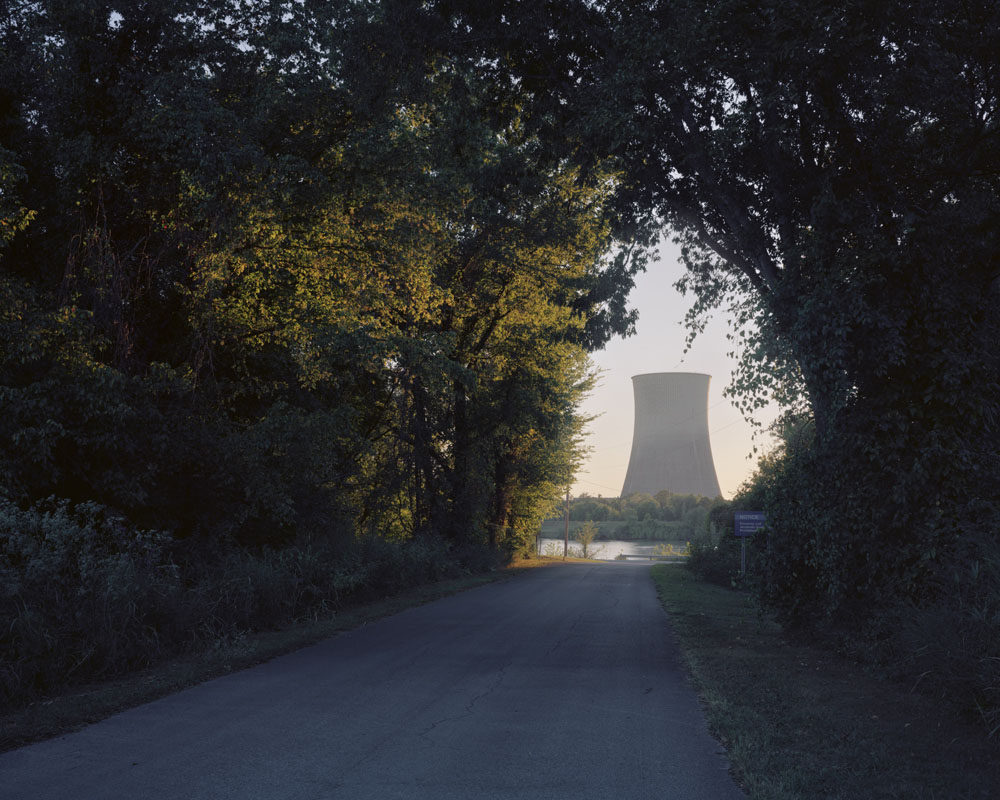 Jeff Rich, Watts Bar Nuclear Plant, Tennessee River, 2010
He shows us a river that is simultaneously used for the purpose of recreation and industry. There are photographs of families wading through shallow creeks, tourist groups riding ski lifts over rocky banks, and thrill seekers on canoes. These photographs become powerful because they exist in conversation with those that document the industrial entities that pollute the river. Rich shows us the power plants, factories, and mills that occupy the shoreline. One photograph depicts the bodies of old cars that were used to reinforce a riverbank and prevent erosion. Another image shows a sewer pipeline running parallel and adjacent to a riverbank.
The French Broad turns into the Tennessee River Basin and the Tennessee River ultimately flows into the Mississippi. The French Broad, and the Tennessee watersheds make up the southeastern corner of the Mississippi watershed.
September 26, 2013
Lightwork
Light Work was founded as an artist-run, non-profit organization in 1973. It aims to provide direct support to artists working in photography and related media, through residencies, publications, exhibitions, and a community-access lab facility. It is housed in the Robert B. Menschel Media Center at Syracuse University, New York, and it has been showcasing contemporary American photographers since 1977.
Though Lightwork supports local artists through a grant program it's exhibition programme has an international focus. They have shown the Hungarian artist Adam Magyar who explorations of the concept of urban life. Magyar depicts the synergies of people, the cities they inhabit, and the technological support structures created to facilitate urban life.
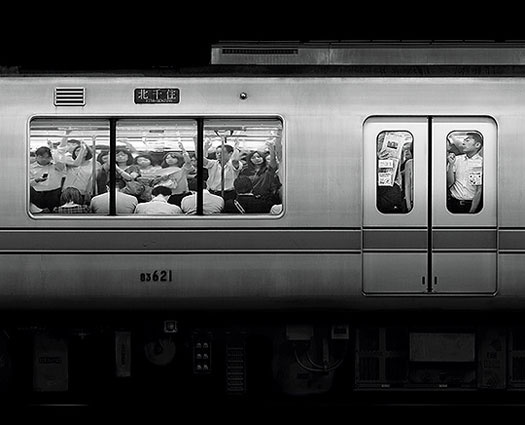 Adam Magyar, Tokyo, 2010, digital silver gelatin print, from the series Stainless
Magyar uses unconventional devices, such as an industrial machine-vision camera that relies on scanning technology. Utilizing software and drivers which he programs himself, Magyar creates constructed images that capture moments in time and place that can neither be seen with the bare eye nor conventional optical cameras.
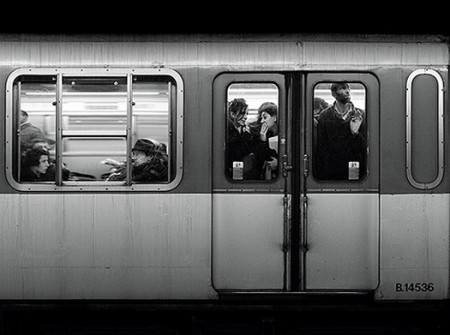 Adam Magyar, Tokyo, 2010, digital silver gelatin print, from the series Stainless
The resulting photographs break with traditional Renaissance-defined perspective. The images combine the aesthetics of classic photography with a technology that redefines our understanding of linear time and singular space in a perfect blend of science and art.
September 24, 2013
UK Photography: Simon Robert's Pierdom
British photographer Simon Roberts has spent the past three years creating Pierdom, a comprehensive survey of Britain’s piers. He loosely followed in the footsteps of Francis Frith, whose company made the last major photographic survey of these peculiarly British structures. Roberts' earlier We English series, was concerned with the culture of leisure in contemporary English society.
Predominantly constructed during the 19th century in the context of expanding Victorian seaside resorts and railways, these seaside structures were often erected as landing docks for pleasure steamers and other sea craft. Growing to accommodate the needs of day-trippers escaping the smog of the city, engineers began to incorporate bandstands, cafes and music halls into their designs, embracing the growing notion of ‘pleasure seeking’ by the seaside.
 Simon Roberts, Clevedon Pier, from Pierdom, 2011
The history of the pleasure pier follows the story of Britain’s relationship with the seaside. Our piers bear witness to the growth of the coast as a pleasure destination for a monied elite, as well as the working class enthusiasm for the seaside brought on by the development of the railways and the introduction of bank holidays.
At the turn of the century the British coastline boasted over 100 piers, some modest and functional, others elegant, exotic Victorian structures thrusting out into the sea. Now under half remain, the others destroyed by fierce weather and fires, with many dismantled during the 2nd World War to prevent German landings. Britain’s piers have become cultural landmarks, tracing history, national identity and economic fortunes from Victorian industrialism to the post-war boom, and finally now to the recent economic downturn.
 Simon Roberts, Eastbourne Pier, from Pierdom, 2011
Roberts’ large format (5x4) photographs are often taken from elevated positions incorporating peripheral details and the elements. Others are made close from underneath the piers' steel and wood structures.
September 20, 2013
American photography: Joni Sternbach
Joni Sternbach, a Brooklyn-based photographer, uses both large format film and early photographic processes to create contemporary landscapes and seascapes.
The seascapes are interesting because she is doing what I do. She stands out there on the bluffs or at the edge of the shore with a dark cloth over her head that is attached to a 5x7 field camera and basically lets the picture take itself.
 Joni Sternbach, Ocean details #3, gelatin silver print
Sternbach became known through her inclusion in the Museum of Modern Art's exhibition Pleasures and Terrors of Domestic Comfort in 1991 and subsequent book. In the years that followed, her focus shifted to landscape subjects.
The interest in Stenbach's work is SurfLand---contemporary portraits of surfers using 19th-century photographic processes.
However, I am fascinated by what grew out of her early ocean studies--her sea/sky scapes:
 Joni Sternbach, Sea/Sky #9, gelatin silver print
She say that:
these pictures are a direct result of persistence and happenstance. On the day I went out to make a portrait of the sea, the sky turned out to be more interesting. Feeling a commitment to the sea, yet disappointed by its surface of that particular day, I simply pointed the camera upwards. I became interested in reducing all of the natural elements to a mystery of formal abstraction.
We still recognize the sea and the sky in these abstractions, which is what I find appealing.
September 19, 2013
Richard Avedon in Australia
The National Portrait Gallery in Canberra has an exhibition of the American photographer Richard Avedon (i923-2004)/This is the first Australian exhibition of Avedon’s work.
Avedon produced significant portrait photographs in the twentieth century. These were mostly intimate images of the key intellectual, artistic, and political figures of the late 1950s through the early 1970s.
 Richard Avedon , self-portrait, gelatin silver print
The 1985 In the American West portfolio was a notable exception to the celebrity photographs. His portraits, overshadow his fashion work, which was the bread-&-butter of Avedon's career & also the work which brought him to public attention, initially.
Avedon was the first staff photographer for the New Yorker. Until Avedon the magazine used drawings. He also worked for such photograph-driven publications as Vogue and Harper's Bazaar. In American popular culture, this was where Avedon mattered.
However Avedon's life work is portraiture and his subjects were generally posed against a plain white background with no props:
 Richard Avedon, Marilyn Monroe, 1957, Gelatin silver print
There is a sadness in this picture that undercuts the golden coiffure and glittering sequinned dress with plunging neckline; an emphasis on interiority or subjectivity.
Recalling the portrait session with Monro that took place in his studio on a May evening in 1957, Avedon says:
For hours she danced and sang and flirted and did this thing that's—she did Marilyn Monroe. And then there was the inevitable drop. And when the night was over and the white wine was over and the dancing was over, she sat in the corner like a child, with everything gone. I saw her sitting quietly without expression on her face, and I walked towards her but I wouldn't photograph her without her knowledge of it. And as I came with the camera, I saw that she was not saying no.
Avedon photographed the point of convergence between actor and character, between the private self and the public role. The character is a melancholy heroine collaboratively created by the photographer and his subject.
Up until the late sixties, Avedon had been using a small, square-format Rolleiflex for nearly all of his fashion and portrait work.This camera, which he held at waist level, peering down into the viewfinder, was a mobile and tractable tool that eventually came to feel like an extension of his own body.
In 1969 Avedon began using an eight-by-ten-inch Deardorff view camera on a tripod—a cumbersome and demanding piece of equipment that brought with it a new way of working and a new set of constraints. Rather than moving with the Rolleiflex at his waist, he was now standing beside a large box with a static lens. No longer a mobile extension of the eye, the camera became a silent witness to the concentrated face-off between photographer and subject.
September 16, 2013
Australian photography: John Austin's Forest Threnody
I've mentioned John Austin, the WA large format landscape photographer, before on junk for code in relation to his work helping to protect and save WA's karri and jarrah forests.
 John Austin, Tree sitter buffer marking, Lane 01, Wattle State Forest, Northcliffe, Western Australia, 15 November 1998, NLA
Austin has just made a video of this body of work made from scans of still black and white images made between 1994 and 2013.
Forest Threnody from John Austin on Vimeo.
After a break of ten years Austin has started documenting the SW Western Australian karri and jarrah forests---entitled Quinninup Environmental Documentation.
September 14, 2013
US photography: Michael Light
Michael Light's photos of the western U.S. sun belt cities are taken from a two-seater plane that he pilots himself. This provides an Olympian or hawk’s-eye view view of the western landscape that is photographed with a Linhof Aero Technika.
Examples are the Ascaya luxury housing development, Black Mountain, Nevada, which has lain dormant since the economic crash of 2008 and Lake Las Vegas, a complex of luxury housing, country clubs and casinos fringing an artificial lake.
 Michael Light, Unbuilt Ascaya development looking Southeast, Black Mountain, 2012
The Ascaya development is based on mountaintop removal and terracing and it looks like an empty mining camp. The building boom is finished and the developers have mostly departed or gone bust, leaving behind a landscape that will define the city and landscape for decades.
This kind of development represents a failure to understand the desert, its ecosystem, its light and heat; a failure to live with respect for the community and the natural surroundings. It represents a blindness to context.
 Michael Light,Barcelona homes and the edge of Lake Mead recreation area. Lake Las Vegas, Henderson, NV 2011.
The Sun Belt cities experienced the most rapid growth of any American urban area in the early 21st century, and were the hardest hit in the economic downtown after the Global Financial Crisis. The developers replicated the winning formula in Las Vegas, which had made them so much money in the rest of the Sun Belt. The model was suburban sprawl, cheap land and the mass production of homes in a sharply limited variety of models. They built with the assumption that growth in the valley — of residents, tourists, consumers — would lead to profitability.
September 11, 2013
US photography: David Schalliol
One of the photographers that I have a lot of respect for on Flickr is metroblossom, namely the Chicago photographer David Schalliol. He is the founder and editor of Metroblossom and Managing Editor of Gapers Block
I really love, and I'm fascinated by, his isolated buildings project:
 David Schalliol, Residential Building (Camden, New Jersey), digital chromogenic print
Schalliol is a Ph.D. student in the Department of Sociology at the University of Chicago and his photographic work seem to revolve tightly around his research in that department. Neighborhoods, buildings, inhabitants and structure are all at the core of David's work.
He studies neighborhoods around Chicago and the rest of the country, and how government agencies are gentrifying areas and how residents of those areas are adapting to the changes that inevitably follow.
I also love his urbanscapes, for instance his photographs of the original Chicago Housing Authority Brooks Homes built in 1951:
 David Schalliol, The View Northeast from Chicago Housing Authority's (CHA's) Loomis Homes, 2009
The Chicago Housing Authority is the municipal agency that since the late 1930s has directed the planning and development of the city's public housing to provide publicly funded housing for the impoverished.
This is a photography that is linked to social stratification and meaning- concentrating on the South Side and West Side of Chicago, looking at what’s been happening in the neighborhoods that have been most affected by industrialization, racial change and so on.
Another example of his urbanscape is his photographs of silos or grain elevators:
 href="http://davidschalliol.com">David Schalliol, grain elevator, Buffalo, New York, 2013
These photos are often made on his travels to conferences, in this case one associated with The Society of Architectural Historians.
September 5, 2013
UK photography: Michael Jackson
Michael Jackson's Other Small Worlds project explores the unusual patterns in the sand created by the tides at Poppit Sands, Pembrokeshire, in Wales. The project interests me, given my own work along the beaches at Victor Harbor in South Australia.
Jackson photographs the details and patterns and motion of a moment in the sand created by the constant change of tides:
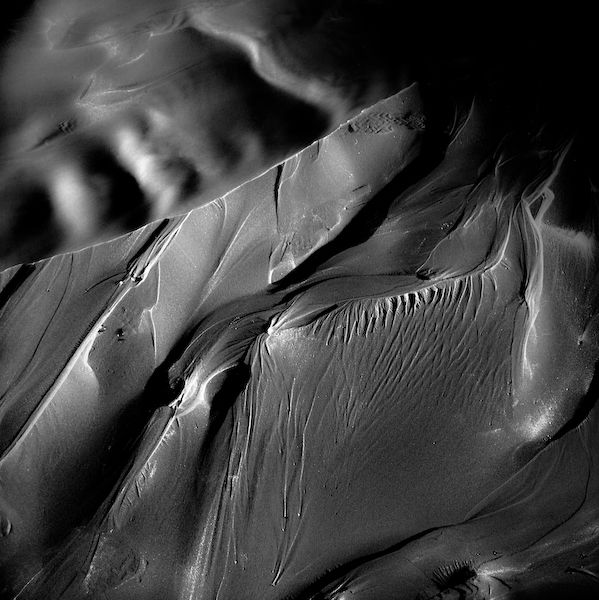 Michael Jackson, Poppit Beach, Wales, silver gelatin print, from the series Other Small Worlds
Jackson has been photographing at Poppit Sands for six years running. He says:
“Through photographing a single location over a long period of time I find that I can study certain aspects of the three elements available to me – sand, water and sky – and try to focus in on the relationships that they have with each other and how these specifics can blend to create an image of strength and excitement.”
Though the emphasis is on the unusual rather than the beautiful, the goal is a combination of the unusual and the beautiful.
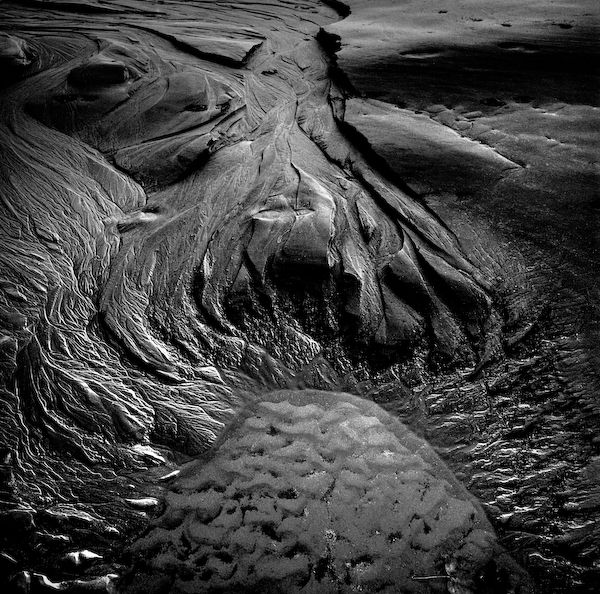 Michael Jackson, Poppit Beach, Wales, silver gelatin print, from the series Other Small Worlds
The work quite often shows the negative of what Jackson saw.
Jackson says:
When I look through the viewfinder I imagine the final image and make adjustments to get that image. You could say that a painter’s interpretation of a subject doesn’t look like the real world and nobody would question it – so why is it questioned when a photographer does it? I use the negative of the image because I find that it excites me – the darks turn to glowing highlights and at the end of the day the negative is the actual solid thing that I am left with in the camera. The piece of film is the record of my visit. Displaying the negative as it really is could be more truthful to my photography than inverting it to bring it back to ‘reality’.
The work is an interpretation of the sand patterns on the beach that go beyond the initial layers of experience from the first couple of visits.
September 4, 2013
Nadia Sablin: Two Sisters
Nadia Sablin, a Brooklyn-based photogrpaher, says that her Alehovshchina: Two sisters project is a series of photographs detailing the lives of two unmarried sisters, her aunts, who live in Northwest Russia.
Sablin, 33, was born in what was then Leningrad and emigrated to the United States in 1992, settling with her parents in Cleveland. She studied photography at the Rochester Institute of Technology, graduating in 2002, and received a master’s degree from Arizona State University in 2011.
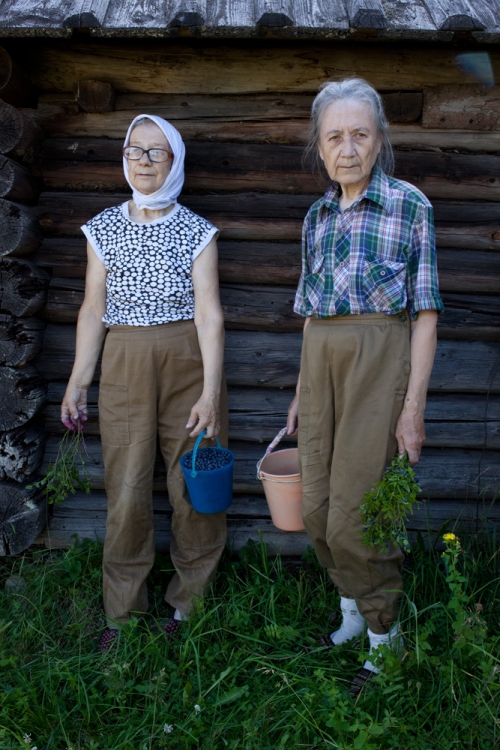 Nadia Sablin, untitled, from Alehovshchina: Two sisters series
The two women are in their seventies, but carry on the traditional Russian way of life, chopping wood for heating the house, bringing water from the well and making their own clothes. As they get older, they are less and less able to perform the grueling tasks of running their small farm and must rely on financial help from their relatives.
Sablin has spent the summer of the last three years photographing this vanishing way of life. She adds:
In 1952, my grandfather began to lose his vision as a result of being wounded in WWII. Wanting to return to the place where he grew up, he found an unoccupied hill in a village in the Leningrad region of Russia, close to his brothers, sisters and numerous cousins. He took his house apart, log by log, and floated it down the Oyat river to its new location and reconstructed it. This house, with no running water or heat, is the place where my father and his siblings grew up, each moving to the big city after finishing school.
The house still stands, occupied by two of my aunts in the warmer months, whose life is spent in the routine of chores, handiwork and puzzles.
September 2, 2013
South Australian photography: Grant Hancock
Grant Hancock is a successful commercial photographer who has done a study of rock abstracts that continues the marginal tradition of abstractions from nature in Australian photography.
The Parker series of toned black and white images of weathered rocks is entitled Illusions of Place:
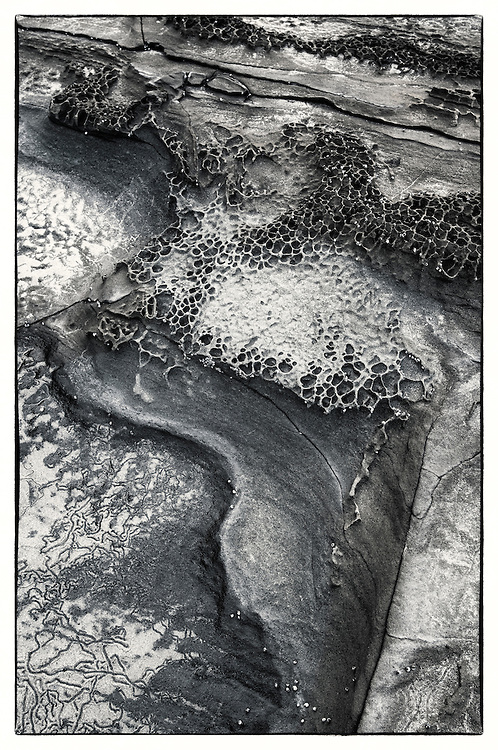 Grant Hancock Parker Inlet, Otway Ranges, Victoria, 2009
I know little about this series other than what is on Hancock's website. It was exhibited during the 2013 SALA festival in South Australia.