|
January 9, 2012
I recently took my Schneider Symmar 210mm lens (circa 1970) that I use with the Cambo 8x10 to Charles Bridgwood in Adelaide to have both the fungus in the lens removed and a non-functional electronic shutter replaced by a working mechanical one.
Charles mentioned an ex-South Australian photographer working with an 8x10 in the south west corner of WA. It was John Austin, who works with a Sinar Norma monorail view camera to represent the swamps, forests, rivers and beaches of the local landscape:
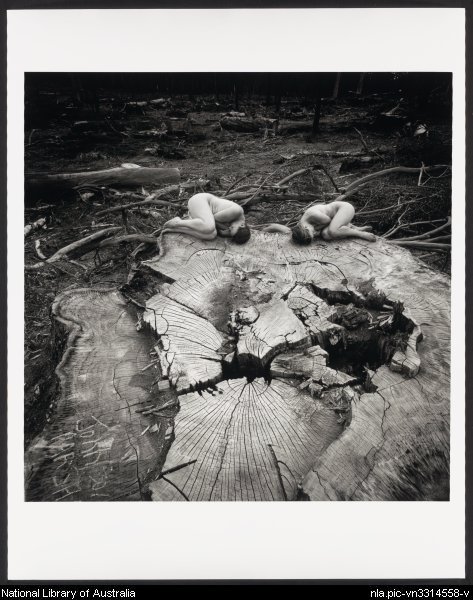 John Austin, Peta Sargison and Debbie Ludlam on the "Megastump", Gardner 08 State Forest, Chesapeake Road, Northcliffe, Western Australia, 1999, NLA
There cannot be many Australian photographers working with an 8x10 in black and white and a chemical darkroom. Despite a rich tradition of fine black and white photography that is linked to Minor White and Edward Weston in the USA, you could probably count these traditionalists in Australia on one hand. The high digital end of the medium format is definitely taking over.
Austin is based in the south-west forest of WA (in Quinninup), and he works exclusively with fine silver-gelatine black and white prints, normally from large format cameras. A large body of his work documents the destruction and defence of the last of the southern tall karri and jarrah forests in WA. As there are very few of his b+w pictures online in the public domain you have to look at his website.
Though Austin's work is in the tradition of nineteenth century Australian landscape photography it has a critical edge. Whereas the former's trade views these professionals practised photography as a trade in the market place) celebrated the pioneering conquest of a nature to create farming properties, Austin highlights the destruction of the karri and jarrah forests by a short sighted forestry industry that has little understanding of sustainable forestry.
Austin's photography is ethically based practice in that he is interested is protecting ecosystems and cultural heritage that is of value, is fragile and is continually threatened by a resource based industry and a pro-development state. Austin would be one example of Les Walkling's exploration for an ethical practice embedded deep in our work and that can be the foundation for a contemporary art practice.
|


