« November 2008 | Main | January 2009 »
December 31, 2008
political blogging: a comment
Graham Young at Ambit Gambit has a post on blogging. He considers the argument that this kind of blogging in Australia has arisen in reaction to the flaws in a safety-first journalism:
So, a consequence of lack of experience, lack of understanding, lack of resources, lack of tools, lack of proper training and lack of aptitude may well be that journalists end up practising "safety first". Or it may just be that journalism is a social activity and we tend to herd in social activities, which looks like "safety first".
I concur with his account of the flaws of journalism in the mainstream media----it is a more sophisticated account than the one I mentioned here.
Young then adds that if practising "safety first" journalism in the mainstream media was so, then we would expect to see scuds of bloggers who disagree with each other. However, his observation is that this is not the case, as what tends to happen is that bloggers herd together in mutually reinforcing circles:
There may be more points of view than are represented in the MSM, so there is less uniformity and more niches, but as there are more bloggers than journalists I doubt whether this represents a real increase in the risk profile. In which case, perhaps the urge to blog is driven not so much by the tendency of journalists towards "safety first", but because journalists are by and large socially homogenous and don't reaffirm the views of most bloggers, who in reaction create their own social networks.
I concur with this observation about Australian political bloggers. It's a better and more accurate account of what is happening than that of David Burchill in The Australian mid 2008.
If you recall, Burchill's column dismissed bloggers as the political dark side of the web:
The chief purpose of the political blog isn't the production of argument, but rather the staging of ceremonies of degradation and purification. The blogger's goal is to solidify a tribe of acolytes around them, and to ritually degrade those who are seen as renegades from the cause...This vast outpouring of pseudo-expertise and vituperation serves mainly as a testament to Western societies' tendency for producing self-important, opinionated folks far in excess of our capacity to employ them...In this the blogosphere resembles the so-called literary low-life of the decades before the French Revolution. In those days resentful and under-employed scribblers amused themselves by illegally publishing salacious rumours about Marie Antoinette or the clergy, the better to strip away the sacred veil of monarchical rule. Except that, in those days, publishing even salacious rumours required a certain sort of bravery.
Young's account shows up Burchill's account for what it is: as a conservative polemic against left wing bloggers.
The missing categories here are power, public sphere, deliberative democracy, debate, critical reasoning and user generated content. These categories, especially the latter, take us away from the narrow frame of the citizen journalism literature which tends to reduce blogging to journalism. Instead of looking back we can look forward to what blogging opens up for us in the context of the decline of the business model of the press and the crisis in journalism.
Posted by Gary Sauer-Thompson at 7:25 AM | Comments (9) | TrackBack
December 30, 2008
Israel: the drums of war beat
One always hopes that things will improve in the Middle East. These are always dashed. This time round in the circle of violence Israel's strategic objective in bombing the Gaza strip appears to be to "neutralise" Hamas, and so forcing the movement to accept a new ceasefire on Israel's terms.
It is always more complicated than that, isn't it, given the imposition of a total blockade which prevented basic goods, like food stuff and medicine, from entering the Gaza Strip. Israel choked off supplies after Hamas won the elections almost 2 years ago. Israel wants to topple the Hamas regime, rather than end the siege of Gaza and allowing freedom of movement between Gaza and the West Bank could rehabilitate life in the Strip. The problem is that the state of Israel does not accept that Hamas rule in Gaza is a fact, and nor does it accept that it is with that government that Israel must reach a situation of coexistence.
What then is the justification for this kind of attack on Hamas' centers of operation in Gaza is justified? Tom Segev observes that both the justification given for the assault on Gaza and the chosen targets are a replay of the same basic assumptions that have proven wrong time after time. Yet Israel still pulls them out of its hat again and again, in one war after another. in which the lethal logic of belligerence dominates.
The first assumption is that:
Israel is striking at the Palestinians to "teach them a lesson." That is a basic assumption that has accompanied the Zionist enterprise since its inception: We are the representatives of progress and enlightenment, sophisticated rationality and morality, while the Arabs are a primitive, violent rabble, ignorant children who must be educated and taught wisdom - via, of course, the carrot-and-stick method, just as the drover does with his donkey.
The second assumption is that:
The bombing of Gaza is also supposed to "liquidate the Hamas regime," in line with another assumption that has accompanied the Zionist movement since its inception: that it is possible to impose a "moderate" leadership on the Palestinians, one that will abandon their national aspirations.
The head of the Lebanese militia Hezbollah, Hassan Nasrall, has drawn a comparison between the Israel Defense Forces offensiv in the Gaza Strip and the 2006 Second Lebanon War, which Hezbollah waged against Israel in southern Lebanon.
What we can infer is that there is war between Israel and Hamas. Israel's opening salvo is not merely another "surgical" operation or pinpoint strike. This is the harshest IDF assault on Gaza since the territory was captured during the Six-Day War in 1967--it is "shock and awe" designed to deal as serious a blow as possible to the Hamas chain of command in order to throw its operating capabilities off kilter.
The third assumption is that all of Israel's wars assume that Israel is only defending itself. That ignores a circle of violence in which the Gaza Strip has been subjected to a lengthy siege that destroyed an entire Paalestinian generation's chances of living worthwhile lives.
Posted by Gary Sauer-Thompson at 4:21 AM | Comments (12) | TrackBack
December 29, 2008
Conroy has company
The Australian Minister Against Communications is not on his own in seeking to control what can and can't be done with the internet. The US has been toying with the idea for a while, and the UK is scouting around for an ISP-level solution that won't result in humiliation. It's hardly surprising that some would begin to suspect some kind of multi-government conspiracy against the people when the 'saving the kiddies' argument is so flawed.
Could the think of the children line simply be a smokescreen for repression of free speech? After all, I’m not exactly seeing protesters calling for repressive internet censorship anywhere in the world at the moment.Could it be a play by big media to take back control of news gathering, or the movie and music industry to kill the internet so as to kill piracy (notably Burnham throws piracy into the mix).
And why left wing Governments? And more than one of them….at the same time, out of the blue.
A left wing conspiracy to kill the internet?
I know, far fetched, and a little loopy on the suggestion side, but we’re not getting the whole picture here, and something more than kiddies is driving this.
Comments sensibly point out that there's nothing left wing about it. Also in comments, Clarencegirl argues it's in the interests of corporate profits, which makes more sense:
This push to censor the Internet is nothing more than business wanting a bigger share of hyperspace or, more accurately, the profits that can flow from creating software/systems which are required to use the world wide web.Censorship/security via filtering is a growing commercial opportunity that certain big IT companies are eager to get a piece of and, many are already actively lobbying for or privately supporting the government plans to legislate mandatory ISP-level filtering.
Mandatory filtering is also being supported by those companies which feel that sales and royalties are being lost due to file sharing.
A brief Google will bring up pages of IT companies selling programs capable of limiting what can be viewed or downloaded and many are apparently quite happy to encourage calls from religious and community groups to 'protect' children from the evil Net.
It's a fair argument, and there are others to play with as well.
Common knowledge has it that the Vietnam war would have gone altogether more splendidly if the ugly bits weren't broadcast into civilian living rooms every night. Embedding media with the good guys in Iraq should have solved this problem, but now you've got odd bits of citizenry describing civilian casualties to one another on the internet. It's hard to convince people everything's under control when you've got people on the ground in Mumbai tweeting and blogging contradictions to your official pronouncements about how fantastically well you handle your duty to protect citizens in such circumstances. And now Israel's idea of reasonable force is escaping its proper narrative confines.
Add to that the citizenry's newfound ability to organise dissent (what's the point of having a monopoly on violence if they won't leave their houses and mob in the streets?) and clearly something has to be done.
For people already doing the digital thing a digital economy is naturally emerging in its own chaotic way, with some following whatever is fashionable at the moment and others sticking with what works. But what makes anyone think this kind of thing is what Conroy has in mind when he uses the words digital economy? It's way more likely that he's talking about Microsoft's and Disney's and Warner Bros' version, which is altogether different.
When it comes to controlling the internet, the corporates and government both have an interest in McDonaldising it. Their chances don't appear to be all that good from a geekish point of view, which will probably burrow its way around whatever ISP nick nackery they come up with. But where the broader citizenry whose internet use is currently limited to banking, email and maybe Facebook is concerned, the internet must become an orderly reproduction of the offline status quo.
Conspiracy theory? Maybe. But maybe not.
Posted by Lyn Calcutt at 8:53 AM | Comments (17) | TrackBack
December 28, 2008
melting of the ice
2008 was warmer and drier than usual. Water storages are lower than ever in southern Australia. In South Australia the premier is saying that the state won't run out of water. He says little was about helping to install bulk-buy solar roof panels, or that the federal Government is sending a message that it's not prepared to make that leap into the future of renewable energy in a big way.
Little is also being said what rising sea levels in the future would mean in coastal South Australia. There is a vacuum around the significance of the loss of Arctic summer sea ice, or the possibility of the Arctic sea becoming ice-free in summer and Greenland's ice melting.
 Matt Golding
In Climate Code Red David Spratt and Philip Sutton warn that glaciologists are convinced the summer Arctic ice will disappear within five years, returning only as a thin layer during winter.
They argue that the question is not whether this can be stopped, but whether it can be reversed over coming decades to avoid sea level rises much worse than predicted by the comparatively conservative Nobel-Prize-winning Intergovernmental Panel on Climate Change — probably between two and five metres.
Posted by Gary Sauer-Thompson at 5:23 AM | Comments (17) | TrackBack
December 27, 2008
Benedict XVI on Xmas
The Pope--Benedict XVI--- in the context of his Christmas "greeting" to the Roman Curia made some controversial remarks about gender and homosexuality along the lines of protecting the rainforests from destruction in the same vein as protecting heterosexuals from homosexuality. The full text is here.

The pope's concession to the environment is perfunctory and superficial – "Yes, the tropical forests merit our protection" – and subordinated to "the human being as a creature (which) merits no less protection – a creature in which a message is written which does not imply a contradiction of our liberty, but rather the condition for it."
This is a religion that gives human beings dominion over nature, the conquest of which has been one of its proudest achievements. It is not likely that it will contribute anything very helpful to the discussion of the relationship either between humanity and the earth
Posted by Gary Sauer-Thompson at 11:09 AM | Comments (3) | TrackBack
December 26, 2008
auto industry in the US
An odd story about this, especially when the auto industry is in decline and dependent on public handouts to survive. By most most accounts, the Big Three US auto companies brought ruin upon themselves. The US is becoming the bailout nation.

What appears to be happening is that with the help of Nissan, Toyota, and BMW, the South is trying to replace Detroit as the center of U.S. automobile production, using low wages, anti-union laws, and low taxes to benefit from the outsourcing of industry from societies more advanced than the South, like Japan and Germany. A recession-plagued US is becoming a space for outsourcing.
the auto industry is central to the 20th century American mythos in that the American auto manufacturers are the backbone of American manufacturing and industrial might. Now Detroit and American car manufacturing is becoming a
rustbelt due to a corporate culture that was not geared towards innovation, nor towards making small, efficient cars. By all accounts the industry will use government funds to continue exactly as they were before.
Posted by Gary Sauer-Thompson at 5:02 PM | Comments (1) | TrackBack
December 25, 2008
Merry Xmas
Have a great day everyone. Thanks for dropping by, commenting and discussing politics and policy issues during 2008. It's been a great year blogging wise. Blogging is slowly gaining acceptance in Australia, despite the resistance.
 Gary Sauer-Thompson, Camellia, Canberra, 2008
Looking forward to many more discussions and debates on public and political issues after the Xmas holidays. It sure has been an eventful year, what with the crisis in financial capitalism and its impact of the global economy. That has made it a watershed year. When coupled with climate change (less rain, the melting of the Arctic sea ice, and temperature increases of 2 degrees are effectively already in the system) 2008 was an epochal year.
The Rudd government delivered ion the economic slowdown. It's response to climate change was characterised by short term politics and a culture of failure.
Posted by Gary Sauer-Thompson at 6:24 AM | Comments (4) | TrackBack
December 24, 2008
after the stimulus?
So we end the year on an upbeat economic note: big stimulus packages to kick start the economy with the rhetoric saying that things will get better soon. As Paul Krugman puts it in relation to the US: once a burst of deficit spending turns the economy around we can quickly go back to business as usual.

Steve Bell
However, Krugamn argues that things can’t just go back to the way they were before the current crisis.
The prosperity of a few years ago, such as it was — profits were terrific, wages not so much — depended on a huge bubble in housing, which replaced an earlier huge bubble in stocks. And since the housing bubble isn’t coming back, the spending that sustained the economy in the pre-crisis years isn’t coming back either.
Krugman asks: So what will support the economy if cautious consumers and humbled homebuilders aren’t up to the job? The answer in Australia is simple. The miners. Another resource boom for the Lucky Country. Boom boom, bust bust, that is the way capitalism goes.
Posted by Gary Sauer-Thompson at 5:00 PM | Comments (2) | TrackBack
December 23, 2008
blogging: a note
Glenn Greenward over at Salon remarks on the the sneering references to "bloggers" and "blogs" in the mainstream media about bloggers ignoring evidence" with this characteristic being common for the blogging world. He says:
Given that virtually every establishment media outlet now regularly writes in this format, I'm really not sure -- nor is anyone else -- what distinguishes a "journalist" from a "blogger" these days. The terms have no real definition and no real purpose other than to allow the former some instrument for demonizing, sneering at, and feeling superior to the latter. So while these terms have long ago lost their definitional clarity, their true purpose means they're unlikely to disappear any time soon.
He notes that the audience size for some political blogs is larger than some cable news shows, and thus, it's foolish to ignore what is said on blogs and only pay attention to what cable news shows discuss, particularly since blog commentary often foreshadows what will eventually occur in the wider discourse.
The conservative media----the right-wing noise machine in the US --- simply invent pure fiction, trade in myths and specialise in abuse usually hurled at the liberal bogey figure of the day.The latter is a form of preaching to the converted pioneered by Rush Limbaugh about two decades ago.
More generally the mainstream media help to implant false story lines in public discourse,and uncritically publish what they're being drip fed from their cherished "political sources", and without even the pretense of verifying whether any of it is true and/or hearing any divergent views.

Kudelka
That leaves a space for bloggers to speak truth to power and to become a critical voice in liberal democracy's mediascape. Of course, that means greater attacks on the liberal middle-class Left by the conservative media in the News Ltd stable in the form of more rants about cultural Marxists, political correctness, environmentalism etc.
Posted by Gary Sauer-Thompson at 9:41 PM | TrackBack
December 22, 2008
glog does filtering
Stephen Conroy put his name to a curiously disconnected entry at the Digital Economy Blog today. The entries over the past few days suggest that the blog is being written by a group of people with different objectives and different understandings about what a blog is. Or someone who mostly has their mind on other things.
Friday came an entry headed Developing Australia's Digital Skills which started with a gesture at engagement:
Yes, we know you want to talk about filtering and we will be posting about it on Monday...in the meantime, we wanted to talk about digital skills
Commenters took a dim view of Sunday's post, which appears to be a recycled media release.
Then today's post, the much anticipated chance to discuss mandatory filtering, does a series of odd things.
For one thing, it was posted three days before Christmas when there are few people around to respond, which queers the claim that "the Government is experimenting with a new form of consultation and a new level of openness in this medium." The header, Civil and Confident Society Online won't be attracting a lot of people wanting to talk about mandatory filtering either.
It's framed as part of an effort to increase public and business confidence in the internet in the interests of supporting a digital economy, as if they're trying to turn it into something like a sanitised mall experience. It would be difficult to design a less grounded understanding of reality. eBay's doing just fine amid the anarchy and child porn. Did they even ask airlines and travel agents how well online purchases are going?
Conroy says he's following discussions at Whirlpool, GetUp and the nocleanfeed Twitterverse, which must be keeping him up into the wee small hours. Whirlpool's up to its 18th installment with no signs of slowing down. Most Whirlpoolians appear to have given up on Conroy's blog, which isn't surprising. Is there really any point when "The Government takes the issue of cyber-safety extremely seriously and welcomes public debate about how we can achieve our goal of protecting children from harmful internet content" pretty much sums up where this is going.
Ditto for Conroy's responses to comments. Commenter Klaw81 responded to a bunch of the responses with some of the more obvious objections, but if the attitude of the whole thing is any indication, it's a waste of pixels.
If it gets through the Senate, I hope there's a bunch of much smarter people than me feverishly working away at some subversive software.
But wait, there's more:
Loads more comments have been posted, and more are still coming through. Today we get a so long and thanks for all the fish message with a Tannerish flavour:
All in all, we appreciate everyone who took time to engage with this first attempt at blogging by the Australian Government and we will reflect in the new year on the many lessons we have learned, in the hope that we can ensure that future online engagement efforts are more productive for everyone. Something that we have realised is that there are no established community norms about how people respond online to government and a lot of the nuances about how government functions are not transparent. This possibly led to some frustration in how we set up the blog, how we responded and what action is taken in response to the many comments we received. Hopefully, when the Government blogs again, we can work together in building up norms and improving the transparency.
Individual discussion spaces have unique community norms. It's good to see that somebody realises that and that a government blog, like any other, needs to establish its own. Norms take time to develop.
Kim over at LP links to Axel Bruns' thoughts at Gatewatching (as I should have done, Axel being an authority and all).
By attracting a sizeable number of commenters (and presumably an even larger number of lurkers) right off the bat - by virtue of its being an official government blog - the DBCDE blog never had a chance to move through the community phase in which those social structures establish themselves that are so crucial to the effective functioning of communities as communities.
So, quite apart from the filter controversy, what’s (necessarily) missing and what’s thus making the DBCDE blog a somewhat unwieldy beast at this point is a community with a sense of purpose and direction. An established community can be relied upon to do a good deal of self-policing - ensuring that comments remain on-topic, that participants exercise a modicum of civility, and that newcomers are effectively socialised into the established environment. But such communities are best grown organically, from a relatively small group of initial participants, as is evident in Australia’s best-known political blogs
While all of that is true, there's always the chance that you'll end up accidentally fostering an Andrew Bolt type community. Trevor Cook calls the ABC's Unleashed a ghetto, which is a fair call most of the time.
Still, there's no denying the glog would have stood a much better chance at establishing nice community vibes if it hadn't been launched with the filtering business hanging over its head. That was always begging for bedlam. To make matters worse on that score, there's more bad news for Conroy in the media today. We can also anticipate a bit more of this sort of thing from regional areas struggling with dial-up.
Interesting timing, shutting down the glog the day live trials start. What was that about transparency again?
Posted by Lyn Calcutt at 2:52 PM | Comments (26) | TrackBack
corporate welfare
Foe once I agree with Paul Sheehan. He says in the Sydney Morning Herald that the Rudd Government's multibillion-dollar plan to reduce Australia's greenhouse gas emissions
is a green light to every big polluter in the country to keep doing what they have always done, which is short-change the future by polluting the present without adequate compensation. This policy does nothing to create green jobs....After all the horse-trading with big business and the unions by Labor's bagmen in cabinet, the primary burden of paying for this scheme will rest not with big polluters but with middle-income households and small businesses. Not only do big polluters get excess hand-outs, they are given little incentive to make radical change.....The policy sends the wrong market signals to polluters. It sends almost no market signals to consumers. The scheme will operate with no independent governance. It is entirely political.

And the Liberals have gone missing on the issue. Meanwhile Rudd, Tanner and Swan are trimming waste so the Government could deliver to priority areas, including pensioners and battlers struggling in the face of the global economic crisis. Despite the global financial crisis had poked a "$40 billion hole" in expected tax receipts over the next four years, the Rudd Government has been spending like there is no tomorrow. Why not trim the waste of corporate welfare?
Posted by Gary Sauer-Thompson at 5:59 AM | Comments (1) | TrackBack
December 21, 2008
US: climate change
The US is in a period of transition between Presidents. Though the future will be no more climate change denial or downplaying from the White House, the cap-and-trade model of climate legislation, which many in Washington believed had achieved bipartisan consensus, remains out of reach.
Nor is likely to change quickly, since Obama faces the deepest recession the United States has seen in decades, a failing health system, and a crumbling infrastructure. So his top priority will be to get the U.S. economy back on its feet not addressing climate change.
 Peter Brookes
If carbon pricing and pollution trading are politically dead, what is possible is major federal investment la to radically drive down the costs of clean-energy technologies---including carbon capture and storage, and solar, wind, nuclear, geothermal, and tidal energy---in a competitive environment along with investing in the enabling technologies necessary to broadly deploy them. This pathway is what the Australian Government has avoided as it primarily concerned with carbon capture and storage to save the coal industry.
Obama still support for a cap-and-trade system, reducing greenhouse gas emissions to 1990 levels by 2020, giving the private sector $15 billion each year to support their investments efforts in clean energy and creating green jobs. The strategy looks good. The US's aging infrastructure is in need of repair and modernization, the massive job-creation needed to fix that is a strong antidote to rising unemployment levels, whilst ramping up renewable energy use is essential for moving to a more sustainable economy and for mitigating climate change.
Posted by Gary Sauer-Thompson at 1:48 PM | Comments (3) | TrackBack
December 20, 2008
doing infrastructure badly
Infrastructure Australia has announced the state infrastructure submissions to be financed by the Commonwealth---there are 94 projects worth about $200billion down from the initial 600. The Rudd Government had already ruled out at least 66 of the 94 projects and it refused last night to say which 28 projects it had decided were ''suitable for funding'' from the $12.5billion Building Australia Fund. Nor would it reveal which it had classed as ''priority projects'' ready to proceed.
Judging from the list in the AFR under Laura Tingles article this has turned out to be worse than I 'd expected in that none of the state's main priorities bothered to address climate change. These proposals to rebuild Australia are mostly about transport and roads with rail infrastructure second. Many appear to be the state's pet projects with many lacking any economic analysis to demonstrate the case for funding. Many of those that had, the supporting evidence was weak according to Infrastructure Australia.
So either the left hand doesn't know what the right hand is doing, or this infrastructure rebuilding (modernising) is another exercise in compensation for past failure and sugar coating ----handouts----that makes the Rudd government look more like the Howard Government. Money is put before reform (structural change) and public accountability.
What is appears to be lacking with Rudd is a state guiding the economy in the direction of a low greenhouse emission economy. Will the funding for state infrastructure be as over the top as the recent compensation deal for heavy polluters in the climate change white paper?
So either the left hand doesn't know what the right hand is doing , or this infrastructure rebuilding (modernising) is another exercise in compensation for past failure and sugar coating ----handouts----that makes the Rudd government look more like the Howard Government. Money is put before reform (structural change) and public accountability.
What is appears to be lacking with Rudd is a state guiding the economy in the direction of a low greenhouse emission economy. Will the funding for state infrastructure be as over the top as the recent compensation deal for heavy polluters in the climate change white paper?
Posted by Gary Sauer-Thompson at 3:01 PM | Comments (8) | TrackBack
December 19, 2008
politics as management
Historically, the right argued in favour of framing the market in a state managed by a highly skilled technocratic elite, albeit under a degree of political control, while coupling this with social solidarity managed by the state. The left sought to bring about egalitarian outcomes through social engineering and disliked the market as the generator of inequality.
The social democrat view of the interventionist welfare state was seen as broken by the 1980s because the state was held to be inefficient in guiding the economy and was acting as a brake on the freedom of the individual. The solution was to withdraw the state both from its management of the economy and to some degree from regulating it and the extension of the market into areas hitherto protected from it, like health and education. The victory of liberalism was followed by the capture of liberalism itself, by those who reduced it to an overwhelmingly economic reading of it
George Schöpflin in Open Democracy says in this period of the shift to marketisation:
saw the emergence of the slogan "politics as management" - a clearer illustration of depoliticisation is hard to imagine. The idea that the market is politically neutral in effect says that political forces should not intervene in regulating the market, including the consequences of introducing market values into areas traditionally exempt, basically because markets are self-correcting and will return to the optimal outcome, equilibrium.The result of this depoliticisation, that there are key areas of activity to which political and social considerations do not apply, has been a kind of political vacuum, now increasingly occupied by populist narratives.
Schöpflin says that the ideals of egalitarianism, social solidarity and social justice have been badly bruised in this process. The major income inequalities that have resulted have simultaneously affected the life-chances of significant sections of society and have left them without much of a stake in the system, especially where cumulative losers are concerned.
In Australia the inequality caused by the global market was countered by tax cuts and tax transfers. This pattern is continuing with the structural adjustment taking place to address global warming and it indicates that the state has continued to play a far greater role in determining economic strategy and regulating the economy
Posted by Gary Sauer-Thompson at 5:38 AM | Comments (10) | TrackBack
December 18, 2008
rights-based entitlement ethic
Jeremy Sammut, a research fellow at the Centre for Independent Studies, lines up the social democratic left in The Australian for their response to the the global financial crisis. He connects this response to the collapse of household saving, indebted households and the welfare state and then critiques the culture of dependence that has arisen from the rights-based entitlement ethic.
Sammut says:
Quick to interpret the crisis as a morality play, social democratic commentators have railed against credit-driven consumption or the so-called debt binge that plunged household saving into the red for the first time in recent years. Citing the long-term decline in net national saving from 12 per cent of gross domestic product in the 1960s to about 5 per cent today, the most virulent critics of the "culture of excessive debt and consumption" have welcomed the end of the long boom as an opportunity to revive traditional values such as thrift and living within our means....social democrats who complain about low saving and piously bang on about affluenza are hypocrites who conveniently ignore the most critical issues. More than a product of the Australian love affair with plasma TVs, the national saving culture, or lack thereof, is a consequence of the world that social democrats have created with the help of the Howard government.
Apparently, we blinded, hypocritical social democrats do have a point about household debt, consumption and the recent boom, that Sammut is willing to concede:
the debt-is-doom merchants... do have a point. While the recent growth in personal debt reflects rising incomes and has financed the purchase of housing and other financial assets, a significant part of household borrowings have been used to fuel additional consumption in excess of current income. Against the expected trend, saving has continued to decline in an era of unprecedented economic prosperity. Baby boomers were expected to put more of their incomes aside in preparation for their looming retirements. The "forgotten people" of our era appear to be those who have forgotten how to save.
Nothing is said about capitalism creating a debt fueled consumer culture to ensure consumption of over production. That takes us to Marxism, doesn't it.
Sammut's main bone of contention is the world that the social democrats have created with the help of the Howard government--the world of the welfare state and its culture of dependence. His argument is that the failure to save is similar to long-term welfare dependence in that the former trend is a product of the rights-based entitlement ethic that lies behind the growth of the welfare state since the '70s. This has white-anted what once were core [liberal] social values:
For most of the 20th century, to the chagrin of social democrats, social policy was under liberal stewardship and shied away from unconditional or universal welfare benefits to encourage work, thrift, and saving to cover future needs....Along with setting the value of the pension at a modest level and alleviating the poverty of recipients judged to "deserve" a pension, these arrangements were designed to discourage improvident behaviour and to promote the expectation that all who could save and provide for their own retirements should do so.
Unfortunately, the social democrats policy of expanding the welfare state to counter the negative effects of capitalism (unemployment, poor public services etc) has undermined the classical liberal culture of independence and self-reliance:
The idea that it wasn't respectable to depend on government doles (due to the stigma of charity) has been undermined by social democrats, who have all too successfully persuaded citizens that they have an unconditional right to receive a taxpayer-funded pension and free health care. Growing acceptance of the principle of government provision has diminished individual responsibility and weakened incentives for saving, just as predicted by liberals who opposed the welfare state for these prospective reasons.
The real moral of the story, for Sammut, is that promoting the culture of thrift means reining in the corrosive, anti-thrift culture of excessive welfare. An example is the baby boomers approaching retirement have taken on debt they intend to repay using their superannuation, or have double dipped by taking early retirement or blowing their super on cars, holidays and renovations, safe in the knowledge they can go on the increasingly valuable pension and use their political clout to extract higher transfers.
Nothing is said about the crisis in finance capitalism wiping out out half of the baby boomers superannuation , requiring them to work longer. The central problem is the failure of social democrats to don't admit that demographic change has rendered the welfarist model un-sustainable. Pay-as-you-earn taxpayer-funded pension and health arrangements were never designed to cope with the much larger and longer-living elderly populations of the 21st century. Consequently, requiring saving-as-we-go and pre-funding health costs is the next logical step in intergenerational reform
Posted by Gary Sauer-Thompson at 3:36 AM | Comments (5) | TrackBack
December 17, 2008
Bradley Review: some comments
The Bradley Review Report is still not online. The Departments website has nothing on the Review. It is a blank text. So I have to rely on commentary by others who have access to the report.
From what I can gather it argues that the financial situation faced by universities has been worsening; it also confirms that Australia is losing its earlier competitive edge - "Australia is losing ground against a number of its competitor countries on a range of indicators… In 2020 Australia will not be where we aspire to be – in the top group of OECD countries in terms of participation and performance – unless we act, and act now.”
Steven Schwartz says that the review does contain two very big ideas - Australia needs more university graduates and university funding should be “driven by student demand”. On the first point Schwartz says that the reports states:
Australia’s standard of living.....depends on our winning an international educational competition for the most skilled workforce. Put simply, we need more graduates in order to ensure our national prosperity. .....Given that school leavers from middle class and professional backgrounds already attend university in large numbers, increasing the number of Australian graduates requires that capable students from currently under-represented backgrounds (low-income, rural, indigenous) enter higher education and successfully complete their degrees.
Many of the review’s recommendations proceed logically from this premise. If we want to attract more students from under-represented backgrounds, then we need outreach programs designed to raise aspirations and student support funds to help low-income students while studying. We need to concentrate on outcomes rather than inputs and we should have agreed targets by which to measure progress.
Schwartz says that:
The review’s other big idea - student-driven funding - will ensure a Commonwealth subsidised place to every student accepted by an approved higher education institution. Universities would be free to determine how many students they wish to enrol in various subjects and a new place would be created more-or-less automatically.This reform has the potential to provide students with greater choice than they have now; it would also make it possible for universities to respond to student demand.
However, universities be forbidden from raising the level of private contribution that students make toward their education (that is, tuition fees would be capped at current levels).The review recognises that price competition is a major mechanism for delivering efficiency, but claims that it is necessary to cap fees in order to keep “established” institutions from sharply raising prices.
Update:
The Report has finally been released to the general public and concerned citizens. The academic and think tank commentators had their copies much earlier. It says that the reiew
was established to address the question of whether this critical sector of education is structured, organised and financed to position Australia to compete effectively in the new globalised economy. The panel has concluded that, while the system has great strengths, it faces significant, emerging threats which require decisive action. To address these, major reforms are recommended to the financing and regulatory frameworks for higher education.
It argues that the nation will need more well-qualified people if it is to anticipate and meet the demands of a rapidly moving global economy. but that from 2010 the supply of people with undergraduate qualifications will not keep up with demand. It goes on to say that:
The measures supported in this report are designed to reshape the higher education system to assist Australia to adapt to the challenges that it will inevitably face in the future. However, because the world is in a period of rapid and unpredictable change, it is not clear if they will be sufficient to enable the higher education system to meet these challenges adequately. Because other countries have already moved to address participation and investment in tertiary education, as a means of assisting them to remain internationally competitive, the recommendations in this report, if fully implemented, are likely to do no more than maintain the relative international performance and position of the Australian higher education sector.
The policy language is all about Australia's competitive position in the global economy, improving its relative performance against other nations and education as an export industry that underpins the earnings of the higher education sector. In a globalised world, higher education and skills development are central to national
productivity growth, which is the key to our economic future.
That's the ALP's growth strategy. Will Rudd and Gillard deliver on that?
Posted by Gary Sauer-Thompson at 4:37 AM | Comments (17) | TrackBack
December 16, 2008
more broadband blues
An update. The Government panel has rejected Telstra's 13 page token bid to build the $5 billion national fibre-to-the-node broadband network because it is non-complying. Telstra has been excluded from the process.

Acacia, Axia, Optus-Terria, TransACT and the Tasmanian Government had met all the requirements of the process. At this stage a bidder other than Telstra will build the network. Telstra's strategy will be to boost the speed of its Next G mobile broadband network to the point where it is faster than than the Government's proposed fibre-to-the-node network.
Its history indicates that it will use the legal system to attack (prevent?) a competitor building the national fibre-to-the-node broadband network that utilizes Telstra's telephone wires that run into most Australian homes and businesses.
Telstra will fight to prevent anyone gaining access to the existing Telstra copper network. It has a record of denying ADSL2+ services to customers (even though they could “flick the switch” if they wanted to) until competition forced their hand. It's a mess. So we can kiss the building of Australia’s national infrastructure goodbye for some time.
Posted by Gary Sauer-Thompson at 5:50 AM | Comments (7) | TrackBack
Australia is not taking climate change seriously
The UN's scientific body believes the 2020 target for developed countries should be cuts in the range of 25 and 40 per cent below 1990 emissions to keep the global temperature rising above two degrees and avoid dangerous climate change. This, along with slowing the emissions from developing countries, is required to keep global greenhouse gas concentrations at about 450 parts per million and achieve an ambitious climate agreement.

The reasonable ones, Rudd and Wong, have effectively said that the UN position is that of the extreme left. It is they who have got the balance between reform and economy right. They see little point in dramatically reducing emissions by investing in new technologies such as wind, ocean, geothermal and solar.
The Rudd Government have lost the plot: ie., scrapping the old polluting technology for new, cleaner tech, such as the gas and wind power stations now being built. That's the reform pathway to reducing emissions. The pain caused by reform requires compensation for, not protection from, reform.
Tim Colebatch in his Kevin 07 morphs into a classic version of Howard in The Age observes:
Ross Garnaut envisaged a rigorous emissions trading scheme with few exemptions, and raising $4 billion a year to speed research, development and commercialisation of clean technology. The Rudd model spends everything on compensation, and has nothing left over to help solve the problem.There is nothing left to promote change, such as the Greens' plan to retrofit the homes of low-income earners with energy-saving equipment.
What Rudd + Co have been done is the construction of the minimal architecture of an emissions trading scheme, not enabling Australia to become a leader in low pollution industries. There have been far too many concession to business for the latter; concessions that shield business from the necessary reform.
Posted by Gary Sauer-Thompson at 5:30 AM | Comments (21) | TrackBack
December 15, 2008
university reform
Apparently, the release of the Bradley review report on the cash-strapped higher education sector is imminent. Luke Slattery in The Australian says that the report is:
expected to recommend a new sectoral architecture. High on her agenda are the goals of increasing participation and access; undergirding quality; addressing concerns about institutional viability in regional, remote and outer-suburban Australia; and in broad terms creating a durable, vital and forward-looking sector. But to some extent neither her expected recommendations nor those already in the public domain from the Cutler innovation review (Bradley is likely to echo Cutler on the need to fund research at its full cost) matter half so much as the Rudd Government's response.
Does a new sectoral architecture mean the merger of regional universities linked to the desire to get a greater numbers of poorer rural and regional students into tertiary education?
There are also reports that the Bradley Review of higher education will recommend student deregulation --- the abolition of quotas on students numbers-- in the form of a shift away from the centralised allocation of government-funded places by granting students an entitlement they could take to whatever university would admit them.
It appears unlikely that there will be fee deregulation even though the core problem is to end the chronic underfunding of universities.
Posted by Gary Sauer-Thompson at 8:05 AM | TrackBack
White paper on climate change
The Rudd Government's white paper on an emissions tradings scheme (ETS) will be made public today. It is pretty clear that it will politically be situated in the middle ground between what Rudd is calling deep cuts advocated by environmentalists and The Greens and the doing nothing position of the miners, heavy energy users, big emitters and the sceptical Right whose rhetoric is about short term economic survival, job losses and businesses being driven offshore.
Rudd + Co want to be criticised by both sides of politics to show that their government is doing something sensible and rational. So we can expect a low starting point to reform. The ground has been well prepared with all the talk about the cap target to reduce Australia's greenhouse gas emissions in 2020 being between 5 and 15 per cent below 2000 levels. The Opposition has focused on the timing of the proposed ETS, dodging the issue of appropriate targets or caps on emissions.
The middle ground----striking the right balance says Rudd + Co--- will provide lots of free permits for the energy intensive industries, lots of talk about dire economic conditions and the need to protect jobs, compensation for households and business, little in the way of incentives for innovative investment in renewable energy and not that much to drive energy efficiency in households and business.
This--a shift to a low carbon economy--- is going to be a major structural economic reform, and it will help define the politics of the Rudd Government and the possibility of its re-election in 2010. There has been no "solar revolution" rhetoric from the Rudd Government; very little from them about new green jobs or renewable manufacturing industry; and little about any assistance to heavy polluters being conditional on investment in low emission technology deployment industries to ensure investment in world’s best practice low emission technology and energy efficiency.
Wong's standard message has been to attack the Coalition for being opposed to an emissions trading scheme and the scepticism within its ranks,. She has been concerned to paint the Coalition as climate change sceptics. She has said very little about industry rent seeking, industry's need to invest in clean technology research, and/or integrating the cost of carbon into long-term planning, decision making and investments; or industry's failure to be clear about safe, long term global greenhouse gas levels.
Update
What a damp squid! 5% unilateral reduction in 1990 levels of greenhouse emissions. An absolute maximum cut to emissions of 15% by 2020 - if the world signs an effective climate pact -The emissions scheme is expected to earn about $12 billion a year. Of the $12 billion, about $10 billion will go for compensation and free permits. Only $700 million goes for energy efficiency measures. It's out and out protectionism disguised as an example of the "reforming centre" that locks Australia into a hot and rather bleak future.
Rudd and Co have simply crumbled under pressure from the big polluters. They've only had enough political courage to stand firm on their commitment to begin the emissions trading system in 2010.They have shielded from change everything emissions trading is designed to change. So how are Rudd and Co going to drive the change to a lower carbon economy? Where are the reform drivers?
Posted by Gary Sauer-Thompson at 5:11 AM | Comments (19) | TrackBack
December 14, 2008
Afghanistan: disaster looms
It is increasingly obvious that the NATO (American) backed Afghan government of President Hamid Karzai is increasingly isolated. The Taliban and other related groups enjoy de facto control in large parts of the country's south and east. Insurgent attacks have increased by 50% over the past year and foreign soldiers are now dying at a higher rate here than in Iraq. Disaster looms for the Americans.
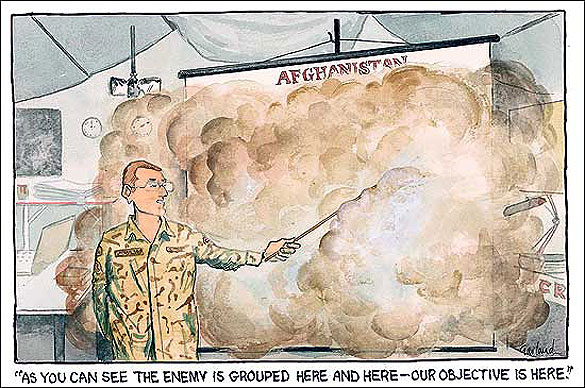 Garland
It looks as if President Hamid Karzai will have to begin negotiations with sections of the insurgency. The more moderate sections of the neo-Taliban presumably, as they have entrenched support from among the wider Afghan population. With a military solution to the conflict looking increasingly unlikely, there is little to be lost in negotiations.
Posted by Gary Sauer-Thompson at 8:44 AM | TrackBack
December 13, 2008
bullies
Clarencegirl observes that the Australian Youth Forum doesn't appear to be generating much youthful enthusiasm. Who knew it was even there? On the topic of bullying, 40 comments and 181 votes is nothing, and worse, as Clarencegirl points out, most of the comments appear to be from adults.
Whether young people would participate if they knew it was there is a bit doubtful, but if they're not responding on the issue of bullying, they definitely don't know about the site. I don't know of a better way to engage them on the net, but you're not going to find too many teenagers prepared to regularly check a government website. Maybe some kind of mass MySpace action. People under 18 generally don't do Facebook.
They're out there talking about it on the net, just not at a central site. This is part of a MySpace blog entry by a 15 year old (call him Hobjobble) reproduced with permission:
What does "cool" exactly mean these days? Most people can just say "school sucks" or go out and get drunk or stoned and all of a sudden they feel bigger than the people that don't do those things and they tend to bully them for it. I don't know how anyone else sees that but I find it extremely stupid. The younger people of this generation have somehow managed to find a way to make everything harder for themselves and it's all because of this word "cool" which basically means nothing.And why can't anyone just be themselves and feel accepted by others as a friend? I myself have lost many friends to other people just because they feel that what they are doing and what they like doing isn't good enough to be accepted by the more popular people around them. Even just the clothes people wear changes how people see them and judge them as a person.
A lot of people that were around me while I was still in school were called "emo" because we prefered listening to a different style of music and didn't look like everyone else did. I found it quite annoying and so did my friends. There's no reason to pick on people just because they choose to like something you don't like.
Another thing people tend to do a lot is to only be friends with people from certain countries, culture, skin colour etc. I find this quite annoying. Why can't everyone just accept people for how they look?
I know basically no one on my myspace friends list will read this but I don't really care what you all think, I'll do what I want and act how I want, not how anyone else wants me to act. And to be honest... Really I only have one friend that I actually like because he's not dumb enough to try be like any one else and most people hate him for it.
Bullying is a hard thing to pin down. We imagine the stereotypical school bully belting up the weaker kids behind the sports shed, but it's way more complex. At a conference a couple of weeks ago a network researcher presented a network map of bullying relationships at three schools that doesn't fit the stereotypical image. It looked like the result of a dangerously inebriated, mass spider party.
The only easy part is that everyone can identify bullies, and that kids are well aware that bullying includes ostracism. Bullies bully one another. Weaker kids bully one another. Non-bullies will bully one another if they think popular kids will approve. Some popular kids bully, some don't. Bullies often see themselves as victims, rather than perpetrators of bullying.
Helen Skepticlawyer recently posted a typically beautiful entry which illustrates the systemic nature of the problem. She wasn't popular:
My lack of girly-vision meant that I seldom made relationship connections, and tended to view girls and their obsessing over boys with ill-concealed contempt.
That alone is enough to isolate a person. But she did have someone onside at school:
One teacher was kind of in my corner. I think she was a feminist, but saying that now involves a major exercise in looking through the retrospectoscope. She didn’t ‘get’ me, but then no-one did, so we were square.
One teacher who was eventually sacked for being different. Hobjobble had one friend, which entailed choosing ostracism for being different.
In questions at the network presentation I asked whether the kids had been allowed to nominate teachers as bullies, which resulted in much chortling. It's funny, but it's not funny. A school is a system, not just a bunch of kids. So it's interesting that the Minister for Youth writes:
What is most concerning about bullying is that it’s often done on the sly and out of sight of teachers or other adults.
That's kind of like saying the walls are often there on the sly and out of sight of the panopticon.
Posted by Lyn Calcutt at 7:18 AM | TrackBack
taking the wrong turn
The impression is forming that money is being thrown around by the Rudd government in the name of stimulating the economy, coupled with precise numbers of jobs resulting from each stimulus package. it would seem that the state, once again, is a problem, that the process of planning is deeply flawed, and that we are dealing with the fictions of abstract econometric models not reality.
We need to remember though that the market is no longer seen as the solution to every problem and that the state has to step in to save capitalism. Everything has changed with the global financial crisis and the recognition of the dangers of financial deregulation. So we can infer that economics, somewhere, somehow took the wrong turn.

We do have a self-devouring capitalism with the global financial crisis. Economists, until recently, still routinely invoked the imagery of the invisible hand, the notion that economic theory has demonstrated that market outcomes are optimal and that private greed reliably creates social good. These assumptions have been shown to be flawed.
Posted by Gary Sauer-Thompson at 5:43 AM | TrackBack
December 12, 2008
associations
Or as Mark over at LP has it, affiliations.
Via Mark, via Jason Soon at Catallaxy and in relation to Conroy's clean feed, it's all starting to sound like an elaborate conspiracy.
Jason's not particularly fond of Hamilton, and neither is Kerry Miller, who marks him down in her Spiked article as a communitarian.
I do wish people would stop allocating Hamilton to the Left. Or anywhere for that matter. It's like locating Barnaby Joyce in the coalition.
Miller thinks Hamilton has influence with the Rudd Government, and says
Hamilton and the Australia Institute began their campaign for internet censorship back in 2003, with a deliberately targeted media splash, based on some rather spurious research supposedly documenting the evil effects of porn on Australian youth
Another odd hybrid, pro-life feminist (?) with strong religious connections, Melinda Tankard Reist, is also a deft hand at deploying the odd statistical malfunction in support of the clean feed. Though she's a little more subtle than Hamilton. Tankard Reist apparently spent a lot of her training time with Brian Harradine, although this strange bio gives Freudian credit to a girlhood tragedy involving a horse. That's not the sort of thing you want to be tangling with in a pornography debate.
Guy Rundle doesn't try to attach the authoritarianism of the clean feed with an ideological Left, rather he works with the strange history of the Labor Party's associations with religious groups and the current public fixation with child pornography. We're now at the point where Bart Simpson can land you in trouble.
Rundle:
Furthermore, Conroy is from the conservative Catholic right wing of Australian Labor, a group whose politics have always been defined by social repression in the interests of ‘ordinary people’. The faction departed Labor for 25 years (after which many members of the faction returned to the Labor Party), forming the Democratic Labor Party and allying with the Liberal Party to keep Labor from power for two decades. Based in large labour groups such as the Shop Assistants Union, the faction has spent decades styming censorship abolition, abortion law reform, equal rights for women, and the decriminalisation of homosexuality, among other things. Effectively it is a right-wing party within a Labor host, its politics closer to Italy’s post-fascist Social Alliance party than anything emerging from an emancipatory working-class tradition.
So that's where Conroy came from. Although the next bit doesn't doesn't seem to square:
Though its socially repressive agenda was subdued under the centrist Labor governments of the 1980s, the Catholic right got a new opportunity to assert its power with the election of a senator from a Christian conservative start-up party called ‘Family First’. Though Senator Steve Fielding gained only 1.3 per cent of the vote in the proportional system which governs the Australian Senate, he had enough preference deals to get himself elected. Together with an anti-gambling single issue senator and four Green senators, Fielding now has the capacity to help Labor muster sufficient votes to pass legislation.
True, Labor need Fielding in the Senate, but that doesn't necessarily mean they need Conroy in Communications with his sticky little fingers on our conduit to the digital economy. It doesn't mean they have to get all Book of Revelations on us. Anyone half articulate could have been charged with the Fielding-sitting job.
Rundle ends on an optimistic note:
What Conroy and Co. don’t seem to have counted on is the degree of opposition that the proposal would generate, and the mass protest movement it would rapidly give rise to, with a broad coalition of activists, cyber and otherwise, attacking it on all fronts, from demonstrations of how utterly random and inadequate filters are, to plain old street protests against the proposal. There’s something amusingly ironic in this – the Rudd government was so eager to summon up the idea of a protean and demonic internet reaching into all areas of life with its dark materials that it didn’t understand that the power of the net was chiefly invested in the added power to create new grassroots initiatives through better, multi-levelled co-ordination and multiple fronts of attack.
I don't know that the rise was all that rapid. Miller blames Lefty bloggers for the slow start, saying the proposal "has remained largely unmentioned by the major ‘left’ blogs in Australia, which have tended to oppose the censorship scheme anaemically, at best." I'd argue that very few of any political leaning paid much attention. After all, we've recently been smothered with a global financial meltdown, an American election and a terrorist attack in Mumbai.
It doesn't strike me as an issue which belongs to either Left or Right, Liberal or Labor. Although it would be nice to know where the Libs stand on it. What does Barnaby think? Barnaby's thoughts seem to be their overriding concern these days. And the polls.
Come on Malcolm. Play the game. Here's a suggestion:
The Rudd Government's clean feed will not disrupt child pornography networks. This government is using child pornography as an excuse to introduce draconian legislation on working families, which is a disgrace. In these times of economic turmoil blah, blah, blah.
See if you can get a bounce out of the increasing numbers of broadbanders.
Posted by Lyn Calcutt at 3:00 PM | Comments (5) | TrackBack
the downward turn
One day Rio Tinto, the worlds third largest miner, was talking about an eternal resources boom with ever rising prices, the next day it is slashing 14,000 jobs from its global workforce, selling several of its most attractive assets and closing down its mines. The reality is that Rio Tinto is burdened with debt and there is a big question mark over its capacity to service its $A59 billion debt given the crash in commodity prices.
The future is not promising. China's exports fell for the first time in seven years, (down 2.2 per cent in November), with imports falling 17.9 per cent. China's economy has slowed much more quickly than anyone had forecast. Asian economic growth in general is declining.This suggests that global trade is contracting quite rapidly. And since trade accounts for a rising share of global activity, it suggests that the global economy is contracting.
Posted by Gary Sauer-Thompson at 4:51 AM | TrackBack
light relief
A lighter moment as the work year winds down towards the holiday season.
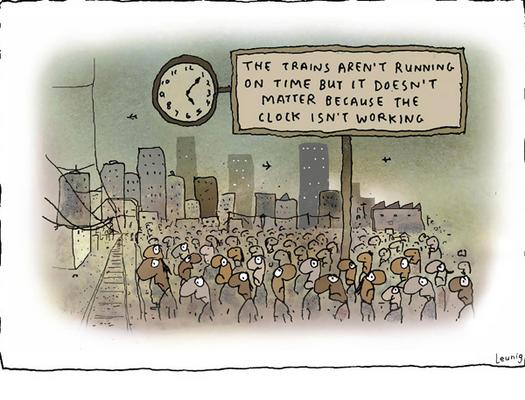
Soon there will be a different kind of queue----those of the unemployed and soup kitchens arising from job loses. The looming recession will probably speed up the long, slow decline of newspapers as management cut jobs as the newspapers get financially squeezed. Aggregation sites such as Google News have shone a harsh spotlight on the overlap and repetition in national coverage in newspapers.
Posted by Gary Sauer-Thompson at 4:20 AM | TrackBack
December 11, 2008
national charter for human rights
The Australian's response to the movement to a national charter human rights is pretty negative. It says that supports human rights as a cornerstone of our national life, However, Australia doesn't need it or want a charter of right. The argument is that human rights are:
best protected by democracy and the rule of law. As Jesuit lawyer Frank Brennan and his panel set about consulting Australians about human rights policies and laws, the weight of evidence against a bill or charter of rights is compelling. Paradoxically, it would be more likely to undermine democracy and personal liberty than enhance them, at vast expense, as lawyers enjoyed not a picnic, but a banquet. A week ago, The Australian pointed out that those clamouring for a charter of rights have been unable to explain how the community would benefit by stripping power from elected politicians and handing it to unelected judges. Since then, the arguments advanced by proponents of a bill or charter have been unconvincing.
The position conservatives defend is the supremacy of Parliament which, to all intents and purposes means executive dominance. The position the conservatives attack is a countering of that power through the legal system so as to give some substance to the checks and balances on political power.
The conservatives cover this with fog. Thus Cardinal Pell,
The push for a charter of rights springs from a suspicion of majority rule, a preference for judicial decision-making on fundamental questions, the imperatives of the particular social and political agenda that a charter of rights serves, and the elitism of privileged reformers."
Majority rule pulls a cover over executive dominance whilst elitism covers over the liberal concern for individual liberty against executive dominance. Therefore it is bad to have checks and balances on "majority rule"
Posted by Gary Sauer-Thompson at 7:07 AM | Comments (4) | TrackBack
Poznan: its slow
In the Sydney Morning Herald Jonathon Porritt says that the negotiations at the Poznan conference is based on the scientific consensus that emerged at the end of last year from the fourth assessment report of the Inter-Governmental Panel on Climate Change. That work, which was done by more than 2500 scientists between 2000 and 2005 ( the cut-off year for the IPCC's rigorous peer-review process), is out of date.
 Moir
Moir
The vast majority of those studies tell us incontrovertibly that the impact of climate change is more severe and materialising much more rapidly than anything reflected in the fourth assessment report. It is much worse and is getting worse even faster. These reports indicate that the earlier work underestimated the damage associated with temperature increases, and underestimated the probability of temperature increases.
Is Australia seen as acting as a mouthpiece for its coal industry in these international reforms with the Rudd Government seen as behaving like the Howard government? Paul Howes, the national secretary of the Australian Workers Union, indicates the way the debate in Australia concentrates on the cost of reform and going slow. In an op-ed in The Australian:
While carbon trading may well assist in establishing new industries and opportunities, it is not necessary to lay waste to our existing world-class industries to achieve this. Policies that deny costs or view traditional industries as the problem are bound to create costs for us all.
Howes argument centres on the costs---killing jobs---not on the benefits. Heather Ridout, the chief executive of the Australian Industry Group, says that the global financial crisis presents a strong case for the Government to go real slow:
One option is to adopt a start that is akin to a pilot scheme or a dry run. This could involve, for example, minimum cost burdens and placing emphasis on education about how to comply with reporting obligations rather than imposing heavy penalties on errors and misunderstandings.
Ridout also wants greater subsidies for both the emissions-intensive trade-exposed and less emissions-intensive businesses.The emphasis in Australia is on burying the emissions from burning fossil fuels not on renewable energy, since this would allow the continued heavy use of coal for power.
Posted by Gary Sauer-Thompson at 5:41 AM | Comments (3) | TrackBack
December 10, 2008
glog
We have a government blog. woo hoo.
Conroy and Tanner want to know what we think about the future of the digital economy.
We plan to release a draft of the paper for detailed feedback shortly; but in the meantime, it seemed logical to us to use one of the key communications platforms of the digital economy—blogs—as a way to engage with you and your ideas.
Very sensible. And there's some interesting stuff on the way.
Some of the themes that we will explore in upcoming blog posts include:
What does the digital economy encompass? How do we maintain the same 'civil society' we enjoy offline in an online world? (this is the post that touches on the issue of filtering and we welcome your feedback about the issue in response to this post) Is there a benefit for the digital economy from open access to public sector information? Does Australia's regulatory framework need tweaking to enable a vibrant digital economy in Australia? How can the digital economy respond to environmental concerns? What should Australia do to ensure that our businesses and citizens have the necessary skills to participate fully in the digital economy? How can we measure the success of Australia's digital economy?
The second point is an interesting one. What, exactly, is meant by 'civil society', let alone 'same civil society'? This is where we have a say about ISP filtering, so I wonder whether it's defined in terms of governance rather than prevailing values. If you were to theorise it you'd have to start thinking about the different cultural norms in on and offline settings, and risk upsetting people who claim nothing new is happening. Anyhoo, we'll find out when the post arrives.
Dave Bath is seriously pleased, but warns it's in the trial phases, "a trial run of a prototype component of a suite of improvements to mechanisms allowing two-way consultation between government and citizens", which probably means we should be nice if we want it to continue. Although,
Indeed, the more you want to be able to criticize (and make suggestions to) government, the more important it is to help get these incoming tools sanity-checked, by as many eyes as possible, before the tools are set in stone, rolled out across all agencies, and we are stuck with something awful that allows governments to ignore us (or even have deniability that they can hear us).
Robert Merkel is a tad skeptical,
I’m not entirely convinced this is going to work. Governments around Australia have become increasingly paranoid about being “on message” - not without justification, since Oppositions and media outlets pounce on the slightest deviations from uniformity as the indication of a government in disarray. Such a climate makes it very difficult to hold a substantive two-way conversation about policy.
It's a good point. You and I will be over there doing the citizen thing, but the opposition and its friends in the press will also be over there rooting around for ammo. In theory that's the right and proper democratic thing to happen, but it's also likely to ensure that it's a fairly bland exercise.
I haven't read the moderation policy yet, but it should be interesting to watch how that pans out. It will be a tricky thing to get right, but let's hope it doesn't descend into a manipulative farce.
Update:
Off to a running start. 230-odd comments on Lindsay Tanner's welcome. In the first 10 pages (most recent on top), two comments don't mention filtering and two support it. The rest are a large mob of very angry people. Plenty of IT types patiently explaining why it won't work, but mostly people upset about censorship.
There are whopping great chunks of the population who only ever use the net for banking and reading the news, but the trend is towards more adventurous stuff like networking and blogging. These are the spaces where newcomers get their introduction to the wilds of the intertubes. It also looks as though this kind of thing is where business use and our future digital economy are headed.
If banking and newsing mums and dads with porn surfing kiddies support filtering while they're only using these narrow spaces, you have to figure that won't last long.
Posted by Lyn Calcutt at 8:52 AM | Comments (13) | TrackBack
green lite Ergas
Henry Ergas's response to the economists open letter to Kevin Rudd commends their initiative in engaging a debate on these issues and says that it takes courage to make proposals as bold as those they recommend, and that courage helps illuminate the choices that lie ahead. Ergas is not persuaded however, as he says that the three key recommendations are unconvincing and, if implemented, are likely to make things worse rather than better.
On the issue that I was concerned with, namely substantial incentives be provided to boost spending on energy efficiency, Ergas says:
The letter claims that firms and households underinvest in energy efficiency, but that claim is controversial. Firms have every incentive to minimise unnecessary costs and there is little evidence that they systematically fail to do so. As for households, some are constrained in their access to credit and cannot finance investments that would otherwise seem worthwhile at market interest rates. However, it is reasonable to believe that what investment funds those households do have are allocated efficiently among competing uses, including energy efficiency. There is, in other words, no market failure reducing household investment in these types of assets relative to other equally durable capital goods.
True, there is no market failure but there is little retro fitting of the existing stock of buildings and little regulation to ensure high standards of energy efficiency in new offices and houses. So energy efficiency is not really happening in a systematic way, even though it is a good way to address global warming. There is a need to introduce energy efficiency standards (green ratings) to inform consumers of the extent of the retro-fit and upgrade of the property they are planning to buy.
Ergas continues:
Given that [lack of market failure] and especially with an emissions trading scheme providing price signals for emissions abatement, it is not clear why public subsidies for household capital spending should be compulsorily allocated to outlays on smart meters, insulation and solar hot-water systems rather than to renovating kitchens, extending patios or painting roofs. After all, once price signals are properly set, subsidising households to reduce their energy use is no more sensible than subsidising them to reduce their consumption of toilet paper, cat food or tinned beans. To suggest otherwise is to attribute a magical status to energy, as if it were uniquely worthy of being economised on. The costs of throwing money at energy efficiency are likely to be compounded by the forced pace of the subsidised spending.
Attributing magical status to energy? The way that energy is currently produced from coal fired power stations is the problem, because it causes greenhouse gas emissions and global warming. This pollution is classic market failure and is the reason for government intervention---- even if the carbon trading scheme has a low reduction target of 10% when it starts in 2010.
Secondly, the public subsidies to reduce energy use is not the equivalent of economising on cat food because we are dealing with market failure on energy usage. Thirdly the point of solar panels ls on roof tops with a feed-in tariff is not to increase energy efficiency; it is to make the shift to alternative forms of energy production that do not cause greenhouse gas emissions.
Making that shift is difficult in Australia because of the market power of the coal fired power stations and energy intensive uses that is being used to prevent the shift to lower carbon economy. They are using their power to look after their sectional interests at the expense of the public good.
Posted by Gary Sauer-Thompson at 4:59 AM | Comments (3) | TrackBack
December 9, 2008
The Howard Years
I watched the fourth and final episode of the ABC's The Howard Years that traced the Liberals defeat at the 2007 election and their failure to swap Howard for Costello. Not that the change/renewal would have saved them, as the Liberal Party had run out of ideas and policies. It was on the defensive.
I found the fourth episode more interesting than the others because it went beyond the standard mix of political context and surface comments from key players about political events to incorporate judgements about the success or otherwise of their actions and strategies. So we gained an insight into how their assessment of how they were travelling.
The one dimensional characteristic of the previous episodes was overcome, the political mask was dropped and people started talking as people. What came through was the baggage of the Liberal Party from the Howard years on industrial relations and its head in the sand on climate change. The political ground had shifted and the Coalition looked stranded. The Liberal ship was going down and they knew it.
Today the Liberal Party is deeply divided, not withstanding the hugh, and growing, gap between the Rudd Government's reformist agenda and its actual practice. Instead of standing firm on their own amendments on greater accountability and transparency on Infrastructure funding to prevent funds from being rorted, and on the recent water bill they folded. The former is understandable--blocking necessary investment in an economic crisis but not the latter. The Liberals did not even push for an scientific/hydrological assessment of the water savings even though they had the numbers in the Senate to do it.
Posted by Gary Sauer-Thompson at 6:47 AM | Comments (7) | TrackBack
Economists open letter
A group of economists - Tony Cole, Saul Eslake, Allan Fels, Rod Glover, Nicholas Gruen, Ian Harper, Tony Harris, Mike Waller - have written an open letter to the Prime Minister advocating aggressive stimulus of the economy.

The economists propose three strategies for a second package of stimulatory measures:
---a one-off downward adjustment to compulsory superannuation contributions to free up funds for short-term consumption combined with an acceleration of contributions towards a target of 12 percent as the economy recovers;
---a sustained program of nation-building public investment, funded by additional public borrowing, to modernise Australia’s ageing economic and social infrastructure; and
----targeted temporary assistance to our households and businesses to improve their energy efficiency and help them adjust to climate change.
The latter is what caught my eye in the light of the renewable industry struggling to stay afloat and the frozen billions of investment dollars in Australia's wind and solar industries.
They say that the need for temporary economic stimulus presents an opportunity to prepare households and businesses for the carbon-constrained world we are building. If well designed and combined with appropriate pricing measures, a short-term investment in energy efficiency could prove a highly cost-effective means of reducing emissions.
Faiiure to act on energy efficiency and renewable energy is becoming a characteristic of the Rudd Government. What we have is support for the energy intensive industries that produce greenhouse gases----cash for the coal industry is the latest subsidy--- and an indifference to the renewable energy industry that is covered by strong rhetoric about decisive action on global warming.
Meanwhile, the United Nations-led talks in Poznan, Poland will be based on the first draft of a new global agreement on reducing greenhouse emissions.
Posted by Gary Sauer-Thompson at 4:52 AM | Comments (4) | TrackBack
December 8, 2008
National Security Statement
The Rudd Government's National Security Statement was pretty bland, announced little by way of policies apart from rejecting a department of homeland security, and had little impact in the media. It kinda came and went with few noticing.
But it is significant in that it talks in terms of an agenda beyond terrorism and counter terrorism as it includes traditional statecraft and classical military capabilities. Hugh White observes that one of the most interesting things about the statement :
is the way in which, the language used to describe terrorism, because he [Rudd] was I think surprisingly and if I can put it this way impressively modest. For a long time we've been used to politicians really since 9/11, describing terrorism in apocalyptic terms as a challenge to our whole way of life, the whole international order and so on. By contrast I thought Kevin Rudd's words talking about it as a serious ongoing threat were accurate, correctly expressed the fact that it is a serious ongoing threat but didn't overstate the nature of a terrorism challenge. .....One of the big challenges we've all had in the last few years is recognising that terrorism is a serious challenge but not letting it take over, have a bigger place in our overall national security thinking than it deserves and I think that's one balance that the statement today got just about right.
The National Security Statement talks in terms of Australia being proactive about shaping the strategic environment in the Asia-Pacific; creative middle power diplomacy, energy security as well as border integrity; thinks in terms of the relationships between China, the US and Japan and India; and understands that climate change represents a most fundamental national security challenge for the long term future.
The demotion of terrorism and the promotion of climate change as security issues is a welcome rupture from the neo-conservative position of the Howard Government in which the national security state placed terrorism front and centre. Disappointingly, Rudd made no mention of reducing the excesses of the national security apparatus or easing the way that it encroaches on, and subordinates, legal and civil rights and individual freedom--the liberties of citizens--- to national security.
Geoffrey Barker in the Australian Financial Review comments on the inflated language of the national security state:
The trouble with Rudd's view of national security "challenges" [as distinct from threats] is that it seems to include everything and involve everyone. He even managed to drag" "business and the general community" into the national security machine. Rudd defined national security as freedom from attack, the maintenance of territorial integrity and political sovereignty and the preservation of freedoms. He did not distinguish fears, concerns and inconveniences from existential threats.
Most of the "challenges" do not threaten Australia's existence as a nation and many concerns do not constitute national security. The paranoid, insecure perspective of the Australian national security state is still there.
Posted by Gary Sauer-Thompson at 7:59 AM | Comments (5) | TrackBack
the new custodians of the global economy
The banks are cutting jobs across Asia including Australia in response to the swirling economic storm. Many of the foreign banks are leaving Australia. The declining exports of India, South Korea, China and Japan indicates just how quickly the global economy has been struck by the financial crisis that has its origins in the financial house of cards built in the developed world. The slowdown in the US and Europe poses social unrest problems for the Asian economies that used exports to fuel rapid growth.
 Martin Rowson
Will the Americans and Europeans, hitherto the custodians of the liberal international economic order, retreat into protectionism? Will China, India and Japan become the new custodians of the liberal international economic order?
So who will finance Australia's proposed infrastructure development? The gobal resources boom has become the global resources bust. Who will then supply credit to the corporate lending market? The Rudd Government is already loaning finance to the car dealers so they can refinance following the exit of foreign financiers.
The US economy is in free fall: declining production, rising unemployment (2 million and rising); a bankrupt car industry; a collapsed housing market; scarce credit. This kind of eeconomics decline means that we are coming to the end of a United States dominated world and the beginning of the rise of China. Will there be attempts to design the new world order, the new vision or will this design come from the market and non-coordinated political processes determining the new world order through the process of creative destruction.
My fear is that it will be the latter.
Posted by Gary Sauer-Thompson at 4:41 AM | Comments (7) | TrackBack
December 7, 2008
Fairfax Media: cold winds blowing
David Kirk's resignation as CEO of Fairfax Media and his replacement by Brian McCarthy is a good time to assess what is happening to corporate media in Australia. Fairfax has diversified---adding more legs to its broadsheets and its dependence on the Sydney and Melbourne advertising markets. It has extended its strong position in traditional newspaper publishing into online businesses. It has done so by going on a spending spree ($5.4billion) over the last three years including Southern Cross Broadcastings' radio stations and production company.
Despite this repositioning Fairfax's share price has been ravaged by short selling, there have been cost-cutting programmes at The Age and the Sydney Morning Herald; these broadsheets continue to lose circulation, and its revenue is still 80% dependent on advertising, a market suffering from weak conditions. McCarthy as CEO means cutting costs and keeping them down. Presumably that means no frill newspapers. Goodbye quality broadsheet journalism.
So what does this mean for newspapers? Media companies in the US, UK and Australia are seeing a slump in revenue and earnings, and most are cutting staff and reducing costs. The Future of Journalism Report by the Media Alliance says that the old model of newspapers is undergoing systematic collapse and not just a cyclical downturn.
Rupert Murdoch in his Boyer Lectures observed that we are moving from newspapers to news brands.
In this coming century, the form of delivery may change, but the potential audience for our content will multiply many times over.... My summary of the way some of the established media has responded to the internet is this: it's not newspapers that might become obsolete. It's some of the editors, reporters and proprietors who are forgetting a newspaper's most precious asset: the bond with its readers.
Margaret Simons says that the events at Fairfax are a generational moment in Australian journalism and public life - the moment:
when it became crystal clear that newspapers were no longer going to be the main, or most important, forum for serious journalism and public debate. That does not mean that journalism and public debate will die. It does mean we are in the middle of a profound paradigm shift with implications for every aspect of our democracy. Things are still playing out, and will do for another decade or so, but the depth of the crisis is clear.
She adds that Fairfax Media may well survive as a company. Kirk’s legacy, the diversification away from newspapers and into internet advertising sites, means that Fairfax Media is unlikely to disappear. However, it is unlikely to be the home of premier Australian journalism in the medium and long term.
Well, we've known that for sometime. Mass media has fractured from the collapse of the old business and journalism model. What then is Simon's paradigm shift? Is it diverse media voices in a digital media landscape? What does premier Australian journalism mean in such a fragmented digital media landscape? How would it work and be funded?
Posted by Gary Sauer-Thompson at 12:15 PM | Comments (18) | TrackBack
December 5, 2008
Canberra watch: water
So it has come to this in the Murray Darling Basin. South Australia will have to buy water to guarantee supplies for critical human needs in Adelaide and towns next year. Necessary water supplies to Adelaide and towns across the state are at this stage not secured from July next year, and this has forced the Rann Government onto the open water market. Authorities must have 201gigalitres in reserve to ensure the water needs of the nation's fifth-largest city and the rest of the state are able to be met.
And Victoria is taking water from the River Murray for Melbourne. And the Rudd government ducks and weaves on the issue of the new pipeline to Melbourne. Is the pipeline the price that Rudd Labor pays for Victoria to sign up to the commonwealth taking charge of Australia's largest river system? There is to be no cap on the water taken from the River Murray in Victoria until 2019!
What kind of deal is this? Isn't the Rudd Government committed to a more sustainable use of water in the Murray-Darling Basin?
The Murray-Darling Basin Commission reports that inflow into the Murray last month was 140 gigalitres, just 18 per cent of the long-term average of 780gigalitres. November was the 38th consecutive month of below-average inflows. Under the River Murray dry flow contingency plans, the first priority is given to critical human needs. Yet the modernization of Victorian irrigation is premised on "normal" flows of 780 gigalitres, not on the more realistic reduced flows in a warmed up world.
Posted by Gary Sauer-Thompson at 3:49 AM | Comments (13) | TrackBack
December 4, 2008
Qantas: some questions
Why the "potential merger" between British Airways and Qantas? Qantas is profitable, British Airways has financial trouble. Asia is the growth region not Europe. So why a deal of equals rather than a Qantas takeover? How would that merger of equals add value to Qantas? Is it a step towards building a global airline with a former cornerstone shareholder? Or is it simply the economic pressures of rationalisation in a global economy in recession?
The reason for the merger talk would appear to be the economic pressures in a global world to cut costs, rationalise routes, share resources and muscle up in purchasing from the manufacturing duopoly of Boeing and Airbus. Michael West in the Sydney Morning Herald says:
The merger is a good idea in principal. Airlines have extremely high fixed costs - they are capital intensive, labour intensive and fuel intensive - and around the world aviation companies have been battered by high oil prices and are just now getting hit by an acute downturn in the global economy.And while BA has a large pension deficit to fund, Qantas has a fleet to upgrade. This fleet ain't no spring chicken, being as old as any in the developed world...the average age of a jet in the Qantas mainline fleet is 11 years.
West argues that the world must embrace the notion that the era of individual national carriers must soon come to a close. That's the dynamic of globalization.
Yesterday's Government Green Paper on aviation raised the prospect of lifting the foreign ownership cap from its present 25% to 49% so things are moving in favour of the deal. Maybe there are other mergers in the wind---one of its Asian rivals, or a United States carrier? Consolidation looks to be inevitable. Presumably the Macquarie-led private equity consortium that tried to take over Qantas is looking for some action.
Posted by Gary Sauer-Thompson at 6:24 AM | Comments (4) | TrackBack
December 3, 2008
chilly economic winds
Another interest rate cut by the Reserve Bank. Another sign that the economic storm clouds are brewing offshore as the optimists pen their op-eds on growth and bargains galore on the local share market. The Liberal opposition has yet to adopt a new talking point: fairness is a luxury for countries in decline.
 Alan Moir
Everybody is slashing interest rates these days. Chinese exports are declining as is it's manufacturing output. So much for the optimist's myth that China can decouple itself from the US economy, thanks to a strengthened domestic economy. Asia's export-driven economies are being battered by the chilly winds of faltering demand in the US and Europe. (Don't you just love the weather metaphors for economics?)
The global economy is already headed toward a recession. A hard landing in China will have severe effects on growth in emerging market economies in Asia, Africa and Latin America and in Australia, since Chinese demand for raw materials and intermediate inputs has been a major source of economic growth for emerging markets and commodity exporters.
The World Bank’s latest China Quarterly Update says that China really is a manufacturing and investment driven economy and that China ultimately has to produce for Chinese demand not world demand. However, wages have fallen from around 50% of China’s GDP at the start of the decade to around 40% of GDP and so consumption is a low share of GDP.
As Nouriel Roubini pointed out in Forbes several months ago:
For the last few years, the global economy has been running on two engines: the U.S. on the consumption side and China on the production side, both lifting the entire global economy. The U.S. has been the consumer of first and last resort, spending more than its income and running large current account deficits, while China has been the producer of first and last resort, spending less than its income and running ever larger current account surpluses.
If the US engine of growth has effectively shut down, then the Chinese engine of growth has stalled. An aggressive easing of monetary and credit policy will not prevent a hard landing since monetary and credit-policy easing may be ineffective given the overinvestment of the last few years has led to a glut of capital goods.
Could fiscal policy rescue the day? The Chinese government has massive infrastructure projects for the next five to 10 years; but front-loading most of that multi-year spending over the next 12 to 18 months will be close to impossible.
Posted by Gary Sauer-Thompson at 6:49 AM | Comments (5) | TrackBack
Ergas contra Keynes
Paul Krugman in the New York Review of Books argues that what the world needs right now is a rescue operation. Circumstances right now are anything but normal. The global credit system is in a state of paralysis, and a global slump is building momentum. To deal with the clear and present danger policymakers around the world need to do two things: get credit flowing again and prop up spending.The latter is good old Keynesian fiscal stimulus.
In an op-ed in The Australian Henry Ergas, the chairman of Concept Economics, argues that trying to spend your way out of recessions is a mug's game:
When the economy slows, government outlays increase due to higher welfare payments while tax revenues diminish. This fiscal weakening cushions the extent and effect of the slow-down. Governments can try to augment this "automatic stabiliser" by a further, discretionary, weakening in their fiscal position, through increased outlays, lower taxes, or both.It is debatable whether such discretionary fiscal policy is desirable. As the eminent macroeconomist John Taylor recently noted, the evidence is mixed as to whether discretionary fiscal stimulus works, and if so, when, how and by how much. But even if it is desirable, the '80s showed that approaches centred on increased outlays can be both ineffectual and inefficient.
Ergas is in favour of allowing the automatic stabilizers of the market to work but is opposed to Krugman's good old Keynesian fiscal stimulus (public spending) to help prevent a weakening economy from sliding into an actual recession.
Ergas' argument that Keyensiaan economic policy approaches that are centred on increased outlays are both ineffectual and inefficient is this:
They are ineffectual because the lags between government spending decisions and ultimate economic impacts are difficult to predict and, at least for some kinds of expenditures, likely to be very long .... Increased social spending has shorter lags, but often reduces incentives to work and save, creating problems for the future ... Increased outlays are additionally likely to be inefficient because the setting of spending priorities is so vulnerable to rent-seeking. As spending increases are targeted to favoured constituencies, a steep deterioration typically occurs in the quality of public expenditure, making the community worse off.
Ergas qualifies his general argument by saying that if a discretionary fiscal stimulus is required (presumably he accepts that it is), then it is consequently far better delivered through general cuts in taxes (ie., moving the tax system towards flatter rates of tax, eliminating distortions at the bottom and the top of the taxable income distribution) than through targeted increases in outlays.
Hasn't the Rudd Government already put tax cuts into place to return the surplus? Why would any more money from extra tax cuts actually be spent in the current circumstances? Secondly, infrastructure spending would mean that something of value (e.g., decent public transport) would be created.
Surely Australia needs now is good investment in public infrastructure in health, education, renewable energy, public transport, water. The lag argument can be countered by saying that it very hard to see any quick economic recovery, unless some unexpected new bubble arises (broadband anyone?) to replace the housing bubble. Secondly, there is no reason why this investment cannot be based on full transparency of cost-benefit evaluations. isn't the problem the criteria for infrastructure project selection.
Posted by Gary Sauer-Thompson at 5:29 AM | Comments (7) | TrackBack
December 2, 2008
The Howard Years: episode three
I watched Episode Three of the ABC's The Howard Years last night. It was on 9/11 and it looked as if it was about another time, even though the events were very recent. Why another time?
Tony Karon writing in The National gives us a clue. He says that Washington’s dominance of the global financial system and the institutions that manage it, such as the International Monetary Fund (IMF) is coming to an end, and this means that:
the US can no longer shape the global financial system on its own terms, and it will be forced adopt international standards anathema to the conventional wisdom of post-Reagan Washington if it wants to keep playing the global financial game on which its economy depends....And the erosion of the financial hegemony of the US will accelerate the decline of its geopolitical hegemony. a bailout that already looks likely to cost a lot more in the end than the Iraq war will prompt the US to begin wrapping up a military commitment that may already have achieved as much as it’s going to achieve politically. The Iraqi government has demanded that the US begin scaling down its involvement next year and be gone by the end of 2011. Given the dire state of the US economy, Washington may oblige.
There ends the era of the Bush administration and the 9/11 scenario whose end game is Afghanistan. In Iraq everyone is in wait for ''the Americans to leave' mode and it will soon be a similar situation for NATO in Afghanistan.
If the business-friendly bailout Wall Street Bush administration has left not just its own projects, but the nation it ruled, in ruins, then the incoming Obama administration looks to be recycled Clintonism that endeavours to recapture the lost hegemony by muscle and leverage. Yet there has been a radical break with the "Washington Consensus" of the Clinton years in which the United States insisted that the rest of the world conform to its free market model of economic behavior.
Posted by Gary Sauer-Thompson at 7:07 AM | Comments (3) | TrackBack
Mumbai fallout
The perpetrators of the siege of cosmopolitan Mumbai (India's commercial and cultural capital) are possibly linked to the Kashmir-orientated Lashkar-e-Taiba (Army of the Pure / LeT), which killed around 174 people, have raised tensions between India and Pakistan. There are suggestions that the gunman who attacked Mumbai---'the sinful city' for the righteous believers in the jihad---- were linked to elements of Pakistan's intelligence services and security establishment.
Though these attacks indicate that cities had become the theatres for asymmetric war this event is not part of what the Americans call the "global war on terrorism"---the shorthand is 9/11, meaning just the latest example of militant Muslims targeting 'the West'. That interpretation, favoured by the chest-thumping the American right at National Review ignores India's complicated history of Hindu-Muslim relations.
Secondly, we have Pakistan's continued commitment to terrorism as an instrument of state policy initially against Soviet forces occupying Afghanistan in the 1980, then subsequently in Kashmir, and its support of the Afghan Taliban that is designed to counter the influence of India in the region. As much of the north of the country slips out of government control the fundamentalist Islamists have increasingly followed their own agendas to the extent that they now feel capable of launching well-equipped and well-trained groups into Indian territory.
Pakistan has increasingly pursued its clandestine proxy war against India in Kashmir and on the Indian mainland through layers and layers of self-managing and non-state groups. The Pakistan Army persistents in pursuit of its objective of military pressure against India in Kashmir and political-military pressure on India more broadly.
Posted by Gary Sauer-Thompson at 4:12 AM | Comments (3) | TrackBack
December 1, 2008
CoAG: does it deliver?
COAG struck new agreements on health, education, housing, disability, productivity and indigenous services, most requiring states to publish data about their relative performance so voters would be able to assess whether the money was being used properly. The final agreement, which included $15.1 billion in new funding as opposed to the $11.1 billion in new funding mentioned before CoAG, has been sold as a stimulus package to create jobs and shield Australia from the economic downturn.
The aim is to develop plans to pay employers incentives to encourage healthier lifestyles among staff under a new preventive health package agreed by the commonwealth and the states.Though the weekend's Council of Australian Governments allocated $450 million to a new Health Prevention National Partnership, which aims to keep people well and take pressure off hospitals by targeting smoking, drinking and obesity, it was a hospital booster package.This package is contingent on the states meeting certain preventative health performance standards.
Most of the money went into hospitals for the Australian Health Care Agreement: an extra $500 million, a 7.3% indexation rate; an extra $750 million in 2008-9 to assist hospital emergency departments and $500m for subacute beds for older patients; $800 million for an Indigenous Health Partnership; and $1.1billion for training health workers. The details are not yet available.
The money is earmarked specifically to four new (out of 15) Indigenous-specific National Partnership (NP) payments in the areas of remote service delivery, health, remote housing and economic participation. Overall, it is hard to know to what extent this is the fiscal response to the COAG-agreed ambitious targets for closing the gap between Indigenous and non-Indigenous Australians across the continent. There is recognition by the Rudd government that ‘closing the gap’ will not magically happen with business as usual and an implication that it is case of joining the mainstream, or continuing to be marginalised and neglected.
Funding crises in health (and education) that have now being partly addressed do owe a good deal to state mismanagement of the resources they have had. It is only reasonable that the Commonwealth is now seeking greater transparency and accountability for money it gives to the states, and, in particular, that it wants to link its grants to outcomes as much as outputs.
Posted by Gary Sauer-Thompson at 5:08 AM | Comments (1) | TrackBack