« August 2011 | Main | October 2011 »
September 29, 2011
it's just bad journalism from News Ltd
News Ltd's response to the Federal Court judgement handed down in the Bolt case by Judge Mordecai Bromberg is predictable. Freedom of speech (of the media) is at stake here. It's a bad law. This is maintained even though the Racial Discrimination Act, has embedded in it a strong freedom-of-speech defence: insulting or humiliating people because of their race or colour is not unlawful when it is done "reasonably and in good faith" in pursuit of a matter of public interest.
Thus we have this kind of rhetoric from Chris Merritt, the Legal Affairs editor of The Australian, saying:
The court's "Bolt principle" will encourage Australians to see themselves as a nation of tribes - a collection of protected species who are too fragile to cope with robust public discourse....It will limit public debate on the issue of race and lead to public policy that will be dismissed by those whose views are not heard. It will encourage people to see themselves not as Australians but as separate racial groups. By thinking in such racist terms, they will have the advantage of a law that is ridiculously skewed in their favour.
The argument ignores what Bromberg said that the language utilised in the newspaper articles was inflammatory and provocative and that Bolt had got his facts wrong in that the individuals whom he wrote about had been raised with an Aboriginal identity and enculturated as Aboriginal people. Freedom of speech is not an absolute right.
News Ltd covers up the bad journalism by its columnists with its rhetoric about strong journalism causing offence whenever it exposes hypocrisy and Bolt providing the sort of robust exchange our society should expect and defend. This leads the Australian's editorial:
to the inescapable conclusion that the 1995 racial vilification amendments to the Racial Discrimination Act were a step too far for a liberal democracy. At a time when issues of immigration, racial preference and multiculturalism need to be debated in an open and mature manner, these laws have thrown a dangerous blanket over free speech.
The Labor Government is the problem because it is considering new privacy protections and is pressing ahead with a media inquiry, and this creates an ominous momentum against press liberty. An authoritarian state looms for News Ltd. James Paterson of the IPA agrees:
It is a risky step to grant government the power to decide what can be discussed and debated in a democracy. A free society is best preserved by allowing controversial opinions to flourish in an open debate. Social attitudes change over time, and what government may regard as heretical in one generation may be accepted wisdom in another. Prematurely outlawing discussion on a controversial topic is an attempt by government to freeze social attitudes in time by limiting debate.
This ignores the judgement that Bolt that its okay to interrogate notions of identity and culture but not to make stuff up, present it as fact (he said that Ms Berehndt had a white father, when instead he was, in fact, black) and then be rude about it. The judge found that Bolt's articles contained "erroneous facts, distortions of the truth and inflammatory and provocative language" and the removal of two blog posts and an apology will satisfy Justice Bromberg.
The inference is that journalists (especially those outraged partisans from News Ltd using the bully pulpit) pay a little more attention to getting the facts right and to take responsibility for what and how they write. They should not be deliberately inciteful and untruthful.
The News Ltd position ignores that the right to freedom of expression is limited to its reasonable and good faith exercise having regard to the right of others to be free of offence. The requirement of proportionality does not involve the subjugation of one right over the other and is consistent with achieving a balanced compromise between the two.
Bolt doesn't see it this way of course. He finishes his column thus:
Despite Justice Bromberg's assurances, I feel that writing frankly about multiculturalism, and especially Aboriginal identity, yesterday became too dangerous for any conservative. It's simply safer to stay silent, or write about fluffy puppies instead. And so the multiculturalists win. They win, because no one now dares object for fear of what it will cost them in court. Hope they're satisfied, to win a debate not by argument but fear.
He's lost his freedom. He's been silenced. The problem is that he doesn't address the bad journalism issues Judge Bromberg highlighted---apart from saying, "I also made mistakes, Justice Bromberg said, although none seemed to me to be of consequence." That's how he glosses the errors in fact, distortions of the truth and inflammatory and provocative language" that were deemed to be central to Bromberg's judgment. Bolt doesn't appear to realize that if the appellants had brought a claim against him for defamation, they would have won.
Journalism is subject to the rule of law, even bad, shoddy journalism.
Update
My suspicion is that the knee jerk reaction of many journalists is to side with News Ltd: Bromberg's judgement is an attack on the freedom of expression of the press. The press is going to bleat big time on this without much in the way of self-criticism of its practices of rushed, poorly-researched, partly-informed and partisan opinion commentary that is daily churned out by the Fourth Estate.
An example is Andrew Dodd's position that Bromberg's judgement "limits the kinds of things we can discuss in public and it suggests there are lots of taboo areas where only the meekest forms of reporting would be legally acceptable." It means that journalists cannot ventilate unpopular views openly and have a robust discussion about them.
Bromberg's judgment, an interpretation in law in relation to an act of parliament, is dismissed by Dodd as in the end being "just one person's view." Dodd doesn't appear to realize that Bromberg makes a judgment using the set of laws handed to him in accordance with the ethos of legal reasoning.
Update 2
The most considered response is that by Jonathon Holmes who says: that "... Justice Bromberg's interpretation of the Racial Discrimination Act, and his application of it to Bolt's columns, strikes me as profoundly disturbing." He says that "His Honour's claim that his judgment need not affect the media's freedom to publish reports and comments on racial identity is clearly absurd."
I find Holme's argument confusing. He provides no argument that Bromberg was wrong in his judgement. What he does have a problem with the Racial Discrimination Act (RDA) itself because "...it sets a disturbingly low bar. It's very easy to cause offence, and quite plainly Bolt's columns were likely to do so; and they were all about race, colour and ethnicity."
Holmes appears to have a problem with the addition of Part 2A of the Racial Discrimination Act in 1995 because:
It creates one particular area of public life where speech is regulated by tests that simply don't apply anywhere else, and in which judges - never, for all their pontifications, friends of free speech - get to do the regulating.
Holmes' core concern, therefore, is with the law, and he flags that he wants it to be different. It is not with Bromberg's interpretation of the Racial Discrimination Act. Presumably, his concern is with the he explicit intention of the Racial Discrimination Act, which was to, prohibit the deliberate and unjustified incitement of racial hatred. It specifically targeted speech.
Do judges regulate as Holmes' claims? Can Bromberg's judgment be interpreted as regulating? Holmes makes no argument for this. What Justice Blomberg is saying is that you can criticise or say anything you want about anyone you want, unless is it clearly malicious and hurtful in respect to race. That is prohibited under the Racial Discrimination Act. That illegality is what Holmes finds problematic. Yet all that Bolt is required to do is to publish a correction.
Holmes' solution? Move away from legislative controls over the media and freedom of expression to media self-regulation?
Posted by Gary Sauer-Thompson at 1:14 PM | Comments (10) | TrackBack
September 28, 2011
lifting the lid
Alessio Rastani, a financial trader in London, gives us an insight into how finance capitalism operates from the perspective of the gambler or speculator. He says:
For most traders, we don't really care that much how they're going to fix the economy, how they're going to fix the whole situation, our job is to make money from it. The governments don't rule the world. Goldman Sachs rules the world. Goldman Sachs does not care about this rescue package, neither does the big funds. This economic crisis is like a cancer, if you just wait and wait hoping it is going to go away, just like a cancer it is going to grow and it will be too late.
The trader has lifted the lid on what The City, or Wall Street, actually thinks. The crisis in Europe may be scaring the world, but for Wall Street and the City it is an opportunity to make money in a downward market.
What has happened to Greece is happening to Italy. The austerity measures imposed by the Troika"---the European Commission, European Central Bank (ECB) and the International Monetary Fund (IMF) ---causes the economy to slow budget targets get more difficult to meet, and then interest rates on Italian bonds rise, increasing the government's budget deficit. Bondholders and speculators then sell or short the country's bonds, driving interest rates up further and reducing the value of the bonds held by European banks. The traders make money by pushing up the yields on the bonds.
The interviewer thanked the trader for his candour but told him that "jaws had dropped" around the BBC newsroom", which indicates that the BBC news team either have no idea what is going on in the trading sector or they are pretending they don't. It's more likely the former.
The context is of this is that we’re still in the aftermath of 2008. Today it is debt deflation that is becoming the distinguishing phenomenon of the current time in the US and Europe. The signs are reduced consumption, shrinking markets, companies not investing, stores closing, “for rent” signs spreading on the main streets, and local tax revenues falling. So companies will lay off their employees and the economy will shrink more. Life will get harder.
The worldview of financial capital is that no matter what happens, the banks have to stay solvent for the economy to operate. So the loss is shifted onto the public. According to this view the role of the government is defend the interests of financial capital vis-à-vis the rest of the economy. This view shrinks the economy keeping the debts in place, so that is the basic internal contradiction at work.
Posted by Gary Sauer-Thompson at 8:43 AM | Comments (13) | TrackBack
September 27, 2011
digging up all we can dig
European policy makers continue to dither as a spectre of bankruptcy default and deepening poverty hangs over Greece, which has to make further spending cuts, tax rises, privatizations, wage-cuts etc. to ensure the sixth payment of €8bn.
There is no new plan (ie.,the expansion of the European Financial Stability Facility (EFSF) from €440bn to €2tn? bailout fund and an "orderly" halving of Greece's €315bn debt) --just the old plan of "temporary" financial assistance to eurozone members in difficulties. It has €440bn available and about €142bn of this has been used to prop up Greece, Ireland and Portugal. The proposed expansion looks like a sovereign bailout device but is really a “save the big French and German banks” vehicle.

The eurozone’s problems are now too big for the eurozone alone to deal with, given the continuation of world's major economies are heading for a "massive jobs shortfall" over next year. There already has been 20m jobs disappear since the financial crisis in 2008 and the most likely outcome is a protracted period of low, slow growth and a slow decline in living standards and wealth in the US and Europe.
As Paul Krugman reminds us the core reason is that the above financial measures fail to address the underlying problem of German’s high level of exports within the Eurozone, and reliance on austerity rather than growth strategies (and writedowns) to help reduce debt level in periphery countries:
Think of it this way: private demand in the debtor countries has plunged with the end of the debt-financed boom. Meanwhile, public-sector spending is also being sharply reduced by austerity programs. So where are jobs and growth supposed to come from? The answer has to be exports, mainly to other European countries. But exports can’t boom if creditor countries are also implementing austerity policies, quite possibly pushing Europe as a whole back into recession...I see no sign at all that European policy elites are ready to rethink their hard-money-and-austerity dogma.
In a global economy Australia is not immune from the problems outside its borders. For Australian neo-liberals the worry continues to be the budget surplus and what they claim is the looming fiscal car crash due to the failure to get the government spendathon under control. In The Australian, for example, Michael Stutchbury says:
Mining boom mark II is not generating the same surge of tax revenue, particularly from company tax. And the renewed sharemarket sell-off will undermine the forecast recovery in capital gain tax.This means the budget will be in serious trouble if China's economy weakens significantly and our record high terms of trade corrects sharply, as it usually does. It probably will require a budget hard landing to shock the system into this given how our China boom has fuelled a political culture in which the answer to just about every problem is spending more taxpayers' money.
The talking point is the old one: Labor is a wasteful government and a poor manager of the economy. It's a wonder Stutchbury didn't go on about the proposed price on carbon destroying the Australian economy at a time of global economic crisis.
The Australian neo-liberals are into austerity politics just like their European and US counterparts. Although they talk in terms of 'expansionary fiscal contraction’ or 'expansionary austerity' they have no plan for growth other than a mining boom based on digging up all we can dig and getting the budget into surplus through harsh cuts in government spending.
You rarely hear them talk about life after the mining boom in the sense of Australia making the shift to advanced, high-tech manufacturing, an information economy or a greened economy. For them Australia's economic future is limited to being China’s quarry.
Posted by Gary Sauer-Thompson at 10:24 AM | Comments (3) | TrackBack
September 26, 2011
the clubs & pubs: fear and loathing
There is commentary in the media that the AFL and NRL sporting bodies have joined the Clubs and Pubs in coming out in opposition to pokie reform (mandatory pre-commitment technology on poker machines) to protect their revenue stream. These bodies, which publicly support junk food, show little responsibility for the misery caused by problem gambling of the one armed bandits; or little concern for the need for harm minimisation.
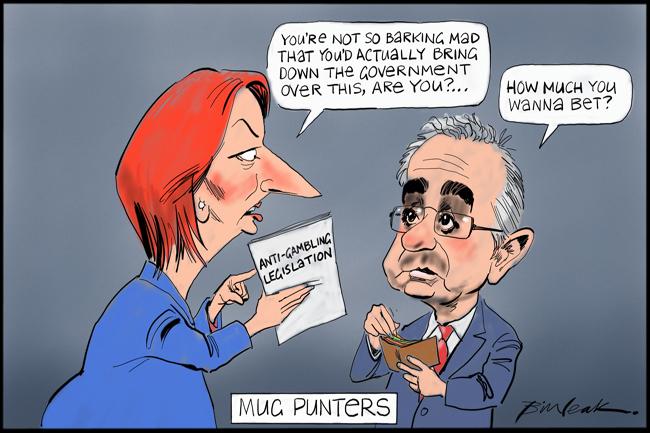
Pokie machines contribute around 6-10% of their income and it appears that what are they are actually opposed to is a cut of around 10-15 per cent of that revenue stream. The reform is minimal--mandatory pre-commitment technology on poker machines means that a person predetermines how much they can afford to lose on the pokies.
A pre-commitment scheme aims to give problem gamblers back some of the control they have lost. It may not be the full answer to problem gambling, but it is surely an important part of it. As the Productivity Commission pointed out, 40% to 60% of total losses, that is, the poker-machine industry’s revenues, derive from those with gambling problems.
The professional football industry with its faux outrage and ritual incantations about "a tax of football" that will cost jobs and destroy football and that it won't work -- comes across as a capitalist enterprise concerned solely with its commercial interest. The poker-machine industry's campaign is based on greed and market power: a power granted by government legislation that is now biting the hand that fed it. Wilkie has challenged the cosy compact between government and industry based on knowingly creating and then harming problem gamblers.
No doubt we will hear the right wing rhetoric of the nanny state government trying to tell us what we can and can't do (Andrew Wilkie is holding the country to ransom), and that is what is needed is more deregulation of the gambling industry so the free market can sort the issue of problem gamblers. This ignores the widespread public support for pokie reform.
The industry's jobs argument--- the economic benefits of the jobs created by the industry--- are simplistic, since the money spent on gambling was money not spent on other goods and services; and that the enjoyment of recreational players was outweighed by pain of those who become addicted.
The industry’s view is that only a small proportion of gamblers suffer harmful consequences from playing the pokies, and that it is the personal failings of these individuals, not the machines themselves, that are the source of the problem. The reality, as the Productivity Commission highlighted, is that the gambling industry profits and, by extension, the lucrative revenue streams flowing to state governments, are underpinned by the misery experienced by problem gamblers and their families. The pokie industry is reliant on the sustained, heavy and socially damaging losses of problem gamblers.
Update
The media had it wrong about the AFL. Andrew Demetriou, the chief executive of the AFL, has said that the AFL opposed Labor's pokie reforms, but he distanced the league from the astroturf campaign being run by the public relations forms on behalf of Clubs Australia and the NRL. With the $1.2 billion over five years in TV licence fees, the AFL does not need to depend on addiction and destroying lives to run the game.
However, there are those AFL clubs attacking the Gillard Government's responsible gambling laws and in doing so they are putting forward the dubious proposition that sporting clubs need the proceeds of problem gamblers to remain viable entities. If people who can't control their gambling are protected from themselves, then the code itself is in peril.
The astroturf campaign, with its paid on-air reads, coordinated free media splashes and talking points, looks increasingly like its becoming another front in the political attack on Labor.
Posted by Gary Sauer-Thompson at 9:06 AM | Comments (10) | TrackBack
September 25, 2011
Déjà Vu?
The powers that be in Europe are readying yet another bailout plan, this one is supposedly big enough to do the trick once and for all. The new rescue program seeks to create a sovereign debt crisis firebreak at Greece, Portugal, and Ireland. Every day its the same kind of news – Greece lurches nearer to a default, the financial markets panic, and governments come up with a few more euros or some soothing words to calm them for a few hours.
In Does the Euro Have a Future? in the New York Review of Books George Soros says that:
In 2008 the US financial authorities that were needed to respond to the crisis were in place; at present in the eurozone one of these authorities, the common treasury, has yet to be brought into existence. This requires a political process involving a number of sovereign states. That is what has made the problem so severe. The political will to create a common European treasury was absent in the first place; and since the time when the euro was created the political cohesion of the European Union has greatly deteriorated. As a result there is no clearly visible solution to the euro crisis. In its absence the authorities have been trying to buy time.
He adds that in an ordinary financial crisis this tactic works: with the passage of time the panic subsides and confidence returns. But in this case time has been working against the authorities. Since the political will is missing, the problems continue to grow larger while the politics are also becoming more poisonous.
He continues:
Under the pressure of a financial crisis the authorities take whatever steps are necessary to hold the system together, but they only do the minimum and that is soon perceived by the financial markets as inadequate. That is how one crisis leads to another. So Europe is condemned to a seemingly unending series of crises. Measures that would have worked if they had been adopted earlier turn out to be inadequate by the time they become politically possible.
The authorities have reached the end of the road with their policy of “kicking the can down the road.” Even if a catastrophe can be avoided the pressure to reduce deficits will push the eurozone into prolonged recession and this will have incalculable political consequences.
Soro adds:
There is no escape from this gloomy scenario as long as the authorities persist in their current course. They could, however, change course. They could recognize that they have reached the end of the road and take a radically different approach. Instead of acquiescing in the absence of a solution and trying to buy time, they could look for a solution first and then find a path leading to it.
The pathway is to give birth to a European treasury with the power to tax and therefore to borrow. This would require a new treaty.
Posted by Gary Sauer-Thompson at 10:41 PM | TrackBack
September 24, 2011
US: a double dip
Paul Krugman's argument about the “fiscalization” of economic discourse in America is one that refers to the way in which a premature focus on budget deficits--ie., slashing spending and reducing deficits so as to restore confidence and drive economic revival----has turned Washington’s policy attention away from the ongoing jobs disaster.
Growth-oriented policies--not trickle down economics--- are what is required to address the issue of long-term unemployment. The US economy is in crisis. People are hurting. So government must act, and it needs to act quickly.
As Robert Reich puts it this way:
When consumers can’t spend and businesses won’t spend without additional consumers, government must be the spender of last resort. Juicing the economy back to health ... will require at least $700 billion in additional federal spending this year and next. But this magnitude of additional spending isn’t feasible in the face of Tea Party Republican intransigence. Hell, Republicans won’t even spend additional money on flood and hurricane relief. The Tea Party obsession about the federal deficit and the size of the government is prevailing.
The Republicans are determined to keep the US economy in the doldrums. Their goal is to get Obama out of the White House and that’s more likely to happen if the economy is in recession come Election Day 2012. They'll trash the political and economic institutions--the government is the problem; make the whole process of governing bitterly partisan and rancorous --- to do it.
Since monetary policy will probably not ride to the rescue--the Republicans have effectively put an end to fiscal stimulus, and now hope to derail monetary stimulus as well. So poverty and unemployment will almost surely increase, wages will stagnate or continue to fall, and inequality will widen and Wall Street will win the battle against regulation.
Posted by Gary Sauer-Thompson at 3:56 PM | Comments (10) | TrackBack
September 23, 2011
The euro crisis: spinning out of control?
The IMF is calling on the leaders of European Governments (eg., France and Germany) to bail out their banks again in the context of the growing risk of default by Greece and other vulnerable eurozone countries.
However, the eurozone countries have very little ammunition to confront the coming financial storm that will cause havoc amongst the cowboys and machos in the finance-driven, deregulated economy in which we now live. The euro crisis looks to be spinning out of control and the euro’s survival increasingly hangs in the balance.
On current policy trends, a series of sovereign and banking defaults are unavoidable: the inability to issuance eurobonds; the European Central Bank (ECB) is highly unlikely to be permitted to carry out the full range of lender of last resort functions to eurozone sovereigns and bank---eg., to step in and buy unlimited amounts of government debt in order to demonstrate to investors that their fears over insolvency are unfounded; the slowness of the eurozone governments to move to recapitalise their banks, so that they were better placed to cope with the coming debt defaults.
Then we have the failure to shift away from fiscal austerity even though household and business confidence is crumbling rapidly across the currency union, depressing economic activity, and with it the likelihood of governments meeting their fiscal targets.
The inference from this is that there are sever and well known limits of the eurozone: it has a "single currency" that isn't backed by political sovereignty, a central bank that doesn't act as lender of last resort or finance government borrowing, and no significant European public budget. The flaws of the ECB's obsessive anti-inflationary stand, and its propensity to raise the interest rate whatever the cause of price rises, are also plain to see.
The issue is whether Greece, Spain and Italy are forced to quit the currency union in order to be able to print money, recapitalise their banks and escape deflation.
Posted by Gary Sauer-Thompson at 3:26 PM | Comments (6) | TrackBack
September 22, 2011
whatever it takes
Some of the conservative commentators are becoming critical of the way the Liberals are conducting themselves. Paul Sheehan is an example. Principles matter he argues.

Paul Kelly is another. Kelly says that the impression Abbott leaves with his tougher and more humane stance on the asylum issue is that his real motive is to cripple Gillard in political terms-- he is more focused on sinking Gillard than stopping the boats.
It is good to see a bit of argy bargy happening within the ranks of conservatives. Normally they are into consensus---conform in how they think---not debate. Their partisan rhetoric is used to cover over the cracks within the ensemble of power --eg., social conservatives, neo-liberal free marketeers, war hawks, and the Christian right.
Update
It used to be just the neo-liberals stirring the pot on needing to make industrial relations more flexible (ie., the casualisation of labour, ) and to break the power of the unions. Bring back WorkChoices for the battlers is the cry. It's more choice and greater efficiency that is needed.
This is an indication of how neoliberalism will shrug off the challenge that the financial crisis presented. Whilst neo-liberalism appears to be about free markets, in practice the ideology is concerned with giant corporations' dominance over public life. This has been intensified, not checked, by the recent crisis and the acceptance that certain financial corporations are ‘too big to fail'.
Posted by Gary Sauer-Thompson at 8:03 AM | Comments (14) | TrackBack
September 20, 2011
out of the loop
I've been out of the political loop as I've been in Ballarat and Melbourne on a phototrip. I haven't listened to the news or read a newspaper since Friday. I presume that I haven't missed that much.

Abbott is continuing to tear up the rule book and to up the anti on conflict to smash the Gillard Govt; the latter continues to limp along; the rhetoric about stopping the boats and breaking the people smuggling business model is still being rolled out; News Ltd continues to rant and rave about the media inquiry and the Green bullies continuing to run the country and hold it to ransom; and Gillard and Labor continue to be unpopular because of doing deals with the Greens.
Question Time is as bad as ever. Etc etc. Has anything shifted in the political landscape?
Posted by Gary Sauer-Thompson at 10:02 PM | Comments (14) | TrackBack
September 15, 2011
a media inquiry
A media inquiry into the Australia media now going to take place. It is narrow in its focus as it is concerned with print media regulation, including online publications, and the operation of the Press Council. There is nothing explicit about the concentration of media ownership, but it could function to open issues up.
It is linked to ongoing Convergence Review that's been looking at those parts of the media which have always been regulated by the state - radio and television. How should the rules that used to apply to them be recast to be relevant in an era when all media are about to converge into the digital stream? Will the announced media inquiry be linked to issues around individual privacy, in the light of the Law Reform Commission reports and News International's phone hacking in the UK.
News Limited is the biggest player in the Australian media and any inquiry will touch on its business. It's reaction was predictable: --the inquiry is a threat to press freedom and free speech and it is driven by the Greens. Mark Day says:
The Gillard government's media inquiry is a sop to the Greens - a piece of window-dressing designed to demonstrate that it can be seen to be doing something...newspapers have been free of government controls for nigh on 400 years and represent a vital part of the democratic process.The terms of reference leave open the possibility of tighter codes of practice and new regulation.If the inquiry produces such recommendations the media industry will push back strongly, which is hardly what a government polling in the 20s a year out from an election is likely to want.
Therein lies the threat from News Ltd. It will to attack the Gillard Government with even more negative coverage if they dare to introduce even some modest regulatory reforms.
For News Ltd there is no issue here other than ensuring that self-regulation continues. Not even the crappy, journalism designed to misrepresent that is now normal. Or accountability of the media to the public. Or that the Press Council to be given more statutory teeth, that it requires non-media resources, that it needs to lift its game and that it should be broadened to cover all media.
The News Ltd's position is that free speech is reduced to press freedom and equated with no regulation. Surprisingly, many journalists and commentators concur. Michelle Grattan, for instance, finishes her column thus: "any move to regulate newspapers would be laced with more dangers than positives."
Grattan presents no argument to supported this claim, even though News Ltd newspapers daily breach their own Professional Conduct Policy. And yet she well knows that the press do not to present information to citizens without distortion, misrepresentation and deception on issues such as the Iraq war, climate change, the national broadband network, clean energy etc.
Journalist's are loathe to criticize the media for the deceptions practiced in the name of an enlightening media that professes to hold governments accountable to s ensure a better democracy.
Posted by Gary Sauer-Thompson at 8:50 AM | Comments (6) | TrackBack
September 14, 2011
'here I stand'
Watching the Question Time theatre in the House of Representatives yesterday indicated to me that the Abbott lead Coalition will not support the Gillard Government's legislation to change the Migration Act to allow off shore processing. Gillard’s argument is that changes to the migration legislation will help any future government, not just her own. The Coalition just keeps saying no to Malaysia. No no no.Then throws Nauru in her face. Only Nauru. Only Nauru.
As the Coalition sees it, the problem is one of the Gillard Government's own making. They dug themselves into the asylum seeker hole and so they can dig themselves out. The Coalition, far from supporting them ensure off shore processing will keep pushing them back into the hole and standing on their fingers when they try to crawl out. If they support the legislation, then that gives the Government a free pass.
That doesn't look like happening, given the level of hatred and loathing towards Gillard and her Government, the stark polarization of politics, and the high level of both adversarial politics and journalism. The antagonism, hostility, outrage and contempt is only going to be rammed up to ever higher levels in order to gain a political advantage.
However, there is some truth in the claim that the problem is of Gillard's making. She has made the asylum seek issue central, tied it to her political legitimacy and then to the authority of executive government with respect to border control. She has put her head on the chopping block and said: 'Here I stand, I can do no other.' The Gillard government is determined to proceed with its Malaysia solution .
What is open to Gillard is to us the tools of executive authority to make the most of what the law had to offer, staying within the letter of the law, but opting for interpretations that reflected differing, but legally permissable, readings of the law. The Gillard government can make clear that a government has a duty to carry out the law to the best of its ability, which includes its interpretive ability.
Meanwhile the Coalition in chanting Nauru Nauru Nauru ignores the Immigration Department 's advice to them that the High Court ruling was a game changer and that Nauru Solution would not be an effective deterrent for asylum-seekers. Nauru would merely be a holding point and those that spent their days languishing while their claims were processed on would head to Australia in time.
Posted by Gary Sauer-Thompson at 1:06 PM | Comments (3) | TrackBack
September 13, 2011
a euro crisis?
The Euro crisis appears to be getting worse, not better.
Greece appears close to default as the interest rate on two-year Greek bonds have now climbed above 85 per cent. The market's focus has shifted to the debts of the German and French banks. Germany has adopted bailout fatigue as official policy and the politics of the eurozone crisis are largely determined in Germany.
That politics currently means that Greece will not get any more money lifelines (bailout cash) until they shape up---that is comply with Germany’s austerity dictates, and get their budget deficit under control. This politics is a strategy to defend the French and German banks, because they would be the major causalities of a Greek default. Germany and France continue to insist that Athens stick to the tough deficit-reduction programme, that is taking Greece ever deeper into recession; whilst preparing for a default.
Paul Krugman in his An Impeccable Disaster in the New York Times says that the euro is now at risk of collapse:
Financial turmoil in Europe is no longer a problem of small, peripheral economies like Greece. What’s under way right now is a full-scale market run on the much larger economies of Spain and Italy. At this point countries in crisis account for about a third of the euro area’s G.D.P., so the common European currency itself is under existential threat.
He adds that all the indications are that European leaders are unwilling even to acknowledge the nature of that threat, let alone deal with it effectively.
Their political strategy is still one of austerity--not letting the peripheral countries off the hook for their fiscal sins. Instead of the monetary union requiring political union---a United States of Europe--- the Germans are forcing harsh economic medicine down the throats of the reluctant Greeks, Irish, Portuguese and Spanish electorates. The European Central Bank (ECB) has acted exclusively in the interests of big finance--- to prevent the banks from losing money on their poor investments. This has made it impossible for Greece to narrow its deficits by boosting growth.
The end game is now approaching. The default events now appear inevitable. Without the next €8bn tranche of the bailout at the end of the month Athens will be unable to meet repayments due on its bonds. It's currently not doing enough over job cuts in the civil service and the privatisation of €50bn-worth of state assets. Then Greece faces another progress check in December. Greece will default, it's just a matter of time, as its economy is shrinking.
That means the shaky German and French banks are in the firing line and the subsequent collateral damage will need to be contained--ie., the banks are shored up through a government-backed injection of capital in banks. A Greek default would have dire knock-on effects for banks in Germany, France and the UK that are presently holding billions in Greek debt.
Since the EU banking system is undercapitalized whatever capital is left in the coffers is quickly sucked down the plughole once the Greek, Portuguese, Irish, Italian and Spanish government bonds are written down to market values. Many of the banks could face excruciating restructuring or, perhaps, bankruptcy.
The commentary from the economists of finance capital in Europe is one of doom and gloom: a Greek default would be a financial and economic disaster not only for Greece, but also for 16 continuing euro area member states, and that it would also have severe economic and political implications for the whole of the EU and the wider global economy.
Posted by Gary Sauer-Thompson at 10:27 AM | TrackBack
September 12, 2011
can the ALP rebuild itself?
Politics in Australia is now largely about opinion polls and focus groups not policy issues. Screeds of commentary is written and spoken about the significance of the minor up and down movement of the polls (the statistical sampling errors are conveniently ignored). Polls are a form of politics as entertainment in a 24/7 tabloid media world that is full of flea-circus ringmasters such as Alan Jones, and a political world thoroughly infused with the ethos of Hollywood.
Only a few journalists now write about policy, the options, and the arguments.So it is good to see policy being foreground by Dennis Glover in The Australian. He argues that the ALP's decline as a political party started with the Tampa affair in 2001, and that the decline can be primarily marked by its position on a single policy issue.

His argument is this:
One issue above all others did this: the refugee issue. The dramatic events of late 2001 between the arrival of the Tampa in August, the terrorist attacks in September and the election defeat of November drove a wedge between Labor and the idealists and reformers who have historically given the party its drive. That wedge has not gone away, and it should surprise nobody that it has returned in the form of last week's dramatic High Court decision. A generation ago, the lawyers who brought on the case would probably have been activist Labor members.
He says that Labor's supporters have all but given up on it, reasoning that when push came to shove the party of progress would morally fold once again.
Glover adds that ten years on it's time for Labor to face up to the hard reality. If it is to have a future it has to show the broad "Labor" community what it really stands for on the asylum-seeker issue.
My judgement is that Glover is right about the decline and decay of the ALP--- in the sense that the policies do matter, the ALP has really bungled its asylum-seeker policy, and its political deals on this have been hollowed out. The decline is not just one of a narrow electoral support, but the sense that the ALP has little in the way of an idea of where it wants to take the country and how to use policy issues to make Australia a better place.
Where I differ from Glover is that I'm not so sure that the ALP is actually capable of rebuilding itself on firmer moral foundations, as Glover thinks, or hopes. My sense is that it's too late--the decline has gone on for too long, and it now has its own momentum. Even if it did start the rebuilding process, as opposed to its short term political survival, how many citizens would listen? Many of those who supported the ALP a decade ago have moved on.
Posted by Gary Sauer-Thompson at 9:37 AM | Comments (14) | TrackBack
September 11, 2011
The Lancet on obesity
The Lancet has just run a series on obesity that explores its drivers, its economic and health burden, the physiology behind weight control and maintenance, and what science tells us about the kind of actions that are needed to change our obesogenic environment and reverse the current tsunami of risk factors for chronic diseases in future generations.
 Gary Sauer-Thompson, poster, MacDonalds, 2011
The fact is, many Australians are fat and they are getting fatter.In the global obesity pandemic: shaped by global drivers and local environments paper, it is stated that:
The simultaneous increases in obesity in almost all countries seem to be driven mainly by changes in the global food system, which is producing more processed, affordable, and effectively marketed food than ever before. This passive overconsumption of energy leading to obesity is a predictable outcome of market economies predicated on consumption-based growth.The global food system drivers interact with local environmental factors to create a wide variation in obesity prevalence between populations... in high-income countries it affects both sexes and all ages, but is disproportionately greater in disadvantaged groups.
The primary cause is fast food and lack of exercise in an urban environment in which making healthy choices has become increasingly difficult.
The classical liberal view that individuals should make their own choices, free from state intrusion. According to this liberal account, the fact that your risk of being obese relates closely to your socio-economic status is not a question of social justice but a problem of the feckless poor being too ignorant or spineless to make good choices. Nudging us to healthier choices is OK, but regulating is not.
This view ignores the way that solutions to obesity and to improve health and development cannot be based on the existing framework (consumption-driven growth creating financially-defined prosperity) because this approach has helped to create the difficulties in the first place. Within this framework the fast food industry has become effective in its exploitation of basic human biological drives, desires, and weaknesses.
Posted by Gary Sauer-Thompson at 9:38 AM | Comments (2) | TrackBack
September 10, 2011
defending liberty
David Cole in his After September 11: What We Still Don’t Know in The New York Review of Books makes a good point about the US political system.
The Constitution created a divided government to limit overreaching by any one branch, and established judicial review to ensure that we would have a government “of laws, not men,” as Chief Justice John Marshall put it. In ordinary times, that structure functions reasonably well. But in times of crisis, it has proved inadequate.....In each crisis, the political branches were more likely to goad each other on than to impose limits, and the Supreme Court either expressly affirmed what went on or looked the other way.
He adds that the 9/ll crisis was different:
As before, the executive overreacted. As before, Congress imposed no meaningful limits. But this time the Supreme Court, breaking from its past, stood up to the President. It insisted that it was responsible for reviewing detentions during wartime, rejected claims that it must defer to the executive, ruled that military detainees must be accorded Geneva Conventions protections, and, most extraordinarily, kept the courthouse door open for the Guantánamo detainees even after Congress and the President, acting together, had unequivocally sought to close it.
However, the Court has done nothing to halt the US government from overreaching its legitimate constitutional powers, even declining to review several cases challenging the executive’s aggressive uses of secrecy, torture, and rendition.
Cole says that the real drivers in the defence of liberty comes from civil society— the loosely coordinated political actions of concerned individuals and groups, in the US and abroad whose public criticism of government actions (eg., the widespread preventive detention of Muslim and Arab immigrants; rendition to torture; the CIA’s black sites) appealed to the residual power of the ideals encompassed in the rule of law—liberty, equality, fair process, and dignity.
Posted by Gary Sauer-Thompson at 2:45 PM | TrackBack
September 9, 2011
modernity vs terrorism
The mainstream media's interpretation of 9/11 ten years on is still one of (western) modernity vs (Islamic) terrorism and modernity winning over terror. The West stood firm--staying the course--- in this clash of civilizations. However, ever vigilant we must be. This is war.
Most of the western commentary read like an attempt to justify the horrors committed by the West in the last decade and to bat away a faith based presidency's ruthlessness and venom for revenge (a crusade) in its long war against a nihilist Islam. It's a good v evil view of the world that allows for no shades of grey, and, as know, there are many shades of grey. Despite this it is still us v them,

What is covered over or rationalized away in this conception of an enlightened modernity (science and progress; freedom and civilisation) fighting off the dark, irrationality of barbarism (myth and superstition) of them (Al Qaeda, Taliban insurgents, 'terror' itself) is the dark side of modernity.
Consider the lies about Iraq's WMD's; the destruction of Iraq and the civil war in Afghanistan; the drones bombing in Pakistan; the acceptance of torture at Abu Ghraib and Guantánamo Bay; the surveillance of western citizens and the erosion of their civil liberties; renditions, detention camps to incarcerate refugees from Iraq and Afghanistan; and the turn against science around global warming.
Violence and terror are an integral part of western modernity and always have been; just like the ferocious drive to extract as much out of the Earth as possible without giving anything back to it; or pollution in its many destructive forms. The deaths of the non-American civilians (100, 000) are deemed to be insignificant. American security was what mattered and it is held that there is little that is fundamentally wrong with American foreign policy in the Middle East.
We are still immersed in the middle of "the American era of endless war" with no end in sight and the US has done little to honestly confront the nation’s past wrongs done under the veil of secrecy.
After September 11, 2001, it was often said, “everything changed.” The shock of that day, on which nearly three thousand American civilians were murdered, still reverberates, affecting politics, law, and policy in the US and elsewhere. What has stayed with me is how Australia has changed as a result of the war on terror. We've become so security obsessed, so suspicious, so wary of strangers. Ordinary office buildings require IDs before they'll let you in. Taking pictures is a suspicious activity. Private security guards are everywhere. Factories, boats and convention centres have become high security sites, concrete barricades blocked the area around Parliament House. Australia sees itself as Fortress Australia.
Posted by Gary Sauer-Thompson at 11:21 PM | Comments (4) | TrackBack
September 8, 2011
with friends like these
Here we go again. Another ex-Labor bully boy trashing the federal Labor Government and recycling conservative talking points in the attack. It's Michael Costa in The Australian. In his Trashing the Hawke-Keating legacy where he lays the boot into Keynesian economics from a neo-liberal perspective:
It was Rudd who undermined Labor's economic credentials with his overblown anti-capitalist rhetoric and overcooked policy response to the global financial crisis. So desperate was he to avoid a small technical recession that he unleashed an undisciplined spending spree that, despite its Orwellian marketing, provided little in quality economic infrastructure. Rudd was able to manipulate the short-term quarterly aggregate economic data sufficiently to avoid a technical recession, but this manipulation has left Labor with the political legacy of programs such as Building the Education Revolution, the pink batts installation and the cash for clunkers scheme, which have become synonymous (rightly or wrongly) in the public mind with government incompetence and mismanagement.
He adds that massive spending programs, such as the National Broadband Network, have added to the perception of a clueless administration spending recklessly on frivolous luxuries that are high risk and of no immediate consequence to the real day-to-day concerns of people struggling with cost-of-living pressures and urban congestion.
I'm surprised that Costa makes no mention of "the carbon tax destroying Australia's economy" talking point, but he does add for good measure that Gillard's real NSW disease is her alliance with the Greens.
Costa's home is The Australian, the mouth piece of Australian conservatism, as he works within Murdoch's political beliefs and the ideology of News Ltd, which is conducting a high-volume and unbalanced campaign directed against the Gillard Labor government. There is a vindictive streak running through this--- Costa appears to be settling old scores?-- and this fits in with the way News Ltd routinely acts in a vindictive manner to those it designates as the enemy within. News Ltd profits from its vindictiveness.
As a result of the bully boys in the Coalition, the Murdoch press and the shock jocks there is has been an increase in the level of venom and aggression in the public discourse to the point of toxicity.
Posted by Gary Sauer-Thompson at 9:35 AM | Comments (4) | TrackBack
September 7, 2011
food labelling logic
A core strand of public health policy is directed at the 'development and implementation of cost-effective ways to reduce saturated, transfats, salt and sugar in foods by discouraging the production and marketing of unhealthy foods. The policy proposals aim to achieve smoke-free environments, restrictions on food marketing to children, increased alcohol tax and the promotion of generic medicines.
One proposal is food labelling in the form of front-of-pack ''traffic light'' labels on the food industry's products. This:
categorises the four key nutrients most associated with public health issues – fat, saturated fat, sugars and salt – as high, medium or low compared to the recommended level of intake of these nutrients.These ranks are portrayed as red, amber or green traffic lights on the package. Another light is sometimes included in the signpost for energy content, but it is not a core criterion.
The reason is that there is limited use of nutrition information currently presented on food packages. There is strong support for nutritional information to be placed on the front of food packages, particularly for nutrients that should be consumed in limited amounts, such as saturated fat, sugar, total fat and sodium. There are strong health arguments in favour of raising consumer awareness--informed consumer--- of what is in the food they buy.
The food industry in Australia (the Australian Food and Grocery Council [AFGC]) and elsewhere is strongly opposed to the traffic-light system. They prefer their Daily Intake Guide labelling (DIG), which is complex, difficult to understand and hinders consumers to make quick decisions about which is the healthiest product to buy.
The determination of the Australian food industry to avoid Traffic Lights is probably the surest indicator of their potential impact and we can expect that a big campaign to control public policy to suit their commercial interests. Food labelling is a huge issue for food multinationals – it affects how their products are perceived by the customer, how well they sell. Mandatory labelling could put consumers off the products they sell.
We cannot have consumers overwhelmed with information can we? It would lead to consumer confusion and be a severe burden for manufacturers. So say the industry lobbyists. Any regulation should be industry-related not consumer-related.
Their aim is to occupy the food labelling ground first to show their commitment towards the public health and shape the debate from this position with their DIG scheme. We can expect the free market think tanks to provide the studies to support the food industry's position to reject plans for colour-coded traffic-light warnings. Parliament should obey the food industry's wishes and help block the consumer shift to locally produced and healthy food.
Posted by Gary Sauer-Thompson at 3:51 PM | Comments (1) | TrackBack
September 6, 2011
9/11: ten years on
The commentary around the anniversary of 9/11 is filling the airwaves again. It is ten years on, a part of history now. Then the western media, with few exceptions, was totally in favour of western intervention in the Muslim world and a long war against Islam, Iraq including a civil war in Afghanistan. It was called the war against terrorism
 Steve Bell
It was called the war against terrorism and it was characterised by lies about Saddam Hussein's links to al Qaeda and WMD in Iraq; the Guantánamo and Abu Ghraib prisons; "extraordinary renditions"; torture and spin that the 9/11 was an attack on western "freedom" and our "way of life". Qaddafi was hand in glove with Bush (and maybe Blair?) regarding the “interrogation” of the prisoners sent him from Washington. Bush sent people he had kidnapped (“rendition”) to Libya to be “questioned” by Libya’s interrogators and almost certainly to be tortured.
The critics were right. Iraq was a blood-drenched disaster; and Afghanistan has become a long drawn out failure; a complicity in torture by western governments; and loads of anti-terrorism legislation by the national security state that undermines individual freedom and our democratic way of life.
That is the legacy of Bush, Blair and Howard---the United States and its allies lost the war in Iraq and they are going to lose the war in Afghanistan.
Posted by Gary Sauer-Thompson at 6:55 PM | Comments (3) | TrackBack
September 5, 2011
doing a deal with Abbott?
The Coalition is keen to revive its old strategy of warehousing asylum seekers in Nauru and in Papua New Guinea---a Pacific solution Mark II.This policy is being used as part of the background scratching of the conservative noise machine with the Murdoch media setting the agenda for regime change.
Behind the noisy scratching of "we want an election now" is the policy reality that 61 per cent of the people on Manus Island and Nauru who were found to be refugees were resettled in Australia; and that offshore processing looks increasingly difficult after the High Court's decision.
Though Nauru has joined PNG as a signatory to the refugee conventions, both countries need to insure practical compliance'' with their obligations and they must comply ''in practice with human-rights standards acceptable at least to the United Nations High Commissioner for Refugees''. The inference is that offshore processing could result in another legal challenge.

One possibility suggested by the High Court is a deal with Nauru that kept asylum seekers effectively in Australia's hands would satisfy the requirements of the Migration Act. If so, why bother with Nauru? Why not do the processing onshore? Isn't onshore processing with brief mandatory detention the ALP's platform?
Abbott is contesting the government's interpretations of the Solicitor-General's (Stephen Gageler,) the written opinion, and saying if Labor wants to put the situation beyond doubt, he would support legislation to change the Migration Act to cover Nauru and PNG. Abbott is endeavoring to exploit what he perceives as Gillard's lack of authority and the weakness of minority government.
The desire of both political parties sides is to keep offshore processing as a policy because they see it as the strongest option to act as a deterrent to asylum seekers. They do not want bulging detention centres, years of delays and endless legal appeals from asylum seekers through the Australian courts. The ALP right are basically Howard lite, and they are eager to embrace the Coalition's Nauru option and TPV's.
A far better option is to accept on shore processing and, as a reforming government, work towards some sort of regional co-operation across southeast Asia on the matter of stateless and displaced people. Malaysia was a flawed start. It was an attempt to avoid other countries being put in a situation where they are a way-station for people en route to Australia.
So Australia should cooperate with them. It's what governing means on this issue. There is no policy paralysis here.
Posted by Gary Sauer-Thompson at 9:09 AM | Comments (15) | TrackBack
September 4, 2011
the decline of the west?
John Lancaster has an article in the London Review of Books on the global economy and its future prospects. He argues that best-case scenario for the aftermath of the crash is already dead.
The best-case scenario is one in which governments muddled through to economic growth, cutting public spending in the process, enjoying the already mentioned rebound which tends to follow recessions, and the developed world went back to partying like it was 2006. This prospective version of events had a big hole at the centre, about the way the financial sector should be reformed; in any case, it now looks very unlikely to happen.

Lancaster says that the next scenario – the one we (ie., the West) are on course for at the moment – is modelled on what happened to other parts of the world over recent decades, from Latin America to Russia to South-East Asia, as they underwent debt crises and consequent economic collapse. It is one of years of economic stagnation.
In all [the above] cases, the relevant economies recovered, after about a decade of hard times and widely shared economic pain. In this model, the debts are gradually paid down, the economy is slowly and miserably rebalanced, and eventually things grow back to where they were when the bubble burst. There is a general sense of baffled incomprehension in the West at the idea that this should be happening to Us, instead of to Them; it turns out that this trajectory of crisis and slow recovery is a lot more bearable when it happens to other people, ideally in far-away countries of which we know little. But that is what we look to be on course for at the moment.Lancaster adds that the west (Europe and the US) are on course for relative decline, compared to China and India and the developing world; indeed, we are already living through it, with China now the world’s second biggest economy. A decade-long slowdown would accelerate this shift in global wealth and power and would be a grim thing to live through
Posted by Gary Sauer-Thompson at 10:51 PM | Comments (3) | TrackBack
September 3, 2011
a new and democratic Libya?
As Muammar Gaddafi's last strongholds fall one by one, Britain and France, the two main European powers who supported the rebels (National Transitional Council), line up for Libya's oil. There are lots of western "advisors" in Libya that give evidence of the massive presence of the west in the country.
 Martin Rowson
This is not to suggest that there is something sordid or crooked about business being done in Libya by the US and Western Europe. Hopefully, the NATO air intervention, which is now winding down, does not turn into infantry on the ground, and that the National Transitional Council maintains its position that they don’t need any foreign, Arab or Islamic forces to help preserve security in Libya.
Let's hope they defy expectations and manage to build a new and democratic Libyan state, given how they have fought to regain control over their own country and their own lives. Firstly, the old regime is not entirely dead and it is still possible that Gaddafi would do better to survive and live – to continue a civil-tribal conflict and thus consume the West's new Libyan friends--the pro-Western Transitional National Council---in the swamp of guerrilla warfare.
Secondly, in oil states such as Iraq and Libya anybody who can gain authority, even for a short period, stands to make a great deal of money. The political leadership looks weak, and it is unlikely that the militias will tamely dissolve themselves.
Posted by Gary Sauer-Thompson at 4:04 PM | Comments (3) | TrackBack
September 2, 2011
a step backwards?
The conventional wisdom in Canberra about how to respond to asylum seekers arriving by boat is that the only viable public policy is one of ever increasing toughness and hostility. Toughness for the ALP is mandatory detention, offshore processing and harsh treatment of refugees; or, for the right wing faction in the ALP, simply adopting the Coalition's policy hollis bollus.

The common ground between both the major sides of politics is to keep a cordon sanitaire around Australia against asylum seekers to keep them out. At Inside Story Peter Browne usefully reminds us about the significance of 'Fortress Australia' in the conservative political imaginary, or the collective repertoire of collective forms---mythological, rhetorical, narrative etc of the nation state.
He says that:
it’s important to remember that the issue as it’s currently framed belongs to Coalition. John Howard invested enormous energy and vast amounts of public money in his quest to transform a relatively small number of boat arrivals – most of them eventually found to be refugees – into an existential threat...The hardening of Labor’s position since then hasn’t created a sense that Labor is just as tough as the Coalition; it has created a sense that Labor thinks the Coalition was right all along.
Browne's argument is that Labor has let the Coalition set the terms of the debate. He adds:
the [Gillard] government has been trying to match the Howard government’s reputation for “toughness.” This is a dead end for Labor: the opposition will always find shortcomings in its measures, regardless of how harsh they are, and the government will constantly be on the defensive. And for what electoral gain?
This creates a problem for the Gillard Government: where do they go now that the High Court has vetoed the Malaysian Solution? Swallow a bitter pill and adopt the Coalition's policy, even though the entire offshore processing system might have seen its last days?
Or remember that a regional approach to an assessment centre for asylum seekers within a regional cooperation framework is the right option that it was working towards adopting the Malaysian solution. On this model refugee protection needs to be part of a regional response to irregular movement and asylum seekers in three key areas: processing and case management, resettlement and burden sharing, and repatriation of persons not in need of international protection.
An effective regional protection framework would be one which ensures that all asylum seekers in the region have access to fair procedures for determining their protection claims, obtain a durable solution within a reasonable time frame if found to be in need of international protection, and receive treatment that complies with human rights standards in the meantime.
Posted by Gary Sauer-Thompson at 1:40 PM | Comments (19) | TrackBack
September 1, 2011
China as a lynch pin?
In this article in Mute it is stated that China has changed from a failed attempt at autarkic state capitalism into the second largest economy in the world and the largest industrial producer. In 1990 it produced 3 percent of the world's industrial output, 20 years later 19.8 percent, overtaking the US who has held that position for 110 years.
This was made possible through the ruthless exploitation of a large cheap labor force; the massive exploitation of natural resources and its consequent degradation of the environment; and a growth model that depends on expanding exports to the markets of core capitalist countries.The article says:
China's dramatic expansion has benefited the advanced capitals in several ways: its cheap products were the main reason why inflation remained low, the combination of its low wages and modern technology brought huge profits to Western and Japanese investors, and the realistic threat to move production to China helped to curb wages in the advanced countries.
On the expansion of the world market, its impact has also been crucial: less by the opening of its domestic market (which is certainly large and growing, but limited by the extreme poverty of the majority of its population) than by its indirect and paradoxical effect on the market of its customers. Because its expansion was driven by external trade, and because the state kept the lid on Chinese wages and thus on the consumption of the working class, since their low level is its main competitive weapon, each year China obtained a growing trade surplus.As in other state capitalist countries before it (especially Japan), whose industrial development depended on the US market, China used these profits to accumulate a hoard consisting of dollars, public debt and US securities.
The question becomes: can a half Communist and half capitalist China continue to be the driver of the global economy when the US and Europe are in recession?
There are limits to its growth. China's beneficial effect was primarily based on its abundant supply of dirt cheap labour power, well disciplined with the help of Confucius and Stalin. It's weakening because the development of China is changing its society to an industrial and this is pushing the value of labour power higher. Wages are rising. The response is a producer at the cutting edge by using its financial reserves to buy the best technology in all sectors including renewable energy.
U.S. and European economies struggle with stagnation and face potentially increasing crises in the future as the economic contraction continues. In the Financial Times Martin Wolf says:
The depth of the contraction and the weakness of the recovery are both result and cause of the ongoing economic fragility. They are a result, because excessive private sector debt interacts with weak asset prices, particularly of housing, to depress demand. They are a cause, because the weaker is the expected growth in demand, the smaller is the desire of companies to invest and the more subdued is the impulse to lend.
He adds that the buffers have mostly gone: interest rates are low, fiscal deficits are huge and the eurozone is stressed. The risks of a vicious spiral from bad fundamentals to policy mistakes, a panic and back to bad fundamentals are large, with further economic contraction ahead.
China will continue to grow, but less than before because China can no longer rely on exports to lead its economic expansion given the ongoing contraction in the the US and Europe. Consequently, China needs to rebalance toward a domestic consumption-led economy. Its core social problem is how will it employ all the migrants and other refugees from rural poverty, but also the millions of graduates for whom there is no more place in the economy.
Posted by Gary Sauer-Thompson at 2:31 PM | Comments (3) | TrackBack