|
September 26, 2011
There is commentary in the media that the AFL and NRL sporting bodies have joined the Clubs and Pubs in coming out in opposition to pokie reform (mandatory pre-commitment technology on poker machines) to protect their revenue stream. These bodies, which publicly support junk food, show little responsibility for the misery caused by problem gambling of the one armed bandits; or little concern for the need for harm minimisation.
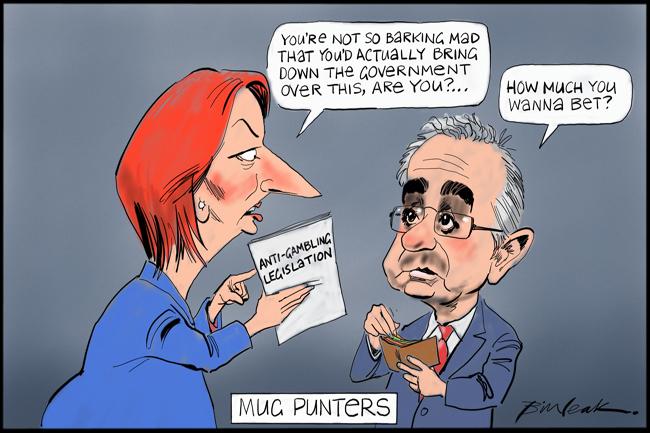
Pokie machines contribute around 6-10% of their income and it appears that what are they are actually opposed to is a cut of around 10-15 per cent of that revenue stream. The reform is minimal--mandatory pre-commitment technology on poker machines means that a person predetermines how much they can afford to lose on the pokies.
A pre-commitment scheme aims to give problem gamblers back some of the control they have lost. It may not be the full answer to problem gambling, but it is surely an important part of it. As the Productivity Commission pointed out, 40% to 60% of total losses, that is, the poker-machine industry’s revenues, derive from those with gambling problems.
The professional football industry with its faux outrage and ritual incantations about "a tax of football" that will cost jobs and destroy football and that it won't work -- comes across as a capitalist enterprise concerned solely with its commercial interest. The poker-machine industry's campaign is based on greed and market power: a power granted by government legislation that is now biting the hand that fed it. Wilkie has challenged the cosy compact between government and industry based on knowingly creating and then harming problem gamblers.
No doubt we will hear the right wing rhetoric of the nanny state government trying to tell us what we can and can't do (Andrew Wilkie is holding the country to ransom), and that is what is needed is more deregulation of the gambling industry so the free market can sort the issue of problem gamblers. This ignores the widespread public support for pokie reform.
The industry's jobs argument--- the economic benefits of the jobs created by the industry--- are simplistic, since the money spent on gambling was money not spent on other goods and services; and that the enjoyment of recreational players was outweighed by pain of those who become addicted.
The industry’s view is that only a small proportion of gamblers suffer harmful consequences from playing the pokies, and that it is the personal failings of these individuals, not the machines themselves, that are the source of the problem. The reality, as the Productivity Commission highlighted, is that the gambling industry profits and, by extension, the lucrative revenue streams flowing to state governments, are underpinned by the misery experienced by problem gamblers and their families. The pokie industry is reliant on the sustained, heavy and socially damaging losses of problem gamblers.
Update
The media had it wrong about the AFL. Andrew Demetriou, the chief executive of the AFL, has said that the AFL opposed Labor's pokie reforms, but he distanced the league from the astroturf campaign being run by the public relations forms on behalf of Clubs Australia and the NRL. With the $1.2 billion over five years in TV licence fees, the AFL does not need to depend on addiction and destroying lives to run the game.
However, there are those AFL clubs attacking the Gillard Government's responsible gambling laws and in doing so they are putting forward the dubious proposition that sporting clubs need the proceeds of problem gamblers to remain viable entities. If people who can't control their gambling are protected from themselves, then the code itself is in peril.
The astroturf campaign, with its paid on-air reads, coordinated free media splashes and talking points, looks increasingly like its becoming another front in the political attack on Labor.
|





Fiona Nicoll says that:
Pokies are too easy to use: insert some coins into a slot or swipe a card, push a button, perch on your stool, stare in a trance-like state at flashing lights while time seems to stand still, listen to a cacophony of sound effects and lose your hard-earned cash, or win on the odd occasion.
The Productivity Commission’s 2010 report on gambling estimates more than 100,000 people in Australia suffer from severe gambling problems. Gambling invariably produces long-term losses. Money is stolen, people are lied to, and savings are wasted in the pursuit of an unattainable dream.