« January 2013 | Main | March 2013 »
February 28, 2013
Italy divided
The elections in Italy that resulted in a hung parliament reflect a divided Italy in the context of corrupt politics, the politics of fiscal austerity imposed by finance capital in the eurozone, a shrinking economy and rising unemployment. Italy is in a crisis.
The centre-left coalition led by Pierluigi Bersani secured a solid majority in the lower chamber, but fell short of a majority by approximately 40 senators in the upper chamber. None of the parties/coalitions can reach the majority quorum of 158 in the Senate, even though Silvio Berlusconi, the leader of centre right was able to climb back. However, no party gained a majority in both the House of Representatives and the Senate.
 David Rowe
The winner of this election is undeniably the ex-comedian Beppe Grillo, whose anti-austerity, social media based 5 Star Movement received one vote for every four cast this weekend. They filled an anti politics void with Grillo’s message being explicitly against the rest of the Italian political class because they have let the country down. Who will the Star Movement support, given their demands for a renegotiation of Italy’s agreements with Europe?
Fabrizio Carmignani observes if a country achieves a steady rate of economic growth, then no draconian tax hikes and expenditure cuts are required to ensure the long-run sustainability of debt. Is there a consensus for a shift from austerity to pro growth policies?
Many of the concerns of Grillo’s supporters are shared by people across Europe in that over the last decade, trust in the EU and national governments and parliament has been on a downward trend across the continent. These movements express a desire for the idea of ‘changing’ the system, the ruling elites and the traditional ways of making policy.
Posted by Gary Sauer-Thompson at 2:14 PM | Comments (8) | TrackBack
February 26, 2013
exploring obesity
Jill Filipovic in Fight unhealthy food, not fat people argues that we should focus on health not on body size in the debate about obesity. It's public health that should be our concern, not pointing the finger at fat people.
She gives one reason why people turn to fast foods or snack food:
With demanding work days, little time off and disproportionate amounts of our incomes going toward things like health insurance and childcare that other countries provide at a lower cost, is it any surprise that we eat fast-food breakfast on our laps in the car and prefer dinner options that are quick and cheap?
Hence the turn to processed snack food. Filipovic adds that nutrient-deficient chemically-processed "food" in increasingly larger sizes is bad for all of our bodies, whether we're fat or thin or somewhere in between.
What is crucial at this point from a public health perspective is the corporate processed food companies knowingly make heavy use of salt, sugar and fat in their food because it tasted good. The food companies have known for decades now that sugary, salty, fatty foods are not good for us in the quantities that we consume them, but they use science and marketing to get people hooked on foods that are convenient and inexpensive. They make lots more money that way.
The main purpose of these giant food companies is to make money. Health concerns are at the bottom of their agenda. They have to keep their profits up. They are on a winner with addictive junk food. Karen Hitchcock in Fat City: What can stop obesity? in The Monthly says that
The pleasures of eating are complex and multifaceted. In our society, consumption is a form of entertainment and pleasure. Eating is part of this: from the theatre of a meal at a fine-dining establishment to a bag of chips augmenting the television-viewing experience. Most people do not overeat because of a feeling of hunger emanating from the stomach; they are giving in to a desire to consume – they are seeking pleasure or relief, or hoping to fill a void.
She adds that in thousands of other labs across the planet, food scientists and marketers are working on ways to make you eat more. They employ highly sophisticated psychological and physiological research to this end; they examine the effects of colour, unit size, price, texture, packaging and advertising on human desire.
Hitchcock continues:
Corporations make it easier for us to eat than to abstain. They loudly promote and supply cheap, taste-intense, non-sating food that is bad for our bodies. They know us better than medicine does. When a fast-food chain dropped its television ads for a weekend, its revenue that week fell by more than 25%. There are more shelves in some supermarkets selling highly processed, nutrient-free combinations of starch, fat, sugar and colouring than there are bearing fresh fruit, vegetables, meat and grains combined. Very few people get obese and none get morbidly obese through the consumption of home-cooked whole foods. To get that fat, for most people, takes piles of highly refined, ready-to-chow junk food and drink.
She says that the waiting rooms are full, the waiting lists are long, the demand is swelling. Obesity is in many ways the logical endpoint of the way we live.
Posted by Gary Sauer-Thompson at 10:30 AM | Comments (1) | TrackBack
February 25, 2013
journo's reflecting on the media
We all know that journalism in Australia has been on the decline for some time now. Katherine Murphy reflects on the state of the media, the 24 hours news cycle, and the gatekeeping practice by the old style journalism.
She acknowledges that:
Audiences have never been more hostile to the journalistic filter. They don't trust us. They want information without the narration, the calculated ellipsis, the bias, the back story. I can understand the impulse, because there is a lot about the modern media cycle that is toxic and random, even if the intentions are to be otherwise. I think we are responding, either thoughtfully or by default, to a desire from the audience for a purer form of journalism - ''just the events, ma'am'' - coverage so fast and furious and unfiltered that there's not time to overlay some secret agenda on it. Technology enables this shift.
This doesn't go far enough because the audience has woken up to the fact that journalists--ie., the hacks--- no longer concentrate on reporting events in their raw form but, rather, as mediated and interpreted by ministerial aides and "spin doctors" of the political parties. They sit at their desk and re-write what people send them in the form of press releases.
The audience have also woken up to the fact that news stories emerge as some kind of private deal between government and reporter; and that the political and media classes enter into a "conspiracy against the ordinary reader and, consequently, much reporting of politics now amounts to an elaborate fraud perpetuated on the Australian public. It is a fraud because a lot of what journalists write is fabricated, as are the sources and statements that the articles are built around" They deal in fictions.
Why? One reason is that the journalists have joined the powerful. Thus the mainstream journalists in the Murdoch press create a semi-fictitious political world whose most striking features are media events and fabricated stories that push the current company line.
The media and particularly the Canberra Press Gallery keep pushing personalities, leaders and politics when clearly the public wants to hear about policy. It's what sells newspapers and it functions as clickbait for online readers. Moreover the newspapers no long have journalists who have the necessary policy expertize to dig beneath the surface. The shockingly incompetent journalism we have often seen around the national NBN debate is a good example.
Posted by Gary Sauer-Thompson at 5:14 PM | Comments (5) | TrackBack
February 23, 2013
a certainty?
It's a certainty according the Canberra Press Gallery. The Coalition will win the 2013 federal election and win it well. Maybe even take the Senate. Labor is a lost cause.
They say that Labor has retreated to protecting its core blue collar union base. Its lost the plot. The electorate has made up its mind, is deaf to Labor's policies and sees Labor as a party of sectional interests remote from the concerns of ordinary people.
 David Pope
The Coalition will then undo what Labor has done. So we need to start thinking about what kind of Australia that would be.
Though there is a deep nostalgia in some sections of the electorate of the electorate for the Australia they grew up in, I'm not sure that the communitarian traditionalists will withstand the creative destruction wrought by a free wheeling capitalism. Nor will the Coalition reinvigorate civil society.
Posted by Gary Sauer-Thompson at 8:42 PM | Comments (13) | TrackBack
February 21, 2013
Labor eats its own
The Rowe cartoon is the definitive representation of how the Canberra Media Gallery represent the Gillard Government: --death stalks the government. Its horror accrues from this image depicting the aftermath of a bloody narrative. The characters are forever marred by an unforgettable memory of the abominations that have occurred.

David Rowe
Rowe refers to the Raft of the Medusa by the French Romantic painter and lithographer Théodore Géricault. It is a painting that embodies a rich field of interpretations that explore the painting's historical, cultural and social significance.
This depicts a moment from the aftermath of the wreck of the French naval frigate Méduse, when 147 people were set adrift on a hurriedly constructed raft; all but 15 died in the 13 days before their rescue, and those who survived endured starvation, dehydration, cannibalism, and madness.
The Raft of the Medusa portrays the moment when, after 13 days adrift on the raft, the remaining 15 survivors view a ship approaching from a distance. The makeshift raft is shown as barely seaworthy as it rides the deep waves, while the men are rendered as broken and in utter despair. One old man holds the corpse of his son at his knees; another tears his hair out in frustration and defeat. A number of bodies litter the foreground, waiting to be swept away by the surrounding waves.
It is a Romantic painting in that it subordinates a public idealised rationality to inner, subjective experience, fixated on the morbid, pushing towards the extremities of suffering and a loss of innocence. It expresses a sense of the tragic rooted in the sublime.
Posted by Gary Sauer-Thompson at 4:18 PM | Comments (6) | TrackBack
February 20, 2013
much ado about nothing
So the Greens have started to distance themselves from the ALP to protect their vote and in preparation for a conservative Abbott Government. They have done so by arguing that climate change is real, it is a serious threat, and that Labor cannot have it both ways. The ALP cannot argue that they take the climate science seriously and at the same time subsidise massive mining and export of fossil fuels to the tune of $10 billion.
Christine Milne then affirmed that the Greens are an independent entity with a clear policy agenda, whilst continuing to support the Gillard government’s supply bills and to vote against any no confidence motions in parliament.
 Leunig
It's what you would expect in an election year, despite attempts by the Canberra media to paint this as a divorce that sends shock waves through the polity. Some are even saying its time Labor.
Thus shift by the Greens gives the ALP an opportunity to establish its own electoral identity ---it's product in market speak--- after having suffered electoral damage by pretty much sticking to its agreement with The Greens. Labor's product, it seems, is to be the party of “jobs and growth”.
It's all much ado about nothing because disgruntled Labor votes who shift to the Greens will come back as preferences in most seats, and Labor relies on those preferences to be electorally competitive. It has done so a couple of decades.
Update
Tad Tietze at The Drum says The Greens are in a difficult position----the party's now-dead alliance with the Gillard Government weighs like a nightmare on their current political options. He calls this the Greens' dilemma, which he outlines thus:
They [The Greens] refuse to admit the alliance with Labor was a mistake, despite it having cost them support with little to show in return, and so they've made a pragmatic shift to a superficially more independent position. Their desire to be "responsible" has not delivered votes or recognition, because as a party of the Left such an image is less important than taking principled stands. And association with the failed "new paradigm" of minority government has tainted them.
So pricing carbon and making the shift to renewable energy is nothing? This indicates that the core of the Greens is about the corporate domination and exploitation of nature to the point that it causes substantial environmental damage.
Posted by Gary Sauer-Thompson at 12:06 PM | Comments (10) | TrackBack
February 19, 2013
a disturbing picture
I guess that this is what occupation of the Palestinian lands looks like. It is what Israeli military control over the Palestinian civilian population looks like in that it embodies the idea that Palestinian children are targets. They are.

The above photos was published on the Instragram account of an 20 year old Israeli soldier Mor Ostrovski. The account has since been deleted.
Of course, the pro-Israeli commentators would deny the word that the Palestinian territory is currently under Israeli occupation. They hold, contrary to international law, that this is an “empty” land, over which now the “two sides” are struggling. The occupied Palestinian West Bank, with all its illegal Israeli settlements, Jewish-only roads, Israeli checkpoints, Israeli military incursions and Israeli demolitions of Palestinian homes, is reduced to a territory to which two different groups are laying equally legitimate claim.
We need to remind ourselves that unquestioned support for Israel is basically unchallenged in US political debates, even though a key tenet of US policy toward Israel is opposition to settlement construction in the West Bank with the US government seeing the construction of settlements as an impediment to peace.
The debate in the public sphere is often characterized by stifling the criticisms of Israeli occupation and settlements through bullying threats and intimidation.
Posted by Gary Sauer-Thompson at 11:38 AM | Comments (5) | TrackBack
February 18, 2013
Here we go again
Here we go again. More speculation from the Canberra Press Gallery and commentariat about a Rudd leadership challenge that is reinforced by bad poll numbers for federal Labor. This is the world of the Canberra Press Gallery. It loves all that internal infighting, leaking, and rumors as it reinforces its chaos narrative.
 David Rowe
The narrative favoured by the Canberra Press Gallery is destabilization. Rudd is coming back. The future of a ham-fisted Swan is in doubt. Every bit of minutiae is interpreted within this narrative. It provides the necessary fodder for the chatter on the various opinion and chat shows on television. It's kinda like the swinger's guide to politic
What we have here is an example of the symptoms of the crisis being treated as the "illness" itself. The poll swings are a playing out of a deeper crisis for social democracy. So what is the illness?
Tad Tietze summaries his analysis of social democracy and says that:
the dimensions of Labor's crisis include the erosion and splintering of its "rusted on" vote, the decay of its party organisation, the dramatic decline in the organised social weight of its base in the unions, the ossification of its factional structures with an emptying out of the social interests they reflected, and the gradual evaporation of the party's raison d'être - the representation of a class interest within the political system.
With the embrace of neo-liberalism and technocratic managerialism social democratic parties, including Australian Labor, increasingly moved to the Right on a series of social issue and increasingly embraced social conservatism. Consequently, the substantive policy differences between the major parties have shrunk.
The result is a hollowing out of the Australian Labor Party. Here's one argument for this position from Christine Milne:
This is her National Press Club Address of 2013---'Australian Democracy at the Crossroads.' She has the mining industry in her sights. They have captured both major political parties.
Posted by Gary Sauer-Thompson at 10:19 AM | Comments (8) | TrackBack
February 17, 2013
taking a political stand?
Australia's industrialised food system, with the two big supermarkets (Woolworths and Coles) at the centre, is one that is driven to relentlessly squeeze its suppliers so as to keep prices down and profits up. This in turn results in the constant driving down of the quality of the raw materials used in processed meals. This food is then eaten by people hooked on cheap, easy and overly plentiful food.

If the powerful food companies obtain profits by extracting unreasonable concessions from primary producers and workers in the food system, the price of food in Australia is expensive whilst processed and junk food is a major cause of obesity. Foods high in salt, fat, sugar and calories are unfortunately a great way for the industry to make good profits.
As is remarked here:
It’s for very good commercial reasons that the food industry systematically waters down public health reform proposals and plays a central role in influencing public behaviour through sophisticated marketing practices, without concern for the long-term health outcomes.
It is self-regulation for marketing junk and processed food --ie., the market will deliver healthy outcomes.
What underpins the food industry approach are the neo-liberal verities:-- the market is unalloyed magic, business must always be unshackled from "wealth-destroying" regulation, that the state must be shrunk, inequality is good for wealth creation, the end of economics is wealth creation, and that capitalism always organises itself to deliver the best outcomes. So there is no need for the government to regulate Big Food to be socially responsible.
The political reality is one in which:
governments fear the power of the many industries associated with the obesity epidemic. It’s not just the producers, manufacturers and retail giants, but also the advertisers, public relations companies and media. All have major economic interests in marketing of unhealthy foods and beverages, including alcoholic drinks.
At some point a political stand needs to be taken by governments in the name of public health.
Posted by Gary Sauer-Thompson at 4:44 PM | Comments (6) | TrackBack
February 16, 2013
why we need to bleed the patient
The Coalition's economic policy is one of enthusiasm for austerity that includes severe cuts to social programs and the safety net. They are deficit hawks, even though austerity in response to the current global recession is a lose-lose proposition, as it reduces already inadequate private and public sector demand and economic growth. It is the economic analog to bleeding a patient and making them sicker.
Austerity, eliminate the budget deficit and a balanced budget public services to the poor to pay for the roll back of the mining tax and carbon pricing. The rhetoric is one of we’re running out of money; and that if we can’t keep running huge deficits, and increasing our national debt forever, because eventually, our creditors will just cease lending us money.
We cannot tax “the job and wealth creators” very much (eg., Big Mining and the fossil fuel industry) because they’ll go on strike and won’t create any jobs because the government has killed their incentive. So we have to reduce our borrowing, because we cant have any tax increases on “the job creators”.
A fiscally responsible government, therefore, has to lower taxes on “the job creators” even more, and cut spending substantially on programs that provide benefits for the poor and the middle class, so we can live within our means,” and remove the burden of excessive public debt on our grandchildren.
That's why we need to bleed the patient for the sake of prosperity.
There'll be smoke and there'll be mirrors because some states in the federation will be increasingly characterized by low public investment, worker abuse, environmental degradation, educational backwardness, high rates of unwanted pregnancy, poor health, and so on. The smoke and mirrors will in the form of how sharp cuts in taxes and government spending can generate jobs, wean citizens off public aid and spur economic growth.
Making most people poorer is the way to become rich is the smoke and mirrors.
Posted by Gary Sauer-Thompson at 4:04 PM | Comments (5) | TrackBack
February 15, 2013
tensions in federalism
So some of the Big Miners, who reckon that they should be allowed to run the country to suit their interests, are doing it tough because of their management incompetence.
 David Rowe
The miners are actually handing over more of their revenues to governments, albeit in the form of increased royalties to state governments rather than MRRT to the federal government. The Gillard government has been unable to convince the states – the actual owners of the resources concerned – to freeze royalty rates. So a deal with the states is necessary. The government can try to use the distribution of GST and other revenues as either a carrot or stick to convince them to play ball.
The issues is one of federalism. Those states with large resource bases are quite hostile to the notion that they should give up their revenue and autonomy in response to either threats or promises from Canberra to ensure a more equitable distribution of wealth across the states.
Posted by Gary Sauer-Thompson at 11:31 AM | Comments (1) | TrackBack
February 14, 2013
Tasmania at the cross roads
The Conversation has been running a series of articles on Tasmania in conjunction with the Griffith Review and the Inglis Clark Centre at the University of Tasmania. The articles are about the Tasmanian moment; or Tasmania at the crossroads. Tasmania confronts the future; or Tasmania at the tipping point. The theme is Tasmania sliding down the drain or Tasmania innovating and embracing change.
Rodney Croome in his article says:
Tasmania is a fractured and polarised society with a weak middle ground. It moves forward by the grinding of fault lines against each other. Unfortunately this sometimes produces great heat and instability, but it offers far more to the world as a result. Tasmania is neither entirely conservative nor predictably progressive. If it were, it could not have made its great and original contribution to the nation and the world.
Tasmania relies on Canberra for two-thirds of its funding, and it cannot continue to rely on federal GST distributions via the transfer from the richer mining states (Queensland and Western Australia), given the increasingly fractious and adversarial nature of Commonwealth-State relations. Tasmania must stand up for itself.
The after effects of the global financial crisis has seen the Commonwealth 's revenue decrease: Australia's budget position has deteriorated swiftly because commodity prices have crumpled while the dollar remains high. Treasury had been expecting the exchange rate to fall when commodity prices fell last year.
Richard Eccleston says that this has implications for the states:
when national governments come under financial stress it is normal, and indeed politically rational, to cut discretionary transfers to the states early and hard, effectively passing the political burden of cutting services and increasing taxes and charges to state politicians...the current state budget cuts prove that the rate of Commonwealth funding to the states over the next five years will be at historical lows..Given that Tasmania relies on Canberra for two-thirds of its funding, there is little wonder that this drought has been felt first and hardest in Tasmania.
The fact that all states are now dealing with this structural decline in revenue provides support to the thesis that Tasmania’s financial condition is symptomatic of a more fundamental problem, namely, the states do not have sufficient resources to meet their constitutionally defined obligations.
Posted by Gary Sauer-Thompson at 6:48 PM | Comments (4) | TrackBack
February 13, 2013
America's Broken Dreams
I watched Philippe Levasseur's America's Broken Dreams on Four Corners on Monday night. Close to 20 million Americans remain unemployed or underemployed. Older boomers are retiring, but the major cause for this level of unemployment is simply the lack of jobs and low economic growth.
This is the unintended consequences of the elite bankers on Wall Street becoming wealthy by looting financial institutions with little risk of prosecution. This widespread fraud and looting was not aberrant, as Wall Street had created for themselves a legal system that authorizes looting and a moral code that glorifies it. It was called deregulation and it was designed to enable the emerging financial oligarchy to encircle Washington and have its political leaders essentially do the bidding of the finance capital.
Levasseur showed that when you lose your job in the US today there is very little to protect you. In 2008 the global financial crisis hit the poor first, but now America's middle class is being devastated from being laid off from either a full-time or part-time job and the impoverishment of the American middle class is brutal. The picture created was reminiscent of the 1930s .
Yet the political class the Washington beltway is consumed with debt and deficits, as if high debt is responsible for slow growth and joblessness. For them the federal budget deficit is America's most important problem. Their focus is not the joblessness, falling real wages, economic insecurity, and widening inequality that continue to dog the nation, even these are the overriding concerns of most Americans.
Jobs, improving wages, and economic growth is what is needed in the US. Deficit reduction moves in the opposite direction and that means less consumer spending.
President Obama's in his first State of the Union message of his second term attempt to shift Washington's attention back to jobs and economic growth. But similar White House moves to address jobs and the economy over the past four years have been half-hearted and politically feeble.
It is likely that the jobs message delivered by Obama will be overshadowed and weighed down by the endless and destructive partisan battles over our long-term budget position and Washington’s misguided plans for budget austerity and fiscal contraction. A fiscal policy intervention aimed at economic renewal on behalf of the jobless and the struggling is very difficult in a Washington environment that is steeped in a culture of corruption, high-powered lobbying by vested interests and elite indifference to the problems and aspirations of ordinary people.
Wall Street wants to control directly and indirectly, the monetary system ie., the operations of the central bank in setting interest rates and supporting banks in making credit available to consumers, local governments, other financial institutions, and businesses. private lending policy”
This strategy involves straitjacketing the spending and taxation policies of government, to allow a larger political and economic space for maneuver for finance capital (the banks and insurance companies).
Posted by Gary Sauer-Thompson at 9:20 AM | Comments (6) | TrackBack
February 12, 2013
Innovation in Australia
I listened to part 3 of Mark Dodgson's series on Innovation in Australia on The Science Show at Radio National. Dodgson argued for argues for the importance of innovation in creating a prosperous society and then said that Australia was hopeless at innovation.
 Bruce Petty
Dodgson says about Australia that:
We have a massive productivity problem and need to rebalance our economy to hedge our reliance on resources. Innovation-driven growth is the only way forward. Yet apart from a few lone voices we have never had a comprehensive innovation research capacity in Australia.
Australia came late to the commercialization of university research, and when it did, it was based on an old strategy of science discovers and business applies. The new strategy is collaboration across diverse groups in different sectors and firms in different industries.
A good example of just how bad Australia is at innovation can be seen in the energy field. The electric energy industry has remained relatively bottled up and stagnant for most of the last 100 years. The game-changing technology has not developed from within the industry, but outside of it, and the utilities and regulatory entities continue to resist the disruptive renewable energy technologies rather than foster innovation.
It is an industry that has been notoriously averse to promoting or accepting change. Even though Australia is meant to be transitioning its economy to a low carbon one, innovation in the energy industry is somewhere between dire straits and dead. Stagnation is the ethos of the fossil-fuel energy industry.
Innovation is needed in the areas of climate change, sustainable society and the information society. The Australian public bureaucracy won't lead as it is innovation averse and has a culture of compliance and its hierarchical structure thwarts initiative to developing a national innovation system. I cannot think of any Australian city that has an explicit innovation focus and substantial programmes to attract talented people and innovative organizations to an innovation hub, even though they some have deep research capabilities and extensive technological infrastructure.
Posted by Gary Sauer-Thompson at 2:24 PM | Comments (1) | TrackBack
February 11, 2013
China's modernity
China looms large over Australia's horizons because its industrialization requires Australia's minerals. Yet we rarely hear much about the process of the state led industrialization in China itself after the market- oriented industrial reforms in the mid-1980s. China is the world’s manufacturing power house and its economy has come through two major global crises in the past four years.
We do know about the “great firewall of China”, the cheap mass labor resulting from the migration of the population from the country side to the cities, low-cost manufacturing, economic and income growth driven by exports of consumer goods to Europe and the US, and China useing a huge amount of coal based energy and both energy use and emissions are increasing rapidly. Despite this China is see as the not yet---not yet becoming like the West: liberal, open, modern, and free but doomed to fail.
Given the rapid de-ruralization and urbanization in China what happens to the rural people migrating to the cities in search of work when they partake of urban life? What kind of modernity is it for them? We know that those who live in modern tower blocks must put up with clogged roads, polluted skies and cityscapes of unremitting ugliness.
Due to the rapid growth of its cities, China's middle class is growing—but so is its urban poor. Tom Miller says that many:
live in cities' vast underground basements, renting unventilated rooms and sleeping in shifts so more people can share a single bed. Still others live in pre-fab dormitories on factory grounds or near workplaces, or camp out in tents near construction sites.
He adds that these rural workers who have no work skills transferrable to urban life:
If I’m a farmer ... I’m being put into a new tower block, where there’s nowhere I can keep any hens, and I have no chance of getting a job. I have no urban skills. What this is actually doing is creating a huge urban underclass of people who can’t function in the society.
China’s household registration system (or hukou), which legally ties migrant workers to their rural home and bars them from receiving most urban benefits, means that more than 250 million migrant workers lead second-class lives in the city, with little access to subsidized schooling or health care.
Posted by Gary Sauer-Thompson at 5:32 PM | Comments (2) | TrackBack
February 9, 2013
no surprises, really
Why are we supposed to be surprised, shocked or disgusted by the use of drugs in sport? Professional sport is a billion dollar business and its prime concern is making profits. It is a profit driven industry that is in bed with the gambling industry.
To win, you must beat the competition. So there is a demand for short cuts and incentives that are needed to stay in the game and to get ahead of the competition. Money is to be made by supplying that demand.
 Bill Leak
Are we really surprised or shocked that the Australian Crime Commission's report, Organised Crime and Drugs in Sport, raises questions about a nexus between sport, drugs, crime and gambling. Sure Australia's sporting image of the sun-kissed, clean-skin, Garden of Eden has been tarnished.
But that image was one that was manufactured and touched up by the sporting industry itself, whilst acknowledging that there were a few bad apples taking drugs and gambling. You know, the ones with personality problems and character flaws.
Posted by Gary Sauer-Thompson at 1:43 PM | Comments (6) | TrackBack
February 7, 2013
The Coalition's developmentalism
A leaked draft discussion paper ---"Developing Northern Australia - a 2030 vision ---- reveals Coalition draft plans to create a new economic zone in northern Australia and to compulsory move thousands of public sector jobs to north of the Tropic of Capricorn to Darwin, Cairns, Townsville or Karratha.
The aim is to boost populations in those areas through immigration policies, relocation allowances, and personal income tax incentives. The paper also indicates that $800m of foreign aid money would be redirected to build tropical health centres and increase medical training opportunities, and a relocation of hundreds of public servants.
 Alan Moir
It is a plan to transform the nation by rapidly developing its least populated regions. There'd be new dams, PNG hydro-electricity to supply baseload power and a 15 year 'rolling priority list' of infrastructure spending. The big government interevention is supported by the free market Institute of Public Affairs. So much for their commitment to market based solutions.
– Developing a food bowl including premium produce which could double Australia's agricultural output.
– Growing the tourist economy in the north to $100 billion and 2.5 million tourists.
– The growth of an energy export industry worth $150 billion with a major proportion of sustainable energy.
– Tripling of resource exports, adding over $100 billion to the economy.
– Relocation of defence facilities to the north to support our strategic and regional objectives and allies.
– Establishing at least two world class medical centres of excellence in the north.
– Creating three to five leading vocational and higher education campuses with world class strengths in selected areas.
– Growing Australia's exports of technical skills related to resources and agriculture to a $7 billion industry.
It's a mixture of 1950s style developmentalism and Gina Rinehart's northern economic zone with its different tax laws, different tax zones and maximising the profits.
This northern development old style developmentalism because holds that the northern parts of Queensland, the Northern Territory and Western Australia are the "last frontier". It is in the same vein as turning back the rivers and building the Ord River dam in the Kimberleys.
This food bowl and dams is in the form of the cornucopian 'Australia Unlimited' dreaming. The north is underdeveloped; the land is there; just add water. And we have large-scale irrigated agriculture in northern Australia. The dream is the massive transformation of landscapes akin to that of the Murray-Darling Basin--ie., large scale land clearing and weakening environmental laws
To make the most of these foodbowl for Asia opportunities, the anti-development ideology that has locked up large tracts of northern Australia must end so that Big Agriculture can overcome the Green's irrational aversion to building new dams. However, the CSIRO argued, based on its research for the Northern Australia Land and Water Taskforce, that northern Australia is “water limited” thanks to high evaporation rates (of water in dams) and a lack of rainfall for six months of the year. They say:
The north’s annual floods make people and places inaccessible, render much of the landscape unsuitable for development, and are responsible for the teeming fish stocks of the north’s rivers and oceans. The north’s annual droughts make large parts of the landscape unattractive to humans, inhospitable for animals and present a considerable impediment to development.
Northern Australia will not be the food bowl of Asia, simply because it doesn’t have the amount of water and land to spread irrigation without doing major damage to our rivers, and to the countryside.
Posted by Gary Sauer-Thompson at 2:58 PM | Comments (8) | TrackBack
February 6, 2013
political corruption
This Rowe cartoon pretty much sums up the ethos of the NSW Labor Right. Politics is a means to enrich to themselves at the public's expense. That is what the New South Wales Independent Commission Against Corruption (ICAC) shows.
 David Rowe
The commission's hearings suggests that political corruption in Australia is more widespread than we might think, despite Australia's relatively clean image.
NSW, despite its long history of corruption that reaches back to the 50 years of military dictators in the early history of the colony, is not alone. Earlier episodes occurred in Queensland during the late '70s and in Western Australia during the late '80s. The use of kickbacks and connections to bend the rules in one's favor is very noticeable in the land-planning decisions of cities and suburbs
Political corruption is the misuse of public office for private gain:
Political corruption is the manipulation of policies, institutions and rules of procedure in the allocation of resources and financing by political decision makers, who abuse their position to sustain their power, status and wealth.
Corruption occurs and is often tied to the search for campaign funds by politicians and political parties.
So the NSW Right's business-as-usual undermines democracy and good governance by flouting or even subverting formal processes, thereby eroding the institutional capacity of government.
Posted by Gary Sauer-Thompson at 7:33 AM | Comments (1) | TrackBack
February 5, 2013
some plain speaking on energy
Robert F. (Bobby) Kennedy Jr, in an interview with Renew Economy makes some excellent points about the fossil fuel industry in the context of global warming.
 Gary Sauer-Thompson, Playford B (coal-fired) power station, Port Augusta, South Australia
Kennedy says that the rules by which energy is regulated were written to favour the fossil fuel industry:
The (IEA) recently identified that the global subsidies, the direct subsidies from governments to the fossil fuel industry, stood at more than $585 billion a year, whereas the subsidies to renewables are a less than $80 billion. Why should the oil industry, the most profitable industry in the history of the planet, be getting half a trillion in subsidies a year? ... I always say wherever you see large-scale pollution, you will also see the subversion of democracy, you will see the compromise of public officials, the capture of the agencies they are supposed to protect, they become sock puppets of the industries they are supposed to regulate. You see that in the political system, the kowtowing of the politicians who become indentured servants in the US and in Canada.
And in Australia as well.
Kennedy says that the incumbents know they can’t publicly come out against wind and solar, because that’s unpopular, but they can undermine wind and solar by undermining business reliability. What the renewable energy really need is long-term faith in some of these government programs. Like any industry, the renewable energy needs certainty--not just renewable energy credits. Kennedy continues:
If the subsidies for the incumbents disappeared, we would drown them in a marketplace with a level playing field. They have the advantage of incumbency, the advantage of political control, and they are able to regulate the political system, to continue to externalise their cost and get huge subsidies from the government....if we can rationalise our free market economy, so that we have truly free market capitalism, where everyone is forced to internalise their costs. The market place decides what the cheapest form of energy is. Then we can quickly eliminate coal and oil, because they are so much more expensive than any other fuel.
He says that we are going to see the kind of technology growth curves in solar energy that we saw in the computer industry. Solar panels are akin to computer chips: the more we make, the cheaper they will get.
Posted by Gary Sauer-Thompson at 1:32 PM | Comments (1) | TrackBack
February 4, 2013
a neo-liberal university
The neo-liberal university is finally taking shape in Australia.
One early sign in the 1990s was reduced federal government funding and the increased reliance on student fees. Then it was worse student-staff ratios, the casualisation of teaching staff, the replacement of the shared governance (collegial) model with one more typical of a business corporation and the introduction of audit and performance measures and reviews.
The moment of the social democratic university (eg., that of Whitlam) and the culture of critical thinking was passing, as the publicly supported university gave way to the publicly assisted university in the newly forming knowledge economy.
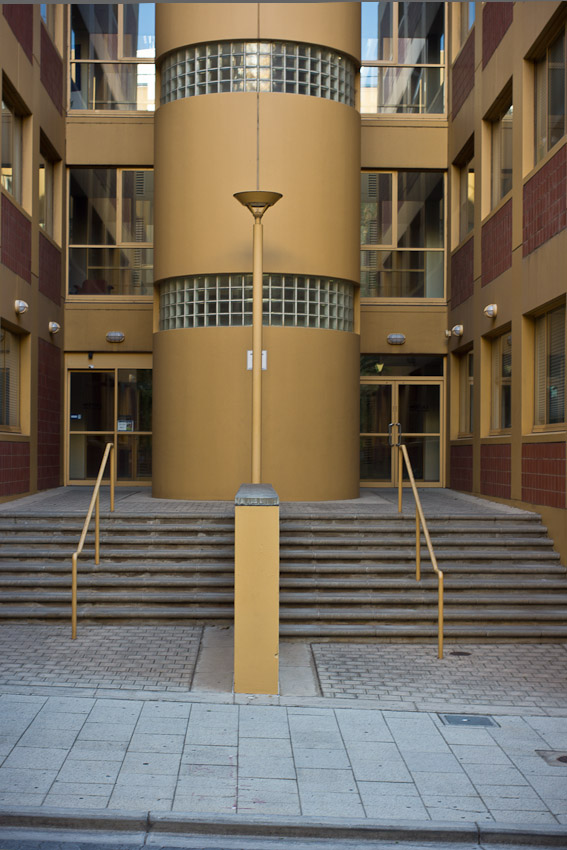 Gary Sauer-Thompson, University of South Australia, Adelaide, 2012
Today, in the corporatized university the governing decisions, including increasingly those affecting the curriculum, are determined by a top-down pyramid style of authority in order to generate increased revenue streams.
The new business model found its most powerful income stream in profession education. Professional education, such as in public or business administration, or law school, became the cash cow of colleges and universities; and one that was heavily reliant on overseas students.
This business model uses high tuition from graduate professional programs to finance the rest of the university. University degrees were tickets into the work force, whilst professors become revenue generators securing grants and contracts. The expanding on-line programs, often went with minimal investments in faculty, especially in the humanities, which were continually downsized. Increased teaching loads was the punishment for the failure to bring in research grants and academic teachers were seen as second rate academics.
The corporate managers are now using the weapons of cuts and austerity to shrink their already overstretched academic workforces. The long term strategy is to create a cheaper, more casualised, less unionised, more precarious and less protected academic labor force.
They can do so because of the emergence of the Internet, on-line classes. A specialist academic designs the curriculum for courses and then the university hires adjuncts to deliver the canned class. Here, the costs of offering a class are reduced, the potential size of the classes are maximized, and if and when the curriculum needs to be changed to reflect new market needs or preferences, it is simple to accomplish. There is no need to employ a lot of tenured academic staff. Those that bring in lots of research money will be retained.
What is driving the current austerity (staff retrenchment and cheaper courses) is decreasing public funding, falling demand for higher education services and reduced revenue for the corporate university. The overseas student bubble has burst, and that means cost cutting by university managers. High student debt, slow economic growth and low job hiring by companies also means reduced applications to graduate professional programs including business and law schools. Why go into debt if the jobs aren't there?
Along with these changes goes the erosion of the culture of critical thinking that enables students to think critically and connect their private troubles with larger public issues.
Posted by Gary Sauer-Thompson at 11:43 AM | Comments (7) | TrackBack
February 3, 2013
over-hyped scandal
We have yet more superficial political commentary about leadership struggles in federal Labor, the chaos of the Gillard Government, more erratic political polling that is interpreted as spelling a big disaster for Gillard Labor, and election race calling. It's a shock horror meme from a mainstream media, whose central narrative is one of the Gillard Government being a failure and in disarray.
 Bruce Petty
The over-hyped scandal meme is 'constant crisis'---the standard News Ltd text, for instance, –is ‘disarray’, ‘rocked’, ‘dramatic’, ‘frantic’, ‘shambolic’, chaotic. Every event that happens is plugged into the never ending disaster meme, as are the political rumours and journalist speculations about what might happen. It's the 'government teetering on the brink' narrative.
Russell Marks at the Conversation says that the Gillard Government is marked by dull neo-liberal grey due to the lack of fundamental purpose behind much of the government’s activity. He adds that:
It’s difficult to escape the conclusion that this is the sort of thing that happens when a social democratic party trades away most of its social democracy for the ideology of its opponents – free-market capitalism – and then attracts and rewards highly ambitious numbers-men....When a party is struggling to articulate its purpose, it’s no wonder some of its key agents run out of puff early.
According to Marks, the ALP has lurched from one panicked reaction to another. So Mark's "analysis" also buys into, and reinforces, the constant crisis narrative built on media beat-ups.
Why not explore an alternative or competing narrative: the Gillard Government is still standing and reforming in spite of the relentless attacks on it from the mainstream media, the Coalition and the Big Business. Why not analyse the difficulties and limits of a social democratic mode of governance in a low growth global economy where the economic outlook is deteriorating. Or what is happening to social democratic governance with an economy in structural transition?
If the Gillard Government has lurched from one panicked reaction to another, then this minority government is residing over low inflation, low interest rates, low unemployment, a massive investment boom, a “safe haven” currency, growing labour productivity, a sharemarket up nearly 20% since a carbon price commenced. How did this happen? Marks offers no account for the gap between his narrative and the current state of the economy.
Posted by Gary Sauer-Thompson at 8:54 AM | Comments (12) | TrackBack
February 1, 2013
SA Liberals:-disunity is death
The SA Liberals, who have historically been deeply divided between their conservative and moderate factions, now have a chance to get their house in order after Isobel Redmond, the stop gap or compromise leader, has resigned. Will they finally be able to do so?
That factional division has been so entrenched and embittered that the SA Liberals are a dysfunctional political party with often stock policy responses based on a few talking points about debt and deficits. They have been in the political wilderness for a decade or more and continue to publicly deny that there are no factions in the Liberal Party. They need a game changer more than just a breath of fresh air.
Redmond's time as Opposition leader was characterized by her anti-politician persona, a small-target, policy-lite approach to Opposition, political gaffes, and a lack of policy innovation. Despite this we know some of the policies:--- eg., the public service is to be reduced by 25,000 jobs, but the Liberals are afraid of saying and defending this kind of slash and burn in public.
This implicit neo-liberal politics of austerity has allowed Jay Weatherill, the Labor Premier, to stamp his imprimatur on the state political scene. Labor gives the impression of having got its house in order and Weatherill being in charge of things.
The Liberals are mostly climate change denialists, have little time for renewable energy, and should they get into power – they are promising to bring in laws that will make it unviable to build any more wind farms in many rural areas. They are backing fossil fuels and don't want to do do much at all about reducing Australia's greenhouse gas emissions.
They hold that wind and solar power are a major cause of rising electricity prices in South Australia despite wholesale electricity prices falling during the period when most of South Australia's wind farms were coming on-line.
Whoever is the new leader--Steven Marshall?--- of the SA Liberals, it remains a backward looking party. They continue to back the fossil fuel industry even though one of South Australia's coal-fired power stations in Port Augusta only operate for six months of the year whilst the other is to be closed-down indefinitely (largely due to the introduction of a significant amount of wind power in SA).
Update
Steven Marshall, the Member for Norwood, is the new leader of the SA Liberals. The old factional conflict was over the deputy leadership in the form of a Vickie Chapman (moderate) and Iain Evans (conservative) contest. Chapman wins and the Liberals are talking about unity.
ill the Liberal leadership group, which encouraged former leader Isobel Redmond to pursue a small-target strategy since the 2010 election, continue with that strategy now? Are they going to stick to a hard edged politics of austerity as a solution to a fragile, slow-growing regional economy in transition---that is, continue to argue that fiscal tightening is needed for economic growth is to recover? Will they address the declining minimum reading standard and declining standards of science and mathematics education in South Australia?
Posted by Gary Sauer-Thompson at 12:24 PM | Comments (13) | TrackBack