August 28, 2014
Shimmer Photography Biennal 2014: Jacqui Dean
The Shimmer Photography Festival in Adelaide is slowly growing from its modest roots as a local festival into a Biennale that helps to raise the profile of photographers and photography in Australia.
One of the photographic artists at the Arts Centre Port Noarlunga is Jacqui Dean, who is exhibiting Translucence that has been previously shown in Melbourne, Brisbane and Sydney.
This is still life of Australian flowers--native and introduced---that reduces the flowers to their essential, sculptural shapes:
 Jacqui Dean, Calla Lilies, Transluscence
Dean uses using x-ray and digital imaging to highlight the flowers interior structures. She worked with a radiographer. What you see on a screen from an x-ray isn’t interpreted in the same way ias a digital image in Photoshop.
 Jacqui Dean, Lisianthus Transluscence
X-Rays reveal everything that lies beneath what our eyes can see; a negative tonal arena in which their inquisitive, diagnostic electrons reign supreme, effortlessly revealing both order and chaos in our biology. These rays also allow us to see the most intimate structures of, in Dean’s case, her chosen Muse – flowers
August 26, 2014
Australian Photography: Kristian Hӓggblom
Kristian Hӓggblom is an Australian based photographer working with expanded modes of photography. He is the curator of Wallflower Photomedia Gallery in Mildura and is completing his PhD through Monash University.
One of his project is Viewing Platforms that documents Australian touristscapes--the infrastructure, so to speak, of mass tourism.
In this project tourist landscapes are considered as "heterotopian stages" that are charged with both negative and positive possibilities.The photographs explore the physical infrastructure that is imposed over particular landscapes and the intended and unintended psychological effects this has on tourist visitors. Do the tourists' try to get behind the stage that is provided for them to find something real to experience--an authentic experience?
 Kristian Hӓggblom, Broken Hill, 2010
Hӓggblom's perspective is akin to an anthropology of tourism as a cultural subject and their effects on the landscape and small ethnic communities.It questions the underlying assumption that tourism is bad and that it has negative effects for local communities and landscapes. Tourism does not provide real benefits to local people, that it has a detrimental transformative role in changing local socioeconomic relationships, and that it also destroys local cultural practices and artifacts by converting them into commodities that can be bought and sold.
 Kristian Hӓggblom, Bunker (with heart), Woomera, 2000
The negative view has its roots in both tourists often behaving irresponsibly, an unrestrained tourism development in ecologically sensitive areas and in places where tourism is out of the control of local communities and key archaeological sites being overrun by tourists.
Hence the idea of ecotourism, which is seen as a way to protect fragile ecosystems while providing some economic benefit to local communities. However, the term ecotourism has been taken over by large tourism companies promoting “alternative tourism,” which is merely mass tourism with a different label.
On the other hand, authenticity in modern tourism is the search for a travel experience with “the Other” (non-home) is important to many tourists escaping from the pressures of their daily routine. With travel, they can break out of the routine and experience a “real” (but largely imagined) life and so escape from the confines of social strictures in their everyday lives.
August 22, 2014
Australian photography: Jeff Moorfoot
Jeff Moorfoot is a former advertising photographer, a former Vice President of the Victorian Division of the AIPP, who is currently the Festival Director at the Ballarat International Foto Biennale. He does a magnificient job at ensuring that Australians have access to contemporary art photography in a printed form.
One of Moorfoot's projects was Legumes Morts, which was made with a flatbed scanner replacing the camera as the imaging device. The subject matter was bits of vegetable matter that come from his garden and which were in an advanced state of decomposition. I love the subdued palette and the subtle lighting of this work:
 Jeff Moorfoot, Untitled, 2013, from the series Legumes Morts
This series references, and contemporises, the photograms made in the analogue darkroom and Anna Atkins ' cyanotypes of British algae.
 Jeff Moorfoot, Garlic with Bamboo Leaves, 2013, from the series Legumes Morts
I don't know the process by which this work was done. It looks like careful studio photography (using a Kodak folding camera?) to me along with high grade printing. Is the print then scanned with a flatbed scanner.
Moorfoot currently has a show at Manning Clark House in Canberra entitled Requiem for a Lost Love, which takes a more abstract turn.
August 20, 2014
The Sievers' Project
“The Sievers Project” is one in which six “early career” photo-media artists respond to Wolfgang Sievers’ photographs in both direct and more esoteric styles. It was organized by Melbourne’s Centre for Contemporary Photography (CCP) and the artists – Jane Brown, Cameron Clarke, Zoe Croggon, Therese Keogh, Phuong Ngo, and Meredith Turnbull – were given an open brief.
Therese Keogh departs from photography entirely by replying to an uncharacteristic Sievers photograph by creating a delicate pencil reproduction alongside a conceptually based sculpture. In contrast Jane Brown, like Cameron Clarke, responded to Sievers' legacy by returning to actual locations Sievers photographed and focused on some of Sievers' more industrial images.
Brown, for instance, revisited various sites including the Ford Factory and AMCOR’s Australian Paper Mills in Melbourne.
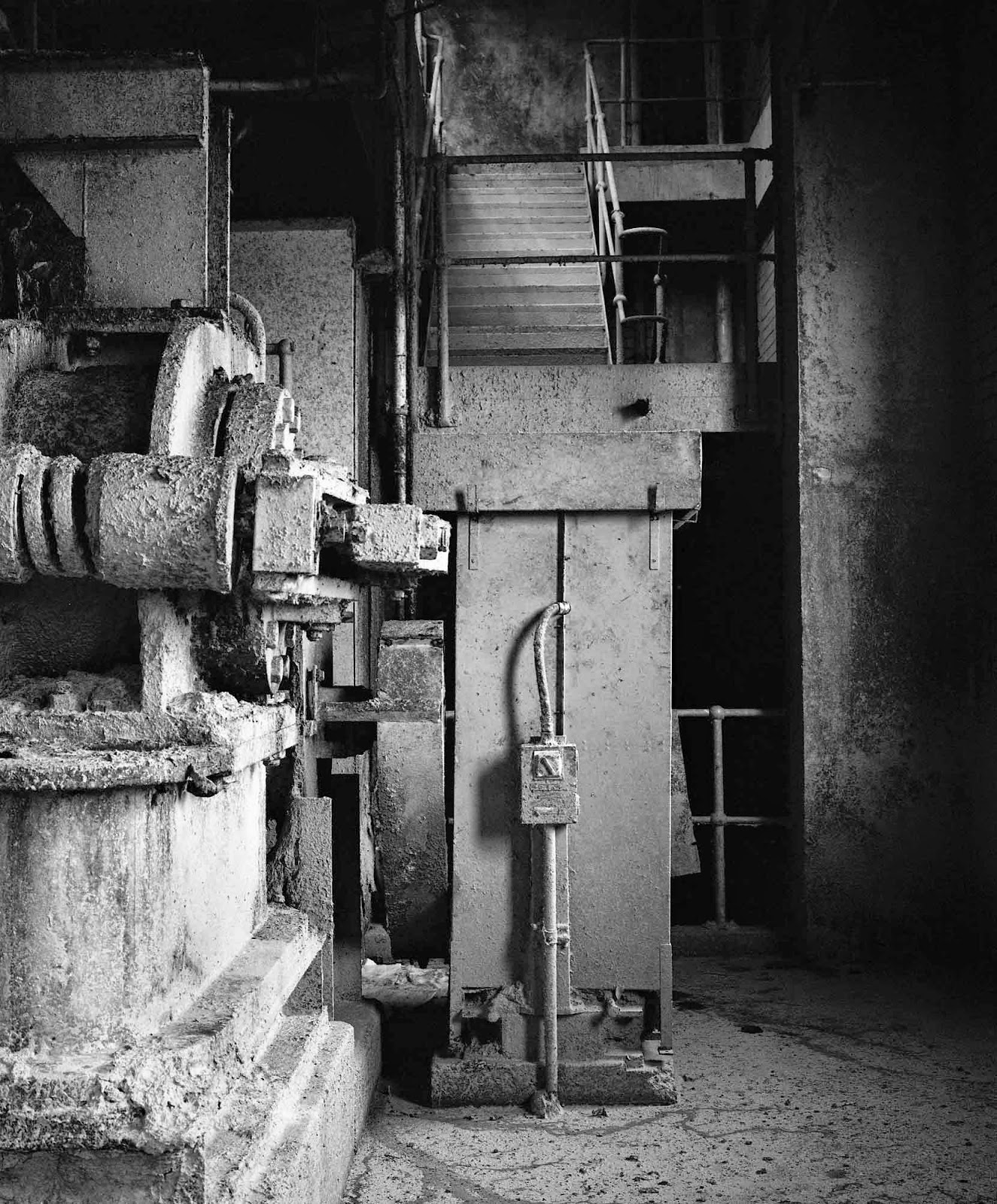 Jane Brown, Former Amcor and APM site, Fairfield, silver gelatin print, toned, 2014.
Wolfgang Sievers is an icon in Australian modernist photography and his industrial photos of Australian manufacturing was the core of his photography. That was an era when Melbourne was a manufacturing hub. Now the bulk of Australian industry is a distant memory, with the remnants of manufacturing probably being melted down for scrap.
The once pristine, precision machinery Sievers' celebrated in black-and-white is now covered in dirt, dust and gunk. These are gritty testaments to the changing structure of the Australia economy are eerie and tragic.
 Jane Brown, Former Amcor and APM site, Fairfield, silver gelatin print, toned, 2014.
We are a long way from the Bauhaus and the iconic images of the industrial age in Australia.
This is a Melbourne centred work that doesn't explore the big mining project in WA or the modernist architecture in Adelaide which Sievers' photographed. It's understandable, given that Melbourne was where Sievers lived and primarily worked, but in doing so it does fail to engage withe death and breadth of Siver's modernism.
August 14, 2014
2014 Bowness Prize finalists: Claudia Terstappen
Another interesting contemporary art photographer amongst the diverse 2014 Bowness Prize finalists is Claudia Terstappen whom I've posted on before in relation to her In the Shadow of Change exhibition at the Monash Gallery of Art, at Wheelers Hill, Melbourne, Australia.
That pictures in that exhibition were part of a vast archive of landscapes and places undergoing significant change. The picture in the 2014 Bowness Prize continues this as it is part of a series of Vanishing Landscapes and it alludes to the human influences on Australia’s natural environment and the prospect of impending change.
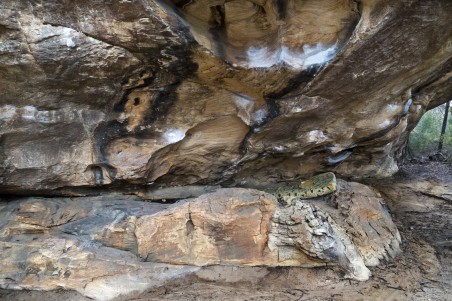 Claudia Terstappen, Bouldering, from Vanishing Landscapes, 2014, pigment ink-jet print
In her Artist's Statement Terstappen says that:
the small signs of human intervention often herald the beginning of larger changes that negatively impact on the ecological system. The small and secret paths of our childhood wilderness have been traded for dirt roads, bitumen and housing developments. Since European settlement, hundreds of species have gone extinct and it is likely that many more species will follow in the near future.
This is especially so with the impact of global warming on the Australian continent. According to the IPCC, the world has warmed by about 1C over the past century and will get even warmer – by between 0.3C and 4.8C – by 2100, based largely on the amount of greenhouse gases released into the atmosphere.
The Great Barrier Reef, for instance, is under pressure from the oceans warming due to climate change, pollution running off the land into the sea, coastal development and direct impacts such as fishing. Then we have the dredging near the reef for the expanded Abbot Point port, near the town of Bowen, will require five million tonnes of seabed to be dug up and dumped within the reef’s marine park. The latest healthcheck of the Great Barrier Reef shows the overall outlook is “poor”, and getting worse
Even though it is unlikely that global action will keep global temperature rises below 2 degrees in Australia the ethical dimensions of climate change have given way to the rhetoric of self-interest and economic rationality--- to focus on protecting Australia’s “international competitiveness”, “domestic economy” and limiting action to our “appropriate” or “full proportionate share” of any global mitigation effort. This form of economic rationality means inaction.
That then leaves us with aesthetic reason.
August 11, 2014
SALA in Adelaide: photography + history
It's SALA Festival time in Adelaide.
The annual SALA Festival is a state wide celebration and promotion of the diverse talents of South Australian Living Artists. There are hundreds of exhibitions across the state--too many for one person to see.
One exhibition that I have managed to see is the Everyday Memories one at the Light Gallery, run by the Centre of Creative Photography (CCP). This is an exhibition of black and white photographs of the ordinary and commonplace in South Australia's rural and urban landscapes by Louisa Cowling-Tziros (landscapes), Rosalie Wodecki (Cheetham salt fields) and Victor Wodecki (architecture).
It stands out from the deluge of colour images on social media, with their apparent loss of the referent amid a postmodern (Baudrillard) hall of mirrors. The hall of mirrors metaphor rejects the view that photographs are mirrors with memories and states that a postmodern representation inevitably succumbs to a depthlessness of the simulacrum, or that it gives up on truth to wallow in the undecidabilities of representation.
The series in the exhibition that intrigued me was Victor Wodecki documentary photographs of the old suburban buildings and corner shops. This is informed by, and tied to, historical memory, and it establishes a link between Australian history, public memory and personal experience. It reminds me of the work of Richard Stringer in Brisbane.
This is a documentary photography with an intimate eye on Adelaide's urban history whose present is marked by the closing of many small businesses after the global financial crisis. Wodecki's picture below of a shop in Holbrooks Road in Adelaide's western suburbs is a good example of the process of historical reconstruction and photography's relationship to historical meaning.
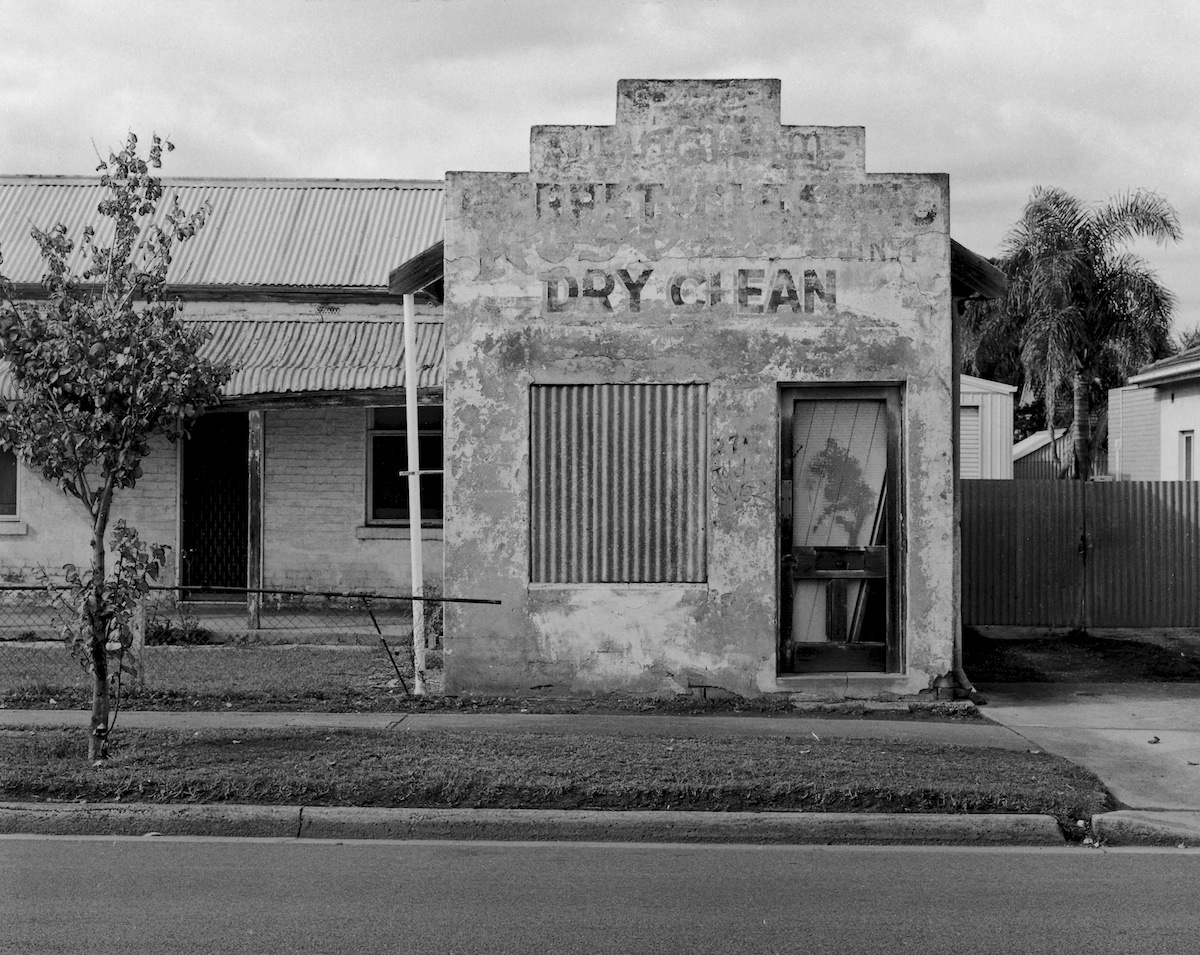 Victor Wodecki, Holbrooks Rd., 2014, silver gelatin print
Wodecki says that in the 1950s and 1960s people used to go to the corner shop to buy newspapers and lollies. Those corner shops have now disappeared because they are inefficient and anachronistic compared to the suburban retail mall owned by Westfield. Consequently, many of these shops now stand abandoned and empty. What is left, apart from the decaying buildings, are the private memories of a former mode of urban life.
Walter Benjamin, as a chronicler of modernity, called for a history which could redeem the past by yanking it into the present. His figure of the Angel of History whose face turns towards the past as she is blown into the wreckage of the future might also represent the documentary imagemaker who can only make images within the historical present, even as it evokes the historical past.
Documentary photography is usually a reconstruction-a reenactment of another time or place for a different audience-----a graphing of history, in and through, the photographic image onto the present.
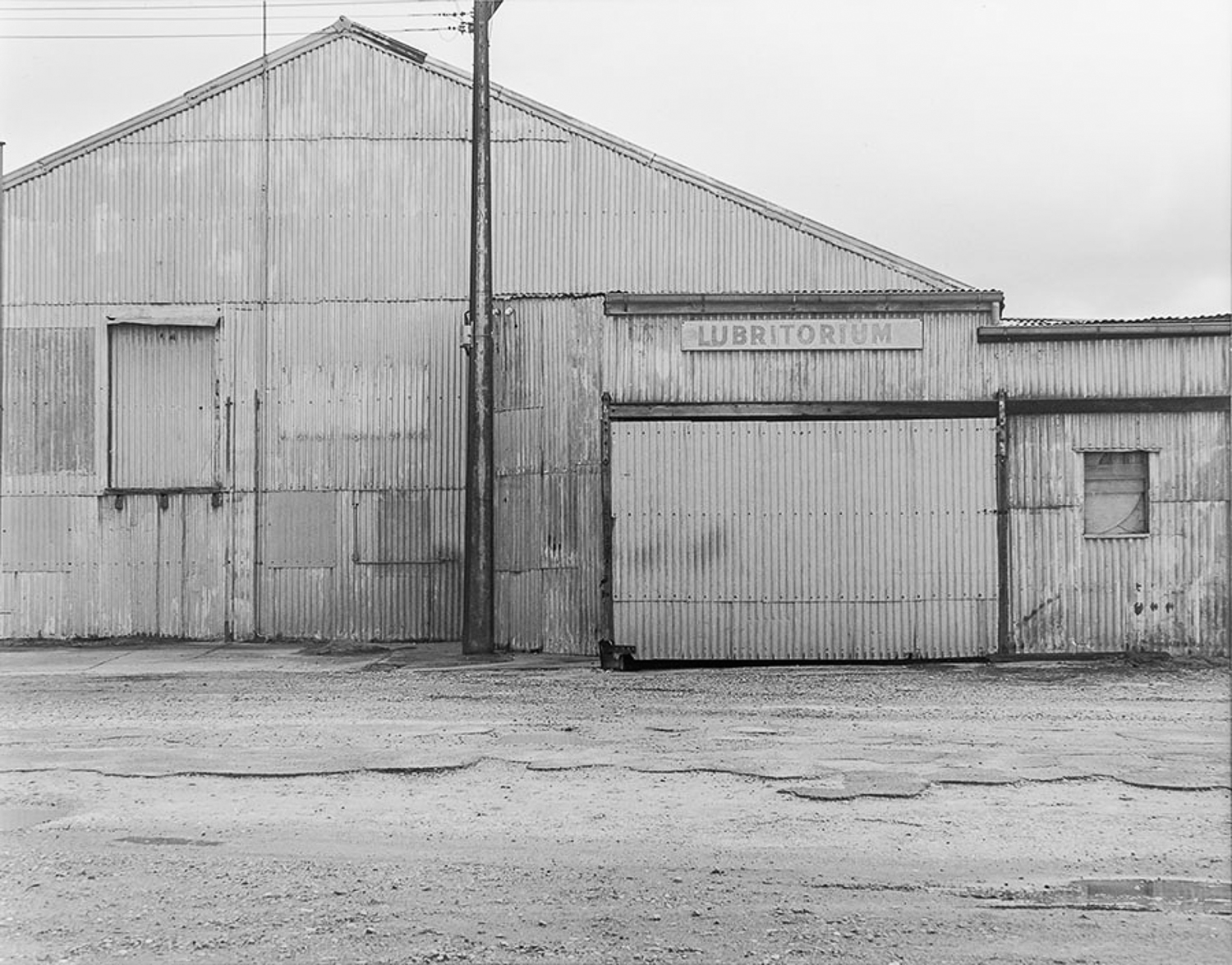 Victor Wodecki, Lubitorium, 2014, silver gelatin print
Is this a nostalgia for a past that is already lost?
Wodecki, in photographing a disappearing species in the form of traces of the past is providing a stability to an ever-changing historical reality, in the form of a visual archaeology that uncovers the past we have forgotten. What is presented to us is a collection of fragments. The photographs in themselves "are dumb" and their meaning is constructed in the web of interpretations that we give them. The importance of Wodecki's personal memories is that they indicate that his photography does not so much represent this past as it reactivates it in images of the present.
This is an example of a rethinking of documentary photography--- a recognition that photographic representation does not simply hold up a mirror to past events, since the representational refers to the codes, conventions, and social schemata within our specific culture. Wodecki's personal memories help us to make sense of his Sorry, We're Closed series. The mundane and ordinary architecture is embedded in a history, placed in relation to the past, given a new power, not of absolute truth but of repetition.
This deconstructs the all too simple dichotomy between, on the one hand, a naïve faith in the truth of what the documentary image reveals—the discredited claim to capturing events while they happen—and on the other, the embrace of fictional manipulation. Of course, even in its heyday no one ever fully believed in an absolute truth of documentary photography, since as they recognized it as a genre or style rather than the essence of photography.
The ground Sorry, We're Closed stands on is not an unearthing a coherent and unitary past; it is one that deploys the many facets of the hall of mirrors to highlight the depth of the past's reverberation with the present.
August 1, 2014
2014 Bowness Prize finalists: Nici Cumpston
The 2014 Bowness Prize finalists are very diverse and are an indication of what is happening in contemporary art photography in Australia. One example is a picture of a grass tree (Xanthorrhoea) from Nici Cumpston's 2013 Contested Places series that is entitled ‘Mulyawongk’.
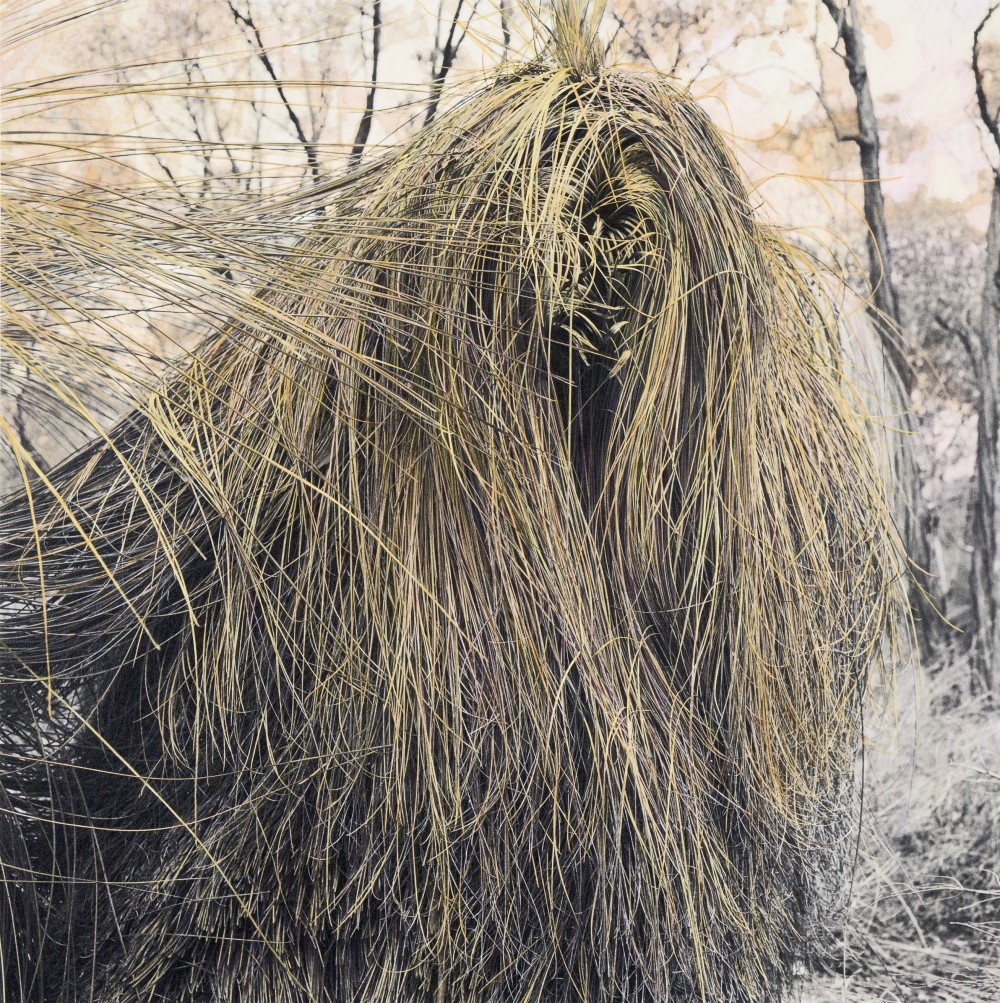 Nici Cumpston, Mulyawongk’, Whroo – Rushworth State Forest, 2013, crayon on pigment ink-jet print
Whroo Historic Reserve is a gold mining area near Rushworth, Victoria where Cumpston noticed evidence of Aboriginal peoples occupation of this land when walking around. She says:
The story of the Mulyawongk has stayed with me since I was a child growing up along the Murray River in South Australia. A Ngarrindjeri cultural story, the Mulyawongk is likened to a bunyip rising from the River if a child does something wrong. Archie Roach sings a haunting lament of his late wife Ruby Hunter, her relationship to the River and the Mulyawongk.
Cumpston is one of a number of contemporary artists addressing Indigenous issues in post-colonial Australia--an archaeological digging into the Australian landscape that reconnects to a sense of belonging to land, to place. It is the hand colouring that gives the grass tree in a dry landscape its eeriness.
So we have a photograph that needs to be read as it is overlaid with cultural meanings as it embodies the codes, values, and beliefs of our post-colonial culture. We have a picture that is ambiguous and complex.