« October 2008 | Main | December 2008 »
November 30, 2008
Berg on internet censorship
Chris Berg has an op ed in internet censorship in the Sunday Age in which he argues that the claim by the Rudd government that it s proposed internet filter is designed to eliminate child pornography is too tricksy by half. He says:
After all, child pornography is already illegal. And imposing an elaborate filter on every Australian internet connection is unlikely to have a significant impact on the child pornography trade...the biggest problem with the filter isn't technical and it isn't its likely failure to reduce child pornography.The biggest problem is a little word that Mr Conroy slipped out in the middle of a Senate committee hearing. The pilot filter program will not only target the existing blacklisted sites, most of which are child pornography, but will also target "unwanted" content, whatever that means.The Government has developed a secret list of 10,000 unwanted sites (there are only 1300 on the current blacklist).
This is the point where Senator Government becomes tricky. Despite all the indications of the broadening of what is to be filtered, Conroy's, and the Rudd Government's, talking points are that the issue is just about child pornography. It's the politics of deception.
Berg continues:
What does it say about Australian politics that the reaction of both major parties to such a liberating technology is to demagogue about its dangers? Our politicians rave about evils online more than any other liberal democracy. As a consequence, the Federal Government's proposal is far more extensive than any other internet censorship scheme outside the totalitarian world.There is a certain element of Australian political culture that sees censorship and banning as the panacea to almost every social and policy question. But wowserism dressed up in concerned rhetoric about the sanctity of childhood is still wowserism.
It is not just wowerism. What this issue has disclosed is the authoritarian tendencies within the political culture of Australian conservatism. That conservatism is deeply embedded in the ALP Right and it is deeply hostile to Australian liberalism and its conception of individual freedom.
Posted by Gary Sauer-Thompson at 6:36 AM | Comments (4) | TrackBack
November 29, 2008
Canberra watch
There is such a fetish about budget deficits in Canberra. It is seen as the hall mark of economic mismanagement and irresponsibility. The politics is that Labor equals budget deficit because they cannot run the economy. And as this politics goes, a deficit is not seen as a way to prevent he economy from sliding into recession.

It is hard to build a case against the way the Rudd government has responded to the economic downturn on budget deficits are bad. What is the next step? That the Rudd Government is going a spending spree? That doesn't cut much ice when the general economic consensus is that there is a need to boost demand through government spending on infrastructure and aggregate demand.
What sits underneath this deficit is bad view is the neo-classical view that economic systems tend naturally towards equilbrium when markets cleared and all resources are fully allocated; and that regulation is distrusted and needs to be minimised.
Posted by Gary Sauer-Thompson at 4:30 AM | Comments (4) | TrackBack
November 28, 2008
recycling water----Queensland backs off
The rains have come in Queensland and the Bligh Government has used the big wet to back away from both building the Traveston Dam and investing in recycled water so that recycled waste water could be pumped to Brisbane's Wivenhoe Dam. That still leaves Brisbane dependent on one source of water supply ---dams that are dependent on the rain falling in the catchment area of the dam. In backing away from making the shift to a more sustainable mode of urban life Brisbane remains vulnerable in terms of water security.
Urban Australia is still too reliant on single sources of water - mainly rain-fed dams. Australian cities can no longer rely on one source of water, whether it be dams or the River Murray as for Adelaide. Water security, especially in a warmed -up southern Australia requires a diversification of water supplies that includes recycling storm and water water since these are less-climate dependent sources of supply.
The National Water Commission says that:
Australian cities of the future will be designed water sensitively – and it is important that water recycling continue to be available as the backbone for more enlightened water sensitive urban designs.The National Water Commission therefore regards water recycling in all its forms as a vital option to re-build Australia’s water security and as an enabler for water sensitive urban design. The Commission believes it should be considered on its merits with an open mind alongside other less-climate dependant water sources such as desalination, stormwater capture and inter-basin water transfers.
The opposition to recycled water from the conservative side of politics, notably The Australian's campaign against what it calls "recycled sewerag"e, over looks the history of recycling of water for non-drinking purposes long been widely accepted across Australia, for use by industries, irrigation and households.
Moreover, recycled water has also been used for drinking purposes for zonks – with many communities in Australia drawing on water supplies --eg., the River Murray --that contain treated wastewater discharged from upstream sources.
Given the effects of global warming Australia needs to all put all water supply options on the table and invest in the development and commercialising of new water technologies including de-salination technologies. Issues of sustainability, long given lip service by politicians and decision-makers, do need to become a substantive part of the formal agenda of politics.
It is difficult to understand the entrenched opposition to making use of different water supplies in favour of relying on rain filled dams given the lack of water in parts of regional Australia, lessening river flows, water restrictions in urban Australia, and the way that storm water just runs into the sea.
Posted by Gary Sauer-Thompson at 6:53 AM | Comments (10) | TrackBack
NSW Health: Garling Report
On the eve of CoAG there is the promise for extra Commonwealth funding for health care in the form of a new five-year health funding agreement between the Commonwealth and the states designed to end the blame game.
The states' demands are for extra funding. They are seeking a more realistic indexation arrangement and a restitution in the key area of public hospital funding of the 50-50 funding split that was eroded under John Howard and Peter Costello. The federal government funds about 42 per cent of public hospital services. The states are also seeking a one-off catch-up payment to reflect poor deals in the past on public hospital share and indexation.
More than extra funding is needed. The recently released Garling Report into hospitals in NSW indicates that the states need to reform the way health is delivered. Commissioner Peter Garling, SC, said that though the NSW had a public hospital system of high standard, that system was on the brink of collapse:
Given the demographic changes and the rising costs, it is the case that we have entered into a period of crisis for a public hospital system which has always been free and accessible to all. If public hospitals are to survive as providers of free care for all, there will have to be some radical changes in the way they do business. We are on the brink of seeing whether the public system can survive and flourish or whether it will become a relic of better times. To start with, a new culture needs to take root which sees the patient’s needs as the paramount central concern of the system and not the convenience of the clinicians and administrators.
So it is not just a case of more money from the Commonwealth to maintain real rates of growth in funding in the face of an ageing population and technological change. Radical changes are needed. What are these?
For Michael Costa this involves the federal Government having responsibility for all aspects of national health care, including funding and administration of the public hospital system. Plus hospital-level competition on quality and cost effectiveness of service provision should be introduced with resources flowing to the best hospitals.
Garling takes a different tack. He says radical reform includes new models of care at the clinical unit level at the state level:
The doctors, nurses and allied health professionals will need to replace the old system where different specialists would see the patient but no one person would necessarily take complete charge of the patient’s care. A new model of teamwork will be required to replace the old individual and independent “silos” of professional care. Furthermore, the rigid demarcation between what a doctor’s job is, and what a nurse’s job is, needs to be consigned to history. Once the concept of teamwork is accepted as the norm in treating a patient, it is easier to see why a qualified nurse practitioner should be able to do many jobs once reserved for doctors.
This means the changing of a professional culture and this can only occur if the why and wherefore of reform is taught in the undergraduate and early clinical training years. This means the creation of a modern, well trained, flexible hospital workforce.
This reform needs to be backed up investment in informations technology so that the information collected is to be directed to how well the patient has been treated, not to process-driven, often politically-driven, data which may make administrators more comfortable, but not the patients.
In contrast to Costa's top down reform model Garling says:
that redesign of clinical practices must be a bottom-up reform driven by clinicians; that information about the safety and quality of treatment at the unit level is the greatest guarantee of a quick change-over to evidence based best practice models of care; that the only way to avoid a slide of the present clinical standards into mediocrity or worse is by strengthening the training of new clinicians in better, safer treatments based on a patient centred team approach; that the safety and quality of public hospital care should be the highest priority of the public hospital system, and that its employees need to implement this at the individual patient level.
Garling adds that know that, as a rule, a person with an illness is often better off being treated outside rather than inside a hospital. Of course this does not apply to someone who suffered a serious accident or has taken the wrong medication or is suddenly struck with chest pains. But the bulk of chronic conditions are
better dealt with in the home or in the community than in an acute care bed.
Posted by Gary Sauer-Thompson at 4:58 AM | Comments (2) | TrackBack
November 27, 2008
a note on combating climate change
Over in a little corner of the public sphere we have this kind of debate amongst the Quadrant conservatives. Climate change denialism has a life all of its own; one that has yet to come to terms with market failure of greenhouse pollution or the need for a more sustainable mode of life.
In the world of public policy the debate is concerned with a different set of issues---finding ways to reduce greenhouse gas emissions to 1990 levels by 2020. There are multiple pathways to achieving decarbonisation or a lower carbon economy. They include reducing energy use, increasing energy efficiency, switching to low carbon energy sources and capturing carbon emissions for long term storage. However Australia's energy systems are characterised by lock-in, with coal fired technologies remaining dominant despite the existence of others that could meet current and future needs more effective and the slow rates of change in the physical structure of the built environment.
One pathway to help meet the targets to cut greenhouse gas emissions is through increased energy efficiency. That means improving the energy performance of the existing building stock by retrofitting older homes to make them energy efficient. Building insurance would be dependent on reaching a certain energy efficiency standard.
One way to address the historical dominance of producing electricity through coal -fired power stations is though decentralising energy systems, so as to help smaller-scale technologies get a foothold. This includes solar hot water panels on homes, a combined heat and power system for a block of flats, or a larger renewable power plant in a city centre or a rural area.
The argument here is that Australia is entering a period of energy transition. The main forces driving change are a growing consensus about the scale and importance of climate change, the need to ensure secure energy supplies for Australia in the face of rising global demand and the urgent imperative to re-shape policy in order to decarbonise the energy we use and to secure sustainable supplies for the long term. Achieving these goals requires that policy makers focus their attention on the relationships between energy systems, the built environment and the human activities within it. A lot of Australia's carbon emissions come from energy used in buildings.
Posted by Gary Sauer-Thompson at 4:18 AM | Comments (11) | TrackBack
November 26, 2008
Go8 on university research
The Go8 group of universities want to concentrate research investment in their hands and so shift away from an egalitarian model to an elite model of research funding. Their argument is intensified global competition requires Australia to provide more resources to proven performers, most of whom work within the Go8. This would enable Australia to remain competitive in research, since if Australia does not have world class -research intensive universities, it won't be able to participate fully int he international research system.
And so we have the dynamics of globalization working themselves out in higher education. As Rupert Murdoch observed in his Boyer Lectures education is now a global currency. So what would happen to the rest of the universities on the Go8 model? The bottom tier ones can become community colleges where 2 year degrees are in vocational training, and they act as a pathway into the undergraduate universities as a second tier, with a Group of 8 university concentrating on research and postgraduate work at the top tier.
This model, which is the Californian system of a community college network with its three distinct tiers, has been suggested by Glyn Davis, and it is an argument for a division between teaching and research institutions.
It looks appealing but, as things stand now, it would probably relegate universities in regional areas to a second -class status of teaching only universities, since all the Go8 universities are in the capital cities. The implication is that the Go8 model would nourish a handful of historically privileged universities.
Another body of universities--- the Innovative Research Universities Australia representing James Cook, Flinders, Griffith, La Trobe, Murdoch and Newcastle universities ---make another point out. Since the Go8 universities already attract 74 per cent of competitive grants, so the deliberate concentration of research funding in a selected few institutions based on past performance will weaken competition, restrict diversity, inhibit the emergence of new fields of research and stifle innovation.
Thirdly, what happens to the non-aligned universities---- Charles Darwin, Central Queensland, Southern Queensland, Sunshine Coast, Southern Cross, Deakin, Victoria, Ballarat, Swinburne, Western Sydney, Edith Cowan, New England and Canberra universities, as well as the Catholic University, who had 23 per cent of Australian doctoral students last year?
Posted by Gary Sauer-Thompson at 8:38 AM | Comments (12) | TrackBack
the party is over
So BHP has walked away from its takeover bid of Rio Tinto. That sends a very clear signal about the economic downturn, commodity prices (aluminium, copper, nickel, iron ore and coal) going lower, and the unlikeliness of China's economic growth continuing to power a long-term seller's market for all the major commodities. It's contraction all round these days.
 Moir
Moir
This has implications for the global balance of payments system, which has been dominated in the last decade by the trade and investment relationship between China and the US. This relationship where excess US demand and excess Chinese supply were in a temporarily stable balance and as part of running a trade surplus, China necessarily accumulated dollars, which were exported to (invested in) the US. is now undergoing a major shift. Domestic consumption is falling in the US and that gives rise to overproduction in China.
In Can China Adjust to the US Adjustment? Michael Pettis says:
But since the balance of payments must balance, something else must happen to equilibrate this decline in US household consumption. Either consumption in other sectors of the US economy (i.e. the government) must expand by that amount, or consumption by China (by which we mean all foreign countries, with China bearing the brunt) must expand by that amount, and as it does so its savings must decline. To the extent that neither happens, global overproduction – which consists mainly of Chinese overproduction – must decline by that amount. This is just a way of saying that if net American consumption (the excess of consumption over production) declines, either consumption must rise somewhere else, or production must fall.
Everybody ---including BHP---has been banking on the first scenario--that consumption will rise somewhere else, namely China to prevent a global slowdown. China was the world's insurance policy. But, as Pettis points out, this is unlikely:
In the best possible world Chinese consumption would rise by exactly the same amount as US consumption drops, and a new stable balance would quickly be achieved with one major difference: the US trade deficit would decline, and the amount of capital exported by China to the US would decline by exactly the same amount ..... But if it doesn’t, total global consumption must decline, and the world economy slow – in fact as it slows global income will decline with it, so that both savings and consumption could decline, trapping the world in a downward spiral.
By how much must Chinese consumption rise to prevent a global slowdown? Given that the US economy is about 3.3 times the size of China’s, and consumption accounts for less than 50% of China’s income, Chinese consumption will have to rise by nearly 40% in order to accommodate a 5% increase in US savings. This is clearly unlikely.
Since domestic demand in China is not rising fast enough there is massive overproduction.The option of relying on net exports to protect itself from its overcapacity--- ie., trying to export their way out of a slowdown---is not there. So there is going to be a global slowdown.
All that Australia, like the US a current-account deficit countries, can do is expand moderately so as to slow down the adjustment period. China, as the central current account surplus country, needs to force domestic demand up. Since expecting private consumption to rise quickly enough is unrealistic, it has to be public consumption – and that means large fiscal deficits. The other option is for both current account deficit and surplus countries to work to expand global trade.
Posted by Gary Sauer-Thompson at 5:15 AM | Comments (10) | TrackBack
November 25, 2008
broadband blues
And so we continue to struggle and crawl our way to a national broadband network (fibre to the node) that offers minimum speeds of 12 megabits per second and covering 98% of the country. It's a big infrastructure investment built on a second rate concept and half measures and a tender process that doesn't spell out the regulatory framework in which competition will operate. Things look a mess for this cart before the horse scheme even though the tender bids are due in at high noon tomorrow.
Telstra continues to pay its high stakes game of bluff on regulation and separation---it will not bid unless there is a guarantee that it will not be structurally separated into separate companies - one limited to offering the network hardware and the other offering retail services to customers in competition with other retailers. Telstra continues to demand 1an after-tax 8% return on its investment and to talk in terms of a wholesale access charge of $59 a month and charging competitors $85 for a basic service of 512 kilobits per second. Monopoly prices for nothing special.
Doubts persist about the ability of the Optus-led Terria consortium, which is suffering credibility problems due to questions over its ability to source funding during the credit crunch and Telecom New Zealand, TPG-Soul and TransACT pulling out. The financial crisis has removed any outside industry bidders, and possibly the Optus-lead Terria bid, due to the unwillingness of the banks willing to lend much money at all to anyone. Most analysts and investors believe Telstra remains the only party capable of building and coughing up the money for a network which is expected to cost at least $15 billion.
It's in Telstra's interests to stall the competition, to eliminate their existing competition and to block open points of presence. This is a company that still thinks in terms of a being a monopoly and it has has sought to drag out the process time and again. It will continue to pull its usual stunts of legal challenges, go-slows, refusal to put its traffic on the new network and threats to build its own network if anyone else wins.
Since there is little talk of encouraging initiatives to build fibre or other high speed options in the last kilometre or two from the node to the home and business, it is unlikely that Australia will emerge from the looming recession with a 21st century communications industry.
Posted by Gary Sauer-Thompson at 5:01 AM | Comments (11) | TrackBack
November 24, 2008
Murray-Darling Basin: more bad news
A report by CSIRO on ground and surface water resources in the Murray-Darling Basin warns that climate change will threaten already strained resources in the Basin. It says:
The south of the MDB was in severe drought from 1997 to 2006 and the catchment runoff in the southernmost parts of the MDB was the lowest on record. This event would occur once in more than 300 years without climate change. Such conditions will become increasingly common. The drought conditions in the south of the MDB have worsened in 2007 and 2008.
Though the impacts of climate change by 2030 are uncertain the report says that surface water availability across the entire MDB is more likely to decline than to increase and that a decline in the south of the MDB is more likely than in the north. The six most accurate climate change models predict a drier future for the southern part of the basin than the full range of models:
Under the median 2030 climate, diversions in driest years would fall by more than 10 percent in most New South Wales regions, around 20 percent in the Murrumbidgee and Murray regions and from around 35 to over 50 percent in the Victorian regions. Under the dry extreme 2030 climate, diversions in driest years would fall by over 20 percent in the Condamine- Balonne, around 40 to 50 percent in New South Wales regions (except the Lachlan), over 70 percent in the Murray and 80 to 90 percent in the major Victorian regions.
The report predicts that by 2030 there will 50% less water flowing at the end of the catchment ----the Murray Mouth end in South Australia ---- than now, if the climate change conditions of the past ten years continue. It says that there will be increased use of groundwater even though current groundwater usage is unsustainable in seven of the twenty high-use groundwater areas in the MDB. Surely the Murray-Darling Basin Authority will set caps on future surface and groundwater use.
Why then is the Brumby Government in Victoria building a pipeline to take water from the Victorian part of the Murray River for Melbourne? It is from that threatened southern Murray-Darling Basin that 75 billion litres will be diverted down the Goulburn pipeline to Melbourne. The State Government is investing $1 billion in new irrigation infrastructure in the hope of stemming the amount of water that is "lost" each year, and thus keeping both farmers and city domestic consumers happily supplied.
Sure Melbourne's water storages are at 33.3 per cent capacity compared to 40.2 per cent at the same time last year and the threat to move to stage 4 water restrictions, under which all outdoor watering would be banned, looms. But why that pipeline option instead of capturing storm water and recycled water? Why is the Commonwealth Government merely looking on whilst this happens? Why did it agree to this pipeline?
The Brumby Government and the water policymakers are not willing to encourage urban and regional water re-use when they have committed large chunks of money to a questionable pipeline and an expensive desalination plant with its high cost of water. Isn't it about time it started looking at reducing the amount of land used for irrigated agriculture (which consumes 77 per cent of the state's water) rather than continuing to prop up uneconomic irrigation farms?
At some point the Commonwealth Government is going to have to take some serious steps to making the irrigation practices in the Murray Darling Basin more sustainable. One step requires pressuring the states to prevent the projected rise in ground water.
Posted by Gary Sauer-Thompson at 4:21 AM | Comments (15) | TrackBack
November 22, 2008
what kind of public works?
Mike Davis has published a couple of interesting books ---City of Quartz and Ecology of Fear --- which created controversy over Davis’s ambiguous balancing of academic research and reportage. This work, which represents a coming together of Davis's urban concerns with his wider environmental agenda, can act as a prism through which to evaluate interpretations of the modernist city based on supersized lifestyles-addicted to fossil fuels, shopping sprees, suburban sprawl, and gas guzzling cars. Will Americans give up their SUVs, McMansions, McDonald's, and lawns?
Davis has an interesting couple of paragraphs in a recent article in Salon on the US economy.
America's "Futurama" is defunct. The famous walk-through diorama of a car-and-suburb world, imagineered by Norman Bel Geddes for General Motors at the 1939 New York World's Fair, has weathered into a dreary emblem of our national backwardness. While G.M. bleeds to death on a Detroit street corner, the steel-and-concrete Interstate landscape built in the 1950s and 1960s is rapidly decaying into this century's equivalent of Victorian rubble.
As we wait in potholed gridlock for the next highway bridge to collapse, the French, the Japanese and now the Spanish blissfully speed by us on their sci-fi trains. Within the next year or two, Spain's high-speed rail network will become the world's largest, with plans to cap construction in 2020 at an incredible 6,000 miles of fast track. Meanwhile China has launched its first 200-mph prototype, and Saudi Arabia and Argentina are proceeding with the construction of their own state-of-the-art systems. Of the larger rich, industrial countries, only the United States has yet to build a single mile of what constitutes the new global standard of transportation.
Davis argues for a public-works strategy for national recovery. But what kind of public-works strategy? Should it be transport infrastructure, health and education or green manufacturing? Davis has a history of being critical of the modernist urbanization of Los Angeles
He says:
I'm not an infrastructure-crisis denialist, but first things first. We are now at a crash site, and our priority should be to save the victims, not change the tires or repair the fender, much less build a new car. In the triage situation that now confronts the president-elect, keeping local schools and hospitals open should be the first concern, rebuilding bridges and expanding ports would come next, and rescuing bank shareholders at the very end of the line.
He says that saving (and expanding) core public employment is, hands-down, the best Keynesian stimulus around. Federal investment in education and healthcare gets incomparably more bang for the buck, if jobs are the principal criterion, than expenditures on transportation equipment or road repair.
Will this happen in Australia? Or will we go the big infrastructure route and cut back on health and education?
Posted by Gary Sauer-Thompson at 3:30 PM | Comments (7) | TrackBack
good old days
Barack Obama has stated his intention to shut down Guantanamo Bay and there's some spirited debate going on about what should be done with the inmates. Geoffrey Robertson QC seems to think it shouldn't be all that difficult, considering that ordinary courts require evidence which should be the undoing of most cases, and evidence tainted with torture won't count any more. There could also be some other small matters to be cleared up, which shouldn't require too much effort:
TONY JONES: And what about trials that have already been conducted under the military tribunals and the system which will now effectively be defunct, and that includes, obviously, the first of those trials, that against David Hicks?GEOFFREY ROBERTSON: Yes, of course. I think it's time while we've still got the monarchy to give David Hicks a royal pardon because his trial was obviously an expedient at the request of an Australian Government that needed to sure up votes.
Are we allowed to say that now?
Since that interview Hicks made his public plea for an end to the now quite silly looking control order, and the AFP almost immediately released a statement saying they wouldn't be seeking a new one. Why ever not? Surely once a convicted terrorist, always a convicted terrorist?
The Haneef inquiry has also handed down its report, but we're not allowed to know what it says in the interests of national security. Unless either Mick Keelty or Kevin Andrews recently changed their name to National Security, the report must say something about top secret AFP surveillance and evidence gathering methods, and it's understandable that those should not be made public if what we've seen so far is meant to inspire public confidence.
Robert Merkel suspects this is the end of the road for Keelty
The upshot is likely to be that Mick Keelty’s time as AFP head will end; perhaps other senior AFP officers may follow him.
Can't see it myself. As Merkel points out, "The one example where Labor has acted on a perversion of justice - mandatory detention - they were at pains to pretend that they weren’t doing so." Rudd's shown no inclination so far to apply his Behoeffer principles when it comes to prominent people. If anything, Keelty will quietly leave when he realises he's being starved of media attention. Letting it be known that they're dropping the Don questions from the citizenship test on a Saturday, the doldrums of the political news cycle, is about the most significant thing they've done when it comes to important people.
We're not likely to see any spectacular indicators of change here, unlike the Americans who appear to be getting into a real groove with this new justice stuff - raining down nastiness on Cheney and his crew. No, the most outrageous thing we could come up with is The Howard Years, and it's doubtful any major consequences of children overboard or the AWB rort will come of that.
Posted by Lyn Calcutt at 9:29 AM | Comments (5) | TrackBack
November 21, 2008
US car industry on the ropes
Unlike Australia the car industry in the US is having trouble getting government handouts----an auto bailout of $25 billion--- even though unemployment continues to rise. There is not sufficient support for a rescue plan in Congress despite the Democrats being sympathetic to such a subsidy and the car companies warning that the industry faces a “catastrophic collapse” if the politicians didn't fund them. The problem is that the car companies have given little indication how it plans to restructure the industry for the future.
 Moir
Moir
In the US the current argument is where is the money going to come from. Democrats have demanded that the White House and the Treasury carve out $US25 billion ($39 billion) in funding from a $US700 billion finance industry bailout to support the automakers. The White House has refused and called on the Senate to allow the industry to use $US25 billion in already existing Energy Department loans.
The problems of the US auto industry are of its own making. As homeowners borrowed against their homes to buy ever bigger toys, the companies responded by building ever bigger gas-guzzlers. When the Japanese maker Toyota introduced a hybrid car combining an electric motor with a petrol engine 11 years ago, the US companies were in denial and had to play catch up. As recently as January, GM's vice-chairman, Bob Lutz, was telling journalists that global warming "was a crock" and hybrid cars "make no economic sense". US manufacturers were losing customers, who deserted them on grounds of quality and model choice as they shifted to smaller, more fuel-efficient cars.
The Big Three's market share has fallen from 66 per cent in 2001, to 47 per cent. Of the three, Ford is the only company assured of surviving next year without the bail-out since it arranged financing ahead of the credit freeze.
The GM bailout should be more than a hedge against job losses, it's a way to upend the political economy of climate change and force the auto industry into a constructive posture. If so then bailout" is probably the wrong word. Unfortunately the message from the Big Three that they are well advanced in restructuring and cost-competitive with, or superior to, their foreign rivals were greeted with scepticism by many in Congress.
Posted by Gary Sauer-Thompson at 5:48 AM | Comments (7) | TrackBack
November 20, 2008
Reserve Bank: financial stability and high growth
In his speech to the CEDA annual dinner Glenn Stevens, the governor of the Reserve Bank, is pretty optimistic. Even though we face difficult circumstances there is no need to worry really. The economic authorities and regulators have things are in hand by the economic authorities and regulators. All we need to really worry about is worrying about how bad things are. Confidence is what is needed, not gloomy talk.
After reading the speech I had the impression that we live in parallel universes. What has happened in the financial world has been catastrophic and its effects on the Australian economy are likely to cause is a recession and a rise in unemployment. Yet Stevens, whilst acknowledging systemic collapse, continues to think in terms of normal business cycles and the markets automatic stabilisers. Referring to the financial crisis Stevens says that:
a good deal has been done already towards addressing the financial problems themselves. These measures cannot avert a significant slowing in the global economy – it is fairly clear that a recession in the major country group, the G7, is under way. That, in turn, means that credit losses will be incurred by the lenders in those countries as typically happens in a business cycle downturn. But the measures averted, in my judgment, potential systemic collapses that would have had massive repercussions throughout the world. That leaves an international business cycle event to be addressed. So what are the ingredients for doing that?
The worst is over, in other words. Now it's just a matter of a business cycle to sort out. And its easily done. Stevens says that the fall in commodity prices has increased the scope for many central banks to reduce interest rates and for fiscal expansion that passes the ‘good policy’ test. Stevens does not mention an active labour policy (training,wage subsidies, direct job creation), nor say what the good policy test is, other than "worthwhile public investment."
"Worthwhile" is not unpacked. Presumably, it means nation-building infrastructure projects as opposed to tax cuts for the rich, bailing out NSW, or concreting river beds in the Murray-Darling Basin. Does "worthwhile" exclude the recent grants to local government? If not, then what sort of nation-building infrastructure project? Does it include an active labour market policy for unemployed workers?
Stevens adds that it is not realistic to assume that regulators and central bankers will always have the wisdom and prescience, or even the scope, to deploy their few instruments such as to ensure that an ideal combination of financial stability and high growth can be achieved consistently. Note the "ideal combination of financial stability and high growth". There is no mention of policy reform to shift the Australian economy to a low carbon one. Shouldn't a principal policy intervention be to place a price on carbon to support changes on both the consumption and production sides and to encourage necessary investment in R&D and the takeup by business?
On Stevens account, as it stands, we can have high growth coupled with environmental destruction on a massive scale. He qualifies this by saying that policy-makers and regulators both here and abroad will need to stand ready to act promptly to provide any necessary support for the financial system and sustainable economic activity, without saying what sustainable economic growth is. It is not obvious that "sustainable" would include seeking a lower level of emissions or active labour market measures.
Stevens goes on to celebrate the market in terms of the recent shift to greater regulation:
the genius of the market economic system is that so much of the risk that is prudently taken, much of the time, turns out to reward the risk-taker, and indeed all of us, with the profitable deployment of capital, jobs, more choice, higher productivity and better living standards.
But he does not mention that greenhouse gas emissions are a classic example of an external cost that is a result of market failure. Both the producers and the consumers ignore any costs caused by the greenhouse gas emissions as they add to the stock of greenhouse gases.
Stevens concludes his speech thus:
given the underlying strengths of the economy, about the biggest mistake we could make would be to talk ourselves into unnecessary economic weakness. Yes, the situation is serious. But, as I suspect CEDA members know well, the long-run prospects for the Australian economy have not deteriorated to the extent that might be suggested by the extent of some of the gloomy talk that is around. If businesses remain focused on the long-term opportunities; if markets and commentators do the same; if banks remain willing to lend on reasonable terms for good proposals; if governments are able to so order their affairs as to continue supporting worthwhile – and I emphasise worthwhile – public investment (even if that involves some prudent borrowing); then Australia will come through the present period.
The biggest mistake is not tackling climate change in a resolute way. It is talking ourselves into unnecessary economic weakness! My opinion of the Reserve Bank sinks lower after reading that "soothing upbeat" speech.
Posted by Gary Sauer-Thompson at 5:43 AM | Comments (10) | TrackBack
November 19, 2008
Reserve Bank: they didn't see it coming
The doubts about the Reserve Bank continue to grow as more information comes to light. Only this month is it recognizing the decline in household wealth from falling house prices and the decline in retail sales. In October it still saw inflation as the top problem, even as Lehman Bros collapsed, commodity prices collapsed, the share market tanked, and the Australian dollar fell. They reckoned that, because Australia was uniquely placed by the resources boom, it could avoid a substantial downturn in economic growth.
Rick Battellino, the deputy governor, was still against interest rate cuts because of the inflationary pressures and he argued that:
household finances and the economy more generally remain in good shape. The main problem that had built up – inflation – is manageable and is being dealt with. The next couple of years will be noticeably more subdued than the past five. We should not be surprised by this as the income and wealth generated over the past five years were simply extraordinary. By definition, the economy must grow at a below-average pace for some of the time. These periods provide the economy with the breathing space to sustain the expansion. There is no reason to assume that the next year or two will not do the same.
That would indicate that it had little understanding of the depth of the financial crisis and the way that its impact of the global economy would effect Australia from the slow down in growth in China and Japan. Or that optimism ruled, as it did amongst most economic commentators.
It's a different story now---the illusion has cracked. It's a turn around in a couple of weeks. The headlines are now about GM Holden halving car production at its Elizabeth plant in Adelaide and a global economic recession. Australia stands on the cusp of a recession, and it is unlikely that interest rate cuts, the fiscal stimulus, and the lower dollar will stop the slide in the short term. Unlike the US there is still trust and confidence in the ability of the policy makers to do the right thing.
Deficit spending will be needed since things are getting worse rather than better in the housing market----as Nouriel Roubini observes:
And of course there is this vicious circle that’s been discussed between the financial shock leading among other reasons to the economic contraction, and now the economic contraction occurring, then the financial losses, the credit losses, delinquencies for households and corporates rising making the financial strains even more severe.
It's called a downward spiral and that means that the Reserve Bank of Australia's ability to pump up the economy by cutting interest rates — has lost traction.
I wonder if the Reserve Bank has any estimate of the bottom of the fall in housing prices? How many people are underwater? What sort of economic stimulus will stop the downward spiral? What would be its size? Does it recognize that 2008 is different from 1992 in that in 1992 Australian consumers were not highly leveraged – it was the companies that were in trouble. This time Australian consumers are among the most highly leveraged in the world, and so Australians are over-extended on two fronts.
Posted by Gary Sauer-Thompson at 6:41 AM | Comments (2) | TrackBack
giving one pause
The reality is that capitalism has caused the ecological crisis, with its accelerated pace reinforced by feedback loops. Thus we have the “production of nature” by capital thesis that is contested by those known as climate change sceptics.
In his review Thomas L. Friedman's Hot, Flat, and Crowded: Why We Need a Green Revolution—and How It Can Renew America in the New York Review of Books Bill McKibben observes tha the text works within:
the tenets of the conventional wisdom, American style, which is that fundamental change in direction is essentially impossible. The world is a growth machine and "nobody can turn it off." Everyone wants "an American style of life," and "their governments will not be able to deny" it to them. So the only option is to tinker with the American style of life to make it greener.
He adds that global warming, above all, should give one pause—after all, we are making our mark now in geological, not human, time.
If we do pause then we can see that the human relation to nature lies at the heart of the problems of capitalism and that an ecological perspective is pivotal to our understanding of capitalism’s limits.
Posted by Gary Sauer-Thompson at 4:43 AM | TrackBack
November 18, 2008
borrowing our way to growth
Robert Gottliebsen in Spending what we don't have in Business Spectator says:
we don’t have the money to hand out tax gifts in the longer term given that the mineral boom, which spawned all our tax cuts in recent times, is no longer there. Right now we are dependent on the Chinese and Japanese shipping us big lumps of money to finance our consumers who are among the most indebted in the world.
That's a different scenario about our consumers ---deeply indebted. Gottliebsen says that we can only keep going if our banks can keep borrowing overseas in a world where borrowing has become a dirty word. Meanwhile Japan slips into recession due to reduced demand for its exports in the US and Europe. That means less Japanese demand for Australian coal and iron ore.
Listening to the local government chat on Radio National Breakfast about the Australian Council of Local Governments in Canberra I was taken back by what the local government mayors didn't say. All interviewed said they had need for lots of infrastructure investment to help stimulate economic growth not one connected that infrastructure investment to help live in a world of climate change.
Using the global economic crisis to provide a stimulus to tackle climate change is not on their radar. They -- and the Rudd Government --- are talking in terms of roads, swimming pools, parks, community centres ---not recycling storm water, solar power, or connecting wind power to the national grid, energy efficiency, modern sewerage treatment plants. So the rhetoric of "decisive action", "being ahead of the curve" , and "acting decisively" with respect to climate change is political spin.
Here we are talking about new infrastructure projects----dreaming---- when local councils around Australia do not have the funds to maintain existing infrastructure. They are restricted in terms of their revenue and so cannot really plan for the long term.
Posted by Gary Sauer-Thompson at 5:50 AM | Comments (7) | TrackBack
November 17, 2008
The Howard Years
The Howard Years is a political narrative told in the words of the Liberal Ministers and their staffers looking back on history and relying on their memories of the events of the Howard regime. It is a top-down oral history of 1996-2007. So we have justification rather than objectivity, fragments instead of narrative, and reminiscences rather than context.
Though the ABC is saying it is neutral---we will provide them with the space to talk about themselves and their actions---the conservatives will no doubt say that the Liberals are making it possible for their political opponents to frame their history. However, as there is little critical commentary in the first episode, it's the Coalition talking about itself in power.
The first episode, Change the Government, Change the Country, is about the first term that is marked by Port Arthur; Pauline Hanson; Aboriginal reconciliation and native title; waterfront reform and the decision to introduce the GST. Some things just happened, others were part of a well thought out political strategy.
The subtext is a presidential Howard ruling the roost whilst Costello labors in the windowless room with no natural light on the slash and burn Budget to counter the $9 billion blackhole. But we never learn what Howard wanted to change the country to---what were the sweeping reforms that he had up his sleeve designed to achieve? We are kept in the dark as much as the ministers were kept in the dark by Howard. They did not share his counsel.
So we just have the issues presented by the ministers in a shorthand way of staying on message with a few personal reminiscences. The background documents to the episode are here for us to explore. The context is given by Graham Morris, the PM’S Chief of Staff in 1997, who says:
And in come John Howard, and he says look, he values families, he values small business, he values hard work. John Howard is a bit like a safe Uncle and we’ll put him in there. He’s not going to do anything wrong, in fact he’ll probably do a lot of things right.
Howard was anything but a safe Uncle. He was a partisan figure, committed to fighting a brutal culture war against the symbols as well as the substance of progressive liberalism. The safe uncle interpretation of what Howard's radical change to create an alternative conservative Australia to the progressive one of Paul Keating, the "safe uncle" is shallow and dissembling. The history of 1996-1998 is one of warfare against indigenous Australians and the unions; warfare wrapped up in the Australian flag.
So we can dump all the ABC spin about there being no spin or commentary. There's spin aplenty -- the failure to mention that many of the ministers between 1996- 1998 had to resign. There is nothing to counter the spin by showing it up as spin.
Posted by Gary Sauer-Thompson at 8:48 PM | Comments (6) | TrackBack
G20: the power shifts
It was not Bretton Woods Mark 11 by any means, but the G20 did take positive steps. It has a reform agenda and a second summit is envisioned next year after Obama becomes President of the US when the details are to be worked out to ensure pro-growth policies.
Its communique said they agreed that the economic crisis real, serious and immediate, that there was a need for measures to boost economic growth (lower interest rates, cutting taxes, increasing public spending), an acceptance of the need for a greater regulation of financial capitalism (more accountable to investors and more transparent to regulators), and consideration of a revival of the stalled Doha round of trade talks.
No supra-national authority over global financial markets though, or a new system of capital controls. Will the credit default swaps market be bought under regulatory control?

So it is goodbye to the old G7 and hello to the G20, which includes China, India, Brazil and Indonesia - as well as energy-rich nations such as Russia and Saudi Arabia. That is a shift in international power relations away from America's traditional global economic dominance and makes Asia the centre of gravity.
The G20 communique says:
We noted that the current financial crisis is largely a result of excessive risk taking and faulty risk management practices in financial markets, inconsistent macroeconomic policies, which gave rise to domestic and external imbalances, as well as deficiencies in financial regulation and supervision in some advanced countries.
Really? Wasn't it the US that was the cause of the financial crisis caused by financial weapons of mass destruction? Wasn't the US the source of the credit bubble? Wasn't it lax monetary policy in the US that fuelled the credit bubble. Didn't the US oppose additional regulation of US financial derivatives? This is a financial crisis that has crippled developed nations of the G7. It was the US that broke the china in the financial shop whilst talking about market discipline.
It is difficult to be impressed by this vanilla offering of strengthening co-operative efforts to bolster growth whilst avoiding specific commitments and deferring detailed decisions on new regulations. They offered a united front but offered promises of future co-operation. So what are pro-growth, stimulus policies in the US----bailing the big three car makers? What is it in Australia----clean energy investment such as building new transmissions lines to harness the capacity of wind power and geothermal to the national electricity grid?
Posted by Gary Sauer-Thompson at 4:50 AM | Comments (3) | TrackBack
November 16, 2008
Afghanistan: why?
Why is Australia in Afghanistan? We are waiting for the Taliban to hand-over Osama bin-Laden. Since they are unwilling to do so they have to be bombed by NATO. The Taliban respond with an endless spate of bombings, instead of a conventional battle. They are denounced as resorting to terrorism by NAT0. However, the western military say that the solution in Afghanistan cannot be purely, or even mainly, military. Clearly, Washington has accepted that militancy, at least in Pakistan and Afghanistan, can't be tamed only through the barrel of the gun, especially given its resurgence in these countries. The military option is a descent into chaos.
So what are Australian troops are supposed to be doing there? Completing the mission apparently. Which is what? Looking for Osama bin-Laden?
Being involved in NATO's counter insurgency----the local Taliban are fighting against foreign troops in Afghanistan----makes no strategic sense at all in terms of Australia's national interest. That interest is not threatened by the Taliban. The Americans are calling for more troops---a surge. Europe resists. Spain, Germany, Britain----even Canada---- want to withdraw their troops.
Posted by Gary Sauer-Thompson at 10:56 AM | Comments (9) | TrackBack
November 15, 2008
what news?
Have we reached the point yet when the news itself is less significant than the identity of the organisation or journalist telling us about it? One of those confused signifier/signified postmodern excesses where the sign is an entity unto itself, self-signifying? Signifying nothing, as the saying goes?
It's possible to know that the West Australian is easily the worst newspaper in the country without ever having read it, and that it's as unashamedly partisan as Fox News. You can be familiar with the reputation of its apparently worst celebrity polemicist Paul Murray without having read a word he's written. Having migrated online the paper is also accumulating brand power through a questionable comments policy. Rolan Stein calls the result toxic crap, which is being polite about it.
Mark Bahnisch describes the Daily Telegraph's subtle promptings for the NSW Labor Government to sacrifice itself for the greater good:
The Sydney Daily Telegraph, a newspaper which likes to see itself as some sort of courageous voice of the people, has been losing readers hand over fist, and more recently, an editor. The paper is also running a campaign for the NSW government to sack itself. It’s impossible to read any article in the online version on state politics without intrusive links in the middle of the story directing readers to its petition, and a plethora of other anti-Rees widgets, rants and commentary.
Is it a newspaper or some kind of uber citizen? The will of the paper is the big story of the day. Could they be more self-referential? Would it have been more appropriate for the editor to publish a letter to himself?
This is the game the Australian has been playing with the "Rudd's Bush G20 comment" story.
In a kind of tail-whip with front-flip logic, celebrity columnist Dennis "We understand the G20 story because we own it" Shanahan cleverly blames the whole thing on Media Watch. Apparently, if Jonathan Holmes wasn't on Christmas break everything would have been sorted by now, and everyone would understand that the alleged G20 slip was more important than whether Chris Mitchell was the source. Kind of like how a two point movement in the polls last year was more significant than whether it was Dennis saying so in the Australian. He didn't convince anybody then and it's unlikely he's convincing anyone now. Why might that be?
Christopher Pearson is another celebrity columnist cum living brand who wishes to share his opinion of fellow brand name Fran Kelly, and his doubts about her ability to fully capture the magnificence of brand Howard in the much anticipated ABC series The Howard Years.
My initial reaction is that the choice of Kelly to do the lion's share of the interviewing and the narration doesn't augur well.
He would say that, wouldn't he? Brand Pearson has a thing about brand ABC that's as familiar as Vegemite, McDonald's and Nikes. It's like Julie Andrews pointing out that she likes singing in the hills. Can we reasonably expect that in the not too far distant future KevinPM will be echoing Obama's Fox comments, "Even the Australian agrees with me on [whatever]"
In his Boyer Lecture on the future of news media, Rupert Murdoch tells us:
readers want what they've always wanted: a source they can trust. That has always been the role of great newspapers in the past. And that role will make newspapers great in the future.
No arguments there. Readers do appear to want a source they can trust. It would be nice though, if we were being asked to trust what we're being told, rather than this reassuring but pointless trust we now have that yesterday's talking head will still be there tomorrow saying exactly what they said last week. Right there you have your problem with associating a generalised version of trust with great newspapers.
In short, we are moving from news papers to news brands.
Less of the news, more of the brands, apparently.
The [Wall St] Journal has the advantage of having a very loyal readership -- a brand known for quality -- and editors who take the readers and their interests seriously. This helps explain why the Journal continues to defy industry trends.
So why can't we have one of those? Why are we stuck with brands as reputable and trustworthy as funnel webs, journalists more interested in themselves and one another than anything else, editors who can't tell the difference between themselves God, and newspapers that really should be on a register of lobbyists, since it's not possible for a media organisation to be a member of a political party?
Posted by Lyn Calcutt at 1:57 PM | Comments (14) | TrackBack
G20: global governance
Will there be an agreement at the G20 for internationally co-ordinated tax cuts, public infrastructure projects and other measures to stave off a severe global recession? Will the Bush administration successfully resist the push by European governments for tighter regulation of world finance? No doubt there will be an agreement to meet again to discuss the crisis of governance.
 Peter Brookes
If recent decades have been dominated by western industrialised nations grouped together under the banner of the Group of Seven, then the summit, this weekend, billed as G20, marks a significant shift. That shift should see China, India and Brazil now have a place at the table and a much greater say in global economic governance.
Presumably, if the G20 is moving towards a new era of international co-operation aimed at preventing a repeat of the financial crisis that has engulfed the global economy, then the first step would need to be bring together fragmented national regulation of some of the world's biggest banks, whose business practices contributed to the financial meltdown. As there is sharp disagreements about the scale and the role of any new international regulatory organisation, there may be enough common ground to begin to remake the financial architecture and establish "early warning systems" that could head off future crises. Presumably the IMF would form part of the "early warning system".
The Bush administration continues to resist moves to strengthen international regulation of the financial system, preferring instead to talk of bolstering national regulatory structures.
Posted by Gary Sauer-Thompson at 11:12 AM | Comments (3) | TrackBack
November 14, 2008
Costa on economics
We can see one of the reasons why NSW is in the doldrums. Michael Costa, the former Treasurer, doesn't like Keynes. He says in The Australian that traditional Keynesian macro-economics is the theoretical refuge of economists who continue to believe economic magic can occur by the government waving its fiscal wand. The reality is that the market is best left to do its adjustment thing. Costa says that we need to put Keynes aside for a while and pick up Joseph Schumpeter and read about creative destruction.
Costa mentions Paul Krugman, as an example, and questions Krugman's argument that monetary policy by itself won't solve the financial and economic crisis and that a fiscal stimulus for the US economy is also needed.
What is wrong with this Keynesian argument? According to Costa:
How Krugman can equate this situation with the circumstances of the '30s described by John Maynard Keynes in his General Theory is difficult to understand.Even if you accept Keynes's analysis that lack of effective demand was responsible for the mass unemployment of the '30s, you would be hard pressed to credibly argue, coming off the recent speculative asset bubble, that lack of effective demand has caused the present problems....what is absolutely clear is that attempting to maintain aggregate demand at the levels seen during the asset bubble is a recipe for further financial dislocation.
Krugman is not saying that we need to return to the levels of demand of the asset bubble. What Krugman says is that:
what the economy needs now is something to take the place of retrenching consumers. That means a major fiscal stimulus. And this time the stimulus should take the form of actual government spending rather than rebate checks that consumers probably wouldn’t spend.
As Martin Wolfe asks on Lateline: what are the engines of demand to pull the world out of this? He adds that historically the final engine of demand for the last 10-15 years has been the US consumer; and to a lesser extent the consumer in the United Kingdom, Australia, Spain etc. However, the big spending consumer is no more. So, where is the demand going to come from that will really pull the world out of this tailspin?
Costa opposes this form of fiscal intervention in favour of letting the market do its automatic adjustment thing coupled with a bit of welfare for the deserving poor:
As the recession bites, households' ability to consume at the levels of the recent past will certainly be curtailed. But remember, this household expenditure was based on excessive leverage and clearly unsustainable. A period of economic contraction and financial deleveraging is the natural, albeit unpleasant, antidote to the excesses of the period. Certainly the Government should provide support to those caught up in the inevitable adjustment process. In many ways the automatic stabilisers built into the system already provide that support through the social security system.
On Costa's account the present financial crisis is caused by the failure of government institutions, principally central banks, that were reluctant to burst the asset price bubble and are unwilling to accept the inevitable readjustment by the market. The inference is that government intervention should be minimal, because the market will inevitably produce the most efficient outcomes. So we should work to restore faith in markets.
His free market ideology Tiss that free markets are always best. This belief holds that that markets ultimately work themselves out, and therefore only need small nudges in the right direction by governments. If free markets are always the solution, then there is little need to flex the muscles of government when markets fail.
That still leaves us with the problem of where the demand going to come from that will really pull the world out of the recession tailspin? Costa's argument is that there are plenty of investment opportunities in the global economy that would return more than the risk-adjusted cost of capital. Markets are sufficient to generate investment, and people aren't hoarding scarce capital because of lack of profitable opportunities; rather, they are confused.
The immediate objection is that this overlooks the fact that without effective demand there is no point in firms investing in capital equipment. Costa's response, however, would be that investment drives growth not consumption---investment creates jobs that create the demand they keep the rest of the economy going.
However, if consumption is falling, and private investment is unable to compensate, then the federal and state governments should--have to---fill the gap. Secondly, Costa's defence of the free market is strange given that the market has failed, free market financial capitalism is broken, and the core of the lending system has been nationalized. This happened because something had gone terribly wrong, the financial world has been mismanaged, and people are now living in a world of hurt.
Where Costa is right is that we are entering a period of structural adjustment, and it will be painful for many.
Posted by Gary Sauer-Thompson at 3:55 AM | Comments (11) | TrackBack
November 13, 2008
problems in the energy industry
Keith Orchison had a good article in The Australian recently on the problems faced by the coal-fired electricity energy industry in Australia. He says that:
the industry, the most critical element in Australia's 21st century economic supply chain, is grappling not only the fall-out from the global credit crunch but also a three-pronged local challenge of surging consumption, ageing asset replacement needs and policy moves to reduce its greenhouse gas footprint from current levels. [It is a critical element] because 92 per cent of electricity in Australia is generated using brown and black coal versus only 30 per cent in the EU, which is a large user of nuclear power.
Orchison's op-ed speaks from the perspective of the coal-fired electricity industry as it ends by saying that rushing ahead with a carbon policy that succeeds only in disadvantaging the domestic economy because other nations won't follow this path could create an enormous backlash for Kevin Rudd. However, Orchison's piece is good on analysing the problems faced by the industry, the need to modernize its infrastructure and the costs of doing so. It is well researched and provides a platform to step forward.
The first problem mentioned by Orchison is the increase in consumer demand for electricity:
The Australian Bureau of Agricultural & Resource Economics has predicted that national demand for electricity, which has risen six-fold since 1965, will go up 90 per cent between now and 2030. This increase in demand will require billions of dollars to be outlayed on extra supply infrastructure, not only for power stations, but also transmission systems and distribution networks.
Isn't an increase in demand good news for an industry in a capitalist economy? It means growth and profit through capital investment to increase supply to meet demand. Isn't this opportunity for the industry?
The second problem is the ageing of infrastructure one. Orchison says:
Engineers Australia, the professional voice of the discipline, is warning that the country faces an additional problem: the ageing of generation plants. EA believes there has been substantial under-investment in generation capacity and Australia is now "reliant on relatively large, ageing plants" Engineers Australia points, in particular, to ongoing surges in peak demand. The peak load requirements in NSW, the ACT, Victoria and Queensland -- home to 80 per cent of national power consumption -- will be a third higher in 2016 than in 2006.
Firstly, the companies that bought the assets in the 1990s knew they were buying ageing generation plants. Secondly, solar panels on house roofs with feed-in tariffs helps to address the peak demand problem.
Orchison says that the third problem faced by the coal-fired electricity industry is that:
the capital spending needed, and the flow-on of costs to electricity bills, does not stop at the power station gate: half the costs of supply are caught up in the web of pylons, poles, wires, sub-stations and transformers that carried electricity to consumers. Supply cannot serve community needs without network reliability -- which is only as good as its weakest link -- and billions of dollars of assets have been, and will continue to be, built for use only in extreme weather when loads peak.
The grid can be decentralized with regional hubs in a national system. Why cannot Eyre Peninsula in SA generate its own power from wind, instead of relying on power from Victoria?
Orchard says that the fourth problem is that:
both government-owned and investor-owned generators are wrestling with how to deal with the core element of the plan: driving them away from burning coal and to using natural gas or coal seam gas and renewable energy. The coal-fired electricity industry claims that just building conventional plant to meet growing demand will cost it about $13 billion in the next 10-12 years, while constructing low-emission power stations to replace the older coal burners initially stranded by carbon charges could push this up to $33 billion.
Well, they have known about that for a decade or more. Why aren't they doing it now? It would be economically rational to do so.
The fifth problem Orchison mentions is that meeting:
the Rudd Government's renewable energy target -- intended to deliver a fifth of the nation's electricity needs by 2020 -- will be expensive. Estimates of $27 billion to $35 billion are being put forward for investment in wind farms and other forms of renewable generation between now and 2020 to meet the target.This will require a big outlay on transmission networks since the new technologies will require the plants to be sited far from the existing grid and will need major changes in network links.The coal-fired electricity Industry estimates set the price tag from now to 2020 at about $4.5 billion.
Isn't that what infrastructure spending is supposed to do--- to build the required transmission networks to enable the shift to a lower carbon economy?
Posted by Gary Sauer-Thompson at 7:07 AM | Comments (2) | TrackBack
avoiding climate change
I watched yesterdays Question Time in the Senate last night on ABC television. I wondered if the atmospherics in the Senate was different to the House of Representatives, where the Coalition's attack on Treasury and the argy bargy about the G20 phone call leak, were designed to position the Liberals in the public eye. Attacking Treasury and the Reserve Bank is an explicit political strategy for the Turnbull Liberals.
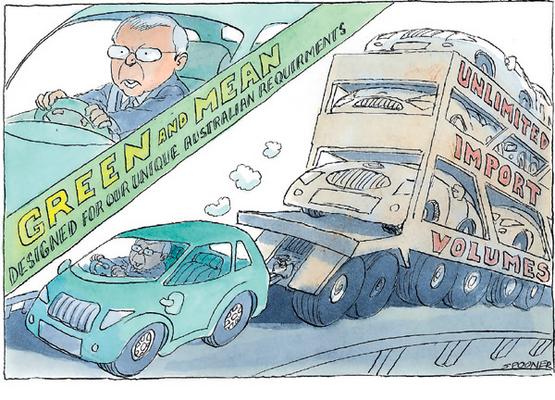
The atmospherics were different in the Senate. Less theatre more policy. There was a concentrated attack by the Liberals on two fronts ---the public investment in the car industry and the costs of emissions trading scheme on industry. The Senate Liberals gave a clear indication that they are opposed to both.
 Spooner
The line of attack was the costs of emissions trading scheme on industry and it being forced to go offshore with the implication that Australia should not establish an emissions trading scheme. Nowhere did the Liberals mention the costs of not acting to reduce greenhouse gas emissions on Australia. It was depressing.
No mention was ever made of Ross Garnaut's report in which he argued that:
The Australian Government should at an early date say that Australia was prepared to play its full proportionate part in an ambitious global mitigation effort which would require reductions of 25 per cent on 2000 levels and 90 per cent on - 25 per cent reduction on 2000 levels by 2020, 90 per cent by 2050....the Government should say Australia is prepared to play its full proportionate part in a global agreement that adds up to a 450 parts per million outcome.
Secondly, I said that if that is not possible internationally, and what is more likely to be possible internationally would be Australia playing its full proportionate part in a 550 parts per million outcome which would involve a 10 per cent reduction on 2000 levels by 2020 and an 80 per cent reduction by 2050....It's a long way from a practical agreement to get to 550. And I'd like us to be working as hard as we can to make what currently seems impractical practical.
The goal of 450 parts per million stabilisation target would mean two degrees of global warming with a 50 per cent chance of entering dangerous climate change. The 550 per million stablisation target is dangerous climate change as it would means three degrees of warming.
It is dangerous territory because it would include major impacts on melting of the Greenland ice sheet, substantial sea level rise, condemn the Great Barrier Reef to almost complete destruction in its northern areas, condemn Australia's alpine areas to essentially becoming sub alpine, cause the destruction of the Kakadu wetlands and result in immense damage to the Murray-Darling Basin by restricting inflows even further.
It was obvious from Question Time in the Senate that Liberal Senators had no appreciation of the damage that will be imposed on Australia's environment and Australia's employment opportunities, Australian industries and Australian households by the adverse impacts of climate change. The NSW Government's mini-budget showed that Rees Labor had no understanding either.
Posted by Gary Sauer-Thompson at 5:33 AM | Comments (2) | TrackBack
November 12, 2008
NSW: a tough budget for tough times?
The NSW mini-budget is an indication of what is to come from state governments in response to the global and economic crisis. It is to raise taxes, sell off assets, reduce infrastructure spending, cut public service spending. The neo-liberal Treasury i rules to protect the state's credit rating with rating agency Standard & Poor. The political will to reform is kept in the can in favour of measures to stunt the growth of the regional economy on the edge of recession.
Keynes, it would seem, is still out of favour. As Ross Gittens in The Age says
And if it makes the downturn worse for the people of NSW, that's just something they will have to cop. At a time when Federal Labor is increasing its spending and rapidly turning a budget surplus into a deficit to bolster the economy, it may strike you as strange that its state Labor counterpart is doing the opposite: cutting government spending and increasing taxes.You're right, it is strange. Perverse, in fact.
Though the Roozendal mini budget has the appearance of reform ---the start of an effective system of congestion taxing in Sydney with the harbour bridge toll changes and increased parking levies in major business areas---it is only an appearance. There is no investment in public transport: both the North-West Metro and the South-West Rail Link are axed.
Labor is yet to deliver enough baseload electricity to keep the lights on, hospital spending is bursting its banks, Sydney is gridlocked, and no moves are made towards shifting to a more sustainable ---carbon less--economy. Treasury rules. Close things down.
Posted by Gary Sauer-Thompson at 7:06 AM | Comments (9) | TrackBack
internet censorship
I see that the Rudd Government is pressing ahead with its promise of protecting people from unwanted material. It has just called for expressions of interests from ISPs keen to participate in live trials of the proposed internet filtering system. The proposed filtering system is both a mandatory filtering of all "illegal material", and a second optional filter to block content deemed inappropriate for children, such as pornography. The claims by the Rudd Government that it is working within the boundaries of economic and political liberalism are undermined by mandatory filtering.

The justification for "mandatory" censorship is unclear---- Senator Conroy is going beyond Labor's election promise on this, as Labor had a policy of an optional filter for those who wanted it. We know that the first tier filters includes a blacklist of thousands of illegal web pages (a compulsory URL blacklist ) managed by the Australian Communications and Media Authority. We also know that Senator Conroy plans to extend the list in future -- to include terrorist material?
The definition of "illegal material" has been left vague, and presumably it is close to what the Australian Family Association and the Australian Christian Lobby define as inappropriate material, or what is needed to keep the internet safe for families. These moral panic social conservatives assume that unfettered access to the internet harms the fabric of Australian society and that anyone that does not want to be filtered, must be for the sexual abuse of children.
The pilot is only about technical implementation, and will not address freedom of speech concerns over what might be added to the blacklists in the future---the 'unwanted or inappropriate material.'
I guess it won't matter for the 2 million subscribers who remain on dial-up, despite the widespread availability of ADSL because their preference is not to pay for broadband; nor for the 25% of all households who do not have a computer. Nor does it matter to "clean feed" Conroy that mandatory ISP filtering inaccurately blocks content which should not be blocked; slows subscribers down even as he proposes to build a faster national network; reduces the ability of parents to adjust their filtering preferences to suit their own parental judgement about what is best for their children.
It is ineffective at inspecting or blocking “Peer to Peer” traffic that comprises over 60% of Australia’s Internet traffic; and is easily circumvented, either using a free web proxy, which acts as a middle man between you and the site you want to see, or an encrypted tunnel to the United States.
There seems to be little argument from the cultural conservatives for why there is a need to shift from a PC-based filtering system to an ISP one or little concern that a mandatory filtering system places Australia in the same basket as China, Iran and Saudi Arabia. They misrepresent their critics as equating freedom of speech with watching child pornography. Mandatory filtering is another example of the social conservative's authoritarianism and antagonism towards individual freedom.
Posted by Gary Sauer-Thompson at 5:03 AM | Comments (16) | TrackBack
November 11, 2008
child care
Child care is a tough one. It's necessary for two income middle class families to work. It is expensive---out of reach for many working class families---and the market has not really been successful in providing good quality child care, despite the substantial government subsidies. The demise of ABC Learning, the knowledge that many (up to 40%) of the child care centres were running at a loss, and the necessity for the government to protect service continuity until the end of the year indicate this.
Why are so many of these child care centres unviable given the demand? Where to next?
Some call for greater regulation of the industry. Others---Henry Ergas in The Australian--- call for greater competition whilst becoming all emotional over centralized planning Moscow style:
In short, it is not central planning we need but better and more effective markets. The collapse of ABC Learning creates serious short-term challenges but also offers an opportunity to take real steps in that direction. The Government says it is committed to using markets to meet social policy goals; here is the chance to prove it.
Others call for the government to help community based organisations to take over ABC Learning's centres as it is a central social service.
Posted by Gary Sauer-Thompson at 4:30 AM | Comments (6) | TrackBack
November 10, 2008
global economic governance
The disordered international response to the current financial crisis, with the IMF standing on the sidelines watching, has resulted in calls for a new global financial system. Talks are proceeding, as they say, on the need for co-ordinated action. And regulation? Will there be an international response to the global economic downturn?; a downturn evident in Europe, America and the decline in Chinese exports.
The consensus is that by itself monetary policy----cutting interest rates---is not sufficient to counter the contraction in global economic growth. The gradual improvement in money market conditions is not sufficient to stop the downturn in global economic activity. Wolfgang Münchau says in the Financial Times:
The reason is that the channels through which monetary policy affects the real economy are still clogged. There are several such channels, including ones for bank lending. But most of them go through the money market, as neither companies nor households have direct access to central bank money. To the extent that the money markets are not working properly, monetary policy is correspondingly ineffective....At this juncture, monetary policy is playing little more than a supporting role during this crisis.The most potent policy instrument we currently have at our disposal is fiscal policy.
Fiscal policy here means a stimulus package by governments. The International Monetary Fund called for governments to use fiscal stimulus to help their economies weather the slowing global economy. However, in the absence of a co-ordinated international approach nation states must do their own thing.
As the estimates of Australia's growth keep going lower, Australia, which is heavily reliant on raw material exports, is still hoping that Chinese demand for Australian raw materials will continue due to China's strong growth. Alistair Davidson observes in The Age that Australia cannot expect simply to ride in the slipstream of the two major economies, the US and China.
How well Australia weathers the storm and how shipshape it is when the storm abates will depend on how well the Australian Government manages monetary and fiscal policy and marries these policies to structural policies aimed at dealing with the even larger challenge of climate change and the related issue of peak oil....The best way to get the economy going is to undertake a program of infrastructure spending to fill the gap left by the drop in private spending.
Government is the spender of last resort. Davidson goes onto say that:
The argument put by state governments and the Federal Government, that government infrastructure projects must be pruned because the budget surplus is reduced, is one of the silliest arguments to have come out of this crisis. They are a throwback to the primitive arguments for procyclical balanced budgets made during the 1930s, which prolonged the depression until the threat of total war led to a huge increase in government spending financed by borrowing.
It is the content of a stimulus package that is contested. Many---including Münchau---- suggest that it means tax cuts. For others---Australia--- that means tax cuts and cash for working families and rescuing the ailing car manufacturers. For others ---China---means spending big on infrastructure investment.
China's stimulus package is huge--$850 billion, which amounts to almost 20 per cent of GD---and it is targeted at low-rent housing, roads, rail and airports and rural infrastructure. There are also measures designed to lift investment in plant and machinery, increased farm subsidies and the lifting of restrictions on bank lending. Will the stimulus help tilt China's economy away from exports and towards domestic demand?
Posted by Gary Sauer-Thompson at 6:35 AM | Comments (12) | TrackBack
November 9, 2008
Sunday cartoon: indigenous health
One of the pillars of the initial phase of the Northern Territory Emergency Response from a health point of view was the health checks carried out on up to 17 000 children aged 15 years and under in 73 target communities. The health checks were designed to bridge the seventeen-year mortality gap for all Indigenous people. By 19 October 2007, medical teams had already completed checks on more than 3200 children.
 Golding
What happens after the health checks? Those who are sick need treatment. How is that to happen? Fly in specialists?
William J H Glasson, a member of the emergency response taskforce, wrote in the Medical Journal of Australia:
The findings of these checks are sobering, and underline the need for the intervention. We already knew that the children in many of these communities had very high rates of chronic diseases, but have found that the situation is even worse than the official picture. The Indigenous population has a burden of disease up to six times higher than in the non-Indigenous population.
Probably 80% of the Indigenous children have middle-ear diseases. Intestinal parasites and skin infections are rife. An absence of water for washing — taps don’t run, toilets don’t flush, there is no soap — has led to skin hygiene so poor that pathogens thrive. This in turn contributes to the devastating levels of renal disease and heart disease, the latter particularly associated with rheumatic fever. Type 2 diabetes is also increasingly common in children.
The call has now gone out for health professionals, doctors, specialists and nurses to help out with the follow-up, but this type of approach to the delivery of needed health services is an emergency response and is not sustainable. Something more is needed.
Posted by Gary Sauer-Thompson at 11:08 AM | Comments (7) | TrackBack
November 8, 2008
SA "trim its sails"
If the financial and banking crisis train has left the station, then so has the global recession train, and it looks as if we are in for a long and severe and protracted two year global recession. Already the economic crisis is beginning to play havoc on state government budgets. NSW is now usually mentioned as on the way to becoming a basket.
The impact is also significant in South Australia, which is facing a $400 million budget blackhole that is expected to wipe out projected surpluses for some years into the future. Public sector job losses, spending cuts and deferment or cancellation of major capital works are now on the table, since SA has accepted that its cherished AAA credit rating will be under threat if it does not defer spending on capital works.

Kevin Foley, the Treasurer, has quarantined from the chopping block plans for a series of superschools, the $1.7billion new central hospital and $1.4 billion desalination plant. However, the Rann Government is hoping that the Rudd Government will rescue the centrepiece of the last state budget -- a $2 billion electrification of Adelaide's rail network and extension of its tram lines.
It is a similar story in other states. All are hoping that the Rudd Government will finance their infrastructure projects, since it is the federal Government wants to fast-track new infrastructure projects to pump-prime the slowing economy.The global financial crisis had reduced federal budget surpluses by $60billion over the next four years continued to cause deep concern in state governments, which had been expecting big contributions from the commonwealth for infrastructure and new COAG funding deals on health and education.
The International Monetary Fund was expecting the global downturn would be "deeper and more prolonged" than previously anticipated. It projected that the developed world as a whole will move into recession in 2009. Rebuilding balance sheets and allowing house prices to fall back to sustainable levels will make for a grim time. Unemployment will rise. The IMF argued that politicians across the world should take measures to get people spending again.
Nouriel Roubini says:
For the last few years the global economy has been running on two engines, the U.S. on the consumption side and China on the production side, both lifting the entire global economy. The U.S. has been the consumer of first and last resort spending more than its income and running large current account deficits while China (and other emerging market economies) has been the producer of first and last resort, spending less than its income and running ever larger current account surpluses.....For the last few months the first engine of global growth has effectively shut down ....More worrisome there are now increasing signs that the other main engine of the global economy – China - is also stalling.
He adds that with the two main engines of global growth now in serious trouble a global hard landing is now almost a certainty. And a hard landing in China will have severe effects on growth in emerging market economies in Asia, Africa and Latin America as Chinese demand for raw materials and intermediate inputs has been a major source of economic growth for emerging markets and commodity exporters.
That prognosis applies equally to Australia.
Posted by Gary Sauer-Thompson at 1:28 PM | Comments (8) | TrackBack
November 7, 2008
New Zealand election
The Labour Government of Helen Clark looks likely to be replaced by the Nationals on Saturday. The polls say a National-led Government. That's the interpretation of the mainstream metropolitan dallies--a comfortable win for the Nationals.
However, the two-vote mixed member proportional system allows smaller parties to play such a significant role, that we need to talk in terms of blocs or alignments consisting of several allied parties. The election has sorted the parties into two blocs. For instance, the Greens are not interested in doing a post-election deal with National. They have also said that they won’t work with Winston Peters in Cabinet. NZ First is not looking like it will be in Parliament, let alone in Cabinet. So it is a contest in which the first-place-getter isn’t automatically declared the winner, and the contest may be tighter than the polls suggest.
New Zealand is already in a mild recession: house prices are falling, wage growth is slowing, households are squeezed by rising prices. The public mood is for change, Clark Labor is seeking a third term, and the change mood is to dump Helen Clark, despite a good record. That makes things tough for Labour, They are fighting desperately against a mood for a change even though the Nationals propose to return to the first-past-the post electoral system.
Labour's campaign has been one of mostly running 100% negative TV ads with their campaign built around the premise that Labour are better than slippery John Key, the leader of the Nationals. There is not much by way of new idea or policies.
The talk is of only miracles can save Labour. Will it be the Maori party? Is Clark’s real hope of regaining power one of cutting a deal with the Maori Party? That would produce a Labour/Progressive/Green/Maori Party coalition and shift the centre left to the left with The Greens and Maori Party demanding new policy initiatives.
Tim Watkin editor of Pundit in NZ sums the situation up thus:
It looks as if National will win the most votes and can count on ACT and United Future for support. Labour will come second, with the Greens and Progressives onside. The questions are whether the centre-right coalition led by National can get enough seats to govern, whether New Zealand First survives to boost Labour, and if the Maori Party can win the balance of power.
If the former, then it is more roads, pieces of privatisation (eg., prisons) and tougher prison sentences but for the next three years National is pretty much tied to the centre.
Update
Well Labour Labour failed to contain the swing to National and the mood for change. Labour has been tossed out of office. It was decisive. Seats that should be solidly Labour slid away from its grasp with Labour losing a decent chunk of its working class, white vote. The National-led right wing bloc, which includes Act and United Future, won 65 of the 122 seats. Helen Clark has resigned as Labour leader and Winston Peters bowed out of parliament.
The country enters what could be its worst recession in decades.
Posted by Gary Sauer-Thompson at 8:03 AM | Comments (3) | TrackBack
an independent media in Australia?
Tim Dunlop has closed his Road to Surfdom weblog down, a few weeks or so after finishing his Blogocracy gig at News Ltd in order to write a book. These were high profile and successful weblogs and it is sad to see them become another archive. Still, blogging is a tough gig, and people move on to do different things.
In his final post Dunlop comments on the state of the mainstream media in Australia, and his diagnosis of its unhealthy condition is spot on. He says:
The fact is, Australia’s mainstream media is moribund. Although there are great journalists and other contributors out there, the institution itself is stuck in a hopeless, self-serving, tenured cul-de-sac and is failing in its job to properly inform, discuss, debate and entertain. Not to mention, reinvent itself. The form is dominated by a handful of insiders who have grown so content with their own lot that they are immune to sensible criticism and lack the self-awareness to reassess what it is they are doing. They are supported in this self-satisfied loop by a political class that is happy to exploit the status quo, feeding them leaks and other tidbits to keep the whole charade ticking over in such a way that nothing really changes.
I concur. It's not the liberal bias that the conservatives complain about that is the problem. It is that the media do not do their job as the watchdog of democracy. They have mostly dumped that tradition and shifted to the insider drip feed, infotainment and partisan opinion, whilst the old journalist ethos that underpinned informing discussing, debating has been buried.
Dunlop continues with his diagnosis:
The narratives, the memes, the discussions of our political and social life are set in concrete and endlessly recycled. We have learned to accept the daily, largely manufactured, controversies of political and social discussion in lieu of genuine examination. The same voices — and there are only about 20 of them — continue to define what is important or useful or worthy of discussion and the few organs of the mainstream media keep churning them out. Their lack [of] seriousness is only matched by their lack of courage.
Spot on.There is little by way of analysis and general examination of policy issues and problems in the mainstream media. We are subjected to manufactured moral outrage, crude ideology by entrenched economic interests and the outpourings of the political noise machines. Many journalists recycle media releases, and they have no knowledge of, or interest in, policy issues. Nor do they see this as a cause of concern. The media's political focus is primarily on leadership conflict within the political parties and between them.
This dumbing down or decline of the mainstream media creates a space in a digital Australia for an "independent media" to pick up the watchdog for democracy role. What then is the condition of the "independent media"? Dunlop says that:
there are some new voices out there trying to make a difference. Some of them are thinktanks, some of them of grassroots organisations, some of them are blogs or other forms of online media. None of them has really “broken through” in the way that is necessary to make a real difference, but they are a start.
This space is quite healthy and vigorous in a grassroots way, as the new and independent media slowly replace the little magazines of the pre-internet era. However, their public presence and influence is low apart from Crikey, and there is little of the cross fertilisation of ideas between journalists, bloggers and thinktanks as there is in the US. Most of us in the new media still live in our silos.
So where to now? What do we need to do? Dunlop adds that at this moment we need to foster an independent media and enable it to move into a new and more vibrant phase. This means that people need:
to think about what needs to be done and what we can do. Citizenship matters and it is too important than to leave in the hands of the cynical gatekeepers who currently decide what is important in this democracy of ours.
True. What is the next step? A professional independent media says Dunlop. What do we need to do to produce the professional product that Dunlop says is necessary? Dunlop says it's hard cash--financial support. Mark Bahnisch, in picking up Dunlop's post at Larvatus Prodeo, concurs. Dunlop's call for a genuinely professional product, he says, requires the shift from amateur bloggers to professional writers, and that this step requires some way to earn a living from the writing so the writers can write full time:
not to put too fine a point on it - if we really wanted to try to provide the sort of independent media we think we deserve in this country, we’d need several people working full time on such an effort. There is just no other way.The frustrating thing is that I know we’ve collectively got the expertise to do it, but we can’t, because we don’t have the seed money to even get started. (And I very much include the LP community in that “we”.)
That is probably true as well--the expertise is there, the cash is not. Bahnisch appears to be reinventing the professional journalist in the mainstream media for the digital age. As a collective blog LP may evolve into some kind of online magazine with some blogs.
However, not everyone wants to be a full time citizen journalist in the independent media--an example of what is meant by citizen journalism? Many do want to do do other things than practice citizen journalism---as they are academics, policy wonks, artists, writers of books etc. If the internet's technology has opened up many ways for us to become produsers, then diverse opportunities beckon, especially for those with an entrepreneurial bent, or an eye to innovation.
Posted by Gary Sauer-Thompson at 5:53 AM | Comments (26) | TrackBack
November 6, 2008
the start of the downturn
Treasury's mid-year outlook takes the wind out of the sails of the panglossian spinners who have underestimated the financial and economic crisis until the last possible moment.
Treasury estimates that growth in output will slow to 2% this year and 2.25% next year; predicts that jobs will keep growing, slowly, while unemployment is kept to 5.75%; that business investment will rise even higher, then level off, and exports will increase in the depressed global market due to the lower Australian dollar.
 Spooner
The mid-year outlook marks official recognition of the protracted economic downturn the financial market meltdown has caused. Some commentators say that Treasury believes the worst global financial crisis since the Great Depression will cause no more of a ripple across the Australian economy than we saw with the introduction of the GST in 2000-01. A ripple with 5.75% unemployment and $46 billion wiped off the budget surplus over the next four years? That sounds pretty grim to me.
The mid-year outlook admits that Treasury simply doesn't know what lies ahead. "Significant uncertainty remains over the extent and duration of the economic downturn stemming from the crisis, and the effect on Australia" it says. So things could be worse than forecast. The growth projections could be on the sunny side. If they are lower then unemployment will go higher.
The known unknown is that the economic downturn is not going to be quickly reversed. As Malcolm Maiden says:
The national balance sheet will be hit successively over several years by lower capital gains receipts that flow directly from the market losses, and then by lower corporate tax revenue as the crisis undermines consumer demand, pricing power, margins and profits.
We have a share market slump, falling house prices, scared households paying off their debts, businesses shelving their expansion plans and the collapse in commodity export prices.
Posted by Gary Sauer-Thompson at 6:47 AM | Comments (5) | TrackBack
November 5, 2008
US Presidential elections: death of Republican America
Obama "could actually win this thing" as many voters have job security in a depressed economy on their minds. That change is what is dawning on Americans. The dream of change will happen and become political reality. What kind of change though?
There is still the election. How significant will be the Bradley effect---where people say they're going to vote for Obama but in the privacy of the voting booth, they won't vote for a black man? Will the Rovian sludge and sleaze work on voters and save the Republicans? Will the US change from being a center-right country". Or will the entire "center" shift leftwards?
 Leak
Leak
Will the voters reject the GOP's claim that the war in Iraq is the "front line of the war on terror"? Maybe today's election will witness the end of the Republican era in American politics; one that began in reaction to Lyndon Johnson's Great Society, the Vietnam war and the civil rights revolution; a conservative movement pioneered by Richard Nixon, consolidated by Ronald Reagan, and was then shattered by George W Bush.
It would be great to watch the hissy fits on Fox News as a form of US comedy show as the results in favvour of the Democrats come in. (I don't have cable in Adelaide). The Fox line is that African-Americans are cheating and stealing the election for Obama, and Obama is going to take the white people's money and give it to African-Americans with a new welfare program. Socialism! Obama is Karl Marx reincarnate. Obama is a commie!
That kind of crazy scare won't work. American wants change. They want the Republicans out. They want to kick Bush into history.
Does Sarah Palin represent the end of an era of culture wars, and be the last culture warrior on a national ticket? Well, she'll be going back to Alaska to lick her wounds amongst those moose shooting social conservatives; the ones who reckon that humans walked the earth with dinosaurs 6000 years ago and who desire God's dominion on earth.
Update
CNN has called the election for Obama, who ran a superb bottoms-up electoral campaign. It's a historic moment for the USA, given its racist past and the shameful way that it has treated its African-American citizens since the civil war. America has now shifted centre-left. I guess we are going to hear a lot more about American exceptionalism about how only America can make such a big political change in the US media.
McCain's speech is gracious in defeat and he acknowledges the historic significance of a black President of the US. He speaks honestly ---he was himself, speaking as an elder statesman of the Senate, not as the presidential candidate. McCain's crowd was as ugly as he was gracious.
The opening of Obama's 'Yes we can' speech:
If there is anyone out there who still doubts that America is a place where all things are possible; who still wonders if the dream of our founders is alive in our time; who still questions the power of our democracy, tonight is your answer.
It’s the answer told by lines that stretched around schools and churches in numbers this nation has never seen; by people who waited three hours and four hours, many for the very first time in their lives, because they believed that this time must be different; that their voice could be that difference. It’s the answer spoken by young and old, rich and poor, Democrat and Republican, black, white, Latino, Asian, Native American, gay, straight, disabled and not disabled – Americans who sent a message to the world that we have never been a collection of Red States and Blue States: we are, and always will be, the United States of America.
It’s the answer that led those who have been told for so long by so many to be cynical, and fearful, and doubtful of what we can achieve to put their hands on the arc of history and bend it once more toward the hope of a better day.
It’s been a long time coming, but tonight, because of what we did on this day, in this election, at this defining moment, change has come to America.
I love that phrase--- to put their hands on the arc of history and bend it once more toward the hope of a better day. He adds that this is not the change we seek, but only the chance for the change we seek.
Bush and his cronies are history. That's worth a drink isn't it. The Americans see Obama's victory as representing a decisive transition into the future. There was a sense that an America that could do this was a different America than the one we had been living in for the past few years.
Posted by Gary Sauer-Thompson at 6:49 AM | Comments (11) | TrackBack
Murray-Darling Basin: reform movement
Finally the Rudd Government has shown some initiative on putting the Murray-Darling Basin on a more sustainable basis. It has taken them some time to do this, but they are finally beginning to move against the recalcitrant state governments.The Rudd Government is particularly keen on removing two barriers to water trading in Victoria:
■A limit that prevents more than 4% of water being traded outside an irrigation district.
■A limit that prevents non-landholders such as the Federal Government buying more than 10% of water entitlements in a system.
The Federal Government wants the rules removed so they do not hinder the Commonwealth's buy-back of irrigation water for the Murray-Darling river system.
Senator Wong has declared that the grants for small-scale farmers (those with less than 15 hectares of land) to cease irrigating would be paid only to farmers whose home state had abolished certain barriers to water trading. That means farmers seeking financial incentives ( worth up to $150,000 for each farmer) to quit irrigating will be unable to receive money from the Federal Government until Victoria removes a series of barriers to water trading.
Finally Victoria has been placed in the spotlight. The move forces the anti-reform Brumby Government to effectively choose between two groups of farmers in Victoria. It spits those farmers seeking to leave the irrigation industry ----farmers in Victoria's Sunraysia district---against those who wish to remain irrigating under the current trading protections, and politically wedges the Brumby Government between the two groups.
Posted by Gary Sauer-Thompson at 6:37 AM | TrackBack
November 4, 2008
US: a shift away from conservatism
An interesting article on McCain's electoral strategy by Ezra Klein, one of the bloggers at American Prospect. What it doesn't do is describe the tectonic shift in the US electorate away from Reagan conservatism--a generational shift, if you like. A new political landscape is in formation, if you take the polls seriously. Its back against the wall for the Weekly Standard crowd for, according to Bill Kristol, an Obama administration and a Democrat Congress means a more debilitating nanny state at home and a weaker nation facing America's enemies abroad.
McCain is basically defending the states that Bush won in 2004 as Obama is seen as the antidote to the disaster of the Bush years. The Bush states of Ohio, Indiana, Virginia and North Carolina are in play. Iowa, Colorado and New Mexico are judged to have turned blue. It's defending the base as it were from the Democrat threat to take the centrist states and districts from the Republican side.
The GOP is poised to take a beating in congressional races. Will the business wing of the Republican party become reconciled to a Democratic majority--- if for no other reason than self-preservation. If so, then that will leave the evangelical/Southern wing of the party in effective control. Will the logic of bigotry, fanaticism and xenophobia that now grips and motivates the Republican party base deepen, and trash the virtues of democracy and constitutionalism?
If the Republican Party is driven back into the deep South and deep West then the GOP is in for a long stay in the political wilderness. Will Sarah Palin be its political voice? She reckons she's the one.
Even if Obama wins the religious fundamentalist right will continue to shape the way America understands school prayer, creationism, public displays of religious symbols, proselytizing in schools, abortion, gay marriage, religious warfare and foreign policy--its public cuture. No doubt, they will express strong support for conservative policies in the forthcoming ballot initiatives (plebiscites) on social issues in many states.
The Bush administration's legacy is going to haunt the US for quite some time as it is highly toxic. As Tom Engelhardt says the legacy President Bush and his pals are leaving behind includes:
A wrecked economy, deflated global stock markets, collapsing banks and financial institutions, soaring unemployment, a smashed Republican Party, a bloated Pentagon overseeing a strained, overstretched military, enmired in an incoherent set of still-expanding wars gone sour, a network of secret prisons, as well as Guantanamo, that "jewel in the crown" of Bush's Bermuda Triangle of injustice, and all the grim practices that went with those offshore prisons, including widespread torture and abuse, kidnapping, assassination, and the disappearing of prisoners (once associated only with South America dictatorships and military juntas).
As Michael Schwartz argues the Iraq that has emerged from the American invasion and occupation is now a thoroughly wrecked land, housing a largely dysfunctional society.
Posted by Gary Sauer-Thompson at 6:48 AM | Comments (4) | TrackBack
different moods
Melbourne Cup day. Lots of gambling and partying and excess. House prices continue their quarterly fall in Sydney, Perth, Hobart, Canberra and Brisbane, retail sales continue to contract, whilst newspaper job ads have slumped. Help is on the way as the Reserve Bank announces further reductions in interest rates. The political rhetoric is now about sheltering households from the global economic storm and preventing a recession.
 Moir
Moir
In contrast to the spectacle of the Melbourne Cup the new public mood is one of belt tightening given the looming job market recession.Continual drops in the value of our property is a signal to hoard, not spend. And the commodity boom has just ended in the sunbelt.
Update
I cannot see how reducing the interest rates by 0.75%, which is a form of mortgage relief, is going to counter the decline in house prices, restore manufacturing output, prevent unemployment and restore state government revenues. Even when monetary policy is working in tandem with fiscal policy --- the Rudd Government's $10.4 billion stimulus package. Maybe the economic mandarins are relying on resilience and entrepreneurial flair to counter the economic downturn and keep economic growth going.
The economic mandarins have been slow on the appreciating the significance of the economic downturn, as they had pinned their hopes on the China effect to insulate Australia from the effects of a recession in the US and the global economic downturn on the Australian economy. Maybe they were too busy listening to the spin from the miners (eg., Rio Tinto + BHP) about the resource boom lasting for ever, with global demand for iron ore increasing forever?
The core problem is that the Australian housing boom has seen the household total debt double relative to their disposable income from 80% to almost 160%. Excessive household borrowing makes us vulnerable. to the global recession.The Reserve Bank is optimistic, as it reckons that household finances are in good shape in terms of income, whilst household assets are higher than liabilities. What if the value of the assets (shares and investment properties) continues to fall?
Posted by Gary Sauer-Thompson at 5:59 AM | Comments (1) | TrackBack
November 3, 2008
Murdoch on Australia's future
The title of Rupert Murdoch's Boyer Lecture is A Golden Age of Freedom and it refers to the way the opening of new markets is leading to the rise of new nations, and adding hundreds of millions of people to a new global middle class. In this new world Australia's leading trade partners are the great nations of Asia not Europe.
In the first lecture Murdoch, an ex-pat, says that he is concerned about Australia's future in a globalised world, since, on his account, Australia is not prepared for the challenges caused by the global economy.
While Australia generally does well in international rankings, those rankings can blind us to a larger truth: Australia will not succeed in the future if it aims to be just a bit better than average. We need to revive the sense of Australia as a frontier country, and to cultivate Australia as a great centre of excellence. Unlike our parents and grandparents, this new frontier has little to do with the bush or the outback. Today the frontier that needs sorting is the wider world. Complacency is our chief enemy…
Australia is not prepared because it is complacent. Where, then, is the Australia's complacency in a globalised world, given the opening up of the economy in the 1980s and the embrace of the global market?
Murdoch says it is our continuing dependency on government:
[We] need to reduce dependency on government … to reform our education system … to reconcile with Australia's Aboriginal population and to maintain a liberal immigration system. At a time when the world's most competitive nations are moving their people off government subsidy, Australians seem to be headed in the wrong direction. In a recent paper [the director of the Institute for Private Enterprise] Des Moore pointed out that while real incomes had increased since the end of the 1980s, about 20 per cent of the working aged population today received income support, compared with 15 per cent two decades ago. While a safety net is warranted for those in genuine need, we must avoid institutionalising idleness. The bludger should not be our national icon.
It is not clear that the Rudd Government is institutionalising idleness or making and the bludger our national icon? Surprisingly Murdoch says that traditionally the Liberals have been more free market in their outlook than their opponents. But Labor has also recognised that central planning does not work. But increased middle class welfare was a characteristic of the way that the Howard Government used economic prosperity to deliver on the "fair go".
Murdoch says that traditionally the Liberals have been more free market in their outlook than their opponents and that Labor has recognised that central planning does not work. However, increased middle class welfare was a characteristic of the Howard Government. Since when has the ALP advocated central planning? Surely Rudd Labor is pro-market, pro-business and pro-globalisation.
Murdoch says that is a good start, but then warns:
....being pro-market, pro-business and pro-globalisation means working for a society where citizens are not dependent on the government. That means ending subsidies for people who do well. It also means sensible targeting and persistence - so that when subsidies are given, they help those passing through a rough patch or born into abject poverty build themselves up to a point where they can provide for themselves. And it means smaller government and an end to the paternalism that nourishes political correctness, promotes government interference and undermines freedom and personal responsibility
This requires reforming our public education system as it is a nineteenth century system in a 21st century economy that in effect writes off whole segments of society and deprives them of the skills to take advantage of the opportunities of a global economy.
Murdoch reduces freedom to economic freedom. Where is political freedom? Secondly, Murdoch's Australia appears to be a different world to the one where we live in, which is where the coal industry, miners and big energy users want lots of subsidies as Australia makes the shift to a lower carbon economy. Where in our liberal democratic world is paternalism is encouraging political correctness? Does that imply that Australia is not an open society? Would Fox News make Australia a more open society?
What does political correctness mean today? Leftwing? Presumably, Murdoch is not referring to the heritage of a decade of the Howard Government? If it is leftwing---as understood by the conservatives at The Australian is not a cleaner, greener world, or reducing inequality suffered by indigenous people, since Murdoch accepts the need to address these issues. More than likely "political correctness" means a rejection of neo-liberalism--small government, deregulated markets and limited welfare?
Posted by Gary Sauer-Thompson at 4:50 AM | Comments (22) | TrackBack
November 2, 2008
a win for the terrorists
A gem of an article discovered riffling through the magazines in a dentist's waiting room the other day brought back some horrible memories. What if?
In an October 2006 column in the old Bulletin, Laurie Oakes was getting stuck into John Howard for his unhealthy obsession with George W Bush. The Lowy Institute had recently published an opinion poll which found that Australians were not at all pleased with the way the Howard/Bush romance was progressing, and were rather more nervous about American foreign policy than about the axis of evil. The fridge magnet had lost its appeal and David Hicks was becoming an irritating issue for the Howard government.
We'd just been treated to television footage of one of our Prime Minister's grovelling visits to the US, and one of Bush's 'man of steel' or 'deputy sheriff' comments. If anything, Kim Beazley seemed as spellbound by Bush as Howard was. Oakes was expecting a Beazley/Howard election in 2007 and it was all looking rather depressing.
The Primaries and Presidential Election were too far away to think about then, but come February we were once again enjoying the spectacle of our Prime Minister being terribly important in the United States, where he declared that an Obama win would be a win for the terrorists.
What if Howard had won in 2007? He'd currently be rooting for McCain and Palin. Most of the world is hoping for an Obama win, but Howard would be on al Qaeda's side, hoping for a McCain win. His best friend is currently as popular as several unsavoury proverbials and his economic management isn't looking all that swish. What would he be telling his AM breakfast radio audience about Obama? Would he be able to keep a straight face while telling us our most important relationship will stay strong regardless of who wins?
Posted by Lyn Calcutt at 9:46 AM | Comments (5) | TrackBack
November 1, 2008
bad Conroy
This time last year we were watching the ALP make halfway decent use of the internet in its election campaign, doing way better with MySpace, YouTube and other bits and pieces than the Liberals who, by comparison, were still drawing on cave walls with lumps of clay. We were promised broadband fabulousness and a laptop for every school kid. Kevin Rudd told us the internet is the way of the future while John Howard was filmed smiling admiringly at a white box with plug holes in the back that apparently had something to do with that computer thingy they all do these days. Howard warned us about porn, Rudd said our kids need the net.
You'd think that with all that tech savvy Stephen Conroy would anticipate at least a tiny bit of the mess he's got himself into with his ISP filtering scheme, now sans the opt out bit. And if he's surprised by the current levels of crossness, he'll be shocked at what follows if he goes through with it. Blocking porn is one thing, chewing up around 30% of costly bandwidth is another.
Mark Pesci foresees nasty things coming Conroy's way via the Twitter mob. As quite a few commenters on that piece point out, Twitter isn't as gigantic a network as its enthusiasts sometimes think, but that neglects the fact that Twitterers have connections everywhere, some of whom blog, some of whom start Facebook groups, some of whom write for Crikey, and one of whom they were reading at Unleashed.
Stilgherrian's another Twitterer who turns up everywhere, but tends to be slightly less restrained about things that make him cranky than the polite Mr Pesci. If you don't mind a bit of blue language with your multitudes of links, there are bits and pieces here, here, and here, an award for Conroy here, and a reproduced Crikey piece here.
Also via Stilgherrian, some big ISPs are unhappy, as you'd expect. Network engineer Mark Newton's piece at Online Opinion is a nice summary of what's wrong with the idea from a user's point of view, which takes account of a newish bit of reality of which Conroy is possibly unaware:
Not only does everyone know that the Internet isn't frightening or uncontrollable; not only do the population's own experiences clash with the Minister's hysterical allusions to unrestricted access to child pornography; but, much to the Minister's apparent astonishment, he doesn't even have the loudest voice anymore.In the past, politicians have been able to shut-down debate by casting McCarthyist slurs which compare opponents to child pornographers: but when Mr Conroy used the same tactic in Senate Estimates on October 20, the blogosphere's incredulous ridicule seeped through into the commercial media, yielding headlines about the Minister's disgraceful debasement of the public discourse.
They may like to ignore the internet when it suits them, but the media are our friends on this. They like to pretend otherwise, but they're as reliant on access as anyone else, particularly if they want to put together one of those moral panics about depravity on the internet. Or publish pictures off some poor sod's MySpace after they've been involved in something newsworthy.
It's now being suggested that ISP level filtering could introduce new hazards for internet banking and other financial transactions.
Way to go Mr Conroy. Maybe you could get some kind of campaign going to get us all nostalgic about those lovely old passbook accounts. The kind that came with free money boxes for kids. We could use the money boxes to store the compensation you're going to owe us for commandeering the bandwidth we pay for.
Posted by Lyn Calcutt at 4:45 PM | Comments (10) | TrackBack
US---change afoot
And so the conservative Reagan Republican era in the US draws to a close, skewered by rising inequality, bad health care, a failed foreign policy and an economy in a recession. President Bush is deemed responsible, the Republican brand is torn and frayed and Republicans are looking for someone to blame for their unpopularity. That brand, which is part of a broader nativism driven by conservative definitions of what constitutes a real or good American, will need rebuilding.
 Moir
Moir
Obama has tapped the mood for change as the American Dream looks to be beyond reach for many Americans. If Obama wins ---as I expect him to--- he will unwind the Bush decade and the debacle of both the financial crisis and the two wars. Trouble is, there is so much to clean up that there won't be much time in the first term to bring about the change that is expected. Expectations are high for a new America.
The New American Century lasted a decade. Financial crisis and defeated objectives in Iraq and Afghanistan (and Georgia?) brought the neoconservative project for American world hegemony reached its limits in the latter part off 2008. The superpower that set the rules for everyone else and considered its way of thinking and doing business to be the only road to success is taken a battering.
What will change is the endless hairy-chested militarism and the corresponding for-us-or-against-us unilateralism that created an atmosphere where dissent was not tolerated.Obama (and McCain) would ratify Kyoto and set modest greenhouse reduction targets.
Posted by Gary Sauer-Thompson at 4:36 AM | Comments (3) | TrackBack