« July 2012 | Main | September 2012 »
August 31, 2012
the industrialisation of the Kimberley
James Price Point in WA is where Woodside Energy and its joint venture partners (BP, BHP, Shell and Mitsui/Mistubishi,) plan to build a giant new hub--the Browse Liquefied Natural Gas Hub---to process gas flowing from offshore wells in the Browse Basin, 350 km to the north.
This is one of the largest industrial projects in Australia’s history and will become the largest gas hub in the world and a slowing Chinese economy is the most likely customer for Kimberley gas.

Photo: Glenn Campbell
Woodside's chosen site requires cutting through native vegetation and dredging parts of the sea bed for the super tankers. Woodside's claim is that the environmental impacts of its $45 billion proposal can be "minimised and managed effectively" with respect to as it applies to vulnerable life forms such as dolphins, dugongs, turtles, fish stocks, and humpback whales.
The WA Environmental Protection Authority (EPA) has given the project the green light, despite major concerns that its scientific basis is less than rigorous.
A core argument by those critical of the proposed development concerns the James Price Point location. They ask, why cannot the gas be processed 800 km further down the coast, in the Pilbara, where much of the necessary infrastructure already exists, and where the environment has already been scarred by development. Or why not use a floating platform as Shell is doing at its Prelude Field in the Browse Basin?
The problem with this argument by those opposed is that the insistence on James Price Point as the only site by the mining companies is because the state and federal governments wrote that into the lease renewal documents. Why so?
The most plausible explanation so far is that the Woodside development at James Price Point is seen to be a way to develop a new port in the north-west so that all the various mineral resources of the Kimberley can be exported, including gas, diamonds, iron ore, copper, lead, zinc, silver, nickel, uranium, coal, tin, mineral sands and on-shore petroleum.
This opening up the Kimberley with a port in the north west is supported by the West Australian and federal governments.
The question to ask now is: does the James Price Point location make commercial financial sense? Is it commercially viable? One recent answer.
Posted by Gary Sauer-Thompson at 2:05 PM | TrackBack
August 30, 2012
dental reform, finally
The $4 billion dental care scheme targeted at low and middle income people is an excellent idea and long overdue. The government will provide Medicare funded dental services to children and an expanded public dental service for low-income adults and those in rural and regional areas, as well as an additional investment in dental infrastructure and workforce.
It is good public health policy as it is preventative and maintenance oral care in the community, even though it depends upon there being a private provider being willing to offer services in one's area at a price one can afford.
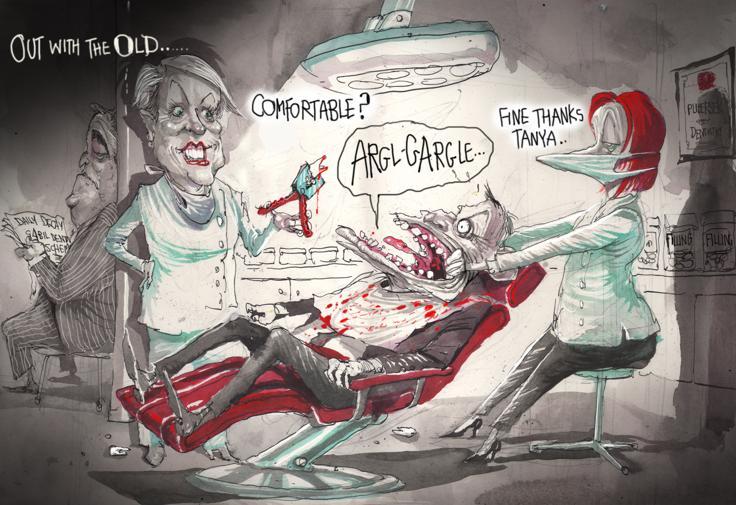
Outside health policy circles the reaction was more along the lines of the Gillard Government being on a spending spree, budget surpluses being blown out of the water, and the budget surplus for 2012-13 being a mirage.
The gigantic budget black hole scenario gives little acknowledgement of the Gillard Government making spending cuts in low priority areas to cover the budget surplus that is under pressure.
In the longer term there is the cost of the new higher priority programs ( the National Disability Insurance Scheme, which is expected to require an extra $10.5 billion a year within six years, the $4 billion dental care scheme, and the $5 billion a year for education recommended by the Gonski schools review) in the context of a mining boom that is winding down.
The argument is that China’s economic boom is showing signs of cooling, potentially torpedoing the federal government’s revenue projections. Iron ore prices, a main generator of government revenue, have tumbled below the level forecast by Treasury. The inference is that the days of the large surpluses being delivered by buoyant tax receipts are behind us and that the tax system will be unable to cope with new spending promises.
The political inference is the lack of fiscal discipline means new taxes to cover the budget deficit. That is, the Gillard Government is firmly in the tradition of big spending, high taxing Labor governments. They are bad economic managers--the familiar right wing riff.
Posted by Gary Sauer-Thompson at 10:18 AM | Comments (4) | TrackBack
August 29, 2012
something rotten in free market economics
The free market economists are a strange lot. They have been, and continue to be, silent about the global financial crisis and they opposed to the use of market mechanisms (an emissions trading scheme) to deal with carbon dioxide pollution from coal fired power stations.
With respect to the latter, the Australian design is one of a fixed price period followed by Australia’s carbon price being linked to, and largely set by, the European price. Australia becomes a part of an international carbon market. The transition from a small standalone carbon market to a much larger international market will greatly increase market efficiency, providing Australian businesses with improved liquidity, reduced volatility, lower marginal costs of abatement and lower transaction costs.
The free market economists at the IPA, who are hostile to subsidies for green energy schemes, are also opposed to the carbon market setting the carbon floor price. In emissions trading the government merely sets the target; it is the market that sets the price. Alan Moran, for instance, talks of a humiliating backdown in the AFR:
In now saying the tax will be linked to that of the European price by allowing Australian carbon dioxide emitters to buy emission indulgences from the EU, the government has conducted four somersaults and a belly-flop...It is time to recognise that the carbon tax is a total failure of policy and to dismantle it before it does further damage to the economy in general and to consumers in their power bills.
The opposition is really a hostility to a transition to a low carbon economy, and the free market economists hunt around for arguments to justify their opposition.
The opposition to a transition to a low carbon economy is premised on a denial of the existence of global warming. If we set free market economics in a broader political context, with greater emphasis on the role of institutions, then behind the denial of the existence of global warming lies the fossil fuel industry and its opposition to the transition to a low carbon economy.
Tristan Edis in Climate Spectator says that:
The base case scenario, assuming no change to European policy settings, is that rather than having the Australian carbon price plummet from $25.35 in the last year of the fixed price period to the $15 floor on July 2015; they instead drop to around $10-$15 – the forecast price for European carbon allowances (EUAs). Such a price would be insufficient to drive much fuel switching in the electricity sector, nor support serious amounts of tree planting, nor notably improve the economics of energy efficiency initiatives....it’s not anything close to a level that would stimulate a clean energy transformation.
The upside is that Europe digs itself out of its current economic morass with deeply indebted governments and this lifts the forecast price for European carbon allowances (EUAs).
These low prices aren't enough to substantially reduce emissions and drive investment in clean energy today. This is why additional policies, such as the Renewable Energy Target and the proposed national Energy Savings Initiative, are required to ensure we transform Australia's high carbon economy.
Posted by Gary Sauer-Thompson at 10:08 AM | Comments (6) | TrackBack
August 28, 2012
Murray-Darling Basin: still negotiating
The states are still negotiating the Murray-Darling Basin plan. The current plan on the table, designed by the independent Murray-Darling Basin Authority, suggests a range of between 2400 and 3200 gigalitres, depending on water-saving measures plus a small increase in the amount of groundwater extracted from the system. NSW wants much more groundwater extracted.
The southern states of Victoria, New South Wales and South Australia are where the contests over water and related funding are most severe in that Victoria and NSW believe the target should be 2100 gigalitres returned to the river.
 River Murray mouth
The conflicts over water and funding are there because this is where most of the over-allocation has occurred, and the Murray-Darling Basin plan, reinforces and asserts the eastern states' hegemony – again. From this perspective South Australia is the recalcitrant state because it wants too much water returned to the river to sustain wetlands. The SA figure is 4000 gigalitres.
The policy impetus can be gleaned from the Windsor Inquiry's report--- Of drought and flooding rains: Inquiry into the impact of the Guide to the Murray-Darling Basin Plan. The key recommendation is that the government build irrigation infrastructure instead of buying back water entitlements from willing sellers.
The aim was to find measures to increase irrigation efficiency, in response to rural angst about water buybacks. The investment in regional futures involving investment to improve irrigation efficiency would allow water to be reallocated. However, it is quite apparent that inappropriate and largely unproductive agricultural enterprises based on inefficient irrigation practices are no longer sustainable.
South Australia's position is that if a deal is done with NSW and Victoria which sells out South Australia's interests then the SA Government will challenge that plan in the High Court.
Posted by Gary Sauer-Thompson at 11:22 AM | Comments (4) | TrackBack
August 27, 2012
Latham's long lunch with Robert Manne
Mark Latham is doing a series on interviews or conversations over a long lunch for the Australian Financial Review. The latest conversation is with Robert Manne, who says that on a range of issues, the left is in retreat. So where did it all go wrong?, Latham asks. Manne's response is:
Many of the problems of the left come from the 70 years it lost in supporting the failed totalitarian ideals of communism. You need to go back to the Russian Revolution to understand this failure. In practice, the left has only had 20 years to think clearly about the important issues of our time. Intellectually, neo-liberalism has filled the gap, with no alternative way of thinking about economic and social policy positions. In dealing with global warming, this has been devastating.
Manne sees climate change in terms of market failure, the inability of advanced capitalism to address the environmental consequences of carbon-based production. He says that there:
are two worlds in this debate. One concerns the findings of the scientific community, which are difficult to dispute. The other world is in public opinion. I think people were supportive of addressing climate change until they saw how it involved a strong element of personal sacrifice. Then they backed away. Realistically, there is no sign of the gap between climate science and community willpower closing. I’m very pessimistic....This is where the lost decades under state socialism have been so debilitating. The left hasn’t developed an alternative economic model and narrative to counter climate change denialism.
This is pretty bleak, since what has been developed is the idea of sustainability through a shift to a low carbon economy through an extensive use of renewable energy to replace fossil fuels.
The mechanism is putting a price on carbon to reduce greenhouse gas emissions and then shifting to an emissions trading scheme--the market is the servant not the master. People are putting solar PV on their rooftops and in some states, such as South Australia, wind power is a significant producer of energy.
So it is not black and white as Manne maintains, with his duality of scientific community versus public opinion. The current situation is much more nuanced in that the shift to clean energy has begun in spite of the hostility of the conservative/right wing commentators who dominate the popular mainstream media.
Posted by Gary Sauer-Thompson at 12:30 PM | TrackBack
August 25, 2012
questioning the Murdoch ethos from within
In giving the MacTaggart address at the Media Guardian Edinburgh International Television Festival, Elizabeth Murdoch praised the BBC; argued that the Olympics experience demonstrates that television is a force for storytelling rather than a route to political power; and stated that profit must be our servant, not our master.
 Martin Rowson
She argued for the need to "reject the idea that money is the only effective measure of all things or that the free market is the only sorting mechanism" and said that "the absence of purpose" could be "one of the most dangerous own goals for capitalism and for freedom". Profit without purpose is a recipe for disaster.
This is not the dominant Murdoch ethos that governs News Corp, or News Ltd in Australia, judging from the recent conduct of The Australian towards the Prime Minister in its pursuit of Gillard over a story about the Prime Minister showing a lack of judgment 17 years ago.
News Ltd, in ruthlessly defending its dominance in Australia media, acts to resist and undermine the emergence of greater plurality in the media, especially when it is leftist. In doing so it embraces the anti-science camp of those climate change denialists, who appeal to the Oregon petition to back up their claims that the science that supports the hypothesis of human-caused global warming and consequent climate damage is wrong.
The petition is used by Jo Nova as “evidence” that climate change science is not valid because it is only an appeal to authority --ie., to scientific consensus. They reduce the scientific method to belief and so collapse the distinction between between belief and evidence.
Posted by Gary Sauer-Thompson at 12:00 PM | Comments (8) | TrackBack
August 24, 2012
after the mining boom
BHP Billiton’s news about falling profits and that it was shelving the planned $20 billion expansion of Olympic Dam (a uranium, copper and gold mine) is a clear indication that the mining boom is winding down. It was subdued commodity prices, declining terms of trade, and higher capital costs associated with removing billions of tonnes of overburden at Olympic Dam that was the basis of BHP Billiton’s decision.
Mining booms collapse in the face of global economic crises--China’s economy has slowed in response to the economic crisis within the eurozone and the sluggish state of the US economy. The peak in investment in Australia is close. The temporary boom doesn't do that much for increased employment and income within Australia, given the hollowing out of the manufacturing sector.

So where to now for Australia? We do need to start thinking about a "post-resource" Australia. Will it be a transition to a low-carbon economy? A deeper engagement with an information and /or digital economy? Will the focus be on brains and high-quality products---a brains-knowledge-information-skills based society that protects the environment?
We have probably seen the the last gasp in the expansion of the coal, oil and gas industries as tge economic transformation is underway with the fossil fuel industry on the defensive.
Will there now be a massive investment in education and training now that we realize that the future of Australia is not in the resource-based industries. Nor is it in manufacturing at the low grade product low-skilled end. It is more in the high IT end.
The Liberal Party have reversed their position from smashing and tearing down the NBN anymore to accepting that the NBN is there to stay. They propose to build a cheaper NBN---a Fibre-to-the-Node (FttN) instead of Fibre to the Premises (FttP) --its short term thinking.
Posted by Gary Sauer-Thompson at 9:54 AM | Comments (3) | TrackBack
August 23, 2012
the smear merchants
It is not just the economics or the technology that is causing the media's woes. We also have the media letting Abbott get away with his exaggerations, lies, misinformation and the his slogans--- we can stop the boats, the carbon tax is destroying the economy, and people seeking asylum are illegals. Black is white in Abbott's inverted world but the media generally let it pass.
Why is this? What does this say about the media? What is going on? Tim Dunlop makes an obvious point about the media's conduct:
all the technology in the world isn't going to change anything if the people in charge continue to prioritise pap over substance.The media business might be struggling because of technological changes, but the quality of journalism is still down to decisions made by human beings.
It's more than pap--it is also smear and dirt in the form of innuendo and rumour. You can see Gillard's response to the campaign around the Slater & Gordon story here.
 David Rowe
The Australian is recycling false and defamatory material as part of a smear campaign. That too is the result of decisions made by the editors. Truth has seemingly become irrelevant. The News Ltd journalists are protagonists in the public arena in constant struggle with News Ltd's political enemies. They see them ---"liberals"---everywhere. It's a paranoid style.
It is ironic then that the journalistic commentary on the Slater and Gordon affair refers to the terrible blogosphere indulging in wild rumour, snark and smear (it's the blogosphere in general not particular bloggers) in contrast to the main stream media which ethically rejects that way of working.Glen Fuller and Jason Wiilson point out that:
Mainstream media often dismisses online forums, blogs and social media as constituting any sort of viable alternative to traditionally constituted, “quality” print and broadcast media. One of the reasons often given is the intemperate nature of online discussion, which is connected by critics with their easy accessibility, their lack of gatekeepers, and the anonymity or pseudonymity that they afford to users.
The purity of the mainstream media a false assumption, given The Australian's conduct and there is an marked unwillingness by journalists to call The Australian on its smear campaign and its justifications for that campaign.
The journalists will only do so when the PM does. They then report what Gillard says without reflecting on online publics in deliberative democracy, or on liberal democracy's decaying civic life and corrupt media. It's as if they don't know how to respond to the changing dynamic of everyday conflicts online.
The redeeming democracy through deliberation is outside their frame of reference even though they rage against the trolls. Trolling is still seen as an aberration-- the conduct of fringe weirdos that aim to derail the conversation -- rather than the norm in online discourse.
Posted by Gary Sauer-Thompson at 11:43 PM | Comments (10) | TrackBack
August 21, 2012
Syria: a regional conflict
Bashar al-Assad's Alawi-based regime in Syria does not appear to be on the verge of departure. It will not go easily whilst Iran continues its strong support for Bashar al-Assad. Diplomatic efforts to resolve the crisis have failed, the prospects for a negotiated transition have largely ended, and Syria now likely faces a long, grinding insurgency with few foundations for a viable post-Assad scenario.
 Pat Campbell
The regime's military capability stands as demonstrated by its bloody reassertion of control over Damascus. Along with the support of Russia, its determination to survive at any price could draw out the endgame. Marc Lynch says that:
Diplomatically isolated, financially strapped and increasingly constrained by a wide range of international sanctions, al-Assad's regime has been left with little room to maneuver. It resorts to indiscriminate military force and uses shabiha gangs and propaganda to inflict terror....Day by day, through accumulating mistakes, the regime is losing legitimacy and control of Syria and its people. Nonetheless, it's premature to think the end is close
The Syrian opposition to brutal autocratic rule appears to be increasingly divided between Islamists and secularists. The US and its allies (eg., Saudi Arabia) seek al-Assad's removal but they fear a violent struggle for the succession where jihadist factions exert greater influence.
The conflict within Syria appears to be one of the Sunni Muslims of Syria taking back their country and pushing out the minority that have been oppressing them for generations. Spurred on by Iran and Hizballah and bolstered by Russian support, while facing an increasingly potent insurgency backed -- politically if not militarily -- from abroad, the chances are that the regime will neither survive nor “fall,” but gradually erode and mutate into militias fighting an all-out civil war.
The conflict has a regional dimension in that much of the funding for the armed Syrian opposition comes from Saudi Arabia and other western Gulf sources, though western security agencies are also involved. The more al-Assad’s regime is threatened, the more Iranian interests too are at stake. Tehran is hugely concerned at the possible loss of its partner in Damascus, which Washington (backed by its close Saudi ally, the main supporters of Syria’s rebels) is determined to see gone.
The agenda of a non-democratic Saudi Arabia is one of a very weakened Iran, either by years of Western sanctions or by a potential Israeli attack. The outcome of long-term violence in Syria would be acceptable to those Saudi's whose primary interest is weakening Iran, rather than protecting civilians or building a more democratic Syria.
The greater the involvement of regional players the less Syrians will remain in control of their destiny, despite the awakening of a broad popular movement, motivated by a sense of wholesale dispossession of their wealth, dignity and destiny.
Posted by Gary Sauer-Thompson at 12:49 PM | Comments (7) | TrackBack
August 20, 2012
Megalogenis on shock-jock journalism
The media in Australia is very slowly coming to critically reflect on its poor performance in covering policy issues and critically analyzing the attempts by governments to reform the economy and society. Unfortunately, the media's critical reflection on its own culture and its failure to do serious, issues-based reporting and commentary is still limited. It is as if they unable to grasp the nettle of what is causing their growing lack of legitimacy.
Thus we have George Megalogenis in his How the language of shock-jocks came to drive political debate in The Australian defending the Canberra press gallery by saying that this is the wrong place to look when diagnosing our reform malaise.
The best journalists in the business still cluster in the federal parliament ...The problem [is] something deeper in our culture.....The white noise of 21st century reporting is, in fact, the language of the shock-jock. Even earnest print journalists such as myself sometimes type with the cap locks on because we have been bluffed into thinking that if we don't shout, we won't be read. The paradox is that the community, and even the politicians, still crave serious, issues-based reporting. Yet the public, and through them our leaders, also insist that everything be simple enough to fit on a T-shirt. Everyone wants more for nothing.
I guess that there is now an awareness that the sneers and jeers of the shock jocks are an integral part of the media; and that the tabloid style has both influenced the culture of the media and the way journalists currently report and comment on politics.
Megalogenis then interprets this downmarket trend to shock-jock journalism in terms of an absence of nuance, even though he acknowledges that Gillard has been verballed on carbon pricing. It's much more than an absence of nuance in the light of the media's conduct around this episode.
The fact that Megalogenis calls it a "carbon tax" rather than carbon pricing indicates the problem:---the notable failure of the Canberra Press Gallery to question the way that the Coalition has framed the policy issue of shifting to a low carbon economy. That failure is interpreted by Mark Latham as Abbott being given a free ride in the press.
Megalogenis says he's not sure about this (ie., Latham has gone too far). My judgement is that Latham didn't go far enough: most of the media --including the Canberra press gallery---have been opposed to those reforms designed to help shift Australia to a low carbon economy. In the case of News Ltd journalists they have been openly hostile. That antagonism is one explanation for the media's lack of scrutiny of the way Abbott frames policy issues in terms of slogans.
The problem goes deeper than Abbott's free ride in the press, the partisan stance of the media, or the media's big shift to infotainment. The general problem, as Freya Mathews highlights is the way that the "news" is constructed by the media. Mathews says that:
those who construct the news focus generally on items of relative triviality while ignoring the literally earth-shattering changes that are occurring at an accelerating pace all around us.... Most [of the media] carry over the 19th century assumption that the natural world, perennial and relatively unchanging, is mere backdrop to the sizzling dramas of human society. With this 19th century assumption goes the further assumption that what happens within the realm of nature is not our responsibility: nature looks after itself and we cannot intervene in its intricately ordered webs of eaters and eaten without upsetting the whole kit and caboodle.
The media's construction of the news is one that gives the impression items about the ecological collapse of the planet are on a par, in terms of moral significance, with everyday items about crime, celebrities, scandals, financial vicissitudes, trends in lifestyle. So the media has become mere “tattlers”, purveyors of tittle tattle, to which people instinctively pay little serious attention.
Posted by Gary Sauer-Thompson at 9:00 AM | Comments (14) | TrackBack
August 19, 2012
Über-hip Adelaide?
Adelaide wants its groove back. It desires to be a vibrant, fun city like Melbourne, which celebrates itself as the world's most liveable city. Adelaide, as a compact regional city, is encouraging local enthusiasms—bicycles, food carts, microbrews, artisanal whatnot, regional food, wine etc. Über-hip Adelaide is the new brand.
 Gary Sauer-Thompson, Gilbert St, Adelaide
The problem is that it has a bleak labour market. Adelaide is an economic backwater. It has yet to benefit from the national shift to a low carbon economy, even though renewable energy has taken off in South Australia.
Renewable energy is not a growth industry because there is no manufacturing of wind-turbine or solar panels in the state. There is also the well-educated “creatives” living in the precarious “knowledge economy” on a contract-to-contract basis. So the quality of life undercuts the liveable city.
What is not happening is the slow, boring work of improving a local area’s educational attainment as path to prosperity in an informational economy. Adelaide needs to have a large numbers of skilled workers who will either attract employers from outside or else lay the groundwork for homegrown success, as well as become a vibrant city.
Little is being done to address rising sea levels. Similarly with increased heat waves which are exacerbated by the urban heat island effect. This is where the centres of a large agglomeration get several degrees warmer than their surrounding rural areas because heat is captured in solid structures such as buildings and roads.
Posted by Gary Sauer-Thompson at 10:01 AM | Comments (16) | TrackBack
August 18, 2012
Canberra: what about Gonski?
When I was watching Question Time in the House of Representatives last week I thought that the Coalition’s iron grip on the political agenda is beginning to loosen. The Coalition's no carbon tax wrecking ball mantra has lost its resonance and momentum --it looks like what it always was, a political slogan with no policy substance behind it with respect to energy policy. Carbon pricing now a fact of life and ordinary life continues.
With Big Tobacco defeated maybe the Gillard Government has a space to begin to focus on its educational reform agenda in the form of the Gonski school funding review. Christopher Pyne, the Coalition education spokesman, has not only rejected Gonski but said that an Abbott government would repeal it.

This provides an opportunity for the Gillard government to push a policy issue to which it might be able to get a positive reaction, since the Liberals are publicly seen to be attentive to the needs of private education at the expense of public education, and they are increasingly assertive in defending public funding for the very richest private schools.
It's an inequitable system as there is a concentration of disadvantaged students within particular parts of the government schooling sector, and the accumulation of resources within particular parts of the private schooling sector. Even though it's an inequitable system the Coalition will offer little to families who want more from the government sector. Their position is one of "equal funding, regardless of need".
The Gillard Government can respond by outlining additional terms and conditions linking funding increases with a commitment to enrolling disadvantaged students when they address the imbalance of responsibility of state and federal government for public and private schools with increased Commonwealth funding.
The Gonski review said that while all sectors should get more, the largest increase is required for the government schools, where there was the most need. The intention of the Gonski Review is that the majority of the funding will go to government schools because that's where the greatest concentration of disadvantage lies.
The review has called for:
*school reform initiatives to reflect much closer Commonwealth-state ties.
*a much closer systemic integration within and between various school providers so that public funding more efficiently reflects national education reform agenda.
*and has identified what those targets should be, which, apart from allocating a fixed entitlement per student across all systems and providers, assigns additional funding in respect of disadvantaged groups, including indigenous students, rural and remote schools and students with disabilities.
One difficulty here is that Gonski’s implementation depends on matching funding from the states. Another is that the elite private schools can harness the social capital of their wealthy parents, plus government funding, to leverage ever higher standards. Most schools in the public system cannot keep up due to their lower resources.
Posted by Gary Sauer-Thompson at 5:48 AM | Comments (4) | TrackBack
August 17, 2012
Julian Assange: Australia's silence
Ecuador has granted Julian Assange political asylum Ecuador says that Assange is at risk of an unfair trial or the death penalty in the United States, that Sweden might extradite him there, and that Australia has abandoned him.
The UK is not pleased.The latter claim that the UK has a "legal duty to extradite" Assange and that it can do so under its Diplomatic and Consular Premises Act 1987. The act gives ministers the "power of de-recognition" of the Ecuadorian embassy — which would allow Assange's arrest in the embassy regardless of whether Ecuador grants him asylum.
 Steve Bell
It is now quite clear that the UK will not facilitate Assange's safe passage out of the country, and that it remains committed to executing the European Arrest Warrant. The police presence, the Ecuadorian Government noted, had risen from two or three to around 50, with officers on the embassy's fire escape and at every window.
Australia remains silent. They are not even saying that it is unacceptable for the UK to take unprecedented action and perpetrate a likely breach of international law in order to seize an Australian citizen. The reason Australia should speak out in a diplomatic sense is that whilst Assange has violated his bail conditions, he is merely a suspect before charges that have not been formally laid.
The gravity of Assange offences hardly qualify as matters of terrorist import, and it would be questionable whether the Diplomatic and Consular Premises Act is being appropriately used since Assange's presence in the embassy is not a threat to the British public. The Ecuadorians had offered Swedish authorities full access to question Assange about the possible charges of sexual assault, but the Swedes turned it down, as they did when Assange made the offer previously while on bail in England.
Secondly, arresting Assange inside the embassy without Ecuadorean permission would be against international law. Australia should clearly state that it accepts the international rules because they are essential for the conduct of business between states, and point out that though the British Government can break the rules, the consequences of embassy premises being no longer guaranteed immunity, means that doing normal government business would be impossible.
Does Assange faces the risks Ecuador claims? Australia's diplomatic service takes seriously the likelihood that Assange will eventually be extradited to the US on charges arising from WikiLeaks obtaining leaked US military and diplomatic documents. Yet the Australian Government has no in-principle objection to Assange's extradition. That is the action of a client state.
There must be a lot of pressure on the UK, Australia and Sweden from the US, given that neither the UK and Sweden will not guarantee that Assange will not be extradited to the US from Sweden. That is what is needed.
Update
What I find problematic in the commentary is the view that makes light of the possibility that, if Assange is sent to Sweden to face his allegations, then he will be extradited to the US.
It's an odd state of affairs given that Sweden could have agreed to question Assange in Britain and Britain could have promised Ecuador that it would extradite him only if Sweden agreed not to send him to America. Or Sweden could have agreed not to send him to America, since Swedish law would not permit Assange to be extradited for political offences such as espionage or treason and that Swedish law would never extradite him to the death penalty, and probably not to a military trial.
Posted by Gary Sauer-Thompson at 12:24 PM | Comments (34) | TrackBack
August 16, 2012
Big Tobacco defeated
The Gillard government and public health advocates are deservedly celebrating the High Court recent decision on upholding plain packaging. This dismissed Big Tobacco's argument that plain packaging amount to expropriation of their trade marks and held that the plain packaging regime is valid under the Australian Constitution. The court has yet to release its reasons.
By December 1 this year, tobacco companies selling cigarettes in Australia will have to standardise the marketing of their cigarette packs in an ordinary olive-brown colour featuring large graphic health warnings with minimal space for their specific brand name. That may help to discourage smoking among young people--prevention of uptake of harmful products is a key strategy in public health.
 David Rowe
The Institute of Public Affairs (IPA) has been diligent in opposing regulatory restrictions on corporations--- paternalist government regulation that restricts individual liberty and responsibility. No doubt it will run its argument about the Nanny State --eg., plain packaging laws are an intrusive nanny state intervention designed to drive those Australians who still smoke off their drug of choice.
No doubt this think tank, which stands for free markets and limited government, will find new arguments to defend the interests of Big Tobacco, which has used the legal system to undermine public health policy that protects people from the deadly health effects of cigarette smoking.
The textbook tobacco industry objections to plain packaging are: it amounts to government seizure of trademarks; there is no evidence it will work; it will make counterfeiting easier. Big Tobacco will now seek to overturn the decisions of a democratic state by using international trading agreements and law (WTO).
Some trade agreements have clauses which allow foreign investors to sue governments, on the grounds that a law or policy ‘harms’ their investment. There are provisions for member states to address public health concerns and to adopt measures necessary to protect public health.
Big Tobacco industry has been evasive in admitting liability for tobacco-related health harm and damage,
Posted by Gary Sauer-Thompson at 9:25 AM | Comments (7) | TrackBack
August 15, 2012
ignoring the Gillard-bashing
The conservative commentary about Julia Gillard being vanquished and humiliated, having retreated to embrace the Coalition policy on Nauru, and Tony Abbott wining a smashing political victory is currently washing through the media circuits. Abbott’s core position, namely that the Coalition’s policy worked and Labor was incompetent to abandon it, is still not being questioned by the media, even though the Coalition is cherry picking the Houston panel's package.

Lets be clear about one thing: the Houston panel does not think the solution to the asylum lies in the Coalition's three ponged policy of Nauru, temporary protection visas and turning the boats back. The panel talk in terms of an integrated package: in which Australia must deal with the wider region and that includes processing in nations that have not endorsed the Refugee Convention through the Bali Process. It states:
Australia needs to engage in, and help facilitate, the development of practical strategies with regional states on protections, registration, processing of asylum claims and provision of durable outcome.
This package involving a regional solution is a clear repudiation of the core Coalition deterrence policy of the iron fist that is designed to exclude aliens.
The panel members argued that their preferred approach will only have the desired effect if the whole package is accepted, rather than cherry picked. That package also involves a deterrent component to Australia’s policy (prolonged migration detention on Nauru/PNG), that is workable and conforms with reasonable human rights standards. Those standards do not appear to involve a non-custodial accommodation arrangement with Nauru and/or PNG whilst waiting out the “no advantage”period.
The panels no advantage period looks like its going to be rather long in practice. Asylum seekers would stay on Nauru for the same period of time that it would have taken them to get to Australia via assessment in other places. Would it be 15 years? Do asylum seekers sit around for 15 years or more in Malaysia or Indonesia hoping to get chosen for Australia?
No one has any idea of how long this length of time is because there is no queue.
Posted by Gary Sauer-Thompson at 12:26 PM | Comments (12) | TrackBack
August 14, 2012
rising sea levels: SA
Climate change policy is usually understood in terms of cutting the carbon pollution from coal-fired power stations and from cars, trucks and other modes of fossil-fuelled transport and making the shift to renewable energy. According to this briefing paper increasing the amount of renewable energy in our electricity supply system, or increasing patronage of public transport would act to reduce the health-damaging pollution from these sources while also reducing greenhouse gases.
At a public policy level it is also about dealing with the consequences of climate change that are starting to effect Australia. One consequence that affects South Australia is lower rainfall in the Murray-Darling Basin. Hence the need for a climate adaptation strategy to deal with the consequences of less water in the Basin.
Another consequence of climate change is rising sea levels along the coastline. Around 80 per cent of the Australian population live in the coastal zone and the concentration of Australia’s population and infrastructure along the coast makes us particularly vulnerable to climate change impacts, especially sea level rise.
We have some acknowledgment of the effects of climate change in the form of rising sea levels on the coastline of South Australia. Adam Gray, the senior policy officer at the LGASA, has argued in a submission to a Productivity Commission inquiry into Australia's preparation for climate change that a "retreat" from some foreshore areas on the South Australian coastline because of rising sea levels is a reality.
Gray says:
It's not feasible to protect any longer. We're also talking about retreat, and so no longer are we going to be able to say to some of our community members that enjoy the views on our esplanades that this land is still going to be here in 50 to 80 years. Protection works are only going to get us so far.
The most vulnerable sites in the state are older canal developments along the coast. Other areas considered vulnerable by previous reports are Port Augusta, where a levee protects some of the town, Hindmarsh Island, Robe, parts of the West Torrens Council area, St Kilda, Tumby Bay, parts of Holdfast Bay, Port Pirie, and the cliffs at Port Willunga.
The Productivity Commission ---has published an issues paper in its inquiry into Barriers to Effective Climate Change Adaptation. This states that Australia’s climate is projected to change significantly over the next century. Estimates suggest an increase in annual average temperature of between 1.8°C and 3.4°C on 1990 levels by 2070.
It adds that while the magnitude and timing of climate change will depend on future emissions, the potential impacts are significant, wide ranging and uncertain. These include:
· Sea-level rise coupled with storm surges could lead to increased erosion and flooding for coastal properties and infrastructure, and a loss of beaches.
· Increases in the intensity and/or frequency of extreme events such as heatwaves, drought, hailstorms and bushfires may place at risk public infrastructure, private property, human health and safety, and economic output.
· Higher temperatures and other factors could impact human health, for example, by increasing risks associated with the transmission of mosquito-borne, food-borne and water-borne infectious diseases.
· Reduced rainfall and higher evaporation rates could negatively affect water supply in many parts of Australia.
· A range of competing factors could have positive or negative effects on agriculture, which could vary significantly by commodity and region.
· Higher sea surface temperatures may lead to more frequent mass coral bleaching, causing loss of habitat and biodiversity in marine ecosystems with flow-on effects for coastal tourism. Higher temperatures, more variable rainfall and a range of related factors could also lead to significant loss of habitat and biodiversity in other ecosystems.
Effective adaptation may help to manage these impacts. By climate change adaptation the Commission means actions to adjust to climate change and this is understood as likely to involve reducing the harmful impacts of climate change, but in some cases it may also mean exploiting potential benefits.
Posted by Gary Sauer-Thompson at 11:40 AM | Comments (6) | TrackBack
August 13, 2012
gridlock
The independent expert panel on asylum seekers will report today. It is headed by former Defence chief Angus Houston and has a refugee expert, Paris Aristotle, and Howard government diplomat and former foreign affairs chief, Michael L'Estrange. Presumably it's recommendations will be based on good research and these will support off shore processing in some form.
But in what form? Will it be able to find a way through or around the impasse or Mexican standoff between Malaysia or Nauru? Do both? Will we continue to have gridlock in Canberra on this issue after the report is made public and the Gillard Government responds?

David Rowe
Will it propose the re-imposition of temporary protection visas? Hopefully not. Will it approach the asylum seeker issue from the perspective of border protection designed to deter and contain asylum seekers. Hopefully they will reject the Coalition's "turn boats back" as a slogan.
Or will its perspective be wider and its recommendations outline steps for a viable regional solution in the Asia Pacific?
What became clear over the parliamentary winter break was that clear over the winter break that neither the Opposition nor the Greens is likely to shift from their entrenched positions and that their boundary lines are set in concrete. Our way is the only way. So the Gillard Government is going to have to compromise due to the politics of fear, and that will mean a further shift to the right.
Australian could increase its annual refugee and humanitarian resettlement program and seriously consider a doubling of the current intake.
Update
The independent expert panel's report is public. It has recommended that Australia process asylum seekers in Papua New Guinea and Nauru as part of a "comprehensive regional network".
The people swap deal with Malaysia should "be built on further" rather than discarded out of hand. If it was to work, protection measures and safety guarantees for the fate of asylum seekers sent from Australia to Malaysia were needed. The argument in favour of offshore processing was that onshore processing encourages people to jump on boats.
The panel has abandoned the language of deterrence in favour of a more nuanced incentives and disincentives approach and it accepts the evidence that people seek asylum in Australia because there are few, if any, feasible alternatives in transit countries. The journey is the only option weighed against the alternative of decades in legal and social limbo in transit countries.
The Gillard Government says that it will reintroduce its migration bill, with amendments, to the Parliament tomorrow. How is that going to resolve the gridlock? Since the Greens have rejected the offshore processing recommendations, the only other option is a compromise with the Coalition who up to now have refused to compromise on their deterrence approach.
Update 2
The Coalition, it appears, remains opposed to Malaysia as a platform for regional processing albeit with increased monitoring and protections. Regional processing in places like Malaysia has been red lighted by Morrison. They have little interest in Houston's long term strategy of devising a regional processing framework because it holds that Nauru (and Manus Island) alone is an answer.
The Coalition are cherry picking the package to suit their stopping the boats line whilst saying that the Gillard Government was responsible for the loss of life at sea and that they were too incompetent to reopen Nauru.
Posted by Gary Sauer-Thompson at 8:49 AM | Comments (35) | TrackBack
August 10, 2012
the media loose the plot
Backed by their own wing of think tanks that increasingly function as public-relations agencies, Australian conservatives are in the process of building a whole alternative ideology system, with its own facts, its own history and its own laws of economics. Their politics around the pricing of carbon is a good example.
We have entered a “post-truth” era in politics, and Tony Abbott has actually campaigned that way for the past two years. Everything is seen a political opportunity to use the tactics of fear to show that the incompetent and distrusted Gillard Government just staggers from one crisis situation to the next.
 David Rowe
What is disheartening is that political reporters in the mainstream press have shown that they are incapable of figuring this post truth campaign out; or if they have, then they have not informed us of the mass deception. What appears to matter for the insider journalists (the political media) is not what’s true, but whether the tactics of the campaign strategy work.
The judgment is that Abbott's fear campaign is spectacularly successful, that of the Gillard Government is a disaster, and so the Gillard Government is going to be wiped out in 2013. This representation, we are confidently informed, is the basic structure of the world. There has been a remarkable silence around the truth content of that fear campaign.
So much for the whole idea of a watchdog press which is meant to help expose the lies of the fear campaign.
Posted by Gary Sauer-Thompson at 9:02 AM | Comments (12) | TrackBack
August 9, 2012
the media's Olympic coverage
The Olympics are finally drawing to a close. So what we will remember. The poor performance of the Australian team? The poor coverage of the Games by the media? The impact of social media? The heavy handed commercialization of the games?
 Martin Rowson
For me the Olympics spectacle highlights the shift in the television mediascape in Australia. Australian commercial free-to-air television has built up an impressive track record of treating its viewers with contempt as it chases the advertising dollar and sticks to routine broadcast schedules even during major sporting events.
The track record continues with Nine's horrendous single-channel Olympics coverage coverage of the 2012 Olympics. It's mixture of vacuous autocue jockeys, constantly repeated mind-numbing advertisements, and limited events are shown on delay have failed to deliver to Nine's viewers.
No longer is the only other option taking out an expensive pay TV subscription from Foxtel. There is the web---livestreaming direct from the BBC's sports portal utilizing net tools that get around the geo-blocking imposed by the IOC to protect its own content or intellectual property.
The National Broadband Network means that the streaming services over the internet will be available to a lot more people, and that puts pressure on Foxtel to be more flexible when it comes to traditional subscriptions, and to provide easier multichannel access.
This is not an internet vs TV narrative. The movement away traditional TV with its scarcity of content within dictated timeslots is more about the options opening up for consumers and them being able to take greater control of what and how they want to watch events and programs.
Posted by Gary Sauer-Thompson at 2:04 PM | Comments (8) | TrackBack
August 8, 2012
the bully boy motif returns
Tony Abbott's speech to the Institute of Public Affairs is part of the campaign that says press freedom in Australia is under threat from the Gillard Government's proposed public interest test recommended by The Finkelstein Report into Media and Media Regulation and Section 18C of the Racial Discrimination Act.

The speech is political through and through. It has little to do with strengthening human rights in the Australian constitution or equal rights and more to do with the right of free speech being under siege from jihads conducted by the Gillard Government. Abbott says that the Gillard government’s response to criticism:
has been thinly veiled intimidation of critics masquerading as proposals for better regulation. Instead of mounting a better argument, this government’s inclination is to disqualify its critics. Its instinctive response to criticism is to bully people rather than to reason with them.This is not a government that argues its case. Mostly, it simply howls down its critics using the megaphone of incumbency...The ferocity of this government’s return of serve often goes way beyond reasonable counter-argument to become a form of state-sponsored bullying.
Therefore, any new watchdog could become a political correctness enforcement agency destined to suppress inconvenient truths and to hound from the media people such as Andrew Bolt or Alan Jones.
Abbott concludes by saying that the Liberal Party is the freedom party---it stands for freedom and it will be freedom’s bulwark against the encroachments of an unworthy and dishonourable government.
Abbott says that the Gillard Government is a government that wants to prohibit statements (S18c of Racial Discrimination Act) that “offend, insult, humiliate or intimidate” another person or a group of people on grounds of race or ethnicity; that conducts jihads against mining magnates; assaults mum-and-dad anti-carbon tax protestors; and is out to get News Ltd for pursuing anti-government stories.
It's politics based on Abbott's usual tactic of misrepresentation and beatup to deepen the partisan divide. What the Finkelstein inquiry recommended was a News Media Council, appointed via an arms' length process which would be mostly funded by industry but with some government funding, and would run in a very similar fashion to the present, industry created, Australian Press Council. As Margaret Simons points out:
The crucial difference would be that in cases where the council found a publication to have breached the well established standards, which are supported by all major media outlets, then it would have the power to order the publication of a correction, apology or right of reply. If the news media outlet refused, then there would be the power to apply for a court order enforcing the council's finding. An editor who defied such an order would be in contempt of court, and could face criminal penalties.
So it is designed to make the media more accountable for their deceptions, misrepresentations, distortions and untruths. Abbott's no to this proposal means he supports, and gives the greenlight to, the self-regulation that okays the deceptions, misrepresentations and untruths by the powerful media organizations who have little time for democracy.
Abbot is going to repeal the anti-discrimination provisions (not hurt feelings) of S18c of Racial Discrimination Act. S18c renders unlawful (not prohibits) acts (not statements) that is likely, in all the circumstances, to offend, insult, humiliate or intimidate another person or a group of people; and the act is done because of the race, colour or national or ethnic origin of the other person or of some or all of the people in the group.
So Abbott's conception of liberalism is that it defends the freedom to discriminate on racial grounds.
Posted by Gary Sauer-Thompson at 1:56 PM | Comments (7) | TrackBack
August 7, 2012
power industry profiteering
Gillard's Electricity prices: the facts speech to the Energy Policy Institute of Australia finally acknowledges that state government-owned electricity network companies in NSW, Queensland and WA, have been gouging households since 2007.This is not new---Ross Garnaut said that the country’s energy giants were gold plating their networks in March 2011, as part of the detailed updates of his climate change review.
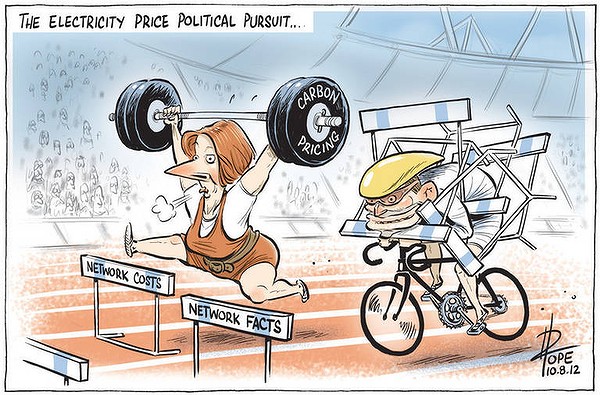
The states have used the pricing of carbon as a cover and continue to do so. So does Abbott--electricity price rises were largely caused by the carbon tax. The reality is that energy price rises are well above the cost of the introduction of the carbon price and taking action on climate change. 9c of every dollar in an electricity bill (the retail price) is for the carbon price – and that’s fully compensated – while 51c is for the poles and wires.
The government regulators signed-off on monopoly networks spending more than $40 billion within five years doing upgrades of poles and wires to serve peak demand for a few days a year. The industry's rhetoric is that peak demand is going through the roof--from 38,000 megawatts today to more than 50,000 MW by around 2020 and climbing like a hockey stick.
Approved network spending will keep driving prices up over the next two years at least – and much of it is questionable. It turns out that we won’t need this, since the low wholesale prices over the last few years reflect the general state of oversupply on the National Electricity Market (NEM), due to falling demand.
The state governments were able to pocket a huge windfall of additional revenue from their network businesses. They use their networks to siphoning off millions per year in dividends. The states have abused their dual roles as owners and regulators of power assets by over-investing to maximise dividends. Even in the face of a clear downwards trend in actual demand, the industry continues to project hockey stick rises in consumption. The money spent on upgrading the networks is determined by these demonstrably wrong forecasts of demand and so, in turn, is their regulated return and the payola for the states.
Gillard is going to have to act on electricity prices as increased energy prices are political dynamite. Will that reform be through CoAG? The Australian Energy Market Commission has been captured by the industry it seeks to govern, whilst the regulator, Australian Energy Regulator, has said that the regulations which govern its decision-making process were overhauled, network operators, including state governments, will continue to overinvest in infrastructure, forcing consumers to cover the costs which the operators receive back as dividends.
The NEM has been set up to increase profits for the industry and it has little to do with social (the interests of the community in which the market operates,) or environmental objectives (climate change and energy efficiency). So why not make network revenue increasingly based increasingly on the success of energy conservation and efficiency initiatives, on the assumption of continued falling peak and total demand, with incentives for achieving even lower demand and penalties for overshooting forecasts?
Posted by Gary Sauer-Thompson at 11:36 PM | Comments (20) | TrackBack
August 6, 2012
city boom, sprawl and bust?
Whilst working on my Adelaide book I started noticing how shallow the commentary on cities and urban life in the mainstream media is. An example is this editorial in The Australian Financial Review and it is yet another example of the downward trend in the quality of mainstream journalism.
The editorial refers to James Packer’s Crown Group spending $568 million in Perth to build a “six-star” hotel near the Burswood casino and convention centre, with that centre also to undergo a $750 million revamp; Lend Lease investing $6 billion in the Barangaroo waterfront project in Sydney that will include a trio of office towers; and In Brisbane, the $700 million One One One project in Eagle Street, Brisbane, which is now the city’s largest office tower. It comments that these:
and several other projects, such as the new 45-storey office tower in Perth that houses 3000 BHP Billiton employees, and Melbourne’s Docklands developments now under construction, are reshaping our cities.A great deal of national wealth comes from this continual remaking of our cities, as developers react to market forces, including the resources boom, and the need to renew ageing office building stock.
The AFR's argument is that the capitol cities in Australia are being reshaped in line with the resources-boom-led remaking of our economy. It's all about corporations and profit, not about the people living in the cities or how they envision a more liveable city. It is not obvious how Packer's “six-star” hotel near the Burswood casino and convention centre with its increased tourism and gambling will make Perth a more liveable city for its inhabitants.
What is even more astonishing is the silence about improving city cores, containing sprawl, and reinforcing transport spines. There was nothing about the sustainability of urban life and changing weather patterns, or the possibility that an entire city framework is threatened when climate change alters rain, heat, and sea levels. Yet cities around the world have grown and retreated as climatic conditions changed.
The AFR only sees the boom, not the suburban sprawl. They have no awareness of the bust---eg., New Orleans---the history of cities going bust, or the implications of the earth warming on Australian cities.
As city expansion increases with wealth, this leads to greater suburbanization in the form of continuous outward development. Car dependency increases with new outer suburban residential developments. There is a correlation between extensive low-density suburbanization and subsequent metropolitan collapse. The reason is that our cities are built to survive in the most benign weather regimes.
Our cites are premised on the expansion of low-rise land use patterns require continued expansion of roads, water, and energy resources. The roads, sewers and the other infrastructure of the modern suburb are based on an assumption of mild weather and cheap energy. If the weather becomes more extreme--eg., system failure in Brisbane---or the energy becomes more expensive, then the infrastructure cannot cope.
Our cities ought to reshaped during boom times to make them more sustainable so they can cope with the changing weather patterns more effectively.
Posted by Gary Sauer-Thompson at 9:41 AM | Comments (14) | TrackBack
August 4, 2012
Olympic glory + triumphalism
Australia is doing rather badly in the London 2012 Olympics and the criticism of the performance in the media intensifies. There is not enough success to allow for triumphalism about the heroes and rubbing defeat in the face of Australia's national villains. Or ruthlessly trample them into the ground.
Australia's heroes should ensure that Australia is one of the top nations rather than slowly sinking down the medal ladder. Maybe the fusion between phony nationalism and sport can be disconnected from the crisis of national identity due to Australians no longer feeling united as a nation.

The Olympics have become an over-hyped carnival of advertising (by corporations who make people fat and sick), brand police, broadcast rights restrictions and a giant bureaucracy. Given the corporatisation of the games, are the modern Olympics akin to the religious rituals of old that created a community, fostered a loyalty and love of that community, and expressed the spirit of the nation?
The Olympic organizers repeatedly make the point that the Games wouldn't exist without corporate dollars yet these cover about about 50% of the cost of the games. The state funds the rest of the spectacle and the public have to wear the cost of disrupted lives and the post-Olympic's stranded stadiums that are unused and become urban ruins.
Posted by Gary Sauer-Thompson at 11:54 PM | Comments (7) | TrackBack
class conflict
Big Business sure is going on and on about industrial relations, declining productivity and the Fair Work Act. It's the Gillard Government's fault. The ALP is refusing to change the regulations to increase company profits, reduce wages and decrease union power. It is the ALP that is responsible for the old culture of conflict and class division.
 David Rowe
An editorial in the AFR spells it out:
Australia should have used the peak of the China boom to do the hard things required to set us up for the opportunities still on offer from our Asian century: if we can grab them. That would include forging the world’s best industrial relations arrangements that encourage a high-performance workplace culture. That is, we should seek to break from the adversarial and over-regulated workplace culture entrenched over the past century.
The AFR then says that the whitewash of Labor’s review of its Fair Work Act this past week showed we have done the opposite. The business-as-usual review by a panel of industrial relations insiders brushed aside concerns that Labor’s reregulation of the job market could have any role in our declining productivity growth.
The claim that Labor’s reregulation of the job market is a cause of the Australia's declining productivity growth is assumed not argued for. That the latter could also have something to do with an educated worked and research and development rather than lower wages ---is not acknowledged, despite a reference to the rise of the services sector as manufacturing declines and the wave of revolutionary technological change.
Posted by Gary Sauer-Thompson at 12:10 AM | Comments (3) | TrackBack
August 2, 2012
John B. Cobb on economics
In this interview in Eurozone John B. Cobb, the co-author of For the Common Good: Redirecting the Economy toward Community, the Environment, and a Sustainable Future, says that:
the academic discipline of economics is based on the idea of Homo economicus. This assumes and reaffirms extreme individualism. Members of the species Homo economics compete with one another for scarce resources. Policies based on this understanding of human beings typically result in the destruction of human community. Even if the result is also that there is more consumption of goods and resources per capita, the people involved are, for the most part, not happier or better off.
If the neo-liberal system of governance is arguably in free fall, then what currently exists in opposition to neo-classical economics is an ecological economics that is premised on the interdependence and coevolution of human economies and natural ecosystems over time and space. It was largely a response to a real or perceived lack of physical and biological underpinnings in neoclassical economics.
Cobb adds that the idea of the common good is oppositional to market fundamentalism because it depends on an understanding of community:
If we approach matters individualistically, as standard economic theory does, then the good of a group of people is simply the addition of the good of individuals. But we believe that each persona is largely constituted by her or his relations with other members of their social group, and by the way the group as a whole is structured and relates to other societies. Individuals are much better off if some of the societies to which they inevitably belong are communities in which all feel some responsibility for all.
He adds that the good of the community involves a pattern of relationships among its members and a concern on their part for how the community as a whole is doing.
The wellbeing of the community directly improves the wellbeing of its members. Why cannot the ALP talk that language? Is it too beholden to economism to be able to do so?
Posted by Gary Sauer-Thompson at 1:50 PM | Comments (4) | TrackBack
August 1, 2012
Wayne Swan's John Button lecture
In his 2012 John Button lecture entitled entitled Land of Hope and Dreams Wayne Swan talked about the ends of economic policy, by which he means what sort of society we want, and the sorts of lives we each aspire to lead. In this he follows John Button who, Swan says, put economics to work for the betterment of the country.
 Swan refers back to, and comments upon, his essay in the March issue of The Monthly. He says his claim then was that:
the rising influence of vested interests is threatening Australia's egalitarian social contract. I argued that a handful of powerful people not only think they have the right to a disproportionate share of the nation's economic success, they think they have the right to manipulate our democracy and our national conversation to gain an even bigger slice of the pie.In the wake of the debate my essay unleashed, let me make one further charge: there is an equally concerning view emerging that such vested interests should somehow be immune from criticism. They should not. They think the rest of us should fear them. We do not. I certainly do not.He adds that he was accused of preaching class warfare, and called unfit to be Treasurer of Australia.
I was told that I was siding with the wealth consumers not the wealth creators; that I wanted to slice the pie not grow it; and that my day job was simply to shut up and to make the wealthiest Australians wealthier still. In short, the idea was promulgated that I had transgressed some new, unwritten Australian law that limits the scope of our democratic debates in this country with this command: don't criticise the powerful, don't argue for equality.
He adds that rather than risking a stagnant and widely divided society, we should be – and are – building a society with a vast middle class and a high degree of social mobility. That's the meaning of economic equality in the 21st Century and it's the central and abiding purpose of the Labor cause today.
Swan is right to say that inequality in Australia is increasing --it has been since the 1980s. Sadly though, Swan doesn't go on to say that the ends of economic policy are happiness, the well-being of the population, or the good life. Equality is a good because it is a necessary pre-condition for the well being of the population.
That point needs to be made because those on the Right are opposed to equality and favour inequality - because it produces wealth creation---so you need an argument to show why equality is better than inequality. Swan doesn't provide that, other than appealling to the fair go.
Posted by Gary Sauer-Thompson at 10:08 PM | Comments (9) | TrackBack