|
August 17, 2012
Ecuador has granted Julian Assange political asylum Ecuador says that Assange is at risk of an unfair trial or the death penalty in the United States, that Sweden might extradite him there, and that Australia has abandoned him.
The UK is not pleased.The latter claim that the UK has a "legal duty to extradite" Assange and that it can do so under its Diplomatic and Consular Premises Act 1987. The act gives ministers the "power of de-recognition" of the Ecuadorian embassy — which would allow Assange's arrest in the embassy regardless of whether Ecuador grants him asylum.
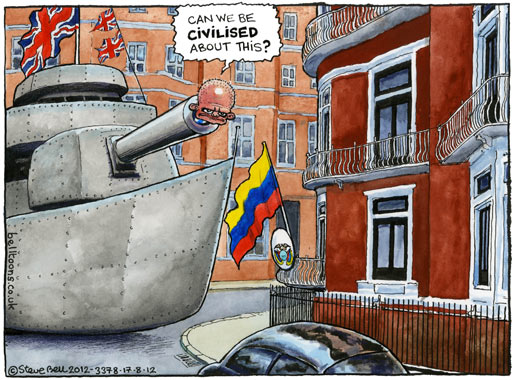 Steve Bell
It is now quite clear that the UK will not facilitate Assange's safe passage out of the country, and that it remains committed to executing the European Arrest Warrant. The police presence, the Ecuadorian Government noted, had risen from two or three to around 50, with officers on the embassy's fire escape and at every window.
Australia remains silent. They are not even saying that it is unacceptable for the UK to take unprecedented action and perpetrate a likely breach of international law in order to seize an Australian citizen. The reason Australia should speak out in a diplomatic sense is that whilst Assange has violated his bail conditions, he is merely a suspect before charges that have not been formally laid.
The gravity of Assange offences hardly qualify as matters of terrorist import, and it would be questionable whether the Diplomatic and Consular Premises Act is being appropriately used since Assange's presence in the embassy is not a threat to the British public. The Ecuadorians had offered Swedish authorities full access to question Assange about the possible charges of sexual assault, but the Swedes turned it down, as they did when Assange made the offer previously while on bail in England.
Secondly, arresting Assange inside the embassy without Ecuadorean permission would be against international law. Australia should clearly state that it accepts the international rules because they are essential for the conduct of business between states, and point out that though the British Government can break the rules, the consequences of embassy premises being no longer guaranteed immunity, means that doing normal government business would be impossible.
Does Assange faces the risks Ecuador claims? Australia's diplomatic service takes seriously the likelihood that Assange will eventually be extradited to the US on charges arising from WikiLeaks obtaining leaked US military and diplomatic documents. Yet the Australian Government has no in-principle objection to Assange's extradition. That is the action of a client state.
There must be a lot of pressure on the UK, Australia and Sweden from the US, given that neither the UK and Sweden will not guarantee that Assange will not be extradited to the US from Sweden. That is what is needed.
Update
What I find problematic in the commentary is the view that makes light of the possibility that, if Assange is sent to Sweden to face his allegations, then he will be extradited to the US.
It's an odd state of affairs given that Sweden could have agreed to question Assange in Britain and Britain could have promised Ecuador that it would extradite him only if Sweden agreed not to send him to America. Or Sweden could have agreed not to send him to America, since Swedish law would not permit Assange to be extradited for political offences such as espionage or treason and that Swedish law would never extradite him to the death penalty, and probably not to a military trial.
|





I don't understand why Sweden refuses to question Assange in the UK, given that he has not been charged with any crime. The Swedish legal experts talk in terms of preliminary investigations into alleged rape.