January 29, 2014
Australian photography: Brenda L Croft
Brenda L Croft, of the Gurindji people, has been exhibiting since the mid-1980s. Brenda Croft captured the emergence of a new wave of community activists in Redfern in the early 1990s. Her career later shifted focus and she went on to become senior curator of Indigenous art at the National Gallery of Australia. Born in Perth in 1964, and having lived in many parts of Australia and overseas, she now lives and works on the South Coast of NSW.
Her work questions stereotypical descriptions of the relations between Indigenous and non-Indigenous people,
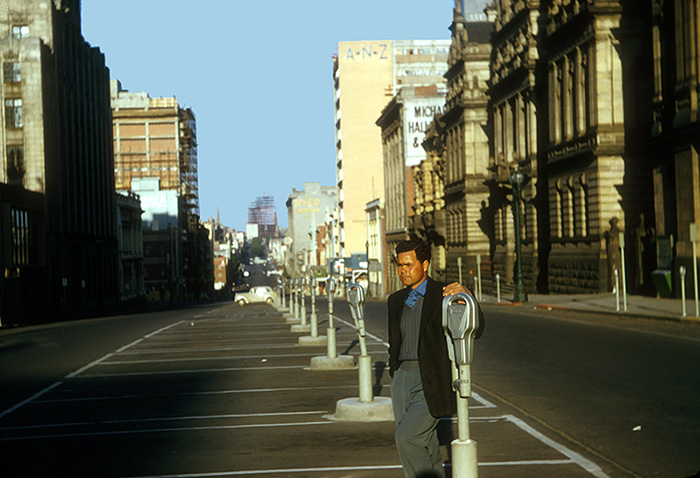 Brenda L Croft, Man about Town, 2003, from the exhibition Man About Town, Giclee print on rag paper
1960s Perth, prior to the national Referendum of 1967 was a place where Aboriginal people lived under the restrictions enforced by authorities of the day: Pass laws, or 'Dog Tags', city boundary restrictions, fringe camps, and removal of children from their families. At the same time new arrivals to the state from around the world were 'greeted/accepted' in diverse ways, depending on their country of origin.
In a formal sense Croft often uses the layering of text and image. The 1998 exhibition In My Fathers House included a series of multi-layered coloured photographs juxtaposed with text. Each picture pulls together family memories from members of the Stolen Generation – one of whom was Croft’s Aboriginal father. layering of text and image.
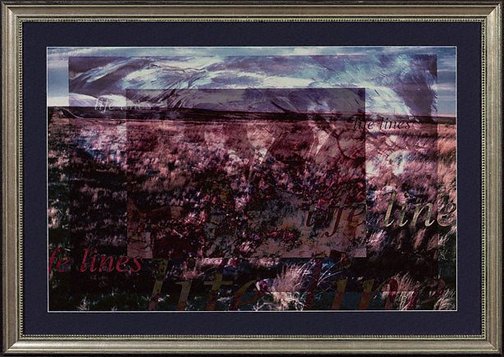 Brenda L Croft, Lifelines, from the series In my father's house, 1998, colour ilfachrome photograph
In this series, Croft juxtaposes religious imagery, language and family photos to comment on her experience of growing up in the suburbs with a white mother and an Aboriginal father who was taken from his family at less than two years of age under the government policy that allowed the removal of Aboriginal children from their parents.
Growing up in institutions, often with religious affiliations, with little or no knowledge of their parents and culture, these children are now known as the 'Stolen Generations'. The constructed layers of memory in Croft's work reflect the fragmented lives of these children and the ongoing effects of this through generations as families reconnect.
January 25, 2014
Claudia Terstappen: Australian landscapes
Claudia Terstappen is a German-born photographer who studied at the Dusseldorf art academy and is now Professor of Photography at Monash University in Melbourne She moved to Australia in late 2004.
Claudia Terstappen has an exhibition at the Monash Gallery of Art, at Wheelers Hill, Melbourne, which is entitled “In the Shadow of Change". It features around 75 of Claudia Terstappen’s landscape photographs that were made between the mid-1980s and the early 2000s and more often than not - represent sites of spiritual significance and environmental change
Some of these landscape images are in tonally rich black and white medium format landscape images of unspoiled or wild places from around the world
 Claudia Terstappen, Curtain fig tree (Queensland, Australia), 2002, From the series Our ancestors 1990-, gelatin silver print
So many are made on film and would often require long exposures to get the depth of field. I admire the Australian landscapes because of the density of the images, or rather they represent the density of the rainforest. The density and multiplicity of the rainforest, and the bush, forces the photographer to inquire into image making.
 Claudia Terstappen, Cabbage trees (Queensland, Australia), 2002, From the series Our ancestors 1990--, gelatin silver print
Terstappen layers shapes within these photographs and she makes reference to the object's sculptural characteristics--the object's sculptural sensation of a physical encounter in space.
The images refer to a sense of the sublime and suggest a link to indigenous cultures.
January 21, 2014
The Photoville Film Festival: Canberra Lab
The Photoville Film Festival was held from September 19–29 in Brooklyn Bridge Park, New York included work by the Canberra Lab curated by Ronan Moss & Julian Hobba It was entitled Canberraville and it was based on 100 Views of CanberraThis was part of the Centenary of Canberra festival.
Canberra Lab is a group of young architects and designers establishing a discourse within Canberra’s design community who were drawn together in a publication by local photographic exhibition space PhotoAccess. This is a public art gallery and the only community gallery space in the ACT dedicated to the photo based arts.
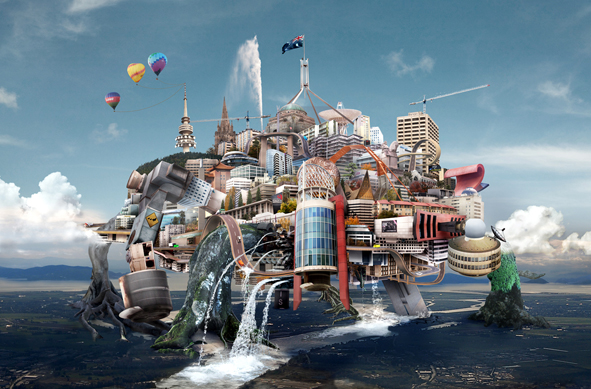 Josh Dykgraaf, The Bureaucratic Machine, 2013
The 100 Views of Canberra offers a vast range of perspectives, skill levels, and aesthetic concerns and represent a cross section of contemporary Canberra life. T he name “100 Views of Canberra” sounds familiar to you, it is. The title is a take on the famous series called “100 views of Mount Fuji” by Japanese Ukiyo-e Katsushika Hokusa and it implies that Canberra can be viewed from many points of view in order to express an infinite variety of moods and nuances.
Another artist in the exhibition was the conceptual photo-artist Katherine Griffiths:
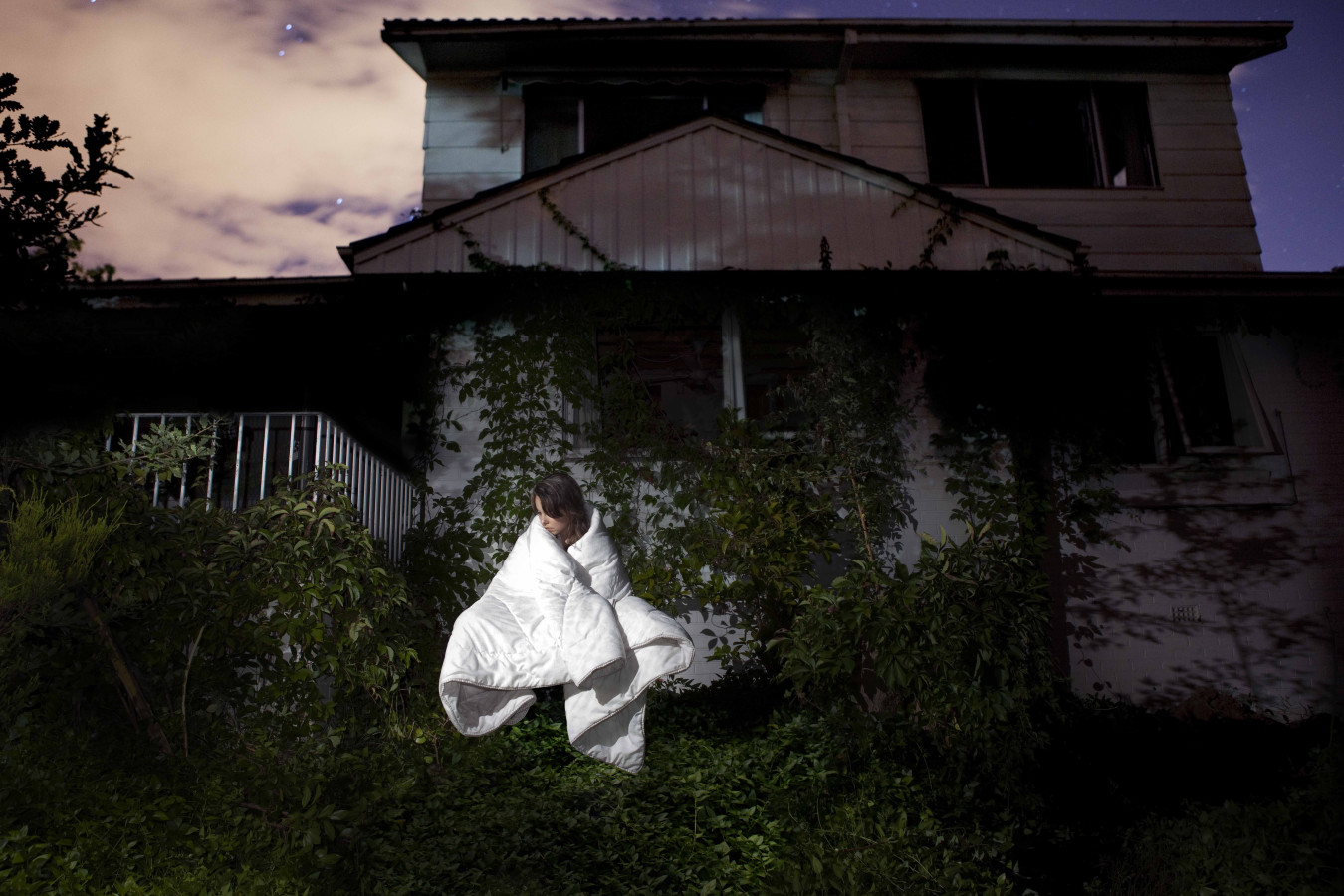 Katherine Griffiths, Comfort, from the series Caught in a Memory
This Canberra based emerging artist uses constructed narratives and cinematic lighting in her work.
January 15, 2014
an old debate revived
Old/new rhetoric has affected the discourses on photography with the emergence of the disruptive emergence of digital technologies and the shift from analogue to digital.
The embracement of the digital is often seen “through the simple binary dialectic of old and new (old/new methods, old/new ontologies, old/new subjectivities, old/new politics) that has characterized the adoption of new media technologies in aesthetic practice.” Not uncommonly, such dichotomous thinking simplifies nuances by willingness to discard the old for the sake of the new.
This kind of discourse sees photographic images as the products of technology rather than culture. This mode of thinking opposes digital imagery to photography and it sees the latter as realist images---simple mirrors held up to mundane realities. Digital imagery, in contrast, constitute a post-photographic culture, represents the creative realm of constructed realities. On the one hand we have science and objective truth, and on the other, we have art and subjective experience of the artist. This dualism has haunted photography since its birth.
Photography, however, is a set cultural practices with different purposes, and we cannot get very far in thinking about these practices in terms of an autonomous technological force.
Vincent J Stoker: Heterotopia: The Tragic Fall
Many of the photos in Vincent J. Stokers‘ series Heterotopia: The Tragic Fall look like they were made on the set of a previously undiscovered Stanley Kubrick film. These abandoned spaces found around the world — an unlikely mixture of control centers, theaters, bath houses, and spots we can’t place — as Stoker explains it are:
“detached from the commonly established relation to time and have entered a temporality of their own. The linear and sovereign time of the watch is replaced with the slow, soft and suspended time of ruins, with the one of the humanist accumulation of the stored knowledge, or with the ever-frozen time of photography.
Heterotopias (Hetero: the other, otherness. Topos: the place) are the other places. It is a concept developed by the philosopher Michel Foucault in the lecture Des espaces autres (1967), published in 1984.
Heterotopias can be defined negatively, by what they are not.
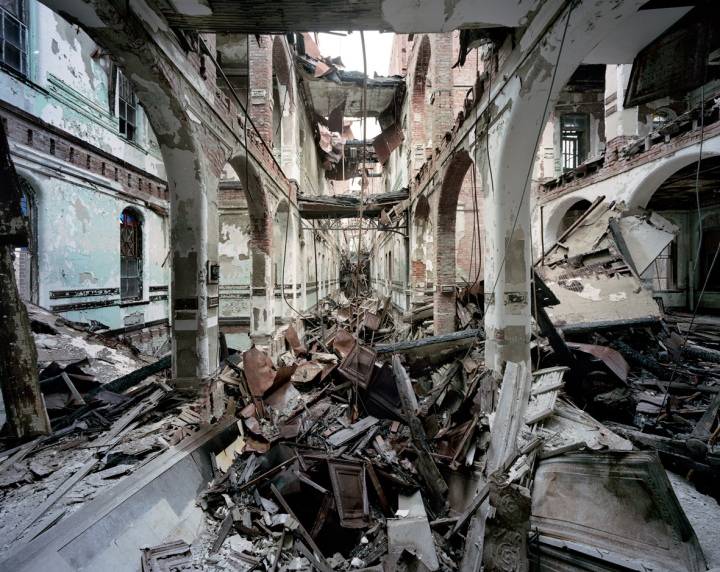 Vincent J. Stoker, Hétérotopie #AAEFI
Stoker's photos are of stout and monumental monsters, relic of the past. They are architectural spaces that have been ignored, deprived of their meanings and functions, places standing outside of daily experiences. He says that the series, The tragic downfall", claims:
that the existence of a place always goes through two moments. From the ascending phase of construction, a time of glorious youth that is the pride of architects, inevitably follows a descending phase where Nature characteristically reasserts its rights. This last moment is what I call the "tragic fall". A change, more or less violent, plunges the existence of the place from one phase to the other. I call this separating moment "dramatic pivot".
The series captures only the descending semi-circle of existence; it is up to the viewers to imagine the other half of this tragic circle by creating their own version of the places’ glorious youth.
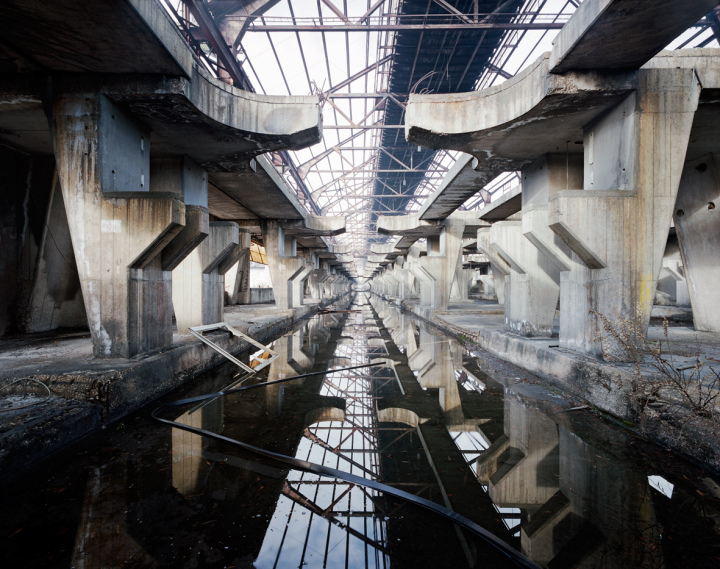 Vincent J. Stoker, Hétérotopie #IEIVI
Although heterotopia is a marginal concept in Foucault, it has provoked a vast number of scholarly as well as artistic interpretations and applications. Stoker's interpretation is ruined locations, abandoned empty spaces where nature has become ascendent.
January 14, 2014
Claude Cahun: photography as theatre
The work of Francesca Woodman shows that photography can be a kind of primitive theater and that the photograph is an arena in which to act. This approach was explored by Claude Cahun, a French artist, photographer and writer, who made of work consisting of highly-staged self-portraits and tableaux that incorporated the visual aesthetics of Surrealism.
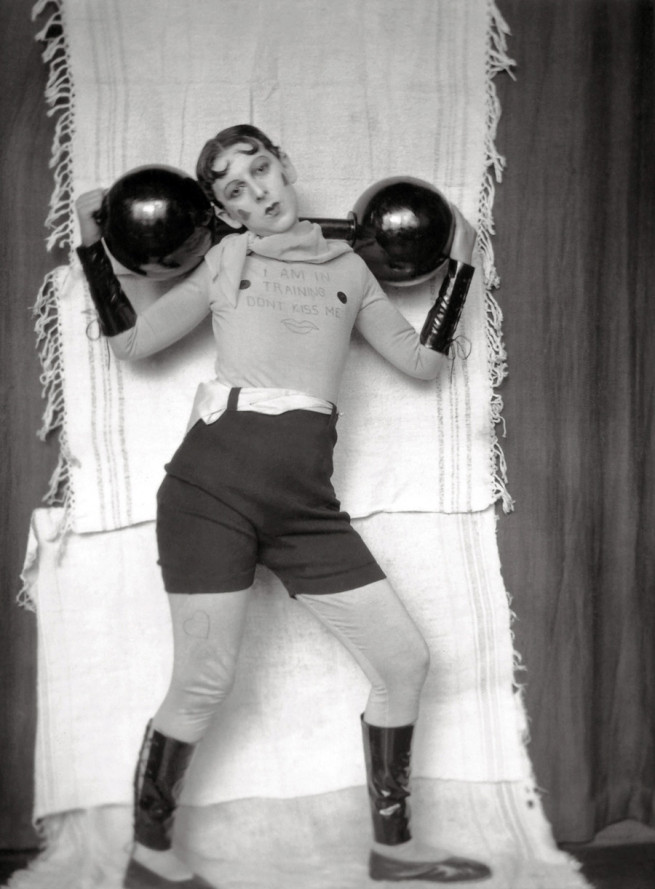 Claude Cahun, Autoportrait, 1927, Gelatin silver print
The photographs for which she is best known depict Cahun in a range of costumes: a coy, effeminate weightlifter with barbells, sporting spit curls, a heart-shaped mouth and pasties, the words DON’T KISS ME I’M IN TRAINING scrawled across her chest; an aviator with camera lenscaps in place of goggles; a dandy in a suit and white silk scarf, one hand perched on a hip, a white handkerchief emerging from a pocket; a sailor; Little Red Riding Hood; a little girl, asleep in a cupboard. In one photograph she dresses as her own father; in another, as a judge. Cahun slips from one gender to another, often sporting a shaved head, adapting to each character with theatrical flair.
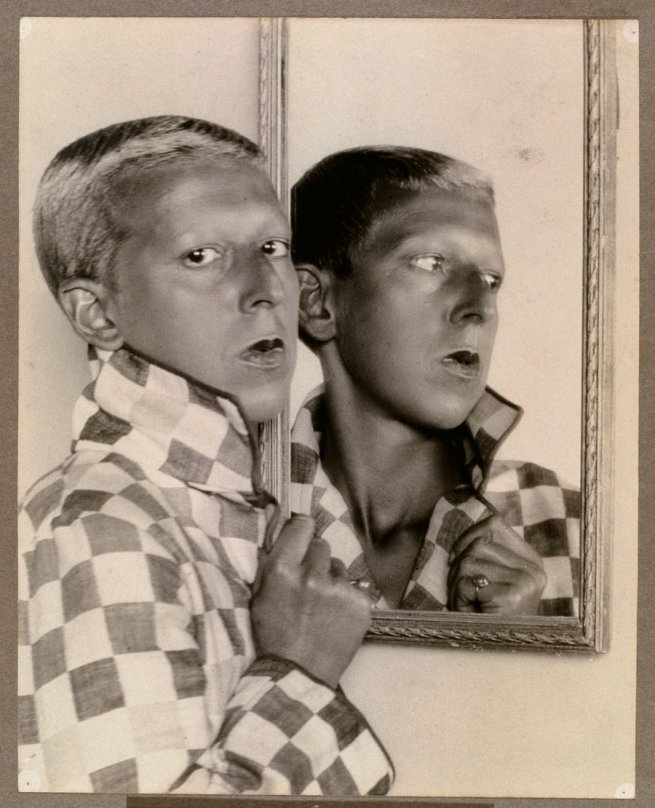 Claude Cahun, Autoportrait, 1929, Gelatin silver print
Throughout her life, Cahun used her own image to dismantle the clichés surrounding ideas of identity. She reinvented herself through photography, posing for the lens with a keen sense of performance and role-play, dressed as a woman or a man, as a maverick hero, with her hair long or very short, or even with a shaved head.
Rather than rely on the photographic techniques to convey her message, Cahun used the camera instead as a means to capture an image of the concept she displayed on her body through dress, expression, emotion, and the occasional mirror or other prop.
January 13, 2014
picturing Mars
The Smithsonian National Air and Space Museum in Washington is exhibiting a decade of the photos taken by remote exploration by the two robotic rovers – Opportunity and Spirit. One of the mission’s main scientific goals was to search for and study a wide range of rocks and soils that hold clues to past water activity on Mars. To do this, the rovers landed on opposite sides of Mars in locations that appear to have been affected by liquid water in the past.
This HiRISE (one of six instruments on NASA's Mars Reconnaissance Orbiter) image of an east-facing slope in Tithonium Chasma was taken to follow up an earlier Context Camera image that seemed to show sediment layers of near-uniform thickness.
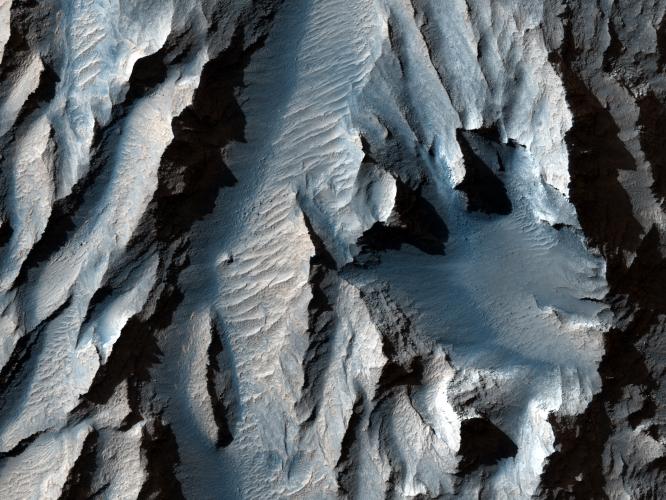 NASA,Tithonium Chasma, Mars
We see Mars through the frame of our own imagined landscapes for the picture that results from earthbound scientists polishing up raw pixels beamed back by robot rovers is shaped by pictorial and aesthetic convention just like any landscape art is.
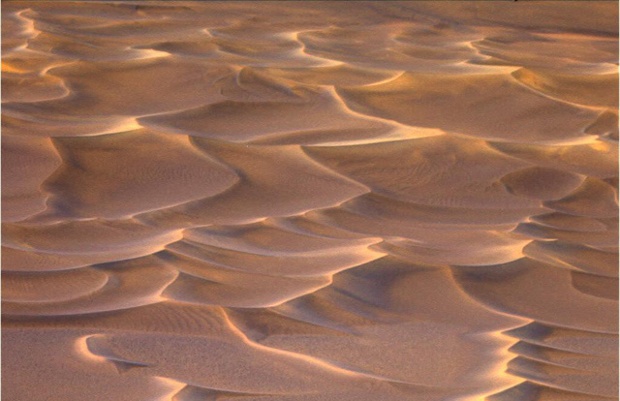 NASA/JPL-Caltech/Texas A&M/Cornell, dunes at Endurance crater, Mars
The pictures of the dusty orange Martian desert resemble vistas in New Mexico or Arizona or the Australian outback.