|
January 14, 2014
The work of Francesca Woodman shows that photography can be a kind of primitive theater and that the photograph is an arena in which to act. This approach was explored by Claude Cahun, a French artist, photographer and writer, who made of work consisting of highly-staged self-portraits and tableaux that incorporated the visual aesthetics of Surrealism.
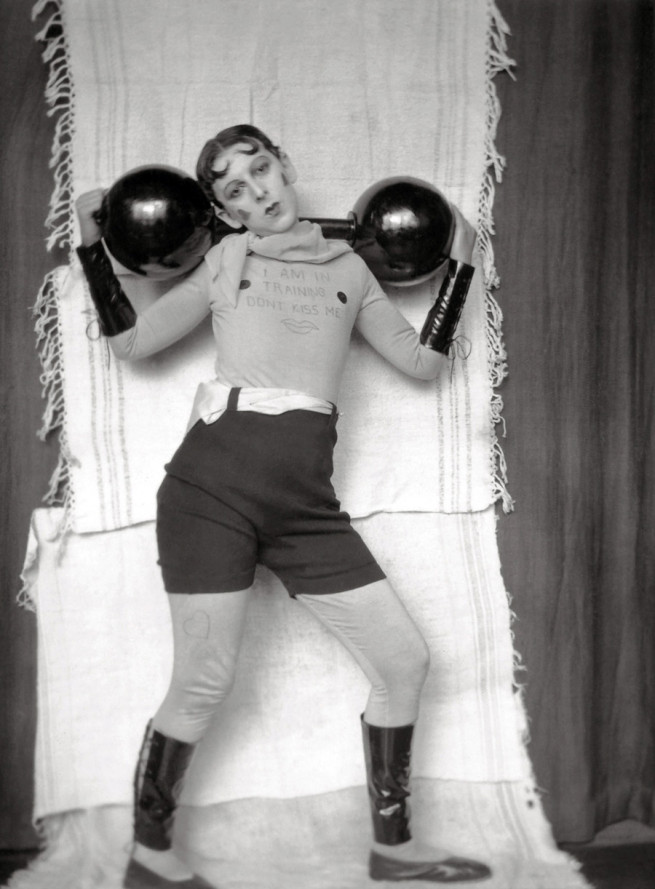 Claude Cahun, Autoportrait, 1927, Gelatin silver print The photographs for which she is best known depict Cahun in a range of costumes: a coy, effeminate weightlifter with barbells, sporting spit curls, a heart-shaped mouth and pasties, the words DON’T KISS ME I’M IN TRAINING scrawled across her chest; an aviator with camera lenscaps in place of goggles; a dandy in a suit and white silk scarf, one hand perched on a hip, a white handkerchief emerging from a pocket; a sailor; Little Red Riding Hood; a little girl, asleep in a cupboard. In one photograph she dresses as her own father; in another, as a judge. Cahun slips from one gender to another, often sporting a shaved head, adapting to each character with theatrical flair.
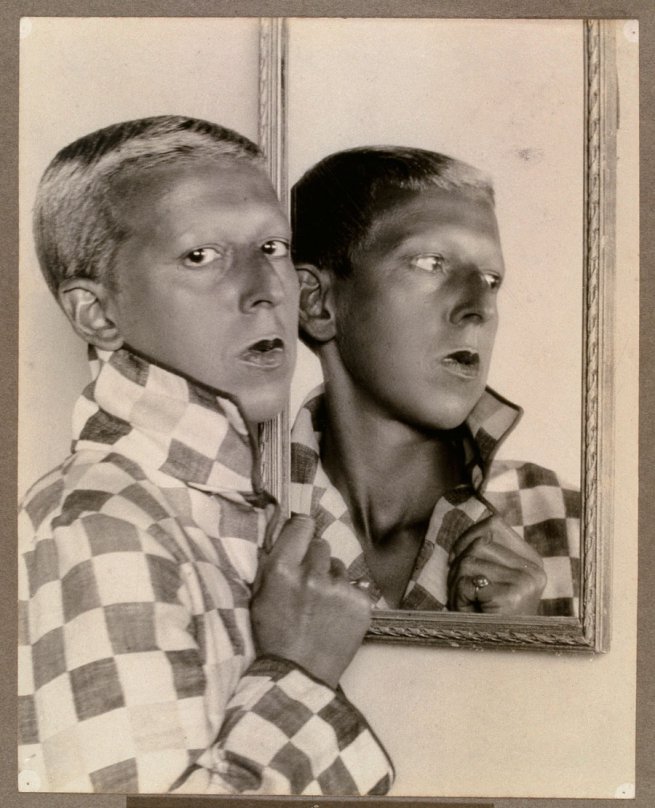 Claude Cahun, Autoportrait, 1929, Gelatin silver print Throughout her life, Cahun used her own image to dismantle the clichés surrounding ideas of identity. She reinvented herself through photography, posing for the lens with a keen sense of performance and role-play, dressed as a woman or a man, as a maverick hero, with her hair long or very short, or even with a shaved head.
Rather than rely on the photographic techniques to convey her message, Cahun used the camera instead as a means to capture an image of the concept she displayed on her body through dress, expression, emotion, and the occasional mirror or other prop.
|


