|
December 12, 2013
Charles Gatewood's career has spanned over 45 years as both a fine art photographer and a photojournalist, has worked on assignment for The New York Times and Rolling Stone, Harper’s, and Time magazines. The internationally respected photographer is best known for his early photographs of the “modern primitives” movement, and of underground and sub-cultures of the 1960s to present.
In the 1970s Charles Gatewood made a different body of work to rock stars and bohemians – and later – alt culture. He explored the financial district of Manhattan--the Wall Street area. This was at a time when America's country’s economy was as depressed as it is now. New York City in the mid-70s was flat broke.
 Charles Gatewood, untitled, New York, 1975, from the Wall Street series
In this interview with Sensitive Skin Gatewood says that:
In January, 1972, I spent a week with William Burroughs in London, doing a feature for Rolling Stone magazine. Burroughs’ ideas about conditioning, power, and control stimulated me, and when I returned to New York, I began to explore Wall Street as metaphor, a poetic photo-rant about neo-fascist architecture and wage-slave robots, the cold glass-and-steel environment that said The World is a Business.
He worked on this photographic essay from 1971-1976. The New York State Arts Council gave him two fellowships to continue the work, and when I published a small edition of WALL STREET, I was awarded the Leica Medal of Excellence for Outstanding Humanistic Photojournalism.
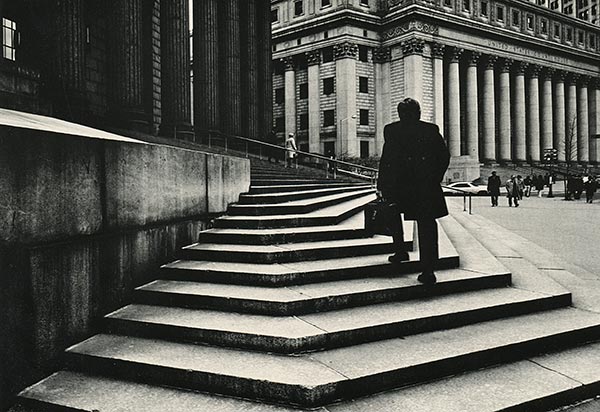 Charles Gatewood, untitled, New York, 1975, from the Wall Street series
In these photographs. Wall St. looks bleak, desolate and depressing, and there is an underlying theme of capitalism and control Wall Street symbolizes greed, corruption, and money addiction--greed is good.
|


