« October 2005 | Main | December 2005 »
November 30, 2005
the friends of democracy
From watching the speeches made in the House of Representatives this last month it is clear that the fourth term Howard Government, can and is doing, mostly what it wants. It is loving all that power, and it cannot resist throwing its weight around.
They are in control and they want everyone to know that this is the way things are these days. So you'd better get used to the strong leader defending national security and keeping the people safe from the bad guys.

Leak
In doing so its members cannot resist mocking those who disagree with it, especially on civil liberties issues. So they undermine---white ant-- the liberal democracy they profess to defend.
Isn't Australia's parliamentary democracy non-negotiable, according to those who reckon we are waging a war on terrorrism and we are facing threats from all and sundry? Isn't it our liberties that make Australia dear to us and the ground of our patriotism (love of country)? So why white ant the freedoms and liberties that underpin liberal democracy? Is this self-inflicting wounds on liberal democracy by the Howard Government the tipping point where liberals become conservatives?
Where are the Nationals----apart from Barnaby Joyce? What are they saying about welfare-to-work and the negative impact on their lower income constitutency? Very little is being said. They lack the political courage to stand up to the Liberals, even to modify the neo-liberal mode of govenrance. What are they saying about the abuse of the parliamentary process that is so noticeable around the anti-terrorrsm legislation? Very little. It is the independents who are speaking up.
The Nationals are cowed, so much so they are even turning on Barnaby Joyce for stirring things up and creating waves. What political form will the discontent about economic reforms, lack of equity in economic growth and social alienation take now?
Posted by Gary Sauer-Thompson at 6:40 AM | Comments (4) | TrackBack
November 29, 2005
corrosive effects of the IR legislation
We know that the industrial relations bill will enable those on high incomes to win greater benefits whilst those on low and middle incomes stand to lose, especially in times of economic downturn and recession.
Louise Dodson in the Sydney Morning Herald draws attention to "the corrosive effects of the IR legislation, and suggests why the slow burn may well have political fallout for the Coalition. The legislation:
"...will produce losers as well as winners and set the two constituencies of the Coalition - economic rationalists and social conservatives - against each other. The Coalition has been successful in recent times partly because it has managed to gain support from both constituencies."
The politics is this:
Nowadays the National Party, just as much as Labor, represents the poorest electorates. Its constituents are unskilled, blue-collar workers, with higher income farmers these days voting Liberal. National Party constituents have most to lose from the industrial relations changes and fear them just as much as Labor's supporters. On top of this they worry the legislation will drastically affect family, community and church life. Church groups and leaders have been some of the strongest opponents of the legislation for the same reason.
This is different from the fear of industrial relations changes not being enough for Labor to win the next election. It brings us to a return of 1996 when the economic rationalists and social conservatives split asunder and the abandoned the Keating ALP.
Will this happen to the Coalition in 2007?
Posted by Gary Sauer-Thompson at 1:42 PM | Comments (0) | TrackBack
November 28, 2005
How's the ALP travelling?
I watched Question Time in the House of Representatives today.The questions about the complex workplaces changes were quickly displaced as an angry Labor called a biased Speaker into account, and dissented from his consistent onesided rulings in favour of the Government.
It was good political theatre done to defend the importance of Parliament as a way of holding the executive accountable. That is the significance of Question Time.The ALP is right to defend the Speaker's undermining of the substance of Question Time.
Labor looked good, very good. This is another example of the recent change in political climate that has resulted from the marshalling of opposition to the industrial relations legislation that the Senate is currently debating. The ALP tacticians have managed to link parliamentary tactics and public opinion, and bring them together into a whole. It is a good, solid achievement.
An editorial in The Canberra Times sounds a note of a warning:
Meanwhile, Labor has almost no profile in developing debates, whether over the centrist trends in primary and secondary education or a shift to a college model in university education, and appears to have no policy whatever (and certainly no critique of Government policy) in Aboriginal affairs. It has made almost no running--- presumably from its own shame and embarrassment ---over immigration scandals, and seems to have dropped Tony Abbott and health care from much in the way of scrutiny, allowing a somewhat bruised minister a lot of time for recovery. It appears to have junked playing any significant sort of role in the welfare-to-work debate, presumably because it is more preoccupied with the industrial relations debate. In the process it is losing important opportunities to point out how the two proposals are linked. Or about how the questions in many minds about potential losers in the industrial relations changes will redouble once it is clear how many new unskilled and untrained people may be entering the system. Likewise, it has shied entirely away from the security debate, and, apparently, from debate about Australian defence directions. Labor, bluntly, is doing very little to hold the Government to account. Nor, while it is ignoring that function, could it claim to be doing much by way of developing new policy and directions, or of selling any sort of ideal or vision of the party.
It's true, unfortunately. The ALP has been consistently outgunned in the strategic, deliberation and cunnning strategy departments by Howard since 1996.
Will this happen again? It is a long way to the next election isn't it. As each year passes the neo-liberal mode of governance deepens. That mode of governance is not going to be rolled back.
Posted by Gary Sauer-Thompson at 5:41 PM | Comments (10) | TrackBack
Iraq gone bad
Iraq is a chaotic bloody mess yet there is no political fallout in Australia. Consider his account in The Observer:
According to the UN, armed militias, criminal gangs and terrorist organisations are proliferating. According to the Pentagon, the number of insurgent attacks is at its highest recorded level - at more than 550 a week - and the rate of civilian casualties is also higher than ever before, at more than 60 a day.The UN believes that more than 30,000 civilians have been killed since the war, about eight times the number of deaths caused by 30 years of conflict in Northern Ireland. Only one or two Iraqi army battalions are capable of independent operations, while subversive sectarian militias have infiltrated Iraqi police and security forces. There are massive deficiencies in the delivery of essential public services, such as water and electricity.
That's a foreign policy failure in ordinary language an indictement of misjudgment and incompetence regarding the occupation, whatever one thought of the invasion.It is an occuaption based on the widespread torture and abuse or prisoners held indefinitely without charge or trial .

"Leahy
Yet this situation makes scarcely a ripple in Canberra. Parliament is not interested in debating the issue. The ALP has gone real quiet.
Posted by Gary Sauer-Thompson at 9:05 AM | Comments (0) | TrackBack
November 27, 2005
the politics of media reform
There was an interesting article in Saturday's Australian Financial Review on media reform by Jennifer Hewett and Tony Boyd that highlights the limits of media reform in Australia. They say that both media barons, Rupert Murdoch and Kerry Packer, are not interested in Communications Minister Helen Coonan's proposed reforms:
While they [Murdoch & Packer] still prefer deregulation of the cross media and foreign ownership restrictions, they don't like Coonan's plan to link this with more competition from new entrants. Murdoch is determined to ensure Coonan doesn't allow unused broadcast specturm to be sold or leased off to become a potential threat to his 25 per cent of pay TV operator Foxtel. Packer also wants to protect his 25 per cent of Foxtel, but he's particularly incensed at any propect that Coonan's plan could mean his....Nine Network...must fight off new kids on the media block.
That's media reform: protect the cosy duopoly of the media barons. Turn away from competition. The political reality is that media reform is about protection of the existing TV operators, with Ministers of Communication being ministers for the media moguls.
What has happened to the basic rules of competition? What has happened to the tough minded neo-liberal economists who advocate efficiently functioning markets. Where is their voice? They are noticeable by their absence.
Will Coonan be any different to previous communications ministers? Will John Howard allow her to be different? What effect will the global shift to the internet, broadband and new digital networks have?
What is off the agenda is a fourth free-to-air network--an Australian verison of Fox--since Murdoch is not interested. What is also off the agenda is multichannelling--it is too much of a threat to Foxtel, Nine and Ten through favoured by Seven. The transfer from analogue to digital TV will keep on being postponed. What remains open is the blocks of sprectrum previously available for data casting as the onerous restrictions, designed to protect the existing networks, end on January 1, 2007.
How much room for movement is there here? Not much. Leasing the spectrum for new digiital content --information services and TV, for hand-held phones, is an option. Connan would lose all crediblity if she allowed the medi barons to bid for the new spectrum then lock it up the way they have the existing airwaves.
So don't hold your breathe for much by way of media reform. The political reality is that we can expect little more than ending restrictions of cross and media ownership while delaying the rest.
Posted by Gary Sauer-Thompson at 6:03 AM | Comments (2) | TrackBack
November 26, 2005
goodbye Dick Cheney?
The political tide is now flowing out from under the Bush administration. The political climate in Washington is changing and the power is shifting.

Sicne 9/11 the Bush administration has played the fear and war on terror card at the expeence of every other hand in its political deck.These were played with incredible effect. No more. The smoke and mirrors are lifting to reveal x cards from the dirty tricks hand.
The language used in the Washington media is that the Bush administration is under siege, is counterattacking, and is fighting a rearguard action.
Posted by Gary Sauer-Thompson at 9:20 AM | Comments (0) | TrackBack
a future challenge for Australian conservatism
I watch the argy bargy of the Queensland Nationals and Liberals from a distance without really gaining in understanding why we have this:

Even reading Ambit Gamit fails to explain the self-destruction.
What I see is a fracture line within Australian conservatism with a lot of sharp edges.
But on the self-understanding of Australian conservatism , as understood by the Institute of Public Affairs --eg., smaller, less instrusive government and restoring the pre-eminence of personal responsibility and self-reliance in Australian society--- there should be unity.
Unless of course that self-understanding is wrong. Conservatism is not neo-liberalism---ie, market liberalism--as it is concerned with multiculturalism, the national security state, aboriginal land rights, national cohesion, nationalism, universities, culture, morality etc etc.
Posted by Gary Sauer-Thompson at 7:44 AM | Comments (3) | TrackBack
November 25, 2005
a bright idea
The Bush administration is waging a fierce campaign to rebut criticism of the Iraq war. It defends a long road of violence and instability, as well as a substantial U.S. troop presence for an indefinite future, whilst demonizing liberals as a bunch of cut-and-run cowards. Consequently, Bush ans Cheney are seen to be more concerned with discrediting their Democrat opponents than addressing American concerns about a war with no apparent end in sight.

Moir
It would be a timetable for withdrawal of foreign troops from Iraq. Isn't that what the Pentagon is doing? It is drawing up plans to reduce the number of U.S. forces in Irag early next year by as many as three combat brigades, from 18 now. It is a gradual, phased reduction to reduce the political damage to the Budsh Adminiitration. Whatever happens after the Iraq elections the US and its remaining allies, are into the wind-down phase, even though the war is far from "won" and the Iraqi Government is not near ready, nor capable, to take responsibility for its own security.
It looks as if Bush and Cheney have dug a political hole for the administration with their intemperate and desperate-sounding attacks on leading Democrats, such as Rep. John P. Murtha, who called for the withdrawal of all US forces from Iraq. Some of thesenor Democrats ---Senators Hillary Clinton and Joe Lieberman, Al Gore's vice-presidential running mate in 2000---- continue to talk in terms of a withdrawal being a "big mistake" and the US having to "stay the course in Iraq".
Posted by Gary Sauer-Thompson at 7:58 PM | Comments (2) | TrackBack
November 24, 2005
Mike Rann's big policy idea
The Rann ALP in SA continues it's long march to the right.

Achinson
The latest tactic is to emulate the Queensland of yesterday and move to abolish the Legislative Council on the grounds that the upper house of state parliament is a relic of a time long gone. The Premier says:
I think it's time to modernise our parliament so it reflects the demands and expectations of a confident state as it prospers and grows into this 21st century. Let's face it, in my view the upper house has become a relic of a time in our democratic history that is long gone. It is past its use by date. It's not a bear pit, it's a sand pit.It's become a circus of smear, a den of petty game playing. Like many other South Australians, I do not believe this house of parliament serves the people as best it could or should. Now, people want to use the chamber as some form of smear machine. It has become a petty, partisan circus.The Legislative Council has lost its way."
The assumption is that the ALP in SA is a modern reformist party and that the reactionary upper house is obstructing good reforms These assumptions are false.
The Rann Labor government is right of centre, deeply conservative, and forever attacking the judicary in the name of being tough on law and order. The Legislative Council is nicely balanced. Of the 22 Legislative Council members in the current parliament the Liberal Party holds nine seats, Labor seven, three are held by the Australian Democrats, two are independents and one seat belongs to Family First. Pretty democratic. It is likely the Australian Democrats will lose two seats in the March election--to the Greens?
Has the Legislative Council lost its way? What is the Rann Government's argument? He says that the Labor ministers are especially angry that key legislation - including changes to development laws, stiffer penalties for aggravated assault, and child protection laws – have been either held up or amended by the Upper House. They also are angry at the way the chamber has established a series of select committees to examine issues such as electricity, the stashed cash affair and the Ashbourne affair.
Isn't amendment of legislation and select committees the way liberal democracy functions in Australia? So the Rann Govermment is making a bid for more power, for executive dominance. Business SA is all for abolition. Murdoch's tabloid Advertiser talks in terms ot being high time to burn down the Legislative Council. Democracy needs to be replaced by strong leadership is their motto.
I hear fascist resonances in that.
Posted by Gary Sauer-Thompson at 1:19 PM | Comments (4) | TrackBack
Higher education: market realities
It was often held that the Howard Government's recent shift to market instruments to govern universities in a global knowledge economy would produce a "super university” through amalgamations. This is the classical option to ensure survival in Nelson’s deregulated higher education world, where all universities struggle for “market share” against their competitors, and some try to build a world class university.
Instead, this neo-liberal mode of goverance has bought about a reappearance of the old binary divide: undergraduate teaching only universities and elite postgraduate research universities. Brendon Nelson, the Minister of Education, is shaping the market structure so that it produces a system that encourages students to do generalist first degrees at outer-suburban (eg., Flinders Uni in SA) and regional campuses and then enter the elite graduate schools at the nation's sandstone universities (eg., Adelaide University in SA) to do their increasingly expensive postgraduate degrees.
This develops what I noted earlier
This approach addresses two problems: the low quality, the limited resources and poor expertise of the postgraduate sector in some of our regional and suburban universities; and, secondly, the lack of teaching qualifications of many academics teaching the undergraduate courses. It enables or facilitates the shift to a global knowledge economy where the focus is on utility not truth.
As Lyotard observed in The Post-Modern Condition back in 1984:
The question (overt or implied) now asked by the professional student, the State, or institutions of higher education is no longer ‘Is it true?’ but ‘What use is it?’ In the context of the mercantilisation of knowledge, more often than not this question is equivalent to: ‘Is it saleable?’ And in the context of power growth, ‘Is it efficient?’ (Lyotard, 1984, p. 51)
The business literature understands universities as standalone corporations swinging free of government in their own global marketplace and subjected to the familiar novelties of corporate management and leadership. In this kind of understanding---eg., that of the AFR--- the university has no history. It is a corporation oriented to profitmaking that exploits prestigious traditional sandstone images for a variety of marketing and branding strategies to increase its market share.
In this shift to a deregulated market system based on user pays, a priority for public spending should involve equity and access measures, including scholarships and bursaries, designed to make access to quality research universities equitable.
Posted by Gary Sauer-Thompson at 9:13 AM | Comments (0) | TrackBack
November 23, 2005
The times are a' changing
I did not watch the political deliberations around the submissions about the Workplaces Relations Bill to the Senate. I should have watched the deliberations online through a video feed but I've been too busy, and the bits that I did see were predictably partisan. This was a one-week inquiry into a bill proposing the biggest legislative change to the law regulating workplace relations in Australia in over a century.
I agree that the opposition that this disregard for the Senate as a house of scrutiny subverts the democratic process and effective law making in Australia, and is a characteristic of a new authoritarian executive order.
The report of the Senate's Employment, Workplace Relations and Education Committee was handed down yesterday, recommending greater protection of a number of entitlements.
Well, there were four reports in all: a government one and three minority reports. I've scanned the government report prepared by the three Liberal Senators and it has Ministerial office written all over it. Read the Preface, especially the section entitled the political and social context of workplace reform.

Pryor.
We can expect the IR bill to be pushed through the Government controlled Senate using the guillotine. I expect there will be minor concessions to fine-tune the legislation, and to buy off Barnaby Joyce, who has not ruled out crossing the floor of Parliament to vote against elements of the legislation.
I'm currently reading the Australian Democrat's Minority Report written by Andrew Murray. This is his judgement:
In a nutshell, the fundamental changes Mr Howard’s Government seek to introduce will be the antithesis of many of the previous consensus items that I outlined above. A national system forced onto resistant states; the individual to be fostered over the collective; an individual wage and conditions fostered over the family wage and conditions; disputes going to the courts instead of the tribunals; capital and business given freedom, and labour and unions’ rights and freedoms heavily restricted. Unwisely, unprecedented ministerial intervention will replace a sensitively balanced system where politicians were kept at an arms-length from work arrangements and disputes. The safety net shrunk by three-quarters; the withering away of the award; the decline in real terms of the minimum wage; the loss of most statutory conditions.
It is radical, far-reaching change that will disadvantage many less skilled workers in an economic downturn.
The ALP has lost this parliamentary battle. But what of the battle for public opinion? Howard's sunshine spin is not working. It's political management of the issue a has been poor so far. The doubts in the electorate have become entrenched. In his Report Senator Murray addresses the politics of the radical change. He says:
The Coalition Government can rely on most Australians not grasping what is happening until long after it has happened. Evidence to the Committee made it clear that the full effects of the legislation will not be felt until after the next election in late 2007. Not only will 25 to 30% of all workers remain under state systems until then, but the transitional arrangements and the continuing validity of many existing agreements that only expire in 2008, means that for large numbers of Australians the effects will only be after the next election. That is what Mr Howard is counting on – that, and the expectation that they will remain in effective control of the Senate for two more elections, after which it will be very difficult for these changes to be reversed.
There's the problem for Beazley. It is why Howard can keep saying that the immediate experience of the legislation will ease current community concern about the the low wage, low productivity scenario predicted by the ALP.
Posted by Gary Sauer-Thompson at 2:46 PM | Comments (2) | TrackBack
Israeli right factures
So the hardline Israeli nationalist right Right has fractured with Ariel Sharon abandoning the Likud party, which he founded 32 years ago. It was on the cards given the Israeli withdrawal from the Gaza Strip and the Likud hardliners opposition to Sharon's evacuation of Gaza. The rift that cut through the heart of Likud over the disengagement plan is more unbridgeable than ever.
Still, it is a dramatic change that reinforces the collapse of consensus from Labor pulling out of its coalition with Likud. Things are shifting.

Leak
Many centrist parties have been formed in Israel 's history. Few have suceeded. Israel has been a society of extremes that do not unite the center. Presumably, there will be another Coalition government formed after the February elections. Does that mean the marginalization of Likud? Will the former ruling party be pushed to the margins as representative only of a religious/nationalist hard core opposed to concessions to the Palestinians?
Does this mean that Sharon may decide on partial withdrawals and a dismantling of settlements on the West Bank?Will the new Israel work to implement the U.S.-backed road map peace plan, which envisions further pull-outs on a far larger scale from the remaining parts of the West Bank and a Palestinian state as a result of peace talks?
We should remember that Sharon is no peacemaker, given his nationalist, pro-settlement history.
Update: 24 November
Anthony Bubalo, a research fellow at the Lowy Institute addresses some of these questions in this op.ed in The Sydney Morning Herald. He says:
The optimists argue that a newly empowered Sharon would revitalise a moribund peace process. After all, if Sharon had intended to do little more than the Gaza withdrawal he could have remained in Likud. Pessimists will point to his record, expecting not renewed negotiations but further unilateral moves that fall well short of Palestinian expectations... the last word should probably go to the pragmatists.Sharon is no convert to the peace-at-any-price camp. But, equally, he seems to recognise that it is in Israel's interests to finally set its borders with the Palestinians. And should the pragmatism in the emerging Israeli political dispensation be echoed in Palestinian legislative elections in December, the door to the resumption of negotiations may well be reopened.
This is fence sitting disguised as backgrounding. Should not pragmatism mention the settlements; the Israeli strategy to prevent a viable Palestinian state through carving up the West Bank; the occupation, refugees or the treatment of Arab-Israeli citizens?
Posted by Gary Sauer-Thompson at 6:17 AM | Comments (0) | TrackBack
November 22, 2005
Bush, China, containment?
I've mentioned the possibility of Australia being squeezed between a resurgent China and a stretched USA before, as a hawkish USA moves increasingly towards a policy of containment of China. The Bush administration regarded China as a strategic competitor before 9/11, and they were consistently confrontational and bellicose in their approach to China. Bush's recent speeches about political reform, opening the doors to freedom, and a free society in China did poke a finger in the Chinese eye, and they are designed to irritate. Bush does stand for pre-emptive strikes to achieve political ends as well as an endless flow of spin about freedom. Is anybody in the Asia Pacific Rim listening to the mantra of freedom as an antidote to terrorism?
Yeah I know 'containment' is the wrong word. It's a Cold War word implying adversarry and the Cold War is over. The US won. But the US is not seeking friendship with China, or working with it as a partner. The neo-conservative Republicans do see China as a regional power bent on regional domination. That's how they code any challenge to US imperial interests in the region. The assumption is that strategic confrontation is inevitable and that the United States had best prepare for it. So lets talk in terms of neo-containment. or constructive containmment.
Henry Kissinger is far more nuanced--he says the ' relationship between the United States and China is beset by ambiguity.' China poses no obvious military threat to the United States at this time. True, but the US is attempting to constrain what it sees as the Chinese trading juggernaut.
Even if Washington is in conflict about what to do about China, the Bush poking/containment policy is not necessarily in Australia's national interests. Australia desires a trading partnership and cooperative relationship. Maybe we should begin to rethink the Deputy Sheriff role? After all, as Kissinger points out, ' the center of gravity of world affairs is shifting from the Atlantic, where it was lodged for the past three centuries, to the Pacific.' As China rises America slips. Australia should seek to be too closely aligned with US interest; or failing that work with China as a "strategic partner". Don't our trading interests lie with Asia? Isn't Asia increasingly becoming an autonomous trading and capital hub.
Posted by Gary Sauer-Thompson at 6:12 PM | Comments (0) | TrackBack
the pathway to greater inequality
I'm not sure that Moir has got this one right:

Moir, Bend it like Beazley
IR is not a spectacular missed opportunity for Beazley. The IR reforms will not lead to all workers getting higher pay and more jobs. The issue is more of a slow burn, as the reality of 'any job is better than no job' sinks in to mean greater income inequality and poverty for many.
IR is slow burn that dovetails into the way that Government changes to welfare will create a new underclass of working poor reliant on charities, family and friends to supplement low wages, church-based employment organisations. Instead of creating incentives for people to find work, the biggest changes in the system in decades will force people on welfare to accept jobs with no award conditions or pay rates or face the suspension of their benefits for eight weeks. The big problem is that as the dole is withdrawn and tax is paid on wages, those going from welfare to work still often see around forty cents in each additional dollar they earn.
That is a slow burn. But how slow?
On the other hand, Moir may be onto something. The ALP defence is one of protecting the rights of workers. How does that square with the small business desire for a more deregulated labour market? Would not small business be influential in some marginal ALP seats?
Posted by Gary Sauer-Thompson at 7:36 AM | Comments (0) | TrackBack
November 21, 2005
the corruption of the Canberra Press Gallery
There is a style of journalism practised in the Canberra Press Gallery that is now as the drip feed--a quiet anonymous leak from the politician to the journalist who spins the viewpoint whilst pretending to be conducting a light version of investigative political journalism acting as a watchdog for democracy. Tis only a whistleblower's mask, for what is actually happening is the Howard Government's largely successful effort to bend Canberra--based news coverage to its ends.
This kind of spruiking journalism is well described by Tim Rutten in the Los Angeles Times. Refering to the Washington Post's Bob Woodward, he says that:
Woodward as the ur-voice among confidential sources virtually created a whole genre of Washington reporting. It's a journalistic strategy style dependent on the cultivation of access to well-placed officials greased by promises of "confidentiality." It's a way of doing journalism that still serves its practitioners' career interests, but less and less often their readers or viewers because it's a game the powerful and well-connected have learned to play to their own advantage.Whatever its self-righteous pretensions, it's a style of journalism whose signature sound is less the blowing of whistles than it is the spinning of tops.
This is one reason why the Canberra Press Gallery has such a poor reputation. This corruption (deception) was raised by Mark Latham in his Latham's Diaries, but the criticism was largely ignored because it basically puts some of the most senior or admired members of the Gallery in a conga line of 'venal patsies.'
Isn't the media meant to be fighting corruption? That was one of its jobs right, as the fourth estate. It's looking more like a fifth column. Rupert Murdoch's tabloids have perfected the art of news and current affairs as a form of warfare. The shrill commentators and journalists are paid to do battle, partisan, abusive and create the conservative/liberal divide in cartoon terms.
Posted by Gary Sauer-Thompson at 6:32 PM | Comments (3) | TrackBack
Economists as the high priests
What is missing from the image is welfare-to-welfare reform. What we have is a trifecta of reforms that are justified because they will boost economic growth and provide prosperity for all. The Howard Government says that as it has a good record on economic growth and poverty reduction so you can trust us. The ends justify the means is the argument.

Economists often make economic growth the absolute end of public policy. More economic growth is needed to provide the resources to deliver the much needed services, such as education, health, repair to the environment, so as to ensure public welfare. Economists wax lyrical at this happiness point, as some even go on to assert that that economic growth has moral benefits as well as the obvious economic benefits. Economic growth has the potential to improve the environment, reduce poverty, it even promotes democracy, and hey, it even makes for a more open and tolerant liberal society.
At this point in the expostion, I stop listening. I interpres economists as naive cheerleaders and boosters for the market economy. When I hear this spin I remind myself that growth has not always brought the promised benefits, that market economy does not automatically guarantee growth, social justice, or even economic efficiency and competition; and that achieving welfare ends requires that government play an important role.
You rarely hear the economic spinners highlighting the importance of externalities -- situations in which an economic actions have negative consequences for others for which that actor does not pay (pollution) or for which he is not compensated (farmers downstream from cotton farms that take all the water).These are "market failures" (the market on its own does not produce efficient outcomes). The end result is extensive damage to the environment (as has happened in the Murray-Darling Basin and the Great Barrier Reef).
Everybody knows about market failure. We know that market economies produce inequalities.
Posted by Gary Sauer-Thompson at 7:03 AM | Comments (0) | TrackBack
November 20, 2005
tensions in the Washington beltway
One of the legacies of the US Republican (GOP) view that war is the only guarantor of peace and security in an antagonistic world of nations:
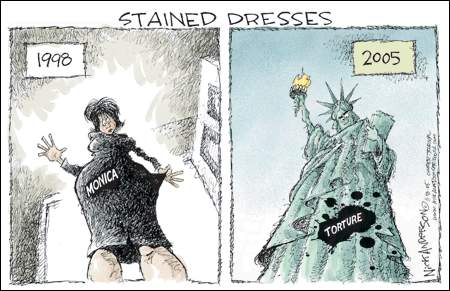
Nick Anderson, Stained Dresses
The Iraq war was an unprovoked, unnecessary and unlawful invasion that became a colonial-style occupation and is now turning into a moral and political nightmare.
The Bush Administration is faced with policy failure, inept government and plummeting support. The Republicans defeats in the recent elections are seen to flow from their identification in the public mind with the President and with the Iraq debacle. Winning in Iraq justifies the right to torture and the use of death squad central.
The Cheney/Rumsfield duo, and their cabal of advisers, political hacks, cronies and sycophants, have created a nightmare in Iraq, and there is no magic wand that can be waved to avoid the blood shed in Iraq by preventing the Iraqi's from killing each other. It's a war the US cannot win. The land force is being killed in Iraq, and the Pentagon cannot maintain current force levels (not to mention the stock of operable equipment) without a greatly increased commitment.
As the December elections loom ever closer, will the House GOP continue to be the court prophets saying only what the president wants to hear? Will they distance themselves from a crippled, angry Bush? Or will they be boxed into a corner.
The broader question for the White House now is whether it can stem rising antiwar sentiment among the American public. Will the White House withdraw troops in early 2006 whilst continuing with the rhetoric of "cut and run" strategy: ie., not leaving until victory is achieved, or until the job is done etc etc. and viciously attack the "defeatists" who counsel the withdrawal. 'Cut and run' becomes classic rhetorical cover for a humiliating retreat.
Posted by Gary Sauer-Thompson at 1:55 PM | Comments (0) | TrackBack
November 19, 2005
Telstra: focusing on the customer?
The Telstra debate has moved on from this situation:

Leahy, oh Barnaby
Telstra is really going strong against any form of regulation of competition about allowing its rivals to use its proposed billion dollar optical fibre network that is designed to offer high speeed broadband, net phone, video on demand and maybe movies. Telstra, for once, is talking value, whilst saying such an investment will double cash flow to $5.9 million by 2010. The telco is becoming a lean, customer-focused and state-of-the-art media company that present consumers with a single, digital home gateway through which it will offer a raft of services that wil make lots of money.
At the same time whilst it raises wholesale prices, Telstra threatens to not invest in the fibre optical cable network unless its competitors are denied access. It proposes to cut its workforce and it continues to confront the Howard Government, which it keeps in the dark about its plans. The Government ministers bristle.
Telstra's share price continues to fall towards the $4 mark--there has been wiping off of $13 billion in shareholder value since Sol Trujillo became CEO last July. The market is still not persuaded by the high risk strategy of a total rejection of planned regulation. Scepticism is justified because Telstra once described itself as the Telstra as the "internet sun" around which other planets would revolve. Well, it is the other planets (ISP's) that have moved onto ADSL-2 and fast data networks, not Telstra. The gorrilla in the marketplace is not a market leader.
Posted by Gary Sauer-Thompson at 2:22 PM | Comments (0) | TrackBack
November 17, 2005
Adelaide locked down
U.S. Defence Secretary Donald Rumsfeld is visiting Adelaide for an Australia-U.S. Ministerial Meeting (AusMin) with Foreign Affairs Minister Alexander Downer and Defence Minister Robert Hill. The aim of the meeting is to enhance the cooperation in the war on terrorism, promotion of democracy and security in Iraq, Afghanistan and south east Asia and responses to the potential for an avian influenza pandemic. It sounds like greater integration of Australia into the US defence infrastructure to me.

Pryor, Rumsfield in Adelaide
No peaceful protests were initially allowed, then parliamentary officials saw sense and lifted a ban. The police said they were ready for anything, including protests and a potential terrorist attack. Everybody needs to take a cold shower.
I notice that the Ministerial Meeting (AusMin) is not discussing concrete steps toward troop withdrawals in Iraq. Shouldn't they be concerned to provide more clarity on how the US intends to exit an Iraq divided against itself? Nor are they acknowledging that the Bush administration has created a "failed state" in the heart of the richest oil lands of the planet. Iraq is now largely an anarchic world where the delivery of such basics of modern life as electricity and potable water (or water of any kind) are no longer givens.
'Staying the course' in Iraq is no longer an option, given the marked misgivings about the war in the US, the American political debate having shifted to how to get out of Iraq and Bush ratings in free fall. Is this the first signs of the Bush administration imploding? It already has a bunker mentality, the largely bipartisan consensus on the war has collapsed, and the spectres of Vietnam and Watergate haunt Washington.
Of course, the Australian neo-cons cover the imperial retreat from Iraq by saying that the close alliance with the US means that this connection augments Australian power in a world of nations. What Australia should do is aim for national greatness----to be a big, strong nation. That means to have an ambition to become an imperial power, doesn't it. Doesn't it?
Rumsfeld and Cheney still control the levers of power within the Bush Administration. They are still dedicated to imposing "regime change" throughout the Middle East to install governments subservient to the United States. They remain in a position to manipulate evidence and provoke incidents--even to entangle the US in a new war with Syria or Iran--- and to continue the about smearing and deception campaign by senior administration officials.
Posted by Gary Sauer-Thompson at 11:05 AM | Comments (0) | TrackBack
November 16, 2005
It's official folks
This little news item is very significant. It discloses the aim of Brendan Nelson's reforms: the privatisation of the public university.
The news report in The Age says:
The death of the Australian university as a public institution can now be officially recorded. It occurred just after midday yesterday, during a news conference by Melbourne University vice-chancellor Glyn Davis. Unveiling his ambitious 10-year plan for Melbourne, Professor Davis noted that the document, Growing Esteem, referred to the 150-year-old university as a "publicly spirited"---rather than public---- institution. Over the past 25 years, guaranteed federal funding has dropped from about 90 per cent of the university's revenue to 23 per cent.
Davis is spot on when he says that Melbourne University cannot be called a public university when only 23 per cent of its is directly guaranteed by the Federal Government. This university is shifting towards generic undergraduate courses and graduate schools for professional training.
This move into graduate entry for medicine, nursing and allied health is starting taking place across the university system. It is the American two tiered model and this form of the shift towards specialization is designed to align Australia's universities with the international American ones. Universities in Europe are already shifting to a two tiered structure.
The ALP's response has been to defend the public liberal university of yesterday and to highligh how the changes favour a privileged few. However, more deregulation is on the cards and with increasing diversity only some universities will be primarily public--- probably the under-resourced, lower status gumtree ones built in the 1960s. In a market society that means they will gradually become second tier universities because not every university needs to be doing research, teaching and scholarship across all areas. Many cannot afford to do this and so they will offer teaching not research.
Posted by Gary Sauer-Thompson at 6:00 AM | Comments (2) | TrackBack
November 15, 2005
where is the health policy?
I've been attending a health policy and services research conference in Canberra. It is strong on the services and low on the policy. The academics have little to say about policy ----addressing the problems they identify in relation to health care reform. They kinda back off and they aren't really willingly to cross the line over into the policy arena.
There was no presence from the policy think tanks eg., CIS. Nor was there a public presence from the senior federal bureaucrats or ministerial staffers who actually do policy. The conference is a platform to present the specialised work of Australian health academics with import from good quality policy people from the US and the UK.
The inference? There is a disconnect between academic research and public health policy despite the work done by Treasury and Productivity Commssion about rising health care costs and health workforce reform. Even when the need for a regulator for the health sector is discussed ---given the medical scandals (Camden, Campbelltown and Bundaberg) and the regulatory failure amongst managers and professional bodies has bought self-regulation into disrepute.
If the instruments of a health market and greater competition are going to be used to drive reforms in the health system, then there is a need for a strong regulator to prevent the anti-competitive behaviour of the medical profession out to protect its interests at the expense of consumers. What sort of regulator should that be? No answers were offered. That's too political.
Here's a suggesiton: why not the ACCC? Or why not a strong regulator for the health industry--along the lines of the British Health Care Commission?
Update: 16 November
Today's conference sessions indicated the bias and prejudice amongs the academic community to the policy world. The latter is a world of unreason, ignorance ,indifferent to knowledge and data, dot points, and pretty concerned with getting votes. This cartoon representation by the health economists from this mob was then contrasted with academic research world of reason, truth and enlightenment. The irony was that this duality and polemic was presented as the truth without any consideration being given to the work of the old Senate or the Productivity Commission in the formation of public policy.
The health economists are moving into health research in a big way--based on their ability to do economic modelling. The economic modelling is about economic or market relationships between individuals without any consideration being given to power relationships in the medical system. When this shortcoming in their assumptions is pointed out to them, and it is suggested that this means that their modelling would fail to capture both the medical dominance and gaze and the anti-competitive behaviour of the medical profession, they just shrug their shoulders and dismiss the criticisms of their assumptions with disdain.
Who cares is their response. They represent truth. The critics are ignorant of economics, prejudiced and biased.
My assessment of this conference? Our major or prominent research universities are self-absorbed institutions, compromised by their close relationship with government and corporations. They are given enough of the research to pie to be complacent, and they are coming close to being unwilling to deal with the fundamental moral and political questions posed by the failures of the health care system.
Posted by Gary Sauer-Thompson at 4:27 PM | Comments (0) | TrackBack
November 14, 2005
Gough Whitlam--yesterday's man
Gough Whitlam is a great Australian-----a national treasure. But he was a centralist who wanted to reduce the power of the Senate and increase that of the executive.

Sorry Gough. I don't buy it. The Senate needs to be made stronger not weaker.
Posted by Gary Sauer-Thompson at 9:09 PM | Comments (3) | TrackBack
November 13, 2005
inside the political machine
I used to work there in the House on the Hill, flying to and fro from Adelaide to Canberra on the shuttle service. It was interesting work, given the balance of power situation in the old Senate. It was hard work, with long hours, low pay, and high stress. A double shift, in fact.
The grind kills some and it wrecks many a relationship or marriage. The political path does not necessarily lead to happiness. Alas many Australians are very cynical about the worth of their political representatives.

Alan Moir
This is the moral view of the world that is certain of itself, isn't it. What it knows is its subjective self-certainity, or individual self-conviction. The morality is that of the beautful soul that desires its subjective conviction to be recognized by others.
Sure many polies are time servers, hacks and bad men and women often engaging in unethical conduct and personal self-advancement that is indifferent to the welfare of the population. Others, however, worked very hard for the good of their country. It was seen as a public duty as understood by the customs of the land. Often there was a big conflict between duty and sensuous inclination that is difficult to resolve.
I concur that the polies and their staffers won't work weekends in the place on the hill under the new IR legislation. Nor will their benefits and conditions be cut. But that place on the hill is only part of their job. The other base is the electoral office back home in their electorates.
What Moir doesn't acknowledge is that for some polies and staffers the work is such that one never switches off. Tis 24/7 on that job. Even reading the media is part of the job. It is not pleasure.
As was writing this weblog during my tim in the old Senate. It kept me intellectually supple, alert and on the ball. Kinda like doing the scales daily for the pianoist.
Posted by Gary Sauer-Thompson at 10:04 PM | Comments (0) | TrackBack
November 12, 2005
Andrew Bolt: conservative on the rampage
The News Ltd tabloid media in Australia are engaged in a trial by media with repect to those arrested in Sydney and Melbourne by the counter-terrorists security forces. It is what you'd expect from the Murdoch press. Then we need tor emind ourselves that the NSW police had invited television crews along for the supposedly just in time top secret raids that saved Australians from being blown up by the enemy within.
But this inflammatory column by one the conservative tabloid attack dogs did take me back:
So it wasn't a political stunt. It isn't about Iraq. And the threat of Islamist terror right here is more real than many pretend. How real? If the police are right, they have saved scores of you from being blown up -- as people in Madrid and London were blown up.
Were the police right? Those arrested were not held without charge. as the new anti-terrorism legislation is still to pass the Senate. They will undergo a trial and be able to rebut the charges before they are sentenced or set free. Bolt couldn't care less about a fair trial or the principles underlying our justice system.
Bolt's above paragraph leads to this:
Have you finally had warning enough? Do you finally see the threat is so real that it demands real solutions? At home, multiculturalism must go, and true integration promoted. Radical preachers must be kept out, or held to account. We must let in only Muslims with the skills and desire to adapt and thrive. We can afford no French-style ghettos here, including ghettos of the mind . .. Meanwhile, it will be wise if we learn that some people really are so unhinged as to hate this country and want to kill us. We have been warned enough. It's serious.
Multiculturalism must go and 'true integration' promoted . That means to hell with cultural difference, dosen't it? Become like 'us' of get out, is what it means, does it not? It's 1950s assimilation speak isn't it. For Browyn Bishop the Muslim headscarf does not form part of the school as is being worn as a sign of defiance and difference between non Muslim and Muslim students whilst the Jewish skull cap is okay because it does not signify a way of protesting against Australian culture, laws and way of life.
This is more than political kitsch. Tell me, how is a Andrew Bolt (or a Piers Ackerman) different from the French Right---ie., Jean Marie Le Pen? Aren't these conservative attack dogs the tabloid publicists for the Australian equivalent of the movement headed by Le Pen?
Update: 13 November
Miranda Devine's latest polemic attacks those who critique the One Nation conservative call for a return to assimilation as a " poisoning of young minds, the sense of historic victimhood and alienation" which " is daily fuelled by the self-loathing cultural relativists of the Western intellectual establishment."
Posted by Gary Sauer-Thompson at 1:07 PM | Comments (1) | TrackBack
November 11, 2005
parliamentary tactics
I've had my head whilst I've been busy putting a report together that responds to Productivity Commission's position paper on Health Workforce issues. So kinda lost touch with federal Parliament and the news these last couple of days--apart from all the stuff about The Dismissal. I supported Whitlam but I'm all for a strong Senate with big powers.
I do remember a headline saying that the IR Bill was passed by the House of Representatives. And the Senate? Whilst trying to find out this cartoon caught my eyeas it referred to the cutting short of the debate:

Geoff Pryor
Not many people understand what the guillotine means in federal parliament. It gags debate. The government can do this --and push legislation through--- because it has the numbers.
That is one of the consequences of executive dominance. What the cartoon omits is the incompetent Speaker. Mike Seccombe in the Sydney Morning Herald says it well: 'David Hawker is the most inept and partisan speaker since Labor's egregious Leo McLeay gave up the chair 13 years ago.'
So inept and partisan that David Hawker brings Parliament into disrepute.
Oh I remember now. A Senate committee is looking at the IR legislation. The IR bill will be introduced into the Senate next month.
Posted by Gary Sauer-Thompson at 2:17 PM | Comments (7) | TrackBack
November 10, 2005
fighting executive dominance
I see that the British Parliament has exerted its power and stood firm. The House of Commons has said no to the executive dominance of the Blair Government. The Guardian says:
The House of Commons yesterday secured a great victory for good government by inflicting a great defeat on a key section of the Labour government's bad bill. Last night's 31-vote majority against the government's 90-day detention before charge proposal in the anti-terror bill was an even more emphatic rejection than most observers had predicted. It came in spite of a huge and sustained government whipping effort, in spite of a humiliating effort to drag ministers back from all corners of the globe, in spite of the prime minister putting his authority on the line...
And Tony Blair?

The Guardian says that:
Mr Blair, though, has been weakened. There is no gainsaying both the seriousness and symbolism of this first defeat in eight-and-a-half years of Blair rule. More than 60 Labour MPs defied a three-line whip on the 90-day clause by either voting against it or abstaining. Up to 10% of Labour MPs now seem to be in semi-permanent opposition to everything that Mr Blair does. That does not make Mr Blair's position untenable. But it makes his position more fragile than ever before. It marks a new era in this government's history. It will have to choose more often now between compromise and defeat. Mr Blair needs to listen to parliament's voice.
Blair is a dead man walking. His authority has been shredded by his own party. The Labor Party is turning against its very successful leader and it could slowly tear Blair down on his domestic modernizing reforms.
It is not likely that the assertion of parliamentary power and voice against John Howard will happen in Australia.
Posted by Gary Sauer-Thompson at 7:36 PM | Comments (4) | TrackBack
November 9, 2005
vindication
The discourse of terrorism has changed significantly in the last 24 hours with the arrest of 16 suspected terrorists in Sydney and Melbourne. The Prime Minister has been vindicated. So has Kim Beazley's unquestioning support of the Government on the matter. Both concur that the battle is about security - and a way of life. Yet the “apocalyptic anxieties” of those who claim terrorism threatens the existence of our society are not vindicated, and the secrecy of national security state is still unaccountable.
The suspected homegrown terror cells disrupted in Sydney and Melbourne yesterday were allegedly building the capacity to mount an attack -- within weeks, in the judgment of some security officials. Hmmm. The judgement is that the state was under an imminent threat of a potentially catastrophic terrorist act, and that it was thwarted by the swift action and arrest of the suspects in Melbourne and Sydney. Hmmmm again. I'm reserving my judgement at this stage. Why should the West necessarily be hostile to the Muslim religion and its values?
Will the security envelop be pushed even further now they have an operational cell now?

Yes. The judgements of those arrested have been made--they are guilty. So what has happened to the presumption of innocent until proven guilty? Is not the rule of law is being rolled back with the anti-terrorism legislation before Parliament? There should be no vindication of that.
As Michelle Grattin points out in The Age:
The operation gives flesh to the warning in ASIO's recent report about home-grown terrorism, which presents a community with the most complicated challenges. It makes both more necessary and more difficult protecting civil liberties and emphasising to the mainstream Muslim community that it is a valued and appreciated part of the Australian nation...The wider balancing act between fighting terrorism and protecting civil liberties is tricky enough. It becomes even harder in relation to the minority community.
It sure has.
Those arrested have been judged to be terrorists. What have they been charged with? Plotting to over throw the state? Plotting to bomb Australians? Planning attacks which might have killed tens or even hundreds of Australians? Possesssing explosive? Being members of a banned organization? The specifics of charges are unclear. And they still have to be proven before a court of law. So we should invoke the presumption of innocence.
Full marks to Steve Ciobo and his courage judgement that:
"a statutory bill of rights, at a time when the executive must tread more heavily in areas of individual rights, will provide the necessary counterbalance of providing and ensuring collectively that the individual remains the focus of a liberal democracy.”
Posted by Gary Sauer-Thompson at 11:10 PM | Comments (0) | TrackBack
November 8, 2005
A circuit breaker?
This is a tough representation of Blairite Labor in the UK:

Does it apply to an embattled Beazely Labor in the Australia? It does to a lameduck Bush in the US as the dirty war rebounds on Washington.
Beazley Labor stands strong in opposing the IR reforms. The uproar in the theatrically rowdy House of Representatives last week expressed that outrage and conviction.
Has this outrage connected with the concerns of Howard's battlers about their work values: fair minimum wage, decent working hours so families can spend time together, penalty rates and shift loading being eroded by the IR legislation? Has it given the ALP the electoral circuit breaker it needs to counter Howard's clever manipulation of the political agenda? What are the focus groups saying? Are the previously rusted-on Labor supporters, who transferred their allegiance to the Coalition in 1996, reconsidering their options? Can Beazley maintain the rage, highlight the 'them and us' class divide and talk in terms of 'for all of us' ?
As federal Labor slowly defines the issues on which it intends to campaign my concerns are with the increasing dominance of the machine men of the Right in Beazley Labor. Apart from the IR shakeup and vocational skills training they seem to to go along with the Howard Government and present a small target on other issues. Why not stick their necks out on the sedition laws in the counter-terrorism legisation? Has the ALP right the political courage to do this?
What they present at the moment is a walking backwards into postmodernity.
Posted by Gary Sauer-Thompson at 7:08 AM | Comments (0) | TrackBack
economic whispers
Do hear the whispers?
The ones about the economy not doing that well? Discreet whispers about inflationary pressures pushing up prices in the economy? The louder ones about falling house prices. The persistent ones about falling wage rates from the Industrial Relations reforms.
I've heard them. I keep scanning the Australian Financial Review looking for some professional journalist to put the whispers together into some sort of economic scenario or narrative. I look in vain. I come across journalists reycling media releases from the Reserve Bank, or some talking head economist giving up-beat accounts about the economy, interest rates, job growth etc.
The talking heads are always so upbeat about the ever widening trade deficit, aren' t they. Have you noticed that they always overshoot in it getting better? Nor are they concerned that it stands at around $1.6 per month.
And these journalists mock us bloggers for being mere amateurs into vanity publishing and venting our spleen. But it is not hard to put the whispers together is it? Falling house prices eventually means the mortgage is worth more than the capital value of the house. Worsening working conditions mean increasaed difficulties in paying off the mortgage. That means some Australians are going to do it tough. What economists call belt-tightening.
It looks a realistic scenario to me. It's when we hit an economic slump, as we will, that the shift in bargaining power at the heart of Howard's IR bill will hit home. That's when the low-skill, low-cost road embodied in the IR bill will become much clearer.
There is a big picture narrative: it is the change from a domestic consumption to trade-and-investement-driven growth. But the change is not really happening because of exports. Its called a soft patch. Then we have all the upbeat talk about the mining boom coming on stream. That narrative is a Quarry Australia one isn't it. No worries mate. The good times will continue.
Posted by Gary Sauer-Thompson at 7:08 AM | Comments (7) | TrackBack
November 7, 2005
anybody read.T.B..these days
Does anybody read Tim Blair these days for the interpretation of politics? I don't. He's so aspirational for someone who inhabits a troll culture. I guess that explains the bitter and personal humor that mocks others.
By 'aspirational ' I don't just mean that ‘middle class’ as understood by a Robert Menzies (the forgotten people) or a Peter Costello (ambitious, active, evangelical).
By aspirational I mean the edgy, mobile, aggressive winners from the changing economy of contemporary Australia; but so rightwing with little understanding the tradition of conservatism. Like the IPA they mistakenly equate conservatism with individualism, small government, personal responsibility, and self-reliance.
The postmodern lefties who still inhabit academia and the politically correct ABC would see the TB aspirationals as sooo lower middle class---effiminate, tortured, anal retentive, pretentious, authoritarian etc:

John Spooner, Three Stooges of Diplomacy
But the old radical left would be wrong on this. The suburban asipirationals flaunt money and success with style. As they have their roots in the 'greed is good ' ethos of the 1980s and 1990s, they elbow their tabloid way through life. They understand that history is on their side and they are make sure they step in time with the forward march of conservatism.as they dissect the old traditional values.
Anyvbody read Tim Blair these days for insightful interpretations of our political culture?
Posted by Gary Sauer-Thompson at 10:30 PM | Comments (13) | TrackBack
its called media management
Suprise suprise. The debate on the IR legislation [The Workplace Relations Amendment (Work Choices) Bill 2005] in the House of Representatives was guillotined at the end of last week. Just like that. As Glenn Milne writes in The Australian:
ARROGANT? Anxious to close down debate and curb dissent? What, this Government? You betcha. We had another example of the creeping hubris that may yet consume the federal Coalition late on Thursday. Labor's chief whip, Roger Price, was informed by the Government the parliamentary debate on its contentious industrial relations reform package was going to be shut down early. No ifs. No buts. No beg your pardons. That's what you can do when you have the numbers in both houses.
Suprisingly Milne is critical of the steamrollering of the legislation through the lower house. But then it was never the house that reviewed legislation with a fine tooth comb. That job was done the Senate. No more.

So why the guillotine? Wouldn't it be good politics to allow a genuine debate and for the government to be seen to be working within the democratic conventions of parliamentary process?
Milne gives a good reason:
The uncertainty generated by that debate can only feed the natural fears of employees about what this dramatic shift in industrial power to the employer means for their job ... The solution, from the Coalition's point of view, appears to be: get the bills through the parliament as quickly as possible, batten down, take the issue off the front pages and hope the continuing good performance of the economy will mask any bad side effects of the changes. Because the Government knows that when growth turns down, and the skills shortage eases, that's when employers will begin to use their new-found power to wind back wages and conditions.
There has been a shift today--an extension of the debate has been granted. I've just heard Carmen Lawrence's biting comments that draw on the historical experience of AWA's in Western Australia under the Court Government in the 1990s to highlight the way it will disadvantage women.
So far most of the speakers on the Government side are more interested in the spin, lines, ideology and empty rhetoric. Have they actually read the bill--apart from Malcolm Turnbull? He does go beyond assertions of freedom and flexibility.
The Parliamentary Library's e-guide is very comprehensive. Worth looking at is the community, business, government responses.
Posted by Gary Sauer-Thompson at 5:56 PM | Comments (0) | TrackBack
November 6, 2005
three tiered reform
Continuing economic growth since 1996 has meant that losers from the previous round of economic reforms under the Hawk/Keating Labour Government have gradually been bought into the workforce. Costello and Howard have ensured Australia's continuing prosperity in a competitive world.
The image below is a tough one, and maybe unfair, given the way the Australian economy has continued to boom on John Howard's watch.

John Spooner, Honest John Economy Reconstructions, Pen & ink & watercolour
However, the cartoon is right in another respect. Australia is on the edge of a new era in industrial relations with the new round of economic reforms marked by the IR legislation [The Workplace Relations Amendment (Work Choices) Bill 2005] to create more competitive wage structures for low income workers. This by itself, is not sufficient to ensure continuing prosperity.The linkages to social welfare and the tax system need to be taken into account if the reform is to be fair--fairness here is not just a question of protecting the minimuim wage as the ALP claims of ensuring the unemployed get any kind of jiob as the PM claims.
If the outcome predicted by the ACTU and Labor Party---an increase in poverty and reduction in the living standards of the low paid---is not to eventuate, then the IR reforms need to be linked to changes in the social welfare and the tax system to provide the extra skills and participation in the economy. The reason for this is that way things stand at the moment low income families face very high effective marginal tax rates as they shift from welfare to work.
It is recognized by the Howard Government that the primary mechanism of social protection is the tax transfer system rather than the wages system. The Government argues that the use of social security benefits will discipline and encourage peole back to work, whilst the additional training programs would increase workforce participation and and help fill the skills gap.
But the Howard Government has done nothing to lessen the very high effective marginal tax rates encountered by low income families as they make the shift from welfare to work. And it has given little indication that it will do so in the future as a part of its tax reform agenda.
Malcolm Turnbull is aware of the problem and discussed it in his tax proposal paper.
Posted by Gary Sauer-Thompson at 7:34 AM | Comments (3) | TrackBack
November 5, 2005
The Australian's deception
The Murdoch media has been aggressively in favour of the war in Iraq, the war on terror and a strong national security state. Most of the "arguments" in favour have been poor and deceptive as they have been more partisan polemic than arguments. The purpose is to rally the fearful people around the strong leader by invoking threats and dangers from within and without, real or imagined.
A recent example is the way The Australian "argues" in favour of the new anti-terrorism legislation tabled in Parliament by the Howard Government. Consider this editorial:
With bipartisan state and federal support for proposed legislation to combat terrorism, it is time the self-appointed liberty lobby proclaimed its priorities. ....Rather than a grab for power, the planned laws are the work of a government trying to meet its fundamental responsibility to the people it is charged with protecting: all Australians. Without security in our persons and property, we have no hope of exercising all our rights as citizens. And without a national commitment to security for all Australians, the promise of economic opportunity and the prosperity it can provide is worthless. The fundamental issue in the debate on the terror laws is whether the civil liberties of a tiny handful of people who will kill us if they can are more important than Australians' right to live in peace and freedom.
This is deceptive because the critics are defending the rule of law, our civil rights as citizens and our freedoms as Australian citizens. These rights and freedoms are what is being whittled away by the national security state wearing the mask of Leviathan.
That whittling away of our civil liberties and the rule of law is the fundamental issue. It is not the rights of 'a tiny handful of people who will kill us if they can' being more important than the rights of the Australian people to live a free life.
The Australian is partisan because it is promoting fear of terrorists in an attempt to justify bad laws. It is abusing its media power to withhold, manipulate and distort information provided to the public, whilst falsehoods and propaganda is disseminated.
Such practices are intrinsically anti-democratic.The Australian's 'strong national security state ' is an authoritarian one. It is Leviathan because it is effectively allowing the executive to set up a regime of detention for Australian citizens.
Posted by Gary Sauer-Thompson at 1:33 PM | Comments (1) | TrackBack
print media decline
An article in The Age by Leonie Wood entitled, Newspapers' dog days - getting on with online', gives an accurate accurate of the current decline of the print media. She says:
It's the time for lay-offs in the newspaper industry, a time when publishers around the world are thinning the ranks of journalists, newspaper administration and support staff to counter sluggish revenues.It's a phenomenon not limited to John Fairfax Holdings...A swathe of venerable newspapers have taken the knife to staff numbers this year....Newspapers are facing a crisis. Advertisers are plumping more of their marketing dollars into internet sites, including Google and Yahoo!, and business papers such as the FT are losing ground to real-time news providers, such as Bloomberg and Reuters.
The justification for the layoffs is cost pressure due to advertising streams starting to dry up. A deeper cause, however, is that the audience is moving somewhere else--it is increasingly shifting from newspapers to online sources, from free-to-air TV to pay TV. If the big newspaper companies around the world do not learn how to turn their print audience into an internet audience, then they will continue to decline. So newspapers should be smart and use their journalists to develop their online presence and content, not lay them off.
Wood says that:
The challenge for newspapers is to deftly graft the content produced in the newsroom to online sites and aggressively cross-promote at both ends, from print to online and vice versa, without compromising the editorial quality. It also means being smarter with advertising strategies and bundling ad prices.
So how do they do that? Nobody is really sure. What is obvious is that Fairfax is not being very creative.
Posted by Gary Sauer-Thompson at 1:09 PM | Comments (1) | TrackBack
November 4, 2005
crying wolf
The claim is that bombings in London in July had shown that home-grown terrorists had been overlooked in Australia. The claim is just a claim, as we have seen no evidence of home-grown terrorism in Australia. I would have thought that the threat from contagious diseases (eg., bird flu) represents a bigger threat than that posed by radicalized Australian Muslims living in Melbourne or Sydney.

Geoff Pryor
What we are being asked to do is to trust the spooks. They say there is a homegrown terrorist threat by Islamic extremists. These are the same spooks who gave us definite intelligence that Iraq had weapons of mass destruction, that Iraq posed a significant threat to Australia, and that the only way to deal with this threat was to invade and occupy Iraq. The foundation of that senario was fiction.
Is Howard crying wolf? I'm with Pryor on this one. Howard did not tell the truth about Tampa, or children overboard, or Iraq. He has severely damaged his credibility. That is why his warnings of a terrorist threat from within are being treated with much scepticism. There is no need to go to the conpsiracy stuff: like Tony Blair and George Bush John Howard has become devalued coin.
I'm sorry. At this stage I'm interpreting it as a beat up to justify extending the powers of the national security state.
Posted by Gary Sauer-Thompson at 7:44 PM | Comments (3) | TrackBack
November 3, 2005
Question Time
Question Time in the House of Representatives descended into chaos today. Rowdy, uproar, fiery does not describe what happened.
It was a shambles for half an or so, caused by a parliamentary brawl. The speaker's authority was continually challenged by the ALP, and rightfully so. Another seven MP's were ejected from the Chamber by a biased speaker:--that is 18 MP's in two days: 17 ALP and Liberal. Yet it takes two to tango--hurl the taunts, jeers, sneers, and abuse. However, a blind eye is being turned to the front bench of the Howard Government by the Speaker, even though the Ministers are not answering the questions asked of them.
So we go from point after point of order on relevance being made by the ALP. And they are right in 9 out of 10 situations.
The Speaker is not independent nor are his rulings fair. He is out of his depth and goes along, and supports, the Howard government's white-anting democracy. The Speaker really ought to be defending Parliament from the executive's power grab.
Posted by Gary Sauer-Thompson at 8:34 PM | Comments (5) | TrackBack
IR: informed debate?
The Howard Government's Industrial Relations legislation is currently being debated in the House of Representatives:--the Workplace Relations Amendment (Work Choices) Bill 2005 — and this will continue for most of the day. The bill is not even up on the Parliamentary website. Well, if it was I could not find it.
What we do know about the broad changes is that they include new rules for workplace agreements, a downgrading of the award system and the role of the Australian Industrial Relations Commission, the transfer of minimum wage-setting to a new Fair Pay Commission and the removal of unfair dismissal protections from workers in businesses with fewer than 100 employees.

Hinze, IR Reform
And the detail? We do know that the legislation hands employers unprecedented powers to sack people for "operational reasons" and cracks down on unions by severely limiting their operations. The laws will allow Australian workers to be sacked at any time - without the right to claim unfair dismissal - because of economic or technological reasons, or if a business wants to restructure operations. So it shifts power to employers whilst imposing strict new laws on strikes and other industrial action.
Yet, with the parliamentary process of scrutiny sidelined by the government's control of both houses, the politics shifts to public opinion and to citizen's understanding of the fairness and equity of the new legislation. That legislation makes it as easy as possible for employers to set the terms and conditions of employment.
Most of the debate in the House so far this morning has been heavy in partisan rhetoric and light on the detail of the bill. On the one hand the legislation is heralded as the best guarantee of good jobs and wages was a productive economy. On the other hand it is seen as the biggest attack on living standards of working people in Australia's history. There is little middle ground--eg., flexiblity plus safety net--as each side accuses the other of lies, deceits, abuse, thuggery, etc etc. We go round and round on the same merry go round.
So I've switched to watching the budget estimates by the Senate Committee on Community Affairs on indigenous health and housing, mutual obligation and shared responsibility. At least we get the details from the questioning by Chris Evans and Kim Carr
Update: 3.0 pm.
Simon Crean gave the best and most informed speech by far. It put the others to shame.
Posted by Gary Sauer-Thompson at 9:17 AM | Comments (2) | TrackBack
scarry narratives
We have so many scarry narratives these days, and our politics has internalised the culture of fear. Another scarry narrative is the one around bird flu because of its capacity to jump species.
That has happened, and the virus has transferred from one person to another. This transfer from person to person has been limited and it has stopped. It hasn't continued to move on.
So far.
What if? What if we are wartching a pandemic unfold in slow motion? Peter Martin offers an account in his A punter's guide to the pandemic
The government's response? The same as in the other scarry narratives: Trust me. Trust me. Trust me.
Posted by Gary Sauer-Thompson at 7:48 AM | Comments (1) | TrackBack
November 2, 2005
twists and turns
I caught question time in the House of Representatives today. It was in an uproar for an hour or so on the floor because of the Government's contempt for the House rules that require MPs each to get a copy of a proposed law before the debate starts. None of the 600 pages or so of the IR legislation (plus 500 pages of explanatory notes) was given out before the debate started. This is clear contempt of Parliament, is it not? It is an abuse of power and public faith in democratic process for sure.
Then I saw an inscrutable Philip Ruddock, the Attorney General, introduce some hasty legislation into Parliament this afternoon. He said that the government was acting in response to the assessment that a terrorist attack in Australia is feasible and could well occur.
No details were given--that is now par for the course in the discourse around the politics of fear. But you couldn't miss the import: the existence of an imminent home-grown terror threat from Australian-born Islamic extremists. The evidence? Nothing. Nevertheless the Senate will be recalled to debate the bill tomorrow.
No questions were asked for by the ALP Shadow Ministry Arch Bevis and Nicola Roxon as they agreed to alter the current law referring to 'the' terrorist act to 'a' terrorist act. Nothing was said about the threat of terrorism in Australia having something to do with the Iraq war. Haven't we have sent our own troops into the Iraqi's country?
And Kim Beazley. Why, I'm reading that he put a soft motion to caucus, which backed "tough national security laws with strong safeguards for individual liberties in the national interest". It's the right note, but it means zilch right.? Since when has Beazely been interested in strong safeguards for civil liberties when it comes to national security? He's even more gung ho and hairy chested on national security than the state ALP premiers--he is willing to endorse Howard's anti-terrorism legislation unseen! So is the ALP front bench.

Bill Leak
Oh I know Beazley is in a difficult political position. Granted. But he can still actually back "tough national security laws with strong safeguards for individual liberties in the national interest"?
Oh I know, that's a bit of sho sho to appease, or buy off, the dissidents in caucus willing to defend the rule of law.
How about this for clear thinking strategy then. Beazley says that he will help push Howard's anti -terrorism legislation through, and then go to the next election (in two years' time) with a clear alternative for the electorate. Huh? Is this what they call rat cunning in the ALP? Strikes me that their judgement is impaired. What's their alternative? It seems I've missed that bit.
What about defending the rule of law guys and girls?
Did not the draft of the Anti-Terrorism Bill 2005 abolish the most fundamental right held by citizens of this country - the right to personal liberty in peacetime, which currently exists for all of us, except for persons charged with criminal offences or for persons suffering from serious mental or infectious illness?
Posted by Gary Sauer-Thompson at 6:28 PM | Comments (0) | TrackBack
November 1, 2005
a boxed in White House
The indictment of Scotter Libby, the Vice President's ex Chief of Staff, does disclose the lengths to which the White House went in 2003 to quash the talk of faulty intelligence on Iraq. A dark cloud hangs over the White House. Who cares about this inside-the-Beltway stuff? Not the ordinary folk.
The faulty intelligence was used by the White House to justify going to war in Iraq. A hugh gap exists between the bad intelligence---there were no weapons of mass destruction in Iraq--- and the way it was presented to the world by the Bush administration as a "slam-dunk" case for war. The US Congress has never really addressed that gap.

Nick Anderson
High stakes politics is what is needed--go on the offensive. Take the terror war to the Iranians: If not we will have:
... a new version of September 11th. Perhaps only then will our dithering leaders resume fighting the war against terror, a war currently limited, to their shame, to a defensive struggle within the boundaries of Iraq, while they move against us on a global scale.
That's Michael Leeden writing in the National Review Online
Posted by Gary Sauer-Thompson at 6:09 PM | Comments (0) | TrackBack