September 26, 2012
Goodbye Gunns
Gunns has been entered into voluntary administration after posting a $904 million loss. The banks finally pulled the plug on Gunns.
Poetic justice for the history of Gunns corrupting the polity, cowing the media, poisoning public life and seeking to persecute those who disagreed with Gunn's proposal for a world-scale Bell Bay pulp mill in the Tamar Valley. They decided to fight the environmental assessment of the proposed pulp mill rather than negotiate with green groups and the local community.
Gunns, the logging of old growth native forests, woodchipping, and a pulp mill were, until very recently, seen to be the core driver of Tasmania's development. As Richard Flanagan accurately observes in the Tasmania Times:
The demise of Gunns brings to an end a tumultous three decades of Tasmanian history that began with Robin Gray losing the Franklin Dam battle to the Bob Brown led environmental movement in 1983, continued with Robin Gray losing both the Wesley Vale pulp mill battle and government to a Labor-Green government in 1989, and now the loss of Gunns and Gray’s third white elephant, the Gunns pulp mill.
Gunns wasn't able to make the transition to a plantation-based timber company. The company had a debt load and a declining asset base, and it faced a high Australian dollar and falling woodchip prices. Secondly, the plantation woodchip industry in Tasmania couldn't compete with the low cost chips exported from Vietnam and other places.
After the demise of the one big project maybe the Tasmanian state government can move onto considering a different kind of future--a clean, green, and clever state---as opposed to the old model of economic growth based on the exploitation of natural resources.
The AFR's editorial --Tasmania needs to pay its own way--- opposes this kind of development. It defends the old style development with foreign capital:
Tasmania faces a range of problems due to both external circumstances and its own making. Rather than expending so much effort in preserving their forests by blocking all development, Tasmanians should be working out how to pay their own way.....there is no reason for wealthier states to subsidise Tasmania if the state remains intent on preservation at the expense of economic development. Rather than government subsidies from the rest of Australia that it uses as working capital, Tasmania needs investment capital, including foreign investment, to develop its natural resources.
Tasmania cannot continue to rely on the substantial subsidies at the expense of resource rich states (WA and Queensland), so it has to get its house in order. So what does developing its natural resources mean after the global financial crisis? Ever more mining in the Tarkine with Chinese investment?
A Tasmania of small and medium businesses in the epicure food and beverage sector, tourism, informational technology and a science hub premised on Hobart being the gateway to Antarctica is not a future for the AFR. Yet it is the most realistic one.
The Giddings Labor Government's ongoing defence of the Bell Bay pulp mill as an economic driver is a good example of Lindsay Tanner's argument in Politics in Purpose that Labor was stuck in the 1970s when politics was over the battle for material resources within a nation state. It illustrates how Labor has become an electoral machine largely devoid of purpose other than defending entrenched commercial interests.
Posted by Gary Sauer-Thompson at 9:59 AM | Comments (11) | TrackBack
September 14, 2012
where to now?
The current political fight between centre-left and centre-right is between two different visions of a post-mining boom Australia, and between two sharply discrepant views on the role of government. The writing is on the wall: Australians can no longer rely on mining alone to sustain economic prosperity.
 David Rowe
So were to now? More technocratic progressivism? A greater emphasis on tyhe means of achieving a more equal society from the ALP? More debates over the market versus state? More in the way an individualistic and entrepreneurial interpretation of freedom for Abbott's particular brand of Conservatism?
One issue is stark. Australia's failure to improve productivity sufficiently in recent years can be attributed in large measure to a lack of skills that would enable it to make the shift to high tech manufacturing. Instead we have calls to take the tough decisions required to deal with our high costs.
The AFR editorial says:
The Gillard government mouths this message with talk of productivity gains, but its heart and its headspace remain trapped in the politics of redistribution....Rather than making our industrial relations system more flexible and our tax system less complex, Labor is re-regulating workplaces and has imposed on business a poorly designed mining tax and an ill-conceived carbon tax. And rather than reining in spending to address the budget’s gaping structural deficit, Labor has committed itself to new spending that this newspaper estimates will cost about $120 billion over the rest of the decade.
The AFR's proposal to overcome the slowdown in productivity growth is the federal government needing to get its fiscal house in order; dumping the pricing of carbon; improving Australia's competitiveness by reducing the costs of doing business; rejecting the politics of redistribution; and for the federal government to fall in line with the what the big miners want. After all, this is an industry that has the potential to be globally competitive and wealth-creating for decades to come.
There is nothing here about Australia currently experiencing a classic case of ‘Dutch Disease' in that the mining boom results in the value of the currency going up, manufacturing becomes less competitive, the country losing quite a few industries to lower wage countries, people became more concerned and spend less. With the inevitable downturn after the mining boom there is here was a lot of political pressure on the need for massive spending cuts.
It is fascinating that the AFR makes no mention of using the wealth from the mining boom to ensure that significant part of the NBN is in place to create a sufficient mass to start building new business models on top of this infrastructure. This would create new economic opportunities in the emerging digital economy. Maybe the AFR is in the dark about the benefits of the NBN?
Posted by Gary Sauer-Thompson at 6:18 AM | Comments (14) | TrackBack
September 5, 2012
Tasmania: Forestry not the key economic driver
Changes are afoot in Tasmania.The Tasmania, where the old resource industry's dominated the economy, is fading. This is a state in transition--economically and politically.
Fred Gale says that the Tasmanian forest industry is experiencing its worst downturn in a decade. There is a sea of red ink, failed investments, lost contracts and redundancies everywhere. He spells out the reasons:
Structural factors are at work. These include a historically high Australian dollar; a decline in per capita paper demand thanks to computerised workplaces; the superiority of plantation over native hardwood woodchips coupled with a significant increase in plantation woodchip volumes; and the growth of third-party, Forest Stewardship Council, certification.
He adds that though there can be much debate over the relative importance of these factors they have collectively placed a greater load on Tasmania’s forestry model than it can bear. A debt ladened Gunns cannot afford to proceed with the Bell Bay pulp mill--its a zombie company--- and Forestry Tasmania is loss making and faces major restructuring.
One inference to be drawn from this episode is the need to transition the forest products industry around sustainability--the brand that is Tasmania - clean and green--- and to diversify the broader economy.
Saul Eastlake argues that a single ‘mega-project’, particularly one based on commodity-processing (ie., selling large volumes of essentially undifferentiated commodities at the lowest possible price), is never going to be ‘the’ solution to Tasmania’s economic and other problems. He then refers to the smart state:
Tasmania’s future economic success is far more likely to be found in the production of highly differentiated goods and services, embodying a significant intellectual content (for example in their design or branding), for which customers can be persuaded to pay premium prices. There are many successful examples of that strategy working in Tasmania – but they are all relatively small enterprises, not mega-projects.
One problem in embracing innovation to create the highly differentiated goods and services embodying a relatively high intellectual content and for which customers are willing to pay premium prices is Tasmania’s relatively low levels of educational participation and attainment. Another is that it needs to attract and retain people with creative skills and aptitudes. A third is the low investment in infrastructure.
Posted by Gary Sauer-Thompson at 8:59 AM | Comments (3) | TrackBack
August 31, 2012
the industrialisation of the Kimberley
James Price Point in WA is where Woodside Energy and its joint venture partners (BP, BHP, Shell and Mitsui/Mistubishi,) plan to build a giant new hub--the Browse Liquefied Natural Gas Hub---to process gas flowing from offshore wells in the Browse Basin, 350 km to the north.
This is one of the largest industrial projects in Australia’s history and will become the largest gas hub in the world and a slowing Chinese economy is the most likely customer for Kimberley gas.

Photo: Glenn Campbell
Woodside's chosen site requires cutting through native vegetation and dredging parts of the sea bed for the super tankers. Woodside's claim is that the environmental impacts of its $45 billion proposal can be "minimised and managed effectively" with respect to as it applies to vulnerable life forms such as dolphins, dugongs, turtles, fish stocks, and humpback whales.
The WA Environmental Protection Authority (EPA) has given the project the green light, despite major concerns that its scientific basis is less than rigorous.
A core argument by those critical of the proposed development concerns the James Price Point location. They ask, why cannot the gas be processed 800 km further down the coast, in the Pilbara, where much of the necessary infrastructure already exists, and where the environment has already been scarred by development. Or why not use a floating platform as Shell is doing at its Prelude Field in the Browse Basin?
The problem with this argument by those opposed is that the insistence on James Price Point as the only site by the mining companies is because the state and federal governments wrote that into the lease renewal documents. Why so?
The most plausible explanation so far is that the Woodside development at James Price Point is seen to be a way to develop a new port in the north-west so that all the various mineral resources of the Kimberley can be exported, including gas, diamonds, iron ore, copper, lead, zinc, silver, nickel, uranium, coal, tin, mineral sands and on-shore petroleum.
This opening up the Kimberley with a port in the north west is supported by the West Australian and federal governments.
The question to ask now is: does the James Price Point location make commercial financial sense? Is it commercially viable? One recent answer.
Posted by Gary Sauer-Thompson at 2:05 PM | TrackBack
August 24, 2012
after the mining boom
BHP Billiton’s news about falling profits and that it was shelving the planned $20 billion expansion of Olympic Dam (a uranium, copper and gold mine) is a clear indication that the mining boom is winding down. It was subdued commodity prices, declining terms of trade, and higher capital costs associated with removing billions of tonnes of overburden at Olympic Dam that was the basis of BHP Billiton’s decision.
Mining booms collapse in the face of global economic crises--China’s economy has slowed in response to the economic crisis within the eurozone and the sluggish state of the US economy. The peak in investment in Australia is close. The temporary boom doesn't do that much for increased employment and income within Australia, given the hollowing out of the manufacturing sector.

So where to now for Australia? We do need to start thinking about a "post-resource" Australia. Will it be a transition to a low-carbon economy? A deeper engagement with an information and /or digital economy? Will the focus be on brains and high-quality products---a brains-knowledge-information-skills based society that protects the environment?
We have probably seen the the last gasp in the expansion of the coal, oil and gas industries as tge economic transformation is underway with the fossil fuel industry on the defensive.
Will there now be a massive investment in education and training now that we realize that the future of Australia is not in the resource-based industries. Nor is it in manufacturing at the low grade product low-skilled end. It is more in the high IT end.
The Liberal Party have reversed their position from smashing and tearing down the NBN anymore to accepting that the NBN is there to stay. They propose to build a cheaper NBN---a Fibre-to-the-Node (FttN) instead of Fibre to the Premises (FttP) --its short term thinking.
Posted by Gary Sauer-Thompson at 9:54 AM | Comments (3) | TrackBack
June 7, 2012
Queensland: gungho development
It would appear that nothing can stand in the way of the mining boom, not even the Great Barrier Reef. The Big Miners rule. We must do what they say immediately, and give them what we want without dissent. There is no other way to govern the country.
The current Campbell Newman state government in Queensland is all for coal mining development in Queensland’s Galilee Basin in the form of the Alpha Coal mine; the development of Gladstone Harbour to enable liquefaction of CSG and the transfer of LNG to large vessels, and to a strong Coal Seam Gas industry in Queensland.
 David Rowe
If this development impacts negatively on the Great Barrier Reef, then that is the price paid for the rapid coastal development and the economic growth from gas ad coal exports. It doesn't seem to matter to the Newman state government that Great Barrier Reef as one of Australia's leading environmental assets and tourist destinations.The rhetoric is that the rapid extraction of minimal resources in this fashion is needed to pay for hospitals and to keep the lights on.
Although Queensland has jurisdiction over its lands and inshore waters in the case of Gina Rinehart’s Alpha Coal mine the Commonwealth has the final word on development because under the Australian Constitution it has jurisdiction over areas subject to international agreements such as World Heritage sites.
An editorial in the AFR draws the following conclusion:
Whatever the justification the federal government may have for freezing the approval process for the coal project, the message for foreign investors is clear – don’t invest in Australia.... The states are not without blame in these matters as their approval processes have also been allowed to grow unchecked and become overly long. However, the overlap between the federal and state government approvals process is one obvious, very large piece of green tape that should have been ripped up long ago.
That green tape is the Environment Protection and Diversity Act 1999.
Posted by Gary Sauer-Thompson at 1:54 PM | Comments (6) | TrackBack
April 17, 2012
investing in infrastructure
I rarely read The Australian these days now that it is behind a paywall. The exceptions are Meganomics and Mumble and the occasional opinion piece if it looks to have something interesting to say. Few do.
Since George Megalogenis recommended that I read David Uren's We've lost the will to build I went and had a look. It's behind a paywall but Uren argues that Australia has lost the ability to develop infrastructure in the teeth of community opposition.
 David Rowe
He traces this back to 1983 when the newly elected Hawke government used the commonwealth's external affairs power to block the construction of a 180-megawatt hydro-electric project on the Franklin River in Tasmania.
He mentions the failure to build hydro-electric, irrigation or urban water dam projects; coal-fired power stations, and the second airport in Sydney as examples of this failure to build necessary infrastructure. This is important, says Uren because the declining productivity seen in Australia now partly reflects the ageing infrastructure reaching its use-by date.
I have three comments about this. First, Sydney's second airport is a good example of this failure to build crucial infrastructure. The finger can be pointed at both the ALP and the Coalition because they have placed their own interests above the public interest.
Secondly, the other examples chosen--dams and coal-fired stations--- are problematic from an environmental perspective, given the ecological destruction wrought in the Murray-Darling Basin and global warming being caused by the burning fossil fuels.
Thirdly, Australia is building infrastructure in the form of the national broadband network and renewable energy (wind and solar) But The Australian, and News Ltd in general, is deeply opposed and downright hostile to this form of infrastructure building and it conducts campaigns against them; even though Australia is a “late starter” in the transformation to a low-carbon economy, thanks to its reliance on low-cost fossil fuels.
Uren, therefore, basically mentions specific infrastructure that is favoured by particular industries---the irrigators, the fossil fuel industry and the big emitters who want the Australian energy market to remain highly concentrated, and structured around centralised power generation.
Posted by Gary Sauer-Thompson at 3:43 PM | Comments (7) | TrackBack
March 21, 2012
Australian forest industry
Tasmania is still caught up in the conflict over logging native forests for export woodchip, even though Gunns is on its last legs, half of Australia's chip exports now are plantation-based, and the native forest industry is on life support through government subsidy.
Lyndon Schneiders in The Age reminds us that it was in the 1960s and '70s that export wood chipping of native forests became entrenched:
Export wood chipping was portrayed to sceptical Australians as a sensible way of finding a market for those parts of a logged tree that could not be processed by a sawmill. But within a few years wood chipping became the only economic reason for logging native forests. By the 1990s, millions of tonnes per year of native forest woodchips were exported as sawmills quietly closed across the country. Now, with changing market expectations, the world has lost its taste for woodchips from Australia's ancient forests.
Demand has dropped and the native forest industry is dying. Without considerable government input the forestry industry could not survive.The time is opportune for governments in Australia to shift virtually all of the wood production out of native forests and into the plantation area.
Judith Ajani says that commodity wood production becoming a part of agriculture would allow native forests are valued primarily for their contribution to biodiversity conservation, climate change mitigation and water conservation. She argues that the forestry industry:
should be a plantation-based industry. That’s where the industry is actually heading to. I mean it’s struggled, of course, to get there, but it is getting there. And if we overlay the plantation resource with a processing [industry] policy which we all know has got the wealth and the jobs, and much more in the processing levels than exporting raw materials. Then we have got the potential to have a very vibrant and very prosperous and jobs-rich forestry industry.
I'm not sure what has happened to the ‘peace deal’ between the forestry industry and the environmental groups over 430,000 hectares of old growth native forest in Tasmania.
Posted by Gary Sauer-Thompson at 9:28 AM | Comments (4) | TrackBack
March 20, 2012
a different narrative
The Gillard Government is hardly adrift or marooned in the sense of its capacity to pass legislation. It is actually is being very successful at doing this. Gillard has now passed the second of the three agenda items she promised to fix when she assumed the prime ministership nearly two years ago.
Yet the tendency in the mainstream media is interpret the country through our leaders. The argument---if there is one ---goes something like this. Gillard is unliked by ordinary Australians. She has a credibility problem. Her speeches are flat and dull. Therefore Labor is increasingly on the nose. Most voters oppose key policies. That is why the Opposition would win an election hands down. Australia is a conservative nation.
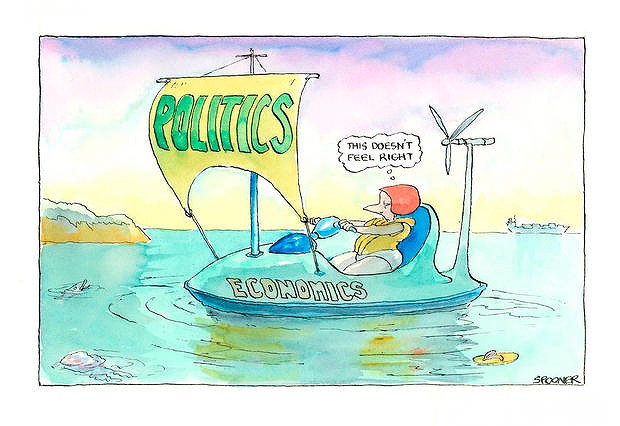
The hard reality is that Australia's economic fortunes and well being primarily depend on the sustained demand for commodities from the major five Asian countries (China, India, Indonesia, Japan and Korea) not on Gillard's personality or lack of it.
Unless there is continual economic growth in the economies of the US and the developed world and therefore the Asian countries, then the demand for Australian mineral resources will fall. Australia's economic growth will then flatten.
Posted by Gary Sauer-Thompson at 9:12 PM | Comments (14) | TrackBack
December 1, 2011
Regulating the mining of coal seam gas
The Senate's Rural Affairs and Transport References Committee has published an interim report into the impact of mining of coal seam gas in the Murray-Darling Basin. It is part of its inquiry into the management of the Murray-Darling Basin and it was handed down yesterday.
It recommends that coal seam gas exploration be suspended in Queensland and New South Wales "in that part of the Murray-Darling Basin overlying the Great Artesian Basin". There was tripartisan support---the Coalition, Labor and the Greens---for the suspension, and by implication a criticism of the pro-development ethos in Queensland and the Queensland Government’s policy of "adaptive management", which primarily means approving exploration until it can be proven that it is a danger to the environment.
Coal seam gas is a form of gas mining in which coal deposits under the earth are hydraulically fractured, using a dirty mixture of water and chemicals, allowing the methane gas to bubble up and be captured. The danger in this case is de-watered aquifers, millions of tons of salt piled up, polluted water from the chemicals used in fracking, as well as the despoilation of prime agricultural land.
Both the NSW and Queensland state governments want the mining tax revenues and they sided with the cowboy exploration mining companies, who pretty much demanded that the farmers get out of the way. The federal government is eying a billion dollar project, and it has come firmly down on the side of the miners.
Apparently it is now a violation of neo-classical economics principles to require miners to internalize the cost of negative externalities. That is contrary to economics and would lead to a poisoned world in which firms that spent money to restrict harmful externalities who would be driven out of business by their competitors who avoided such expenses and obtained a decisive cost advantage. Policy uncertainty is choking development.
Parliament, in contrast, has taken the opposite stance to a neo-liberal mode of governance (ie., markets are self-correcting, bubbles are impossible, and economic crises are impossible). Parliament is concerned to limit the market for social and environmental objectives. The Committee says that:
it has seen examples of land degradation caused by seepage from extracted water storage ponds, leaking gas pipes, untreated water seeping into watercourses and erosion caused by poorly installed pipelines. It has heard from landholders who felt bullied or patronised by gas company representatives seeking access to their land. ....In addition many submissions to the committee have suggested that the regulatory framework is not sufficiently robust, and particularly that the regulatory authorities lack the resources to monitor such a dispersed and complex industry.
It is going to be interesting to see how the state and federal governments will respond to this report, especially with respect to the Great Artesian Basin and the revision of the Environment Protection and Biodiversity Conservation Act 1999 to include the ground water that forms part of the Great Artesian Basin.
The miners will act to prevent effective regulation. Their attacks on regulatory policy reform become “policy uncertainty,” which becomes a purported empirical basis for preventing effective regulation.
Posted by Gary Sauer-Thompson at 1:49 PM | Comments (1) | TrackBack
July 11, 2011
carbon tax: going slow
The various Australian industry lobby groups (Australian Chamber of Commerce and Industry or ACCI, the Australian Coal Association and the Australian Industry Group) some free market economists and conservative politicians have beaten up the carbon tax big time as a radical and painful measure that would lay waste to the economy.
Australia's media bears some responsibility for perpetrating this deception in that they failed to investigate and critique the cartoon doom and gloom images about economic ruin:

Despite Australia being the world's 10th biggest aggregate emitter, with the world's highest per capita emissions, our mitigation effort and short-term target (a cut of minus 5 per cent below 2000 levels by 2020) are among the weakest among all industrialised and major industrialising nations.
And there are heaps of subsidies and compensation to ease the political fallout on the Gillard Government by showing that Abbott’s big scare campaign about the cost of living has been wrong and to deprive him of the chance to offer his own tax cuts.
The economic reality is otherwise and the ground underneath the Australian industry lobby groups and the conservative politicians has been effectively undercut. Their lines of "a toxic tax ", "socialism masquerading as environmentalism", economic ruin, recklessly shooting our wealth-creating industries in the foot etc etc now sound decidedly hollow.
It is the free market economists who are quick of the mark to create doubt about this first step to a low carbonb economy. For instance, Sinclair Davidson says at The Drum that Treasury modelling relies very heavily on assumptions about technology. Consequently,
Electricity generation is expected to move from being predominately coal-generated to renewable energy with some coal being used in combination with carbon capture and storage technology. Right now that technology is not viable; Treasury assumes it will be viable after 2021. Renewables are expensive and unreliable. Treasury imagines the greatest growth will be in geothermal energy – again a technology that is unproven.
Davidson comments:
Of course technological improvements occur all the time and these technologies may well be viable in future. Yet the Government is betting our economic prosperity on these technologies becoming viable in the very near future. If those assumptions do not work out, electricity prices will be very high and very likely Australians will experience rolling black-outs. This is a policy that undermines our domestic energy certainty.
The message? It's too risky. The lights will go out. So the deal fails. What has happened to the Hayekian idea of markets and innovation? What has happened to an analysis of the public policy that addresses this risk--eg., the investment fund to facilitate innovation ion the renewable industry?
Judith Sloan's response is that to the target of a reduction of 5 per cent by 2020:
the wildly inefficient schemes – particularly the subsidisation of small-scale renewable energy and the appalling Mandatory Renewable Energy Target – will be required to do the heavy lifting in order for the target to be met..Indeed, it is a case of a major opportunity foregone – to replace the melange of inefficient schemes with a carbon tax...The explanation, of course, is politics. The only way to get the Greens across the line with a 'low and slow' approach to the introduction of a carbon tax was to continue, indeed bolster, the concoction of visible, feel-good but costly schemes.
Her judgment is that it is:
Better to feel you are doing good rather than actually do good, seems to be the message. And when billions of dollars of other people's money can be directed to your mates in the renewable energy industry and the research community, the package all of a sudden makes sense. Hence the creation of ARENA – the Australian Renewable Energy Agency – clinched the deal.
The inference? Corruption!
Sloan does not mention that Australian Renewable Energy Agency (ARENA) and the Clean Energy Finance Corporation with its $10 billion for innovation in renewable and clean energy--- will be placed out of the hands of politicians. They are independent and will sit beyond ministerial interference.
The unspoken assumption of Davidson and Sloan economics is that the governments have the ability to destroy economies and that interventionist politics undermine economic prosperity. There ought to be less not more regulation with respect to energy markets. Heavy-handed regulation by hands-on apparatchiks, undermines investment and the rewards for risk taking in business.
Posted by Gary Sauer-Thompson at 9:15 AM | Comments (7) | TrackBack
June 25, 2011
green growth
Those on the political right who both deny the science that informs us that the greenhouse emissions are produced by economic activity have caused global warming, and who oppose using market mechanism to help reduce greenhouse gas emissions, basically argue that saving the planet will destroy the economy.
It's a simple message or slogan, that is endlessly repeated in News Ltd's newspapers, and it overlooks, misrepresents, or refuses, to acknowledge the emergence of what the UN calls a green economy or the OECD calls green growth. This concept has moved into the mainstream of policy discourse.
As Michael Jacobs in An idea whose time has come at Inside Story observes:
these terms – green growth, low-carbon growth, the green economy, green development – are being used to convey a simple but potentially radical idea: that environmental protection and the reduction of carbon emissions need not be at the expense of economic growth but can actually contribute to it. ago ....At its most basic it derives from the recognition that a key route to protecting the environment is to use resources – energy, land, water or whatever – more efficiently. This is essentially a form of productivity improvement: getting more output for less input. So long as this is done at a relatively low cost – particularly by using market mechanisms to encourage firms and consumers to change their behaviour – it should help growth not hinder it. It’s true that the growth generated by raising resource productivity can lead to new emissions and more environmental impact, but the evidence shows that the total impact almost always remains environmentally beneficial.
The more informed business-as-usual News Ltd journalists basically argue that though green spending can stimulate growth, it just stimulates less growth than the brown alternative. Low-carbon energy is more expensive, so the costs will be higher and the returns less. More economic growth is better than less growth.
The problem here is with business-as-usual. What if there is no “business as usual”? Jacobs says that:
If – as is now widely expected, and indeed may already be happening – failure to take action on climate and the environment in practice leads to effects such as rising oil and fossil fuel prices, greater water scarcity, lower agricultural productivity, declining fish stocks, more frequent extreme weather events, and so on, then the base case against which the green growth path needs to be compared may be rather different from what has generally been assumed.
he says the modelling shows that the “green investment” scenario starts off generating slower growth than the base case. But by the second half of this decade this has reversed, as growth rates in the base case start to decline under the impact of environmental pressures. By 2030 and beyond, the “growth dividend” of the green investment scenario becomes quite marked.
Posted by Gary Sauer-Thompson at 11:01 AM | Comments (2) | TrackBack
April 5, 2011
kinds of development
One conception of development is giving the property developers in the capital cities what they want, even if that means the state government overriding the wishers of residents and a lower quality of life in the city.

Another kind of development is the long terms one of making the transformation from an industrial economy to an information one. The National Broadband Network signifies such a transformation, as it means opening up regional communities (eg., in Queenstown, Tasmania) to high-speed internet access.
The old world shock jocks in NSW have their heads in the sand with respect to the NBN, as this allows many business people and other professionals, who were facing the prospect of having to move into bigger cities, to continue to live and work in regional communities.
Mobile broadband works. I'm typing this on my Apple MacBook in the caravan park in Queenstown using Telstra's pre-paid mobile broadband. It works a treat. However, it is far too expensive for long term use if you are a resident in this isolated community. You need fibre optics and low cost entry points, especially for those on struggle street. The NBN is coming to Queenstown.
This highlights the flaw in the standard argument that wireless broadband access is growing at such an alarming rate that there is no need for the NBN to be built using fibre and so who would want a fixed-line connection when you can have the flexibility of wireless access? So argues Malcolm Turnbull.
Turnbull is wrong as people want both fibre and wireless not wireless at the expense of fibre. Wireless is supplementary technology.
Posted by Gary Sauer-Thompson at 10:57 AM | Comments (4) | TrackBack
March 30, 2011
urban planning: Sydney style
One of the core issues of urban like is the way that developers appear to control the process of urban planning. They mostly get their way over local governments because the state governments have legislation that over rides the normal planning rules and procedures.
Sometimes this is necessary--for crucial major projects-- but, more often that not, this exception has been white anted by the bags of cash developers donate to political parties in the states. So we end up with bad development, poorly designed and built suburbs and an impoverished urban life.
At the National Times Elizabeth Farrelly gives a good example of this by showing how urban planning in Sydney has worked. She says:
In truth, planning in NSW has never been about planning. I doubt that a single decision has ever been made, since Pat Hills dudded the Cumberland County green belt in the 1950s, that genuinely had the city's overall future at heart. Planning here has always been principally an exchange of favours; long lunches, special pleadings, spot rezonings, windfall gains.
The key in NSW is Part 3A, the horse-and-cart amendment to the 1976 Environmental Planning and Assessment Act.
This gives the minister:
near-limitless discretion it concentrated in the minister's hands. It mandated no criteria either for the calling-in or for the decision itself; required no written rationale or judgment, even after the event; and suspended almost all associated environmental protection legislation, as well as requirements for consultation, that would otherwise apply. The developer only had to inflate his claim outrageously and he was pretty much home and hosed.
She gives exampes: Catherine Hill Bay, Gwandalan, Sandon Point, marinas up and down the coast, high-rise apartments, Redfern-Waterloo, Luna Park, the Caritas redevelopment, Barangaroo, Wallarah Peninsula, Vincentia Village, spot-zoned shopping centres and the entire rash of Hunter Valley coalmines approved by minister Keneally.
What seems to have great difficulty in getting off the ground in Adelaide is the promotion of a pedestrian culture in the city: eg., completing a city tram loop, providing more facilities for cyclists, closing some streets to cars and making others a public transport-only street; providing more trees for summer shade, widening footpaths allowing for outdoor cafes, etc.
The car lobby, of course, is outraged by these kind of suggestions by the various thinkers in residence, such as Fred Hansen. Public transport is for the poor; lefty (socialist left) minority groups are imposing their idealistic green vision on the hard working common sense majority; there are too many bike lanes; more freeways are needed;thinkers in residence are too academic and impractical etc . Adelaide is a motor city period.
It's the cultural wars all over again.
Posted by Gary Sauer-Thompson at 10:23 PM | Comments (2) | TrackBack
March 8, 2011
can a rustbelt Adelaide reinvent itself?
Can a rustbelt Adelaide reinvent itself with the decline in its manufacturing industry? Boston did. It was able to boost its economic growth by becoming a center of the information economy in the late 20th century. Human capital---a strong base of skilled workers---was the key to urban growth. The policy message is that as ideas and knowledge became more important in capitalism cities with skilled populations began to thrive.
Can Adelaide look like the future and not the past? Can Adelaide transform itself from a dying factory town to a thriving information city? In Reinventing Boston: 1630–2003 the American economist Edward L. Glaeser, the author of Triumph of the City, states that the story of Boston’s history yields the following implications about urban dynamics.
First, long run urban success does not mean perpetual growth. Long run urban success means successfully responding to challenges. The basic pattern of Boston’s history is that the city specializes in one area and inevitably either this area declines or their dominance in the area is challenged. The survival of the city hinges on re-orientation.
Second, Boston’s ability to re-orient itself hinged on industrial diversity.
Boston had never been just a port and from the beginning, artisans in the town had manufactured goods which were then taken on Bostonian ships abroad. As such, the switch from seaport to factory town required a large re-emphasis, but not inventing industry from scratch. Likewise, Boston’s seafaring commerce had always needed financial services, and as a result, the city had always had banks, brokers, and insurers. As Boston’s manufacturing declined, finance was able to take up its slack.Third, Boston’s ability to regenerate itself hinged upon its ability to attract residents, not just firms:
The American cities that grew because of proximity to productive natural resources, such as coal, have suffered tremendously over the past 50 years. When the demand for the key natural resource declined, no one saw any reason to remain in the city and they left. By contrast, from its earliest days, Boston existed not only as a productive center but as a place that people wanted to live: a consumer city. Because people wanted to live there, as well as work there, during times of economic trouble, residents innovated and stayed. In the coal towns of central Pennsylvania exodus, not innovation, was a more common response.Fourth, in all of its period of reinvention, Boston’s human capital has been critical:
today more than ever, Boston’s skills provide the impetus for economic success in technology, professional services, and higher education. Boston’s experience certainly suggests that human capital is most valuable to a city during transition periods when skills create flexibility and the ability to reorient towards a new urban focus.Educated cities grow more quickly than comparable cities with less human capital because they become more economically productive.
Lastly, city government has played an important role in Boston’s periods of both success and failure.
Glaeser's argument is that geography is especially important to the growth of post-industrial economies and so it is much better to push development in places where people and businesses actually want to move to or set up shop. Declining or struggling towns and cities where people and firms don't want to live should be encouraged to decline further.
Posted by Gary Sauer-Thompson at 9:14 AM | Comments (5) | TrackBack
January 12, 2011
fixing limits for the growth of a city?
A defence of suburbia --American style. They have become more diverse and they are becoming economic powerhouses. Fair enough, but suburbs today still mean cities sprawling across the landscape, with some of them becoming increasingly bloated, congested and polluted with their transformation into large urban agglomerations (eg., south east Queensland) and mega cities eg., Mexico City or Shanghai.
Should cities just keep growing? Or should they be governed so they develop within limits?
We have the argument that living in compact, well-planned, walkable and integrated cities is part of the solution to the issue of economic development and environmental sustainability. Paul James observes:
Imagine a boundary to the city—some European cities have them—where the suburbs are edged by permanent forests and grasslands for leisure use, and by agricultural land for feeding the city. Imagine a series of compact and dense urban centres, punctuated by parks and threaded by bicycle and walking paths that give easy access for work and leisure.
But no limits are being placed around the edges of Australian cities. They continue to sprawl. Developers rule. Hence the alternative position of "well-managed" cities looks to be more feasible.
Chetan Vaidya says:
Thus, rather than restricting city growth, urban strategy should focus on harnessing the benefits of urban growth by managing it well, ensuring improved and equitable service provision and promoting good governance. Planners of sustainable and inclusive cities need to review urban planning practices and approaches, be aware of resource constraints, and identify innovative approaches that are more responsive to current and future urbanisation challenges.
Managing cities means managing them for a goal---such as an innovative, liveable and sustainable city. What once used to be called sustainable development.
This then raises another question? Who actually governs our cities? In Australia it appears to be the state politicians but we soon realize that they are largely acting on behalf of the interest of the developers --private capital. The justification? It's usually something along the lines of endless growth and profitable investment. The economic model underpining this is one that advocates smashed the power of labor and deregulated finance so that the financial system that can put investment funds in the right place and the right time in order to ensure new rounds of capital accumulation.
Capitalism is permanently in flux as it constantly renewing itself in a process of what Schumpeter termed ‘creative destruction’. The question is whether Australia has a state that is capable of making the long-term investments in 21st-century infrastructure needed to provide avenues for profitability and growth, to say nothing of establishing social programs that raise the living standards and purchasing power of the middle and working classes.
Posted by Gary Sauer-Thompson at 8:37 AM | Comments (2) | TrackBack
September 16, 2010
Ross Garnaut: mining + the environment
Ross Garnaut has built an enviable reputation as one of Australia's leading public intellectuals.He is known for his key role in opening the Australian economy as part of the team that came into office with Bob Hawke in 1983, for his seminal 1989 book Australia and the Northeast Asian Ascendancy, and he is the Australian Government's chief adviser on climate change and carbon emissions.
Garnaut is currently in the news as a result of a critique by the ABC of his association with Lihir Gold Limited. This has operatesd one of the world's biggest gold mines on Papua New Guinea's Lihir Island under the under leadership of its founding chairman Professor Ross Garnaut. The ABC raised concerns over the environmental record of Lihir Gold Limited with respect to its use of Deep Sea Tailings Placement (DSTP) rather than land-based tailings disposal. Garnaut has defended his actions.
Garnaut has a long history in PNG, having helped establish the country's post-independence monetary and mining policies. He now sits on the Ok Tedi board and is chairman of PNG Sustainable, the mine's current majority owner. The key question is: do the externalised environmental costs of mining exceed the benefits of income earned from mining?
Garnaut puts it this way:
There are genuine dilemmas in resources development anywhere, including in poor developing countries. Mining inevitably generates waste and tailings. The disposal of waste and tailings inevitably involves some disruption of the natural environment—as does almost all human economic activity. The important judgements are always about making responsible choices between alternative means of managing waste and tailings, and about whether, when the best possible means of managing waste and tailings have been chosen, the benefits of a particular mine exceed the costs.
There is a growing reliance by Papua New Guinea on mineral exploitation for foreign direct investment, government revenues, and foreign exchange. The greater the insistence on environmental protection the less attractive a resource exploitation opportunity becomes. That resource exploitation and minimal environmental attention occur most commonly in developing countries is not coincidental.
Despite the public evidence of the damage to the environment and the ensuing affect on the people of Papua New Guinea by mining activities; and despite universal condemnation of these activities and the companies responsible; the companies continue to conduct these activities without official hindrance and with little apparent concern for the long-term ramifications of their actions.
BHP, the original owner of the OK Tedi mine, did not find a balance between the need to generate income and to protect sensitive areas and respect the wishes of indigenous populations. BHP's Ok Tedi mine over-relied on a tailings dam that proved unsustainable in that geology, and then sent the tailings down the Ok Tedi – Fly River system ( the waste is dumped into the Ok Tedi and Strickland rivers which are tributaries of the Fly River and form part of the Fly River system).
I remembered pictures showed tons of mud and mine waste polluting the river and the land around it, indicating that the company’s practices resulting in “severe environmental damage. The toxic river of waste killed the fish and crops, destroyed thousands of square kilometers of rainforest and caused terrible hardship for local people. Ok Tedi owner BHP agreed to pay more than $100 million in compensation to the local people for this eco-catastrophe after being taken to court to force it to adopt environmental management systems and to pay compensation.
In 1995 Garnaut said in defence of the Ok Tedi gold and copper mine mine in Papua New Guinea:
Take Ok Tedi - it's currently in the news, BHP being much criticised for the environmental impact. Without taking a view on the pros and cons of that current debate on the environmental issues, it is, I would have thought, a relevant part of the debate that the people of the Star Mountains, where the Ok Tedi mine is related, were some of the poorest, most miserable people on earth when this mine was first conceived, twenty years ago. Life expectancy of women was nineteen years. There has been a very substantial improvement in nutritional standards; in general health and welfare the opportunities for those poor and miserable people have expanded very considerably. That is part of the Ok Tedi history that is just as real as the environmental problems in the Fly River. There is no quick and easy solution to the task of development in a poor, underdeveloped economy. What I hope for Papua New Guinea is that there will be a gradual building, a gradual learning, over a long period of time, a gradual strengthening of institutions.
For Garnaut the economic benefits outweigh the environmental costs according to a utilitarian calculus. The standard way was to focus on the amount of money that was being invested in community rather than how the pollution problems were actually impacting on sustainability or long term sustainable development.
In 2002, BHP withdrew from the project and gave its 52 per cent share to the PNG Sustainable Development Program. With the transfer, BHP gained legal indemnity from PNG government action with respect to all the pollution and destruction it has already caused and will cause in the future. The PNG Sustainable Development Program is designed to provide long-term benefit to local communities, but whose income is dependent on the very mine killing the local environment.
PNG Sustainable was specifically set up to invest in projects on behalf of Papua New Guineans to help soften the impact when the mine closes in five years' time. Before leaving, BHP set up a dredging program to return the river to a safe state and avoid further destruction. For the past decade, this dredge has been sucking waste out of the river near Bige village and stock-piling it close by. The dredge has only removed a fraction of the amount of waste required to keep the river safe.
Posted by Gary Sauer-Thompson at 10:15 AM | Comments (6) | TrackBack
September 11, 2010
regional development + the Australian settlement
We know that the agreement struck between the Gillard Government and the regional Independents (Oakeshott and Windsor) focused on parliamentary reforms and a new deal for regional Australia. The principles invoked were that regions "have not been given their fair share" and that "equity principles" must prevail.
A new deal for regional Australia means regional development in a globalized world based on state intervention into the open market so as to advantage the people the Independents represent. What does regional development mean? How are we to understand that? How is it a break from the past attempts at regional development under the Howard Government.

I haven't seen the agreement, but Paul Kelly has. His position on minority government, if you recall, is that we have a weak minority national government, a parliament where reform will be more difficult and a group of "special interest" politicians controlling the cross-benches.
He says in The Australian that at the level of Government it involves a new cabinet-level minister for regional Australia and a new department:
There will be a regional Australia cabinet committee, a regional Australia co-ordinating unit in the Department of Prime Minister and Cabinet, an office of northern Australia, a new House of Representatives committee for regional Australia chaired by an independent, a new government-funded regional Australia think tank, methodology to enable the Finance Department to better analyse spending by location, and a review of all rural and regional funding.
About time is my response. This has to be done properly given the complexity of economic and environmental problems in regional Australia. Done properly means economic growth and supporting regional communities whilst shifting to a sustainable Australia
Kelly's interpretation of this approach to regional development is that:
The name of the game is redistribution. With invocations of that ageless Australian narrative of the bush in its fight against "drought, floods, fires and cyclones" the document endorses notions such as "place-based thinking" and "localism". It is notably weak on the economic adjustments and productivity challenges facing the regions....This resurrects an old Australian instinct described in the immortal words of historian W.K. Hancock of the state as "a vast public utility whose duty it is to provide the greatest happiness for the greatest number" (along with winning votes for several political generations).
I have little problem with "place-based thinking" and "localism", and I accept that Australia's public philosophy has been utilitarianism, and that this moral philosophy underpins neo-classical economics' conception of cost benefit analysis. Good public policy is that which produces the greatest happiness for the greatest number.
Now there was a substantial shift in the economic policy regime in Australia in the 1980s as market liberalization (open to foreign competition, and largely de-regulated and privatized) was deemed to be a desirable response to the changed external economic environment (a global economy). Kelly's interpretation links regional development within those political traditions that have never accepted the post-1983 pro-market reform era of Hawke and Keating ---and we should add the neo-liberal mode of governance.
Kelly says regional development represents a return to the Australian Settlement that was set out in his book The End of Certainty (1992, 1994).
There have been two influential political traditions that never accepted the post-1983 pro-market reform era that delivered Australia recession-free from the recent global financial crisis. They are the unreconstructed rural interventionists that often mock the Nationals as sellouts and the ideological Left, once strong in the ALP but now at home in the Greens and sections of the education establishment where the Greens draw much support.It is tempting to see the current crossbenchers as embodying these two throwback movements, but dressed up in the fashion of caring environmentalism.That raises the heresy that the coming parliament, far from constituting an exciting new politics, is actually a reversion to the discredited past.
Why cannot there be regional development and an open economy? Why isn't this a possibility? If state developmentalism, a central plank in Australian Settlement, refers to the state playing a substantial role in promoting and regulating economic development, then there can be diverse threads in this weave.
For instance, Geoffrey Stokes points out that Kelly reduces state developmentalism to protection and tariffs. Referring to Marian Sawer's The Ethical State? Social Liberalism in Australia, Stokes says Kelly overlooks another dimension and rationale for state developmentalism that extends beyond the economic:
the tradition of social liberalism evident in Australian parties of both the Left and Right encouraged them to adopt an interventionist state ideology for reasons associated with giving citizens a ‘fair go’. Through implementing a wide range of social and economic policies, the role of the state was to ensure that all citizens were given the opportunity to develop their potential fully. The intersection between the economic and the social is especially evident in the requirement for equal opportunity in education policy, but it is also apparent in other policy areas.
Instead of Kelly's interpretation of a throwback dressed up in the fashion of caring environmentalism, we have the possibility of regional development as the intersection between the economic and the social and the environmental.
Posted by Gary Sauer-Thompson at 12:23 PM | Comments (12) | TrackBack
September 3, 2010
yet another fear campaign
The Australian's attacks on the Labor-Green alliance continues to gather pace. Mostly it's a fear campaign whose narrative is that the Labor-Greens coalition could be the most left-wing government since the days of Gough Whitlam. The political reality being constructed by News Ltd is that such a government would destroy Australia in the name of the gospel of sustainability.
The latest bullet comes from Robert Carling, a senior fellow at the Centre for Independent Studies in his Tax policy devised by party that is green with envy. Behind the material on tax lies an economics.
Carling says that the Greens would back-pedal on the economic reforms that have helped deliver 18 years' uninterrupted economic growth and greatly enhanced living standards. He adds:
The Greens' tax policy, if taken literally, paints them as a party of "tax and spend" and as a party that is more interested in redistributing wealth than encouraging its creation. Their tax policy is green from envy. The main parties should be very cautious in courting Green support to form a government. Those 1.25 million voters may or may not have voted for less economic growth and lower living standards, but we can be confident the others did not.
So the Greens are part of the social democratic tradition that has been traditionally premised on equality and the welfare state. Carling stands for personal income tax be cut to with a top rate of 35% that is indexed. This would reduce government revenue. But that can be offset by gains to revenue from cutting back on selective tax breaks and by imposing a tight rein on government spending. So Carling is low tax and small government man.
It's a fear campaign based around the talking point of anyone who earns a reasonable quid in Australia would be made to pay big time so the Greens could introduce more energy-efficient industries and turn their backs on the conventional mining sector. These are dangerous hands to be holding holding the balance of power. Carling's assumption of less economic growth and lower living standards is not plausible because he ignores the possibility of wealth creation from the emergence of green industries as Australia makes the shift to a low carbon economy.
How then is infrastructure investment in renewable energy going to take place with small government? The invisible hand of the free market (meaning spontaneous order) of course with the standard appeal to Adam Smith's The Wealth of Nations, even though Adam Smith did not credit the invisible hand metaphor with the importance that authors, from the mid-20th century onwards, give to it.
Gavin Kennedy in his Adam Smith and the Invisible Hand: From Metaphor to Myth at Econ Journal Watch says:
Significantly, and contrary to the assertions of the modern consensus, he [Smith] gave the invisible hand no role in his theory of competitive markets in books i and ii of Wealth of Nations. such roles given to it since the 1950s rely solely on assertions and interpolations by modern economists...modern benign invisible hand explanations from the second half of the 20th century elevated the metaphor into ‘principles’, ‘theories’ and ‘paradigms’ of markets, which do not correspond to anything written by smith and neither do they explain anything.
Could we not, in the context of climate change, imagine a spontaneous order in which people were led as if by an invisible hand to promote a perverse and unpleasant end--eg., the tragedy of the commons? Self-interested actions are not necessarily always socially benign.
Surely, ‘the desirability of the market order that emerges as the unintended consequences of human action depends ultimately on the kind of rules and institutions within which human beings act, and the real alternatives they face’ ? It is the rules and institutions that are crucial for understanding how markets function, not metaphors like "the invisible hand."
Posted by Gary Sauer-Thompson at 1:17 PM | Comments (7) | TrackBack
May 12, 2010
hot rocks indeed
The economic narrative of the Rudd Government's 2010 pre-election budget is that Labor are responsible economic managers. They steered Australia through the global financial crisis and economic recession with generous stimulus spending that meant low unemployment. They imposed fiscal discipline with a 2 per cent real spending cap; they have charted a course back to budget surplus and enabled the economy to recover.
This kind of economic prudence is such a contrast to the huge cuts to public spending that will need to be implemented by the new coalition Conservative/Liberal Democrat government in the UK under David Cameron. In contrast to the turbulence in the economies of Europe that are burdened with debt for many years to come, Wayne Swan, Australia's Treasurer, is talking about a return to surplus in three years from a flow of tax revenue from strong economic growth due to the mining boom in iron ore, coal and natural gas.
Australia is the lucky country. We ride the mining boom to prosperity thanks to the continuing industrialization of China, and forget all about the effects of climate change on Australia. It's a political amnesia that flows out of winning the next election. And after the election? The China-fuelled growth means infrastructure bottlenecks, labour shortages, stubborn inflation pressures, rising housing prices and rising interest rates.
Climate change is over the horizon, beyond the rainbow of the never ending mining boom. There is no need to restructure the economy to take into account climate change by making a substantive start on baseload electricity generation by renewables. There is no commitment to a substantive investment in research and development in green energy technologies; investments so that we can have cheap solar panels rather than expensive ones as we have now.
Maybe, even though the reality of global warming is accepted by the Rudd Government, they are thinking that dramatically cutting carbon emissions is simply not warranted.
Posted by Gary Sauer-Thompson at 8:53 AM | Comments (4) | TrackBack
May 9, 2010
'enuf said
The Leak cartoon says it all really. The WA miners and the Coalition are beside themselves with rage in defending their self-interest. The miners want all the loot from digging up rocks for themselves. The Coalition cannot see beyond digging up rocks and selling them for a top dollar (spot price) to the Chinese steel mills.

What is missing from the cartoon is the role of the Murdoch Press, which is acting as the publicity arm of the miners and the Coalition in their attacks on the Rudd Government. This is a rightwing power nexus that has no time at all for a world of climate change, finite natural resources and protecting the environment. The miners should rule.
Progress for them is digging more rocks out of the ground, making lots of money and ensuring that governments toe the line by ensuing that the economy is flexible, is internationally competitive and has the right light regulatory framework.
Not for them an ecological enlightenment. They represent the old order that resists this kind of change and are prepared to engage in mass deception to do it.
BHP is putting pressure on the Rann Government in SA. Though the $20 billion expansion of Olympic Dam copper, uranium and gold mine in South Australia has not been shelved--- it would be "very difficult" to approve the new mine if the tax was introduced in its current form. The hacks in the Murdoch papers then write t it up. The strategy is get Rann to pressure Rudd to lay off the miners. And to get Anna Bligh in Queensland to do the same.
This is another example of how large companies use the media cycle and their political power as a deliberate part of their government lobbying strategies.
Update
It comes as no surprise that Kevin Foley, the SA Treasurer, will lobby Canberra for changes to ensure the expansion of Olympic Dam in the state's outback. The Rann Government shared the concerns of BHP, which is leading the mining industry attack on the tax, and its position is that the tax should be instituted in a manner that did not threaten current or planned investment.
Posted by Gary Sauer-Thompson at 12:36 AM | Comments (4) | TrackBack
April 4, 2010
a Big Australia
If more people now leave Australia for resort holiday in Asia, rather than holidaying in Australia, then more people want to come to Australia. Nor problems, given that the current political discourse is about a Big Australia to live. The concept of a Big Australia refers to total population levels, rather than annual immigration numbers and refugees, and it is tied to economic growth and development.

The ability to sustain a larger population depends on the planning abilities of state and federal governments and a larger population means that large investments in urban infrastructure must go hand in hand with longer-term reforms to boost the productivity and participation of the existing workforce.
Yet population is tied to migration, asylum seekers and boat people by those who play on the atavistic fear of boat people in the Australian population.
Thus the Liberal Opposition, ever anxious for "product differentiation" in difficult times, quickly ties a Big Australia, to border protection, and quickly ups the anti on asylum seekers coming to Australia by boat people. The federal government is far too soft on asylum seekers is the talking point. They lack the muscle that is required to control Australia's borders effectively and stop the boats. They are moving towards making "the boat people" a major election issue.
So we don't really have a debate about what a Big Australia means for our cities. Nor will we have one in 2010.
Posted by Gary Sauer-Thompson at 11:37 PM | Comments (15) | TrackBack
January 19, 2010
Intergenerational Report: Australia to 2050: Future Challenges
So there is to be a third Intergenerational Report, entitled Australia to 2050: Future Challenges, which analyses the key long-term challenges facing Australia for the first half of this new century. This is to be released in the next few weeks, but we have heard this account before from Peter Costello, when he was Treasurer in the Howard Government. Kevin Rudd adds little that is new. More problematically he says nothing about addressing the effects of climate change on the economy.
According to Rudd's Australia Day speech the ageing of our population is the key challenge. Rudd says that to understand its implications, we need to ask three basic questions:
First, how much are we ageing by?
Second, how will this impact on family living standards and the economy?
Third, what can we do about it?
No mention of ageing and wellness at all. For Rudd its all about the negative impact of ageing economic growth and prosperity. Rudd says that:
On the first question, the Intergenerational Report projects that our population will grow from 22 million today to 36 million by 2050... On the second question public finances will be burdened with the increased costs of looking after the needs of older Australians - in health, aged care and age pensions - but with a smaller proportion of Australians in the workforce, tax revenues won't keep pace with those rising costs.
Consequently, we will either generate large, unsustainable budget deficits into the second quarter of the century, or else we'll need to reduce government services - including health services - as the needs of an ageing population become greater. This is the same message as Costello. For the old political order an ageing population is not an active population.
The third question is what can be done to strengthen economic growth in the face of the fundamental challenge from the ageing of the population.Rudd says:
In the long-term, there are three sources of economic growth - the three Ps of population, workforce participation and productivity growth.With lower fertility rates and stable migration ratios, population policy will on current trends at best make a marginal contribution to the challenge of an ageing population.The truth is that the strong policy levers lie with policy measures to lift participation and productivity growth...the most important of the three Ps [is] productivity growth. It is productivity growth that must play the central role in building Australia's future economic growth.
Again this is same message as Costello. It's Treasury's message. Rudd's twist is that productivity growth had fallen under the Howard Government:
During the 1990s, productivity growth hit the two per cent mark following the reforms of the Hawke-Keating Governments, but it fell to just 1.4 per cent in the first decade of this century. If we let this trend of lower productivity growth continue, Australia will struggle to meet the major challenges facing our economy in the decades ahead....The Australia to 2050 report shows that without a concerted effort to increase productivity, average annual productivity growth will be just 1.6 per cent over the next 40 years, leading to average annual economic growth rate falling to 2.7 per cent, compared to the historical average of 3.3 per cent over the last 40 years.
And Labor's plans to grow Australia's productive capacity over the long-term? Well, there is nothing new there either.
It is increased investment in long-term nation-building economic infrastructure including in roads, rail and ports; an education revolution, in the form of doubling the investment in Australian schools over the next five years; helping businesses use technology to work smarter and faster through the high-speed National Broadband Network, and implementing microeconomic reforms to cut red tape for business and build a seamless national economy.
Nothing about greening Australia to make it more sustainable or making the shift to a low carbon economy. Not a mention, even though this is actually a key long-term challenge for Australia.The inference is that Rudd Labor is not serious about making the shift to a low carbon economy.
Posted by Gary Sauer-Thompson at 3:41 PM | Comments (14) | TrackBack
January 9, 2010
Adelaide: drifting into a genteel poverty?
Our economy is in the midst of a fundamental long-term transformation—similar to that of the late 19th century, when people streamed off farms and into new and rising industrial cities. That industrial epoch of capitalism had its own distinct geography, a post 1945 spatial fix of suburbanization based on mass production, cars and consumer credit.
Today, the economy is shifting away from manufacturing and toward idea-driven creative industries--what some call the knowledge economy. The decline in manufacturing is the result of long-term trends—increasing foreign competition and the relentless replacement of people with machines. This transformation will also have its spatial fix.
Adelaide is one of the older, manufacturing regions whose heydays are long past, and it has continued to struggle long after the mega-regional hubs and creative cities have put the crisis of the early 1990s behind them. As a rust belt city it stands for a region in decline as the manufacturing industry has shrunk, whilst the local high-end services—finance, law, consulting—that it once supported have also diminished. This region is no field of dreams.
The policy question is: How does a city such as Adelaide prevent its stagnation and decline? Will it make the transition from a resentful, post-manufacturing tawdry inward- looking city to a cosmopolitan friendly, hip city open to the global economy? Or will the city and its regions continue to decline and become a relic of the industrial age? Can Adelaide reinvent itself?
Richard Florida in his The Rise of the Creative Class. argues that innovation., economic growth, and prosperity occur in those places that attract a critical mass of top creative talent. The key drivers of such a transition are the "three T's" of technology, talent, and tolerance. If cities could make themselves appealing to the Web designers, architects, biomedical researchers, and other innovators who are now the drivers of economic growth, then they would also attract the businesses that want these footloose pioneers to work for them.
Florida's urban renewal theory is that the creative class fosters an open, dynamic, personal and professional environment. This environment of bohemian lifestyles and creativity in turn, attracts more creative people, as well as businesses and capital. It is a “creative capital” view of human capital generating growth.
I've thought that the “creative capital” view of human capital generating growth is on the right track. First, about the importance of knowledge-creation and creativity becoming a more important part of the economy Secondly, as cities turn on creative people, they need to attract creative people. Thirdly, bohemian types like funky, socially free areas with cool downtowns and lots of density, as in Melbourne. This is funky, creative chic, innercity area is what Adelaide lacks, even if it has the odd bohemian coffee shops with free wireless. So we have the idea of the new economy that stands in contrast to the old economy with its older-style industries and more traditional values-----a smoke-stack economic development.
The problem for Adelaide is that the well-established tendency for most types of economic activity to cluster in relatively few places rather than dispersing widely--Michael Porter's theory of industry clusters. A second problem is is another well-established characteristic of economic activity: in addition to being clustered geographically, the various activities are also tiered functionally. It is tiered functionally because ventures of one sort systematically demand services of other particular sorts. Consequently, people are crowding into a discrete number of mega-regions, systems of multiple cities and their surrounding suburban rings. The ability of different cities and regions to attract highly educated people—or human capital-- varies immensely.
Adelaide's prospects as a creative magnet are too daunting, and it has limited possibilities to become a magnet for talent clustering to be come a postindustrial phoenix. It really needs economic development and the city has to grow skills and talent from within. So Adelaide needs to present itself as being in the top category—of something---in order to grow its skills and talent and prevent people from leaving, getting by on tourism and retirees subsisting on the pension.
What is this top something for Adelaide in a global economy? Rann Labor has little time for the creative industries. Their drivers are uranium mining and defence industries based around building submarines, and these are seen as the key drivers of technological innovation, economic growth, and improved living standards. This version of high tech and laptop professionals is a long way from Florida's idea of cities with its thriving arts, cultural climates and openness to diversity of all sorts and also enjoying higher rates of innovation and high-wage economic growth.
Will these drivers result in a new economy based on generating ideas, with a higher density of of talented and creative people? A creative, postindustrial economy? I cannot see uranium mining and submarines coupled with low-density urban sprawl creating new software and alternative energy industries. I cannot see that encouraging and shaping economic growth through mining and defence will position Adelaide so that it is becomes best positioned to compete in the coming decades. These are not enough to attract young professionals and creative types or to ensure the emergence of high-growth services and industries.
Posted by Gary Sauer-Thompson at 5:05 PM | Comments (12) | TrackBack
September 27, 2009
they mine water in SA
Despite the threats of climate change to Australia it is still business as usual. Resources are the key to Australia's prosperity. Australia is selling as much gas and coal and uranium as we can whilst paying lip service to the environment.
 Bill Leak
No where are the contradictions starker than in SA where the Rann Government is spruiking the long-term economic and social benefits of mining development.
BHP Billiton has been mining the Great Artesian Basin for years at no cost for the Olympic Dam copper and uranium mine at Roxby Downs.It plans to increase the amount of water it mines from the Basin as part of its proposal to turn Olympic Dam, in far-north South Australia, into the world's largest open-cut mine. The price BHP Billiton will pay for all this water is nothing.
The Rann Government's response is don't worry baby any concerns about the use of water will be addressed by BHP Billiton. The Rudd Government says that there s no indication that the use that's being made of groundwater by BHP is unsustainable. All three concentrate on the economic benefits and ignore and downplay the environmental costs.
For them it is acceptable that BHPBilliton expects to continue to extract water from the Great Artesian Basin AB for free.
Posted by Gary Sauer-Thompson at 9:53 AM | Comments (5) | TrackBack
September 3, 2009
Melbourne's Docklands + urban renewal
Urbanization has always been a class phenomenon in terms of where people live. Behind this spatial distribution surpluses are extracted from somewhere and from somebody, while the control over their disbursement in the city typically lies in a few hands. This is Marxism, but we are talking about capitalism and its constant search for new markets to ensure the ongoing process of capital accumulation.
David Harvey, the British geographer, has consistently argued that the urban spaces of the city are seen as a tabula rasa for the accumulation of capital and the pursuit of wealth and power. Urbanization, he says, has played a particularly active role, alongside such phenomena as military expenditures, in absorbing the surplus product that capitalists perpetually produce in their constant search for profits.
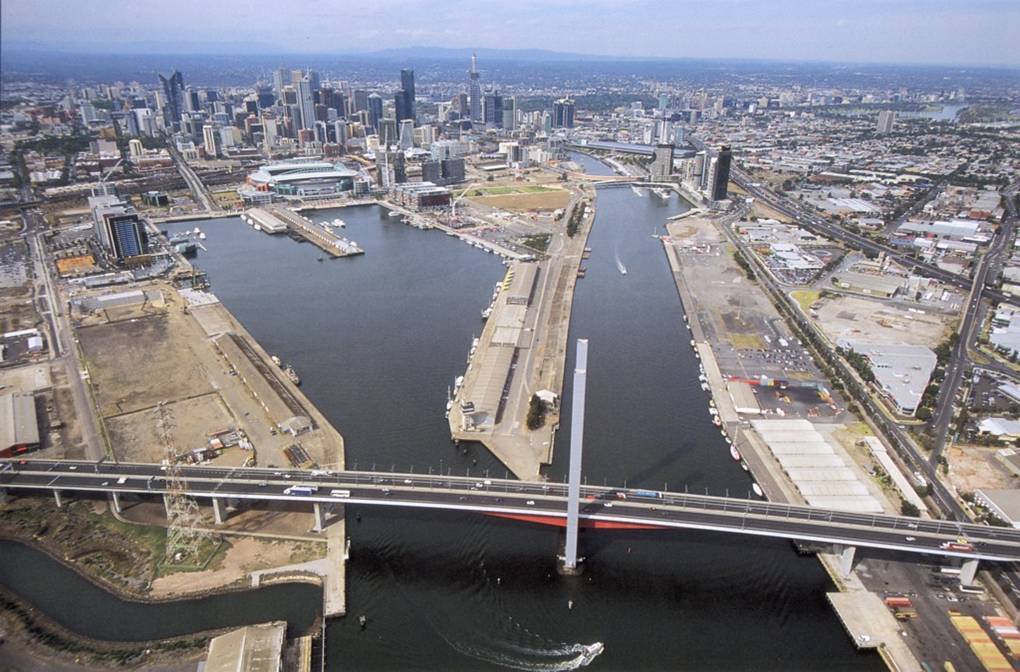
Urban renewal of the wasteland of empty docklands in Sydney, Melbourne and Adelaide under a neo-liberal mode of governance has taken the form of shaping the city along lines favourable to developers, finance capital and and promoting the city as an optimal location for high-value businesses and a fantastic destination for tourists. What we have is a small political and economic elite who are in a position to shape cities more and more after their own desires. Melbourne's Docklands is a prime example of the city as a building site.
The result so far, in what is Australia's largest urban renewal project--- building the new urban world on the wreckage of the old---is a half-finished development that has resulted in a windy and sterile urbanscape with very limited public green space for people to gather. It is a development that precludes lower-income and even middle-class people from access to accommodation anywhere near the water or the urban centre.
Referring to the recent phrase of capitalist renewal Harvey, in The Right to the City, observes:
As in all the preceding phases, this most recent radical expansion of the urban process has brought with it incredible transformations of lifestyle. Quality of urban life has become a commodity, as has the city itself, in a world where consumerism, tourism, cultural and knowledge-based industries have become major aspects of the urban political economy. The postmodernist penchant for encouraging the formation of market niches—in both consumer habits and cultural forms—surrounds the contemporary urban experience with an aura of freedom of choice, provided you have the money. Shopping malls, multiplexes and box stores proliferate, as do fast-food and artisanal market-places. We now have, as urban sociologist Sharon Zukin puts it, ‘pacification by cappuccino’.
Since the 1980s the property market has directly absorbed a great deal of surplus capital through the construction of city-centre and suburban homes and office spaces, while the rapid inflation of housing asset prices—backed by a extensive wave of mortgage refinancing at historically low rates of interest—boosted the domestic market for consumer goods and services.
Posted by Gary Sauer-Thompson at 10:29 AM | Comments (7) | TrackBack
August 24, 2009
Techport Australia
Techport Australia in Osborne, South Australia, is the home base for the $6 billion Air Warfare Destroyer (AWD) project and the construction base for the Royal Australian Navy's next generation of submarines. According to the Rann Government this AWD platform is being developed into Australia's largest naval shipbuilding hub. Establishing infrastructure that would support multiple users (a "common user" hub) to attract leading defence companies from around the world to Adelaide would help SA win more defence contracts and jobs.
One possibility that is being lobbied hard by the Rann Government is for the US Navy to use this Port Adelaide shipbuilding centre as a repair base for its warships. Currently, the US has repair bases in Japan and Singapore. So whip up the threat of the North Koreans missiles and nuclear warheads to show that South Australia is a safe and secure location.
The salt marsh of the nearby Mutton Cove Conservation Reserve doesn't stand a chance when the Rann Government eyes the possibilities of a future $100 billion in contracts. Economic development rules in the Defence State----there is no doubt about that. It's full seam ahead.
SA is hungry for defence industry work, and this is all about networking, the arms industry exploiting the maximising business opportunities and backroom policy making. Where is the ecocriticism of the development and growth of defence and sustainable defence industries by those dismissed by the Rann Government as “feral low-life”.
Surprisingly, there is little public presence from the neo-liberals. Their big concern about the dominating state and the road to serfdom, does not target a military-industrial complex in formation, despite the threat of this complex endangering our liberties and democratic processes.
The military-industrial complex is a tough nut to crack and it requires a non-stop diet of external threats to keep the capital accumulation process going, with its associated moral hazards and rent seeking. Even if you come at the criticism of this complex from the waste angle--due to "front loading," defense contractors overpromising results, underestimating costs, and profiting from continuous, costly modifications----you are still open to accusations of being "soft on terrorism" and appeasement.
Posted by Gary Sauer-Thompson at 8:47 AM | Comments (2) | TrackBack
August 17, 2009
30-year draft Plan for Greater Adelaide
As noted earlier the 30-year draft Plan for Greater Adelaide was recently released for public consultation. The draft says that it returns to some of the principles of Colonel Light’s plan, such as the concept of a balance between nature and the city, by expanding the network of parks and greenways to encourage walking and cycling and to provide more shade to urban areas.
It sounds good--too good. Now I have been photographing along the Port River estuary on the LeFevre Peninula, which has been subject to pollution from heavy industry, and is a local example of the immense damage Australia has done to its own environment through its own actions. So I turned to Northern LeFevre Peninsula Masterplan to see how it exemplified the Greater Adelaide Plan's proposal for the network of parks and greenways.
The Peninsula Masterplan says that after extensive community consultation:
an additional 62 hectares of land on the Lefevre Peninsula has been rezoned for defence, infrastructure and port-related industry to meet demand generated by the State’s success in attracting the billion dollar Air Warfare Destroyer contract and major infrastructure developments in the region.
Well, that puts the development priority upfront.
The reality is that the Lefevre Peninsula is one of the state’s three key areas for future industrial land development due to its significant export function, the extent of its infrastructure and the amount of industrial land available. The ecological values of open spaces, wetlands and saltmarshes are little more than an afterthought. The open spaces are just minimal ideas.
The masterplan goes to say that the Northern Lefevre Peninsula Development Plan Amendment creates:
a framework for the integration of new industry with the natural landscape, including an open space corridor from the coast at North Haven to Mutton Cove on the Port River. It recognises the need for buffer zones and open space to maintain the integrity of the environment, protects areas of significant biodiversity and provides stormwater management policies.
However the Development Plan Amendment frames the area as one of having "a significant opportunity to contribute to a well planned and integrated industrial cluster to support defence and port related activities that will further contribute to employment and economic growth for South Australia, and to the provision of infrastructure and enhancement of open spaces on the Peninsula for the benefit of the community and the environment."
The majority of vacant land on the northern Lefevre Peninsula is held in State Government ownership and vested with Defence SA. Defence SA is responsible for delivering South Australia’s Defence Industry Strategy, including the State Government’s commitments to the Royal Australian Navy’s $8 billion Air Warfare Destroyer (AWD) project; and ensuring the sustainable development of a defence and port-related industrial precinct on the northern Lefevre Peninsula. This is the face of SA as a defence state.
Posted by Gary Sauer-Thompson at 8:36 AM | Comments (2) | TrackBack
August 13, 2009
shifting to sustainment
A key issue for us today is how to make the shift from unsustainability – the dominant condition of our society – to sustainment, as an ethos, a culture and an economy. The term unsustainability is most often associated with negative biophysical impacts like the polluting of water and air, destruction of forests, climate change induced by accumulative emissions of carbon dioxide and other greenhouse gases. However, unsustainability is multifaceted and so a way of life can be unsustainable, due to its negative impacts.
How we undertake this transition is still very vague. Canberra is preoccupied with a weak emissions trading scheme that will do little to shift Australia from unsustainablity. Then there are those individual designers and architects preoccupied with ‘sustainability’ striving to realise their objective by designing artefacts and built structures with reduced environmental impacts and, to a lesser extent, retrofitting existing products and buildings. Sad to say, most new buildings are still being designed so that they depend upon energy generated from fossil fuels, which would themselves add to greenhouse gas emissions problems, thereby worsening the climate change problem.
Tony Fry in Living in a Changed Climate says that after more than a decade of analysis, projections and attempts to curtail greenhouse gas emissions:
the actors in this drama are now facing two discernible failures. First, is the failure to gain international agreement on adequate action to curtail greenhouse gas emissions. Second, is the less publicised, but equally significant failure to initiate adaptive measures to mitigate the effects of climate change.
Many conservatives view mitigation in terms of no longer being able to afford the creature comforts of a consumerist culture, and we humans will fall back into the privative animality of simple existences ---- a bare life reducing humans to survivalists.
We need, they say, to defend the car as the ultimate expression of an individual autonomy through appealing to the self's freedom, autonomy and authenticity. Techno mastery of the earth is cool Striving to conquer the environment is necessary.
What has not begun to be adequately contemplated in policy terms at a state or national level is that the complex inter-related consequences of climate change will generate massive social, cultural, political, economic and health problems. Fry says:
These problems will become evident in many ways, such as — growing numbers of environmental refugees (from floods, drought, heat, cold, lack of food and water); in the climatic inappropriateness of many traditions of building and dwelling; in conflicts, of various scales over desertification, fresh water resources and fertile soil; in failing agricultural economies (exacerbated by what will become inappropriate farming methods and nutritional health problems); and in the numerical increase and geographic spread of vector and non-vector delivered tropical diseases (because of climate change, sub-tropical regions are expanding, as are their populations).
One impact is that suburbs in some of our cites may have to be abandoned along with low lying coastal communities. In other parts of the world--eg., Bangladesh--whole cities may have to be abandoned. This indicates the more complex picture of climate change and it highlights the need to broaden the constructive responses to climate change beyond scientific and technological approaches.
This is not just an issue that many existing built forms will become more and more inappropriate to the emerging climate and a massive amount of the current built fabric will have to be retro-fitted to cope with climate change. The issue is more one of learning how to live with climate change --living in the still emergent consequences of our own and others actions.
Posted by Gary Sauer-Thompson at 9:44 AM | Comments (3) | TrackBack
July 24, 2009
manufacturing or bust
Paul Howe, the anti-climate change unionist, is calling for an manufacturing policy to ensure that Australia continues to make things rather than just digs rocks. He says that in the middle of the worst global recession since World War II, Australia must do everything we can to support manufacturing and position the industry for the future.
The future, we should add, means adaption to global heating and an emissions trading scheme to deal with greenhouse gas emissions. Howe has run a campaign against an emissions trading scheme in the name of protecting jobs ( job security) from the extra costs of electricity under an an emissions trading scheme.

It is fair enough to defend manufacturing as opposed to Quarry Australia. However, what sort of things does Howe have in mind? Howe has come across as defending old Australia in the face of the new in the past.
Recently, Howe has been talking about a 21st century Steel Plan---a stratagem to save a key industry in the face of the global economic crisis. Howe is advocating motor vehicles, of course. And the steel industry. Howe says:
we need to build on the new steel plan launched earlier this year by the AWU. Steel's position as a strategic sector of the economy, with vital capability to meet infrastructure and defence requirements, should be recognised with greater accountability in the tender procurement process -- that is, if a project does not source Australian steel, it would need to explain why not -- to keep foundries busy supplying nation-building projects.
Buy Australian steel is the message here. It implies subsidies to encourage private sector buyers to take Australian steel over cut-price steel from global conglomerates. Does Howe's suggestion that a national manufacturing policy should build on progress in steel and automotives plus adding value to Australia's natural resources through investment in downstream processing mean something like an uranium enrichment plant? A national action plan, according to Howe, would build:
on progress in steel and automotives, elements include how best to add value to Australia's natural resources through investment in downstream processing; integrate trade and industry policy more effectively by getting the Industry Capability Network, Austrade and Enterprise Connect working together. We also could encourage the emergence of a new generation of global firms anchored in Australia, including in the $6 trillion environment and low-carbon industries; forge organisational design and skills formation into a competitive advantage; educate and inform so that manufacturing attracts the best and brightest students; and deal with the consequences of the next boom and an appreciating exchange rate to ensure the nation retains a viable manufacturing sector.
Now Howe does mention the $6 trillion environment and low-carbon industries. What does "green technology" mean in terms of manufacturing in new forms of renewable energy, a knowledge economy or sustainable cities, given Howe's antagonism to an emissions trading scheme, the shift to a low carbon economy, and greater use of renewable energy rather than coal?
Update
Howe's argument is that the impact of the economic crisis is starting to bite. Steel plant furnaces going offline from reduced demand from steel, and they may not be started up again, resulting in the loss of tens of thousands of jobs. Without significant government intervention, regional centres such as Wollongong and Newcastle would be devastated.
The AWU's steel plan for the 21st century does appear to be centred around production subsidies, guaranteed sales to government infrastructure projects and extra protection from foreign takeover bids under an industry "survival strategy".It is about helping struggling steel manufacturers to adjust and restructure from reduced demand.
Posted by Gary Sauer-Thompson at 9:28 AM | Comments (10) | TrackBack
June 26, 2009
Murray-Darling Basin: water theft
Miles Kemp in the The Advertiser reports that the state governments of Victoria, New South Wales and Queensland are turning a blind eye to water theft and manipulation of irrigation rules to protect their irrigators in the Murray-Darling Basin. That is what the water politics is about----protecting irrigators at all costs.
Kemp outlines how the various ways by which water is being stolen by irrigators across the Murray-Darling Basin; ways that indicate the indifference of the irrigators to the health of the River Murray. These include:
Tampering with water meters to stop them recording water use.
Frequent breaching of water use caps without prosecution.
Inadequate policing of water theft.
Earthworks which divert floodwaters, bypassing water metering.
Recapturing downstream of water destined for environmental flows.
Poor control of groundwater use.
The most significant regulatory issue was that legislation needed to be reviewed and updated to control water harvesting from flood plains and multiple channels. Flood-plain "harvesting" and its diversion to storages in Queensland and parts of northern NSW was extensive, and once the water gets out on the flood plain state governments have no idea how much there is or what is being taken. Nor do they care, it seems.
Adelaide has a water problem, and it desperately needs to cut its reliance on River Murray water for its critical human needs. Hence the belated turn to a desalination plant, near the now disused Port Stanvac refinery. The refinery will be dismantled by Mobil.
That still leaves the slow drying out of both Lake Alexandrina and Lake Albert because no water is coming down the River Murray. The pumping of water from Alexandrina to Albert, which has kept the latter going as a lake, will soon stop. The effect is that the Lake Albert will dry out during the summer. Lake Alexandrina will follow.
Posted by Gary Sauer-Thompson at 1:45 PM | Comments (4) | TrackBack
April 16, 2009
BrisConnections + infrastructure development
BrisConnections, it is fair to say, is yet another example of the disaster that arises from private public partnerships to build urban infrastructure. Why so? What explanations are available. One general argument is that the problem arises from incompetent state governments not the market failure per se. Thus Michael Bounds in The Australian says that:
The BrisConnections Airport Link in Brisbane is the latest casualty of a failure of responsible state governance of infrastructure development. Under the Airport Link funding model the, mostly small, shareholders are obliged to pay a further $2 on shares that have now fallen from $1 in value to 1c. They are understandably reluctant to pay. Anna Bligh remains silent about this elephant in the city.
Isn't this a failure of the Macquarie model of financing infrastructure as distinct from just being a problem of state governance? Why should the state be held totally responsible for the way that Macquarie set up the financing within a neo-liberal mode of governance?
Deregulation has devolved management down to the management of individual developments resulting in conflicts of interest and a regulatory vacuum in relation to both infrastructure development and the quality of life in new medium density developments associated with the rapid transformation of our economy to a service sector driven economy.
There been a shift away from the neo-liberal mode of governance to one based on state intervention as a result of the fallout from the global financial crisis? Bounds, who is an Australian sociologist and Associate Professor in the School of Social Sciences at the University of Western Sydney, uses the BrisConnections example and the cross-city tunnel under Sydney's CBD to argue that state government's should not be trusted with infrastructure development as opposed to the neo-liberal mode of governance. He argues thus:
The federal Government, through the Building Australia infrastructure fund is about to give $12.5billion to the states for infrastructure development. When the leaders of government are routinely blaming the banks and finance houses for the global financial crisis, the answer is to pour money into infrastructure.State governments have proven themselves singularly inefficient in managing the development and financing of infrastructure yet they are about to be showered with billions of dollars and an instruction to spend it as quickly as possible.
He has a point in that the early reports on state bids to the commonwealth infrastructure fund were that bids were so ill considered as to be unacceptable. The Infrastructure Australia Committee has formed its priority list for funding state projects and has produced a checklist of minimum information to be provided.
Bounds in his recent Urban Social Theory: City, Self, and Society is a proponent of the new urbanism. This is a movement that confronts the contemporary problems that beset our cities: problems of urban sprawl, crime, environmental degradation and alienation through the promotion and creation, and restoration of diverse, walkable, compact, vibrant, (and) mixed-use communities that include the housing, work places, shops, entertainment, schools, parks, and civic facilities that are essential to the daily lives of the residents.
Unlike the free market advocates Bounds is not arguing for the market to replace state government within a regulator framework. His concern is that:
we should be hearing proposals for the federal Government to monitor the performance of states in the financing and implementation of infrastructure projects. There should be no impediment to establishing an independent authority to report on the financial engineering and realisation of development targets on such proposals.Without an auditing process, on the basis of experience taxpayers can expect their $12.5billion may well be spent without a successful outcome...
He has a legitimate point.
Posted by Gary Sauer-Thompson at 8:19 AM | Comments (4) | TrackBack
March 29, 2009
cars not people
It is not overpopulation per se. It is more the auto-industrial civilization isn't it.
 Matt Golding
It is the industrial auto-civilization that needs to change ---is changing in fact, as it is in decline. Thus the Obama administration in the US is to extend more short-term aid to General Motors and Chrysler but impose a strict deadline for union workers to make concessions that would help the ailing automakers become viable businesses and avert bankruptcy.
Posted by Gary Sauer-Thompson at 5:41 AM | TrackBack
February 17, 2009
peri-urban development + bushfires
Michael Buxton, an associate professor environment and planning at RMIT, says in The Australian that governments have been in denial over the issue of increased fire risk and higher populations is emerging on the periphery of many Australian cities and regional centres.
 M Smith
The peri-urban regions are at the cross- roads of significant change. In many of many of these "peri-urban" municipalities increasing numbers of Australians are building houses on small rural lots in some of the most fire-prone land in the world. Many of these new houses cannot be defended against fire. Can we have sustainable peri-urban landscapes in the regions of our capital cities in the medium to long term, given that the peri-urbanisation process will continue?
Buxton says:
Doing nothing is no longer an option. Conditions will worsen. Change will happen. We must anticipate it, prevent its worst impacts by facing hard decisions. This needs far-sighted planning, not people who visit the costs of their denial on to others....The most important task for the Government is to buy out people from fire-prone areas that cannot be defended and prevent further people from moving into those areas. Bushfires will always be with us. But we can dramatically reduce the number of fatalities by not allowing people to build their homes in harm's way.
This implies a comprehensive re-assessment of the way we Australians relate with one another, with our unique biophysical heritage and the ecological communities we are a part of. A new land ethic, if you like, with good urban planning to shape market forces and peri-urban development.
Currently existing statutory planning attempts to prevent this continued fragmentation will not be sufficient to address future peri-urbanisation resulting from the sale and split up of multi-titled farms comprised of a number of small lots. Research shows that we have spatial fragmentation and land use intensification and an assemblage of temporary mixes of urban and rural activities and functions.
This peri-urban region is often characterised by conflicting values and social disharmony and is a situation of constant change that is usually irreversible.
Posted by Gary Sauer-Thompson at 7:33 AM | Comments (3) | TrackBack
February 13, 2009
end of an era?
A lot of recent economic commentary raises the spectre of the rise of protectionism in response to the global economic recession. This commentary states that trade amongst nations is part of the solution, not the problem, that nations need to keep exporting, and politicians need to work towards liberalizing trade to ensure economic growth.
Simon Crean, the Australian Trade Minister, is a strong advocate of this position in the context of a huge economic crisis and an overheated planet in the pages of the Australian Financial Review.

The rationale is that globalization is good. It lifts poor nations out of poverty etc. Maybe we are not experiencing an economic downturn, but are living through the end of an era of export-oriented industrialization. The trade liberalization model has built-in contradictions and the era of growth may be coming to an end.
Export-oriented industrialization is where Japanese--and U.S companies---tapped into the platforms of export processing zones, where foreign capital could be married to cheap (usually female) labor using them to re-export goods back to Japan, the U.S., and elsewhere. China perfected the strategy.
Walden Bello at the Foreign Policy in Focus think tank highlights the limitations of the export growth model:
This process depended on the U.S. market. As long as U.S. consumers splurged, the export economies of East Asia could continue in high gear. The low U.S. savings rate was no barrier since credit was available on a grand scale. China and other Asian countries snapped up U.S. treasury bills and loaned massively to U.S. financial institutions, which in turn loaned to consumers and homebuyers. But now the U.S. credit economy has imploded, and the U.S. market is unlikely to serve as the same dynamic source of demand for a long time to come. As a result, Asia's export economies have been marooned.
End of an era. The sheer size of China--and the rapidity with which exports platforms were built, without any regard to dangerous imbalances--simply crashed this simple model of globalization
Posted by Gary Sauer-Thompson at 3:09 AM | Comments (3) | TrackBack
December 20, 2008
doing infrastructure badly
Infrastructure Australia has announced the state infrastructure submissions to be financed by the Commonwealth---there are 94 projects worth about $200billion down from the initial 600. The Rudd Government had already ruled out at least 66 of the 94 projects and it refused last night to say which 28 projects it had decided were ''suitable for funding'' from the $12.5billion Building Australia Fund. Nor would it reveal which it had classed as ''priority projects'' ready to proceed.
Judging from the list in the AFR under Laura Tingles article this has turned out to be worse than I 'd expected in that none of the state's main priorities bothered to address climate change. These proposals to rebuild Australia are mostly about transport and roads with rail infrastructure second. Many appear to be the state's pet projects with many lacking any economic analysis to demonstrate the case for funding. Many of those that had, the supporting evidence was weak according to Infrastructure Australia.
So either the left hand doesn't know what the right hand is doing, or this infrastructure rebuilding (modernising) is another exercise in compensation for past failure and sugar coating ----handouts----that makes the Rudd government look more like the Howard Government. Money is put before reform (structural change) and public accountability.
What is appears to be lacking with Rudd is a state guiding the economy in the direction of a low greenhouse emission economy. Will the funding for state infrastructure be as over the top as the recent compensation deal for heavy polluters in the climate change white paper?
So either the left hand doesn't know what the right hand is doing , or this infrastructure rebuilding (modernising) is another exercise in compensation for past failure and sugar coating ----handouts----that makes the Rudd government look more like the Howard Government. Money is put before reform (structural change) and public accountability.
What is appears to be lacking with Rudd is a state guiding the economy in the direction of a low greenhouse emission economy. Will the funding for state infrastructure be as over the top as the recent compensation deal for heavy polluters in the climate change white paper?
Posted by Gary Sauer-Thompson at 3:01 PM | Comments (8) | TrackBack
October 25, 2008
global economic governance
Jeffrey Sachs argues that the international financial system is broken; an integrated set of reforms will be needed to achieve sustained economic growth and shared prosperity; and that the G8 leaders must go well beyond the issues of financial regulation. A true Bretton Woods II summit would set a financial framework to achieve urgent global goals in macroeconomic stability, economic development, environmental sustainability and trade for development. Who is going to push for this?
 Martin Rowson
There will be no lasting settlement that is centred the global economy on the United States system as was Bretton Woods as we are witnessing the end of American economic dominance.
There needs to be something more modest. On Lateline Joseph Stiglitz said that there was a need for a financial product safety commission, a financial system stability commission and getting the economy going in the short run in a way that's consistent with long run needs of the US. The former, a financial product safety commission, would:
look at the individual products, like these credit default swaps, and make a judgment; are they appropriate for these, as I say, commercial banks that are taking care of other people's money.They might be appropriate for particular uses; for instance, if you are exposed to a foreign exchange risk you can insure against that foreign exchange risk, but not to gamble. So, one would look at the specific products and make a decision about what uses are they appropriate for, are they transparent, can we see what will happen?
The latter, a financial system stability commission, would:
look at the system as a whole, the financial market stability for the whole system, because what we've discovered is that AIG, an insurance company, was insuring Goldman Sachs, an investment bank, that the interrelations of the various institutions are so complex that each of them has become too big to fail. And if they're too big to fail, that means, and they know it. That means they have an incentive to take too big risks; and we've seen that.
Stigletiz argues for a broad role for governments in getting economies out of the crisis, particularly in America. His big picture solutions include calls for big public investments in infrastructure, education, and technology, but also energy.
Posted by Gary Sauer-Thompson at 10:24 AM | Comments (4) | TrackBack
October 24, 2008
Costa, urban planning
The op-eds in The Australian by Michael Costa, the former Treasurer of NSW, give us an insight into the mentality of the Right of the NSW Labor Party - (currently headed by Obeid, Tripodi, Rozendaal) that now run the clapped out administration called the NSW Government.
Costa's latest on public infrastructure adopts the stance, and frame of, neo-liberal economics to have a go at those who advocate a shift to a more sustainable economy in our public culture. Costa says:
The growth of the "sustainability industry" is closely correlated with the emergence of green politics, particularly the anthropomorphic global warming religion of which Carr is attempting to become Australia's high priest...There is a tendency among the more extreme public transport ideologues to adopt a "Field of Dreams" approach to public infrastructure projects: build it and they will come. It is also true that many of these people are urban planners. The availability of appropriate public transport in dense urban environments is a logistical necessity.
These urban planners aim to to shape the urban environment around their personal green worldview that is ideologically based.
 Spooner
Costa rightly says that the real debate is about what type of public transport, where it should be provided and at what price. Who could disagree other than add that the investment ought to foster the shift to a more sustainable mode of urban life.
Then he says that;
most urban planners have an elitist disdain for market-based land use outcomes. They are particularly hostile to the lifestyle preferences of Rudd's "working families", witness their hostility to the McMansion.
Maybe the urban planners are critical of McMansion style suburbia because that urban mode of life is not sustainable in terms of energy and transport in the context of climate change?
That is not good enough for Costa. Such an approach to urban planning and public transport provision for him is ideologically based as the urban planners views on global warming influence their urban planning approach. He illustrates this with reference to Peter Newman, a former NSW Carr government-appointed sustainability commissioner, and present board member of Infrastructure Australia. It is the scepticism about climate change ("the science is not in") that underpins Costa's antagonism to sustainability, public transport, urban planning, and urban planning elites advocating so-called urban villages.
Costa, no doubt, would see this negative stance as continuing his campaign to challenge Labor shibboleths after another begun with removal of tariffs, the deregulation of the economy, ditching centralised wage fixing and the embrace international competitiveness. He has little time for environmental concerns, talks in terms of the environmental McCarthyism of the Greens and public transport ideologues, and made his last stand as Treasurer on energy deregulation.
Costa, apparently is not an ideologue, despite his neo-liberalism and his view that it is not only 'elitists' that are pushing for more public transport.
Posted by Gary Sauer-Thompson at 4:47 AM | Comments (13) | TrackBack
October 15, 2008
how things have changed
The politics of prosperity that framed Labor's rise to power less than a year ago have transformed into the emerging politics of austerity. Austerity is not inflation---it is recession looming. Main Street may go bust, as it were. The world really has changed is the new economic narrative. Inflation is not the central concern. It is possibility of recession and a surge in unemployment that are the central policy problems, and then how to how to soften the slide.
Now it was only last week that Rudd and Co were trumpeting an IMF report that Australia was doing well---- a relative soft landing for Australia, with the economy expanding by 2 per cent-plus through 2009---- and the economic advisers in Treasury and the Reserve Bank were saying that China's growth was Australia's insurance policy. No worries. The world should be looking at us and so on.
My my how things have changed in a matter of days. First, there was the emergency government banking guarantees. Now we have Keynesian pump-priming to help kick-start the slowing economy:

We have a fiscal package that is worth a total of $10.4 billion, of which $9.65 billion will be spent in 2008-09, and which is targeted at pensioners, families, carers, seniors card holders and first-home buyers. They are being told to spent it quick smart. That is nearly half the previous budget surplus of almost $22 billion expended in one substantial hit around Xmas.
It can mean that they--the policy makers and ministers-- fear the risk of a deep recession in the global economy impacting heavily on Australia. The inflation hawks or policy mandarins at the RBA, would not have produced the 1% cut last week if they were concerned about inflation. So what happened to the first fiscal stimulus plan (the big tax cuts for households) announced in the 2008 Budget? Not working as a fiscal stimulus? Spent on shares?
So what was all that upbeat optimistic talk of the past two months about? Spin? Or have they--the policy mandarins at Treasury and the Reserve Bank--- just put the looming recession picture together: ---a global financial crisis, slowing global economic growth led by the teetering US, UK and European economies, falling prices for Australian commodities, the dollar has plunged, unemployment is going up, business and confidence indicators in Australia are dropping, and household debt levels are very high.
Or have the policy makers dumped their modeling since it doesn't work when faced with the extent of the damage that has already done from the fallout of the crash in stock markets and financial markets? Or did the policy makers look up from their modeling, peer into the abyss of a global recession and remember Keynes' advice on using fiscal policy to boost aggregate demand?
It's odd that Rudd Labor----Swan in particular--- are now trying to sell a message that they knew what was happening all the time and they were on top of it. What utter nonsense. They had little idea of what was going to happen. Few did.
This kind of fiscal stimulus does imply that the private sector is not spending and/or cannot spend. Consumer demand is down and business investment is falling. If old fashioned traditional Keynesian spending by the government is now deemed necessary, why isn't it embracing infrastructure, the development of new green technologies that addresses the reality of climate change, rather than shipping more coal and minerals to China.
Posted by Gary Sauer-Thompson at 2:09 AM | Comments (13) | TrackBack
September 29, 2008
Building Australia
The Building Australia Fund is a multi-billion dollar infrastructure fund set up by the Rudd Government to help modernize Australia by easing road congestion, roll out faster broadband services and build coal ports. It is to overseen by Infrastructure Australia, an independent body that will evaluate and scrutinize the various projects in terms of their economic importance.
So far it sounds as if the whole infrastructure push has a corporate agenda---- ie., limited to building infrastructure to help business--- rather than assessing infrastructure projects in terms of both their economic importance and greenhouse implications. Maybe this is because it is basically Labor's rebadging of the Coalition's AusLink during the last election. So ity is more about six lane highways than public transport. Still the failure by the Rudd Government to connect infrastructure development with climate change is worrying, given the imperative of Australia needing to adapt in a warmer climate.
The current debate about climate change is disconnected from the debate about infrastructure development, even though the two are deeply intertwined in making the shift to low carbon-economy. Few ministers in the Rudd Government are talking about prioritising climate friendly infrastructure--other than protecting the coal industry from competition and compensating them from loss of asset value caused by the carbon emissions trading scheme.
Business, of course, is saying that cutting greenhouse emissions by 10% is beyond the capacity of the economy. Business does not appear to be interested in building infrastructure so that Australia is able to live in a future one of more extreme weather events and natural disasters, inadequate rainfall and water shortages, higher utility and food prices and insurance costs, better health services for the vulnerable and aged, and which has much more responsible management of Australia's finite resources and fragile environments.
Business just want infrastructure built that will enable it to ship more rocks to China as fast as possible. China, apparently, is Australia's sure bet in a slowing global economy. Exporting more rocks is what is urgent, not addressing climate change, as exporting more rocks will protect jobs.
Posted by Gary Sauer-Thompson at 8:49 AM | Comments (4) | TrackBack
July 27, 2008
creative industries
The postmodern scene in the late 1980s was linked with the discussions about post-fordism, flexible specialisation, globalisation, the collapse of the post-war socio-political settlement of social democracy and the integration of national economies into the global economy. The academic judgement was that a new economic and social order was emerging; one organised around consumer markets for symbolic goods that in turn related to new forms of social distinction and identity.
This phenomena---capital’s ‘cultural fix’ for leftwing academics--- ’ worked particularly at the level of the City, where spectacles, festivals, shopping experiences and ethnic quarters had transformed the derelict industrial cities of the developed world into centres of up-market cultural consumption. Darling Harbor in Sydney and Docklands in Melbourne are examples.
Along with the flows of people, money, goods and information was a vast range of symbolic objects – texts, images, sounds, and experiences, which changed the position of the cultural industries vis-à-vis the rest of the economy. The growth of symbolic consumption (Apple computers?) meant that the cultural industries were no longer seen as a strange remnant of an older craft -based production system, but became the cutting edge, a template for the others to follow into a new economy of ‘signs and space’.
Creative industries are those industries which have their origin in individual creativity, skill and talent and which have the potential for wealth and job creation through the generation and exploitation of intellectual property, and thirteen creative sectors are usually identified namely: Advertising; Architecture; Art & Antiques Market; Craft; Design; Designer Fashion; Film & Video; Interactive Leisure Software; Music; Performing Arts; Publishing; Software & Computer Services; and Television and Radio. The academic discourse was structured around regional clusters, embedded networks, the ‘network society’, and the growth of key nodal points which controlled and directed global flows
Cities were now the new economic powerhouses built on the ability to process knowledge and manipulate symbols, and they were plugged into the new global infrastructure of flows, whose different currents flowed together to generate a current of reform and transformation of city life.The cultural industries policy discourse was deeply concerned with ‘the art of city making’, and it represented an model of urban transformation that drew on a European tradition rather than the real-estate driven model of the US . It stressed public space and argued for a new popular urban vision through a ‘revitalisation of the symbolic content’ of cities.
This in turn draws in state governments and city councils. The latter link these transformations with ‘ambitious public efforts of urban rehabilitation in the attempt to enhance local prestige, increase property values and attract new investments and jobs. The revitalisation of the little lanes of Melbourne are a good example.
Posted by Gary Sauer-Thompson at 4:57 PM | Comments (3) | TrackBack
July 22, 2008
a coal fired Queensland
Queensland, during Peter Beattie's premiership, marketed itself as the Smart State. Under Anna Bligh it is the Resource State. Queensland's mining boom is a coal boom: coal is dug up in the Bowen Basin in Central Queensland exported to China and India, with McKay as the epicentre of the coal boom. Coal is the Queensland government's biggest export earner, and the mining talk is of a never ending boom with little in the way of wealth trickle down to the regional towns. This is a long way from recession times in America, where consumer's purses are snapping shut as house prices continue to fall and unemployment increases.
It is one indication of the way that Australia has reverted back to Quarry Australia, how state governments are hostages of Quarry Australia, and why they drag their heels on emissions trading. So they use weasel words to demonstrate their concern for reform while fudging commitments and pandering to special interests. The whole mode of governance is designed to reduce the political costs of any reform to business as usual.
Declining growth in the US and UK and boom in Australia, China and India highlight the contradictions in the world economy; contradictions that point to a general slow down in the world economy. What of the ecological consequences of China's breakneck industrialization that produces boom times in Queensland?
I'm not just thinking of the coral of the Great Barrier Ree, or the air thick with pollutants in cities such as Chongging or Peking, which turn the cities ' mists into pea-soup fogs. There is also China's surging emissions of carbon dioxide, with China overtaking the US as the world's biggest annual emitter of CO2.
Posted by Gary Sauer-Thompson at 8:41 AM | Comments (1) | TrackBack
July 15, 2008
development in Adelaide
The South Australian Government's decision is to put an independent assessment body in charge of all city projects worth more than $10 million. The Adelaide City Council's recent rejection of a $180 million building development in Franklin Street/Bentham Street in the CBD is given as one reason for the Rann Government's decision to move to keep Adelaide City Council out of planning decisions involving any development worth more than $10 million.
I do not know why the Adelaide City Council rejected the development proposal for the Franklin Street high rise apartments. I understand that the Development Assessment Commission recently rejected a multi-million-dollar office project for the corner of Franklin and Bentham Street in the city, known locally as Post Office Square, because it did not fit the publicly agreed planning guidelines.
The Council has been very pro development under Mayor Harbison, so I don't know why the State Government needs to make life easier for those developers who push the envelop by breaching the development rules that govern development in the city of Adelaide. The antiquated anti-development rhetoric of the Property Council makes little sense.
This City Council's record undercuts the claim by Paul Holloway, the Minister for Urban Development and Planning, that the Adelaide City Council wants to keep the City of Adelaide as a 19th century back water, and that such a position reflects the views of a few hundred voters. Holloway is spinning.He comes across as saying that any development is good because it is development.
It looks like a power grab to me; one based on knobbling local government (cut and dice is the phrase reportedly used by Holloway when addressing the Property Council) as it was done without any consultation or negotiation with the Adelaide City Council. The Rann Government comes across as becoming increasingly intolerant of democratic opposition and countervailing centres of power, rather than engaging in a public debate about what sort of city Adelaide should become with globalization and climate change.
Posted by Gary Sauer-Thompson at 7:52 PM | Comments (7) | TrackBack
June 14, 2008
Rudd's car
Rudd would be taken more seriously if he also started talking in terms of improving public transport to help deal with the impact of higher petrol prices from the emissions trading scheme. Isn't expanding public transport networks a high priority in Australia?
 Leak
What we have is Rudd attacking Asian petrol price subsidies in a bid to curb regional demand and bring pump prices down for Australian motorists and is pushing to get them to abolish their petrol subsidies and price caps in the name of free trade. Higher petrol prices are bad in Australia but good in India and, China and Indonesia?
This strategy, like demanding that OPEC increase oil production, seems to be for domestic consumption--the Rudd Government has to be seen to be doing something so as to block the political pain. However, the demand from fuel users for help to cope with the pain from soaring fuel costs jars with the Rudd Government's advocacy of measures to discourage the use of fossil fuels and cutting greenhouse emissions.
For years, public transport advocates have argued for federal funding for public transport infrastructure. Roads got all the money, we argued, and we were right. Do we now we have a Prime Minister who wants to give major federal bucks to public transport projects?
Posted by Gary Sauer-Thompson at 9:25 PM | Comments (3) | TrackBack
April 22, 2008
no tech
There are some good reasons to approach Richard Florida's Creative Class with caution, especially when it comes to methodology. Still, even if he did have to make up his own indices, he pretty much nails the importance of knowledge workers in the global economy, whether you think it's post industrial or late capitalism or whatever. This appeared to be the logic behind the laptop for every child idea - that the as yet unknown jobs of the future would be tangled up with the digital world. Better to create a well-prepared nation of digital natives than face global redundancy.
Either our brightest creative types haven't read Florida or they were so suspicious of his methods they chucked the whole thing. Reports emerging from the Creative Australia stream of the summit are disappointing, if not annoying. Stuart Cunningham's piece at New Matilda suggests that our creative types' creativity is limited to imagining what already exists, only better funded. I guess they're stuck in the 'industries' bit of 'creative industries', much like Bill Gates' information superhighway, which was supposed to see us all compiling assortments of our favourites from the Guggenheim collection rather than making anything new.
Ben Eltham extends the argument with reference to reports of the procedings, but the bit that really gets up my nose is the dotpoint section suggesting linking creativity and education.
• Bring art into our schools by introducing ‘practitioners in residence’ via a national mentoring plan funded by philanthropic funds and tax incentives
Eltham doesn't mind this bit, but I do. If by art practitioners they mean people whose imagination stops at digitising museum collections, they'll be laughed out of the classroom. I'm not knocking art for art's sake, more power to it in fact, but the only practitioner in resident the kids I know would pay attention to is the one who can teach them how to better incorporate bits from The Simpsons into the videos they post at YouTube. If the plan is for a resident oil painter at every school they'll successfully engage about 1.5 percent of the student body.
• Mandate creative, visual and performing arts subjects in national curricula with appropriate reporting requirements for schools. Explore new opportunities for extension and development such as Creativity Summer Schools, pre-service and in-service training for teachers
Yep, go for it, as long as the creative, visual and performings arts in question somehow contribute to their knowledge of the technologies that go with those arts. If they come out knowing the minutiae of how Shrek was produced you will have accomplished something.
• Digitise the collections of major national institutions by 2020
And make sure kids look at it? Fab. Will they be allowed to Photoshop our national treasures as well? You could start an interesting annual Archibald Photoshopped competition. Not sufficiently respectful maybe.
• Make creativity a national research priority with funding access to R&D, ARC and similar funding
This is my favourite. You could get high school kids to workshop the ARC funding application process. That could keep them busy through years 9 to 12 at least. And nobody would ever have to worry about truancy or kids dropping out ever again.
'Make creativity a national research priority' is a joke. Ask Richard Florida. Or any of the other contributors to the vast body of already existing literature on creativity. Creativity and autism, creativity and giftedness, creativity and crime recidivism, creativity and mental health, creativity and early learning through play, managing creativity (talk about an oxymoron), collective creativity, creativity and multiple intelligences, creativity and the kitchen sink. It's all sitting around gathering dust while school kids are exploring the possibilities of digital media for themselves in their own time, because why? Perhaps because Cate Blanchett's baby is the only kid these people have ever met?
If this is the best they could do Julia might as well cancel that laptop order and reintroduce the cane. And maybe the slate. Or perhaps the hammer, chisel, and stone tablet.
Now I feel better.
Posted by Lyn Calcutt at 5:03 PM | Comments (20) | TrackBack
April 6, 2008
industry protection + innovation
I'm not sure that it's a black and white issue of tariff and protection versus free trade any more now that the Australian economy has been integrated with the global one. Mitsubishi's closure in Australia showed that manufacturing needs to get smart and export to survive and ensure global competitiveness and innovative capacity.
There seemed little point in going back to protecting industries, behind tariff barriers to "save" Mitsubishi. As this shows protectionism may lead to short-term gains, it ultimately leads to longer term pain, reducing firm competitiveness, global outlook and innovative capacity. The reduction in tariffs under Paul Keating's prime ministership continues to one of Labor's approach to economic reform.
Yet the debate is still being framed in terms of protection versus free trade or open markets with the finger often pointed at neo-liberalism:
 Spooner
The common criticism is that neo-liberals see manufacturing as an industry in decline; or that Australian manufacturing is fundamentally uncompetitive with the vast manufacturing capacity and low cost structures of China, India and others. Thus Mitsubishi.
Australia has few distinct comparative advantages in the motor vehicle industry. Its domestic market is small, it is a long way from major markets and the fundamental industry structure remains based on assembly and distribution to the domestic market, notwithstanding some excellent performance, albeit on a minuscule scale by global standards, in export markets.
Does this overlooks the possibility of ‘new manufacturing’ within the global economic environment that is based on new forms of innovation, new opportunities for internationalisation and new ways of capturing the productivity advantages.
I presume that building globally-oriented businesses is an objective in the industry development policy of the Rudd government. An example is the $2 Billion Green Car Partnership, which involves investing $500 million in a “Green Car Innovation Fund” designed to generate $2 billion in investment to support innovation in vehicle technology which reduces emissions.
However, it is not clear that this technology-push initiative approach can stem the decline in the underlying comparative advantage of a motor vehicle industries in developed nations. Is it Is it subsidising "green" technology development for the motor industry?
Posted by Gary Sauer-Thompson at 10:06 AM | Comments (2) | TrackBack
April 1, 2008
digital economy and innovation
I see that the digital economy bit of the 2020 Summit has disappeared. So where are we on this? Anyone have any ideas? What is the connection to the creative economy and social networking and the innovation system in the changing media landscape? How do we begin to connect these diverse flows together? Is it through an information or knowledge society?
Let's begin with David Frith, who writes Doubleclick in The Australian. Those, like The Australian, who claim to have their pulse on the nation should have some ideas, shouldn't they? Firth has a post that considers and questions the telco's view of the infrastructure underpinning the digital economy:
WiFi hotspots - now spreading through cities worldwide like a virus - will become as irrelevant as telephone booths... WiFi is doomed because: (a) more and more people are switching to mobile third-generation (3G) phone services such as Telstra's Next G, and (b) support for high-speed packet access (HSPA) networks such as Next G is being built into more laptops.With a little 3G gizmo plugged into the USB port on our Apple MacBook, and an external antenna plugged into the module, we can log on to the internet wirelessly at very fast speeds just about anywhere in Australia, even in moving trains.Optus, Vodafone and Hutchison offer similar services, although without the geographic spread at this stage.
Well I have one of these 3G gizmo's for my Toshiba laptop and it works fine in metropolitan Australia--eg., when I was in Perth last week. I do not need to use a phone to blog, nor do I want to. Even Apple's iPhone, which connects to the internet via WiFi, probably won't change the fact that it is the laptop which is my mobile toolbox, not the phone. It was what I could do with the technology that was important.
Frith, who is arguing against the telco view of the digital economy, goes on to say:
Now it's true that if you have a 3G mobile broadband connection, you're unlikely to use an airport WiFi hotspot; simply because the airport monopolies charge mightily for WiFi, but there are a lot more WiFi users than 3G mobile broadband users, and we can't see the hotspots becoming the equivalent of unused telephone boxes for years to come.
The WiFi hotspots are free in most Australian airports in the capital cities --apart from Sydney. I've been heavily reliant on them in the past. What is noticeable is the lack of WiFi hotspots in our cities which is what drove me to get a 3G connection.
Firth's argument for WiFi amounts to this:
There are WiFi and 3G connections, a web browser and GPS navigation maps. So WiFi is far from dying, or even indisposed, but there's no doubt 3G mobile broadband is an up-and-comer that will make inroads in its market.
He has no argument. There is no mention of what Internode's Regional WiMax Network is achieving; what Internode is doing in Adelaide with hotspots, or how viable the strategy of building a series of hot spots into a wireless network is. Nor does Firth consider what Australians might do with their digital capability once they’ve got it, or how we will acquire the skills and motivations required to benefit fully from this new technological mode of being. As John Hartley points out:
The physical ICT infrastructure that has developed since the 1990s has not been matched by a concomitant investment in education – public or private – to promote creative uptake of digital technologies by entire populations. Usage across different demographics is patchy to say the least, continuing to reproduce the class and demographic divides inherited from the industrial era. The scaling up of digital literacy is left largely to entertainment providers and those who want users for their proprietary software applications. In other words, the market.
He adds that for the most part the education system has responded to the digital era by prohibiting school-based access to digital environments, apart from walled gardens under strict teacher control. From this, kids also learn that formal education’s top priority is not to make them digitally literate but to “protect” them from “inappropriate” content and online predators. Although schools and universities certainly teach “ICT skills” and even “creative practice,” so far they have not proven to be adept at enabling demand-driven and distributed learning networks for imaginative rather than instrumental purposes.
Posted by Gary Sauer-Thompson at 7:28 AM | Comments (14) | TrackBack
March 31, 2008
SA's expansion of Olympic Dam
SA is anxiously awaiting for the copper and uranium mining boom to happen so that it can join the high speed economies of WA and Queensland in Australia's two speed economy. SA is in a state of suspended longing as it stands on the verge of a boom, despite government concerns that BHP is backing away from value-adding processing in favour of exporting all expanded production as copper ore concentrate rather than smelting into metal, as it does currently. Such a move would reduce BHP Billiton's capital spending.
Digging up the rocks will be undertaken by BHP Billiton over the next decade. This expansion of Olympic Dam will require a desalination plant on the coast of the Upper Spencer Gulf to provide the extra 120Ml/day of additional water. The water will then be pumped 320 km north to Olympic Dam, which is 600km north of Adelaide.
That expansion will need to be powered by electricity. South Australia has been an importer of electricity for several years and its power distribution network was stretched to capacity to meed the demand during the heatwave. Yet BHP Billiton will need nearly half of South Australia's current electricity supply to power its copper and uranium mining at Olympic Dam. It will require 690 megawatts to run the operation with 60 megawatts needed to run the desalination plant. BHP Billiton currently uses 120 megawatts.
So where is that extra 570 megawatts of power going to come from?
The Rann Government, which routinely lectures the rest of the nation on climate change and the need to increasingly source energy from renewable energy has not imposed any mandatory requirements on BHP Billiton to source renewable energy.
The technology to source base-load renewable energy from "hot rocks" geothermal sources in the north of the state is not proven; whilst gas-fired power stations take three years to build if the option is to pipe gas from Queensland. Does that leave coal-fired power stations supplying the vast amount of base-load power Olympic Dam requires?
Does that mean SA becomes a greenhouse pariah as BHP Billiton turns to coal-fired power stations at a time when Ross Garnaut's report argues that power generators not be compensated in a carbon trading scheme?
Posted by Gary Sauer-Thompson at 12:51 PM | Comments (3) | TrackBack
February 5, 2008
Goodbye Mitsubishi, hello knowledge economy?
It has finally happened. Mitsubishi has pulled the plug on manufacturing cars at its South Australia plant. They have been on life support from both the SA and federal governments for years. It was no longer viable. Politicians and business leaders reassure us that the states economy is strong enough to withstand the shock, that they have been shifting the economy away from its reliance on manufacturing, and that Adelaide is not destined to be a backwater.
South Australia's future depends on maximizing opportunities sin the the resources sector. The most promising development we are told is the multi billion dollar expansion of the Olympic Dam uranium mine.This will lead to a mini-resources boom. And an increasing focus on defence and education is also part of the strategy to diversity the states narrowly based economy.
This strategy is having some success as manufacturing and agriculture, the traditional lifeblood of the South Australian economy have been declining in importance (from 27% in 1990 to 20.8% in 2006).
However, few of the movers and shakers in South Australia talk in terms of the knowledge economy as a strategy of diversification, which the Organisation for Economic Cooperation and Development (OECD) defines as:
one that encourages its organisations and people to acquire, create, disseminate and use codified and tacit knowledge more effectively for greater economic and social development.
Doesn't globalization and a new knowledge-driven economy present South Australia with a major challenge in that digital technologies are transforming the old agricultural/industrial society into an information society?
We have to see, in any strong way what is so evident in Sydney: the tendency to privilege the kind of skills and expertise which can circulate easily and rapidly through global networks (finance and property), relatively unfettered by national regulations and easily absorbed by those in other cultures; coupled to the tendency to marginalize those types of knowledge which are more nationally bounded and/or relational and context dependent.
Posted by Gary Sauer-Thompson at 5:34 PM | Comments (6) | TrackBack
February 3, 2008
Adelaide, a backwater
If Adelaide is a backwater then Melbourne is so modern. The latter will drift into a backwater like Adelaide if it fails to make big investment in infrastructure such as deepening Port Philip Bay for super size container ships to use the Port of Melbourne. You have to keep up with the times and adapt to the flows of global market forces. Adelaide stands as a warning what happens if you don't keep on your toes and remain modern. That's progress.
 Matt Golding
So says Victorian Premier John Brumby. Victoria would end up as a "backwater'' like Adelaide if it didn't proceed with channel-deepening in Port Phillip Bay. The $1 billion dredging project:
is very important to Melbourne, it's very important to Victoria. If you want Melbourne to be a backwater, if you want Melbourne eventually to be an Adelaide - as someone described it the other day - well, don't do this project, and Melbourne will just die a slow death.
Adelaide, therefore, is dying a slow death; one that has lead the rust-bucket state to becoming a backwater.
Brumby's argument is that the shipping channels in Port Philip Bay aren't deep enough for many of the world's cargo ships to load to full capacity at the Port of Melbourne. So deepening the shipping channels is necessary for the economic long-term economic future of Victoria. Business says that it needs to engage with the rest of the world in making sure its exports (manufactured goods) are available to the wider world market and to expanding the markets for Victorian goods.
The contentious Port Phillip Bay channel dredging plan has limits. The dredging is an interim measure, as channels would have to be deepened again in 15 years as ships got even bigger. Why doesn't the State Government focus on making Hastings the destination for larger ships while Melbourne remains a hub for other shipping. Hastings, in Western Port, can take large ships without dredging.
Posted by Gary Sauer-Thompson at 4:09 PM | Comments (1) | TrackBack
January 4, 2008
Noel Pearson's reform plan
Noel Pearson's reform plan in indigenous Cape York Peninsula rejects the existing artificial economy of unconditional welfare. It is paying for abusive lifestyles that compromise the protection of indigenous children and families.
The reform makes welfare payments conditional on four basic expectations: ensure your children attend school; fulfill your responsibilities to keep your children free from abuse and neglect; abide by the laws concerning violence, alcohol and drugs; abide by your public housing tenancy conditions. A family responsibilities commission comprising a magistrate and eminent representatives of the community is to be be created In Queensland to mandate these obligations.
Pearson argues that though these policies have a conservative flavour - a rebuilding of social norms - the other two building blocks of his agenda have a distinctly liberal and social-democratic flavour: realignment of incentives and increased government investment in capability development (that is in developing the capabilities of individuals).
This increased government investment in capability development builds on the work of Amartya Sen, and the argument is that poverty and disadvantage are to a large extent capability deprivation. The key is Indigenous capability development not development purely in terms of GNP growth with poverty seen purely as income-deprivation.
This capability development approach represents a significant policy shift, as the emphasis is not only on how human beings actually function but on them having the capability, which is a practical choice, to function in important ways if they so wish. The emphasis is based on well being and not utility and so it provides a framework for indigenous capability development.
Posted by Gary Sauer-Thompson at 5:49 AM | Comments (7) | TrackBack
April 10, 2007
CoAG's reform agenda: politics rules?
Next Friday's Council of Australian Governments meeting represents a historic opportunity to embrace far-reaching reform, which the Productivity Commission estimates will deliver tens of billions of dollars in economic dividends.The Labor states and territories have outlined their ambitious reform agenda after months of negotiations and, critically, it locks the eight state and territory jurisdictions into a national approach on a range of important issues to lift productivity and work-force participation through a series of reforms involving competition, regulation and human capital.
The plan tackles what the states argue are the big challenges facing Australia, and it builds on a "third wave" of reform outlined by Victorian Premier Steve Bracks in August 2005, that is designed to increase competition, remove red tape and improve health and education outcomes. The states, in delivering a comprehensive program of reform to Howard, have explicitly rejected Peter Costello's suggestion that the states are heading down the road of becoming merely service delivery vehicles, leaving the leadership on reform - and the national economy - to the commonwealth.
I'm not sure about the politics of CoAG. Howard and Costello are under pressure with respect to reform and CoAG is the Labor States versus the Coalition commonwealth. No doubt Howard and Costello will resist sharing the distribution of the economic benefits of reform with the states. Will they resist reform? Will they act as spoilers? It is an election year after all, with the federal Labor opposition dominating in the polls.
So far there has been no agreement on the funding formula. The traditional formula of a 50-50 split is running into resistance, as the Commonwealth is swimming in money, while the states' revenue base, even with the GST, is barely keeping up with growth in the economy.The states want an independent, objective umpire to work out an agreed formula.
Presumably, Treasury would support the reform process as it understands that it is crucial to boosting productivity and workforce participation by an ageing population. Will it be able to persuade Canberra to sign off? Or will politics overrule economics once again? Costello is trying to pick a fight with the states over a national ports plan, by arguing for a national regulator rather than common national regulations.
Posted by Gary Sauer-Thompson at 9:04 AM | Comments (2) | TrackBack
March 27, 2007
developing Canberra
I see that the federally funded National Capital Authority in Canberra has redevelopment plans around the Albert Hall Precinct of Lake Burley Griffin adjacent to the Commonwealth Avenue Bridge and the National Library. The NCA plans to revitalize the area with a landmark (8 story) building to increase tourist activities, whilst responding to the heritage values associated with buildings and the landscape. The NCA says:
It is proposed that this area be zoned to allow a high level of tourist, entertainment and leisure uses and build Canberra as a waterfront city. This amendment would allow for new restaurants, cafes, bars, tourist and cultural facilities to enliven this area instead of surface car parks and redundant road infrastructure.
It is part of the NCA's development of the Griffin Legacy to take Canberra into the 21st century.
It is unclear how a landmark 8 story building that transforms another section of lake foreshore on the south end of Commonwealth Avenue Bridge responds to the heritage values associated with buildings, such as the Hyatt Hotel or the landscape. The latter includes open green space as well as planned common areas and would preclude a Darling Habour-style revitalization or a Kingston foreshore development.
.
There is not much greenery left in Manuka and Kingston apart from the Telopea Park and this makes the greenery around the Hyatt and the old Albert Hall even more precious. The latter land is in the parliamentary triangle is a national heritage responsibility and not for Canberrian's decide. Presumably there is money to be made for privatising the public land by NCA on behalf of the development lobby
Posted by Gary Sauer-Thompson at 9:14 AM | TrackBack
February 2, 2007
water development--SA style
It's amazing the way water politics has worked, isn't it. BHP Billiton uses millions of litres of water a day from the Great Artesian Basin without paying for it. It is effectively mining water. Other users of the aquifer, which runs beneath NSW, Queensland, the Northern Territory and South Australia, are subject to a management plan for the basin, but BHP is exempt. Water is a resource to build company profits and drive the economy.

And BHP wants to extract more water---an additional 120 million litres per day---as part of BHP Billion's proposed expansion of the Olympic Dam mine. How about that?
Who is responsible for this unsustainable use of water; for a form of economic development that has a history of no consideration for the environment. The SA Government is responsible for this destruction of the commons by the mining companies. Under a 1982 agreement with the South Australian Government, BHP's Olympic Dam uranium, gold and copper mine and the neighbouring town of Roxby Downs draws 33 million litres of water a day from the basin free of charge.
John Quiggin has argued that the doesn't see the need for a Commonwealth takeover of the water sector:
I don’t see the need for this. There are plenty of problems in water policy, and plenty of mistakes have been made, but there’s plenty of blame to go around. There’s no evidence that the Commonwealth would do a better job on the Murray-Darling by itself than through the long-standing co-operative arrangements, let alone, as Hal Colebatch points out (in a piece for which the link I had is broken), that it has any business running the water sector in states like WA and Tasmania.
The SA government has done little about BHP mining water for free, despite all its rhetoric about the unsustainable use of water in the Murray-Darling Basin in the last decade. So you can see why the states have such little credibility on the governance of water issues. You can also see why it is necessary for the Commonwealth to take over the governance of water. The Rann Government in SA is far too weak, and lacks the political courage, to take on BHP over its use of water.
Something needs to be done since the Great Artesian Basin supports many mound springs within an arid region. The mound springs are natural up-wellings of water which, over millennia, deposit water-borne minerals that form into mounds. The springs are unique arid land habitats and have world class natural and cultural significance. They support rare and delicate micro flora and fauna, many species of which are endemic to a particular mound spring. Since water extraction for the mine began in a region now known as Borefield A, many of the surrounding mound spring complexes have experienced reduced flows, or have ceased flowing altogether.
A far better option is for BHPB to building a desalination plant to supply the mine’s additional water requirements.
Posted by Gary Sauer-Thompson at 6:34 AM | Comments (2) | TrackBack
November 3, 2006
climate sceptics: pathetic responses
I went to the National Press Club on Wednesday to listen to Bob Brown. His speech was mostly about the wasted opportunities to apply innovative Australian research on solar energy to create an renewables manufacturing industry. It's all gone offshore because the Howard Government over the last decade has withdrawn support as it has sought to protect the coal industy from competition. Brown's speech developed his key theme that green manufacturing is the upside of global warming that is increasing temperatures across the nation.
In contrast we have Greg Hunt, the parliamentary secretary for the environment,saying that addressing climate change other than Howard's way of appeasing the coal industry is pleasing the cafe latte set! That leaves the Secretary's credibility looking a little ragged.
Bob Carter, The Australian's inhouse climate rationalist, goes even further with his talk about morality taxes. He then says:
The Stern review is not about climate change but about economic, technological and trade advantage. Its perpetrators seek power through climate scaremongering... Though it will be lionised for a while yet, the Stern review is destined to join Paul Ehrlich's The Population Bomb and think tank the Club of Rome's manifesto, Limits to Growth, in the pantheon of big banana scares that proved to be unfounded. It is part of the last hurrah for those warmaholics who inhabit a world of virtual climate reality that exists only inside flawed computer models. Meanwhile, the empirical data stressed by climate rationalists will ultimately prevail over the predictions of the unvalidated computer models. Perhaps then we will be able to attend to the real climate policy problem, which is to prepare response plans for extreme weather events, and for climate warmings as well as coolings, in the same way we prepare to cope with all other natural hazards.
I presume Carter, who doesn't sound very rational here, is pro-biotechnology, pro-nuclear power, pro-modern farming, pro-economic growth, pro-business but not pro-environment.
Then we have the Victorian Chamber of Commerce and Industry saying that the Greens' anti-business policies could discourage investment and strangle economic growth because putting a tax on energy failed to "acknowledge the link between economic growth, jobs and trade on the one hand, and rising living standards of the vast majority of people on the other". As Alastair Davidson observes in The Age that:
the industry rump that controls VECCI thinks of economic growth as more factories and more smokestacks. It can't conceive that sustainable economic growth can mean more investment in more energy-efficient ways of doing things and meeting needs, that the necessary precondition for a healthy economy is a healthy environment.
The VECCI sounds economically and environmentally ignorant in the light of Bob Brown's speech.
Posted by Gary Sauer-Thompson at 6:16 AM | Comments (0) | TrackBack
January 8, 2005
Tsunami Relief: UN v US
There has been a bit of politics being played out between the UN and the US around the emergency relief for the countries devastated by the tsunami. President Bush initially said that the US was in charge:
"We've established a regional core group with India, Japan and Australia to help coordinate relief efforts."
As Simon Tisdall, writing in The Guardian, observes Bush made no mention of the central coordinating role of the United Nations, nor did he offer direct assistance to the several UN agencies that were already tackling the disaster. The impression given was the ambivalence of the US to the UN's leadership role. The US did a big emergency number with money ships, marines and helicopters.
After the Jakarta summit the "core group" was disbanded and the UN's overall control of reconstruction was acknowledged. The UN sees this as an opportunity to regain some credibility.
At issue are long-standing, fundamental tensions between the world's only superpower and the pre-eminent global political organisation. Tisdall says:
The Bush administration craves the legitimacy that only the UN can confer on its policies in places such as Iraq. On the other hand, it resents attempts by other countries, acting through the UN, to place restraints on its exercise of power.Since the cold war ended, the UN has become the principal battleground where states' practical and ideological differences over the application of international law, multilateralist versus unilateralist solutions, and the "Bush doctrine" of pre-emptive force are fought out.
However, the conflict is more than this.It is also about the kind of development of the Southeast Asian region that needs to take place to restore lost livelihoods. The UN is going to use the reconstruction to go beyond delivery aid to push for its Millennium Development Goals of reducing poverty, hunger, disease, illiteracy, environmental degradation and discrimination against women.
The US and Australia are not that happy about this socially driven agenda since this kind of reconstruction delinks aid from western business interests, American influence in the region, and Washington's demands for US-style democracy and a market economy to be imposed everywhere.
Australia has already opted out of the UN with its bilateral arrangment with Indonesia. No doubt the US will seek to head off a revitalised UN. The UN will be allowed some independence but only up to a point.
Posted by Gary Sauer-Thompson at 9:55 PM | Comments (0) | TrackBack
January 6, 2005
livelihoods gone
It is clear that Short-term relief is not going to be enough when livelihoods and fishermen's hamlets have gone:
So what next? Maybe we need a bit of debt relief?
An argument can be found here. A counter argument. Others say that trade is more important. However, both aid and trade are needed. Europe, for instance, could acknowledge that far-reaching debt relief and the opening of its markets, would start countries such as Sri Lanka on the slow ascent out of chronic poverty. The G7 should grant debt relief.
It is also clear that the region needs more than debt relief.
It needs long-term development assistance to help restore livelihoods and enable shattered communities to get back on their economic feet:
So the Australian Government's $1billion reconstruction and development package to Indonesia is to be welcomed.It will be administered by Indonesia and Australia, not the UN; and it places an emphasis on the reconstruction of the devastated region of Aceh and its future development. More detail on the package can be found at Geoffry MG's Beyond Wallacia.
I presume the focus of this package is on restoring livelihoods. Can we so presume, given the ongoing military operations still being conducted by the Indonesian military in Aceh?
However, we should retain a critical eye. Will the emergency relief, when channelled into this conflict zones, serve to feed armed conflict and undermine the ability of local economies to recover and develop?
What is clear is that Indonesia should lift its military state-of-emergency in the tsunami-devastated Aceh province and allow aid groups should not be pressured, and even forced, to turn over aid to the military for delivery.
It is clear is that there is national self-interest as well as the good neighbour humanitarianism at work in Australia's long-term development assistance to Indonesia. The development package gives Australia lots of benefits.
It enables greater cooperation with Jakarta in the war against terrorism; it helps to ensure that a viable Indonesian economy provides benefits for Australian trade and investment;it provides opportunities for Australian companies to be involved in rebuilding key insfrastructure in a devastated Aceh province; and it ensures that Australia becomes a key regional player playing a different role to the deputy sheriff of the US willing to launch pre-emptive strikes against Australia's neighbours.
Australia is doing good deeds in Indonesia. Read the Diplomad for an embassy perspective on the good on the ground work being done by the Australians and Americans, in contrast to the slow moving UN.
Posted by Gary Sauer-Thompson at 12:54 PM | Comments (0) | TrackBack