« February 2011 | Main | April 2011 »
March 31, 2011
pushing the law as far as it will go
Republicans in America sure are a strange bunch. They are now claiming that political correctness is killing Americans and undermining the national security of the United States.
The argument is that political correctness is allowing al-Qaeda-ish wolves in sheep’s clothing to penetrate the country’s defenses is spreading amongst Republicans based in part on claims about unlearned lessons from past incidents of terrorism. Political correctness gives a free pass to Islam which is a dangerous religion.

What is the solution? The Republican response to toughening up national security in the face of external threat requires the national security state to jettison a wide range of traditional legal protections and stiff arm civil libertarians and human rights advocates.
Karen Greenberg, the Director of New York University's Center for Law and Security, says this involves denying US citizens the protections of U.S. law. She says at Tom Dispatch that a recent example of this kind of roll back of civil liberties:
can be found in the case of Bradley Manning, the U.S. Army private who allegedly downloaded hundreds of thousands of classified documents from Army computer systems and turned them over to WikiLeaks. He is now being held on 24 charges in 23-hour-a-day solitary confinement in a brig at Quantico Marine Base in Virginia, while awaiting a court martial slated to begin later this spring.
Under the Obama administration Manning is being treated as a criminal and a spy. He is charged with violating not only Army regulations but also the Espionage Act of 1917, making him the fifth American to be charged under the act for leaking classified documents to the media. It is punishment without a trial for threatening national security.
Posted by Gary Sauer-Thompson at 8:14 AM | Comments (3) | TrackBack
March 30, 2011
urban planning: Sydney style
One of the core issues of urban like is the way that developers appear to control the process of urban planning. They mostly get their way over local governments because the state governments have legislation that over rides the normal planning rules and procedures.
Sometimes this is necessary--for crucial major projects-- but, more often that not, this exception has been white anted by the bags of cash developers donate to political parties in the states. So we end up with bad development, poorly designed and built suburbs and an impoverished urban life.
At the National Times Elizabeth Farrelly gives a good example of this by showing how urban planning in Sydney has worked. She says:
In truth, planning in NSW has never been about planning. I doubt that a single decision has ever been made, since Pat Hills dudded the Cumberland County green belt in the 1950s, that genuinely had the city's overall future at heart. Planning here has always been principally an exchange of favours; long lunches, special pleadings, spot rezonings, windfall gains.
The key in NSW is Part 3A, the horse-and-cart amendment to the 1976 Environmental Planning and Assessment Act.
This gives the minister:
near-limitless discretion it concentrated in the minister's hands. It mandated no criteria either for the calling-in or for the decision itself; required no written rationale or judgment, even after the event; and suspended almost all associated environmental protection legislation, as well as requirements for consultation, that would otherwise apply. The developer only had to inflate his claim outrageously and he was pretty much home and hosed.
She gives exampes: Catherine Hill Bay, Gwandalan, Sandon Point, marinas up and down the coast, high-rise apartments, Redfern-Waterloo, Luna Park, the Caritas redevelopment, Barangaroo, Wallarah Peninsula, Vincentia Village, spot-zoned shopping centres and the entire rash of Hunter Valley coalmines approved by minister Keneally.
What seems to have great difficulty in getting off the ground in Adelaide is the promotion of a pedestrian culture in the city: eg., completing a city tram loop, providing more facilities for cyclists, closing some streets to cars and making others a public transport-only street; providing more trees for summer shade, widening footpaths allowing for outdoor cafes, etc.
The car lobby, of course, is outraged by these kind of suggestions by the various thinkers in residence, such as Fred Hansen. Public transport is for the poor; lefty (socialist left) minority groups are imposing their idealistic green vision on the hard working common sense majority; there are too many bike lanes; more freeways are needed;thinkers in residence are too academic and impractical etc . Adelaide is a motor city period.
It's the cultural wars all over again.
Posted by Gary Sauer-Thompson at 10:23 PM | Comments (2) | TrackBack
March 29, 2011
intervening in Libya for what reason?
The UN intervention into Libya has has moved beyond a purely humanitarian mission under the Responsibility to Protect Doctrine as the intervening forces are more-or-less openly seeking to topple Qaddafi's regime.

The threat of some sort of massacre in Benghazi by Qaddafi's military has now been removed. Mission creep has emerged as NATO air strikes against Qaddafi's forces are making it possible for the rebels to advance east towards Sirt, the town of Muammar Qaddafi’s birth. Germany, which broke with its European allies and voted to abstain from resolution 1973, has argued that mission creep could force the coalition to get involved in a drawn-out war.
Whilst the emboldened neocons are now talking about Syria, the Arab support for an intervention against Qaddafi to protect the Libyan people is beginning to fray as the action increasingly includes Western bombing of an Arab country.
I support the UN's liberal interventionist military intervention into Libya because of the events in Bosnia and Rwanda. At the moment, I don't see it as legitimating American dominance in the region, which is the rationale of the neocons. My main reservation about the UN's military intervention is that it may degenerate into an extended civil war which that l require troops on the ground regardless of promises being made today.
Stephen M. Walt argues differently. He says:
The only important intellectual difference between neoconservatives and liberal interventionists is that the former have disdain for international institutions (which they see as constraints on U.S. power), and the latter see them as a useful way to legitimate American dominance. Both groups extol the virtues of democracy, both groups believe that U.S. power -- and especially its military power -- can be a highly effective tool of statecraft. Both groups are deeply alarmed at the prospect that WMD might be in the hands of anybody but the United States and its closest allies, and both groups think it is America's right and responsibility to fix lots of problems all over the world. Both groups consistently over-estimate how easy it will be to do this, however, which is why each has a propensity to get us involved in conflicts where our vital interests are not engaged and that end up costing a lot more than they initially expect.
It is true that most of the U.S. foreign policy establishment has become addicted to empire and it doesn't really matter which party happens to be occupying Pennsylvania Avenue.
However, the key question is what if Qaddafi hangs tough, and moves forces back into the cities he controls, blends them in with the local population, and the rebels cannot dislodge him? Libya could become a "giant Somalia". What then of the limited, principled nature of the humanitarian mission?
Libya's opposition is a poorly defined group of mutually hostile factions that have not formed a meaningful military force thus far, and are even less likely to form a functioning government.
Posted by Gary Sauer-Thompson at 7:18 PM | Comments (9) | TrackBack
March 28, 2011
political toxicity
Federal Labor will be haunted by the justified wipe out of the corrupt and inept NSW Labor Government at the recent state election. That political haunting is not because of the smell from the putrid carcass of NSW Labor, but because the political machine of the NSW Right has decamped to Canberra where it has been busy playing its toxic style of politics.

The macho style of politics of the Sussex Street power brokers is one of being a machine for the effective exercise of political authority, rather than as a political expression express their members' various hopes and dreams for a better life.
The values of social justice, solidarity and reform (those of social democracy) were trashed by NSW Labor governing on behalf of the property developers, publicans, gambling operators and insurance companies. A conservative middle class then turned their backs on NSW Labor, as did a large section of the working class.
Posted by Gary Sauer-Thompson at 9:19 AM | Comments (4) | TrackBack
March 27, 2011
the politics of austerity economics
In his The despair doesn't come from the marchers in The Observer Nik Cohen makes a good point about the politics of austerity in the UK. The Conservative strategy is that a sharp financial retrenchment is the best road to recovery through growth and investment.
 Martin Rowson
Cohen says that the 2010s resemble the 1930s and 1980s, a decade of recession and insecurity presided over by a right-wing government:
The bitter lesson of recessionary times in Britain is that rightwing governments can survive and prosper despite mass unemployment as long as the majority are surviving and prospering with them. The coalition hopes to repeat the success of its predecessors. It believe it can pile spending cuts and tax rises on to a weak economy and by a mysterious alchemical process no one but initiates understands private enterprise will boom and provide the jobs and income to change Britain into a rich country with a small state.
The mysterious alchemical process of course is the dynamics of the free market. It will do its thing with lots of help from the government. It will do its thing because of the confidence fairy.
Paul Krugman in The Austerity Delusion in the New York Times observes:
Austerity advocates predicted that spending cuts would bring quick dividends in the form of rising confidence, and that there would be few, if any, adverse effects on growth and jobs; but they were wrong....Why not slash deficits immediately? Because tax increases and cuts in government spending would depress economies further, worsening unemployment. And cutting spending in a deeply depressed economy is largely self-defeating even in purely fiscal terms: any savings achieved at the front end are partly offset by lower revenue, as the economy shrinks.
So jobs now, deficits later was and is the right strategy.
In the UK growth has stalled, unemployment is rising and the government has marked up its deficit projections as a result. The confidence fairy appears to have gone walkabout.
Posted by Gary Sauer-Thompson at 3:18 PM | Comments (6) | TrackBack
March 26, 2011
SA government: spruiking nuclear power
Reports are emerging that parts of the crippled Fukushima Daiichi nuclear plant were so damaged and contaminated that it would be even harder to bring the plant under control soon; that the reactor vessel of the No. 3 unit may have been damaged; and that Japanese officials have begun encouraging people to evacuate a larger band of territory around the complex.
Some Right factional ministers in the Rann Government in South Australia have emerged as cheerleaders for the nuclear industry in Australia. Thus Tom Koutsantonis, South Australia's Minister for Minerals Resources and Development, recently argued to the Paydirt Uranium conference, that it is now necessary to step up to the plate and argue for nuclear power in Australia.
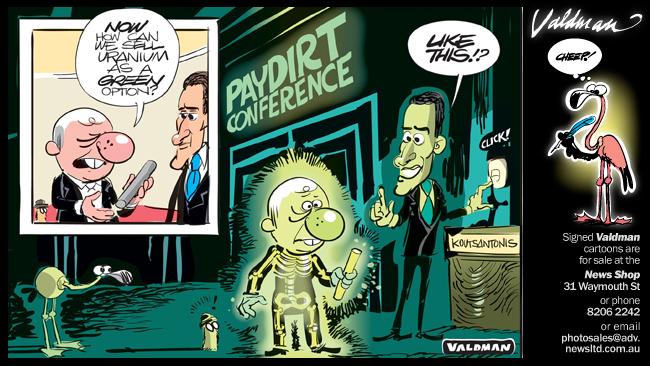
Koutsantonis, who sees himself as a progressive figure, attacked the hysteria around the effects of radiation, given the safety of nuclear reactors in Japan. There were no deaths from radiation, he said, unlike the thousands of deaths from the earthquake and the tsunami. South Australia, in his view, should be enriching uranium within 10-30 years and its storage in South Australia.
This is the nuclear industry's spin: it is good newsstory. Despite the events in Japan, nuclear is a safe, affordable and “clean” energy source that does not spew harmful carbons into the environment or rely on foreign producers.
Often the enframing of the issue of whether Australia should have nuclear power is in terms of nuclear power, or it’s climate change. Many of those who defend nuclear power accept this frame, and do so without arguing for why the debate should be enframed this way, given the emergence of renewable energy industry (solar, wind geothermal)into the energy mix.
A classic example is Kevin Foley, the ex -Treasurer of SA, who quickly came out and backed Koutsantonis' call for uranium enrichment and advocated domestic nuclear power: mine it, enrich it, store the by-product, produce energy, and store the waste. South Australian governments have a long history of spruiking for a nuclear power plant in SA (Port Augusta, SA has been mentioned in the past).
Now the Labor' Right's justification for Australia going nuclear is that it is the only realistic way to reduce greenhouse gas emissions. They reckon it is inevitable, and presumably, they want the commonwealth to subsidize it's construction and the costs of waste management and storage. BP Billiton sure ain't going to build an uranium-enrichment-industry-in-SA on its own. The Labor Right say it will even create new jobs! Oh, and they add when pressed, that the liability of nuclear power plants would need to be limited should a catastrophe like the one in Japan happen here in Australia.
The best that can be said of this event is that the SA Labor Party is now officially divided, and that many Labor politicians on the Right have supported, and continue to support, the nuclear industry.
It's a strange time to let the cat out of the bag that the SA Government is behind the push to spruik nuclear power in South Australia, since reports from Japan indicate that there are now abnormal levels of radiation in milk, some vegetables, tap water, sea water and sea food. You would think that they'd be less hairy chested and show more concern for the plight of the Japanese people especially the workers inside the plant who are sacrificing themselves.
My own view is that the nuclear industry is a snake-oil culture of habitual misrepresentation, pervasive wishful thinking, deep denial, and occasional outright deception. For more than 50 years, it has habitually lied about risks and costs while covering up every violation and failure it could. We have seen this once again around the Fukushima disaster.
Posted by Gary Sauer-Thompson at 4:20 PM | Comments (15) | TrackBack
March 25, 2011
NSW: where to for the ALP?
A core question that will arise from the certain defeat---nay massacre---of the corrupt, incompetent NSW Labor government is what next for Labor. The ALP faces a rout, their Sussex St style of bullying politics is utterly discredited, their progressive base has deserted them for the Greens, and their traditional blue collar base has decamped to the Liberals en mass. Labor is going to be left with minimal political representation.

The answer to what next for Labor is that the ALP will have to renew and reinvent itself. At the moment NSW Labor merely stands for a political machine winning elections for its own sake and staying in power---the NSW right's cult of 'whatever it takes'. They will have plenty of time to renew and reinvent in opposition. Reinvent themselves into what though?
If the political landscape is changing with the slow but steady decay of the two party system, then what is the identity of the ALP in a multiparty system? How does the ALP differentiate itself from the Liberals and the Greens now that Australia is committed to becoming an open market economy? If the old identity of the working class party is decaying, what is Labor's emergent political identity?
I don't know the answer to these questions. I do know that though they will be pressing questions to NSW Labor after it has become a shadow of its former self, it is also applies to Gillard Labor. The latter's style of politics looks to be increasing managerialist in orientation with a set of platitudes and talking points designed for marketing the Labor brand to the ever shrinking political base.
People suspect that like NSW Labor the political core of Gillard Labor is hollow. At the ABC's Unleashed Malcolm Farnsworth gives expression to this judgement:
This, then, is the concern about Gillard: she revels in the political game but seems to lack any deeply-held or coherent philosophy, beyond a handful of platitudes and snippets of management-speak. Give her a brief, a new set of lines to deliver, and she learns them off by heart and trots them out when the political situation requires. And then there’s her tin ear. For someone so intensely political, she seems oddly out of sync with political sentiment....[Gillard] she battles a perception that her government lacks something at its core.
Does this matter? Surely politics is now inhabited by the hollow men and women engaged in professional politics.
Update
It was a massacre for a scandal-ridden NSW Labor, as was expected.The swing was around 17 per cent and Labor will hold around 20 seats. It appears that The Greens failed to win the inner city seats of Marrickville and Balmain; the Independents have been reduced by the resurgence of the Nationals; the Legislative Council has swung to the right.
The ALP heartland in western Sydney has gone. NSW Labor now resides in a political graveyard---its primary vote is at 25 per cent. The Liberals have taken a giant step into areas where their political brand had barely ever registered respectable support.
Alex Mitchell in the SMH states that the rebuilding starts to reconnect it with its traditional base among blue- and white-collar voters. It will need to do more than that.
Posted by Gary Sauer-Thompson at 8:31 AM | Comments (11) | TrackBack
March 24, 2011
question time
I've been watching Question Time in the House of Representatives this week, and it has degenerated into name calling, sledging, personal abuse and hurling invective at one another. It looks like the latest episode in the culture wars.
It is not a public space of deliberative reason under any description in which carbon tax is debated and persuasive arguments are mounted and criticized. It is much more than political point scoring, as there is no respect or civility in question time for the ethos of parliamentary democracy. Liberal democracy has been hollowed out. It is a empty shell; a facade.

The Liberal Party has been the worst in this during Question Time, and they have been lead by the overheated rhetoric of Abbott and Hockey. Their tactics have been to create as much noise as possible; and in doing so they been playing to the public gallery full of denialists from the anti-carbon tax rally.
It was organized by the astroturf Consumer and Taxpayers’ Association’s (CATA) group who say that they are leading a genuine grass roots people's revolt. The reality is that we have a fake grassroots movement organised by big-dollar lobbying masquerading as street-level activism.
In Crikey Bernard Keane says that this revolt of old white blokes--- "good, decent Australians from middle Australia who wanted honest government" according to the Liberals---is:
not really about climate change or immigration, but about social change and the social and economic transformation of Australia in a way that older, white Australians resent. This crowd grew up in a monocultural, British country that relied on protected industries -- particularly the "real jobs" to be found in manufacturing. They grew up with a political system dominated by old white men. Australia has changed beyond recognition for them and because of their education levels and their age, they aren't as well equipped to handle it as others are. They therefore feel disoriented, dispossessed and resentful, particularly because they don’t hold the same pre-eminent position they used to hold socially, economically or politically.Keane adds that this is why there’s such a strong conspiracy theory fringe to climate denialism. The placards about UN and IMF plots yesterday weren’t coincidental. Like most conspiracy theories, they’re driven less by paranoia than by a desperate search for reassurance that someone, somewhere, however evil, is actually in control of what’s going on, and the right order of things could be restored.
There are two objections to Keane's reworking of the standard interpretation One Nation movement. First, it does not really describe the radical right---ie., the Citizens’ Electoral Council, The Australian League of Rights, National Civic Council, an anti-gun control enthusiasts and the Lavoisier Group. What the rally indicates is that the Liberal Party has increasingly shifted to occupy the terrain once represented by One Nation. They demand the right of the corporations to make more money, pay less tax at whatever social cost, and to dump the environmental regulation of big government.
Secondly, Keane does not mention the emergence of astroturfing in Australia. This is limited to political groups such as Consumer and Taxpayers’ Association’s; it also includes ''persona management'' systems that are designed to flood online discussion sites with comments of a predetermined political slant from fake members of the public. If you read the comments to the various columns of the mainstream press, what you notice is that they are largely cut and paste reiterations of extremely thin, simplistic and explicit political spin.
Posted by Gary Sauer-Thompson at 2:42 PM | Comments (7) | TrackBack
March 23, 2011
living in a liberal world
I'm starting to find the conservative's emphasis on the Judeo-Christian heritage (whatever that means) and the central significance of the bible for understanding the history of the West rather tedious. Sure the bible is an important literary text--just like Plato's dialogues or Shakespeare --and you do need to know about the history of Christianity to understand how religion has been crucially important in shaping the history of the West.
However, we no longer live in a Christian world. We live in a secular world of liberal democracy, our ethics are secular (ie; utilitarianism is our public ethics), God is not a foundation stone of the Australian constitution, and our cultural framework is that of Enlightenment, which displaced Christianity; and religion has become a matter or private conscience. Christianity is no longer the cornerstone of our liberal civilisation.
As Chris Berg says in West's history not complete without reference to Christianity at the ABC's Unleashed:
While liberal democracy was conceived in a Christian framework, one obviously need not be Christian to be part of liberal democracy.That’s the whole point. Liberalism as practised in the 21st century is wholly secular and wholly pluralistic - we don’t need to rely on theology to justify universal suffrage or individual freedom.And, of course, understanding the importance of Christianity in the development of Western thought does not mean we are required to design policy according to conservative Christian values.
The purpose of public education is to educate Australians to be liberal citizens who can think for themselves, not for Australians to become Christians. If the latter is the education they desire, then they go to an independent Christian school. Even then, the schools, if funded by the state, should not teach a Christian fundamentalism that replaces evolutionary theory in schools with ‘intelligent design’ explanations for biology.
Oh, I know, Christianity is being used as a weapon in the cultural wars by conservatives to bash the modern left and postmodernism, and that this is part of the conservative backlash to 1968. However, the western liberal democratic tradition was born from a divorce of church and state. The separation of church and state is what the conservatives want to roll back.
The pressure is from the fundamentalist religious right to restore christian values to the centre of Australian politics or who insist that God must be restored to the centre of Australian political life. What this minority is seeking to overturn is the principle of the separation of church and state which has been interpreted in Australia in terms of state neutrality--ie. governments should not favour one church over another.
Though the Christian fundamentalists want a Christian society as opposed to a secular state based on state neutrality the Christian right is very much a minority voice. So their attempts to strong-arm the Australian political system in order to install Christian values is going to been as not the way to go. Australia’s traditions are of religious pluralism, in which political and cultural institutions have tried to encourage acceptance of difference.
Posted by Gary Sauer-Thompson at 10:17 AM | Comments (13) | TrackBack
March 22, 2011
ALP: writing the obituary
The Canberra Press Gallery is starting to write the obituary of the Gillard Government and that of the ALP. Are there interpretations plausible?
For instance, Glenn Milne addresses the issue of the Gillard Government when he writes at the ABC's Unleashed that with 'Gillard battling on many fronts, Liberals dare to hope, for the first time since the Labor minority government was formed, that Julia Gillard's first term in her own right may be her last.' He adds:
This is not to say they now believe the Government will not go full term. To the contrary, there is a grudging recognition that the dreams of an early implosion between Gillard and the independents she relies on to govern were misplaced. It's just that senior Liberals now believe Gillard's prime ministership may be terminal, a fate that will become clear at the time of the next election.
There is a growing belief among senior Liberals, he concludes, that Gillard's eroded legitimacy may be fatal to her re-election chances.
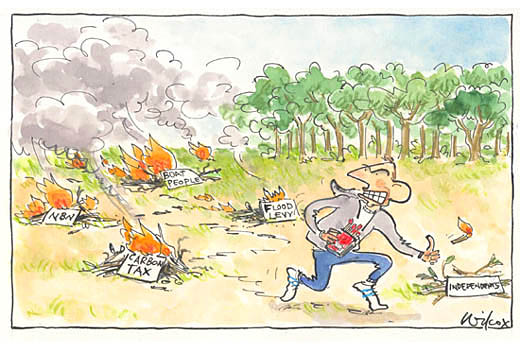
From my perspective Milne's columns on the ABC's Unleashed are basically him writing publicity for the Liberal Party. They tell us little more than what senior Liberals are thinking about the current state of play in politics. The content is mostly about hope.
Peter Hartcher prefers to make his own judgements. In the Sydney Morning Herald he says:
The Prime Minister is like someone under a death sentence, carrying on breezily as if everything is normal. Let's be realistic. As things stand, Labor cannot hope to govern in its own right any more.....As a party able to offer itself as a viable government, Labor is not just under existential threat. It is finished. Unless, of course, it can engineer an extraordinary resurgence. Labor's looming death as a stand-alone political entity is the biggest story in contemporary Australian politics.
His thesis is that the ALP has self-destructed as the party of the progressive vote. Even if Gillard can win passage of a carbon tax through the Parliament, it will not be enough to save her, and Labor, from oblivion.
Let us accept that Labor cannot govern in its right any more---the coalition of ALP and Greens in the ACT and Tasmania gives us the reasons for accepting this part of Hartcher's thesis. What then of his oblivion claim?
Hartcher doesn't address the possibility of a coalition between ALP and Greens at a federal level. Hasn't the ALP depended on Greens preferences to be competitive since the 1980s? If the ALP cannot win elections with a vote in the mid-30s, then it needs some sort of an alliance with the Greens.
Hartcher is ambivalent here. On the one hand, the alliance possibility is sidelined on the grounds that the Right faction is dominant within Labor and it has no interest in moving left to appeal to progressive voters. On the other hand, Hartcher acknowledges this possibility with his claim that Labor has yet to squarely confront the fact that it is on track to bring the two-party system to an end as Australia witnesses the rise of a three-party system.
We already three-party system---eg., Liberals, National and ALP. Nay, the political landscape has changed so that we actually have a four-party system: Liberals, National, ALP and Greens. How does that constitute Labor's oblivion--that Labor is finished? Nobody seriously claims that the Liberals are finished because they are required to form a coalition with the Nationals. Why the ALP then?
Posted by Gary Sauer-Thompson at 12:24 PM | Comments (12) | TrackBack
March 21, 2011
NSW: good riddance to Labor
Next Saturday voters in NSW will have the opportunity to finally dump the disliked Labor Government and the detested NSW Labor Party machine. They have had to put up with long years (16 years) of broken promises, ineptitude, bitter fighting, cronyism, factional manipulations, bad urban planning, poor transport services, scandal and corruption.

Labor has zero credibility with the electorate--it is an incompetent government that has self-destructed. Who cares that the Liberal-National coalition doesn't stand for much policy substance in NSW--not being Labor is simply good enough for the moment.
The question, what does an O'Farrell government stand for?, will emerge after Labor have been reduced to a parliamentary rump--(to 16 seats some say). No one really cares at the moment.
Not much will be initially expected from an O'Farrell government and the Legislative Council will probably be hung with several cross benchers holding the balance of power.
The factionally-riven O'Farrell Liberal National Coalition promises a lot--they'll cut taxes, create 100,000 new jobs, fight federal Labor's carbon tax, invest $3 billion in NSW hospitals, reduce the fat in the public service and hire 900 additional teachers, fix creaky infrastructure etc etc ---and so many promises will be broken. That's to be expected. As is some real pain.
The religious right has become prominent in the NSW Liberal Party and it will resist the Liberal National Coalition moving to the political centre
Posted by Gary Sauer-Thompson at 11:30 AM | Comments (7) | TrackBack
March 20, 2011
media matters
We know that the future of newspapers is one that has much less money attached to it and far fewer people working for them. The problem the New York Times and all other newspapers and magazines are facing is that, as readers increasingly move online, news organizations aren’t getting enough money from them to maintain newsrooms of any decent size. Print subscribers and advertisers heavily subsidize the free news that online readers take for granted.
It's an uncertain future in which newspapers will have to innovate to reconnect with their readers. In response journalists have lashed out at Google and bloggers, rather than addressing issues such as massive debt-load and a failure to adapt to the times. If simple traffic and advertising isn’t doing the trick to increase cash flow, then that money has to come from somewhere else. One option is a metered approach, as opposed to a all-or-nothing subscription method, which isn't a viable one for a general news site.
The New York Times has announced that it is launching digital subscriptions for its online site. If you want to read more than 20 articles a month, you’ll need to dig in your pockets for $15 every four weeks (this will cover NYTimes.com and the Smartphone App). The changes take effect soon—first in Canada, and from 28th March, in the US and the rest of the world.
Readers who come to Times articles through links from search, blogs and social media like Facebook and Twitter will be able to read those articles, even if they have reached their monthly reading limit. For some search engines, users will have a daily limit of free links to Times articles.
There is a need for a viable stream of revenue from digital that is not tied to advertising, and, amongst journalists, that their work is good enough for readers to pay for it. The success of subscription-based models at the Wall Street Journal and the Financial Times indicate how this might be done; however, unlike the New York Times, these are specialist publications, with monopolies in their own markets.
Unlike the partisan newspapers of News Ltd, which continually throw mud at public broadcasters (ABC + BBC) minimise the misbehaviour by News Ltd media (eg., the phone hacking done by the News of the World), the New York Times, for all its faults, is still a good newspaper.
Posted by Gary Sauer-Thompson at 10:59 PM | Comments (1) | TrackBack
March 19, 2011
troubled times in the US
In The Forgotten Millions column at the New York Times Paul Krugman says:
More than three years after we entered the worst economic slump since the 1930s, a strange and disturbing thing has happened to our political discourse: Washington has lost interest in the unemployed....So one-sixth of America’s workers — all those who can’t find any job or are stuck with part-time work when they want a full-time job — have, in effect, been abandoned.It might not be so bad if the jobless could expect to find new employment fairly soon. But unemployment has become a trap, one that’s very difficult to escape. There are almost five times as many unemployed workers as there are job openings; the average unemployed worker has been jobless for 37 weeks, a post-World War II record.
The big debate in Washington is about how whether to cut $10 billion or $61 billion from the federal budget between now and September 30. Succinctly stated the Republican view is that less government spending equals more private sector jobs. Yet the clear and present danger to the prospects of young Americans isn’t the deficit. It’s the absence of jobs.
The Republicans figure this tactic the one sure way to unseat Obama. They know that when the economy is heading downward, voters fire the president. Anyone who suggests that the Americans actually need to focus on unemployment instead of slashing spending now can expect to face harsh attacks, which leads all too many Democrats to shy away from the current economic policy debate. They give ground in spite of the stagnating incomes and high rates of unemployment.
The social-democratic solution to this kind of situation was developed in the early twentieth century. Jon Elster in Alternatives to Capitalism described this solution thius:
It was recognized that market institutions create unacceptable inequalities and leave some citizens in circumstances of insecurity, deprivation, and indignity; and it was argued that the institutions of the state needed to correct these tendencies through the establishment of a strong social safety net. The majority of a society would have the electoral strength to create and maintain strong protections of the interests of ordinary working people through a combination of positive economic rights.
The triumph of social and economic conservatism -- starting with Thatcher, Reagan, and other conservative European leaders and their political parties -- took this theory of the role of the state off the public agenda, and the past thirty years have witnessed the systematic disassembly of the institutions of social democracy in most countries.
The consequences are predictable in the US: more inequality, more deprivation, more severe disparities of life outcomes for different social groups.
Posted by Gary Sauer-Thompson at 2:58 PM | Comments (2) | TrackBack
March 18, 2011
Liberal interventionism + Libya
Liberal interventionism in the world of nations is alive and well. The UN has voted for a no-fly zone and air strikes against Muammar Gaddafi's forces in Libya.
The resolution, which is the result of painstaking multilateral diplomacy, lays out very clear conditions that must be met by Gaddafi. As interpreted by Washington it holds that:
• All attacks against civilians must stop.
• Gaddafi must stop his troops from advancing on the rebel stronghold Benghazi, and pull them back from Ajdabiya, Misrata and Zawiya.
• Gaddafi must establish water, electricity and gas supplies to all areas.
• Humanitarian assistance must be allowed to reach the people of Libya.
If Gaddafi does not comply with the resolution the international community will impose consequences and the resolution will be enforced through military action. No foreign occupation is envisaged at this stage.
 Martin Rowson
This UN intervention recalls the intervention in the 1999 Kosovo crisis, when NATO planes were dispatched to bomb Belgrade in an effort to stop Serbs from “cleansing” Kosovo, and Europe's failure to act in Bosnia. The policy of intervening in the world's troublespots to uphold democracy was reduced to tatters because of the disaster in Iraq. The era of liberal interventionism in international affairs appeared to be over.
British, French and US military aircraft are preparing to defend the Libyan rebel stronghold of Benghazi. There's no guarantee that a piece of paper will succeeding in protecting the thousands of Libyans in Benghazi from Qaddafi's forces, which are gathering some 100 miles away outside the besieged town of Ajdabiya and have completely surrounded Misrata.
Hillary Clinton said the following in testimony to Congress last week:
I want to remind people that, you know, we had a no-fly zone over Iraq. It did not prevent Saddam Hussein from slaughtering people on the ground, and it did not get him out of office. We had a no-fly zone, and then we had 78 days of bombing in Serbia. It did not get Milosevic out of office. It did not get him out of Kosovo until we put troops on the ground with our allies.
There is no guarantee that military intervention will result in Gaddafi's demise. Liberal interventionism, as realists are quick to point out, needs to be backed by the iron fist of military power. Does that eventually mean troops on the ground?
Ian Buruma reminds us in Revolution from Above in the New York Review of Books:
The principles of “liberal intervention,” or the “right to intervene” to stop mass murder and persecution, were developed in Paris in the 1980s, by Mario Bettati, a professor of international public law, and popularized by a French politician, Bernard Kouchner, who was one of the founders of Médecins sans Frontières. This is how Kouchner described his enthusiasm for liberal intervention with military force: “The day will come, we are convinced of it, when we are going to be able to say to a dictator: ‘Mr. Dictator we are going to stop you preventively from oppressing, torturing and exterminating your ethnic minorities.’”
Liberal interventionism is about saving minorities from death and persecution, not about spreading revolution. Some realists see national interests as paramount, and would make deals with any dictator to protect them.
Update
European countries and the US backed by Arab League members have launched attacks from air and sea against Gaddafi 's regime in Libya. The bombing raids by fighter jets, cruise missile strikes and electronic warfare are aimed at knocking out military units and capability being used to attack rebel strongholds such as Benghazi and Misrata. Air defence systems are being targeted to give the jets clear skies.
Libya may well end up divided into the rebel-held east and a regime stronghold in the rest of the country which would include the oil fields and the oil terminal town al-Brega. There is a strong risk, too, that it will become the region's fourth failed state, joining Iraq, Afghanistan and Yemen. So the the West gets drawn into an increasingly complicated civil war.
What is political endgame here? What is the role the U.S. or the Europeans might be expected to play should Qaddafi fall? What steps will follow should the No Fly Zone and indirect intervention not succeed in driving Qaddafi from power? The best answer is regime change — displacing the Gaddafi government of Libya and replacing it with a new regime built around the rebels.
Posted by Gary Sauer-Thompson at 4:29 PM | Comments (12) | TrackBack
March 17, 2011
nuclear power in Australia?
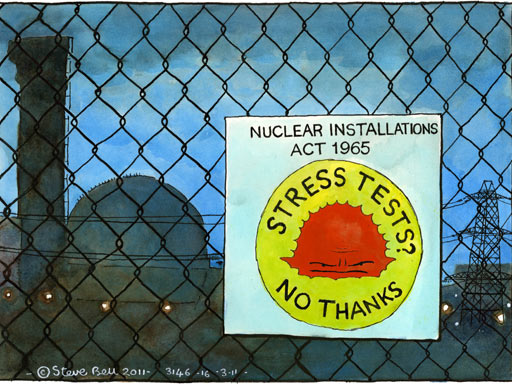
The big concern of the pro nuclear lobby in Australia is that an attempt to rely on nuclear power and to build nuclear power stations to ensure energy security may well be stymied now because of the disaster at the Fukushima Daiichi nuclear plant in northern Japan.
The lobby had been hoping for a nuclear renaissance in the context of global warming after the Three Mile Island disaster in 1979, and the Chernobyl disaster in 1986, effectively shut down new commercial nuclear projects across the globe.
Their argument was that in order to address climate warming and to solve our energy security Australia needed to build a new generation of safe, clean nuclear power plants. If new-build nuclear plants was the most rational way to go, then the future bright for nuclear energy required easing the dark fears and anxiety amongst the public through education.
 Steve Bell
Many in the nuclear camp---though not Barry Brook---are of the view that steering any investment toward alternative forms of renewable energy (wind, solar, geothermal) that would almost certainly be less dangerous and, possibly in the long run, cheaper is absolutely out of the question. Those who advocate this approach to a low carbon economy are dismissed as anti-nuclear and as prejudiced and so not rational.
So they end up trying to reassure us that everything at the Japanese plant was working according to plan and there was no real cause for concern and they critique the media for cashing in on the business and politics of fear. Advocates of nuclear power maintain that failure is very rare, that new reactors are safer, that the benefits outweigh the costs and that nuclear energy is a solution to the energy and climate crisis that is available immediately.
The problem I have is that many in favour of nuclear power are also deeply opposed to pricing carbon, either in the form of a carbon tax or an emissions trading scheme. Yet nuclear power is extraordinarily expensive, especially for a country like Australia that has neither nuclear power construction experience, nor regulatory infrastructure. There is no energy utility in the country that possesses the balance sheet to contemplate the scale of investment, let alone the risk that is attached to it.
The industry depends heavily on cheap, long-term loans, which usually need government guarantees; whilst the additional and massive cost of decommissioning reactors and storing radioactive waste is so great the cost burden must be borne by governments, not industry.
The problem that the pro nuclear lobby has is that they need what they oppose---a big carbon tax--- to get a nuclear industry off the ground in Australia. As the Switkowski report commissioned by the Howard government, pointed out in the absence of a substantial carbon price nuclear power is not competitive with coal. It states:
Cost estimates suggest that in Australia nuclear power would on average be 20–50 per cent more expensive to produce than coal-fired power if pollution, including carbon dioxide emissions, is not priced....Nuclear power can become competitive with fossil fuel-based generation in Australia, if based on international best practice and with the introduction of low to moderate pricing of carbon dioxide emissions.
The figures range from a minimum of A$25 to $40 per ton of carbon dioxide.
The contradictions in the conservative position don't matter. Believing in nuclear power is increasingly become a question of identity---rather than public policy--for conservatives, just as denying climate change has become a question of conservative identity. This then leads to the war on natural science.
The political reality is that no nuclear energy industry will emerge in Australia, or at least not for another decade or two. The push for a nuclear industry within a mildly reformist Gillard Government has been ruled out, in favour of investing renewable technologies and cleaner fossil fuels, whilst the Coalition won't go there in the short term, given their intense opposition to both a carbon tax and big government intervention.
The nuclear lobby are whistling in the wind. Their current energies at the moment will be taken up in damage control, as the poor public image of nuclear power has taken a battering.
Update
Tom Koutsantonis, South Australia's Minister for Minerals Resources and Development, has argued to the Paydirt Uranium conference, that it is now necessary to step up to the plate and argue for nuclear power in Australia.
In doing so he attacked the hysteria around the effects of radiation given the safety of nuclear reactors in Japan. There were no deaths from radiation unlike the thousands of deaths from the earthquake and the tsunami. South Australia, in his view, should be enriching uranium within 10-30 years and its storage in South Australia.
Kevin Foley, the ex -Treasurer of SA, then came out and backed Koutsantonis: mine it, enrich it, store the by-product, produce energy, and store the waste. The SA Labor Party is now officially divided.
Posted by Gary Sauer-Thompson at 10:15 AM | Comments (10) | TrackBack
March 16, 2011
Japan nuclear situation: fear or fact?
What we would expect from Australian scientists and academics with expertise in nuclear power, engineering and energy is to keeping us informed about the unfolding nuclear disaster in Japan. We don't expect this from partisan newspapers such as The Australian which uses its op-ed page top fight the culture wars and destroy those on the left side of politics. Anything goes for them. The scientists, in contrast, try to educate the public so that we have an informed citizenry.
I have been reading Prof. Barry Brook's (he's an environmental scientist at Adelaide University) brave new climate blog. Though Brook is a nuclear power advocate he publicly adopts a 'just the facts' approach: one that is designed to inform rather than deceive so as to facilitate a rational debate about nuclear power in Australia. This is important, given the misinformation and hyperbole flying around the internet and media about the Fukushima nuclear reactor situation.
 Martin Rowson
On his March 15 post---a summary of the situation report--- Brook's position was that the situation with respect to Fukushima Daiini, is now under control, and units are in, or approaching, cold shutdown. He adds that units 1+3 at Fukushima Daiich plant were fairly stable. Unit 4 was stable. Unit 2 was the one of most concern, but the odds are that no one will be hurt from radioactivity.
My interpretation of the analysis on his blog is that the situation is under control, there is no reason for concern as the situation is clearly (but slowly) stabilising, and that the radiation level at the site boundary is not a risk to the public.
However, an editorial note by Brook to a guest post by Ben Heard does jar:
[Ben is a relatively recent, but very welcome friend of mine, who is as passionate as I am about mitigating climate change. I really appreciate publishing his thoughts in this most difficult of times. Now, more than ever, we must stand up for what we believe is right]
What is right? Nuclear power is the solution to global warming? Australia should embrace nuclear power? Does this frame the opinion contained in the blog posts?
In his post Heard details how the deteriorating situation at the Fukushima Daiichi has led to a severity rating of INES 6. He says that this is clearly very serious and adds that the Three Mile Island Accident was a 5. Chernobyl, however, was a 7 (the highest), and is a very different league. He finishes thus:
If Japan’s nuclear power sector can withstand the worst natural calamity I hope to ever see in my life and contribute no deaths, minimal injuries and minimal environmental impact, then nuclear power must be just about the sturdiest, best designed, best managed and least dangerous infrastructure in the world. And in a world that is quickly cooking itself through climate change, nuclear power must not be allowed to suffer from the hype, headlines and hyperbole that have stemmed from this tragic event. Fear or facts. I choose facts. I hope you do too.
It's not a case of fear or fact---it's both plus an interpretation of facts. Brook's interpretation of the facts of an "ongoing crisis situation"---ie., new explosions, fires, exposure of fuel rods, containment vessel of reactor #2 being breached, the fire in unit #4 apparently released significant radiation to the environment, etc.--- is that the situation is under control. That is Heard's interpretation as well.
This strikes me as an optimistic interpretation in an unfolding, dynamic situation. A bit too rosy perhaps? If we dig deeper into Heard's post we find this statement:
The bottom line of the events at Fukushima and the nuclear power sector more broadly would appear to be as follows: ...No significant or lasting environmental impact whatsoever
How would Heard know that? The facts aren't even in as this statement refers to future events that have yet to happen. We have spin, or ignorance, in the form of speculation Nor is there any mention of people being evacuated in a 20-30k radius and workers are ordered to leave the site where they are most needed due to radiation.
Recall that Brook's holds that this is a critical time for science, engineering and facts to trump hype, fear, uncertainty and doubt. If we dig into Brook's past post--eg., that of 12 March --- we find this confident statement: "There is no credible risk of a serious accident." Events have proved otherwise, haven't they.
We now have the reactor shutdown generating heat from the hot fuel but no cooling systems. That is the same basic scenario as at Three Mile Island. The company--Tokyo Electric Power (Tepco)-- is having difficulty in bringing the plant under control.The 50 workers left are struggling to keep hundreds of gallons of seawater a minute flowing through temporary fire pumps into the three stricken reactors, Nos. 1, 2 and 3, where overheated fuel rods continued to boil away the water at a brisk pace.
Brook's "clearly (but slowly) stabilising" interpretation does need to be questioned.in the light of what is happening.
Update 1
Brook's "clearly (but slowly) stabilising" interpretation is looking increasing implausible. Surprisingly, comments to that effect on his blog posts are being deleted. At best it looks as Japan is struggling to regain control as conditions at its failing nuclear plant continue to deteriorate further.
A more pessimistic interpretation was given in a briefing on the nuclear plant crisis in Japan to the US Senate's committee on the environment and public works by Greg Jaczko, chairman of the US Nuclear Regulatory Commission Recall that Brook's position is that Unit 4 is stable. Jaczko, in contrast, says that there is no more water in spent fuel pool at No 4 reactor:
We believe at this point that Unit 4 may have lost a significant inventory, if not lost all, of its water.... There is no water in the spent fuel pool and we believe that radiation levels are extremely high, which could possibly impact the ability to take corrective measures....We believe that around the reactor site there are high levels of radiation. It would be very difficult for emergency workers to get near the reactors. The doses they could experience would potentially be lethal doses in a very short period of time."
Tokyo Electric Power are saying that they can’t get inside to check but reckon there is no problem.
Jaczko also said there was the possibility of a leak in the spent fuel pool in reactor No 3, "which could lead to a loss of water in that pool", as well as a falling water level in the spent fuel level at the No 2 reactor. The water level has been dropping in the No 5 reactor as well.
If the American analysis is accurate and emergency crews at the plant have been unable to keep the spent fuel rods at that inoperative reactor properly cooled — they need to remain covered with water at all times — radiation levels could make it difficult not only to fix the problem at reactor No. 4, but to keep servicing any of the other problem reactors at the plant.
Posted by Gary Sauer-Thompson at 10:30 AM | Comments (22) | TrackBack
March 15, 2011
Gillard in America
Julia Gillard sure buttered up the Americans when she was in Washington. Fawning is what Peter Costello called it. Didn't John Howard do the same?

In her speech to the powerful US Chamber of Commerce, bestowed lavish praise on her hosts by celebrating the politically-charged issue of American ‘exceptionalism’ — the popular US conceit that it is both different from and (by implication) superior to other nations.‘Yours remains what it has always been, a nation which is exceptional in every way’.
Gillard also stated that US optimism will help the global superpower overcome its economic woes and lead the world to a return to prosperity and strong economic growth because of its capacity for innovation, reinvention and recovery.
In her tear jerking, emotion ladened speech to the US Congress Gillard told her audience that America is the cradle of democracy and that Americans can do anything. Gillard was warmly received for endearing herself to her American audience.
From an Australian perspective Gillard's message was the familiar catechism of loyal friendship--- that Australia is a rock solid ally. The subtext? Australia eagerly supported the US in a bad war in Iraq and was only too willing to back America in the deeply problematic intervention in Afghanistan. So don't let us down.
So what does that backslapping from an admiring ally mean for Australia's relationship with China? A split between political and economic interests? Isn't the US burdened with debt with American citizens facing unemployment, cuts to their pensions, superannuation, and social welfare? Isn't the G.O.P. austerity approach to the budget budget wrongheaded and destructive; one that sneers at knowledge and exalts ignorance?
It is hard to think of Gillard's remarks about American innovation and reinvention without thinking of Wall Street and the global financial crisis. United States Treasury Secretary Tim Geithner's view of the nature of world economic growth envisions a central role of the US financial sector--the too big to fail US banks take the lead in the financial development of countries like India, China, and Brazil. That means more financial crises, more government bailouts and more countries bought to their knees by Wall Street.
Posted by Gary Sauer-Thompson at 11:13 PM | Comments (3) | TrackBack
March 14, 2011
Japan: nuclear crisis
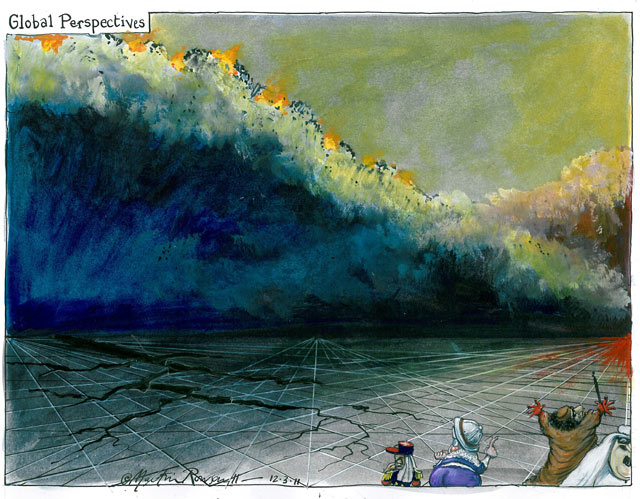
Three days after a devastating earthquake unleashed a tsunami in which at least 10,000 people are feared dead Japan faces a deepening nuclear crisis. An intense public-relations battle has already started.
 Martin Rowson
Damage has been caused to the antiquated Fukushima Daiichi nuclear complex in northern Japan from the 9.0 magnitude earthquake and subsequent tusnami. The outer containment wall was destroyed in an explosion on Saturday.
All three reactors (units 1, 2, 3) are threatening to overheat. The auxiliary buildings of the nuclear plant were destroyed by an hydrogen explosion and the plant will have to be decommissioned because seawater is corrosive.
In response to the disaster the nuclear lobby in Australia are quick to say that we don't need to worry about a thing. Nuclear power is safe.
It is emerging that the government, the power industry and the academic community had seriously underestimated the potential risks posed by major earthquakes to their nuclear plant. The designs of plants were not built to robust enough standards for serious quakes caused by the build up of tension from the movement of tectonic plates.
The threat is real but unclear. Japanese authorities are doing all they can at the moment to keep the core of units 1+2 cooled with seawater after emergency cooling systems failed to stabilise the radioactive cores. If the cooling fails, the reactors could overheat and cause a total meltdown of the radioactive fuel rods in the core. This would only lead to a major release of radiation if the reactor's containment vessel was breached.
Update
In this account it is stated that once a nuclear plant shuts down, it has two ways to get electricity, one is from the grid, and another is from emergency diesel generators that they have on site. In Japan's case:
because of the magnitude of the earthquake, the grid basically went dark, so they were operating on their diesel generators and everything was functioning as it should be. But then, based on news reports, about an hour after the earthquake and the shutdown, the tsunami hit, and flooded the plant, where the diesel generators were, and that caused them to lose their diesel generator power and reduced them to their emergency battery backup power only.
The problem is that emergency backup on the batteries gives them very limited capabilities---they are only good for a few hours--- and so they were having a very difficult time keeping the plant cool. Using sea water to cool the reactor means that they’re basically down to their last option.
Even though they must have got additional generating power onto the site to pump the sea water, it seems that they have experienced a partial core meltdown.
Update2
In The Australian Brendan O'Neill says that the response by Western reporters and experts to the explosions at the nuclear power station in Fukushima in northern Japan is seriously overblown, and that it reveals more about us and our fears than it does about the reality on the ground in Japan. He adds that this response:
has been driven not by hard evidence that there will be a devastating radioactive leak, but by a culture of fear which feverishly seeks out the worst-case scenario; by an almost pornographic apocalyptic outlook unsatisfied by the images of waves of water wiping away towns and villages - no, it needs a nuclear component to this tragedy too.
O'Neill says that many observers are now fantasising about a possible meltdown at a nuclear energy station that was badly shaken by the quake, which apparently could give rise to a radioactive holocaust that would make nature's fury look like a tea party in comparison.
The problem here is that the nuclear situation in Japan is developing rapidly. It now appears that all three nuclear reactors are likely to have suffered partial meltdowns, though this could mean just one fuel rod or nearly all of them melting within the cores. The reactors are at risk of going into meltdown because although they had shut down, the fuel rods continue to give off heat. Reactors 1 and 3 appeared stable for the time being, but that reactor 2, where fuel rods were most exposed, was still a concern.
We also know that radiation has spread from the three reactors of the Fukushima Dai-ichi nuclear complex and that the level seems high enough to damage human health.
Update 3
A large blast was heard at the No. 2 reactor at the Fukushima Daiichi Nuclear Power Station. It happened in the “pressure suppression room” in the cooling area of the reactor, raising the possibility to damage to the reactor’s containment vessel. Any damage to the steel containment vessel of a nuclear reactor is considered critical because it raises the prospect of an uncontrolled release of radioactive material and full meltdown of the nuclear fuel inside. If there is heavy melting inside the reactor, large amounts of radiation will most definitely be released.
Tokyo Electric Power Co (Tepco) is warning that "it had lost the ability to cool Fukushima Daiichi's reactor 2," and the current failure of officials to keep water levels up to cool the fuel rods has heightened the possibility of a meltdown.
Update 4
The Australian says that it stands for science and knowledge against the irrationality of environmentalism that distorts public debate. The editorial says:
It is the triumph of reason that sets humankind apart, that has freed us from superstition, enabled us to prosper, to develop wondrous cultures, to travel and explore from the depths of the oceans to the fringes of the universe.
The Australian says that they are opposed to fearmongering and hysteria over climate change that has been propagated by scientists, educators and politicians; and the fearmongering in the wake of the Japanese tsunami disaster. They say that the Japanese tsunami tragedy was caused by a shift in tectonic plates and that climate change is irrelevant to this event.
I haven't come across any commentary that links the Japanese earthquake and tsunami to climate change--it's a straw dog argument. What we have is anti-nuclear activists talking in terms of a Japanese Chernobyl occurring at Fukushima, even though the nuclear reactors are quite different.
What I have come across is commentary that critiques the optimist view of the nuclear lobby (eg., Switkowski and O'Neill) in The Australian that talks in terms of a culture of fear, that says there is little to worry about from the damage to the Fukushima Daiichi Nuclear Power Station, and that it's mostly fearmongering and mass hysteria by the "antinuclear power bandwagon" and environment groups who are opposed to the development of nuclear power in Australia.
I would consider The Australian's kind of crudity a distortion of the public debate. This video from Britain’s Channel 4 News on the deteriorating situation at the Fukushima plant is a rational voice based on knowledge rather than the voice of someone fighting the culture wars:
At Three Mile Island, there wasn’t any loss of power and the equipment functioned. The mistake was that people turned off the emergency cooling. At Fukushima there is a loss of power and the equipment malfunctioned. So the situation in each of the four troubled reactors at Fukushima Daiichi Nuclear Plant is much more serious than the Three Mile Island incident.
Posted by Gary Sauer-Thompson at 6:22 AM | Comments (25) | TrackBack
March 12, 2011
history by numbers
In The Wonderfulness of Us in the London Review of Books Richard J. Evans explores the conservative view of history in the UK.
As is well known, conservatives start from the claim that the left's version of history trashes the past, shift to an emphasis on factual knowledge and what happened, and makes narrative (story telling) central and links this to national identity. Evans comments:
Gove, Schama and other advocates of the new Britain-centred narrative are all essentially proponents of the Whig interpretation of history, a theory exploded by professional historians more than half a century ago under the influence of Herbert Butterfield. Gove’s vision of ‘our island story’ is about examining the ‘struggles of the past’ to see how they brought about ‘the liberties of the present’. Similarly, Schama wants younger generations to ‘pass on the memory of our disputatious liberty’ to their descendants.The demand, really, is for a celebratory history: how otherwise could it serve as the cement of national identity?
What we have, in both the UK and Australia, is a narrowly nationalistic identity built on myths about the ‘British’ or 'Australia' past; one based on passive consumption rather than active critical engagement; on old-fashioned narratives without interpretation.
However, history is by its nature a critical, sceptical discipline. Historians commonly see one of their main tasks as puncturing myths, demolishing orthodoxies and exposing politically motivated narratives that advance spurious claims to objectivity.
Posted by Gary Sauer-Thompson at 2:13 PM | Comments (1) | TrackBack
March 11, 2011
sleeping rough in Adelaide
Since their flight from tribal violence in the Northern Territory's Yuendumu in September last year, a section of the Warlpiri people have been camping off and on in Adelaide's South Parklands--- in September 2010 and March 2011.
 Judy Watson Napangardi, Mina Mina (country)
They--around 50 transients--have been given their eviction notice by the Adelaide City Council that is backed by the Rann State government on the grounds of both public health and drunken violence.
It is a pity that Yuendumu was still a potential war zone given the art work that is produced there. The trouble traditional aboriginal people have in coming to Adelaide is that there is little to no short term transitional accommodation available for them. So they become homeless. So they live in the parklands.
A fundamental issue is the need for the State Government to provide housing on a short-term basis. There are transitional centres in Ceduna, Port Augusta, one proposed for Coober Pedy but none in Adelaide, despite Commonwealth funding. Consequently, people visiting Adelaide from remote communities either sleep rough in parklands or stay with relatives in what are already overcrowded houses.
I understand that transitional housing was to be built in Adelaide and Cooper Pedy by 2007 with $9 million in federal funding, but there is still nothing. The Rann Government's response is that the beaches of Ceduna or Streaky Bay would be a better place for those illegally camping in the parklands.
Posted by Gary Sauer-Thompson at 11:42 AM | Comments (2) | TrackBack
March 10, 2011
reduce subsidies to fossil fuel industry
Michael Jacobs in Taking stock on climate at Inside Story says that debate about climate change rests on three pillars of evidence.
On one corner is the science – the evidence on whether human-caused warming is taking place, and the effects it will have. On another are the emissions – how big they are now, and what their future trajectory will be given the targets countries have set. And on the third is the investment – the evidence of what is actually happening on the ground to cause emissions to grow or decline.
He says that most of the new evidence produced over the last two years suggests that the risks may be greater than previously thought and that we are entering the phrase of positive feedback” which occurs when warming has effects that, in turn, speed up the warming process.

With respect to the second pillar, the current level of global greenhouse gas emissions, though carbon dioxide emissions from energy use in developed countries have plummeted as a result of the recession, overall global energy emissions were more or less the same in 2009 as in 2008. This was due to undiminished growth in emissions from China and India.
There is still a gap between the emissions gap between the 2 degrees goal to which countries have signed up, and the pledges they have actually made.
However, and this is the third pillar, there is evidence of changing patterns of energy investment such as to make governments’ 2020 promises believable. Since 2008, more has been invested globally in renewable capacity than in fossil fuels and this is right across the renewable technologies---solar panels and other “distributed” renewables, wind power and the new technologies of smart grids, energy storage and electric cars. Unfortunately most of this new investment occurred in China.
In Australia, of course, the fossil fuel industry and its friends is trying to block reform and there is little attempt by the Gillard Government to reduce the tax incentives and subsidies to the fossil fuel industry worth around $12.2 billion. Australia just keeps on putting off the inevitable transformation to a low carbon economy.
Posted by Gary Sauer-Thompson at 6:58 AM | Comments (8) | TrackBack
March 9, 2011
greenhouse reform: lie + tax
Ken Henry, when signing off as the Secretary of Treasury, delivered the Giblin lecture at the University of Tasmania. He made the following comment:
Today we find ourselves having avoided a recession that paralysed the rest of the developed world. We have low inflation, low unemployment, and a terms-of-trade boom that has, to date, boosted average living standards. How does one, today, communicate the imperative for action? That is the question.
His general answer is that there is not the same sense of urgency among our politicians as there was in the 1980s and that there is a sense of complacency in the broader community that hasn't put the political system under as much stress as there was in the 1980s. He says nothing about the dysfunction of our political system--its inability to solve big problems through our political system--or that Australian life is becoming more polarized.
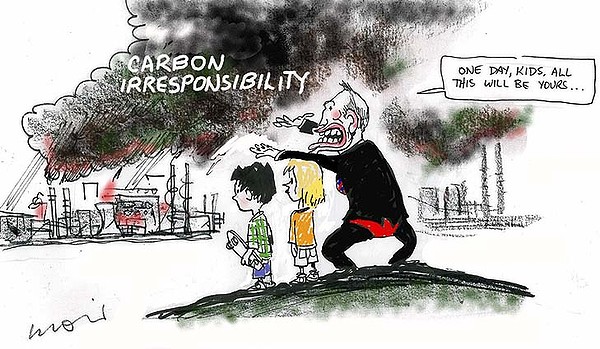
However, the Gillard Government's tactics on carbon pricing can be criticized. Lenore Taylor argues that Labor created the void and Abbott is busy filling it up with his great, big, new tax on everything. All we have in the public debate on making the polluters pay is 'lie' and 'tax'.
Rather than a reasoned debate about a substantive issue we have politicians, shock jocks and business people denounced “the carbon tax ” without seriously proposing to do anything about global warming.
Tony Windsor argues that one reason for this is the common view that the ALP and Greens are not selling the carbon price well. On a href="http://www.abc.net.au/lateline">Lateline Windsor said that the Greens and the Gillard government have jumped the gun in terms of the process:
I don't think they sold it too well, and my understanding as part of that committee was that the Climate Change Commission would in fact get out there and talk to the community, engage the community. And I think they've put the cart before the horse a bit here. They've sort of given the conclusion without a number, without a target, without a price, and then said that there will be a debate within the community. So, I'm not surprised that there's been a bit of a reaction to this.
Windsor's view is that the Gillard Government has brought a bit of this "people's revolt" upon themselves under pressure from the Greens and that's reflecting in the polls. One counter to this is that we have a form of policy gradualism by the Gillard Government with the shift from a carbon price to a carbon tax to a carbon trading scheme. The policy goal is an emissions trading scheme, which has been in Europe, with its 500 million people, since 2005.
Neither Windsor or Henry mention the way the media's shift to infotainment --its focus on scandal, spectacle, and the now moment of the “game” of politics--- is driving citizens away from public affairs, making it harder for reform minded politicians to do an effective job, and at the same time steadily eroding our public ability to assess what is happening and decide how to respond. It is the political media--as distinct from journalism that lie to us and then forgets it is a lie.
Posted by Gary Sauer-Thompson at 6:41 AM | Comments (5) | TrackBack
March 8, 2011
can a rustbelt Adelaide reinvent itself?
Can a rustbelt Adelaide reinvent itself with the decline in its manufacturing industry? Boston did. It was able to boost its economic growth by becoming a center of the information economy in the late 20th century. Human capital---a strong base of skilled workers---was the key to urban growth. The policy message is that as ideas and knowledge became more important in capitalism cities with skilled populations began to thrive.
Can Adelaide look like the future and not the past? Can Adelaide transform itself from a dying factory town to a thriving information city? In Reinventing Boston: 1630–2003 the American economist Edward L. Glaeser, the author of Triumph of the City, states that the story of Boston’s history yields the following implications about urban dynamics.
First, long run urban success does not mean perpetual growth. Long run urban success means successfully responding to challenges. The basic pattern of Boston’s history is that the city specializes in one area and inevitably either this area declines or their dominance in the area is challenged. The survival of the city hinges on re-orientation.
Second, Boston’s ability to re-orient itself hinged on industrial diversity.
Boston had never been just a port and from the beginning, artisans in the town had manufactured goods which were then taken on Bostonian ships abroad. As such, the switch from seaport to factory town required a large re-emphasis, but not inventing industry from scratch. Likewise, Boston’s seafaring commerce had always needed financial services, and as a result, the city had always had banks, brokers, and insurers. As Boston’s manufacturing declined, finance was able to take up its slack.Third, Boston’s ability to regenerate itself hinged upon its ability to attract residents, not just firms:
The American cities that grew because of proximity to productive natural resources, such as coal, have suffered tremendously over the past 50 years. When the demand for the key natural resource declined, no one saw any reason to remain in the city and they left. By contrast, from its earliest days, Boston existed not only as a productive center but as a place that people wanted to live: a consumer city. Because people wanted to live there, as well as work there, during times of economic trouble, residents innovated and stayed. In the coal towns of central Pennsylvania exodus, not innovation, was a more common response.Fourth, in all of its period of reinvention, Boston’s human capital has been critical:
today more than ever, Boston’s skills provide the impetus for economic success in technology, professional services, and higher education. Boston’s experience certainly suggests that human capital is most valuable to a city during transition periods when skills create flexibility and the ability to reorient towards a new urban focus.Educated cities grow more quickly than comparable cities with less human capital because they become more economically productive.
Lastly, city government has played an important role in Boston’s periods of both success and failure.
Glaeser's argument is that geography is especially important to the growth of post-industrial economies and so it is much better to push development in places where people and businesses actually want to move to or set up shop. Declining or struggling towns and cities where people and firms don't want to live should be encouraged to decline further.
Posted by Gary Sauer-Thompson at 9:14 AM | Comments (5) | TrackBack
March 7, 2011
US: showdowns and shutdowns
Robert Reich says that In the US there are currently around 13.7 million unemployed, the number working part time who’d rather be working full time is 8.3 million and the new jobs pay significantly lower wages with lesser benefits than the jobs lost.
Rich's argument is that though the proximate cause of America’s economic plunge was Wall Street’s excesses leading up to the crash of 2008, its underlying cause is so much income and wealth have been going to the very top that the vast majority no longer has the purchasing power to lift the economy out of its doldrums.
Paul Krugman on the Republican's job-killing short-run deficit reduction act gives the broader context of the policy response:
The bubble economy of the Bush years left many Americans with too much debt; once the bubble burst, consumers were forced to cut back, and it was inevitably going to take them time to repair their finances. And business investment was bound to be depressed, too. Why add to capacity when consumer demand is weak and you aren’t using the factories and office buildings you have?The only way we could have avoided a prolonged slump would have been for government spending to take up the slack. But that didn’t happen: growth in total government spending actually slowed after the recession hit, as an underpowered federal stimulus was swamped by cuts at the state and local level.
The years of high unemployment and inadequate growth are seeing the emergence of some economic recovery.
Krugman says that the clear and present danger to recovery:
comes from politics — specifically, the demand from House Republicans that the government immediately slash spending on infant nutrition, disease control, clean water and more. Quite aside from their negative long-run consequences, these cuts would lead, directly and indirectly, to the elimination of hundreds of thousands of jobs...Over the next few weeks, House Republicans will try to blackmail the Obama administration into accepting their proposed spending cuts, using the threat of a government shutdown. They’ll claim that those cuts would be good for America in both the short term and the long term.
The Republicans contend that the direct job-destroying effects of their proposals would be more than offset by a rise in business confidence. Their message is that bloated government is responsible for the lousy economy that most people continue to experience. Cut the bloat and jobs and wages will return.
Washington is currently headed for government shutdown with the House Republicans raising the alarm alarm over deficit spending and simultaneously squeezing popular middle-class programs. They say that they won’t budge on the $61 billion cut they pushed through last week. The Republican Tea Party Right wants total Democratic capitulation and they equate compromise with surrender.
The Obama administration tactic appears to give away the store before real bargaining even begins. The administration is proposing $50 billion in spending cuts -- halfway to the tea party's policy -- as his opening offer. These proposed cuts are in in programs the poor and working class depend on – assistance with home heating, community services, college loans, and the like.
The administration has yet to substantially challenge the Republican narrative on cutting spending now -- at the beginning of a fragile recovery -- will cost hundreds of thousands of jobs, slow growth, and fail to reduce red ink.
Posted by Gary Sauer-Thompson at 1:51 PM | Comments (2) | TrackBack
March 6, 2011
consumer empowerment?
Bruce Guthrie's ongoing troubles with Telstra raise the question why bother with them. ISP’s are the only entry point to the Internet and digital networks and Telstra's behaviour is that of a monopolist. Why not shift to an ISP that routinely provides better service?
The deeper issue that this saga raises is that we are dealing with the way that capitalism shapes the internet. The incentive is to “privatize” the Internet as much as possible, and to use their control over broadband access as a bottleneck where they can exact additional tolls on users. That is the argument for the “information superhighway” to be a public network analogous to the national or interstate highway system.
The tendency for capitalism is not towards cut throat competition and increased consumer empowerment --as proclaimed by the free market economists-- it is to consolidate monopoly power, create artificial scarcity, and erect fences wherever possible. Wired editor Chris Anderson put the matter succinctly:
Monopolies are actually even more likely in highly networked markets like the online world. The dark side of network effects is that rich nodes get richer. Metcalfe’s law, which states that the value of a network increases in proportion to the square of connections, creates winner-take-all markets, where the gap between the number one and number two players is typically large and growing.
Google is one example. Apple another. The latter's devices such as the new devices, such as the iPhone and the iPad, carry with them applications specific to a given device that are designed to lock customers in a whole commercial domain that mediates between them and the Internet.
The more that a particular device becomes the interface for whole networks of applications, the more customers are drawn in, and the exponential demand-side economies of scale take over. This directly translates into enormous economic power, and the ability to determine much of the technological landscape. Once such economic power is fully consolidated and people become increasingly dependent on a new device, network prices can be leveraged up.
Those within the walled garden are fleeced. The internet is not simply a generator of competition and consumer empowerment. Just as the internet is not impervious to control or censorship, and is just the tool of the democratic activism.
Posted by Gary Sauer-Thompson at 6:43 AM | Comments (3) | TrackBack
March 5, 2011
paying homage
I heard on Radio National Breakfast that when Julie Gillard goes to Washington to see President Obama she will also pay homage to Rupert Murdoch, who has just been given the green light by the Cameron Government in the UK to allow News Corporation to buy the 60% of BSkyB it doesn't already own BskyB.
 Steve Bell
What News Corp has gained by being allowed to takeover the rest of Sky, the UK’s largest cable network, is an ability to create a £7.5bn British media giant with access to the vast cashflows of the satellite broadcaster. The man who pretends to be a great free marketeer has built an empire almost entirely out of circumventing competition to throttle free markets. What Murdoch wants he gets.
As Steven Barnett observes in The Guardian yet another minister meekly surrenders to the media power of Rupert Murdoch's News Corp. It has been the story of the past 30 years of British media policymaking. Barnett says:
This deal will create a hugely powerful newspaper, TV, online and ISP media conglomerate that will dwarf every other media organisation in the UK, with guaranteed rising profits for years, on a scale that would not be contemplated in any other self-respecting mature democracy.
The concentration of media ownership continues. New s Corp defies regulators, governments and tax authorities to carve out an anti-competitive market dominance with an unmatched global concentration of media power.
As a result of the BSkyB acquistion Murdoch's global media empire has increased its stake in Sky News pay television channel in Australia. As Margaret Simons points out at Crikey:
Our local SkyNews is a joint venture operation, owned in equal thirds by BSkyB, Channel Nine and Channel Seven. Under the current ownership of BSkyB, this means that News Corporation owns just 39 per cent of one third of Australian Sky News. But assuming News Corporation takes over the whole of BSkyB, Rupert becomes an equal one third owner with Channels Nine and Seven, increasing Rupert’s domination of the news content business in Australia and creating a new field of interesting corporate manoeuvres with Kerry Stokes.
So we can expect more attacks on the ABC, and ABC24 in particular. What does Murdoch want in Australia? If Telstra exits Foxtel, then that creates an opportunity for News Limited to increase its stake.
Posted by Gary Sauer-Thompson at 9:02 AM | Comments (3) | TrackBack
March 4, 2011
keeping on trucking
If we make a distinction between the policy and politics of a carbon tax, then this article by Eric Knight in Fairfax's National Times is a contribution to the policy debate. He says:
The principle behind a carbon tax is that you cannot solve the environmental problem until you have solved the technological problem. A tax allows the economy to focus on new technologies first, and on achieving environmental parameters second...[an] emissions trading... works only once there is a flourish of affordable low-carbon energy technologies in the marketplace. One hopes the tax will achieve this, then - with more alternative energy sources available - the carbon price needed to change behaviour will be lower.
Lets push all the political theatre and noise to pressure and intimidate the independents into the background.

We can now see that Gillard is adopting the right approach to reform. The problem is that the politicians, obsessed with the politics of a tax on petrol, still have their heads in the sand over dwindling oil supplies and increasing oil prices. They continue to believe the oil company spin that oil will be squeezed out of the ground pretty much forever.
The reality is that the price at the petrol pump is rising, Australia is dependent on importing oil, the global oil price is increasing because because it cannot be produced fast enough. demand is projected to be greater than supply in the next 3-4 years (the peak oil crunch point) and no one thinks the long term price of oil is downward. We need to move away from oil – not just because it generates carbon emissions that are heating up the planet through global warming, but also because it is fast running out.
Canberra is doing little to build an alternative low carbon economy and infrastructure that will wean us off our dangerous addition to oil; it is doing next to nothing to reduce the subsidies to the fossil fuel industry. Consider the ACF’s recent comparison of the fossil fuel subsidies (red) versus climate change programs (green) in millions of dollars:

That is sobering. There in lies the reality behind the political noise and theatre. No doubt, with increasing pump prices, the various representatives of the haulage industry, vehicle manufacturers and motoring organisations will call for tax breaks to stabilise fuel prices--ie., taxpayers would effectively have to subsidise motorists. That does not help Australia make the shift to a low carbon economy.
The better policy is wean Australia away from foreign oil with a mixture of policies including tax rebates and cash incentives for electric cars, more car pooling services and improvements to public transport.
Posted by Gary Sauer-Thompson at 8:48 AM | Comments (6) | TrackBack
March 3, 2011
public debate in Australia
This is the contribution by SA Liberal Senator Mary Jo Fisher in the Australian Senate to the public debate about the Gillard Government's adoption of a carbon price to begin the process of reducing greenhouse emissions. It gives an support to those Australian citizens with some knowledge and understanding of public policy criticizing some politicians for being hollow.
The Gillard Government's carbon pricing policy is open to criticism from a number of perspectives. Alan Kohler in Business Spectator, for instance, says:
Just as Howard repainted the Liberals’ brand with a tinge of xenophobia in 2001, Julia Gillard is now slapping green paint on Labor’s logo.That is intention No.1 of the carbon tax. Intention No.2 is to raise an almighty barrel of pork for the 2013 election. Call me cynical, but I would say carbon abatement is intention No. 3 on the PM’s list, with daylight between two and three.
He says that Julia Gillard’s target in declaring war on carbon taxation is not the Coalition, but the Greens.The ALP’s greatest threat comes from erosion of its base by Bob Brown’s Greens. If that continues, Labor’s future as an independent political force looks very dim.
So the cash raised from the tax is going to be spent to help out the battlers and working poor and not the high income households. Cynical yes, but an argument worth considering.
Senator Mary Jo Fisher, in contrast, does not have a substantive argument. It's more akin to a comedy routine in the Adelaide Fringe, not a debate about public policy in the Senate, which is committed to deliberation and public reason on public issues.
Posted by Gary Sauer-Thompson at 12:37 PM | Comments (9) | TrackBack
March 2, 2011
Libya: civil war
From what I can gather the rebellion against the rotting Gaddafi regime in Libya has resulted in a divided country and civil war. Gadaffi controls the west whilst the rebels control the east, with the rebels aiming to take further territory away from Gadaffi's forces. Qaddafi’s regime is shrinking to the size of Libya’s capital, Tripoli and the rebel army is preparing to march on Tripoli.
Juan Cole points out that the problem that Gadaffi has is that some 80% Libya’s developed petroleum fields are in rebel-held territory and Gadaffi’s own foreign funds increasingly frozen. So his cash on hand to pay mercenaries and bribe clients will rapidly decline.
 Steve Bell
The neo-con's New American Century looks tattered with the aftershocks from the political earthquake. Their strategy was one in which Washington would utilise maximum US force, power and influence to create a Middle East obedient to the interests and objectives of the US that was geared to the preservation of the superiority of Israel and the utilisation of American hard-power to eliminate any threats posed to it.
The attitude of western states is one where public declarations of support from political leaderships disguise unease at the prospect of dealing with more democratic governments. The western relationship with regional autocracies is decades old---the islands of stability that the US has traditionally favoured---and these forms of government were not the e sort that the people of the Arab world have desired
Old habits die hard. These habits extend back to the condition of European coloniality and are at odds with the birth pangs of the first postcolonial nations emerging from the post-independent pathologies of European colonialism, when native tyrants replaced their European counterparts and for decades abused thei rpeop[le, banked on their fears, plundered their r resources, wasted their hopes, robbed them of their democratic dignity, and delayed any meaningful formation of sovereign and liberated nation-states.
Posted by Gary Sauer-Thompson at 12:13 PM | Comments (4) | TrackBack
March 1, 2011
climate change: the politics
I watched Question Time in the House of Representatives yesterday. I wanted to see how the ALP and the LNP were approaching the issue of reform and climate change as distinct from the free market think tanks such as the IPA.
In the heated atmospherics the Coalition had reduced the policy and the proposed architecture and timetable for placing a price on carbon---to the issue whether Gillard had lied about a carbon tax and they argued that she could not be trusted. We need an election now they all demanded. There was lots of mock outrage, faux anger and huff-and-puff that would play well with the conservative base's intense dislike of the "irrational" Greens (who represent the path to tyranny), and their assumption that the Coalition is just a hair's breath away from forming government this term. The ALP response was an assault on Abbott's character.

I guess the tactic behind the theatre of the various censure motions aims to put pressure on the "backstabbing" Independents (Tony Windsor and Rob Oakeshott ) to dump Gillard and force an early election. If so, then the tactic is misfiring badly, because the Gillard Labor government will last until the next election in 2013 and Gillard will lead Labor to the election.
Gillard has nailed her colours to the post: getting a carbon tax through both the House of Representatives and the Senate. Abbott's stance is to prevent this action being taken on climate-change-by throwing mud, and if he fails, then to roll it back in 2013 once he's elected. In saying he will turn back the clock he is pretending that nothing needs to be done about climate change and that there is no need to build competitive, low-carbon industries in Australia.
Everything indicates that Gillard will take the fight to Abbott---and that it will be a tough fight. The view of the commentators in The Australian's view is that Gillard is already losing the fight. It is the Coalition's scare campaign that has the momentum.
It didn't look that way in parliament.
Update
The policy issues are not being discussed. It is still a blank slate, as discussion on a comprehensive program has not even begun. Presumably, the policy goal is to achieve an agreed target reduction in emissions per capita (or some other benchmark) by 2020 and beyond. If so, then what is the target; what are the options for solving the stated problem; and what is the quantum of funding is required to facilitate the transitions?
What would the Australia of 2020 look like after the programs of the selected options have been implemented?
Posted by Gary Sauer-Thompson at 9:35 AM | Comments (15) | TrackBack