|
March 9, 2011
Ken Henry, when signing off as the Secretary of Treasury, delivered the Giblin lecture at the University of Tasmania. He made the following comment:
Today we find ourselves having avoided a recession that paralysed the rest of the developed world. We have low inflation, low unemployment, and a terms-of-trade boom that has, to date, boosted average living standards. How does one, today, communicate the imperative for action? That is the question.
His general answer is that there is not the same sense of urgency among our politicians as there was in the 1980s and that there is a sense of complacency in the broader community that hasn't put the political system under as much stress as there was in the 1980s. He says nothing about the dysfunction of our political system--its inability to solve big problems through our political system--or that Australian life is becoming more polarized.
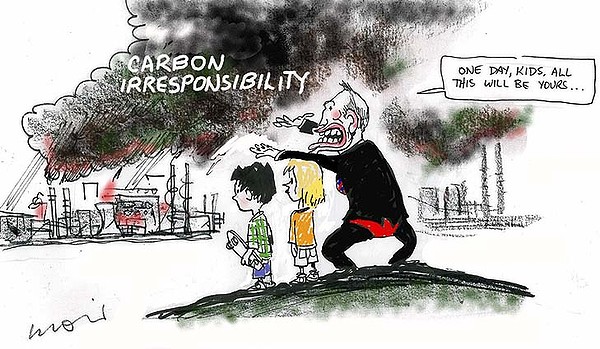
However, the Gillard Government's tactics on carbon pricing can be criticized. Lenore Taylor argues that Labor created the void and Abbott is busy filling it up with his great, big, new tax on everything. All we have in the public debate on making the polluters pay is 'lie' and 'tax'.
Rather than a reasoned debate about a substantive issue we have politicians, shock jocks and business people denounced “the carbon tax ” without seriously proposing to do anything about global warming.
Tony Windsor argues that one reason for this is the common view that the ALP and Greens are not selling the carbon price well. On a href="http://www.abc.net.au/lateline">Lateline Windsor said that the Greens and the Gillard government have jumped the gun in terms of the process:
I don't think they sold it too well, and my understanding as part of that committee was that the Climate Change Commission would in fact get out there and talk to the community, engage the community. And I think they've put the cart before the horse a bit here. They've sort of given the conclusion without a number, without a target, without a price, and then said that there will be a debate within the community. So, I'm not surprised that there's been a bit of a reaction to this.
Windsor's view is that the Gillard Government has brought a bit of this "people's revolt" upon themselves under pressure from the Greens and that's reflecting in the polls. One counter to this is that we have a form of policy gradualism by the Gillard Government with the shift from a carbon price to a carbon tax to a carbon trading scheme. The policy goal is an emissions trading scheme, which has been in Europe, with its 500 million people, since 2005.
Neither Windsor or Henry mention the way the media's shift to infotainment --its focus on scandal, spectacle, and the now moment of the “game” of politics--- is driving citizens away from public affairs, making it harder for reform minded politicians to do an effective job, and at the same time steadily eroding our public ability to assess what is happening and decide how to respond. It is the political media--as distinct from journalism that lie to us and then forgets it is a lie.
|




Don't blame the media entirely. There is a lot of justified reform fatigue in the electorate, which is beginning to see that the brave new world of a reformed Australia is divisive, unequal and, for many people, impoverished.
As far as climate change is concerned, we are all facing the wrong way. Ever since the Kyoto process caved in to US demands that market mechanisms be used to control emissions, we have suffered a plague of economists trying to control the process. Before about (from memory) COP 5, the EU was proceeding down a regulatory path for emissions control. Since then, that whole option has been erased from memory and we seem to believe that only market mechanisms are possible. We need to revisit the options of the early 1980s and tell the economists to go home.