|
March 17, 2011
The big concern of the pro nuclear lobby in Australia is that an attempt to rely on nuclear power and to build nuclear power stations to ensure energy security may well be stymied now because of the disaster at the Fukushima Daiichi nuclear plant in northern Japan.
The lobby had been hoping for a nuclear renaissance in the context of global warming after the Three Mile Island disaster in 1979, and the Chernobyl disaster in 1986, effectively shut down new commercial nuclear projects across the globe.
Their argument was that in order to address climate warming and to solve our energy security Australia needed to build a new generation of safe, clean nuclear power plants. If new-build nuclear plants was the most rational way to go, then the future bright for nuclear energy required easing the dark fears and anxiety amongst the public through education.
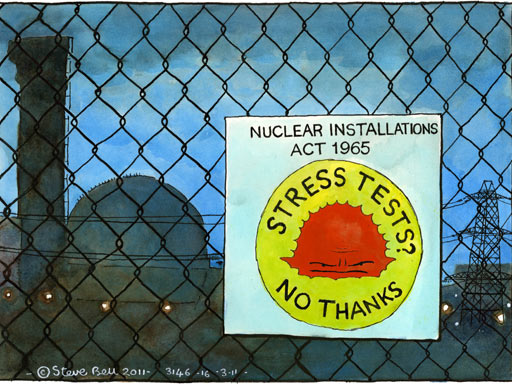 Steve Bell
Many in the nuclear camp---though not Barry Brook---are of the view that steering any investment toward alternative forms of renewable energy (wind, solar, geothermal) that would almost certainly be less dangerous and, possibly in the long run, cheaper is absolutely out of the question. Those who advocate this approach to a low carbon economy are dismissed as anti-nuclear and as prejudiced and so not rational.
So they end up trying to reassure us that everything at the Japanese plant was working according to plan and there was no real cause for concern and they critique the media for cashing in on the business and politics of fear. Advocates of nuclear power maintain that failure is very rare, that new reactors are safer, that the benefits outweigh the costs and that nuclear energy is a solution to the energy and climate crisis that is available immediately.
The problem I have is that many in favour of nuclear power are also deeply opposed to pricing carbon, either in the form of a carbon tax or an emissions trading scheme. Yet nuclear power is extraordinarily expensive, especially for a country like Australia that has neither nuclear power construction experience, nor regulatory infrastructure. There is no energy utility in the country that possesses the balance sheet to contemplate the scale of investment, let alone the risk that is attached to it.
The industry depends heavily on cheap, long-term loans, which usually need government guarantees; whilst the additional and massive cost of decommissioning reactors and storing radioactive waste is so great the cost burden must be borne by governments, not industry.
The problem that the pro nuclear lobby has is that they need what they oppose---a big carbon tax--- to get a nuclear industry off the ground in Australia. As the Switkowski report commissioned by the Howard government, pointed out in the absence of a substantial carbon price nuclear power is not competitive with coal. It states:
Cost estimates suggest that in Australia nuclear power would on average be 20–50 per cent more expensive to produce than coal-fired power if pollution, including carbon dioxide emissions, is not priced....Nuclear power can become competitive with fossil fuel-based generation in Australia, if based on international best practice and with the introduction of low to moderate pricing of carbon dioxide emissions.
The figures range from a minimum of A$25 to $40 per ton of carbon dioxide.
The contradictions in the conservative position don't matter. Believing in nuclear power is increasingly become a question of identity---rather than public policy--for conservatives, just as denying climate change has become a question of conservative identity. This then leads to the war on natural science.
The political reality is that no nuclear energy industry will emerge in Australia, or at least not for another decade or two. The push for a nuclear industry within a mildly reformist Gillard Government has been ruled out, in favour of investing renewable technologies and cleaner fossil fuels, whilst the Coalition won't go there in the short term, given their intense opposition to both a carbon tax and big government intervention.
The nuclear lobby are whistling in the wind. Their current energies at the moment will be taken up in damage control, as the poor public image of nuclear power has taken a battering.
Update
Tom Koutsantonis, South Australia's Minister for Minerals Resources and Development, has argued to the Paydirt Uranium conference, that it is now necessary to step up to the plate and argue for nuclear power in Australia.
In doing so he attacked the hysteria around the effects of radiation given the safety of nuclear reactors in Japan. There were no deaths from radiation unlike the thousands of deaths from the earthquake and the tsunami. South Australia, in his view, should be enriching uranium within 10-30 years and its storage in South Australia.
Kevin Foley, the ex -Treasurer of SA, then came out and backed Koutsantonis: mine it, enrich it, store the by-product, produce energy, and store the waste. The SA Labor Party is now officially divided.
|





"denying climate change has become a question of conservative identity. This then leads to the war on natural science."
The Coalition's opposition to the basic findings as to the reality of global warming and the threats of climate change has brought both a mainstreaming and a radicalization of antiscientific thought.
The conservative movement has decided to take on the scientific establishment. The war on science is seen as good politics.