|
July 10, 2004
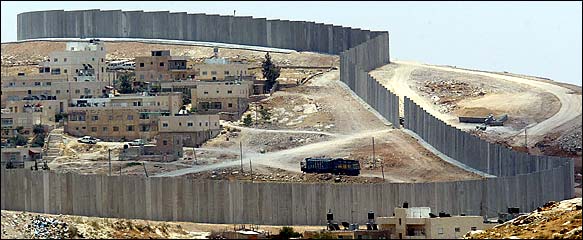
A stretch of the barrier that Israel is building in the West Bank, in the village of Sawahreh (Agence France-Presse—Getty Images).
Whilst Israel continues to build more settlements than it dismantles the International Court of Justice at The Hague has ruled against Israel's security wall.
The IJC has condemned Israel's West Bank barrier saying that it had illegally imposed hardship on thousands of Palestinians; that it is contrary to international law; and that with those Palestinaians who have already suffered because their land has been confiscated for the construction of 450-mile barrier should be compensated. The International Court held that the construction of the wall and its associate regime creates a 'fait accompli' on the ground that could well become permanent, in which case ... it would be tantamount to de facto annexation. It said that the wall should be torn down.
The ruling by the international court of justice is non-binding. The findings has already been rejected by Israel as politicised and one-sided. Washington has indicated that it will veto any security council resolution in support of enforcing the world court's decision.
What is significant about the ICJ ruling is that it sees the wall as a potential constraint on the Palestinian right of self-determination--something the Israeli High Court of Justice did not consider in its deliberations. About 120 miles of the 437-mile barrier have been completed since construction started about two years ago. Though parts of the fence, both built and unbuilt, run along Israel's pre-1967 border, a large part of the barrier's route is inside the Palestinian West Bank. It was this portion that was the object of the International Court's 64-page decision, and Israel's Supreme Court. The latter's ruling, which found the concept of the fence legal, ordered the rerouting of a portion of it because it caused too much hardship on Palestinians.

Protesting the Wall, Khalil Abu Arafeh, Alquds, 7/8/04
The key strategic question is: Does Sharon's security wall makes a viable Palestinian state impossible? The ICJ answered this. It acknowledged that Israel had "the right, and indeed the duty, to respond in order to protect the life of its citizens". However, the IJC also said that the path of the barrier could work toward creating a "de facto annexation" of Palestinian land by Israel through the creation of "a fait accompli on the ground that could well become permanent."
The wall arises because the Israeli right cannot accept a solution that abandons the core Israeli settlements in the West Bank. Hence we have Sharon's disengagement plans for the Gaza strip depending on accommodating the settlements in the West Bank. That puts into question the view that Ariel Sharon is fighting the good fight to withdraw Israeli troops and settlers from Gaza and struggling against recalcitrant rightwing Likud ministers to do so.
What is coming into the foreground is the view that Israel's absorption and Judaization of the occupied territories are increasingly rendering a two-state solution meaningless.
July 13
Eric Wilson, in this article in the Sydney Morning Herald, says that
the Israel barrier would be illegal if it could be shown to breach a treaty obligation of some kind. Does it? Wilson says:
"Here, the ICJ followed the lead of the Israeli Supreme Court, which grounded part of its ruling on the domestic status of both the 1907 Hague Regulations and the 1949 Fourth Geneva Convention governing the protection of civilians during wartime.
The ICJ went further and considered Israel to be in breach of two international covenants on civil and political rights, and on economic, social and cultural rights, both treaties deemed by the World Court to be of universal application.
If a fortification within a zone of occupation has a harmful effect upon any population disproportionate to otherwise lawful self-defensive measures, or there are discriminatory effects on the basis of ethnic identity, then it breaches international law."
Wilson says that this is the impact of Israel's barrier. "It restricts the rights and freedoms of Palestinians within their territory, while seeking to ensure that settlers on illegal settlements can enjoy those rights and freedoms."
|





The Warsaw Ghetto sticks in my mind everytime I see this wall.
The Israelis have certainly learnt from the Germans. I wonder what their next step is?