October 10, 2012
energy: a contested policy space
As Michelle Grattan notes the first three months of carbon pricing (she continues to calls it a carbon tax) have been an anti-climax even though Abbott seeks to keep the tax as centre of his campaigning. She also notes that climate change has turned from an emotional rallying cry to a practical policy challenge with all the accompanying difficulties.
That is a reasonable interpretation of the current state of play in Australia---the carbon price framework and the renewable energy target orients the country in the right direction, and they provide the long term predictability and stability necessary to decarbonize the economy. The immediate target is to get to 20% renewables by 2020.
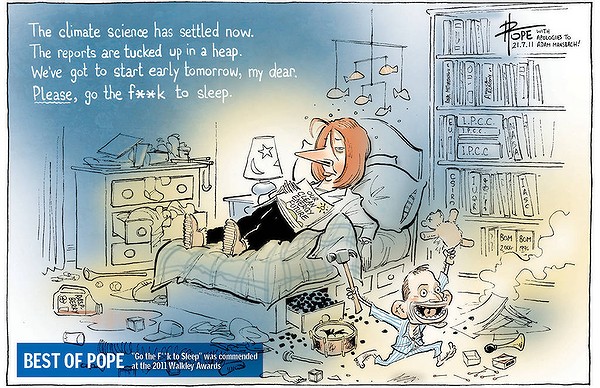 David Pope
What Grattan does not say is that the core policy issue has shifted to electricity and the growth of renewables. Energy has become a fiercely contested policy space due to the policy of phasing out fossil fuels and replace them with renewable energy and other forms of very low emission energy.
There is the large gap between wholesale and retail price of electricity; the fight against the increasing supply of renewable energy (wind and solar photovoltaic) to protect the interests of the fossil fuel generators; and the structural barriers in the way of renewable energy that have been created by the electricity market rules to protect the electricity market operators.
Big Energy is waging a fear campaign whilst the Gillard government’s ministers are fighting backroom battles among themselves (Martin Ferguson, the energy and resources minister, is pro-fossil fuels).
We know that the states have been increasing prices due to infrastructure gold-plating ----one sixth of our national electricity networks ($11 billion in infrastructure) caters for peak events that last for barely four days per year.
There is $45 billion that’s going to be spent in the next five years on new poles and wires and gold-plating the system. That means increased prices for consumers because the rules of the National Electricity Market allow the networks to pass on their costs by charging consumers for upgrading their infrastructure. This gold plating gives the states that own the fossil fuel generators (eg.,Queensland and NSW) a profit stream from the existing system. The Victorian government, which privatised its electricity generators has been captured by Big Energy.
These states are opposed to regulatory reform and the big energy companies have a exceptionally well-honed ability to game their system through strategic lobbying and because of the power they hold in Australia’s economy. To date, the costly and uneconomic nature of clean energy has been the most effective argument wheeled out by fossil fuel industries protecting their turf.
However, the problem they face is that rising electricity prices themselves is driving the installation of household solar and making their households more energy efficient. Reduced demand means reduced project for Big Energy. Solar threatens the existing business models of retailers and wholesalers.
Posted by Gary Sauer-Thompson at 10:09 AM | Comments (8) | TrackBack
August 27, 2012
Latham's long lunch with Robert Manne
Mark Latham is doing a series on interviews or conversations over a long lunch for the Australian Financial Review. The latest conversation is with Robert Manne, who says that on a range of issues, the left is in retreat. So where did it all go wrong?, Latham asks. Manne's response is:
Many of the problems of the left come from the 70 years it lost in supporting the failed totalitarian ideals of communism. You need to go back to the Russian Revolution to understand this failure. In practice, the left has only had 20 years to think clearly about the important issues of our time. Intellectually, neo-liberalism has filled the gap, with no alternative way of thinking about economic and social policy positions. In dealing with global warming, this has been devastating.
Manne sees climate change in terms of market failure, the inability of advanced capitalism to address the environmental consequences of carbon-based production. He says that there:
are two worlds in this debate. One concerns the findings of the scientific community, which are difficult to dispute. The other world is in public opinion. I think people were supportive of addressing climate change until they saw how it involved a strong element of personal sacrifice. Then they backed away. Realistically, there is no sign of the gap between climate science and community willpower closing. I’m very pessimistic....This is where the lost decades under state socialism have been so debilitating. The left hasn’t developed an alternative economic model and narrative to counter climate change denialism.
This is pretty bleak, since what has been developed is the idea of sustainability through a shift to a low carbon economy through an extensive use of renewable energy to replace fossil fuels.
The mechanism is putting a price on carbon to reduce greenhouse gas emissions and then shifting to an emissions trading scheme--the market is the servant not the master. People are putting solar PV on their rooftops and in some states, such as South Australia, wind power is a significant producer of energy.
So it is not black and white as Manne maintains, with his duality of scientific community versus public opinion. The current situation is much more nuanced in that the shift to clean energy has begun in spite of the hostility of the conservative/right wing commentators who dominate the popular mainstream media.
Posted by Gary Sauer-Thompson at 12:30 PM | TrackBack
August 14, 2012
rising sea levels: SA
Climate change policy is usually understood in terms of cutting the carbon pollution from coal-fired power stations and from cars, trucks and other modes of fossil-fuelled transport and making the shift to renewable energy. According to this briefing paper increasing the amount of renewable energy in our electricity supply system, or increasing patronage of public transport would act to reduce the health-damaging pollution from these sources while also reducing greenhouse gases.
At a public policy level it is also about dealing with the consequences of climate change that are starting to effect Australia. One consequence that affects South Australia is lower rainfall in the Murray-Darling Basin. Hence the need for a climate adaptation strategy to deal with the consequences of less water in the Basin.
Another consequence of climate change is rising sea levels along the coastline. Around 80 per cent of the Australian population live in the coastal zone and the concentration of Australia’s population and infrastructure along the coast makes us particularly vulnerable to climate change impacts, especially sea level rise.
We have some acknowledgment of the effects of climate change in the form of rising sea levels on the coastline of South Australia. Adam Gray, the senior policy officer at the LGASA, has argued in a submission to a Productivity Commission inquiry into Australia's preparation for climate change that a "retreat" from some foreshore areas on the South Australian coastline because of rising sea levels is a reality.
Gray says:
It's not feasible to protect any longer. We're also talking about retreat, and so no longer are we going to be able to say to some of our community members that enjoy the views on our esplanades that this land is still going to be here in 50 to 80 years. Protection works are only going to get us so far.
The most vulnerable sites in the state are older canal developments along the coast. Other areas considered vulnerable by previous reports are Port Augusta, where a levee protects some of the town, Hindmarsh Island, Robe, parts of the West Torrens Council area, St Kilda, Tumby Bay, parts of Holdfast Bay, Port Pirie, and the cliffs at Port Willunga.
The Productivity Commission ---has published an issues paper in its inquiry into Barriers to Effective Climate Change Adaptation. This states that Australia’s climate is projected to change significantly over the next century. Estimates suggest an increase in annual average temperature of between 1.8°C and 3.4°C on 1990 levels by 2070.
It adds that while the magnitude and timing of climate change will depend on future emissions, the potential impacts are significant, wide ranging and uncertain. These include:
· Sea-level rise coupled with storm surges could lead to increased erosion and flooding for coastal properties and infrastructure, and a loss of beaches.
· Increases in the intensity and/or frequency of extreme events such as heatwaves, drought, hailstorms and bushfires may place at risk public infrastructure, private property, human health and safety, and economic output.
· Higher temperatures and other factors could impact human health, for example, by increasing risks associated with the transmission of mosquito-borne, food-borne and water-borne infectious diseases.
· Reduced rainfall and higher evaporation rates could negatively affect water supply in many parts of Australia.
· A range of competing factors could have positive or negative effects on agriculture, which could vary significantly by commodity and region.
· Higher sea surface temperatures may lead to more frequent mass coral bleaching, causing loss of habitat and biodiversity in marine ecosystems with flow-on effects for coastal tourism. Higher temperatures, more variable rainfall and a range of related factors could also lead to significant loss of habitat and biodiversity in other ecosystems.
Effective adaptation may help to manage these impacts. By climate change adaptation the Commission means actions to adjust to climate change and this is understood as likely to involve reducing the harmful impacts of climate change, but in some cases it may also mean exploiting potential benefits.
Posted by Gary Sauer-Thompson at 11:40 AM | Comments (6) | TrackBack
July 27, 2012
Liberals: energy policy
It is becoming increasingly clear that the Liberal Party's energy policy is designed to protect the fossil fuel (coal and gas) industry.
Their main line of attack is that wind or solar are not able to supply much more than their current 3 per cent because they couldn’t provide baseload power, are expensive and unreliable. The tactic is to delay or slow the deployment of renewables, and to keep them locked into pilot studies, research and development and niche markets. Behind this sits the next line of defence: a campaign against the idea of anthropogenic climate change, wind farms and solar PV.
The tactic here is sow doubt in the public mind about the credibility of the scientific warnings and the need to respond. For instance, they argue that solar PV has taken off only because of the poorly designed political quick fixes with tariffs imposed by populist Labo) state governments. These are unsustainable schemes that were shifting enormous costs on households that do not have solar.
If the less ideological defenders do not reject the principal conclusions of climate science, then they work to water down the implications, and to boost “sensible” and cautious economic solutions that would allow the continued exploitation of fossil fuels. This would ensure ongoing economic growth, prosperity and jobs.
Posted by Gary Sauer-Thompson at 2:28 PM | Comments (6) | TrackBack
July 5, 2012
blaming the carbon tax for price hikes
Companies have already started started to make misleading price claims about the impact of the carbon price. The impact of the carbon tax on small businesses will be modest--around $4 or $5 a week for a very small business.

The Australian Trade and Industry Alliance is an anti-carbon tax group that has claimed that the price of electricity would rise 20 per cent immediately and up to 400 per cent by 2019 because of the carbon price. The group is made up of the Minerals Council of Australia, the Australian Chamber of Commerce and Industry, the Australian Coal Association, the Australian Retailers Association, the Housing Industry Association and Manufacturing Australia.
They have been part of the sustained campaign of fear and disinformation around climate change and the carbon pricing that has resulted in the whole field of climate policy in Australia becoming so polarised.
What is going to happen is that the dirtiest fossil fuel power generating capacity in Australia will be closed down by 2020. The plants under consideration are Hazelwood, Yallourn and Energy Brix in Victoria, Playford B in South Australia and Collinsville in Queensland.
Posted by Gary Sauer-Thompson at 3:41 PM | Comments (4) | TrackBack
February 6, 2012
Australia: generating electricity with near-zero emissions?
The Grattan Institutes recent report on renewable energy--No easy choices: which way to Australia’s energy future? --- makes a familiar argument about how our energy is produced in a world climate change and the need for an energy transition.
The age of cheap oil and cheap coal is over and economic growth that increases GDP at the expense of our natural capital, is now “uneconomic growth”. The Australian economy is about to go through one of the most dramatic transformations since the industrial revolution. This will be driven by the need to act on climate change, energy security and resource scarcity.
The argument is that Australia must substantially and relatively quickly change the nature of its electricity supply. It must shift to clean-technologies that generate electricity with near-zero emissions, given that the Commonwealth’s goal is to reduce Australia’s greenhouse gas emissions to 80% below 2000 levels by 2050. The study says that these new, low-emission technologies are wind, solar PV, geothermal, nuclear, concentrating solar power, carbon capture and storage and bio- energy.
Some then say that technology will save the day. By this they mean that technological innovation will always extend resources and reduce prices through efficiency gains and substitution. It's the mastery of nature argument.
The Grattan study states that it is widely accepted that the federal government's emissions trading scheme will change the behaviour of Australian businesses, especially those in the energy sector. For instance, in the short-term, the scheme will make gas prices competitive with coal, and investment will shift accordingly. So an energy transition is under way. But gas will not deliver the emission reductions required and is at best a bridging technology.
However, it adds, what businesses will not do, under the current policy mix, is to invest in new, low-emission technologies – at least not to the degree which many hope and expect. As a result, Australia is at grave risk of not being able to meeting its carbon emission commitments by 2050 while at the same time keeping electricity affordable.
The report argues that any one of these technologies has the potential to be scaled up sufficiently to play a role in meeting Australia's energy needs. However, all face major obstacles to achieving their full potential, and none can deliver the bulk of Australia's needs alone. Despite current projections, it is possible that none of the technologies can produce power at a scale and at costs similar to today’s electricity.
In other words existing policies will not on their own produce the transformation in energy that we need.The carbon pricing scheme, while a good start, is not enough. So what is to be done? The report argues that:
Markets must be the primary mechanism by which Australia reduces its emissions.To ensure markets work properly, government must also remove barriers to deployment of several technologies, such as transmission connection hurdles and subsidies to incumbent technologies.
The current regulatory regime is designed to favour the incumbent gas and coal technologies; and these are supported by between $8 billion and $9 billion of annual subsidies. Imagine the resistance and opposition from the mining and coal interests and their allies to further government intervention to remove these subsidies.
If that is not enough, the report makes another point:
Yet even then, it remains unlikely that enough funds will be invested in the short term to give any of the low-carbon technologies a chance to deliver ... Governments should therefore support research and development in areas of national interest, and demonstration and early-stage deployment of a suite of technology options.
The battle lines over clean energy finance are being drawn up.
The Grattan report says that says regulatory reform is essential if the national electricity grid is to integrate sources such as solar, wind and geothermal, and not merely serve to protect incumbent gas and coal generation. Right now, the grid is designed essentially to connect major coal basics to capital cities. It needs to evolve to include wind and solar and other sources, and it needs to get smarter--- ie., substantial new transmission capacity is necessary including greater interconnection capacity between state regions to cater for variability in wind and solar.
Australia has just taken a few hesitant steps down the path of energy transformation, and it's political institutions have been convulsed by the effort. Imagine the effect the necessary policy interventions beyond the emissions trading scheme is going to have on them. Imagine the resistance and opposition to further intervention to support renewable energy from the mining and coal interests and their allies. This energy transformation is going to be a long and bitter battle.
Posted by Gary Sauer-Thompson at 3:23 PM | Comments (4) | TrackBack
December 9, 2011
UN climate change negotiations: Durban
Will there be a deal on climate change at the United Nations Climate Change Conference, (COP17) in Durban, South Africa, to reduce the rising greenhouse emissions and to replace the Kyoto protocol?
The European Union's roadmap towards a new global agreement is on the table: under the plan all the world's major emitters – both developed and developing countries – would negotiate a new pact or treaty in 2015 to cut emissions substantially from 2020. A new international legally binding treaty, would come into force in 2020.
If there is no roadmap, and the EU withdraws its support, the Kyoto protocol would effectively be dead. Without a clear timetable and the end result of a legal treaty, there is a fear that any deal at Durban would amount only to a commitment to keep talking. In the absence of legally binding commitments and a strategy to raise ambition, we can kiss 2C warming above pre-industrial levels goodbye as we will be on a pathway to 3.5C warming or worse.
Australia has said that it would sign up if the major emitters did--ie. the US, Russia China, Japan and India. India is opposed to a roadmap whils tyhe US and China are in their familiar standoff. The the US came to Durban with a mission to prevent any new commitments before 2020. The US's dysfunctional political system will almost surely keep them from being part of the eventual new agreement. They haven't even ratified the Kyoto Protocol.
Posted by Gary Sauer-Thompson at 3:34 PM | TrackBack
July 17, 2011
Keating enters the carbon debate
Paul Keating on Lateline last week highlighted how a carbon pricing will enable the allocation of capital to the new growth industries that will emerge from the increased price on carbon. These represent Australia's future, whereas the coal fired power stations are part of the old industrial revolution.
Keating's argument is that it is prices and markets that shift the big things and that the new industries are the key new growth industries:
We won't have them here. I mean, the idea here that we turn our back on the new country, on the new transforming Australian economy, by not letting carbon be priced and therefore capital allocated properly is nonsense .... Manufacturing's moved to the east. It's the service industries are the new growth industries. So, to turn your back on the mechanism which allocates the capital out of the old industries and into the new ones is to turn your back on your future.
That is the big picture argument that keeps being forgotten and is rarely explored or evaluated in the media.
Keating also raises the issue of the media's poor performance in the analyzing this big reform with its "he said she said" style of reporting and adds that News Ltd is campaigning for regime change in Australia. Tony Jones avoids the issue of the media's poor performance in analyzing this reform to talk about Murdoch.
When is the media in Australia going to become self-critical about its obvious flaws? Apart from its "How much will you pay, and how much will you get back?" response to the carbon tax package a lot of of the media has more to do with mass deception of the public than with truth---isn't the media's motto the fearless advocacy of the truth?
It is true that the carbon package on its own will not bring big reductions in emissions in the short term, but it can be seen as the first step on the long road to a lower-carbon economy.This is a long term reform process.
Posted by Gary Sauer-Thompson at 1:33 PM | Comments (13) | TrackBack
July 13, 2011
political hubris
Abbott is obliged to keep shifting his ground on the carbon tax as the carbon tax deal undercuts his "we will all be ruined" rhetoric. That campaign now looks to be one based on mass deception, misinformation and lies.

Abbott's current fall back position when the media bothers to confront his lies---eg., that the carbon tax would wipe steel towns such as Whyalla "off the map"--- is that the Gillard Government cannot be trusted. The deceptive claim doesn't carry the same weight.
So those on the right who are opposed to a carbon tax have to find new reasons to oppose it now that it is clear that the sky wont fall in. They are trying out over compensation.
As Peter van Onselen points out Abbott's own response to green gas emissions is a bundle of contradictions:
He'll have significant tax cuts of his own we are told, just without the carbon tax which pays for them. He scoffs at the value of a 5 per cent emissions reduction target by 2020, even though the target is bipartisan and underpins Coalition climate change policy. He won't cut emissions as part of his direct action alternative by purchasing abatements from overseas, even though, without doing so, hitting the 2020 target would be nigh impossible under direct action. And that means the costs of direct action will go sky high, or it will be a multi-billion dollar exercise in window dressing that is never expected to meet the reduction targets.
Abbott's policy is window dressing and cannot be taken seriously.
The Institute of Public Affairs (IPA) is still banging the old Chicken Little fear drum. They aim to stop the green juggernaut because it will suffocate the economy with economy killing measures that will result in economic stagnation. Stuff the shift to a low carbon economy. Let Big Coal rule. Ignore the negative externalities and market failure.
Posted by Gary Sauer-Thompson at 1:00 PM | Comments (2) | TrackBack
July 11, 2011
carbon tax: going slow
The various Australian industry lobby groups (Australian Chamber of Commerce and Industry or ACCI, the Australian Coal Association and the Australian Industry Group) some free market economists and conservative politicians have beaten up the carbon tax big time as a radical and painful measure that would lay waste to the economy.
Australia's media bears some responsibility for perpetrating this deception in that they failed to investigate and critique the cartoon doom and gloom images about economic ruin:

Despite Australia being the world's 10th biggest aggregate emitter, with the world's highest per capita emissions, our mitigation effort and short-term target (a cut of minus 5 per cent below 2000 levels by 2020) are among the weakest among all industrialised and major industrialising nations.
And there are heaps of subsidies and compensation to ease the political fallout on the Gillard Government by showing that Abbott’s big scare campaign about the cost of living has been wrong and to deprive him of the chance to offer his own tax cuts.
The economic reality is otherwise and the ground underneath the Australian industry lobby groups and the conservative politicians has been effectively undercut. Their lines of "a toxic tax ", "socialism masquerading as environmentalism", economic ruin, recklessly shooting our wealth-creating industries in the foot etc etc now sound decidedly hollow.
It is the free market economists who are quick of the mark to create doubt about this first step to a low carbonb economy. For instance, Sinclair Davidson says at The Drum that Treasury modelling relies very heavily on assumptions about technology. Consequently,
Electricity generation is expected to move from being predominately coal-generated to renewable energy with some coal being used in combination with carbon capture and storage technology. Right now that technology is not viable; Treasury assumes it will be viable after 2021. Renewables are expensive and unreliable. Treasury imagines the greatest growth will be in geothermal energy – again a technology that is unproven.
Davidson comments:
Of course technological improvements occur all the time and these technologies may well be viable in future. Yet the Government is betting our economic prosperity on these technologies becoming viable in the very near future. If those assumptions do not work out, electricity prices will be very high and very likely Australians will experience rolling black-outs. This is a policy that undermines our domestic energy certainty.
The message? It's too risky. The lights will go out. So the deal fails. What has happened to the Hayekian idea of markets and innovation? What has happened to an analysis of the public policy that addresses this risk--eg., the investment fund to facilitate innovation ion the renewable industry?
Judith Sloan's response is that to the target of a reduction of 5 per cent by 2020:
the wildly inefficient schemes – particularly the subsidisation of small-scale renewable energy and the appalling Mandatory Renewable Energy Target – will be required to do the heavy lifting in order for the target to be met..Indeed, it is a case of a major opportunity foregone – to replace the melange of inefficient schemes with a carbon tax...The explanation, of course, is politics. The only way to get the Greens across the line with a 'low and slow' approach to the introduction of a carbon tax was to continue, indeed bolster, the concoction of visible, feel-good but costly schemes.
Her judgment is that it is:
Better to feel you are doing good rather than actually do good, seems to be the message. And when billions of dollars of other people's money can be directed to your mates in the renewable energy industry and the research community, the package all of a sudden makes sense. Hence the creation of ARENA – the Australian Renewable Energy Agency – clinched the deal.
The inference? Corruption!
Sloan does not mention that Australian Renewable Energy Agency (ARENA) and the Clean Energy Finance Corporation with its $10 billion for innovation in renewable and clean energy--- will be placed out of the hands of politicians. They are independent and will sit beyond ministerial interference.
The unspoken assumption of Davidson and Sloan economics is that the governments have the ability to destroy economies and that interventionist politics undermine economic prosperity. There ought to be less not more regulation with respect to energy markets. Heavy-handed regulation by hands-on apparatchiks, undermines investment and the rewards for risk taking in business.
Posted by Gary Sauer-Thompson at 9:15 AM | Comments (7) | TrackBack
July 10, 2011
carbon tax: ALP's neck on line
The Gillard Government's carbon price deal was announced today. The $23 per tonne price er tonne price, which kicks in on July 1 next year, is a modest start to a "clean energy future" as it not a sufficient incentive for new investment in clean energy, which becomes competitive at $40 or more.
The 500 highest polluting businesses will pay the carbon price - which will increase by 2.5 per cent above inflation until July 1 2015 when a market-based emissions trading scheme will kick in.

There is compensation everywhere. There is $9.2 billion over three years for trade-exposed industry, with emissions-intensive industries such as aluminium, zinc and steel manufacturing getting more than 94 per cent of their carbon permits for free. There is a $300 million package to support jobs in steel manufacturing by encouraging innovation, and another $1.3 billion towards rewarding coal mines that reduce their emissions.
The burden of taxation is shifted from individuals, communities and jobs to dirty industries in order to encourage greater resource efficiency and minimise carbon pollution.
Some 90 per cent of households will get tax cuts and/or extra payments. Though the introduction of a carbon price will cost households an extra $9.90 per week on average, the average assistance will be $10.10 per week, according to the Federal Government's modelling. Gillard will use the carbon tax to usher in tax reform, tripling the tax-free threshold to encourage low and middle income Australians into work while shielding them from price rises.
There is no doubt that this plan will get through the Parliament.
Will it help Labor get re-elected? To survive the next election it will have to win seats. So it has to protect itself by avoiding consumers finding themselves out of pocket, coal mines and steel plants closing, and the lights going off if the generators shut down? To survive the next election it will have to win seats. So the scheme's design aims to counter Abbott's political scare and the alarm of industry facing pressures arising from the high dollar and weak domestic demand.
In The Australian Paul Kelly says:
Much of Labor's problem lies in the climate change lobby and Greens that define this issue: for too long they patronised people over climate change "virtue", championed schemes that were rip-offs and were contemptuous of legitimate public concerns about higher power costs, jobs and competitiveness. Seen in context the public backlash is completely understandable. Abbott was handed a political opening and he made the most of it. The backlash Abbott now cultivates is deeply embedded. It will not easily fade because it reflects underlying cultural and economic forces. It is by no means obvious that the public, when it sees the details, will say: "OK, we're now reassured."
Labor’s re-election will rely on its ability to sell the package and implement it. Abbott campaigns against Labor adopting the mode of a traditionalist Labor leader, his aim being to smash the post-Whitlam voting alliance that has made Labor successful in recent decades. So Abbott chases the blue-collar, manufacturing, resource industry and lower-middle-class ALP vote and his appeal stretches from an update of the Menzian "Forgotten People" to hip-pocket resistance to new taxes and hostility to green philosophy.
Posted by Gary Sauer-Thompson at 7:10 PM | Comments (5) | TrackBack
July 8, 2011
black, brown, green
Will we see the Greenhouse mafia starting to lose their grip on Canberra now that the Gillard Government starts to sell/market the carbon tax deal to the public? This reform is about changing our everyday practices and the structure of the country's fiscal and industrial systems. Do we want to change our lives? Or should we say no, which is what the Abbott led Coalition says we ought to do in the name of common sense?
From what we know from the leaks, the deal looks to be more of a political fix, rather than a substantive contribution designed to reduce Australia's contribution to climate change.

As is well known the solar and wind industries were given the run around by successive governments in Canberra as Ministers there and in the state capitals 'freezed out' renewables companies and caved into the coal industry, giving it everything it wanted.
This political corruption, whereby the fossil fuel industry had improper influence over the energy policy of both major parties and the public service, was exposed and termed the Greenhouse Mafia by Guy Pearce who highlights how Australia's coal export emissions keep on growing.
Australia is attempting to step towards a clean energy future with a modest scheme, imposing modest costs on households and businesses to achieve modest reductions in emissions. Will this carbon price policy turn around her government's low polling and restore public faith in her leadership?
Are things changing?
If Labor is saying that ticking the carbon price box constitutes an effective climate change response, then it only re-embraced climate change policy as part of the price of forming minority government. However, unlike the earlier attempt at an emissions trading scheme, the deal to get it through the Parliament has already been done.
On the other hand, Martin Ferguson, the Minister for Resources, remains captured by the coal industry. He runs down solar, spruiks for coal, and talks up nuclear. Australia for Ferguson is coal --both in terms of exports and in expanding production on other continents
Steadfast backing for coal exports, faith in ‘clean coal’ and increasingly bipartisan and bipolar flirtations with nuclear power block the way to a real renewable energy boom, instead of the pretend one we have now. While a carbon price is necessary for an effective climate change response, it doesn’t guarantee one.
Labor is still determined to protect the biggest-emitting industries from the effects of its carbon tax. It looks as if this another tentative, token and ineffective proposal tax; its a green wash designed to tarnish The Greens whilst renovating Labor's hollowed out environmental credentials.
Posted by Gary Sauer-Thompson at 2:36 PM | Comments (4) | TrackBack
June 29, 2011
mass deception
One of the big deceptions currently circulating through the mainstream media is that the ongoing rise in the electricity prices is linked to a carbon tax. Prices are rising at a rapid rate, there are more increases in the pipeline (electricity prices are predicted to increase by at least 100% from 2008 levels by 2015), and the carbon tax will keep on being increased.
The inference is that the carbon tax is the reason for the increases in electricity prices even though the carbon tax is non-existent and the main cause of the price rises is a massive surge in electricity network investment. Others say that it is due to solar power (feed-in-tariffs) and the Federal government’s Renewable Energy Target (RET). Therein lies the mass deception of the public.

The grid of the national electricity market is being renovated and extended in order to increase the supply to meet the projected increase in consumer demand for electricity--"keeping the lights on." Peak demand is growing faster than baseload demand, and that is largely driven by increased purchases of airconditioners.
The public policy emphasis is on increasing supply---including goldplating (overinvestment in infrastructure by electricity network companies) --not on reducing demand by making our homes and building more energy-efficient and so reducing peak demand. More money is being spent on poles, wires and substations and not enough on demand-side initiatives like demand management and energy efficiency in homes and offices.
The regulatory structure of the National Energy market discourages cheaper and more reliable demand-side solutions like demand management and energy efficiency, while rewarding supply-side solutions like network augmentation and centralised supply.
Even though Australia's electricity system is the main cause of our excessive greenhouse emissions but there is no consideration of this, or the cost of greenhouse emissions to the economy, in the design of the market. Simply put the rules of the National Electricity Market (NEM) are inappropriately focused on the supply of coal-fired electricity at the expense of energy savings and renewable energy technologies.
The National Electricity Market Objective is set out in Schedule 7 of the National Electricity market law, and it states that the objective of this Law is to promote efficient investment in, and efficient operation and use of, electricity services for the long-term interests of consumers of electricity with respect to:
(a) price, quality, safety, reliability and security of supply of electricity; and
(b) the reliability, safety and security of the national electricity system.
the components of the objective are fundamentally about the supply of electricity itself, irrespective of other consequential impacts associated with the electricity market, such as emissions of pollutants, or any legal rights to levels of service; or the de-carbonisation of the electricity sector.
One of the major obstacles to energy reform continues to be a culture which favours traditional 'build' engineering solutions and which pays little more than lip service to alternative options and the lack of an environmental objective for the NEM. So we have market failure. Hence the need for a sufficient carbon price signal.
Posted by Gary Sauer-Thompson at 8:47 AM | Comments (3) | TrackBack
June 25, 2011
green growth
Those on the political right who both deny the science that informs us that the greenhouse emissions are produced by economic activity have caused global warming, and who oppose using market mechanism to help reduce greenhouse gas emissions, basically argue that saving the planet will destroy the economy.
It's a simple message or slogan, that is endlessly repeated in News Ltd's newspapers, and it overlooks, misrepresents, or refuses, to acknowledge the emergence of what the UN calls a green economy or the OECD calls green growth. This concept has moved into the mainstream of policy discourse.
As Michael Jacobs in An idea whose time has come at Inside Story observes:
these terms – green growth, low-carbon growth, the green economy, green development – are being used to convey a simple but potentially radical idea: that environmental protection and the reduction of carbon emissions need not be at the expense of economic growth but can actually contribute to it. ago ....At its most basic it derives from the recognition that a key route to protecting the environment is to use resources – energy, land, water or whatever – more efficiently. This is essentially a form of productivity improvement: getting more output for less input. So long as this is done at a relatively low cost – particularly by using market mechanisms to encourage firms and consumers to change their behaviour – it should help growth not hinder it. It’s true that the growth generated by raising resource productivity can lead to new emissions and more environmental impact, but the evidence shows that the total impact almost always remains environmentally beneficial.
The more informed business-as-usual News Ltd journalists basically argue that though green spending can stimulate growth, it just stimulates less growth than the brown alternative. Low-carbon energy is more expensive, so the costs will be higher and the returns less. More economic growth is better than less growth.
The problem here is with business-as-usual. What if there is no “business as usual”? Jacobs says that:
If – as is now widely expected, and indeed may already be happening – failure to take action on climate and the environment in practice leads to effects such as rising oil and fossil fuel prices, greater water scarcity, lower agricultural productivity, declining fish stocks, more frequent extreme weather events, and so on, then the base case against which the green growth path needs to be compared may be rather different from what has generally been assumed.
he says the modelling shows that the “green investment” scenario starts off generating slower growth than the base case. But by the second half of this decade this has reversed, as growth rates in the base case start to decline under the impact of environmental pressures. By 2030 and beyond, the “growth dividend” of the green investment scenario becomes quite marked.
Posted by Gary Sauer-Thompson at 11:01 AM | Comments (2) | TrackBack
June 14, 2011
global 'weirding'
The Guardian has an article on the "new normal" of the extreme weather in Europe that is being explained as the result of the adverse effects of climate change.The drier springs and hotter summers that are currently being experienced in Europe is what can be expected in a warming world due to rising concentrations of heat-trapping greenhouse gases in the atmosphere caused by human activities.
Sceptics argue that there have always been droughts and floods, freak weather, heatwaves and temperature extremes--it is just part of the natural order of things--and they discount the trend of record highs and record lows.
 Gary Sauer-Thompson, erosion, Victor Harbor, 2011
In my own local ecosystem in Victor Harbor I notice the sand dunes along a favourite beach on our poodlewalks increasingly being eroded from the rising tides. The sand comes and goes say the sceptics. It's no big deal. Nature works in cycles.
For climate scientists the extreme weather events---the climate is more dynamic and violent--- are occurring more frequently, their intensity is growing, and the trends all suggest long-term change as greenhouse gases steadily build in the atmosphere.
Posted by Gary Sauer-Thompson at 11:54 AM | Comments (11) | TrackBack
May 31, 2011
Garnaut Review 2011
In his final report ---Garnaut Review 2011--- Ross Garnaut says that an historic choice confronts Australia in its goal to reduce greenhouse gas emissions. So what domestic policy response should we take? It's an important question because Australia's trajectory to 2020 is now for its emissions to grow to 24 per cent beyond 2000 levels.
Unfortunately, the political debate in Canberra has not been about this as it has been built around a populist scare campaign by vested business interests backed by the Coalition. Garnaut says that there are two basic approaches to achieving the required emissions reduction: a market-based approach, built around putting a price on carbon emissions; and a regulatory approach, or direct action.
In the market-based approach, carbon can be priced in two ways. Fixed-price schemes, or carbon taxes, set the price and the market decides how much it will reduce the quantity of emissions. Floating price schemes set the quantity of emissions and permits to emit are issued up to that amount. The permits are tradeable between businesses and so the market sets the price. There are various hybrid approaches that combine fixed prices for a period with floating later on, and floating prices at some price levels with a price floor or a price ceiling or both.In the alternative route, regulation or direct action, there are many ways that government can intervene to direct firms and households to go about their business and their lives.
Garnaut argues for a three-year fixed carbon price followed by a carbon trading scheme with a floating price. This is Australia's best path forward towards full and effective participation in the efforts by the world of nations to reduce the dangers of climate change without damaging Australian prosperity.
Garnaut adds that:
As soon as the parameters of the scheme are settled, business will focus on making money within the new rules, rather than on securing rules that make them money. That makes it essential that the rules really are settled. The governance arrangements proposed for the carbon pricing scheme are the key to establishing settled rules: the independent carbon bank to regulate the scheme; the independent climate committee to advise on targets and the transition to a floating price regime; and the independent agency to advise on assistance to trade-exposed industries
This governance advice takes the issue out of the hands of the politicians. That makes it more difficult for the lobbying from those in the old political culture, such as the brown-coal generators and trade exposed industries who demand ever bigger handouts and protection as Australia’s biggest emitters continue with their virulent scare-mongering; from the free riding mining industry and the Business Council of Australia that is deeply opposed to structural reform.
This is a political culture that is unwilling to adapt to a world of climate change. You can see this in the way the Gillard Government has made it clear that its preferred starting point is the compensation arrangements proposed to accompany the Carbon Pollution Reduction Scheme (CPRS).
As Richard Denniss from the Australia Institute points out the the final version of the CPRS also included generous compensation to:
Emission intensive trade exposed industries (EITEs) who would receive up to 94.5 per cent of the pollution permits they required for free
Coal-fired power stations with particularly high levels of emissions were to be eligible for the Electricity Sector Assistance Scheme (ESAS) which would have provided an estimated $7.3 billion worth of free permits to Australia's dirtiest coal-fired power stations
Coal mines with particularly high levels of methane emissions were to be eligible for the Coal Sector Assistance Scheme (CSAS) worth $1.5 billion
Medium and large manufacturing and mining firms were eligible for $1.1 billion through the Transitional Electricity Cost Assistance Program.
This was a low point in public policy making. It indicates that the corporations that have it over a barrel and it gave rise to a a sense of deep frustration with a state that it could not solve this political/economic/environmental problem.
Posted by Gary Sauer-Thompson at 11:20 AM | Comments (9) | TrackBack
May 30, 2011
side show alley
My judgement is that climate change is now the central public policy issue that needs to be addressed by the current Parliament. It looks simple on the surface doesn't it: both Labor and the Coalition claim a reduction target of 5 per cent from 2000 levels by 2020 and that they are simply arguing about the best mechanism to get there. It's either carbon tax leading to an emissions trading scheme, or direct action funded out of the budget.
Dig beneath the surface and it gets more complicated. Many in the Coalition are still deeply opposed to the IPCC's evidence of man-made warming, have adopted an anti-science position and demand that their personal opinion be taken as seriously as the objective evidence from scientific research.

The anti-science noise is from the carnival barkers at the seedy-looking sideshow in a tacky fairground full of astrofurfers. The main game is in the public policy arena and it is the negotiations taking place within the Multi Party Committee on Climate Change (MPCCC).
Here the debate is about a carbon price mechanism that could commence with a fixed price (through the issuance of fixed price units within an emissions trading scheme) before converting to a cap-and-trade emissions trading scheme. The last meeting issued a number of working papers, which I cannot find online.
The negotiations appear to be between the Gillard Government and Big business groups with the latter, as expected pushing for a very low starting price for carbon. The proposal would be something along the lines of a fixed price for three to five years followed by a floating price. If a low starting price is what is agreed to, then that means a step trajectory in the price of carbon to meet the 5 per cent from 2000 levels by 2020.
Of course, Big Business has no intention of trying to meet that target, nor the goal of preventing a temperature rise of more than 2 degrees Celsius – which scientists say is the threshold for potentially "dangerous climate change". Australia's emissions levels keep on increasing, the electricity generators and coal industry are talking in terms of an anti-carbon tax campaign and they want more coal fired stations to be built.
The hard reality is that Australia's seconomy runs on energy, and since most of that power continues to comes from coal, oil and gas, GDP and carbon emissions will be bound together in an economic growth lockstep---Australia's economy is expanding again and belching out more carbon.
Update
In his final report ---Garnaut Review 2011--- Garnaut recommend polluters pay a carbon price of $26 a tonne, raising $11.5 billion in the first year of a carbon tax. Garnaut says 55 per cent of the revenue should go to households and 35 per cent to the polluting businesses as compensation.The remainder will go towards innovation and carbon farming, which will be offset by existing spending. The move to a full floating-price emissions trading scheme should be made in 2015
I await the howls of outrage from the special interests opposed to reform. They are unwilling to pay for the real cost of their carbon pollution--- ie., charging for CO2 emissions--- and are unwilling to invest in clean technology options. Their politics is one of continuing to not to pay a price for continuing to pollute. The Liberal Party supports them.
Posted by Gary Sauer-Thompson at 9:53 AM | Comments (22) | TrackBack
May 24, 2011
a semblance of action
Have you noticed how the opponents to climate change reform are now singing from the same hymn sheet in that their talking points are the same. They hide their climate change denialism, behind the public policy talking point that Australia must guard against moving too far ahead in carbon abatement and risking economic hardship for no environmental gain. So they appear to grant that the science has it right without explicitly saying so.

Behind these words is the position that doing nothing is best. Since China has no intention of reducing its greenhouse emissions it's madness to sacrifice ourselves for nothing.
What is most important is a prosperous economy and working to break up the Labor/Green alliance. The latter provides the opening for the culture war waged by the anti-science 'angries' in the denial-o-sphere.
The core argument is that any carbon policy has to maintain economic growth, international competitiveness and a viable electricity sector. It is then self-evident that Australia should act in tandem with international action, not ahead of it. Specifically and further, policy should ensure that the advantages arising from our relatively cost-competitive energy industry (ie., coal) are not diminished without commensurate environmental benefits. In this context, only significant and ongoing reductions by major emitting nations would over time materially reduce the risks of environmental damage to Australia.
The Business Council of Australia, for instance, has stated that it would support policies to reduce Australia's greenhouse gas emissions where the environmental benefit was clear; the competitiveness of Australia's exporters was not diminished; and the transition to less emissions-intensive electricity followed a planned approach that did not prematurely close plants without adequate compensation, and the risk of generators breaching their debt covenants was removed.
The bottom line is that Australia should act in tandem with international action, not ahead of it. The inference is that the proposed 5 per cent cut in emissions would be utterly pointless in "environmental terms" since it would reduce global emissions by a miniscule amount whilst China alone would increase global emissions by hundreds of times that if not thousands of times. Australia acting alone will shut down Australia as a modern industrialised economy say the trolls.
Behind the rhetoric of being in favour of addressing greenhouse emissions is resistance in the form of a fear campaign that ignores Europe’s six-year-old emissions trading scheme; China’s pledge to cut emissions; and the UK’s decision to cut emissions by 50 per cent by 2025 (which it is already half way towards). Australia is not acting alone. Other nations are leaving the dirty old economy behind and are starting to build a stable, sustainable green economy.
So what we have from those opposing reform is a claim that they believe in climate change and that doing little or nothing about it is a sufficient response. So the opponents do not really believe that continual greenhouse emission is a bad that harms the public good; nor that economic prosperity can come from green growth--ie., shifting to a low carbon economy. The opponents cannot even bring themselves to advocate for an investment bank that is able to use its power to create a clean, green economy; nor to reform our reforming our national energy market to properly reward future clean energy.
Posted by Gary Sauer-Thompson at 10:02 AM | Comments (12) | TrackBack
May 23, 2011
The Critical Decade
Australia's Climate Commission has just released its The Critical Decade is an update on what natural science is now telling us about climate change, and with regard to the underpinning it provides for the formulation of policy and the risks of a changing climate to Australia.

As Alan Kohler points out a key problem that Australia must solve is the use of brown coal in generating electricity. Around 79 per cent of the power sold into the National Electricity Market comes from burning coal and 27 per cent from brown coal. The brown coal alone produces 72 million tonnes of carbon dioxide, which is 13 per cent of the nation's emissions. At the barest minimum brown coal power generation needs to be phrased out.
My interest in the risks of a changing climate to Australia is with the rising sea levels. The report estimates these to rise to 2100 from 2000 to be 0.5 to 1.0 m, though it acknowledges there is significant uncertainty here due to the dynamics of large polar ice sheets, which are currently not well understood.
However, the report states that:
the impacts of rising sea-level are experienced through “high sea-level events” when a combination of sea-level rise, a high tide and a storm surge or excessive run-off trigger an inundation event. Very modest rises in sea-level, for example, 50 cm, can lead to very high multiplying factors – sometimes 100 times or more – in the frequency of occurrence of high sea-level events.
High sea level events are defined as high tides and storm surges and the risks are greater for inundation events, which damage human settlements and infrastructure in low-lying coastal areas, and can lead to erosion of sandy beaches and soft coastlines.
Various scenarios have been modelled by the Department of Climate Change and Efficiency.
Posted by Gary Sauer-Thompson at 9:05 AM | Comments (25) | TrackBack
May 20, 2011
Turnbull on climate change
It appears that the Gillard Government believes that a carbon price alone is enough for deploying renewable energy at scale that would shift the Australian economy to a low carbon one. It is doubtful that a large amount of the proposed carbon price revenue will be allocated to clean technology projects as well as for household compensation.
The debate on how to reduce greenhouse emissions from coal fired power energy generation is starting to become serious. It is starting moving beyond the slogans, deception and handouts in a context where the Liberals smell a big victory at the next election.

Policy issues are coming to the fore and the political party's policies to address the greenhouse emission issue are starting to be publicly evaluated. For instance, on Lateline Malcolm Turnbull described the Coalition's position on reducing emissions with offsets (such as biofuels, soil treatments and reforestation) rather than restricting Australia's carbon emissions with clarity. He then critically assessed it.
Turnbull said:
the Coalition, as you know, no longer supports an emissions trading scheme or a - what you would call a market-based mechanism for putting a price on carbon. ...The Coalition's policy, as laid out by Tony Abbott and Greg Hunt, involves spending taxpayers' money, taking out of the budget, so many billions of dollars, to pay farmer in particular ...the way it works is that the taxpayer - the taxpayers' money would be used to buy carbon offsets from farmers, so that as industry pollutes, the Government would then spend taxpayers' dollars to buy carbon offsets to offset that pollution...It is a policy where... the Government does pick winners, there's no doubt about that, where the Government does spend taxpayers' money to pay for investments to offset the emissions by industry.
Turnbull, in his imitable style, then went onto comment on the politics of the Coalition's policy, in a way that could be called telling the truth. He outlined the advantages and disadvantages in a way that would not enthuse his Liberal party colleagues.
He says that:
as a long-term mechanism of cutting carbon emissions, in a very substantial way to the levels that the scientists are telling us we need to do by mid-century to avoid dangerous climate change, then a direct action policy where the Government - where industry was able to freely pollute, if you like, and the Government was just spending more and more taxpayers' money to offset it, that would become a very expensive charge on the budget in the years ahead.
However, the scheme has two virtues from the point of view of Tony Abbott and Greg Hunt:
One is that it can be easily terminated. If in fact climate change is proved to be not real, which some people obviously believe - I don't. If you believe climate change is going to be proved to be unreal, then a scheme like that can be brought to an end... Or if you believe that there is not going to be any global action and that the rest of the world will just say, "It's all too hard and we'll just let the planet get hotter and hotter," and, you know, heaven help our future generations - if you take that rather grim, fatalistic view of the future and you want to abandon all activity, a scheme like that is easier to stop.
Turnbull's commentary is a pretty effective in showing the limitations of the Coalition's climate change policy. The limitations are so great that Turnbull has repudiated the policy.
Where to now then? Is pricing carbon all that is needed to help shift the Australian economy to a low carbon one? In the interview Turnbull talked about the coming technological revolution which is going to be similar to the information or the industrial revolution. That means big investments in clean energy. How do we achieve that?
Posted by Gary Sauer-Thompson at 10:17 AM | Comments (9) | TrackBack
March 10, 2011
reduce subsidies to fossil fuel industry
Michael Jacobs in Taking stock on climate at Inside Story says that debate about climate change rests on three pillars of evidence.
On one corner is the science – the evidence on whether human-caused warming is taking place, and the effects it will have. On another are the emissions – how big they are now, and what their future trajectory will be given the targets countries have set. And on the third is the investment – the evidence of what is actually happening on the ground to cause emissions to grow or decline.
He says that most of the new evidence produced over the last two years suggests that the risks may be greater than previously thought and that we are entering the phrase of positive feedback” which occurs when warming has effects that, in turn, speed up the warming process.

With respect to the second pillar, the current level of global greenhouse gas emissions, though carbon dioxide emissions from energy use in developed countries have plummeted as a result of the recession, overall global energy emissions were more or less the same in 2009 as in 2008. This was due to undiminished growth in emissions from China and India.
There is still a gap between the emissions gap between the 2 degrees goal to which countries have signed up, and the pledges they have actually made.
However, and this is the third pillar, there is evidence of changing patterns of energy investment such as to make governments’ 2020 promises believable. Since 2008, more has been invested globally in renewable capacity than in fossil fuels and this is right across the renewable technologies---solar panels and other “distributed” renewables, wind power and the new technologies of smart grids, energy storage and electric cars. Unfortunately most of this new investment occurred in China.
In Australia, of course, the fossil fuel industry and its friends is trying to block reform and there is little attempt by the Gillard Government to reduce the tax incentives and subsidies to the fossil fuel industry worth around $12.2 billion. Australia just keeps on putting off the inevitable transformation to a low carbon economy.
Posted by Gary Sauer-Thompson at 6:58 AM | Comments (8) | TrackBack
March 9, 2011
greenhouse reform: lie + tax
Ken Henry, when signing off as the Secretary of Treasury, delivered the Giblin lecture at the University of Tasmania. He made the following comment:
Today we find ourselves having avoided a recession that paralysed the rest of the developed world. We have low inflation, low unemployment, and a terms-of-trade boom that has, to date, boosted average living standards. How does one, today, communicate the imperative for action? That is the question.
His general answer is that there is not the same sense of urgency among our politicians as there was in the 1980s and that there is a sense of complacency in the broader community that hasn't put the political system under as much stress as there was in the 1980s. He says nothing about the dysfunction of our political system--its inability to solve big problems through our political system--or that Australian life is becoming more polarized.
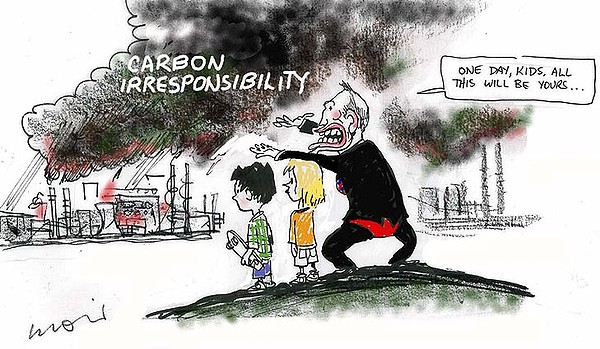
However, the Gillard Government's tactics on carbon pricing can be criticized. Lenore Taylor argues that Labor created the void and Abbott is busy filling it up with his great, big, new tax on everything. All we have in the public debate on making the polluters pay is 'lie' and 'tax'.
Rather than a reasoned debate about a substantive issue we have politicians, shock jocks and business people denounced “the carbon tax ” without seriously proposing to do anything about global warming.
Tony Windsor argues that one reason for this is the common view that the ALP and Greens are not selling the carbon price well. On a href="http://www.abc.net.au/lateline">Lateline Windsor said that the Greens and the Gillard government have jumped the gun in terms of the process:
I don't think they sold it too well, and my understanding as part of that committee was that the Climate Change Commission would in fact get out there and talk to the community, engage the community. And I think they've put the cart before the horse a bit here. They've sort of given the conclusion without a number, without a target, without a price, and then said that there will be a debate within the community. So, I'm not surprised that there's been a bit of a reaction to this.
Windsor's view is that the Gillard Government has brought a bit of this "people's revolt" upon themselves under pressure from the Greens and that's reflecting in the polls. One counter to this is that we have a form of policy gradualism by the Gillard Government with the shift from a carbon price to a carbon tax to a carbon trading scheme. The policy goal is an emissions trading scheme, which has been in Europe, with its 500 million people, since 2005.
Neither Windsor or Henry mention the way the media's shift to infotainment --its focus on scandal, spectacle, and the now moment of the “game” of politics--- is driving citizens away from public affairs, making it harder for reform minded politicians to do an effective job, and at the same time steadily eroding our public ability to assess what is happening and decide how to respond. It is the political media--as distinct from journalism that lie to us and then forgets it is a lie.
Posted by Gary Sauer-Thompson at 6:41 AM | Comments (5) | TrackBack
March 1, 2011
climate change: the politics
I watched Question Time in the House of Representatives yesterday. I wanted to see how the ALP and the LNP were approaching the issue of reform and climate change as distinct from the free market think tanks such as the IPA.
In the heated atmospherics the Coalition had reduced the policy and the proposed architecture and timetable for placing a price on carbon---to the issue whether Gillard had lied about a carbon tax and they argued that she could not be trusted. We need an election now they all demanded. There was lots of mock outrage, faux anger and huff-and-puff that would play well with the conservative base's intense dislike of the "irrational" Greens (who represent the path to tyranny), and their assumption that the Coalition is just a hair's breath away from forming government this term. The ALP response was an assault on Abbott's character.

I guess the tactic behind the theatre of the various censure motions aims to put pressure on the "backstabbing" Independents (Tony Windsor and Rob Oakeshott ) to dump Gillard and force an early election. If so, then the tactic is misfiring badly, because the Gillard Labor government will last until the next election in 2013 and Gillard will lead Labor to the election.
Gillard has nailed her colours to the post: getting a carbon tax through both the House of Representatives and the Senate. Abbott's stance is to prevent this action being taken on climate-change-by throwing mud, and if he fails, then to roll it back in 2013 once he's elected. In saying he will turn back the clock he is pretending that nothing needs to be done about climate change and that there is no need to build competitive, low-carbon industries in Australia.
Everything indicates that Gillard will take the fight to Abbott---and that it will be a tough fight. The view of the commentators in The Australian's view is that Gillard is already losing the fight. It is the Coalition's scare campaign that has the momentum.
It didn't look that way in parliament.
Update
The policy issues are not being discussed. It is still a blank slate, as discussion on a comprehensive program has not even begun. Presumably, the policy goal is to achieve an agreed target reduction in emissions per capita (or some other benchmark) by 2020 and beyond. If so, then what is the target; what are the options for solving the stated problem; and what is the quantum of funding is required to facilitate the transitions?
What would the Australia of 2020 look like after the programs of the selected options have been implemented?
Posted by Gary Sauer-Thompson at 9:35 AM | Comments (15) | TrackBack
February 25, 2011
ALP bites the bullet on climate change?
Whew. The Gillard Government has finally bitten the bullet on structural reform with its framework for a fixed carbon price and an emissions trading scheme to drive the switch to lower carbon economy. Or says that it has.
If it goes ahead it will be a momentous reform as Australia, is just about the world’s largest emitter per capita, and the Australian economy is powered by heavy-emitting fossil fuels – both for the energy that drives its industry and its transport, and the exports which are driving its wealth.
Government and opposition policy is for an unconditional 5 per cent reduction in carbon emissions from 2000 levels by 2020. Government policy also requires 15 per cent reduction if “major economies” agree to comparable reductions and 25 per cent if there’s global action sufficient to stabilise greenhouse gases at 450 parts per million. The Greens policy is for a 25 per cent unconditional reduction.
On February 9, the Department of Climate Change and Energy Efficiency released new projections for Australian emissions in 2020. These showed that without further policy action, emissions in 2020 would now be 24 per cent above 2000 levels. But they’re supposed to be 5 per cent below.
What we have on the table is effectively an agreement to have a discussion about the price; how long it will last; when, how, or if it will transition to a market price; which sectors are covered (there are options to opt in or opt out); the levels of compensation; or even if the electricity sector will have to deal with a carbon price or some sort of white certificate scheme based on emissions intensity.
It’s impossible to say yet whether the carbon price will drive large scale deployment to renewables and to a clean, green energy future. The range of prices being floated $10-25 a tonne of CO2 suggests that it probably won’t. The Green's Senator Christine Milne makes the point:
The carbon price is a very important invention in the market place but it is not going to be enough on its own to drive the transformation to renewable energy in the time frame that we need because we are unlikely to get a higher enough price to be able to do that. So we are still going to need the renewable energy target in my view we will still need a feed in tariff and so on.
Chris Ulhmann, from the ABC, strongly disagrees.
It is also unclear whether this agreement will be designed to reduce Australia’s contribution to climate change, or whether it’s a political fix that postpones the issue of emissions trading yet again. At this stage I'm inclined towards a political fix scenario until events indicate otherwise.
In this round the fight will be about politics — not policy, not evidence, and not science. The Coalition, the big polluters, mining industry and the conservative media will fight this policy to the death.
Posted by Gary Sauer-Thompson at 11:57 AM | Comments (10) | TrackBack
February 23, 2011
the question of coal
The most serious carbon issue today is coal. To avert a disastrous climate change tipping point coal-fired plants must be rapidly phased out to protect the earth. Hence the need for a price on carbon to enable the market to drive energy change and bring down carbon pollution. Increasing the carbon price acts as an incentive for the low carbon investments.
James Fallows in Dirty Coal, Clean Future in The Atlantic (December 2010) argues that the only way to meet the world’s energy needs, and to arrest climate change before it produces irreversible cataclysm, is to use coal—dirty, sooty, toxic coal—in more-sustainable ways. The assumption here is that coal will be used in the future as a substitute for oil and gas when the latter's production has peaked and that new technologies (processing coal into liquid fuel; carbon capture and storage will secure the future of the coal industry's investments.
The immediate response is that the longer we pursue energy from coal instead of committing to renewable energy and reduced energy consumption, he emphasizes, the worse will be the economic and ecological costs and the less likely such a transition will be successful. Secondly, CCS technologies are unlikely to be developed enough to deploy before 2035 at the earliest; these are very expensive; and the peak of higher-quality coal reserves means the shift to lower-quality coal with the social and ecological costs this entails.
Climate policy can create opportunities for massive investment: to expand the supply of renewables; build the power grids of the future; develop the robotics and nanotechnology required for energy-efficient construction materials; facilitate the shift from coal to gas to renewables.
The naysayers--denialists--- say no to price increases on carbon whilst continuing to rely on energy from coal for economic growth. Their old de-industrialise and anti-growth argument seems to been forgotten. They now claim that a socio-political pathology surrounds Australian public policy on climate change.
Europe is on track to comfortably exceed its existing climate change targets of cutting emissions by 20% by 2020, and on current policies will reduce greenhouse gas emissions by 25% by that date.This means that without any extra effort, by 2020 Europe will be well within reach of the higher target of an emissions reduction of 30% which some member states, including the UK, are pushing for.
Australia, in contrast, does not have a low-carbon roadmap with respect to buildings, transport, agriculture etc. It has given up trying to position itself so that it can compete in the €3.5tn global market for low-carbon goods and services. The Gillard Government has foreshadowed a system that would start with a fixed price on carbon, followed by a move to a market-based system in several years.
With the Opposition set to vote against any market-based scheme, the Government will need the support of the Greens and the independents to get the legislation through Parliament. Reduction targets and compensation to industry are again expected to be the main stumbling blocks in negotiations.
Update
The Gillard Government says that a carbon price scheme will be rolled out from July 2012 to begin the move to a clean energy future, The price on carbon would be fixed for a period of three to five years before moving to a cap-and-trade system. This outline of "the framework" is just the start of the process.
However, the starting price has not yet even been discussed, the household compensation package has not yet been discussed, support for emissions-intensive trade-exposed industry has not yet been discussed, the treatment of the energy sector has not yet been discussed.
So the fear campaign begins--the early talking points are that increased electricity prices that cannot be afforded.
Posted by Gary Sauer-Thompson at 1:37 PM | Comments (7) | TrackBack
February 14, 2011
climate change policy
Frank Jotzo in Climate policy: a new momentum at Inside Story states that the climate change policy debate is alive again in Australia, even though there is no binding global agreement. What we have tis a bottom-up approach to international climate policy to curb carbon emissions.
Jotzo asks: But what level of ambition should Australia strive for – what level of carbon price and what emissions reductions target? He answers along these lines:
Australia is in a curious position, as the only major developed country that escaped the 2009 recession, and with continued strong growth driven in part by mining and gas extraction. Without new policies, energy use and carbon emissions are on a strong upward trend, projected to rise to 24 per cent above 2000 levels, according to the government’s latest report, released this week. If this translates into a less ambitious emissions target, we can expect no sympathy from the international community including our trading partners: if the highest per-capita emitter of the major countries in the world decided it could not afford more climate change mitigation action because of a resource boom that is making it rich fast, the irony would be bitter and the backlash assured.
We are just nine years away from 2020 - the year both Labor and the Coalition have pledged that Australia's emissions should be 5 per cent below what they were in 2000.
In the Sydney Morning Herald Lenore Taylor says that projections show the nation's emissions are on track to be 24 per cent above that benchmark. Though a carefully phased-in emissions trading scheme--one using the market---is the cheapest way to achieve greenhouse gas reductions, it has never got off the ground in Australia. It's been blocked by the polluters.
The Gillard Government is now proposing a ''hybrid'' model - a fixed carbon price moving over time to an emissions trading scheme - with the aim of legislating by the end of the year. History suggests that we shouldn't hold our breath.
Posted by Gary Sauer-Thompson at 7:15 AM | Comments (1) | TrackBack
February 8, 2011
ALP: lacking vision or principle?
So far economic growth has gone hand in hand with the growth of greenhouse gas emissions in industrialized countries such as Australia, as they have an energy system that relies almost exclusively on fossil fuels.
So the Earth is warming up. The regularity and severity of recent events--drought, floods, cyclones and bush fires are increasingly a result of global warming in that a warmed up world leads to stronger force cyclones, more severe floods and more intense bushfires.

Climate change certainty is needed for increased investment in generator capacity. The trouble is that we are in the midst of a renaissance of coal, because oil and gas (sic) have become more expensive, but coal has not.
It is the national climate policy uncertainty that remains the major factor in preventing investments in renewable energy and low carbon sources of energy. As Frank Wolak observes in The Guardian:
The choice is stark: either we can continue to wait to implement the perfect climate policy, and in the meantime pay higher prices for oil, and watch countries like China that are able to provide climate policy certainty to investors move forward with this new industrial development; or we could commit to a modest climate policy and so unleash the new technologies and new jobs made possible by this more favourable investment environment.
Australia is going to have bit the bullet sometime because it needs to invest in much more electricity capacity to meet rising demand.
We need energy from renewables, and we need jobs. Renewables can deliver both. The 2020 target is quite low--20 per cent of our electricity to come from renewable energy sources by 2020--not the replacement of the fossil fuel energy infrastructure. So we are stuck with power stations, cars and homes that use carbon-based energy sources.
The big miners and their publicists are not convinced by the need to invest in wind and solar power They say that the real solution for cost effective and reliable electricity in an industrial society is to go nuclear is their spin. They add what happens when the wind stops blowing or the sun stops shining. The lights go out. So renewables cannot provide base load power. Only nuclear can do that. The bottom line is that these will not be privately funded--they are hugely expensive, dangerous and will take too long to build.
The problem with this kind of spin---myth making--- is that nothing will happen when the wind stops blowing simply because it never stops blowing, suddenly, over the whole of Australia. The sun does stop shining at night, but that means the national electricity grid or network requires diverse sources of energy--an energy mix.
Is the policy to run down existing carbon-polluting energy sources rapidly and to replace them with atmosphere-friendly equivalents? No. The political reality is that Australia is going to build new fossil fuel power stations in the near future. It's the light touch in energy policy.
Posted by Gary Sauer-Thompson at 7:11 AM | Comments (7) | TrackBack
February 5, 2011
little more needs be said
There is lots of rhetoric from the ALP on its policy about putting a price on carbon and making the necessary shift to a low carbon economy these days. This rhetoric says that the Gillard Government takes climate change seriously and that it is determined to act on it.
However, there's not much of a need to say more than Alan Moir's cartoon, which really says it all:

We are now in a situation in which unprecedented weather events are to be expected, but for some reason we still don’t expect them. We also know that once-in-a-century weather extremes are now going to become more common. Yet the scenario is one return, rebuild, restart within a a cycle of repetition, with little thought given to mitigation. As Jonathan Nott observed on the ABC's Lateline programme:
We were prepared in terms of the response to the emergency at the time and right now when we're going in and trying to repair things like electricity and make sure that people are safe and sound. We're still not thinking seriously enough about where people should live and how to keep them safe and how to keep them out of the road of danger.
Ross Garnaut has warned that global warming will lead to more severe weather events such as rainfall events and floods, and more extreme bushfires, cyclones and droughts.
When Bob Brown argued that as the planet gets warmer, these rains and floods, droughts and cyclones will become more frequent and more destructive of life and the environment, he was shouted down. Why? Brown connected the turbulent weather conditions to global warming and pointed out that, as this caused by greenhouse gases partly caused by coal fired power stations,then the big miners should contribute to rebuilding the infrastructure damaged caused by extreme weather events.
Though climate change has lost its media mojo in Australia, markets in various countries (eg.,China, Spain and the US) are creating a competitive demand for green technology.
Update
In his Droughts, Floods and Food post at the New York Times Paul Krugman, in arguing for a link between global food shortages and climate change, says that:
As always, you can’t attribute any one weather event to greenhouse gases. But the pattern we’re seeing, with extreme highs and extreme weather in general becoming much more common, is just what you’d expect from climate change.The usual suspects will, of course, go wild over suggestions that global warming has something to do with the food crisis....But the evidence does, in fact, suggest that what we’re getting now is a first taste of the disruption, economic and political, that we’ll face in a warming world. And given our failure to act on greenhouse gases, there will be much more, and much worse, to come.
Both droughts and floods are natural consequences of a warming world: droughts because it’s hotter, floods because warm oceans release more water vapor.
Posted by Gary Sauer-Thompson at 3:20 PM | Comments (8) | TrackBack
December 13, 2010
The Cancún negotiations
The failure of the Copenhagen climate summit last year (it proposed a system of voluntary pledges that were very low) dealt a blow to the idea that governments could control the output of greenhouse gases in their societies.
This failure by the UN disclosed that the Rudd Government was more or less naked on the issue, and that it lacked the political courage to push for the reforms required to shift the Australian economy to a low carbon one. The fossil fuel industry and its allies won that battle.
The Cancún negotiations were an attempt to try and patch up the process of multi-lateral talks and set new building blocks for a legally binding treaty. The result is a modest step on from the failure at Copenhagen As the editorial in The Observer states:
First, they outlined a mechanism that could play a critical role in helping to prevent the deforestation of developing nations, a major ecological issue. Second, the talks established a fund that will raise and disburse $100bn (£64bn) a year by 2020 to protect poor nations against climate impacts and assist them with low-carbon development. Third, they set up a mechanism to transfer low-carbon technologies to developing countries.
The final text has references to a long-term goal of holding temperatures to 2C and a future review of whether the target should be revised to 1.5C. Nations agreed once again that world average temperatures should be allowed to rise by no more than 2C, but once again they declined to commit collectively to real and binding targets for emissions cuts by which performance could be measured.
It is a modest step because the Cancún result pushes the dispute---the widening divide between rich and poor countries over the architecture of a global agreement--- to next year's talks. The current Kyoto commitments expire at the end of 2012, making the next UN conference the last practical opportunity to seal a new set of Kyoto commitments in the form of a global formal treaty through the UN process. The Kyoto protocol is the only existing legally binding treaty, but only demands cuts in greenhouse gas emissions from rich, industrialised nations. Kyoto excludes the big emerging economies of China, Brazil and India.
The US is going backwards on Obama's domestic green agenda. They will not be taking strong action to cut their emissions. They, and other developed nations such as Japan, use various tactics to wriggle out of taking strong action to cut their emissions.
The irony of the situation in Australia is that as temperatures become hotter--especially in the cities--air conditioning will become not a luxury but a life saver. Air conditioning runs on electricity, still provided largely by fossil fuel. The extremes of heat, and the consequent increase in urban air conditioning, are likely to make future heatwaves even more lethal.
Posted by Gary Sauer-Thompson at 11:51 AM | Comments (2) | TrackBack
December 3, 2010
Cancún climate summit
There is not that much being said about the UN Cancún climate summit in the Australian mainstream media. So I have turned elsewhere to see what is going on.
Tim Yeo in Cancún climate summit: Let's look beyond carbon in The Guardian says that:
The perfect outcome would be a binding agreement to drastically reduce emissions – reflecting what the science tells us we need to do to avoid disaster – with all nations ending up with a fair share of rights to the atmosphere.The political reality post-Copenhagen, however, means this just isn't going to happen....It's unlikely that countries will sign up to binding limits on carbon dioxide unless growth can be decoupled from the use of fossil fuels.
The problem we face is simple. Once the planet warms to the point where environmental changes that further add to warming feed off each other, it becomes almost meaningless to specify just how much warmer the planet may get. You've toppled the first domino and it becomes virtually impossible to stop the following chain of events. So the idea is to stop the first domino falling---to avoid crossing the 2C threshold.
It ain't going to happen is it? Even though 2010 is on course to be the hottest year on record and the 10 warmest years on record have all occurred since 1996.
We are on the pathway to a 4C temperature rise by 2060. As John Vidal says:
UN research shows that the pledges and promises made last year by 80 countries to reduce climate change emissions fall well short of what is needed to hold the global temperature rise to 2C and avoid the worst consequences of global warming.
So why not stop the present subsidies of fossil fuels and use the money to reduce emissions? Well, we have the powerful counter-movement, led by corporate-funded thinktanks, that has waged war on green policies. This states that technology can solve all political and economic problems--eg., nuclear power, GM crops and geoengineering.
So the issue is about power--corporate power that has captured the governments of nation states, such as the US and Australia.
Posted by Gary Sauer-Thompson at 12:04 PM | TrackBack
October 5, 2010
a retreat from politics?
This editorial in The Australian states that the Royal Society's new short guide to the science of climate change is an honest account of where climate change science is clear and where it is less certain, such as the impact of energy emitted by the sun, and that the society's previous position was too strident and implied a greater degree of certainty than was justified.
The editorial states that the Royal Society's report also sets out a strong case for pursuing the cautionary, responsible approach long advocated by the Weekend Australian. The Australian's understanding of science is that whilst politics demands certainty to make a convincing case for co-ordinated action, science is driven by skepticism. Each hypothesis formulated from empirical evidence needs to be challenged and tested to within an inch of its life before its veracity can be assumed. From this understanding it infers that:
The Intergovernmental Panel on Climate Change's reports should have been seen for what they were, political documents. They were designed, quite reasonably, as a basis on which to build a political solution. The mistake was to elevate them to the status of divine prophecy. When the IPCC recommended in 2007 that nations reduce global emissions by 50 to 85 per cent by 2050 to have a reasonable chance of averting warming beyond 2C and "catastrophic" consequences, it was clear to those with a sophisticated view of science that the targets were based on assumptions fed into computer models. As the debate unfolded, those who exaggerated the evidence or presented only worst-case projections did much more to set back the cause of carbon restraint than the commentators they derided as deniers. Scare tactics have not worked, and will not work.
The Australian's editorial implies that its war on science has respectable credentials--those of the cautious, responsible Royal Society which are contrasted to the UN's 2007 IPCC report that has been engulfed in scandal.
This is made explicit in this article which claimed that though the Society's new guide does not dismiss climate change or the need for co-ordinated global action to combat it, it undercuts many of the claims of looming ecological disaster that have been made in a bid to gain public support for political action.
The Australian position is well known, "rejects doomsday scenarios pedalled by alarmists, whose proposals would wreak economic devastation". It's voice, along with the Institute of Public Affairs, is one of denialism, and it has conducted a war on science.
However, the problem for The Australian is that the Society's short guide to climate change states that there is strong evidence that changes in greenhouse gas concentrations due to human activity are the dominant cause of the global warming that has taken place over the last half century; that there is strong evidence that the warming of the Earth over the last half-century has been caused largely by human activity, such as the burning of fossil fuels and changes in land use, including agriculture and deforestation; and that this warming trend is expected to continue as are changes in precipitation over the long term in many regions.
The Society also says that the report draws upon recent evidence and builds on the Fourth Assessment Report of Working Group I of the Intergovernmental Panel on Climate Change (IPCC), published in 2007, which is the most comprehensive source of climate science and its uncertainties. The guide reaffirms that:
*Warming of 0.8° has occurred since 1850, mostly since 1975
*The planet is still warming, the 2000s were hotter than the 1990s and warming will continue
*Warming is mostly due to human influence
*A doubling of CO2 concentrations is most likely associated with warming of 3°
*The effects include a long-term decline in the extent of Arctic summer sea ice
*Further and more rapid rises in sea-level are likely, which will have profound implications for coastal communities and ecosystems.
The guide concludes by saying that climate science – including the substantial body of knowledge that is already well established, and the results of future research – is the essential basis for future climate projections and planning, and must be a vital component of public reasoning in making important decisions.
We have another beat-up by the spinning Australian defending business as usual in which prosperity for the few founded on ecological destruction and persistent social injustice is the deemed to be the foundation for a civilized society. For them the role of government is framed narrowly by economic growth as increases in GDP and hollowed out by a misguided vision of unbounded consumer freedoms.
Posted by Gary Sauer-Thompson at 7:52 AM | Comments (13) | TrackBack
July 23, 2010
Canberra watch: Gillard spins her retreat
The ALP is camouflaging Gillard's retreat on climate change with its citizens assembly to forge a national consensus on action on climate change and advisory panel of scientists to help inform its deliberations. I though t that parliament in a liberal democracy was the citizens' assembly. Does Gillard mean a big focus group?
Oh, Gillard also recommits Labor to carbon trading, and pledges that it will be introduced only when "the Australian economy is ready and when the Australian people are ready". That's in never never land.

What we have from the ALP is a poll-driven retreat covered by a public relations exercise designed to head off new versions of the opposition's "great, big, new tax on everything" campaign.The tougher emissions standards that will be implemented to ensure energy generation is "cleaner and greener"---standards that would ban the building of new "dirty" power stations ----do not apply to the 15 coal-fired power stations already on the drawing board in NSW, Queensland and Western Australia.
Labor would also spend $1 billion over 10 years to make it easier to connect renewable energy projects in remote regions to the national electricity grid. That should have been done a decade ago and it is designed to make the ALP look as if it is doing something when it isn't doing anything. The retreat is complete.
Posted by Gary Sauer-Thompson at 8:59 AM | Comments (15) | TrackBack
July 12, 2010
Australia hesitates
The energy challenge facing Australia and the rest of the world is ultimately one of environmental, geopolitical, and resource sustainability. Copenhagen failed, even though the risks of climate change become more visible, increasing numbers of people have come to recognize that the longer we hesitate, the more expensive the problem becomes.

Dealing with climate change is dismissed by those opposed to shifting from a fossil fuel economy to a low carbon one as anti-growth, when it is the only viable growth strategy. Australia hesitates to make the shift. So does the Gillard Government, as it keeps lurching to the right in order to keep itself competitive with the Liberals, making mere gestures to the Left in the process.
The political reality here is that the ALP is losing its social base as its policy agenda fades to blue grey, and the policy differences between Liberal and Labor become minimal under pressure from its NSW factional bosses. Sustainability is one of the casualties.
Given that the market fails to deal appropriately with environmental issues and that growth for growth's sake is no longer an option what is missing is a focus on the interface between ecology and economics instead of the neo-liberal over-focus on markets. There needs to be a recognition of the need for the economy to face the reality of biophysical limits--the limits to resource use, limits to input substitutability, and the uniqueness of energy as a productive input.
The ALP does not have the courage to take a critical look at the notion of growth. They are unable to both stimulate recovery in the wake of the global financial crisis and and at the same time improve the sustainability of the economy. They cannot, or are unwilling, to connect policies that enhance social and economic well‐being to environmental sustainability.
Germany is one country that plans to rid itself of both coal and nuclear energy source-dependence with some smart thinking about integrating renewable energy to ensure base load power:

It is smart thinking as it is connecting the dots and then runnign a pilot project to see whether renewables can deliver baseload power:
Connecting the dots is something the Gillard Government is unwilling to do. They are wrapped up in their dream about clean coal. The Coalition, in contrast, reckons that emissions free base load power can only delivered by nuclear power. Business want to be paid for energy efficiency and says no to a carbon tax or an emissions trading scheme.
This unwillingness to cross the dots is all the more remarkable in that CSIRO's UltraBattery technology has the capability of overcoming the issue of intermittent power generation associated with wind and solar, which remains a fundamental road block for the widespread uptake of renewable energy resources such as these. The UltraBattery can be integrated into wind power systems to smooth intermittency and potentially 'time-shift' energy production to better match demand.
Posted by Gary Sauer-Thompson at 11:18 AM | Comments (8) | TrackBack
July 4, 2010
Greenspan on climate change
Alan Greenspan in devoting two pages in the 531 pages of his memoir, The Age of Turbulence: Adventures in a New World, to the climate issue, illustrates the neoliberal minimization of the issue. What needs to be defended is the free-market ideology that rejects strong regulation of the economy.
His first tactic is minimization of the issue. He has “little doubt” that climate change is real and human induced (p. 454). But he offers merely one proposal to address the issue: an increase in the gasoline tax to protect America’s energy “security”.
There is no commitment about the need for state investments and subsidies to recast the infrastructure of consumption in the zones of transportation, housing, and power production; no urgency to cooperate with other states and international organizations to protect the earth’s forest and ocean systems, though both are key absorbers of carbon dioxide. No exploration of how changes on these fronts could also empower constituencies who seek to foster a positive and timely austerity of material desire.
Hence, his second tactic is evasion, because a robust engagement would throw his key assumptions about market control of investment, consumption, and work into disarray, and he would have to think more carefully about the need for new relays between collective patterns of consumption and state policies. What is his explicit reason for such a tactic? He says that the worst climate effects are scheduled to occur after the period he has “selected” for analysis, from today to 2030! Hence, the third tactic: deferral.
So we have neoliberal minimization coupled to corporate self-interest that functions to prevent action on climate change through a pricing of carbon. Laissez faire capitalism is a refuge for those who maintain that human can and should master and exploit nature.
Posted by Gary Sauer-Thompson at 9:21 AM | Comments (3) | TrackBack
May 16, 2010
before and after
In the The Message from the Glaciers at the New York Review of Books Orville Schell addresses the Fourth Assessment Report of the UN’s Intergovernmental Panel on Climate Change (IPCC) erroneous claim that there was a “likelihood” that Himalayan glaciers would disappear by 2035, “and perhaps sooner”.
This has fuelled the climate change deniers--the anti-science crowd---who claim that the evidence that the climate is warming just isn't there; that the seas are not rising; the ice is not shrinking; the polar bears are not vanishing; and there has been no significant climate warming since 1995.
Schell says though the IPCC's error embarrassed the report’s author it has not altered the reality that many glaciers in the Mt Everest/Himalayan region are, in fact, rapidly receding.
 George H. L. Mallory/Royal Geographical Society, Mount Everest and the Main Rongbuk Glacier in 1921
Nor does the error scientifically invalidate the panel’s overall conclusion that because “more than one-sixth of the world’s population live in glacier- or snowmelt-fed river basins and will be affected by the seasonal shifts in stream flow,” a serious downstream problem is unfolding.
 David Breashears, Mount Everest and the Main Rongbuk Glacier, Tibet Autonomous Region, China, 2007
It is in the region of Asia’s ten major rivers—the Yellow, Yangtze, Mekong, Salween, Irrawaddy, Brahmaputra, Ganges, Indus, Amu Darya, and Tarim—among huge modern-day populations of Asia, that the melting of the Greater Himalayas’ glaciers will have the most significant impact during the coming decades and centuries.
The political reality is that the anti-science crowd, who deny that global warming is real and is principally caused by human fossil fuel use, don’t really want any meaningful action in the form of aggressively deploying clean energy technologies. They are happy with increased temperatures because these conservatives cannot abide the solution to global warming-strong government regulations and a government-led effort to accelerate clean energy technologies into the market.
They have a deep dislike for mandatory restrictions on greenhouse gases and are engaged in winning a battle in an ideological war.
Posted by Gary Sauer-Thompson at 3:25 PM | Comments (1) | TrackBack
April 28, 2010
Rudd's retreat
So it has come to this. Rudd Labor has postponed dealing with climate change until the end 2012. Once an emissions trading scheme was vital and urgent for dealing with ''the great moral challenge of our age''. Now Rudd Labor has distanced itself as far as it can from the dodgy scheme that was progressively watered down in concessions to the polluters--including the coal-fired power sector.
An ETS is buried, even though Rudd + Co know that Australia has to have a carbon price to make a significant difference to Australian greenhouse emissions. Yet Rudd Labor offers nothing in its place. Climate change is not an issue for this political class. When do we expect more subsidies for King Coal? A coal-drive future is our destiny according to some Labor ministers. To hell with all this talk about shifting a low carbon economy.Sustainability is for the idealists. Coal rules, okay. Get real.
Isn't this burial of the ETS an example of what Rudd once accused the Coalition of---"political cowardice . . . an absolute failure of leadership an absolute failure of logic." Isn't this yet another example of political expediency ("clearing the decks") by Rudd Labor?
It cannot even bring itself to defend its own policies on climate change in an election, nor is it willing to see things through. They will go ahead with the internet filter though. The progressive side of Rudd Labor continues to weaken whilst the authoritarian side strengthens.
My only hope is for a surge in the Green vote. What will ensure that Australia's largest carbon dioxide emitters do pay for their pollution is for the balance of power in the Senate to shift to the Greens, and, even more hopefully, for a handful of House of Representative seats to fall to the Greens (eg., Lindsay Tanner in Melbourne, Tanya Plibersek in Sydney and Anthony Albanese in Grayndler). The possibility is the Greens overtaking the Liberals on the primary vote and chasing down Labor with their preferences.
The political system is crook and it needs reform.
Update
Surprise surprise. Janet Albrechtson is trying to argue in The Australian that the anti-democratic Left are launching a new attack on democracy with proportional representation. She's spotted them though and exposed them for the totalitarians they really are.
She says that it is a:
myth that proportional representation is good for democracy. Truth is it's rotten for democracy. Proportional representation will bestow disproportionate influence on minor party leaders to become kingmakers. Forget democratic principles of voters knowing what they voted for and politicians being accountable for their promises. Post-election horse-trading between minor parties and minority governments will mean election promises count for nought.
Just look at Tasmania and the disproportionate influence to the Greens (special interests) who attracted votes from only one in five Tasmanians.
So what is good for democracy? Why, it is strong, decisive leadership taking the tough economic decisions to further a market economy:
when minority governments become the rule, forget about strong, stable governments making tough economic decisions. The sort of gutsy reforms that transformed the British economy under Margaret Thatcher won't happen again if Clegg gets his way with proportional representation. Of course, this is precisely what the Left has in mind, hence their catch-cry about voters embracing a progressive moment
Yep, executive dominance is good because it is democratic (majority rule). So you have to be wary of the canny Left pushing anti-democratic agendas using slogans about improving democracy. But never fear, you can trust Janet to let you know about the latest tricks of the anti-democratic Left are.
Posted by Gary Sauer-Thompson at 10:46 AM | Comments (19) | TrackBack
February 26, 2010
Garrett: and so it came to pass
I landed in Melbourne this morning from photographing in Tasmania to learn that a wounded Peter Garrett, the Minister of Environment, had pretty much reached the end of his illustrious career. I was surprised. I thought from reading the headlines that the roof insulation story had been managed and controlled by the Rudd spin machine.
Presumably, an ambitious Garrett sought political power so as to make a real difference to the lives of the Australian population. If so, then that goal is clearly unattainable with his " reduced range of responsibilities".Garrett loses all responsibility for energy efficiency ( the insulation scheme, solar rebates and other energy-efficiency programs) and becomes Minister for Environment Protection (whaling, biodiversity and conservation) Heritage and the Arts.

The fallout from the home insulation disaster continues to widen, even though the Rudd Government has suspended the scheme, and Greg Combet has been bought into fix the government problems. If it is tough on Garrett, he knew the political game that he wanted to be a success in. He has been required by cabinet solidarity to announce so many pro-industry decisions on the environment that he has largely lost his green credentials. That is being a team player.
To be fair a lot of Garrett's troubles arise from the Rudd Government's poor track record on climate change, solar energy, as well as the rorting the energy efficiency and solar schemes by the shonky installers (spivs and fly-by-nighters)in the industry. These days Ministers are not sacked and do not resign when departmental public servants fail them because of their incompetence.
The judgement is that Garrett, politically speaking, is damaged goods, with limited opportunities for political rehabilitation.
Posted by Gary Sauer-Thompson at 9:02 PM | Comments (10) | TrackBack
February 19, 2010
Climate change: Wong on adaptation
Penny Wong's speech to the National Coastal Climate Change Forum in Adelaide is significant.This is not because of its reflections about Copenhagen, or the defence of both climate change science or the Rudd Governments' emissions trading scheme, but because it addresses the need to adapt to the effects of climate change.
The Minister says:
even with strong emissions reduction action we face a stark and sobering fact – the opportunity to avoid climate change altogether has passed. It has been lost to us – this generation no longer has that opportunity.Any effective climate change response now also needs to address the question: how do we adapt to the impacts of climate change that we cannot avoid?...
The speech highlights that one of Australia‟s principal adaptation challenges is preparing our coasts since these coasts play a major part in our economy, our environment, and our way of life:
climate change threatens coastal homes and the viability of coastal industries and ecosystems.With our coasts at the front line on climate change, facing sea level rise, storm surges and inundation, they also must be at the forefront of our efforts to adapt to climate change. Australia‟s coastal zone in particular will experience the full range and impact climate change.
It refers to Climate Change Risks to Australia's Coasts report and the National Coastal Risk Assessment.
As is pointed out development around the Australian coast assumes that sea level and storm events would function as they have in the past and our housing estates, business sites and public utilities have been designed as if the coastline and tidal levels would not change. Such assumptions are no longer valid.
The Australian, of course, is not at all convinced. It ain't gonna happen.
Posted by Gary Sauer-Thompson at 6:14 AM | Comments (8) | TrackBack
February 3, 2010
Abbott's green wash
It's what you would expect from the Coalition on climate change after they dumped Malcolm Turnbull as their leader. The risk was that the opposition will be seen as having no policy clothes.Their problem was that they had to do something about addressing climate change, even though they are climate change sceptics and deniers.
They came up with a climate change plan to get the Coalition through to the next election, not a serious plan to refit the Australian economy so that it emits less carbon. It's a fig leaf designed to give them some green wash and a shield designed to protect Australia's coal, aluminum and cement industries from change.
Ben Cubby in the SMH says:
By failing to address the sources of rising greenhouse gas emissions, even the federal government's minimum target of 5 per cent cuts by 2020 would be likely to spiral out of reach, potentially exposing Australia to punitive action from other nations that are able to meet their targets. A 15 or 25 per cent cut by 2020 could no longer be contemplated, passing on much steeper costs into the following decade.In essence, farmers would be asked to plough carbon back into the ground faster than the coal industry can dig it up, and Abbott's volunteer ''green army'' would be asked to plant trees faster than the timber industry can cut them down.
There is nothing to make the polluters feel the cost of their polluting. Without any penalty for forcing emissions down, they would continue to increase because those who decided not to reduce their carbon footprint (coal fired power stations) would have no reason to change. They could keep their emissions at ''business as usual'' levels until 2020 without penalty. This would cause more taxpayers' money to be spent on incentives so the 5 per cent target would be met.
This is another indication that political leaders have proved so reluctant to make big polluters subject to the kind of price signals that are essential to force a shift to low carbon technologies. Neither of the major parties in Australia has adopted a cap that is deep enough to drive the industrial transformation.
The Coalition rejects any form of market mechanism to reduce carbon pollution from energy generation and transport fuels.The strength of the Coalitions' plan is on storing carbon in soils and vegetation and soils.
Posted by Gary Sauer-Thompson at 8:05 AM | Comments (6) | TrackBack
January 5, 2010
a renewables national electricity grid
The Rudd Government has been around long enough for us to know that it says that it wants to promote renewables (the 2020 target, which requires Australia to generate 20% of its energy from clean sources?) whilst it goes for other policies to protect the coal-fired energy companies behind the scenes.
 photovoltaic solar power station, Granadilla, Spain
First, the Rudd Government has no intention whatsoever of kicking dirty energy sources like coal off the national electricity grid. Secondly, a lack of connections to the national grid, which were not designed to channel power from the scattered and remote locations that suit renewables, has stalled the uptake of alternative energy. Thirdly, there is no real policy to transform the national grid to a renewable one, or even to remove the barriers that currently prevent renewable generators connecting to the national grid.
There is no vision in Australia for a continent-wide renewables supergrid so that electricity can be supplied across the continent from wherever the wind is blowing, the sun is shining the rocks are hot, or the waves are crashing.
 photovoltaic solar power station + wind farm, Granadilla, Spain
There is no such action from the Rudd Government. Their action--and those of the states--- is about protecting the coal fired power stations vis-a-vis the national electricity grid, whilst doing little to solve one of the biggest criticisms faced by renewable power – that unpredictable weather means it is unreliable.
Update
What we have in energy policy terms are little bits of investment in renewables here and there rather than a concentrated investment to create a low-carbon economy. Penny Wong's talk about creating a low-carbon economy is just rhetoric that covers up the continued use of coal fired power stations. There is no attempt to increase the size of the renewable energy target, no moves to start building gas-fired power stations on the sites of the existing brown-coal power stations, nor any requirements that mining companies source power from off grid solar/thermal power stations .
In an op.ed in The Australian Richard Denniss says that:
The CPRS legislation proposes that we begin with a fixed pollution permit price of $10 a tonne. Wong has said while her scheme isn't perfect, something is better than nothing. She should take her own advice and introduce a carbon price; $10 isn't enough but it's better than nothing.The advantage of a $10 starting price is it would raise revenue to invest in efficient technologies and send a signal to new investors that the old days are over, while not being so high that it would have a significant effect on our so called emission-intensive trade-exposed industries.
Investing in efficient renewable technologies is the key. However, the Rudd Government is more focused on defending its flawed emission trading schemes--its such a poor example of an emissions trading scheme---- from those who would question it. All we get is the standard talking points repeated over and over again. Block block block.
Posted by Gary Sauer-Thompson at 1:23 PM | Comments (14) | TrackBack
December 31, 2009
using capitalism to save the planet?
In the light of the failure at Copenhagen to halt and reverse the growth of carbon dioxide in the air and the Coalition's forthcoming green light approach to reducing greenhouse gas emissions without cost we have this insight from John Bellamy Foster and Brett Clark in their The Paradox of Wealth: Capitalism and Ecological Destruction. Their argument is that:
Today orthodox economics is reputedly being harnessed to an entirely new end: saving the planet from the ecological destruction wrought by capitalist expansion. It promises to accomplish this through the further expansion of capitalism itself, cleared of its excesses and excrescences. A growing army of self-styled “sustainable developers” argues that there is no contradiction between the unlimited accumulation of capital — the credo of economic liberalism from Adam Smith to the present — and the preservation of the earth. The system can continue to expand by creating a new “sustainable capitalism,” bringing the efficiency of the market to bear on nature and its reproduction.
They add that in reality, these visions amount to little more than a renewed strategy for profiting on planetary destruction.
James Hansen in How to Solve the Climate Problem in The Nation says that there is no "silver bullet" solution for world energy requirements and that the problem demands a solution with a clear framework and a strong backbone.
Hanson adds:
Let's define what a workable backbone and framework should look like. The essential backbone is a rising price on carbon applied at the source (the mine, wellhead, or port of entry), such that it would affect all activities that use fossil fuels, directly or indirectly.Our goal is a global phaseout of fossil fuel carbon dioxide emissions. We have shown, quantitatively, that the only practical way to achieve an acceptable carbon dioxide level is to disallow the use of coal and unconventional fossil fuels (such as tar sands and oil shale) unless the resulting carbon is captured and stored. We realize that remaining, readily available pools of oil and gas will be used during the transition to a post-fossil-fuel world. But a rising carbon price surely will make it economically senseless to go after every last drop of oil and gas--even though use of those fuels with carbon capture and storage may be technically feasible and permissible.
Hanson goes on to say that a successful new policy of “sustainable capitalism,” cannot include any offsets. We specified the carbon limit based on the geophysics. The physics does not compromise--it is what it is.
And planting additional trees cannot be factored into the fossil fuel limitations. The plan for getting back to 350 ppm assumes major reforestation, but that is in addition to the fossil fuel limit, not instead of. Forest preservation and reforestation should be handled separately from fossil fuels in a sound approach to solve the climate problem.
Fossil fuels continue to provide most of our energy because we do not take into account their true cost to society in that the effects of air and water pollution on human health are borne by the public. So the expansion and accummulation of capital trumps actual public interest in protecting the vital conditions of life.
Hanson says that in the end, energy efficiency and carbon-free energy can be made less expensive than fossil fuels, if fossil fuels' cost to society is included. The question is will this succeed in reducing emissions? Or will it simply result in capitalism continuing to profit on the destruction the planet?
Posted by Gary Sauer-Thompson at 9:35 AM | Comments (2) | TrackBack
December 29, 2009
after Copenhagen: the fallout
As we know very little progress was made in Copenhagen despite all the effort of all the nations, leaders and all the political capital invested. So what happened? Well, the post-conference blame game is well underway.
It was China who wrecked Copenhagen says Mark Lynas. China was able to block any proposal that threatened its capacity to expand as a superpower and its negotiators shot down all attempts to make emissions cuts legally binding or to set long-term goals for reducing greenhouse gases.

The last days negotiations were probably more complex than this because India was also determined to block any proposal that might constrain its future economic growth.
The Guardian's Jonathan Watts offers a more complex account:
There was a gulf in the expectations of the different parties. It soon became apparent that the BASIC group (Brazil, South Africa, India and China) were playing for a 0-0 draw. They did not want to sign up to anything that would constrain their future economic growth. Europe wanted ambitious, legal targets for 2020 and 2050. The US was most concerned about ensuring China made its emissions data more transparent and avoiding criticism for its dismal record in recent years. Europe was the furthest from achieving its goals, which is depressing as I think its targets werethe best way to keep the rise in temperature below two degrees celsius.
The consequences is that China and the US, the world's two biggest emitters, can now continue emitting without legal constraints for a longer period of time, perhaps indefinitely.
Underlying the blame game and the finger pointing China is the shift in geopolitical power, the decline of American power and the beginning of the end of the western ascendancy.
Posted by Gary Sauer-Thompson at 2:09 PM | Comments (2) | TrackBack
December 21, 2009
Copenhagen: politics-as-usual
One inference we can draw from the UN COP15 conference at Copenhagen is that politics-as-usual was in charge. A second inference is that politics-as-usual will not prevent climate change, as there are formidable forces pushing to maintain the status quo.
At Bonn in May and Mexico in December 2010 (COP16) that means a refusal to make a deal to limit our emissions of warming gases. Consequently, much will have to be sacrificed to ensure the defence of national self-interest and sovereignty as defined by the fossil fuel industries. We must go for growth.
 Martin Rowson
Inaction on climate change means that the long shadow of the future is already forming behind us as Australia’s coal and electricity industries get back to business as usual. Short-term profit making.
The warming trajectory is now one of 3-4 degrees. So we will have the tipping points of the warming gases stored in the Siberian permafrost melting at 2C and being released into the atmosphere; the world's humid rainforests, which store huge amounts of warming gases in their trees, will they lose their humidity beyond 2C and begin to burn down. So the world gets warmer and warmer beyond 2C.
So why not business as usual with protesters chaining themselves to coal fired stations and coal trains? Direct action is needed not in the trivial fig leaf sense of the Coalition owned by the fossil fuel industry; but non-violent direct action to putt pressure to stop new coal-fired power stations from being built; non-violent direct action to put pressure to close down the old coal fired power stations; and non-violent direct action to put pressure to block the coal trains.
If politics-as -usual in Australia is dedicated to entrenching Labor in power, and only secondarily to achieving real reform, then direct action is needed to ensure a technological transformation from lots of money poured into the new energy industries.
Posted by Gary Sauer-Thompson at 4:00 PM | Comments (6) | TrackBack
December 19, 2009
the Copenhagen Accord
The circulating text of the Copenhagen Accord---there is some anlaysis here. It is a political agreement reached after a meeting among President Barack Obama and Chinese Premier Wen Jiabao, Indian Prime Minister Manmohan Singh and South African President Jacob Zuma.
This green gloss on a distinctly brown political accord still needs to be approved by the 193 nations gathered at COP15. Many of them are unhappy about how the deal went down.
No doubt the US and its friends will spin "the agreement" as an historic success. However, this political fudge is more or less an inglorious ending: a grave disappointment if not failure, since the conference failed to agree on measures to stabilise global temperatures below a rise of 3C and the accord was neither accepted or rejected, it was merely "noted".

The accord is a work in progress as it drops the goal of concluding a binding international treaty by the end of 2010, which leaves the implementation of its provisions uncertain. It is little more than a general commitment to the idea that “climate change is one of the greatest challenges of our time” and that “deep cuts” in global emissions are required. If the best that can be said is that it leaves the door open for a proper agreement, then consensus ended where action should have begun.
So the process is likely to undergo many months, perhaps years, of additional negotiation over the core issues (what targets to set, how to include both developed and developing countries within the same framework, and what financing would be available for international programs to help poorer nations contend with climate change) before it emerges in any internationally enforceable form. Will It?
If the big sticking point still seems to be the Chinese refusing verification involving some form of inspection, then the China-friendly verification provision rests on the "vague international consultations and analysis" clause. There is also a legacy of mistrust of the United States, which has long refused to accept any binding limits on its greenhouse gas emissions and the US Senate has not yet acted on a climate bill. All America is offering is an emissions reductions target of a 17% reduction over 2005 levels by 2020 conditional on Congress passing climate change legislation.That represents just 4% emissions cuts on 1990 levels from a country that has not and will not ratify the Kyoto protocol.
So where to next after this exercise in saving face? The world's worst polluters – the people who are drastically altering the climate – gathered in Copenhagen to announce they were going to carry on emitting and heating the planet, in defiance of all the scientific warnings. If the US has sacrificed the low-lying islands, glaciers and North Pole, then by bringing China and India into the tent he has improved the prospects for the climate change legislation passing in the Senate.
It doesn't look promising, given the systematic campaign of sabotage by certain industrial state governments, which was driven and promoted by the energy industries and supported by the political expediency of nations-states protecting corporate profits. As Hugo Chavez of Venezuela remarked these developed nations acted decisively to save Wall Street and the banks, but they could not act to save the planet.
A willingness to commit to climate actions in the national arena is not the equivalent with a readiness to sign up to a new, international climate treaty. The grim reality is that the national politics of the sort at work in most big economies (Australia being a prime current example) trumps internationalism every time.
If there is any movement, then there needs to be a way to find the most effective means of monitoring whether a nation is cutting its emissions without intruding on its sovereignty - a major stumbling block in this week's negotiations. Presumably, further negotiations t will work out what "international consultations and analysis"—means.
Update
The idea that there is an invisible hand that will sweep up self-regarding actions into a coherent set of climate policies is a chimera. The climate is a commons, and we have forgotten how to look after anything properly that is held in common.Over forty years ago Garrett Hardin identified the result of individuals pursuing their self-interest in the context of a finite resource, even when it is obvious that it is no longer in their interest to do: the “tragedy of the commons”. This is exactly what is happening with climate change.
Robert N. Stavins observes in the Financial Times:
Climate change is the ultimate common global problem, because greenhouse gases uniformly mix in the atmosphere. Therefore, each country incurs the costs of its emission-reduction actions, but the benefits of its actions are spread worldwide. Hence, for any individual nation, the benefits it receives from its actions are inevitably less than the costs it incurs, despite the fact that globally the total benefits of appropriate co-ordinated international action would exceed the total costs (and for many countries the national benefits of co-ordinated international action would exceed their national costs of action).
This creates a classic free-rider problem, and is the reason why international co-operation – whether through an agreement under the United Nations Framework Convention on Climate Change or through some other multilateral or bilateral arrangements – is necessary.
So what to do? Privatise the commons (Hardin’s preferred solution), or create a Green Leviathan that forces individuals and countries to keep their greenhouse-gas emissions to around 450 parts per million (ppm)? Or show that carbon technology is commercially viable by providing capital to encourage private investors to back low-carbon technologies; supporting training programmes; providing infrastructure to support new industries.
Posted by Gary Sauer-Thompson at 10:07 AM | Comments (7) | TrackBack
December 18, 2009
Greening the Reseve Bank
The Reserve Bank of Australia is an independent institution in control of monetary policy. Currently it's monetary strategy is one of raising interest rates to shape economic growth to prevent inflation whilst reducing unemployment. It's primary focus is low inflation and, like the Treasury, it is GDP growth, reducing unemployment and raising productivity. It is not facilitating shifting the Australian economy to a low carbon one.
Carbon reduction is a distraction, or side issue. You can see this from this recent Monetary Policy in Open Economies conference---not one of the papers dealt with monetary policy and carbon reduction! Not one! Nor did any of the Research Discussion papers in 2009. Similarly with its statement on monetary policy in November:
The global economy is growing again after contracting sharply late last year and in the early part of 2009. here has been some recovery in world trade and most of the major economies now look to be expanding. The risk aversion that was so evident earlier in the year, particularly in financial markets, has abated and confidence is gradually returning.Asia is at the forefront of the global recovery. The region’s financial systems have not experienced the same dislocation as elsewhere, and the economies are benefiting from a recovery in domestic demand, underpinned by stimulatory settings of both monetary and fiscal policy. Growth in China and India has been particularly strong.
There is no mention of the UN conference at Copenhagen where all nation states are grappling with issue of economic growth and reducing greenhouse gas emissions; or even the effects on the economy of Australia's attempt to introduce an emissions trading scheme
The monetary policy statement goes on to say:
Economic conditions in Australia have also been stronger than expected. In contrast to other developed economies, the Australian economy is estimated to have expanded, albeit modestly, over the first half of the year and recent data suggest that this expansion has continued into the second half. Confidence has improved and spending has been supported by stimulatory settings for both monetary and fiscal policy. The Australian economy has also benefited from the strong bounce-back in Asia, particularly in China, with export volumes remaining broadly unchanged during a period in which global trade fell markedly.
The inference? The economic mandarins (monetarists?), who are concerned with stable money supply and low inflation, are basically out of touch with the long term transformation of the Australian economy. Do the understand the tragedy of the global commons? Doesn't Australia need to invest in home-grown energy to accelerate the development of green technology whilst boosting the economy and reducing unemployment? What if the Reserve Bank's monetary policy is used to push for less sustainable patterns of growth?
The statement on monetary policy ends thus:
Conditions in the global and Australian economies are significantly better than was expected when the Board lowered the cash rate to 3 per cent earlier in the year. The Australian economy is operating with less spare capacity than earlier thought likely, and the outlook for the next few years has improved. Given this assessment, the Board has judged it prudent to lessen the degree of monetary stimulus that was put in place when the outlook appeared much weaker, increasing the cash rate by 25 basis points at both its October and November meetings. The cash rate remains at a low level, and a further gradual lessening of monetary stimulus is likely to be required over time if the economy evolves broadly as expected. The Board will continue to monitor developments closely and set monetary policy so as to promote sustainable growth in the Australian economy and keep inflation consistent with the medium-term target.
If the aim of monetary policy is to promote sustainable growth in the Australian economy --the Reserve Bank's own goals--then shouldn't 'sustainable growth' include cutting greenhouse gas emissions? Or is the Reserve Bank's assumption that if climate change is real, then we should let pure markets operate to solve it, even though climate change has shown how spectacularly impure markets can be. It is the market failure par excellence.
If high unemployment is to high price to achieve low inflation, then so is a heated up world.
Posted by Gary Sauer-Thompson at 11:58 AM | Comments (5) | TrackBack
December 17, 2009
at COP15
I started monitoring proceedings of COP, the UN climate change conference, on the web last night. Since my bandwidth quota is close to full--its the end of the month--I could only watch for an hour or so. Many who have been registered as delegates are unable to gain access to proceedings and spend most of their day waiting in the queue.
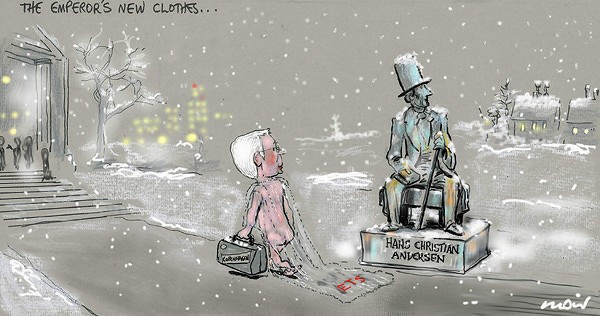
What I saw was the proceedings bogged down by procedural wrangles --points of order. What I saw at the conference of the parties was unhappiness by Brazil, China and India about the failure of the Danish Presidency to present the text designed to establish consensus.The proposal, which involves keeping elements of the Kyoto Protocol structure, is said to form the basis for further negotiations which are now entering into a crucial final phase.
The impression I got was that they are getting nowhere, there are many unresolved issues and there is a growing frustration amongst the developing countries continues to build. Presumably, there is an intense power play going on behind closed doors. Some has to start giving ground somewhere.
Al Gore turned up and applied the pressure. He needs to because the average global temperatures rise by no more than two degrees now looks to be closer to 3.5 degrees with the current offers for greenhouse gas emissions on the table. You can kiss some island states goodbye.
I have no idea what is happening around the negotiations on the two track process (extending Kyoto and a forging new agreement to replace Kyoto). We do know that the rich states complain that Kyoto makes no demand on developing countries, particularly China and India, whose carbon emissions have risen fast and will dominate future growth. The rich nations want a fresh treaty, arguing the world has changed and the major emerging economies such and China and India must commit to curbing their huge and fast growing national emissions. However, the issue is that Kyoto is the only legal treaty compelling rich nations to slash their greenhouse gas emissions. Does that mean two draft treaties or one? It Depends on the balance of power I guess.
I do not know what compromises have been reached (if any) on the key issues: real reduction commitments from the industrialised world with targets and timetables, corresponding commitments to meaningful action by the large developing nations like China, India and Brazil, and money on the table to manage the transition to clean energy in the Third World. From what I can gather the draft text has not been made public. So it is safe to assume that there is still no agreement on a basic framework on which world leaders can negotiate.
Giles Parkinson at Business Spectator says that:
One of the working parties focused on creating an alternative to the Kyoto Protocol met until 7am on Wednesday, formulating a text that included so many brackets – following tit-for-tat gamesmanship between the US and G77 nations – that it was as good as useless as a document for the leaders. When the Danish hosts proposed their own text, minus a bunch of brackets, in an attempt to find a path forward, the representatives of China, India, and Sudan voiced their protests, accusing the hosts of imposing their own ideas. The ambassador from The Maldives rose to tell them to get over it, all to no avail.
Apparently, the Danish hosts had put the finishing touches to what they hope will be a compromise text, and were consulting a group of 25 ministers, including Wong. But even this was proving difficult, as ministers were hard to corral and appointments were not kept
Posted by Gary Sauer-Thompson at 6:18 AM | Comments (8) | TrackBack
December 13, 2009
Copenhagen: just another political problem?
A group of scientists issued an update on the 2007 report of the Intergovernmental Panel on Climate Change and their conclusions in their report--“The Copenhagen Diagnosis” —were that ice at both poles is melting faster than predicted. The climate change sceptics and the fossil fuel industry, who have been trying to cover up the fact that human activities are warming the planet and then to derail the Copenhagen summit, are not listening:
 Martin Rowson
Elizabeth Kolbert says that “The Copenhagen Diagnosis”:
report points to dramatic declines in Arctic sea ice, recent measurements that show a large net loss of ice from both Greenland and Antarctica, and the relatively rapid rise in global sea levels — 3.4 millimeters per year — as particular reasons for concern. Sea-level rise this century, it states, “is likely to be at least twice as large” as predicted by the most recent IPCC report, issued in 2007, with an upper limit of roughly two meters.
The bottom line is that any value of carbon dioxide (CO2) in the atmosphere above 350 and, sooner or later, the ice caps melt, sea levels rise, hydrological cycles are thrown off kilter, and so on. Every year we don’t deal with it, it gets much, much worse.The current level of CO2 in the atmosphere is already at 390 parts per million.
David Corn reports that: the debate:
over process has become a battlefield for the major clashes of Copenhagen. The Obama administration is pressing China and other emerging nations to commit to significant action, noting that these countries will be responsible for 97 percent of the future growth in emissions. (Also, Obama administration officials know that the US Senate will not approve any treaty that goes easy on China; in such an event, the Senate might even kill the pending climate change legislation.) Meanwhile, the developing nations want the historic polluters to go first with deep cuts, and they are demanding big bucks out of the North for clean energy technologies. (The United States and Europe are currently talking about making $10 billion available annually as a start; Di-Aping declared that the US Congress alone should appropriate $200 billion.)
Bill McKibben argues that the politicians are treating the problem of climate change as a normal political one, where you halve the distance between various competing interests and do your best to reach some kind of consensus that doesn’t demand too much of anyone,
Posted by Gary Sauer-Thompson at 8:33 PM | Comments (3) | TrackBack
December 9, 2009
The Drum beats badly
Jonathon Green, ex Crikey editor, promised that the ABC's new online portal The Drum would provide quality and professional commentary-based journalism:
This is not news, this is not opinion, this is thoughtful and thought-provoking analysis. We'll be taking the issues and ideas that count and digging a little deeper into and around them. Looking for a real sense of understanding.
This, he added, would involve analytic takes on the world and events around us by taking a set of facts or known circumstances and holding them up to the light... then having a chat about it.
Well, let's have a chat about a particular piece they published yesterday. This is Kill the IPPC article by Bob Carter on Unleashed, which is part of The Drum's stable and so presumably, falls under its journalistic ethos. Carter asserts or claims that:
the study of climate change, under the aegis of "dangerous global warming caused by human carbon dioxide emissions," has long since been captured by the small group of well connected, well networked and well funded atmospheric scientists and computer modellers who advise the Intergovernmental Panel on Climate Change (IPCC), and whose nearly every utterance confirms their ignorance of the true course of climate history and change on our planet - a topic that is the domain of geologists, not meteorologists and computer jockeys.
It's a big claim: nearly every utterance of IPCC confirms their ignorance of the true course of climate history and change on our planet. There is no argument argument to justify this claim of "nearly every utterance." No facts are given.
We are merely offered an interpretation of the Climategate affair without any attempt to deal with the different interpretations of the significance of these leaked emails that challenge Carter's corruption thesis. The latter implies that science and policy is based on what is said in personal emails from people who are developing some sort of scientific story, rather than the literature that appears in peer-reviewed journals.
This is not holding things up to the light. It is chasing shadows inside the cave. This is more holding things up to the light in the context of thoughtful and informed analysis.
Carter then says this:
Behind the corrupted science of Climategate and the fall of the IPCC, then, lie two things. The first is the degradation, mainly by political interference, of research conditions and practices within modern government-funded research groups. The second is the power and financial clout of the modern, ecoevangelistic Green movement, egged on by crusading media reporters and editors. The world has probably never before seen a propaganda and political machine that is as well oiled, well funded and well organized as this modern army of apocalyptics and their media flag-wavers.
He ends by saying that the siren song of the Greens imperils both our standard of living and, ironically, the state of our natural environment.
The fall of the IPC is the inference! That conclusion merely rephrases the initial assertion that nearly every utterance of IPCC confirms their ignorance of the true course of climate history and change on our planet.
So much for the ABC's "thoughtful" analysis. This is a polemic that belongs on the pages of The Australian appealing to, and stirring up, its populist conservative base. Green knows from his experience at Crikey that this is junk analysis, so they are consciously running the junk under the banner of "thought-provoking" to establish their profile in the digital market place.
Does the ABC need to do tabloid to establish its digital commentary brand and to drum up an audience? My take is that in letting Carter's article through it has undermined the values of professional journalism about objectivity (broadly understood) that it professes to uphold.
Posted by Gary Sauer-Thompson at 3:33 PM | Comments (10) | TrackBack
December 5, 2009
Copenhagen: climate refugees
Is the Rudd Government on edge about climate change refugees from the Pacific Islands being given legal access to Australia due to rising temperatures and sea levels? Will the Rudd Government argue that the UN should redefine international law to give climate refugees the same protection as people fleeing political repression? Will they create a new visa category to be created for climate change refugees?
Yes, no, maybe is my immediate response without doing much by way of research.
Bangladesh, which is expecting its 165m population to increase by nearly 100m in the next 60 years, is the most vulnerable large country, with 60% of its land less than 5m above sea level.
 The Independent
There is mounting evidence in India and Bangladesh and other low-lying countries that sea levels are rising faster than the global average of 1.2mm a year. Islands and coastal communities in the Ganges delta and the Bay of Bengal have recorded rises of up to 5mm a year. In Bangladesh hundreds of coastal villagers are forced to drink salty water as tides continue to rise and the sea intrudes on fresh water aquifers.
The conservative populists will shortly be saying that the upcoming U.N. summit on climate in Copenhagen designed to begin addressing problems like climate change refugees will mean the end of Australian sovereignty. They deny that the rate of change is significant, and has recently been caused by increased greenhouse gases from human activities, that the rate of change has become alarming and is probably unsustainable in the long-term.
Posted by Gary Sauer-Thompson at 1:35 PM | Comments (4) | TrackBack
December 3, 2009
Copenhagen and the global commons
The failure of the Australian political process to deliver a very mangled emission trading scheme, and the Australian's consumer's reluctance to pay more for the energy our lifestyles rely on, has shifted into the background. Despite the context of scientists behaving badly, the debate over the threat of climate change is over. What we have is the twisted disconnect between accepted “political reality” and scientific reality.
What lies in the foreground is the need to move forward with an agreement that will curb carbon pollution and move us to a clean energy future. Here we have the process of nation states once again grappling with the need to find a way to reduce the emission of greenhouse gases that scientists argue drive climate change, and will probably raise the Earth's temperature to higher levels within our lifetimes. Once again there is the gulf between the enormity of the climate crisis and the tepid political response to it.
The aim is to limit global warming to 2C above pre-industrial levels. For this to happen global carbon emissions must start to fall rapidly during the next decade.If countries did not manage to reach agreement, world temperatures could rise by five degrees Celsius by the end of the century, making many parts of the world uninhabitable. It is not likely that political efforts to restrict global warming to an additional 2C — the level will succeed.
Since the Kyoto protocol there has been a series of annual UN climate conferences Buenos Aires, Bonn, The Hague, Marrakech, New Delhi, Milan, Montreal, Nairobi, Bali and Poznan. Copenhagen---COP15 ---will host the highest profile, best attended, most widely publicised and closely scrutinised UN climate talks so far.
The path to a low-carbon economy is through a Copenhagen treaty, that would set new targets for overall pollution levels, and again rely on governments to meet them. The first step is a patch-up accord, or political agreement, then a treaty. The four essentials calling for an international agreement in Copenhagen are:
1. How much are the industrialized countries willing to reduce their emissions of greenhouse gases?
2. How much are major developing countries such as China and India willing to do to limit the growth of their emissions?
3. How is the help needed by developing countries to engage in reducing their emissions and adapting to the impacts of climate change going to be financed?
4. How is that money going to be managed?
These are big issues and big problems that indicate that climate change is the most complicated and complex issue the world has faced. Each nation's plausible choices will depend on what technologies will be available and when.
A lot is at stake for the global commons. The most realistic outcome is an average rise of 4-5C by the end of this century given soaring carbon emissions and political constraints. That means damage limitation.
The BASIC countries (Brazil, South Africa, India and China) are prepared to walk out of the Copenhagen Conference if they are forced to agree to developed nations terms according to the Times of India.
Posted by Gary Sauer-Thompson at 8:47 AM | Comments (8) | TrackBack
December 1, 2009
the politics of climate change
Malcolm Turnbull speaks truth to power, ends up isolated from his party over the ETS, and is forced out of the leadership. The Minchinites link this campaign to cleaning the Wets out of the fractured party, and they argue that this script will deliver them electoral success. What are to make of this scenario?

A three way contest takes place early this morning in Canberra. The rabble that the Liberal opposition has become has changed leaders three times in its first term in the wilderness. Surprisingly, the talk is still about unity in the Liberal party, even though the leadership conflict is also a battle that involves real, and deeply held, ideological and political differences. The politics of climate change has arrived, and it will be increasingly played out over the next decade.
Dennis Glover in The Australian says:
It's not surprising therefore that climate change is starting to pull apart the Liberal Party. Malcolm Turnbull's flawed personality and Tony Abbott's delusional ambition are part of the problem, but the events of the past week can be fully understood only when placed in a wider historical context: this is the first time global warming has produced a leadership struggle in a main political party. Turnbull's agony is the canary in the coalmine, signalling the beginning of the era of climate change politics.
A majority of Liberal Party members appear to agree with the Nationals that electoral victory next year can be achieved by campaigning against the government's Carbon Pollution Reduction Scheme.Their talk is that Coalition in a 2010 election could say yes to the idea of combating climate change but no to this ETS model.
So what is their alternative model to mitigate greenhouse gas emissions? Silence. Big silence. All we hear is the talking point that a big tax is going send us all broke--a scare campaign, in other words.
An editorial in The Australian rightly points out the core difficulties in the Minchinite conservative's position:
The Liberals have spent more than a week seriously contemplating fighting the Rudd government in a climate change election, with a policy fashioned by people within their ranks whose position is out of kilter with that of the clear majority of Australians...the Liberals will not regain power without a clear direction as a modern centre-right party, drawing on the traditions of liberalism and conservatism while understanding the changes under way in the electorate.
The editorial says that if the Minchinites prevail, the party will be forced to run parallel campaigns at the next election. A split party will require separate strategies -- one for the bush and provincial seats, where the conservative base rejects the need for action on climate change, and another for suburban seats such as North Sydney and Wentworth.
You would have to reckon that the Minchinites have a big problem in persuading the middle ground of the electorate that it is in Australia's national interest to say no to climate change in 2010. Turnbull was dead right on this. Maybe the Minchinites do want a pared-down, pure party that remains in opposition for a decade or so?
Update
Abbott prevails over Turnbull 42 to 41 with Hockey eliminated on first round. Turnbull looks good in defeat. The Liberal Party will now move to kill off the ETS in the Senate. The 2010 election will be a vote on climate change and not an emissions trading scheme, which Abbott dismisses as a giant energy tax.
Abbott says that so they'll keep the greenhouse reduction targets but Liberals will not support any action that causes pain to the economy or to the energy intensive export industries. The mechanism to achieve targets is unclear. In his Battlelines book Abbott says that his position is a sceptical one and not that of a climate change denier:
Natural science has undeniably shown us that global warming is man-made and real. But just as undeniable is the economic science, which makes it clear that a narrow focus on reducing carbon emissions could leave future generations lumbered with major costs, without major cuts in temperatures.
So the issue is is how to achieve this: Abbott, who is a big government conservative and centralist, adds:
It's hard to take climate alarmists all that seriously, though, when they're as ferociously against the one proven technology that could reduce electricity emissions to zero, nuclear power, as they are in favour of urgent reduction in emissions. For many, reducing emissions is a means to achieving a political objective they could not otherwise gain.
He then targets an ETS mechanism:
Another big problem with any Australian emissions reduction scheme is that it would not make a material difference to atmospheric carbon concentrations unless the big international polluters had similar schemes. Australia accounts for about 1 per cent of global carbon dioxide emissions. At recent rates of growth, China's increase in emissions in about a year could match Australia's entire carbon dioxide output. Without binding universal arrangements, any effort by Australia could turn out to be a futile gesture, damaging local industry but making no appreciable dent in global emissions.
If night is always darkest before the dawn, then Abbott now presents the Liberal Party with an opportunity to recover its conservative soul, and to argue that this is the only way forward for the Liberal Party.
Meanwhile we need to appreciate that virtually nothing has been done to transform Australia’s economy, even though its economy is the most carbon intensive in the world and Australia, emits more than many countries on a per capita basis. Not a single substantive solar energy facility has been built as a result of the current federal government’s policies, though some wind farms have popped up because state governments have committed to having renewable offsets for installations such as desalination plants. Nor have businesses properly prepared themselves to embrace the challenge of energy efficiency.
Posted by Gary Sauer-Thompson at 5:58 AM | Comments (27) | TrackBack
November 28, 2009
As in Australia so in the US
As in Australia so in the US with respect to acting on climate change. As Jeffrey Sachs observes:
There are several reasons for US inaction – including ideology and scientific ignorance – but a lot comes down to one word: coal. No fewer than 25 states produce coal, which not only generates income, jobs and tax revenue, but also provides a disproportionately large share of their energy... Since addressing climate change is first and foremost directed at reduced emissions from coal – the most carbon-intensive of all fuels – America's coal states are especially fearful about the economic implications of any controls
For Australia just think Queensland, NSW , Victoria, South Australia--coal states. Minimal reform with lots of public subsidies is their game plane. Now think coal state senators with their blackhats.
Sachs says that:
until recently, many believed that China and India would be the real holdouts in the global climate change negotiations. Yet China has announced a set of major initiatives – in solar, wind, nuclear, and carbon-capture technologies – to reduce its economy's greenhouse gas intensity. India, long feared to be a spoiler, has said that it is ready to adopt a significant national action plan to move towards a trajectory of sustainable energy.
Sachs asks: "could the US Senate really prove to be the world's last great holdout?" Nope. There is the Australian Senate since many Coalition Senators senators from the coal states are unlikely to support decisive action on climate change, other than to prevent the economic impact on the coal states and to demand even more favours for business.
They are not concerned about market failure, or how to produce much more energy with much less CO2, nor with influence the demand side of the market, leading to consumers adopting more sustainable behavior by making sustainable low-carbon choices. Nor do they talk about making buildings more efficient or mandating green buildings.
I can imagine some blackhat Senators saying that if energy efficiency worked, everyone would have done it already. When others look a bit puzzled they would elaborate along the lines that what they meant was that this is like the joke about the two economists who ignore a $100 bill they see lying on the street, figuring that if the money were real someone would have picked it up.
So what is Copenhagen about? The conservatives would say that these good guys are a good guide to what is going on. One of them--Lord Monckton spoke at a recent IPA conference in Australia. There is nothing online from the conference, but some of Monckton's climate change denial rhetoric can be foundhere.
Posted by Gary Sauer-Thompson at 11:51 AM | Comments (3) | TrackBack
November 26, 2009
Open Australia
I've been interested in the ideas surrounding, or flowing from, Government 2.0. One of these was Mashup Australia, which was designed to provide a practical demonstration of the benefits that open access to public sector information can provide. I've been curious about how this could help improve my blogging by providing me with greater information.
One example of the potential that can be unlocked when government information is unlocked by pulling together data sets in new and innovative ways is Open Australia, which I stumbled upon yesterday. This is a volunteer run website that helps us to find out what our representatives are getting up to in parliament with the aim of bridging the growing democratic disconnect or deficit that many people feel.
It was always difficult for those outside Parliament to follow debates in Parliament on any issue as it involved scrolling through pages of Hansard record of the day (a pdf) to find the issue. It was too unstructured. The other option, of listening to Senate debates online via a live stream is particularly tedious, especially when the speakers are a bunch of climate change denialists.
Thus we have Senator 'free enterprise' Cory Bernadi's rhetoric about alarmists, leftists, the new religion of climate change, heretics and sceptics, political madness, Orwell’s Big Brother, climate science as a fraud and so on and so on. I just stop listening This kind of content sees climate change through the left-right prism of the culture wars, junk science and delusion in the sense of turning away from reality.
It can be found in the op-eds of Miranda Devine whose wingnut rave is about the heart of the propaganda machine of climate science that has driven the world to the brink of insanity; climate alarmists are dangerous megalomaniacs, foolish, but with enormous power. And so on.
So what does Senator Alan Ferguson, also from SA, who have to say by way of contribution to a public debate.
I am in a rather unique position, having started to make this speech last night prior to any knowledge of proposed amendments and, now, having seen those amendments, I can move on. Can I say first of all that seeing those amendments has not made me any happier. My opposition to these bills remains the same as it was. My position has not changed from last night now that I have actually seen the amendments.
No reason is given for this position. We are offered no argument as to why. It is just assumed that the dismissal of the McFarlane deal is reasonable without giving a reason. Exasperation is my response at the trashing of the values of democratic deliberation and debate.
Senator Concetta Fierravanti-Wells from NSW says:
what has troubled me about the current debate is the language and tone of the public utterances. On the one hand, there has been a fervent, almost evangelical, adherence to a view that the sky will fall in if the world does not act on climate change now. Advocates of this position have pilloried those who have dared oppose their view. They have dubbed them ‘climate change sceptics’ in tones reminiscent of the Inquisition and burning people at the stake. Some have stridently and appallingly equated them to Holocaust deniers. Yesterday’s front page article in the Australian, entitled ‘Hackers expose climate brawl’, and the release of emails only strengthen the views of those who have questioned the science. The apparent glee at the death of one such scientist by those holding opposing views is both sickening and appalling.On the other hand, people have questioned the science. We have seen scientists, such as Professor Plimer, offering alternative viewpoints.
After a while listening to this kind of rhetoric about science that makes a virtue of ignorance is just too much. I just switch off. Fierravanti-Wells is basically defending the coal interests in the Illawarra region. Ever more protection for the coal miners is her policy. This is the ground to fight an election on for the conservatives. They do not seem to realize that they would go backwards, or they don't care. It's a long term split.
Open Australia means that the information is now very easy for bloggers and citizens to access what is being said on particular debates by our local members or Senators inside Parliament. So were can see where they are coming from and how much they support a reform process. Thus Senator Birmingham from SA, in speaking on the Australian National Preventive Health Agency Bill 2009 makes the following observation says:
that no number of marketing campaigns, no number of budgets in these areas will enable you to convince or stop people from making what in the end to some extent are free choices to be able to actually decide how they lead their lives. Unhealthy lives we would all like to discourage, but there are limits to how much government should interfere in people’s lives to discourage them from leading unhealthy lives. Government is not some nanny state that is there to hold the hand of everybody each time they go to the supermarket, to tell you, ‘No, you should not put that in your shopping trolley.’ That is not the role of government and that is not what we should be seeing out of these types of preventive health agendas.
Birmingham appears to accept that a preventive approach to sickness is fundamental to any good health system but is concerned that the debate has not actually focused on when we cross the line of unnecessarily telling people how they should live their lives.
As Pip Marlow points out:
the agenda of Gov 2.0, and of the whole project of providing transparency and openness in government data, cannot be met unless we deal with the challenge of finding the “jewels”, the “gems” in the unstructured data itself.
Open Australia makes it possible to access what our representatives are actually saying behind the spin of media releases, doorstops, and media interviews. We can access what hey are saying at work, so to speak.
Posted by Gary Sauer-Thompson at 7:32 AM | Comments (1) | TrackBack
November 25, 2009
high drama in Canberra
There is a huge gap between Rudd's rhetoric on the necessity for an ETS to mitigate greenhouse gas emissions and decrease the rate of global warming ---- a "fundamental existential question for the future''----and his actions in delivering a revised GPRS. The context here is that it is now virtually impossible to limit global temperature rise to 2C and the decade long delay in acting meant the world would now do well to stabilise warming between 3C and 4C.
What we are witnessing is the politics of buying off the sqwaking opposition to an emissions trading scheme who threaten that the lights might go out. The Rudd/Turnbull ETS primarily supports the coal fired power stations, the emission intensive industry, and a host of other industries. It protects jobs and ensures that coal-fired electricity generators keep producing electricity, but it does little to reduce greenhouse gas emissions, decrease the rate of global warming, and the worsening negative impacts on nation states.

Far from Turnbull staging his own destruction he delivered. He got McFarlane's deal through the shadow cabinet and then the partyroom, even if the latter took him all day to do it. As we learned from Twitter this party room meltdown has deepened and broadened the conservative/liberal divisions in the fractured Liberal Party.
Turnbull has to now get the deal through the Senate by ensuring that Liberal Senators vote in favour of the legislation this week. He needs just 7 votes. That's reason to be confident. Turnbull has crashed through.
Despite McFarlane gaining a host of concessions from Wong and Rudd, this was not enough for the dissenting conservatives who want boss Turnbull's head now. Even though a cap and trade emissions trading scheme is a market mechanism to drive change through price, this minority remains opposed to the Liberal Party becoming relevant to the 21st century. If there is a challenge this week, the backward looking conservatives will lose.
Turnbull has not lost the war - ie, retaining his leadership through to the next election--as Peter van Onselen claims in The Australian. Nor is Turnbull a political dead man walking as Dennis Shanahan claims, since Kevin Andrews as Liberal leader borders on a farce.
The purpose of an emissions trading scheme is to drive change, raising prices to give investors the incentive to replace dirty old plants with cleaner new ones and to replace coal-fired generation with renewable energy (gas and wind energy). If Rudd and Turnbull are driving change from business as usual, while protecting business as usual, then how is Australia going to make the transition to a low carbon economy?
I cannot see the offsets in investment in renewable energy by power generating companies happening. there are too many free permits and not enough auctions. What I see in the Rudd/Turnbull business-as-usual achieving is the increased investment in coal fired power stations. WA government recommissioning two old coal-fired power stations that had been decommissioned; the Victorian Government refurbishing its existing brown coal plants; and the Queensland and NSW Governments building new coal plants.
Secondly, the coal-fired power generators + the major polluters who depend on fossil fuels will make lots of money from selling their free carbon permits whilst households pay for more for their electricity. Cap and trade is a mechanism in delay for the major polluters by buying cheap pollution permits rather than driving change by switching to renewable energy.
Thirdly, carbon trading will only achieve a modest 5% reduction in greenhouse gas emissions whilst giving the major polluters a breathing space to continuing business as usual with it's depends on an over reliance on fossil fuels.
The best that can be said is that cap and trade system is there and it may work more effectively in the future with more auctioning. However, the structural change under this system is dependent on price.Will that reduce green house gas emissions caused by an over reliance on fossil fuels. No. The price mechanism is not enough to make the shift to a low carbon economy.
Posted by Gary Sauer-Thompson at 5:40 AM | Comments (22) | TrackBack
November 23, 2009
The GPRS
The big news in Canberra and politics this week will be the passing of the emissions trading scheme (CPRS) by the Senate. All the indications--as of this morning--- are that the GPRS legislation will be passed by the Senate. No doubt Minchin will probably use the filibuster tactic as his best chance of stopping the CPRS before Copenhagen, many Coalition Senators will cross the floor. There will be blood on the floor as the Liberal climate changed denialists, who don't have the numbers, threaten to blow the show up if Turnbull doesn't do what they want. High drama.
This signing into law will happen in spite of the theatrics of the deep divisions within Coalition, the forever opposed noise from the denialists, the tactics of those right wing Liberals obstructing the bill to protect the coal industry, the now naked threats from coal-fired power generators, such as Truenergy and International Power. Bring on the heat they cry in unison.

The only surprise will be how much the Rudd Government concedes to the Coalition in giving extra subsidies to the coal fired power stations in order to safe-guard the power industry-- protect even the dinosaurs from another era such as Hazelwood and Yallourn. Rudd + Co will bend over a long way in giving the power industry even more free pollution permits and to extend the compensation beyond 2015. The Brumby state government in Victoria wants that outcome as well.
No need to worry though. The CPRS is not designed to reduce greenhouse gases and it won’t do that. Hence the justified opposition from the Greens. The rorts are too great. This legislation won't achieve the levels of emissions cuts promised, nor will it drive the major technological innovations that are needed to shift our economy on to a more low-carbon path.
The only game in town is to clean up existing coal-fired power stations and make the new ones cleaner. Clean coal is the future, so let's roll out the new coal fired power stations to meet increased demand in NSW.
Posted by Gary Sauer-Thompson at 7:18 AM | Comments (19) | TrackBack
November 19, 2009
climate change politics + the media
The conservative voice of extremity is exemplified in Miranda Devine's claims in response to Rudd's Lowy Institute speech that Rudd is attempting to fashion a one-party state whilst the dissent of the climate change denialists is being stifled. This taps into undercurrents of hysteria and paranoia in the Australian polity.
These conservative claims are on par with Senator Minchin's statement that global warming is a left-wing plot to de-industrialise the world, or The Australian's standard talking point that climate change is a conspiracy of myth, deception and exaggeration that is being perpetrated by some sort of global green movement of economy-wreckers whose utopia will take Australia back to the dark ages.
Sure, I appreciate that these kind of arrows are being fired at The Greens because this political party may well hold the balance of power in the Senate after the 2010 election. So they need to be treated as political pariahs by the conservatives, who are trying to shore up their base and reduce the electoral losses they fear. That means a reduced Coalition presence in The Senate and a Labor/Green alliance of sorts.
I appreciate that the latter possibility sends a big shudder up the spine of the Labor Right, who will be mugged by political and economic reality. No doubt these social conservatives will have to grit their teeth and bite their tongue.
A more rational liberal voice is that Arthur Sinodinos in The Australian, who uses Pascal's wager to justify using a market approach to global warming. He then says:
There is no incompatibility between private enterprise or capitalism and the environment. The success of capitalism in raising living standards has been used by some Greens to equate it with environmental degradation.The poor state of the environment in Eastern Europe when the Berlin Wall fell demonstrates that there is no corollary between social and economic systems and the condition of the environment.The Greens have often used environmental issues to peddle an anti-capitalist and populist agenda, focusing on renewable energy sources as good, soft power while rejecting nuclear energy as hard power that is the dirty product of multinational corporations.
There is no mention of global warming as a classic example of market failure there. Secondly, how can government support for fostering a renewable energy industry in Australia be seen as anti-capitalist?
As Geoffrey Baker points out there is little debate in the media on some key issues:
Assuming the reality of climate change, how consistent is government policy with the prime minister’s seemingly apocalyptic rhetoric about non-action on climate change? How significantly are industry and environmental pressure groups influencing climate change policy? What is the next step if, as now seems accepted, Copenhagen cannot finalise an agreement on financing the carbon reduction programs of developing countries? Can countries like Australia ethically outsource greenhouse gas reductions by purchasing carbon credits from developing countries?
Baker's explanation for the failure of the media to use the "implied freedom" of political communication in the constitution to debate these issues is the media gatekeepers are mostly concerned about the daily polemical attack and defence of politics in the 24 hour news cycle, and not policy issues.
True, but as Matthew da Silva points out in The National Times a lot of contemporary journalism in the corporate media is little more than a rebadging media releases from the publicity industry. So readers look elsewhere.
Sinclair Davidson, of the IPA, has made an attempt to take the debate further. He says that suppose we:
imagine we know with more than 90 percent confidence that anthropogenic global warming is occurring, what next? The questions, "Should we do anything?" "What should we do?", and "How should we do it?" remain unanswered. These are not scientific questions at all. In the first instance there are economic questions, "How much will doing ‘something' cost?" Perhaps it would be cheaper to do nothing and adapt. Perhaps not. We simply do not know. The Australian Treasury modelling does not answer that question; indeed it doesn't model the actual policy under consideration.
The 'should we do anything' question has been answered with an emissions trading scheme, which is currently being considered by the Australian Senate. The reason for this policy of using the market to drive change is that we do know from the Stern Review of the UK Treasury that it is cheaper to do something now rather than do nothing and adapt. It is misleading for Davidson to say that we simply do not know about the economic question of doing something rather than nothing.
As a Professor in the School of Economics, Finance and Marketing at RMIT Davidson would know this. So why the ignorance claim?
Posted by Gary Sauer-Thompson at 7:06 AM | Comments (14) | TrackBack
November 16, 2009
fruit loops + talking shops
I watched Question Time in the Senate today on the ABC. It was dominated by questions about refugees and climate change, with the background wall of noise and interjections from the Coalition loudest on the issue of climate change. Their strategy is one of obstruction.
I have to admit I'm utterly sick of the "know nothingness" of the National Party--denialists one and all--give the decline of the agricultural economy. There is the slow destruction of irrigated agriculture in the southern Murray-Darling Basin from lack of water-- so similar to the decline in Central Valley, the thin, fertile band running down the middle of California. and the negative impact on cropping( wheat) agriculture. The Nationals looked and acted like fruit loops. They are in hock to the nation’s coal industry in NSW and Queensland.
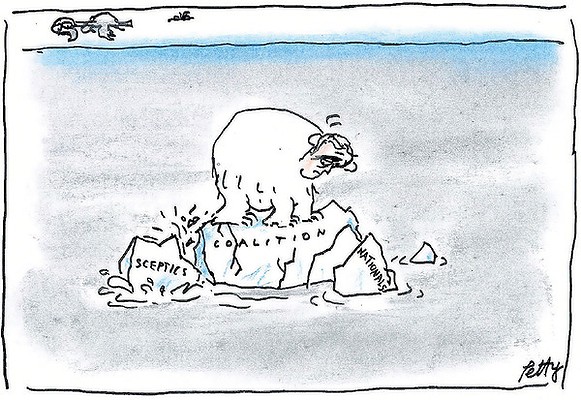
Senate leader Nick Minchin warned that the Rudd Government's backdown on including agriculture in the scheme was “necessary but insufficient” and a long way from delivering enough concessions for the Coalition to support the legislation in its current form. He also warned that Labor could agree to all of the Coalition's amendments and the Coalition could still vote against the government's legislation.
According to Nick Minchin's Liberals it's all a left wing conspiracy and a fraud cooked up by communist greenies intent on destroying the Australian way of life. Or something crazy like that.This economic ruin talking point indicates that truth and science is of no concern to them. So that leaves political advantage.
They reckon that their advantage lies in opposing the government’s emissions trading scheme, even though the Riverland in SA is experiencing the long term impact of farming a region that cannot sustain the current irrigated agricultural practices. It's future is a dust bowl. Just wait for Copenhagen Minchin's Liberals say.
The time has run out to secure a ‘grand global bargain’:--- a legally binding climate deal at the Copenhagen summit in December that was meant to lock in place a global action plan to replace the Kyoto protocol. As there has been lack of progress in recent preparatory talk Copenhagen becomes talks about talks to secure binding emissions targets and overcome the divisions between the developed and developing world. There has been failure to agree on the big issues: what carbon cuts rich countries should make, how much money the poor should get to help them adapt to climate change, and where that money should come from.
The US, Australia and Europe are playing hardball to split the developing countries (G77) in order to weaken their political positions and isolate them before they make them offers (promises of cash soon and greater reward later) and get their way.
There is no Copenhagen deal because of the hold-up of the climate legislation in the dysfunctional US Senate. There the Republican minority has taken obstruction to a new level in that their strategy is to insure that Democrats fail to accomplish anything.
Posted by Gary Sauer-Thompson at 2:34 PM | Comments (11) | TrackBack
November 15, 2009
Australia's coasts + climate change
Climate Change Risks to Australia's Coasts reinforces the House Standing Committee on Climate Change, Water, Environment and the ArtsInquiry into climate change and environmental impacts on coastal communities that I mentioned here. The former report is Australia's first national coastal assessment, and it brings together existing and new information to highlight the scale of problem Australia faces as a vulnerable coastal nation.
It states that there is an increasing recognition that sea-level rise of up to a metre or more this century is plausible, and possibly of several metres within the next few centuries. 1.1 metres was selected as a plausible value for sea-level rise for the risk assessment based on IPPC science, and these sea levels will bring significant change to Australia’s coastal zone in coming decades:
With a mid range sea-level rise of 0.5 metres in the 21st century, events that now happen every 10 years would happen about every 10 days in 2100.The current 1-in-100 year event could occur several times a year ... With much of Australia’s infrastructure concentrated in the coastal zone around centres of population, climate change will bring a number of risks to built environment assets.
Queensland stood to be the worst affected (Moreton Bay, Mackay, the Gold Coast, Fraser Coast, Bundaberg and the Sunshine Coast), then NSW (Lake Macquarie, Wyong, Gosford, Wollongong, Shoalhaven and Rockdale), then Victoria (Kingston, Hobsons Bay, Greater Geelong, Wellington and Port Phillip).
In SA the most vulnerable area to a sea-level rise of 1.1 metres, is Port Adelaide, which is located between the Gulf St Vincent and the Port River near Adelaide, and which is experiencing local land subsidence, due to wetland reclamation and groundwater extraction from the aquifer. It will require the construction of a system of sea walls to protect against inundation.
Yorke Peninsula is also vulnerable, followed by the Kingston and Robe region of the southern coast and the Glenelg foreshore in Adelaide. In spite of this vulnerability the Department of environment and Heritage's 2004 Living Coast Strategy makes no mention of rising sea levels.
It is on the radar of SA Coast Protection Board as there is a long history of allowance for sea level rise in local planning in South Australia Current provisions for sea level rise in development plans around the state allow for sea level rise of 300 mm over 50 years, plus the capability of being protected against further sea level rise of 0.7 meters, using protective measures such as sea walls and setbacks.
Update
The proposed emissions trading scheme, which has been diluted by huge concessions to incumbent power producers, exporters and mining companies and in all probability will be further diluted by excluding agriculture from the scheme ''indefinitely'' will make no difference to rising sea levels. In contrast, US farmers are benefiting from a voluntary cape and trade scheme. A low level mitigation means greater adaptation.
Ziggy Switkowski in his We are already adapting to warming in The Australian says:
And when reports suggest that hundreds of thousands of homes and many billions of dollars of property will be at risk from surging tides this is not necessarily a consequence of rising sea levels but a result of population growth and our inclination to locate ourselves and our expensive belongings ever closer to the coast....Changes in sea levels have not translated into observable changes in insurance claims associated with coastal and riverine flooding....To be sure, annual aggregate insurance costs continue to rise sharply but so far these are caused by societal factors and not anthropogenic climate change.Our continent is especially vulnerable to meteorological hazards so climate-driven shifts should be detected early and none has been, yet.
Coastal flooding is caused by societal factors? Really? Floods, cyclones and bushfires have now become such a fixture of the insurers' landscape that they can no longer be viewed as one-off incidents. They are now seen by insurance companies as an effect of climate change on our weather patterns and this results in a repricing of risk by insurers. That means increasing premiums, not just for beach houses but for towns and cities.
Update
It's not just Pacific Islands, beach houses and remote Arctic outposts falling into the sea. Have a look at these images of Shishmaref village on Alaska's remote west coast, which reveal the tip of a permafrost terrain melting very fast.
Posted by Gary Sauer-Thompson at 8:07 AM | Comments (2) | TrackBack
November 10, 2009
a Liberal Party madness
I wasn't planning to watch the last Four Corners programme entitled Malcolm and the Malcontents attributed to Sarah Ferguson. Not another account of Liberal Party disunity I thought. We know that the conservative and liberal wings are at war. But I was persuaded by the flow of interesting comments on Twitter.
The Coalition sure is a rabble over climate change despite an ETS scheme being their policy. The Nationals are totally opposed and conducting a fear and loathing campaign in regional NSW and Queensland. It's a no vote, absolutely. They reckon they'd win a double dissolution election on opposing an ETS.
The conservative populist rhetoric is that an ETS is "socialist chardonnay rubbish", a left-wing “conspiracy”. There is no global warming, just natural cycles and the appeal to justify this is to 'sense' and 'impression' and pre-existing sentiment (common sense) of the hard done battler. The Nationals have drawn a line in the sand and put their bodies on the line to fight green fanaticism that is taking over Australia. They look such a rag tag bunch, as does their white populist base. They all looked like the One Nation party of the1990s, sadly haunted by the decay of their wizened provincialism. Death beckons.
In the Liberal Party Minchin, Abbott, Jensen, Kormann, McGauran and Bernardi, climate deniers one and all, were openly opposed to an ETS, quite willing to oppose their leader publicly, and to do so on the lefty ABC. Minchin, in particular, was claiming that a majority of the party did not back Mr Turnbull's acceptance of the science behind climate change, and openly encouraging the backbench to defy their leader on this issue.
All this is at a time when the Coalitions' party room has authorized Ian McFarlane to conduct good faith negotiations with Minister Wong to work through the Liberal Party's proposed amendments to the Government’s CPRS legislation now in the Senate.
McFarlane was the only Liberal who came through with any political nous. He was using political reason to think the issue through---he “is no longer sceptical about humans causing global warming but he is now sceptical about carbon capture and storage”--- and to see the Coalition through a very difficult patch. In the meantime the climate change deniers, one and all, have rejected the scientific enlightenment and, just like the Republicans in the US, fully embraced the contemporary form of the counter Enlightenment tradition.
Update
Minchin knows that the failure to get the Liberal Party on side on an ETS will almost certainly end Turnbull's leadership, and he is nakedly acting to make that happen. But for what goal? The disunity strategy is a pathway to many a long year in opposition. That would provide him with an opportunity to continue with the factional politics within the Liberal Party--to clean out the liberals (wets) and replace them with conservatives so that the Liberal Party is liberal in name only? That has been his strategy with the SA Liberal Party. Is this his game plan?
Posted by Gary Sauer-Thompson at 8:20 AM | Comments (19) | TrackBack
October 13, 2009
ETS: public debate
One aim of climate change policy is to prevent more than a 2C of warming. This is probably not feasible anymore and it is more likely to be a 4C increase given that a lot of climate impacts are running ahead of projections. Though there simply isn’t any possibility of stopping this acceleration of climate change in its impacts (eg., the accelerated rate of sea level rise) overnight, how to head off that catastrophe should be the dominant policy issue of our time.
On the 7.30 Report last night Kerry O'Brien asks a question of Ross Garnaut on climate change:
What do you think of the quality of political debate in Australia right now about an emissions trading scheme for this country, and does it really matter whether that ETS is determined in these few weeks before Copenhagen or in the two or three months after Copenhagen?
The core of the debate is what to do, given that Australia's primary energy comes from fossil fuels, whose combustion is putting carbon dioxide into the atmosphere, the biggest driver of global climate change. Basic economics says that if we want to discourage a negative externality, like pollution, then we need to put a price on that externality. One way is through an emissions tax; an alternative, with very similar economic results, is a system of tradable permits.
Garnaut's response to the question is that:
Well, I think this whole process of policy making over the ETS has been one of the worst examples of policy making we have seen on major issues in Australia. It is a very difficult issue, so I suppose it was never going to be easy, but the way it's broken down is extraordinary.
It is hard to disagree with that judgement, especially when the Victorian Farmers Federation carry on about how the doomsday people in climate change are robbing regional people of hope at a time when that’s all they’ve got left.
Groups like the Farmers Federation and the Nationals don’t like the political and policy implications of climate change, so they’ve decided not to believe in it — and they’ll grab any argument, no matter how disreputable, that feeds their denial, even if it involves a contempt for natural science.
The deniers rhetoric also involves dishonesty on the economics of the transition. A cap-and-trade system simply puts a limit on overall emissions, so that emitters have to pay a price for emitting. It transfers money from the emitters, and ultimately those who buy their products, to whoever collects the taxes (governments) or gets the permits, and ultimately whoever benefits from the revenue or rents thus generated.
The three options with regard to climate change are mitigation, adaptation, and suffering, and there is going to need to be a lot of both mitigation and adaptation in order to reduce the amount of suffering that results from climate change. John Holdren, the President Obama's top science adviser, says that:
we need a lot of mitigation in order to hold the changes in climate to the level that adaptation will be able to cope reasonably effectively with. At the same time, we can’t rely on mitigation alone without adaptation because nothing that we could manage in the mitigation domain can stop and reverse climate change overnight.
In a world polluted by some of the worst kind of public relations spin, we routinely experience deception as well as dramatic overstatement and overheated rhetoric about the costs of mitigation and adaptation as "part of the game" being played by the fossil fuel lobby to block change and continue business as usual.
Posted by Gary Sauer-Thompson at 7:50 AM | Comments (14) | TrackBack
September 22, 2009
climate heating: UN negotiates
The Rudd Government has given the impression that its approach to emissions trading scheme has been directed more at placing pressure on a deeply fractured Coalition, rather than reducing greenhouse emissions and shifting Australia to a low carbon economy. Coal rules in Australia and the fossil fuel lobbyists deploy the tactic of delay.
So Australia has targets but no action and we are planning to build more coal-fired power stations to power the nation into a new era of prosperity:
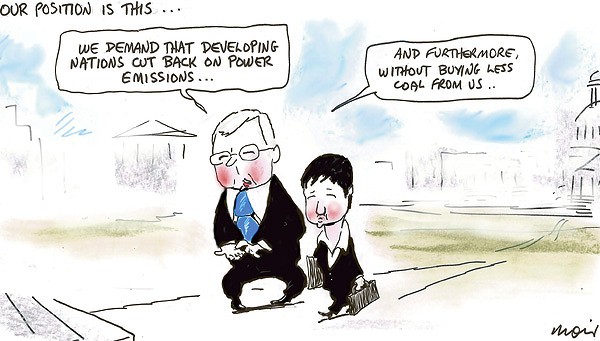
Attention has shifted to the UN in the context of the negotiations for a climate change treaty being adrift. It is marked by the failure of leaders of the big polluting countries to sign on to the deep emissions cuts needed; and the failure of industrialised states to come up with a package on how to compensate poor countries that will suffer the most devastating consequences.
The December Copenhagen summit is unlikely to produce a strong enough agreement that is a successor to the Kyoto protocol. Kyoto was where promises were made but not kept. The Copenhagen negotiations are dangerously stalled.
Even if rich countries clean up their act, a deal to ensure that global emissions peak and start to fall in time to keep temperature rises to less than 2C won't succeed without developing countries, such as China and India. A core issue is how to allow developing nations such as China and India to grow their economies and lift billions from poverty without generating enormous greenhouse gas emissions, as past growth in the developed world did.
The official Chinese position is summarised as "shared burden, differentiated responsibilities", which roughly translates as: We're all in the same boat but it's your fault that it's taking on water, so you'd better do most of the baling. China will not sacrifice its economic growth to prevent the world from warming by more than 2C--- its priority must be economic growth to relieve poverty among its vast population.
Is Beijing is determined to make the rich countries cut deeper and hand over more technology and cash to developing nations? The most vocal arguments are about equity: the rich industrialized world caused the problem so why should the poor world pay to put it right? China's position is that helping developing countries adapt to climate change is not an exercise in charity by rich nations, but their responsibility to help developing countries take a new low-carbon path for development.
Yet Australia is not taking a new low-carbon path for development. The United States is unlikely to be the nation that blazes the trail toward a bold new future in Copenhagen given the political trench warfare in the US,
Posted by Gary Sauer-Thompson at 9:37 AM | Comments (4) | TrackBack
September 16, 2009
climate change: withering in the vineyards
The Obama administration's recent Global climate change impacts in the United States provides a detailed picture to date of the impacts on the US in the worst case scenarios, when no action is taken to cut emissions. What it indicates is that even if the world is successful in cutting carbon emissions in the future, the various states in the US need to start preparing for rising sea levels, hotter weather and other effects of climate change.
Same for Australia. The states have to adapt, no matter what we do, because of the nature of the greenhouse gases means that they are still going to be in the atmosphere for the next 100 years. Cutting greenhouse gases in the future will take decades to have an effect while the planet continues to warm. States have only recently begun to consider what steps they must take to minimise the damage expected from sea level rise, storm surges, droughts and water shortages because of climate changes.
Climate changes means rising temperatures in south eastern Australia over the next few decades that will lead to more heatwaves, wildfires and droughts. Does that mean withering in the vineyards of South Australia?
Every low-lying community coastal in the country will in the coming decades face the real cost of increased erosion, storms and sea-level rises exacerbated by global warming. This presents local people and the government with a stark dilemma. Is it worth spending billions on defending homes and livelihoods? Or, faced with inexorable sea-level rise, should expensive coastal defences be abandoned, leading to the evacuation of land and houses?
The process of coastal erosion from rising sea levels with cause strong political resistance as farm land is lost, house prices fall and fresh water marshes become salt marshes.
Posted by Gary Sauer-Thompson at 8:42 AM | TrackBack
September 1, 2009
River Murray: it's climate change not drought
Finally, some sense on the causes of a warmer south eastern Australia that has seen the annual inflow of one of Australia’s largest river basins drop nearly 80% in the seven years. The hotter drier conditions here have usually been put down to a big drought, with the implication that the drought will break and things will return to normal. 'Normal' in this context means the wetter conditions of the 1950s-1970s.
This is the position of most of the loud irrigator groups along the River Murray. They argue that the federal government needs to modernize the irrigation infrastructure, especially in Victoria (the Foodbowl Modernisation Project) since wetter times will return. The rains will comeback is the position of both the Coalition, who are opposed to the buy back of over-allocated water licences, and it, would appear, the Murray Darling Basin Authority.
 Gary Sauer-Thompson, Clayton, Lake Alexandrina,South Australia, 2008
The South Eastern Australian Climate Initiative was set up in 2006 to find the causes for why south-east Australia had experienced a dramatic loss of rain. The crucial question is the why (drought or climate change?) and, secondly, how the drier conditions in the Murray-Darling Basin will affect stream and river flows in the Basin.
My understanding was that the loss of rain, and the weather patterns in southern Australia shifting to a dry phase was simply due to the rain-bearing storms shifting south off the continent. I had assumed that while the precise role of cyclical changes versus the impact of greenhouse gases remained unclear, changes in the basin are consistent with CSIRO computer modelling of the impacts of increased concentrations of greenhouse gas in the atmosphere.
Melissa Fyfe reports in The Age that scientists working on the research programme have discovered that the 13-year even of hotter drier conditions is not just a natural dry stretch--a drought--- but is a shift related to climate change.
They found that the rain has dropped away because the subtropical ridge - a band of high pressure systems that sits over the country's south - has strengthened over the past 13 years. These dry, high pressure systems have become stronger, bigger and more frequent and this intensification over the past century is closely linked to rising global temperatures.
The Wenthworth Group in their submission to the Senate Inquiry into the Coorong and Lower Lakes stated that we must reduce our extractions of water to:
(1) correct our over-allocation during a period of plenty, (2) to be more sustainable under climate cycles we have experienced in the past and (3) to adjust to declining water availability under climate change.....If we are to maintain healthy rivers and provide high quality water to produce food, our analysis suggests that the consumptive use of water across the Murray Darling Basin may have to be cut by between 42 and 53 percent below the current cap. This will require a re-design of our irrigation industries to bring the demand for water into alignment with the greatly reduced supply capacity from the rivers and groundwater.
If the likely future is one of reduced river flows, then the policy pathway for the Commonwealth is to acquire 300 to 400 GL of river flows into Lake Alexandrina and Lake Albert, to secure a sufficient reserve to maintain lake levels to avoid any significant release of acids this coming summer and autumn. I cannot see that happening myself.
Posted by Gary Sauer-Thompson at 7:51 AM | Comments (5) | TrackBack
August 10, 2009
playing politics
The Government's popular renewable energy scheme has been linked to its controversial emissions trading scheme (CPRS), which faces defeat in the Senate on Thursday. The two schemes were linked by the Rudd Government in May of this year in order to put pressure on the Liberal Opposition in the Senate to pass the emissions trading scheme. Though the CPRS scheme already provides massive support for the big polluters, the Coalition is calling for even more support to save jobs. Turnbull wants electricity generators to buy permits only for extra greenhouse gas emissions above a “best practice” baseline, rather than for all their emissions. So much for Labor's political pressure.
Now the Coalition does support the renewable energy scheme, which merges the state renewable energy schemes into a national scheme that will seek to produce 20% of our energy from renewable energy. Both the Greens and the Coalition support the passage of this legislation and want it passed as stand alone legislation. Senator Wong refuses and calls on Turnbull to pass the CPRS legislation. However, Turnbull shows little interest in doing that, as he hasn't even proposed any amendments to the legislation. So much for the wedge.
The inference? The Rudd Government is engaged in playing politics at the expense of policy reform, despite Australia’s large, but under-utilised renewable energy potential---- wind, geothermal, concentrated solar and biofuels as being crucial technologies. Or despite the biggest gap in Australia’s current policy setting being the absence of a strong, well coordinated and well financed strategy for research, development and deployment of renewable energy. This short-term political tactics at the expense of long-term strategy has the effect of procrastination.
The Rudd Government appears to be not that interested in actually making the shift to a low carbon economy, or in facilitating the emergence of green manufacturing and jobs. They appear to reckon that the clean energy powered industrial revolution is around the corner and over the horizon, and they give the appearance of being unconcerned that it is the absence of a long-term low-carbon policy framework or coherent set of policies that acts as a major impediment to the development and deployment of low-carbon technology.
This Breakthrough on Technology: Perspectives from Australia report from the Climate Change Institute says that there is a need for a mix of technologies (including carbon capture and storage (CCS) technologies) to be developed and deployed to meet Australia’s abatement challenge over the coming decade. There is also a need to ensure the rapid and ongoing improvements in energy efficiency across new buildings and appliances, as well as improved policies and incentives to make efficiency gains in existing commercial buildings and industrial facilities.
Australia has the potential to contribute to the development of new technologies, because of its highly skilled work-force, established research base and comparative advantage in certain technologies. But Rudd’s economic stimulus infrastructure package, which would have been a great opportunity to encourage a move to renewables, through direct grants and improved infrastructure, went to upgrading roads, rail and ports to facilitate the export of coal to fuel the power stations of Indian and China.
Update
Rudd & Co have no intention of reducing the power companies’ reliance of coal and oil as quickly as possible. They would probably even spin any investment in new coal fired power stations as job creation in regional Australia. If the fundamental reason for bringing in an emissions trading scheme is to make polluters pay for the pollution they cause, and to send a signal to investors and the community to move in a new direction, then the CPRS sends a signal to polluters that they can continue to pollute regardless. The Green's name for Rudd + Wong's CPRS -- the Continue Polluting Regardless Scheme--is apt. What they do have right is the economics in that it is better to get price of carbon right and then to soften the income issues with compensation.
Update2
The Rudd Government's CPRS (cape and trade scheme) is shaping up to be a dud because it gives too much leeway to dirty industries. Rather than auctioning the carbon allowances, the bill that recently passed the House of Representatives would give most of them away to powerful special interests. Companies do not have to bid on the right to emit carbon into the atmosphere. This was the mistake the Europeans made in setting up a cap-and-trade system,
The economic modelling of Frontier Economics scheme taken up by the Liberals is based on electricity generators, including coal-fired electricity, being given free permits based on a ''baseline''.
In the reworking of their submission to the Commonwealth Department of Climate Change on the emissions trading scheme Green Paper, electricity generators would receive a certain amount of free credits based on a government-determined ''industry standard'' of carbon emissions. If generators exceed that level they have to buy more permits, if they fall below they can keep the permits and sell them into the carbon market for a profit.The permits are international one.
So two issues are raised. The amount and form of compensation to electricity generators and the level of international trade in permits.
Posted by Gary Sauer-Thompson at 9:28 AM | Comments (11) | TrackBack
August 3, 2009
SA: The defence state
I was down at Port Adelaide yesterday checking out photographic possibilities around Techport Australia and the Mutton Cove Conservation Reserve on the Lefevre Peninsula.
Most of the Peninsula is now a prohibited area. SA is becoming the defence state. Techport Australia is the naval industry hub that is being developed at Osborne, South Australia. This defence precinct appears to be a "campus concept", combining shipbuilding, engineering, high-tech systems and a commercial and an education precinct. This is thinking long term.
What do we need this massive new investment in naval defence (Collins-class submarines, air warfare destroyers etc) for I wondered. Who are we defending ourselves from? What are the threats? Is it about the "war on terror". The increased emphasis on military spending (lots of big boats) implies military threats. From Indonesia? China? Or is there something else going on in this long term military security thinking?
Paul Rogers in A new security paradigm: the military-climate link at Open Democracy makes an interesting point in terms of the relationship between national security and climate change. Climate change for the defence analysts and think tanks is a security issue and they think in terms of conflict control. Rogers says:
No one doubts that some degree of climate change is going to happen, indeed is already happening. It will not be reversed and there will be serious human impacts. But the central problem with the great majority of military scenarios is that they are predicated on a narrow view of the security of the state. Military-analysis research institutes may well have great expertise on vital contemporary global issues - for example, climate change, socio-economic divisions and energy security. But they see their role as one of protecting the state or alliance of which they form part. If climate change is going to be hugely destabilising, then (goes the argument) we must have the forces necessary to protect ourselves from the consequences.
Rogers adds that it is for this reason that the Australian navy is investing in a fleet of long-range patrol-craft to secure the waters between its northern territories and southeast Asia. Climate change acts as a threat multiplier for instability in this volatile region of the world causing widespread political instability and the likelihood of failed states. So conflict-control means new weapons and technologies rather than making a shift to a low carbon economy.
How this account requires the navy to bei much more geared up for conventional war is beyond me. It implies a kind of thinking that views the world as a jungle and that jungle has to be tamed.
Posted by Gary Sauer-Thompson at 1:27 PM | Comments (4) | TrackBack
July 11, 2009
G8 + climate change
The G8, which is being held in L'Aquila, Italy, has addressed the neo-liberal growth machine economy by saying that they have agreed to limit the global temperature rise to 2C, to cut world emissions 50% by 2050, and for the G8 to reduce its own pollution 80% by that date. Sounds good doesn't it.
Unfortunately India or China were not present. The developed rich countries no longer have the lion's share of emissions, and that any action they take is pointless without the co-operation of developing nations such as China and India. The G-8 summit was a funeral ceremony. The G-8 is dead, at least as a global leadership forum. It has now been reduced to a mere talking shop for certain heads of state and government. The important decisions are made elsewhere -- at the G-20, for example.
 Peter Brookes
The developing countries want the G8 nations to sign up to a 40% cut by 2020, but that figure is off the radar of the EU and, given the unwieldy legislation laboriously passing through the senate, not a possibility for the US. Australia is talking in terms of a 5% cut to its greenhouse emissions resulting from stoking the global carbon economy with cheap, dirty coal. Developing countries will commit once they have certainty that developed countries are committing themselves.
Update
What we can infer from the above is that all the signs indicate that the cut to emissions from cap and trade schemes, renewable energy and d energy efficiency will not be enough to prevent a 2% increase in temperature. Global heating is a reality. What happens then? What is going to be done after we have awoken from the neo-liberal dream of an eternal economic boom?

In a talk at the Adelaide Festival of Ideas entitled Climate Change is a crisis of overproduction not overconsumption Brendan Gleeson, the Director of the Urban Research programme at Griffith University, argued that the state will need to intervene big time.
The speed of climate change is interpreted by natural scientists in terms of them saying that that we have the next ten years to avoid a terrible tipping point, after which we face the unthinkable prospect of runaway climate change.
Gleeson's argument was that since capitalism is not able to fix its market failure of global heating so the state needs to step in to protect society from the consequences of global heating. As in World War 2 capitalism is suspended in order to deal with the crisis. 'Deal' means adapting to the negative effects of increased temperatures: a blast furnace of drought, heat and hurricanes. The 10 year drought, which may or may not be over, is a postcard from our future.
Hopefully this suspension of capitalism would result in an ecological modernisation that would decouple economic growth from environmental damage through careful institutional and technical transformation.
It was unclear from Gleeson'ss lecture how this decoupling would be achieved by the state.
Posted by Gary Sauer-Thompson at 1:37 PM | Comments (9) | TrackBack
July 6, 2009
climate change: doing nothing
The politics of climate change is one in which the coal, mining and farming industries, a large part of the Liberal Party, all of the National Party, the free market think tanks and national newspaper, the Australian , are in favour of business as usual. This do nothing alliance has historically justified its stance in terms of denying that climate change is a man made problem.
As this justification increasingly lacks persuasive power in public debates, the denialists have turned to neoclassical economics for a justification for them doing nothing. This social science discipline has a stranglehold over public policy, and the acceptance of its utilitarian framework requires that policy is evaluated in terms of a cost-benefit analysis and discounting to justify the expenditure of scarce economic resources.
Neoclassical economics, which presents itself economics, presents itself as a self-sufficient mode of analysis, is primarily concerned with economic growth of GDP and it values the natural world only in terms of how much profit can be generated by its exploitation. It fails to grasp the ecological underpinnings of the economy, sees the economy as independent of the environment, and holds that there are no environmental constraints on economic growth. Environmental problems either do not really exist, or they can be solved by the free market plus technological fixes.
Even though climate change is the greatest and widest-ranging market failure ever seen, conventional neo-classical economists argue that saving the planet for its inhabitants may be all very well and good … but it is simply too expensive for the capitalist economy to afford. Stabilizing our future climate is too expensive. Conventional economic analysis typically recommends doing much less, and more slowly, in order to avoid dampening the prospects for economic growth. The inference is that it is better for society to bear the long-term costs of climate change than the short-run costs of climate stabilization.
Julian Simon in his book The Ultimate Resource published at the beginning of the 1980s, he insisted that there were no serious environmental problems, that there were no environmental constraints on economic or population growth, and that there would never be long-term resource shortages. Simon's mantle of firring salvos aimed at environmentalism was picked up by Bjørn Lomborg, now an adjunct professor at the Copenhagen Business School). In The Skeptical Environmentalist, (200) Lomborg argued that attempting to prevent climate change would cost more and cause more harm than letting it happen. His Copenhagen Consensus” (2003), which ranked the world’s leading problems, placed climate change at or near the bottom of the world’s agenda.
His 2007 book Cool It: The Skeptical Environmentalist’s Guide to Global Warming (2007) was primarily an extended attack on the Kyoto Protocol and all attempts to carry out substantial cuts in greenhouse gas emissions. Lomborg's essential point was that “all major peer-reviewed economic models agree that little emissions reduction is justified.” He relied particularly on the work of Yale economist William Nordhaus, a leading economic contributor to the economic discussion of global warming, who has opposed any drastic reductions in greenhouse gases, arguing instead for a slow process of emissions reduction, on the grounds that it would be more economically justifiable.
So the slow ‘policy ramp’, with meagre emission reductions over the next quarter of a century, is implicit in the arguments of Nordhaus and other neo-classical economists. The Stern Review stands in marked contrast to these arguments and so the issue was joined.
Posted by Gary Sauer-Thompson at 3:05 PM | Comments (11) | TrackBack
June 27, 2009
Canberra gaze
Well, there you have it. Whilst the Australian Senate evades the issue the US House of Representatives has passed historic legislation to limit pollution blamed for global warming by aiming to reduce greenhouse gas emissions by 17 per cent from 2005 (note the baseline is 2005, not 1990 levels) by 2020, and 83 per cent by 2050. 212 representatives voted no, with all but handful of these no votes rejecting the bill because they rejected the notion that America has to do something about greenhouse gases.
The American Clean Energy and Security Act is a cap-and-trade system that sets a limit on overall emissions of heat-trapping gases while allowing utilities, manufacturers and other emitters to trade pollution permits, or allowances, among themselves. The cap would grow tighter over the years, pushing up the price of emissions and presumably driving industry to find cleaner ways of making energy.
It was hard work to pass the legislation it is riddled with many loopholes and concessions) and the bill must still clear the Senate (where it faces even more daunting odds) before it can be signed into law.
Meanwhile in Australia:
 Moir
In Australia the political play is to have the legislation rejected by both the Liberals and the greens whilst the economic play is to protect the mining sectors and unions, which are part of the base of the present government.
What George Monibot has written about the US applies equally to Australia:
Thanks to the lobbying work of the coal and oil companies, and the vast army of thinktanks, PR consultants and astroturfers they have sponsored, thanks too to the domination of the airwaves by loony right shock jocks, the debate over issues like this has become so mad that any progress at all is little short of a miracle. .....A combination of corporate money and an unregulated corporate media keeps America in the dark ages. This bill is the best we're going to get for now because the corruption of public life in the United States has not been addressed.
Sad isn't it: --we have this form of corruption of liberal democracy under the guise of lobbying as the representation of interests and the free market think tanks go on about 'Leviathan is back', limited government and individual freedom.
For the Greenhouse mafia the effective operation of a democratic political system requires some measure of apathy and non-involvement on the part of some individuals and groups. For them a crisis of democracy can occur when the populace becomes too well-informed about the true goals and motivations of its politicians, government and corporations. Participatory democracy and active citizenship are to be resisted because limits need to be placed on popular sovereignty in order to remove people from decision-making.
Posted by Gary Sauer-Thompson at 4:52 PM | Comments (5) | TrackBack
June 23, 2009
after the smoke clears
So the political crisis that the Liberals promised to engineer in the OzCar affair has fizzled to little more than the standard Parliamentary squabbling and bile. Can Turnbull use his finely tuned barrister skills to turn things around, reignite the blowtorch, and turn it on The Treasurer? How wounded will Turnbull become from the Labor counterattack on his big character?

For the moment people will just switch off now as the fizz has gone and there is no blood flowing as the arrows have missed their target. Some will see the ongoing political spectacle as the politicians throwing the switch to avaudeville understanding of a blood sport. Should we sit back and have a good laugh at the clown's doing their resignation act? Will this act be pushed aside by another act about spooks or moles?
What has been lost sight of with the switch to vaudeville is the politically significant "debate" in the Senate about whether Australia should take a legislated position on carbon reduction to the United Nations Framework Convention on Climate Change in Copenhagen next December. Or whether, like the US, Australia should decide its emissions trading policy after Copenhagen. Australian policy on carbon reduction really matters because it has a direct impact on both jobs and exports and on the necessary shift to a low carbon economy.
How is the big "debate" going? On the one hand, there is a Coalition filibuster on in the Senate to avoid having a debate on cap and trade or the ETS scheme. Delay, delay, delay is their tactic. On the other hand, the Rudd Government has ended the funding for stand alone renewable energy in remote locations of Australia whilst saying that Australia needs infrastructure funding to help soften the recession. Yet another renewable energy programme bites the dust because it is too popular.
What is going on here with Labor? They have even linked the 20% target for renewable energy to the ETS scheme, which is dead in the water in its current form. All the talk from Wong is about pressuring Turnbull to pass the GPRS legislation, when it is clear that Turnbull will delay as long as he can. Putting pressure on Turnbull has been Wong's standard rhetoric for ages.
Neither side of politics seems to have much to fear from voters on this issue, despite the popularity about households making the shift to renewable energy through putting solar panels on their roofs. Consequently, the politicians can afford play their parliamentary games in the legislative tussle with each blaming the other for no action. Maybe our legislators prefer to do nothing at all---so they promise environmentalists they could promise really tough emissions trading reform while also reassuring business (Big Carbon) that no such law is going pass.
Posted by Gary Sauer-Thompson at 7:44 AM | Comments (10) | TrackBack
June 19, 2009
Canberra gaze
Does Costello's bowing out of politics give Malcolm Turnbull some clear air and room to move on climate change and emissions trading, beyond the current Liberal strategy of just saying no, no, no? Or, on other interpretations, just putting off passing the legislation until next year.
Will the Liberals take this opportunity to accept that action is required to ensure that greenhouse gas emissions need to peak within the next six years for the world to give a chance of limiting global warming above pre-industrial levels to about two degrees? Will they go beyond their rhetoric of massive jobs lost and the need for ever more subsidies to Big Carbon.

Costello's presence meant that Turnbull was, or allowed himself, to be trapped by the conservative wing of the Liberal party, which is ideologically opposed to an emissions trading scheme and desires to fight to the death on the issue. Surely the few climate change denialists can be disciplined by the Liberal whips, and The Nationals left to wander off in the wilderness to confront their outrage in the regional mirror. Not even Big Business (including the resource companies behind the green mafia) say they want the Liberal's to reject the legislation twice and so give the Rudd Government the double dissolution trigger.
According to the Climate change: Global risks, challenges & decisions report, recently released at the European Policy Centre in Brussels, Based on the latest scientific evidence presented to a preliminary conference to the main event at Copenhagen it says that recent observations are near the worst-case predictions of the 2007 report by the United Nations' Intergovernmental Panel on Climate Change. In the case of sea-level rise, the report says that this is happening at an even greater rate than projected - largely due to rising ocean temperatures causing thermal expansion of seawater.
Posted by Gary Sauer-Thompson at 1:53 PM | Comments (2) | TrackBack
June 13, 2009
the road to Copenhagen
David Adam in an movement towards a global agreement on reducing greenhouse emissions at Copenagen. The new climate treaty will be replace the Kyoto Protocol which was adopted in Kyoto, Japan, in December 1997 and entered into force on 16 February 2005.
Adam says the climate change has always been more about the politics than the science, and whilst the message from the scientists has hardened over the last decade, the politics has remained largely the same.
In one corner sit the rich countries: made wealthy by development fuelled by the burning of coal, oil and gas. And in the other corner sit the poorer nations, many of them eager to follow the same track. Kyoto crudely divided the fight against climate change along similar lines, with only the rich nations handed binding targets to reduce their greenhouse gas pollution. That was fair, the reasoning went, because rich countries were largely responsible for the problem, and had the resources to develop cleaner technology. Poorer nations would be allowed to carry on as they wished, with a tacit understanding that the burden would be shared more widely in future.
Fast-forward a decade, and the neat division of Kyoto has blurred. Large developing nations such as China and India sit at or near the top of the emission charts. The cuts in carbon that scientists say are needed to avert catastrophic damage cannot be achieved by the developed world alone.To make a meaningful difference, a new treaty must address the soaring emissions from the developing world. Therein lay the politics.
It is hoped that the agreement at Copenhagen conference will close with agreements on four political essentials, namely:
1. How much are the industrialized countries willing to reduce their emissions of greenhouse gases?
2. How much are major developing countries such as China and India willing to do to limit the growth of their emissions?
3. How is the help needed by developing countries to engage in reducing their emissions and adapting to the impacts of climate change going to be financed?
4. How is that money going to be managed?
That goes to the heart of the politics of climate change.
Posted by Gary Sauer-Thompson at 11:55 AM | TrackBack
June 11, 2009
China makes moves on renewables
China is still the world's biggest user of coal and the largest emitter of carbon. Neither of those two things look likely to change, Moreover Beijing has yet to accept any target for reducing carbon emissions and overall greenhouse emissions in China probably won't fall until at least 2020-30.
However, and this in marked contrast to Australia, China plans to ramp up wind and solar power, so that they meet 20% of its energy needs by 2020. There are reports that Beijing will spend up to $600bn on clean power over the next decade - or the equivalent of its entire military budget every year for each of the next 10 years.It is doing so for energy security reasons --to cut its dependence on dependence on foreign fuel supplies.
Despite the infusion of cash and government support for renewable sources of energy, China is expected to remain dependent on coal for about 70% of its energy needs for at least the next two decades, meaning it will remain the world's biggest emitter of CO2, a major greenhouse gas.So carbon capture better work, because China is not going to stop using coal.
Admittedly, this attempt by China to make the shift to a low carbon economy will cut little ice for the deniers in Australia. As Gavin Schmidt points out on RealClimate the denier's current mode of reasoning has indicated a tendency for the same nonsense, the same logical fallacies and the same confusions to be endlessly repeated; along with the recycling of talking points long thought to have been dead.
This video explores what underpins the denier's mode of reasoning:
It is a clear video description of the now-classic Dunning and Kruger papers on how the people who are most wrong are the least able to perceive it.
Posted by Gary Sauer-Thompson at 9:15 AM | Comments (6) | TrackBack
June 9, 2009
Senator Fielding: a climate change denialist
Senator Fielding, the Family First Senator, attended the Global Warming: Was it ever really a Crisis conference hosted by the Heartland Institute. The institute, which stands for free market environmentalism (ie., is opposed to governmental regulation proscribing polluting activities), is not a natural science research institute. It's position is that public health campaigns against smoking are based on "junk science".
 Penny Bradfield
In his 'open mind' op-ed in The Australian Fielding says that his concerns arising from his fact finding tour are scientific ones, rather than policy ones about how to best address market externalities. He says:
I heard views that challenged the Rudd government's set of "facts". Views that could not be dismissed as mere conspiracy theories, but that were derived using proper scientific analysis. The idea that climate change is a result of the variation in solar activity and not related to the increase of CO2 into the atmosphere is not something I can remember ever being discussed in the media. The question of whether global warming is a new phenomenon or something that is just part of the naturally occurring 1500-year climate cycle was never raised in any of the discussions I have had with the Rudd government. Has the government considered these questions, or has it just accepted the one scientific explanation for climate change at face value?
Fielding's argument is that these are the sorts of questions about the science of climate change need to be answered before any emissions trading scheme (environmental legislation to deal with market externalities of greeenhouse gas emissions) can be properly considered.
What Fielding has embraced is the claim that carbon emissions are not driving global temperatures, on the grounds that during the past decade carbon emissions have been increasing rapidly but according to some scientists global temperatures have not been rising; that through the past 100 years, global temperatures have not changed in proportion to the changes in carbon emissions; and that solar radiation is both highly correlated to global temperature changes, and is a plausible alternative explanation for global warming.
Fielding's position is actually a denialist one, ie that global warming is not caused by human actions. It is solar activity that is the cause. We can also infer that he assumes that the market is able to correct the negative externalities of industrial production, because market mechanisms left to their own devices contain built-in incentives for environmental degradation. Fielding, consequently, is opposed to governmental regulation proscribing polluting activities. Thirdly, his open mindedness is limited as he views his environmental opponents in the public debate as being caught up in "alarmist rhetoric and extreme ideology."
If this is not his position, and if he were as open minded as he claims he is in the op-ed, then he would have also visited genuine primary research bodies, such as NASA’s GISS at Columbia, or NOAA’s Climate Diagnostic Centre at Boulder on his US fact finding tour. He didn't. It would appear that Fielding has also not bothered to arrange briefings on the scientific questions ----eg., whether solar radiation is a plausible alternative explanation for global warming----through the CSIRO or the Australian Academy of Science in Canberra. That he hasn't done this means that he not making a genuine attempt to enter the debate and that the criticisms from global warming scientists about his solar flare explanation is warranted.
We can infer that Fielding's position is a political one---he is acting to prolong the transition away from coal and other fossil fuels. Fielding frames his political opposition to an emissions trading scheme in scientific language so as to lend credibility to his blocking of environmental reform. His politics is to exempt coal-fired power stations from an ETS, or to provide them with free permits. In acting as the political representative for the Victorian coal industry Fielding has placed himself on the margins of the debate on the right kind of political action.
Posted by Gary Sauer-Thompson at 8:30 AM | Comments (18) | TrackBack
June 3, 2009
the final showdown
In Australia and the US the final showdown over climate change has shifted to the policy area with the cap and trade legislation going through Parliament and Congress. Those deniers who see climate change as a relic from the past---- "Global warming: was it ever really a crisis? --have lost the battle. They are not sceptics, as they are more akin to "flat-earthers", since they have a fixed position, ignore evidence that does not fit their case and cherry-pick shreds of data that do appear to back them up.
Now the conflict is more naked and out in the open: the old energy companies just opposing reform defending their interests. They see in the economic recession new potential to re-open - and possibly win - the battle on global warming---its all about jobs jobs jobs jobs. The Liberal Party, those sturdy defenders of free market capitalism who distrust government interference, is speaking on their behalf. Many of them have a deep distrust of the key messengers on climate change: the liberal media, lefty politicians and green campaign groups. Their denial of climate change--and that of the libertarian right's various think tanks in the denialosphere-- has been deliberately constructed as a tactic of an business elite-driven counter-movement designed to combat environmentalism.
In Australia the Rudd Government is just going through the motions of defending its legislation in the face of the entrenched opposition to the idea of reducing carbon emissions in the energy industry that sees the emissions trading scheme as effectively a tax on energy. They reject what they claim are knee-jerk government policies in response to activist campaigning that will have far-reaching economic implications while achieving no environmental benefit.
The best interpretation that can be given of the Rudd Government is that they want to get the cap andtrade scheme started and so shouldn't be too aggressive on the early targets and on the early timescales as that would draw considerable opposition and would delay the process for several years. So softly softly is the strategy adopted, even that means more money for the coal fired power stations that oppose any change, allowing state governments to build more coal-fired power stations and pushing solar power to one side because it is still far too expensive to compete with conventional power plants.
Posted by Gary Sauer-Thompson at 12:15 PM | Comments (1) | TrackBack
June 2, 2009
riesling threat
Inside Story is looking to increase (free) subscriber numbers to its newsletter.
You can actually learn things from Inside Story essays. Like this one from Charles Gent, which I personally found quite alarming. More alarming than swine flu or terrorism or Steve Fielding.
Goyder's Line is something of a relic from South Australia's early surveys, drawing an 1865 line between arable and non-arable land bang on the edge of a precious vineyard collection. It's been moving south at an unfair pace and is threatening to take some of the best riesling country with it.
Maggie from The Cook and the Chef must be beside herself.
Posted by Lyn Calcutt at 5:39 PM | Comments (14) | TrackBack
May 28, 2009
the path to Copenhagen
Though the Stern Review on climate change, written for Gordon Brown in 2006, had nothing new to say about the science of global warming, Nicholas Stern did rewrite the story in the language of economics. It is the problem of externality that is global and a market failure to price the damage done. Setting aside a more hostile climate (crashing ice sheets, spreading deserts and super-hurricanes), he warned of an economic crisis 10 times worse than the one we are experiencing now.
That shift to economics was important since prime ministers and ministers usually react to scientific and environmental alarms with incomprehension and give the task to a junior minister cos they see their job as keeping the economy afloat and the growth machine ticking over. So by changing the language Stern made climate change the business of the G20 and the UN security council, not just environment ministers.
The response by the energy, mining and high energy industries to the "cap and trade" system, in which carbon is priced and permits to emit climate-warming gases are rationed, auctioned and traded (thereby lining up the science and the economics to show how the economy can decarbonise itself) has been to come up with "totally implausible" cost estimates for climate change. The second argument is that Australia should do nothing until a global agreement at Copenhagen is signed, sealed and delivered. They fully expect a big failure at Copenhagen, with China and India being the deal breakers. So there is no need to do anything in Australia.
Their story is an anti-growth one, as they explicitly reject the idea of combining growth with cutting emissions to give us low carbon growth. The high carbon growth, advocated by the Minerals Council, cannot be a growth story for much longer, given the cost of carbon and the physical destruction of the planet. The arguments from those who deny the science look more and more like those who denied the association between HIV and Aids or smoking and cancer. Their assumption is that they have the right to destroy the commons.
Nicholas Stern’s lecture at LSE, which was based on his book A Blueprint for a Safer Planet, made two key points. On the science side, the main point was the recognition that the Stern Review underplayed the risks. He cited figures from the Hadley Centre showing that, under business as usual, CO2e concentrations, currently 435ppm, might get to 750ppm or more by the end of our century, which means it is “likely” there will be a 5.5-degree temperature increase. This would mean floods, droughts, crop failures, mass migration, major political conflicts, etc---a transformation of the planet.
The second point is that the understanding and the ability to respond to climate change has deepened. So he is optimistic:
[If] emissions have grown faster than we had assumed and the buffering capacity of the planet has lessened, [then] the pace of technological change has been faster than expected and the level of political commitment is now stronger than it was 2-3 years ago... We will be at 450ppm CO2* within 6 or 7 years anyhow, but it’s possible to hold levels below 500ppm and to then come down from there.
The main points of Stern's blueprint are:
- -We need to keep under 500ppm, or 20 gigatones/yr. For a world of 9 billion people in 2050, that means 2 tonnes/yr/person (the typical UK person emits 10+ tonnes/yr)
- -Considering historic emission stocks, citizens of developed countries should actually have a quota of zero, and pay for their 2 tonnes through trading schemes
- -Pricing CO2 externalities is fundamental and emissions trading has a role to play, but the main parts of the strategy are: energy efficiency, low and zero carbon technologies, carbon capture and a halt to deforestation
- -The developed world should pay for avoided deforestation, but the developing world should be in charge of laying down the conditions. Technology transfer to the developing world is also key.
- -Overall, measures would cost 1%-2% of global GDP to begin with, less in the future as technologies evolve and oil prices rise. And most of this cost is actually investment, which will generate more growth.
The lecture should be required listening for those politicians who say that cutting emissions must be postponed because of the global economic crisis. That's defeatism---we stay with high carbon growth and do a lot of damage from a more hostile climate---rather than attempting to lay the foundations and the challenge is to translate that into developing a strategic plan of action for low carbon growth. That requires an effective and equitable global deal in which the developed countries wear the brunt of responsibility for the flow stock problem.
Hence the global deal requires 80% target reductions for developed countries, carbon trading, sharing of renewable technologies, and stopping the deforestation in developing countries.
Posted by Gary Sauer-Thompson at 11:05 AM | Comments (3) | TrackBack
May 27, 2009
Coalition buys time
Malcolm Turnbull's response to the Rudd Government's emissions trading scheme legislation is to endorse the Government's greenhouse targets - to unconditionally cut carbon output by 5 per cent by 2020, and by up to 25 per cent in the event that the world agrees to a comprehensive global deal. Turnbull then demanded that the Government defers any parliamentary vote until after the Copenhagen conference and until proposed US legislation now before Congress was clear. Turnbull has bought time-- it's a holding position.
That allows the Nationals and other climate change sceptics in the Liberal Party to continue to cry "we will all be ruined", to oppose the emissions trading scheme along with the Minerals Council, and to come up with more dodgy economic analyses that show the economy will be trashed beyond repair if the emssions trading scheme goes through.
Though the Rudd Government has rejected the Coalition's delay argument the legislation will be effectively delayed because it has little support in the Senate. The Greens refuse to support the legislation because it has been too watered down, whilst the crossbench Senators will not rush the legislation through. However, the Coalition almost certainly cannot get the cross bench's two extra votes for its long-term deferral proposal, as Xenophon says there does need to be some debate on the best scheme design for the Australian economy until September.
The politicians do need to thrash the issue of achieving good environmental outcomes and mitigating the impact of the economy out, rather than continue to duck the issue. Copenhagen and the US legislation is not about the detail of domestic scheme in Australia. Copenhagen is about what emission reductions we are prepared to make, not the detail of how we intend to make them. Australian politicians need to work on the domestic design rather than continue with the cartoon politics.
Delaying the legislation is a stalling tactic and it doesn't solve the problem the deeply fractured Liberals face --if the all brown Nationals have gone feral on the issue, then around a green third of the party room supports passing the legislation. Turnbull is in no position to pass the Australian scheme designed around his endorsement of the Government's greenhouse targets. So the Coalition becomes the political issue. They have placed themselves in the spotlight.
Posted by Gary Sauer-Thompson at 8:04 AM | Comments (20) | TrackBack
May 6, 2009
civic action
The green argument is that governments in countries such as Australia should be far more radical in their response to climate change. The core reality, it is stated, is that the limited government action in reducing green house emissions is proving to be inadequate to the scale of the problem. The inference is that the action is so limited that it represents of wilful neglect.
If the political reality is one of the Rudd Government standing firmly behind the coal industry and the heavy energy polluters at all costs, then there could be an emerging that civil action could well force the government to act. Is there a new social movement concerned to stop climate change emerging? Is there a potential for non-violent direct action on the climate issue to damage its reputation?
It is pretty clear that governments alone won't achieve a climate change agreement. It requires pressure from people in civil society to counter the Government's slack of courage to resist the business groups' begging bowl and resistance to action to limit greenhouse emissions.
I doubt that, Peter Garrett, the Minister of the Environment, will make a speech that calls on civil society to take action onvlclimate change, to put prressure on the Rudd Government to stand up to the heavy polluters.
Posted by Gary Sauer-Thompson at 7:10 AM | Comments (2) | TrackBack
May 5, 2009
ETS: backflip
The emissions trading scheme has been delayed for a year. The global recession is the reason for the delay. Fair enough. But wait there is more. Labor will soften the beginning of the scheme with a low, fixed carbon price and a "global recession buffer" of aid for affected industries. They are looking more like the Liberals everyday as the changes are along the lines of what business and the Liberals had been urging. The reason? The global recession.

In the revised package, which the Rudd Government says strengthens the carbon pollution reduction scheme, will:
- Raise free permits to polluting industry from 90 and 60 per cent to 95 and 70 per cent in the first five years of the scheme.
- Fix the price of carbon per tonne to $10 for the first year and offer unlimited permits for that period.
- Provide $200 million to business for building efficiency programs in the next financial year.
There was a move away from brownness and defending the interest of the coal industry, as well as those businesses that will have to pay millions for carbon permits but do not pollute enough to qualify for free permit.
The strengthening spin refers to the heavily qualified pledge of a cut of 25 per cent of emissions on 2000 levels in the unlikely event the December Copenhagen Climate conference endorses an ambitious international agreement. Otherwise it’s the same deal as before: 5% if there’s no agreement, 15% if there’s an international deal short of the 25% cut plus conditions.
What can you say to this? That a mere something is better than nothing? Some sections of big business say that it is a step in the right direction but that it needs even more tweaking. The Liberals, Nationals and Minerals Council say that a fundamental redesign of the ETS is needed; ie., it needs to be hollowed out completely. But they hasten to add, they are all for environmental sustainability it is just that......
Posted by Gary Sauer-Thompson at 7:57 AM | Comments (14) | TrackBack
April 28, 2009
Ian Pilmer: Heaven and Earth
I've been listening with one ear to the bits and pieces of the responses in the media to Ian Plimer's Heaven and Earth on Counterpoint and Lateline. The text is one in which Pilmer challenges the accepted science of global warming, as his argument is within the tradition of those who argue that natural climate change. The process of natural climate change are outside of human hands and are unable to be manipulated by human efforts. The most we could do is adapt to the changes that are occurring.
The natural science argument is reasonable. The Earth is an evolving dynamic system. Current changes in climate, sea level and ice are within variability. Atmospheric CO2 is the lowest for 500 million years. Climate has always been driven by the Sun, the Earth’s orbit and plate tectonics and the oceans, atmosphere and life respond.I have no problems with that.
My problem is with Pilmer's inference from this ---global warming does not threaten the world because human activity does not cause global warming. The world does not face catastrophic climate change unless carbon emissions are drastically reduced, since there is no global warming as temperatures have been dropping since 1998.
Pilmer's claim that global temperatures have dropped since 1998, thus disproving a warming trend, is one that is contested by many of the world's climate scientists. The counter argument is that though temperatures have dropped a very small amount since 1998, both in surface temperatures and in atmospheric temperatures measured from satellites. However, that doesn't mean that global warming has stopped , since The temperatures, if we average from 1998 to 2008, are warmer than the previous 10 years, or the 10 years before that, or any 10-year period over at least the last 150 years.
That issue will be resolved by the normal procedures of science in terms of theory, evidence and modelling.
PIlmer's second argument is quite different as it steps outside natural science. He argues that climate change politics is religious fundamentalism masquerading as science. It's triumph is computer models unrelated to observations in nature and there has been no critical due diligence of the science of climate change. Moreover, dogma dominates, sceptics are pilloried and 17th Century thinking promotes prophets of doom, guilt and penance. Scientists are part of a new religious-like dogma that closes down debate.
I find this equation of normal science with the dogma of religious fundamentalism masquerading as science as crazy stuff. Though I suspect that it derives from Pilmer's adherence to Popper's philosophy of science, Popper's his equation of Freudism and Marxism as nonscience, and his defence of the open society, Pilmer's claim of totalitarianism still makes no sense to me. My eyes glaze over when I read it given that our cultural history has been characterised by the conflict between science vs. fundamentalist religion since Galileo. Is “climate-change fundamentalism” a little poetic license on Pilmer's part, in which senior scientists are likened to the priesthood, Nobel laureates are likened to doctrinal authorities and that science has sacred texts, cience "has rites and rituals? Or does Pilmer understand fundamentalism as “a movement or attitude stressing strict and literal adherence to a set of basic principles.”
Posted by Gary Sauer-Thompson at 8:13 AM | Comments (11) | TrackBack
March 11, 2009
ETS: negotiations
The Rudd Government’s ETS legislation came out yesterday. It sticks close to the compromises of their White Paper and the Garnaut Report. This response ignored science and focused on politics---setting the emission reduction targets low in the hope of winning the support of the energy intensive trade exposed industries and the coal industry for the ETS.

Despite Treasury modelling on the low economic impact of reducing Australia’s emissions over the medium and long term, the Rudd Government rolled over from the pressure exerted by the Greenhouse mafia.
The obvious problems with the CPRS version of a cap-and-trade, as presented in this legislation, are:
(i) the proposed cap--- 5 or 15%--- for 2020 is too weak;
(ii) too many free permits are being handed to heavy polluters;
(iii) exclusion of voluntary emissions reductions beyond those represented by the national cap.
Will the Parliamentary debate and negotiations in the Senate focus on increasing the percentage reduction in Australia’s emissions by 2020 and removing the perverse subsidies to major greenhouse gas emitters? The Coalition has made its position clear--roll back the date and give the major greenhouse gas emitters 100% permits. They, in effect, become free riders.
So it depends on the Greens and the two independent Senators--Fielding and Xenophon---to help ensure that the legislation meets the target of 450 ppm CO2−e. As Treasury argued Australia’s aggregate economic costs of mitigation are small (although the costs to sectors and regions vary), whilst growth in emission-intensive sectors slows and growth in low- and negative-emission sectors accelerates.
Posted by Gary Sauer-Thompson at 7:39 AM | Comments (10) | TrackBack
March 2, 2009
ETS: design flaws
The Nicholson cartoon below expresses the great fear that is at the rhetorical core of the coal industry's resistance to an emissions trading scheme (ETS) The mining sector's everlasting hope that China's stimulus package will save us and everything will be alright, even though China is the largest trade surplus country in the world and it is trying to increase its trade surplus in spite of collapsing world demand,
Jobs jobs jobs is the way the coal industry spins their resistance, even though a 5 per cent target in emission reduction will do little for Australia's environment, and it is fixed until 2020. Nor can the Rudd Government easily adjust the target. The political and economic reality is otherwise to the cartoon:
 Nicholson
The reality is that the voluntary actions of citizens in putting solar panels on their houses to reduce their carbon footprint merely frees up capacity for big polluters to pollute more. Not only will there be no additional emissions reductions from our voluntary efforts--the cap is fixed--- but there will not even be a price inducement to encourage big polluters to pollute less.
As Richard Dennis states in The Australian:
However, in order to take advantage of every additional emissions reduction and allow every concerned citizen to make a direct contribution, the Government needs to convert its "cap and trade" scheme to a "cap and slice" scheme, whereby the number of pollution permits is reduced each year directly in line with the amount of pollution saved by voluntary action. This will ensure that the efforts of people such as Joe and the voluntary actions of all sectors of the Australian community are recognised and useful.
So the Rudd Government's emissions trading scheme (ETS) has a design flaw---it does not have a process inbuilt reduction that recognizes voluntary actions. The Rudd government does not have a good track record on encouraging solar panels for households.
We face two crises: a deep global financial crisis, caused by inadequate management of risk in the financial sector; and an even deeper climate crisis. This provides a window of opportunity to act on the financial crisis and to lay the foundations for a new wave of growth based on the technologies for a low-carbon economy.
However, the country seems to have gone into drift mode, waiting for the tidal waves of the American Depression to roll over the coastline, unsure of how to link the short term to the long term. There is a hesitancy to repudiate the crasser elements of the mining boom years (the miners are the economy) and an unwillingness to act on the promise to invest in green technologies and public transport. Though there is action on investing in affordable, energy efficient homes, it's a dazed and confused period.
Posted by Gary Sauer-Thompson at 6:45 AM | Comments (6) | TrackBack
February 23, 2009
Canberra watch
It sure looks as if the Rudd Government is going weak in its knees around its proposed emissions trading scheme, despite its rhetoric that only Labor is keenly committed to doing the right thing environmentally. Inquiries are announced into the merits of a cap and trade emission trading schemes (ETS) as a policy mechanism against regulatory responses, carbon taxes etc, then quickly pulled within days.
Why such an inquiry by the House of Representatives Economics Committee when the Senate has an inquiry, and the report was to be released after the Rudd Government's legislation for its ETS had gone through the Senate? It sounds like this was designed by the Rudd Government to be a politicized inquiry.
 Moir
Or does this event also signify the dead of the NSW Right and its opposition to reducing greenhouse emissions? Does it signify that the global economic crisis that other ways of dealing with greenhouse gas abatements need to be looked at---eg., a carbon tax. Are there increasing doubts about what is the best policy option?
I don't know the answers. Nor am I clear about the carbon strategy. I sense wobbles as unions and business raise the spectre of job losses, businesses going offshore and capital flight as they wage their politics of fear to block the shift to a low carbon economy.
My interpretation is that the barest minimum will be donevto reduce greenhouse emissions----the Rudd Government will offer to the emergency summit in Copenhagen next month a 5 per cent reduction in emissions by 2020 from 2000 levels. The promise is that the Rudd Government will do a lot more after 2020, but until then, industries need "assistance measures that support Australian jobs". So says Penny Wong.
The implication that can be drawn from the policy assemblage of the low emissions target, the handouts for the biggest polluters, and the likely initial low cost of carbon, is that the ETS will provide no incentives or price signals for Australia’s heaviest industries to do anything other than continue business as usual. So the Rudd Government's actual policy is to preserve a heavy-emitting, fossil fuel-based economy because of its fears of a big backlash from polluter industries and the unions of the people who work in them.
Posted by Gary Sauer-Thompson at 7:44 AM | Comments (9) | TrackBack
February 15, 2009
more coal fired power stations for Australia?
If it is a contest between carbon austerity and fossil-fuel energy then the latter will win hands down under Rudd Labor. More coal-fired stations will be built in Queensland, NSW and Victoria, even though the climate is nearing a tipping point. The rhetoric will be that emissions will be reduced, there will be soothing words new carbon capture and storage (CCS) facilities, the new coal-fired power stations will be retrofited when technology become available.
 Matt Golding
,
True, a realistic green vision of future energy consumption would need to include coal in some capacity, and so a method must be found to render it less toxic by reducing greenhouse gas emissions. The spin from the Rudd Government---others such as the UK + the US--- is that they are working on "clean coal" or that they will build power plants that are "capture-ready" in case technology is ever developed to capture all pollutants. The reality is that the Australian government only pretends to be green because coal interests have great power in Australia, as in the US.
Coal provides nearly 80 per cent of Australia's electricity need and the emissions from coal-dominated electricity generation rose 50 per cent between 1990 and 2004 and they have continued to rise since. with most of thencrease in emissions from coal-fired generators Geosequestration technology is the great hope for the coal industry, even though it cannot be fitted to existing coal power stations, only new ones.
Although geosequestration technology for coal power should be pursued in the longer term, without generating more power from natural gas and renewable sources there is no hope of reducing greenhouse gas emissions in the coming decades.
Posted by Gary Sauer-Thompson at 3:57 PM | Comments (4) | TrackBack
January 26, 2009
Coalition moves on climate change
The Coalition has finally moved beyond moving beyond denial and delay on climate change to understanding taking action on climate change as good risk management and insurance that could lead to economic benefits.
It's three part climate change policy would offset greenhouse gases by biosequestration capturing and storing large quantities of carbon in soil and vegetation, include measures to encourage improved energy efficiency in buildings where Turnbbull says 23 per cent of greenhouse gases originate and increase investment in new technologies such as clean coal.

The second strand, encouraging improved energy efficiency in buildings, is an area where the Rudd Government, has not done much about--ignored even. So they are back in the game; a game however, that is based on continuing to protect and subsidise coal and keep renewable energy at the margins.
Posted by Gary Sauer-Thompson at 6:46 AM | Comments (4) | TrackBack
December 28, 2008
melting of the ice
2008 was warmer and drier than usual. Water storages are lower than ever in southern Australia. In South Australia the premier is saying that the state won't run out of water. He says little was about helping to install bulk-buy solar roof panels, or that the federal Government is sending a message that it's not prepared to make that leap into the future of renewable energy in a big way.
Little is also being said what rising sea levels in the future would mean in coastal South Australia. There is a vacuum around the significance of the loss of Arctic summer sea ice, or the possibility of the Arctic sea becoming ice-free in summer and Greenland's ice melting.
 Matt Golding
In Climate Code Red David Spratt and Philip Sutton warn that glaciologists are convinced the summer Arctic ice will disappear within five years, returning only as a thin layer during winter.
They argue that the question is not whether this can be stopped, but whether it can be reversed over coming decades to avoid sea level rises much worse than predicted by the comparatively conservative Nobel-Prize-winning Intergovernmental Panel on Climate Change — probably between two and five metres.
Posted by Gary Sauer-Thompson at 5:23 AM | Comments (17) | TrackBack
December 22, 2008
corporate welfare
Foe once I agree with Paul Sheehan. He says in the Sydney Morning Herald that the Rudd Government's multibillion-dollar plan to reduce Australia's greenhouse gas emissions
is a green light to every big polluter in the country to keep doing what they have always done, which is short-change the future by polluting the present without adequate compensation. This policy does nothing to create green jobs....After all the horse-trading with big business and the unions by Labor's bagmen in cabinet, the primary burden of paying for this scheme will rest not with big polluters but with middle-income households and small businesses. Not only do big polluters get excess hand-outs, they are given little incentive to make radical change.....The policy sends the wrong market signals to polluters. It sends almost no market signals to consumers. The scheme will operate with no independent governance. It is entirely political.

And the Liberals have gone missing on the issue. Meanwhile Rudd, Tanner and Swan are trimming waste so the Government could deliver to priority areas, including pensioners and battlers struggling in the face of the global economic crisis. Despite the global financial crisis had poked a "$40 billion hole" in expected tax receipts over the next four years, the Rudd Government has been spending like there is no tomorrow. Why not trim the waste of corporate welfare?
Posted by Gary Sauer-Thompson at 5:59 AM | Comments (1) | TrackBack
December 21, 2008
US: climate change
The US is in a period of transition between Presidents. Though the future will be no more climate change denial or downplaying from the White House, the cap-and-trade model of climate legislation, which many in Washington believed had achieved bipartisan consensus, remains out of reach.
Nor is likely to change quickly, since Obama faces the deepest recession the United States has seen in decades, a failing health system, and a crumbling infrastructure. So his top priority will be to get the U.S. economy back on its feet not addressing climate change.
 Peter Brookes
If carbon pricing and pollution trading are politically dead, what is possible is major federal investment la to radically drive down the costs of clean-energy technologies---including carbon capture and storage, and solar, wind, nuclear, geothermal, and tidal energy---in a competitive environment along with investing in the enabling technologies necessary to broadly deploy them. This pathway is what the Australian Government has avoided as it primarily concerned with carbon capture and storage to save the coal industry.
Obama still support for a cap-and-trade system, reducing greenhouse gas emissions to 1990 levels by 2020, giving the private sector $15 billion each year to support their investments efforts in clean energy and creating green jobs. The strategy looks good. The US's aging infrastructure is in need of repair and modernization, the massive job-creation needed to fix that is a strong antidote to rising unemployment levels, whilst ramping up renewable energy use is essential for moving to a more sustainable economy and for mitigating climate change.
Posted by Gary Sauer-Thompson at 1:48 PM | Comments (3) | TrackBack
December 16, 2008
Australia is not taking climate change seriously
The UN's scientific body believes the 2020 target for developed countries should be cuts in the range of 25 and 40 per cent below 1990 emissions to keep the global temperature rising above two degrees and avoid dangerous climate change. This, along with slowing the emissions from developing countries, is required to keep global greenhouse gas concentrations at about 450 parts per million and achieve an ambitious climate agreement.

The reasonable ones, Rudd and Wong, have effectively said that the UN position is that of the extreme left. It is they who have got the balance between reform and economy right. They see little point in dramatically reducing emissions by investing in new technologies such as wind, ocean, geothermal and solar.
The Rudd Government have lost the plot: ie., scrapping the old polluting technology for new, cleaner tech, such as the gas and wind power stations now being built. That's the reform pathway to reducing emissions. The pain caused by reform requires compensation for, not protection from, reform.
Tim Colebatch in his Kevin 07 morphs into a classic version of Howard in The Age observes:
Ross Garnaut envisaged a rigorous emissions trading scheme with few exemptions, and raising $4 billion a year to speed research, development and commercialisation of clean technology. The Rudd model spends everything on compensation, and has nothing left over to help solve the problem.There is nothing left to promote change, such as the Greens' plan to retrofit the homes of low-income earners with energy-saving equipment.
What Rudd + Co have been done is the construction of the minimal architecture of an emissions trading scheme, not enabling Australia to become a leader in low pollution industries. There have been far too many concession to business for the latter; concessions that shield business from the necessary reform.
Posted by Gary Sauer-Thompson at 5:30 AM | Comments (21) | TrackBack
December 15, 2008
White paper on climate change
The Rudd Government's white paper on an emissions tradings scheme (ETS) will be made public today. It is pretty clear that it will politically be situated in the middle ground between what Rudd is calling deep cuts advocated by environmentalists and The Greens and the doing nothing position of the miners, heavy energy users, big emitters and the sceptical Right whose rhetoric is about short term economic survival, job losses and businesses being driven offshore.
Rudd + Co want to be criticised by both sides of politics to show that their government is doing something sensible and rational. So we can expect a low starting point to reform. The ground has been well prepared with all the talk about the cap target to reduce Australia's greenhouse gas emissions in 2020 being between 5 and 15 per cent below 2000 levels. The Opposition has focused on the timing of the proposed ETS, dodging the issue of appropriate targets or caps on emissions.
The middle ground----striking the right balance says Rudd + Co--- will provide lots of free permits for the energy intensive industries, lots of talk about dire economic conditions and the need to protect jobs, compensation for households and business, little in the way of incentives for innovative investment in renewable energy and not that much to drive energy efficiency in households and business.
This--a shift to a low carbon economy--- is going to be a major structural economic reform, and it will help define the politics of the Rudd Government and the possibility of its re-election in 2010. There has been no "solar revolution" rhetoric from the Rudd Government; very little from them about new green jobs or renewable manufacturing industry; and little about any assistance to heavy polluters being conditional on investment in low emission technology deployment industries to ensure investment in world’s best practice low emission technology and energy efficiency.
Wong's standard message has been to attack the Coalition for being opposed to an emissions trading scheme and the scepticism within its ranks,. She has been concerned to paint the Coalition as climate change sceptics. She has said very little about industry rent seeking, industry's need to invest in clean technology research, and/or integrating the cost of carbon into long-term planning, decision making and investments; or industry's failure to be clear about safe, long term global greenhouse gas levels.
Update
What a damp squid! 5% unilateral reduction in 1990 levels of greenhouse emissions. An absolute maximum cut to emissions of 15% by 2020 - if the world signs an effective climate pact -The emissions scheme is expected to earn about $12 billion a year. Of the $12 billion, about $10 billion will go for compensation and free permits. Only $700 million goes for energy efficiency measures. It's out and out protectionism disguised as an example of the "reforming centre" that locks Australia into a hot and rather bleak future.
Rudd and Co have simply crumbled under pressure from the big polluters. They've only had enough political courage to stand firm on their commitment to begin the emissions trading system in 2010.They have shielded from change everything emissions trading is designed to change. So how are Rudd and Co going to drive the change to a lower carbon economy? Where are the reform drivers?
Posted by Gary Sauer-Thompson at 5:11 AM | Comments (19) | TrackBack
December 11, 2008
Poznan: its slow
In the Sydney Morning Herald Jonathon Porritt says that the negotiations at the Poznan conference is based on the scientific consensus that emerged at the end of last year from the fourth assessment report of the Inter-Governmental Panel on Climate Change. That work, which was done by more than 2500 scientists between 2000 and 2005 ( the cut-off year for the IPCC's rigorous peer-review process), is out of date.
 Moir
The vast majority of those studies tell us incontrovertibly that the impact of climate change is more severe and materialising much more rapidly than anything reflected in the fourth assessment report. It is much worse and is getting worse even faster. These reports indicate that the earlier work underestimated the damage associated with temperature increases, and underestimated the probability of temperature increases.
Is Australia seen as acting as a mouthpiece for its coal industry in these international reforms with the Rudd Government seen as behaving like the Howard government? Paul Howes, the national secretary of the Australian Workers Union, indicates the way the debate in Australia concentrates on the cost of reform and going slow. In an op-ed in The Australian:
While carbon trading may well assist in establishing new industries and opportunities, it is not necessary to lay waste to our existing world-class industries to achieve this. Policies that deny costs or view traditional industries as the problem are bound to create costs for us all.
Howes argument centres on the costs---killing jobs---not on the benefits. Heather Ridout, the chief executive of the Australian Industry Group, says that the global financial crisis presents a strong case for the Government to go real slow:
One option is to adopt a start that is akin to a pilot scheme or a dry run. This could involve, for example, minimum cost burdens and placing emphasis on education about how to comply with reporting obligations rather than imposing heavy penalties on errors and misunderstandings.
Ridout also wants greater subsidies for both the emissions-intensive trade-exposed and less emissions-intensive businesses.The emphasis in Australia is on burying the emissions from burning fossil fuels not on renewable energy, since this would allow the continued heavy use of coal for power.
Posted by Gary Sauer-Thompson at 5:41 AM | Comments (3) | TrackBack
December 9, 2008
Economists open letter
A group of economists - Tony Cole, Saul Eslake, Allan Fels, Rod Glover, Nicholas Gruen, Ian Harper, Tony Harris, Mike Waller - have written an open letter to the Prime Minister advocating aggressive stimulus of the economy.

The economists propose three strategies for a second package of stimulatory measures:
---a one-off downward adjustment to compulsory superannuation contributions to free up funds for short-term consumption combined with an acceleration of contributions towards a target of 12 percent as the economy recovers;
---a sustained program of nation-building public investment, funded by additional public borrowing, to modernise Australia’s ageing economic and social infrastructure; and
----targeted temporary assistance to our households and businesses to improve their energy efficiency and help them adjust to climate change.
The latter is what caught my eye in the light of the renewable industry struggling to stay afloat and the frozen billions of investment dollars in Australia's wind and solar industries.
They say that the need for temporary economic stimulus presents an opportunity to prepare households and businesses for the carbon-constrained world we are building. If well designed and combined with appropriate pricing measures, a short-term investment in energy efficiency could prove a highly cost-effective means of reducing emissions.
Faiiure to act on energy efficiency and renewable energy is becoming a characteristic of the Rudd Government. What we have is support for the energy intensive industries that produce greenhouse gases----cash for the coal industry is the latest subsidy--- and an indifference to the renewable energy industry that is covered by strong rhetoric about decisive action on global warming.
Meanwhile, the United Nations-led talks in Poznan, Poland will be based on the first draft of a new global agreement on reducing greenhouse emissions.
Posted by Gary Sauer-Thompson at 4:52 AM | Comments (4) | TrackBack
November 27, 2008
a note on combating climate change
Over in a little corner of the public sphere we have this kind of debate amongst the Quadrant conservatives. Climate change denialism has a life all of its own; one that has yet to come to terms with market failure of greenhouse pollution or the need for a more sustainable mode of life.
In the world of public policy the debate is concerned with a different set of issues---finding ways to reduce greenhouse gas emissions to 1990 levels by 2020. There are multiple pathways to achieving decarbonisation or a lower carbon economy. They include reducing energy use, increasing energy efficiency, switching to low carbon energy sources and capturing carbon emissions for long term storage. However Australia's energy systems are characterised by lock-in, with coal fired technologies remaining dominant despite the existence of others that could meet current and future needs more effective and the slow rates of change in the physical structure of the built environment.
One pathway to help meet the targets to cut greenhouse gas emissions is through increased energy efficiency. That means improving the energy performance of the existing building stock by retrofitting older homes to make them energy efficient. Building insurance would be dependent on reaching a certain energy efficiency standard.
One way to address the historical dominance of producing electricity through coal -fired power stations is though decentralising energy systems, so as to help smaller-scale technologies get a foothold. This includes solar hot water panels on homes, a combined heat and power system for a block of flats, or a larger renewable power plant in a city centre or a rural area.
The argument here is that Australia is entering a period of energy transition. The main forces driving change are a growing consensus about the scale and importance of climate change, the need to ensure secure energy supplies for Australia in the face of rising global demand and the urgent imperative to re-shape policy in order to decarbonise the energy we use and to secure sustainable supplies for the long term. Achieving these goals requires that policy makers focus their attention on the relationships between energy systems, the built environment and the human activities within it. A lot of Australia's carbon emissions come from energy used in buildings.
Posted by Gary Sauer-Thompson at 4:18 AM | Comments (11) | TrackBack
November 19, 2008
giving one pause
The reality is that capitalism has caused the ecological crisis, with its accelerated pace reinforced by feedback loops. Thus we have the “production of nature” by capital thesis that is contested by those known as climate change sceptics.
In his review Thomas L. Friedman's Hot, Flat, and Crowded: Why We Need a Green Revolution—and How It Can Renew America in the New York Review of Books Bill McKibben observes tha the text works within:
the tenets of the conventional wisdom, American style, which is that fundamental change in direction is essentially impossible. The world is a growth machine and "nobody can turn it off." Everyone wants "an American style of life," and "their governments will not be able to deny" it to them. So the only option is to tinker with the American style of life to make it greener.
He adds that global warming, above all, should give one pause—after all, we are making our mark now in geological, not human, time.
If we do pause then we can see that the human relation to nature lies at the heart of the problems of capitalism and that an ecological perspective is pivotal to our understanding of capitalism’s limits.
Posted by Gary Sauer-Thompson at 4:43 AM | TrackBack
November 13, 2008
avoiding climate change
I watched yesterdays Question Time in the Senate last night on ABC television. I wondered if the atmospherics in the Senate was different to the House of Representatives, where the Coalition's attack on Treasury and the argy bargy about the G20 phone call leak, were designed to position the Liberals in the public eye. Attacking Treasury and the Reserve Bank is an explicit political strategy for the Turnbull Liberals.
The atmospherics were different in the Senate. Less theatre more policy. There was a concentrated attack by the Liberals on two fronts ---the public investment in the car industry and the costs of emissions trading scheme on industry. The Senate Liberals gave a clear indication that they are opposed to both.
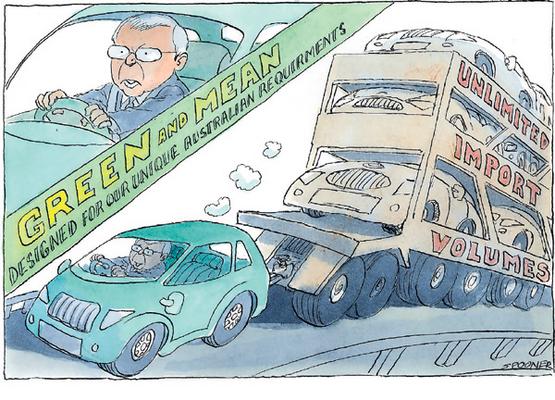 Spooner
The line of attack was the costs of emissions trading scheme on industry and it being forced to go offshore with the implication that Australia should not establish an emissions trading scheme. Nowhere did the Liberals mention the costs of not acting to reduce greenhouse gas emissions on Australia. It was depressing.
No mention was ever made of Ross Garnaut's report in which he argued that:
The Australian Government should at an early date say that Australia was prepared to play its full proportionate part in an ambitious global mitigation effort which would require reductions of 25 per cent on 2000 levels and 90 per cent on - 25 per cent reduction on 2000 levels by 2020, 90 per cent by 2050....the Government should say Australia is prepared to play its full proportionate part in a global agreement that adds up to a 450 parts per million outcome.
Secondly, I said that if that is not possible internationally, and what is more likely to be possible internationally would be Australia playing its full proportionate part in a 550 parts per million outcome which would involve a 10 per cent reduction on 2000 levels by 2020 and an 80 per cent reduction by 2050....It's a long way from a practical agreement to get to 550. And I'd like us to be working as hard as we can to make what currently seems impractical practical.
The goal of 450 parts per million stabilisation target would mean two degrees of global warming with a 50 per cent chance of entering dangerous climate change. The 550 per million stablisation target is dangerous climate change as it would means three degrees of warming.
It is dangerous territory because it would include major impacts on melting of the Greenland ice sheet, substantial sea level rise, condemn the Great Barrier Reef to almost complete destruction in its northern areas, condemn Australia's alpine areas to essentially becoming sub alpine, cause the destruction of the Kakadu wetlands and result in immense damage to the Murray-Darling Basin by restricting inflows even further.
It was obvious from Question Time in the Senate that Liberal Senators had no appreciation of the damage that will be imposed on Australia's environment and Australia's employment opportunities, Australian industries and Australian households by the adverse impacts of climate change. The NSW Government's mini-budget showed that Rees Labor had no understanding either.
Posted by Gary Sauer-Thompson at 5:33 AM | Comments (2) | TrackBack
September 29, 2008
Building Australia
The Building Australia Fund is a multi-billion dollar infrastructure fund set up by the Rudd Government to help modernize Australia by easing road congestion, roll out faster broadband services and build coal ports. It is to overseen by Infrastructure Australia, an independent body that will evaluate and scrutinize the various projects in terms of their economic importance.
So far it sounds as if the whole infrastructure push has a corporate agenda---- ie., limited to building infrastructure to help business--- rather than assessing infrastructure projects in terms of both their economic importance and greenhouse implications. Maybe this is because it is basically Labor's rebadging of the Coalition's AusLink during the last election. So ity is more about six lane highways than public transport. Still the failure by the Rudd Government to connect infrastructure development with climate change is worrying, given the imperative of Australia needing to adapt in a warmer climate.
The current debate about climate change is disconnected from the debate about infrastructure development, even though the two are deeply intertwined in making the shift to low carbon-economy. Few ministers in the Rudd Government are talking about prioritising climate friendly infrastructure--other than protecting the coal industry from competition and compensating them from loss of asset value caused by the carbon emissions trading scheme.
Business, of course, is saying that cutting greenhouse emissions by 10% is beyond the capacity of the economy. Business does not appear to be interested in building infrastructure so that Australia is able to live in a future one of more extreme weather events and natural disasters, inadequate rainfall and water shortages, higher utility and food prices and insurance costs, better health services for the vulnerable and aged, and which has much more responsible management of Australia's finite resources and fragile environments.
Business just want infrastructure built that will enable it to ship more rocks to China as fast as possible. China, apparently, is Australia's sure bet in a slowing global economy. Exporting more rocks is what is urgent, not addressing climate change, as exporting more rocks will protect jobs.
Posted by Gary Sauer-Thompson at 8:49 AM | Comments (4) | TrackBack
July 23, 2008
reducing the political costs of reform
The dust is settling on the Rudd/Wong Green paper on emissions trading and Big Business continues its campaign to ensure that the approach is softly softly with bundles of compensation. We can see more clearly no that the whole Rudd/Wong exercise has been primarily aimed to reduce the political cost of reform on greenhouse emissions. However, I cannot for the life of me see the economic reason why the coal-fired power generating companies need compensation, when they knew all along what was coming since Kyoto in 1997.
Neither can Peter Martin. He says:
Never once on the countless occasions that Australian governments have restricted the sale of tobacco have they felt compelled to compensate the manufacturers for ''significant reductions in their profitability''.Why would they? The cigarette manufacturers knew what was coming (and had decided to invest anyway) and were blessed with rusted-on customers.
As Ross Garnaut had observed there there is no tradition in Australia for compensating capital for losses associated with economic reforms. Australian businesses have not been compensated were the floating of the dollar, the introduction of the goods and services tax and the massive tariff cuts in the 1980s.
In the case of emissions trading, businesses had been aware of the risks of carbon pricing for many years and many had sought to re-engineer their production processes to reduce their reliance on emissions.
So Rudd and Wong's softly softly is about buying off the political opposition to emissions trading. It's about politics not economics.
Posted by Gary Sauer-Thompson at 9:06 AM | Comments (2) | TrackBack
July 17, 2008
a question
Why should polluting electricity generators be compensated? Cash handouts for asset write downs and some free permits. These energy companies will pass the cost of permits onto consumers regardless of how they get them. Isn't free permits for coal fired generators to continue to pollute allowing them a windfall profit, given the estimated 16 per cent increase in electricity prices (assuming the price of carbon dioxide emissions is $20 a tonne)? And these domestic free riders want Australia to be a free rider in a global emissions trading scheme.

It sure looks as if the pressure from the emissions-intensive industries to block the full operation of an emissions trading scheme in 2010 has succeeded. And they have ensured the burden on business is eased. The actuality of special benefits for special interests and the watered down objectives is a long way from all the tough rhetoric about the greatest moral challenge likely to face humanity this century.
Even the Australian Financial Review says that the disappointment with the Green paper lies in the 'caution which seem excessive.' Some call this caution political realism---a measured transition. I would call it lacking political courage, given the generous allocation of permits covering 90% of the energy-intensive trade exposed industries and the open ended nature of the transition scheme to whittle emissions down. The date is 2025 or even latter.
There is little discussion of incentives to boost domestic and industrial energy efficiency whilst the five year cap on the carbon price effectively breaches the emissions trading scheme as it prevents the market from using price to effect behavioural change.
My interpretation of the compensation for coal-fired generators for curbing their pollution that causes global warming has little to do with 'safeguarding investment in industry' and more to do with succumbing to pressure from state Labor Governments in Queensland, NSW, SA and Victoria to protect their dirty coal fired power stations.
Posted by Gary Sauer-Thompson at 8:09 AM | Comments (17) | TrackBack
July 16, 2008
Rudd wimps
The leaked reports say that the Rudd Government's Green paper (the white paper comes later) on emissions trading scheme, which is to be released today, will shield motorists from petrol price rises for at least the first three years of Australia's emissions trading scheme. It will offset resulting price increases with corresponding cuts in fuel excise. For every cent petrol rises due to emissions trading, a cent will be knocked off excise - for a minimum of three years after the scheme is launched. After that, the policy of a three-year moratorium on petrol price increases will be reviewed. The debate moves on.
So the ALP has embraced the Liberals policy whilst belting them over the head for being wimps. They argued that if transport is left out of emissions trading in the long term, everything else, including power, will cost more. So a pattern has emerged: the Rudd Government is strong on rhetoric about moving the economy from a high-carbon-polluting economy to a low-carbon-polluting economy and weak on the politics.
Professor Garnaut argued cutting a deal on petrol would blunt the message, which was to use price signals to encourage people away from high carbon energy. Protecting motorists from the effects of an emissions trading scheme will undermine the scheme's primary purpose - to discourage the burning of fossil fuels such as petrol, and to facilitate a shift to more efficient hybrid cars and public transport.
So Rudd Labor is ensuring it's re-election in 2010 by buying off the opposition. Business continues to cry out for more time and to question the implementation timetable. Doubts do arise. The allocation of permits is an area where governments routinely fail -- whether its over-allocating water licences or maintaining the taxi licence racket. State governments love doing deals and favours -- as it’s already happened in NSW by the Iemma government indemnifying Bluescope steel against any future carbon tax. Some of the wording we have seen about the carbon cap talks about "measured", "soft", "modest" targets. The problem with a soft or moderate target is, is that it probably not going to drive the right sort of investment. But we await Treasury's modelling.
The other area of concern is that the introduction of an emissions trading scheme with soft targets also requires renewable energy targets and energy efficiency targets. An emissions trading scheme is not the silver bullet, as we still need development in renewable energy technology as well as energy efficiency measures to curtail energy consumption. There has been reduced investment in renewable energy under the Rudd Government, and little talk about energy efficiency targets. The states of course (Queensland, Victoria and NSW) continue to invest in coal, pinning their hopes on clean coal technology to reduce the carbon footprint.
Posted by Gary Sauer-Thompson at 7:57 AM | Comments (19) | TrackBack
July 12, 2008
Nelson on climate change
Brendon Nelson says that his position on climate change is that the Coalition is unified in strongly in support of an ETS. However, he argues the case by undermining his stated position. Consider this:
Of course, it is prudent to reduce our carbon footprint, but we should do so in a way that is practical and responsible, not economically ruinous and socially destructive. Because of Australia’s natural abundance of fossil fuels, our prosperity is threatened if the Rudd Government hastily embarks on a misguided approach to climate change. It is the job of a responsible Opposition to help the Government move in the right direction....The Rudd Government’s approach to an ETS has all the hallmarks of a giant revenue grab and centralist redistribution. In contrast, we believe Australian motorists should be protected with no new net taxes on petrol....
There are lots of boo words in that paragraph: "economically ruinous and socially destructive"; a "giant revenue grab"; centralist redistribution". There is not one positive. Still the Coalition fully supports an emissions trading scheme says Nelson. Well his op-ed doesn't read like that at all.
The Coalition 's position hasn't really changed. It fully supports the coal industry and the big energy users antagonism to an emissions trading scheme and their desire to be free riders. That is how the boo words in that paragraph reads. And, then we have this, which strengthens this interpretation:
Design implementation in such circumstances (the developing world's reluctance to do much to sign up to targets ) is critical. We would need to start with a low carbon price and a near flat trajectory. Unless the nations responsible for the biggest emissions commit to effective plans to reduce them, Australian unilateral action would inflict collateral damage on the wider economy in lower growth and higher prices up and down the energy chain. It would lead to the export of our energy-intensive jobs to those nations that do not take action to reduce carbon emissions, thus worsening the emissions problem. And it would reduce the competitiveness of Australia industry and lead to lower living standards.
It's all negatives. It could have been written by the Greenhouse mafia. Still the Coalition fully supports an emission trading scheme. Though not Garnaut's cap and trade model. Which one then? Well there are lots of them to choose from. Such as? Nelson doesn't say.
Posted by Gary Sauer-Thompson at 1:36 AM | Comments (7) | TrackBack
July 5, 2008
screams no yawn
This cartoon accurately describes the public reaction to the policy side of climate change. Only the policy wonks are really interested in the design of an emissions trading scheme. But the last frame is dead wrong. Industry is going to pay for their pollution, and they don't like it, even though they know that the public will bear the costs of their having to pay for their destruction of the environment from greenhouse gases.
 Moir
Hence their campaign against, even even though those generating power for the domestic market will pass their costs of emitting greenhouse in the atmosphere onto consumers. It's the loss of the asset value of their power stations that causes them to scream---'they' refers to the Victorian brown coal generators.
And the Coalition is now in retreat on supporting reform. Shaun Carrney says in the SMH that:
Politically, the Coalition's key objective on emissions trading is to inflict the maximum amount of damage on the Government. Hunt's job is to fashion an intellectual and policy package that conforms to that objective, while simultaneously giving the impression that the Coalition subscribes to the reality of climate change and the need for action.
They are anti-reform but trying to disguise it.
Posted by Gary Sauer-Thompson at 7:28 AM | Comments (4) | TrackBack
July 4, 2008
assesssing the commentary on climate change
Garnaut's report on climate change, judging from the leaks, favours compensating those regions hardest hit by the new emissions trading regime. The report canvasses "structural adjustment" compensation for regions such as the La Trobe Valley in Victoria and the Hunter Valley in NSW as well as providing government funding for industries investing in clean power so as to reward them. The principle is that all compensation paid should be for actually reducing emissions rather than compensating for so-called "stranded assets".
Hence all the dire warnings from electricity generators and those state premiers supporting dirty power about black-outs, bankruptcies (Enron-type collapse) spiralling power bills, and predictions of five years of economic growth being wiped from the economy. The end is nigh.
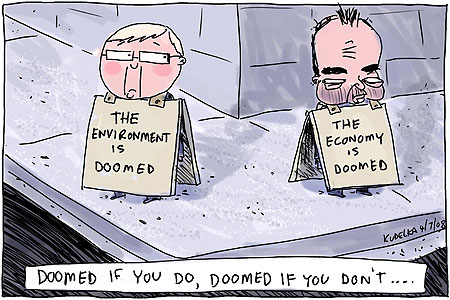 Kudelka
In A Question of Balance: Weighing the Options on Global Warming Policies William Nordhaussays that the most important concern of any policy that aims to address climate change should be how to set the most efficient "carbon price," which he defines as "the market price or penalty that would be paid by those who use fossil fuels and thereby generate CO2 emissions."
He writes:
Whether someone is serious about tackling the global-warming problem can be readily gauged by listening to what he or she says about the carbon price. Suppose you hear a public figure who speaks eloquently of the perils of global warming and proposes that the nation should move urgently to slow climate change. Suppose that person proposes regulating the fuel efficiency of cars, or requiring high-efficiency lightbulbs, or subsidizing ethanol, or providing research support for solar power—but nowhere does the proposal raise the price of carbon. You should conclude that the proposal is not really serious and does not recognize the central economic message about how to slow climate change. To a first approximation, raising the price of carbon is a necessary and sufficient step for tackling global warming. The rest is at best rhetoric and may actually be harmful in inducing economic inefficiencies.
On this criteria most of the business commentary in The Australian and that from the NSW and Victorian state government's are not serious.
Posted by Gary Sauer-Thompson at 6:39 AM | Comments (5) | TrackBack
July 3, 2008
waiting for Garnaut
Ross Garnaut's report on climate change and emissions trading scheme is due tomorrow. It is expected to find that global warming is proceeding faster than projected, and that doing nothing will be far more costly than expected. Well we know that already.
The leaks indicate that the Garnaut's final report will emphasise that there are four categories of likely damage to the economy.Today's report, a draft whose final version is due in September, will quantify only one of these, the conventional macroeconomic cost that can be estimated by economic modelling.
The second category will be the effect on particular aspects of the country. Professor Garnaut has commissioned research into the medical consequences of climate change, including deaths from heat stress.The third category will be the cost of mitigating the effects of global warming. The fourth will be a survey of how climate change affects things Australians value for more than just economic reasons - the bleaching of the Great Barrier Reef, the inundation of the Kakadu wetlands, and the loss of the West Australian karri forests.
Posted by Gary Sauer-Thompson at 7:42 AM | TrackBack
April 15, 2008
NZ: climate change
I'm not sure how climate change is affecting New Zealand. I noticed one of the rivers not flowing as i flew over the Canterbury plains to Christchurch. Then we have story this about falling levels at Lake Taupo, which feeds the Waikato River hydro system in the North Island. I'm not sure about the South Island.
They--the authorities and press---are talking in terms of drought not climate change though. I would have thought that climate change means that New Zealand is likely to experience more frequent droughts and floods.
 Slane, NZ Herald
They should be worried because their electricity is based on hydro power and the level of water in their hydro lakes is falling.
Posted by Gary Sauer-Thompson at 6:05 AM | Comments (6) | TrackBack
March 31, 2008
SA's expansion of Olympic Dam
SA is anxiously awaiting for the copper and uranium mining boom to happen so that it can join the high speed economies of WA and Queensland in Australia's two speed economy. SA is in a state of suspended longing as it stands on the verge of a boom, despite government concerns that BHP is backing away from value-adding processing in favour of exporting all expanded production as copper ore concentrate rather than smelting into metal, as it does currently. Such a move would reduce BHP Billiton's capital spending.
Digging up the rocks will be undertaken by BHP Billiton over the next decade. This expansion of Olympic Dam will require a desalination plant on the coast of the Upper Spencer Gulf to provide the extra 120Ml/day of additional water. The water will then be pumped 320 km north to Olympic Dam, which is 600km north of Adelaide.
That expansion will need to be powered by electricity. South Australia has been an importer of electricity for several years and its power distribution network was stretched to capacity to meed the demand during the heatwave. Yet BHP Billiton will need nearly half of South Australia's current electricity supply to power its copper and uranium mining at Olympic Dam. It will require 690 megawatts to run the operation with 60 megawatts needed to run the desalination plant. BHP Billiton currently uses 120 megawatts.
So where is that extra 570 megawatts of power going to come from?
The Rann Government, which routinely lectures the rest of the nation on climate change and the need to increasingly source energy from renewable energy has not imposed any mandatory requirements on BHP Billiton to source renewable energy.
The technology to source base-load renewable energy from "hot rocks" geothermal sources in the north of the state is not proven; whilst gas-fired power stations take three years to build if the option is to pipe gas from Queensland. Does that leave coal-fired power stations supplying the vast amount of base-load power Olympic Dam requires?
Does that mean SA becomes a greenhouse pariah as BHP Billiton turns to coal-fired power stations at a time when Ross Garnaut's report argues that power generators not be compensated in a carbon trading scheme?
Posted by Gary Sauer-Thompson at 12:51 PM | Comments (3) | TrackBack
March 22, 2008
Garnaut: addressing climate change
Ross Garnaut's key idea to address climate change is simple. The easiest way to reduce greenhouse gas emissions was to set a cap, create a limited number of permits for those who wish to emit, which would decrease over time, and auction them off, letting the market determine their value. The funds generated would be spent on structural adjustment or returned to the community to ensure that government didn't grow in size.
Garnaut's view of greenhouse policy under the Howard regime is clear and hard headed:
John Howard's scheme was designed by the big emitters.They thought the most important thing was that they didn't change at all,so they had to get all the free allocations, and a lot of the other complexities emerged from the complicated starting point.
This states what we tacitly knew. The opposition to a cap and trade scheme comes from power generators, who are acting as the vested interests applying pressure to the policy-making process to block reform.
Why should we give the power generators a free ride? The European trading scheme showed that giving power generators free permits worth millions of dollars didn't stop them putting up their prices. Nor should we go along with the NSW government and compensate the power industry or losing billions of dollars in the value of its coal-fired power stations as they are scrapped years ahead of their use-by date.
Posted by Gary Sauer-Thompson at 3:55 PM | Comments (1) | TrackBack
December 9, 2007
Agriculture and Climate Change
The latest ABARE report on commodities should bring home to everyone the potential realities of climate change setting out as it does the likely impact of climate change on various agricultural commodities.The only good thing I noticed is the 14%reduction itemised for sugar. Can we extrapolate a reduction in obesity?
For the sceptical, and there are plenty about, a reduction in our home grown food supply would be a real wake up call. Climate change is having an affect on prices right now. With a production drop of 13% to 18% for basic foods we will really notice price increases?.
As I understand the science we can look forward to lower production and increasing prices for the next 30 years. If we are sucessfull things might then improve.
At least with CSIRO and the Bureauof Meteorology joining forces we may get better rainfall predictions!
Posted by Gratton Wilson at 11:34 AM | TrackBack
November 22, 2007
that sinking feeling
The recent release by the Intergovernmental Panel on Climate Change of its fourth assessment report summary, Risks and Rewards of Combating Climate Change, says that "warming of the climate system is unequivocal, as is now evident from observations of increases in global average air and ocean temperatures, widespread melting of snow and ice, and rising global average sea level."

Bill Leak
The Howard Government's minimal response--- the world is not going to end tomorrow---indicates its short term thinking. We are thinking about more than tomorrow in terms of the risks to unique and threatened systems, such as polar or high mountain ecosystems, coral reefs and small islands, and the risks of extreme weather events, such as floods, droughts and heatwaves.
Howard and Co have done little to use the wide range of tools available - higher taxes on emissions, regulations, tradeable permits and research, an effective carbon price---to address these problems. Fear of upsetting the Republicans in Washington, the coal industry, and the high energy industries appears to be the reason.
The best it has come up with is "aspirational targets" and the five point plan for a are-elected government doesn't even mention climate change. It struggles to achieve credibility on the issue after years of ignoring it.
Posted by Gary Sauer-Thompson at 5:59 AM | Comments (2) | TrackBack