September 19, 2012
the empire lives on
Tom Dispatch makes a good point about the trajectory of Obama's foreign policy. Recall that Obama was opposed to the use of hard military power of the Republican hawks in the George Bush administration and their national security state.
What has happened since 2008 is that Obama has:
expanded the country’s war in Afghanistan, struggled to keep American troops in Iraq (before fulfilling his predecessor’s pledge to withdraw), and oversaw escalating military interventions in Pakistan, Somalia, Libya, and elsewhere. [He has] failed to close Guantánamo, radically expanded the robotic assassination program, continued and expanded domestic surveillance, vigorously pursued and used the Espionage Act against more governmental whistleblowers than all other administrations combined (but prosecuted no one else in the National Security Complex for illegal activities), and kept his own extensive kill list, personally okaying assassinations.
Mitt Romney would be worse: more profligate military spending, even more troops to send to war, and possibly the addition of a new war or two to the American agenda---eg., restart a cold war with Russia, and possibly undertake a hot war against Iran.
As John Feffer says:
President Obama has largely preserved the post-9/11 fundamentals laid down by George W. Bush, which in turn drew heavily on a unilateralist and militarist recipe that top chefs from Bill Clinton on back merely tweaked.
America has no intention of giving up its empire or its massive machinery for waging war. The US is now “pivoting� to Asia with drones flying surveillance from Australia. Australia is part of the US's elaborate network of its own drone bases on foreign soil.
Seumas MIlne in The Guardian observes that:
Since launching the war on terror, the US and its allies have attacked and occupied Afghanistan and Iraq; bombed Libya; killed thousands in drone attacks in Pakistan, Yemen and Somalia; imposed devastating sanctions; backed Israel's occupation and dispossession of the Palestinians to the hilt; carried out large-scale torture, kidnapping and internment without trial; maintained multiple bases to protect client dictatorships throughout the region; and now threaten Iran with another act of illegal war.
They assume that the U.S. has had nothing but good intentions for the past century, but the intended beneficiaries of its generosity don't get it solely because they've been misled by their leaders and media. Presumably drones don't exist the occupation of Iraq in 2003 was just a little misunderstanding,
Posted by Gary Sauer-Thompson at 12:53 PM | Comments (10) | TrackBack
March 9, 2012
Australia: an independent foreign policy?
I've been on the road to Tasmania and experiencing poor connection from Telstra's mobile broadband on the journey. So I haven't had much chance to read the newspapers online or to post. I'm currently in Tunbridge, the service is barely okay (it's limited) and I'm able just able to post.
I'm just catching up with what has been happening since last Friday--eg., Gillard's cabinet reshuffle and Bob Carr becoming Foreign Minister. I see that Hugh White in The Age has nailed the core international relations issue for Australia:

White says:
The issue is how Australia positions itself between the United States and China as the strategic rivalry between them grows. Our biggest trading partner and Asia's leading power faces our traditional ally across a widening gulf of mutual antagonism....The orthodox view is that we have no choice but to support Washington in whatever policy it decides to adopt towards China. As an ally it is unthinkable for us to do anything else. We just hope that America gets it right, and that China either doesn't notice, or doesn't mind.
I've always suspected that to be the case: the little Americans rule Australia's foreign policy and Gillard was firmly in their camp. They advocated a policy of containment against China to ensure that the US remained the dominant power in the Asia-Pacific.
White comments that Carr rejects this view. He believes:
that America should turn away from Obama's containment policy and explore ways to accommodate China's ambitions where possible while constraining them where necessary. On this view, America should continue to play a central role in Asia, but not necessarily the dominant role. It should be willing to share power with China.
Does this imply that the Gillard Labor Government is going to shift to a more independent foreign policy? One that is critical of the old Pax Americana doctrine defended by the little Americans in Australia.
We can but hope.
Posted by Gary Sauer-Thompson at 10:22 AM | Comments (7) | TrackBack
February 20, 2012
Iran: bizarre media fantasies
The report below by Erin Burnett on CNN---"Is Iran planning an attack in America?" ----indicates that the war drums in the US are being played in the US media. It's the 2002 Iraq war script being replayed. The standard stories in the US media suggesting that Iran is on track to build a nuclear bomb have been broadened by using anonymous official sources to speculate that the Iranian regime may strike the United States, perhaps in collusion with terrorists.
The media drum beats sound so familiar. The script is one of misinformation and scary storylines whose logic is regime change in Iran. Why even New York city is under threat from Iran or Hezbollah. The media's fantasies are bizarre.
The reality is that though Iran might acquire a nuclear weapon, and is capable of doing so, according to the IAEA there is no definitive proof that they have yet decided to try. Moreover, it is Israel that is talking about a preventative war (bombing Iran before Tehran moved its nuclear facilities beyond reach, deep underground); hyping the Iranian threat; and sabre rattling. The US continues its efforts to restrain Israel as it implements UN sanctions against Iran.
There are American attempts to persuade Iran's Asian customers -- China, India, Japan, South Korea -- to stop buying Iranian oil by persuading them that the only alternative is war. The formula is portray the supposed threat as dire and growing; try to convince people that if we don't act now, horrible things will happen down the road; then say that the costs and risks of going to war aren't that great.
Glenn Greenward calls the media campaign against Iran for what it is. He observes:
Many have compared the coordinated propaganda campaign now being disseminated about The Iranian Threat to that which preceded the Iraq War, but there is one notable difference. Whereas the American media in 2002 followed the lead of the U.S. government in beating the war drums against Saddam, they now seem even more eager for war against Iran than the U.S. government itself, which actually appears somewhat reluctant.
The American media depict Iran as the threatening, aggressive party. Iran’s aggression must be contained, and it is leaving the U.S. and Israel with no choice but to pre-emptively attack it. The reality is that it is Israel that is seriously considering preventive war whilst Iran's threats are retaliatory: if you attack us, we will attack back.
Posted by Gary Sauer-Thompson at 12:04 PM | Comments (2) | TrackBack
November 17, 2011
Obama's address to the Australian Parliament
The video and transcript of Obama's address to the House of Representatives is not online yet, but there is a video of the address. It was a plain speaking speech despite all the flattery and over-statement.
The core of Obama's speech was that the United States was “here to stay� in the Asia-Pacific, that it would be stepping up its role in the region, and that America’s fiscal problems will not be an opportunity for China's expansion at the expense of the United States.
Contrary to what Kim Beazley was saying on Radio National this morning that containment was a Cold War term that had no meaning in the current geopolitical context, Obama clearly signaled a determination by the US to counter a rising China. And Beazley is on board--like he always has been. The strengthening of military ties between America and Australia can be interpreted as the latest step in Washington’s coordination of Asia Pacific nations into a containment strategy aimed at limiting China’s growing influence in the Asia Pacific region.
Will the Australian Defence Force now become a fully-fledged subsidiary of the US Armed Forces? One that make "niche contributions" to US-led coalitions far beyond Australia’s immediate region, such as Afghanistan? That was John Howard's model. Will Gillard Labor tread the same path?
In The National Interest Stephen Walt says:
If China is like all previous great powers—including the United States—its definition of “vital� interests will grow as its power increases—and it will try to use its growing muscle to protect an expanding sphere of influence. Given its dependence on raw-material imports (especially energy) and export-led growth, prudent Chinese leaders will want to make sure that no one is in a position to deny them access to the resources and markets on which their future prosperity and political stability depend.
He adds that this situation will encourage Beijing to challenge the current U.S. role in Asia and that such ambitions should not be hard for Americans to understand, given that the United States has sought to exclude outside powers from its own neighborhood ever since the Monroe Doctrine. he continues:
By a similar logic, China is bound to feel uneasy if Washington maintains a network of Asian alliances and a sizable military presence in East Asia and the Indian Ocean. Over time, Beijing will try to convince other Asian states to abandon ties with America, and Washington will almost certainly resist these efforts. An intense security competition will follow.
The short-lived “unipolar moment� to an end, and the result will be either a bipolar Sino-American rivalry or a multipolar system containing several unequal great powers.
The US's grand strategy since the 1990s has been one of global dominance or global hegemony, which John J Mearsheimer in The National Interest describes thus:
Global dominance has two broad objectives: maintaining American primacy, which means making sure that the United States remains the most powerful state in the international system; and spreading democracy across the globe, in effect, making the world over in America’s image. The underlying belief is that new liberal democracies will be peacefully inclined and pro-American, so the more the better. Of course, this means that Washington must care a lot about every country’s politics. With global dominance, no serious attempt is made to prioritize U.S. interests, because they are virtually limitless.
He adds that this grand strategy is “imperial� at its core; its proponents believe that the United States has the right as well as the responsibility to interfere in the politics of other countries.
The Obama administration belongs to the liberal imperialists version of global dominance, and they hold that running the world requires the United States to work closely with allies and international institutions.
Judging from Gillard's action's Australia's defence and diplomatic interests are to remain dependent on US primacy remaining unchallenged-- Australia uncritically supports the Obama Administration's policy of global dominance.
Posted by Gary Sauer-Thompson at 12:26 PM | Comments (14) | TrackBack
November 15, 2011
US interests are Australia's?
The Gillard Government is going to sell uranium to India, even though India hasn't and won't signed the Nuclear Non-Proliferation Treaty and will side with US in its conflicts and rivalry with China with the decision to give the US a significant new military presence in northern Australia.The former decision comes from pressure from the US and is primarily about the geo-political containment of China.
So there goes Australia's independence option out the window along with the option of a policy of “equidistance� between Beijing and Washington. Mungo McCullum nails it:
So we are not really treating China as a friend after all, but as a potential enemy. This is the only sensible interpretation of allowing Australia to be used as a forward base for a contingency operation aimed at China. And it is one that Beijing is unlikely to miss. Thus Australia, however keen it portrays itself to continue the trading relationship, will be seen as potentially unreliable, subject always to the larger context in which it has involved itself.
Australia's long history of subservience to Washington continues, even though the US is a declining global power facing an Asian century. The standard clichés about American global leadership, American exceptionalism, and that never-ending American Century become ever more hollowed out and shrill.
The “American Era�---the era when the United States could create and lead a political, economic and security order in virtually every part of the world---is nearing its end. The US is shifting its main strategic attention to Asia, both because its economic importance is rising rapidly and because China is the only potential peer competitor the US faces.
The US's long-term goal in the Asia-Pacific is to preserve American preeminence and prevent the emergence of a local hegemon--China. However, the US is kneecapped by its accumulated debt, eroding infrastructure and a sluggish economy, and so its options are limited. It cannot remain as Asia-Pacific's pre-eminent power and so it creates a hedge against a rising China---off shore balancing.
The US today is characterized not only by financial collapse, but more ominously by the decreasing ability to rally the globe toward the empire’s ends, and the corresponding need to pursue strategic goals via brute military force. The American century is no more.
Posted by Gary Sauer-Thompson at 7:13 AM | Comments (18) | TrackBack
June 9, 2011
Libya: roadmap for peace?
The civil war in Libya goes slowly in spite of the western-led NATO military campaign against Gaddafi. The various frontlines are all still some way from Tripoli, where the regime still has a tight grip on the population. Apparently it is just a matter of time before Gaddafi goes since there is a trend of the regime forces being pushed back, v
The latest news is that Gaddafi's forces responded to NATO's intensified aerial bombardment of Tripoli on Tuesday by launching a heavy attack on rebel positions outside the liberated city of Misrata, unleashing a barrage of Grad rockets and mortars against rebel positions to the east, west and south of Misrata early on Wednesday morning, and followed up with an infantry assault.
 Steve Bell
It would appear that Turkey's roadmap for peace--- an immediate ceasefire, establishing a humanitarian aid corridor, and starting a process for a new political order in Libya, which means Gaddafi leaving office-- has little traction. There is little indication of a peaceful transition to democracy.
The Arab revolution with its image of a crumbling old order has hit a roadblock in Libya. Gaddafi is proving hard to topple and the US and Europe cannot afford a protracted Libyan civil war, a Libya ruled by a spurned Qaddafi, or a return to the 1990s situation in which multilateral sanctions largely removed Libya from the world economy. Libya's oil is too important for the West and a ceasefire doesn't say geopolitical win.
Though the rebels talk the language of liberal democracy--civil liberties, the rule of law, and democracy---it is the distribution of oil revenues that matter. A state-dominated economy has failed to produce improvements in the standard of living from the 1980s onward.
Posted by Gary Sauer-Thompson at 12:45 PM | Comments (2) | TrackBack
May 3, 2011
making progress?
Osama Bin Laden had become a mythic figure in the Western imaginary and the Islamic one, even though only a minority of Muslims wants such a theocratic dictatorship advocated by Al-Qaeda--- a return to the medieval Muslim caliphate (a combination of pope and emperor). His death is being celebrated in the West as a victory in the decade long war on terrorism--it's a feeding frenzy of commentary. The Americans have their revenge and retribution. It is symbolic event; a cathartic moment.

However history has moved on in that the uprisings that have shaken the Middle East region, from Tunisia, Egypt to the ongoing protests against the Assad regime in Syria, have not involved significant Islamist activity – let alone the violent jihadi and clash of civilization between Islam and the West ideas promoted by Bin Laden, Ayman al-Zawahiri and their associates. The largely peaceful mass movements want parliamentary democracy in that they articulate their desires using categories such as the nation, the people, liberty and democracy.
So the movement Bin Laden founded has already failed: there has not been a broad fundamentalist revolution that would topple existing Arab governments and usher in a unified Islamic caliphate. Al-Qaeda has been almost completely irrelevant to the popular upheavals that have dominated regional politics.
The Australian government is quick to say that Australia will "stay the course" in Afghanistan to "get the job done" so that Afghanistan does not become a haven for terrorists again. The war on terrorism can be won say the neocons.
Yet it is Pakistan that provides the safe haven. The Inter-Services Intelligence Directorate (ISID), Pakistan's powerful security and spy agency, are effectively providing the terrorists with protection and they also support the Taliban in Afghanistan in order to block Indian influence. So the Afghan Taliban and their associates have been able to operate unimpeded from Pakistani soil. What will happen to these Afghan Taliban leaders now?
Al Qaeda isn't the real reason the US is having a hard time in Afghanistan, it has nothing to do with its difficulties with Iran and little to do with Israel and the Palestinians.The anger at various aspects of U.S. policy in the Middle East continues to drive anti-Americanism in the region, and this makes it more difficult for the US to protect its imperial interests in that part of the world. The US is not seen as a benign hegemon whose regional dominance is to be welcomed.
It looks as if the post 9/11 national security state (with its security queues and surveillance) is here to stay for quite some time, even though the NATO counterterrorism mission in Afghanistan is dissipating.
Posted by Gary Sauer-Thompson at 8:40 AM | Comments (27) | TrackBack
April 17, 2011
Libya: regime change
The liberal internationalist's humanitarian case for intervention in Libya does look like a continuation of America's self-ordained role as global policeman that has seen the US fight several genuine wars (Korea, Vietnam, Iraq, Afghanistan etc) and engage in countless military interventions. Libya is about regime change at the point of a gun.
 Martin Rowson
America, as Chalmers Johnson pointed out, acquired an empire as it expanded its military bases during the Cold War, and it now appears after the Cold War to be engaged in a war without end to advance global peace and freedom. The "American Century" has been only 70 years (from 1940-2010). The key to this empire is hard power of the hammer:--whatever needs to be done is to be done by the military.
More often than not the tools of American foreign policy are those of force and hard power, especially with respect to the core US response to events in the regional politics of the Islamic world. Congress now plays no role in deciding on wars and military interventions within the the changes sweeping through the Middle East. The President calls the shots. Congress agrees. America is not the beacon of democracy anymore.
This time round in the greater Middle East the US empire intervenes into a civil war in Libya. We hear "humanitarian intervention" and understand that to mean "regime change" and we do it without blinking even though we know that the only way that solves America's fiscal problems is by sensibly cutting both defense spending as well as increasing revenues.
Posted by Gary Sauer-Thompson at 11:11 PM | Comments (9) | TrackBack
March 29, 2011
intervening in Libya for what reason?
The UN intervention into Libya has has moved beyond a purely humanitarian mission under the Responsibility to Protect Doctrine as the intervening forces are more-or-less openly seeking to topple Qaddafi's regime.

The threat of some sort of massacre in Benghazi by Qaddafi's military has now been removed. Mission creep has emerged as NATO air strikes against Qaddafi's forces are making it possible for the rebels to advance east towards Sirt, the town of Muammar Qaddafi’s birth. Germany, which broke with its European allies and voted to abstain from resolution 1973, has argued that mission creep could force the coalition to get involved in a drawn-out war.
Whilst the emboldened neocons are now talking about Syria, the Arab support for an intervention against Qaddafi to protect the Libyan people is beginning to fray as the action increasingly includes Western bombing of an Arab country.
I support the UN's liberal interventionist military intervention into Libya because of the events in Bosnia and Rwanda. At the moment, I don't see it as legitimating American dominance in the region, which is the rationale of the neocons. My main reservation about the UN's military intervention is that it may degenerate into an extended civil war which that l require troops on the ground regardless of promises being made today.
Stephen M. Walt argues differently. He says:
The only important intellectual difference between neoconservatives and liberal interventionists is that the former have disdain for international institutions (which they see as constraints on U.S. power), and the latter see them as a useful way to legitimate American dominance. Both groups extol the virtues of democracy, both groups believe that U.S. power -- and especially its military power -- can be a highly effective tool of statecraft. Both groups are deeply alarmed at the prospect that WMD might be in the hands of anybody but the United States and its closest allies, and both groups think it is America's right and responsibility to fix lots of problems all over the world. Both groups consistently over-estimate how easy it will be to do this, however, which is why each has a propensity to get us involved in conflicts where our vital interests are not engaged and that end up costing a lot more than they initially expect.
It is true that most of the U.S. foreign policy establishment has become addicted to empire and it doesn't really matter which party happens to be occupying Pennsylvania Avenue.
However, the key question is what if Qaddafi hangs tough, and moves forces back into the cities he controls, blends them in with the local population, and the rebels cannot dislodge him? Libya could become a "giant Somalia". What then of the limited, principled nature of the humanitarian mission?
Libya's opposition is a poorly defined group of mutually hostile factions that have not formed a meaningful military force thus far, and are even less likely to form a functioning government.
Posted by Gary Sauer-Thompson at 7:18 PM | Comments (9) | TrackBack
March 18, 2011
Liberal interventionism + Libya
Liberal interventionism in the world of nations is alive and well. The UN has voted for a no-fly zone and air strikes against Muammar Gaddafi's forces in Libya.
The resolution, which is the result of painstaking multilateral diplomacy, lays out very clear conditions that must be met by Gaddafi. As interpreted by Washington it holds that:
• All attacks against civilians must stop.
• Gaddafi must stop his troops from advancing on the rebel stronghold Benghazi, and pull them back from Ajdabiya, Misrata and Zawiya.
• Gaddafi must establish water, electricity and gas supplies to all areas.
• Humanitarian assistance must be allowed to reach the people of Libya.
If Gaddafi does not comply with the resolution the international community will impose consequences and the resolution will be enforced through military action. No foreign occupation is envisaged at this stage.
 Martin Rowson
This UN intervention recalls the intervention in the 1999 Kosovo crisis, when NATO planes were dispatched to bomb Belgrade in an effort to stop Serbs from “cleansing� Kosovo, and Europe's failure to act in Bosnia. The policy of intervening in the world's troublespots to uphold democracy was reduced to tatters because of the disaster in Iraq. The era of liberal interventionism in international affairs appeared to be over.
British, French and US military aircraft are preparing to defend the Libyan rebel stronghold of Benghazi. There's no guarantee that a piece of paper will succeeding in protecting the thousands of Libyans in Benghazi from Qaddafi's forces, which are gathering some 100 miles away outside the besieged town of Ajdabiya and have completely surrounded Misrata.
Hillary Clinton said the following in testimony to Congress last week:
I want to remind people that, you know, we had a no-fly zone over Iraq. It did not prevent Saddam Hussein from slaughtering people on the ground, and it did not get him out of office. We had a no-fly zone, and then we had 78 days of bombing in Serbia. It did not get Milosevic out of office. It did not get him out of Kosovo until we put troops on the ground with our allies.
There is no guarantee that military intervention will result in Gaddafi's demise. Liberal interventionism, as realists are quick to point out, needs to be backed by the iron fist of military power. Does that eventually mean troops on the ground?
Ian Buruma reminds us in Revolution from Above in the New York Review of Books:
The principles of “liberal intervention,� or the “right to intervene� to stop mass murder and persecution, were developed in Paris in the 1980s, by Mario Bettati, a professor of international public law, and popularized by a French politician, Bernard Kouchner, who was one of the founders of Médecins sans Frontières. This is how Kouchner described his enthusiasm for liberal intervention with military force: “The day will come, we are convinced of it, when we are going to be able to say to a dictator: ‘Mr. Dictator we are going to stop you preventively from oppressing, torturing and exterminating your ethnic minorities.’�
Liberal interventionism is about saving minorities from death and persecution, not about spreading revolution. Some realists see national interests as paramount, and would make deals with any dictator to protect them.
Update
European countries and the US backed by Arab League members have launched attacks from air and sea against Gaddafi 's regime in Libya. The bombing raids by fighter jets, cruise missile strikes and electronic warfare are aimed at knocking out military units and capability being used to attack rebel strongholds such as Benghazi and Misrata. Air defence systems are being targeted to give the jets clear skies.
Libya may well end up divided into the rebel-held east and a regime stronghold in the rest of the country which would include the oil fields and the oil terminal town al-Brega. There is a strong risk, too, that it will become the region's fourth failed state, joining Iraq, Afghanistan and Yemen. So the the West gets drawn into an increasingly complicated civil war.
What is political endgame here? What is the role the U.S. or the Europeans might be expected to play should Qaddafi fall? What steps will follow should the No Fly Zone and indirect intervention not succeed in driving Qaddafi from power? The best answer is regime change — displacing the Gaddafi government of Libya and replacing it with a new regime built around the rebels.
Posted by Gary Sauer-Thompson at 4:29 PM | Comments (12) | TrackBack
March 15, 2011
Gillard in America
Julia Gillard sure buttered up the Americans when she was in Washington. Fawning is what Peter Costello called it. Didn't John Howard do the same?

In her speech to the powerful US Chamber of Commerce, bestowed lavish praise on her hosts by celebrating the politically-charged issue of American ‘exceptionalism’ — the popular US conceit that it is both different from and (by implication) superior to other nations.‘Yours remains what it has always been, a nation which is exceptional in every way’.
Gillard also stated that US optimism will help the global superpower overcome its economic woes and lead the world to a return to prosperity and strong economic growth because of its capacity for innovation, reinvention and recovery.
In her tear jerking, emotion ladened speech to the US Congress Gillard told her audience that America is the cradle of democracy and that Americans can do anything. Gillard was warmly received for endearing herself to her American audience.
From an Australian perspective Gillard's message was the familiar catechism of loyal friendship--- that Australia is a rock solid ally. The subtext? Australia eagerly supported the US in a bad war in Iraq and was only too willing to back America in the deeply problematic intervention in Afghanistan. So don't let us down.
So what does that backslapping from an admiring ally mean for Australia's relationship with China? A split between political and economic interests? Isn't the US burdened with debt with American citizens facing unemployment, cuts to their pensions, superannuation, and social welfare? Isn't the G.O.P. austerity approach to the budget budget wrongheaded and destructive; one that sneers at knowledge and exalts ignorance?
It is hard to think of Gillard's remarks about American innovation and reinvention without thinking of Wall Street and the global financial crisis. United States Treasury Secretary Tim Geithner's view of the nature of world economic growth envisions a central role of the US financial sector--the too big to fail US banks take the lead in the financial development of countries like India, China, and Brazil. That means more financial crises, more government bailouts and more countries bought to their knees by Wall Street.
Posted by Gary Sauer-Thompson at 11:13 PM | Comments (3) | TrackBack
February 1, 2011
Egypt: goodbye Mubarak?
It increasingly looks as if the Mubarak regime in Egypt is finished. The military's decision not to fire on the protesters, because their demands for political freedom were legitimate (eg., "freedom of expression through peaceful means is guaranteed to everybody") may well be the tipping point.
 Steve Bell
Mubarak will try and hang on by avoiding political reform and trying to ensure a return to stability but the regime's legitimacy is gone. So its goodbye Mubarak as the revolt intensifies and Egypt's economy grinds to a halt.
Presumably, regime change in Egypt will send shockwaves across Jordan, Saudi Arabia, Yemen, Algeria, Libya and Syria as the Arab people resist domination through the extensive and systemic use of torture by the police and security services. Stephen Walt observes that:
Egypt is not a major oil producer like Saudi Arabia, so a shift in regime in Cairo will not imperil our vital interest in ensuring that Middle East oil continues to flow to world markets. By itself, in fact, Egypt isn't a critical strategic partner. .... the real reason the United States has backed Mubarak over the years is to preserve the Egyptian-Israeli peace treaty, and to a lesser extent, because Mubarak shared U.S. concerns about Hamas and Iran. In other words, our support for Mubarak was directly linked to the "special relationship" with Israel, and the supposedly "strategic interest" involved was largely derivative of the U.S. commitment to support Israel at all costs.
A more democratic Egypt would be more critical of Israel's treatment of the Palestinians and its refusal to accept a viable two-state solution. It will also be less willing to collude with U.S.-backed policies such as the counter-productive and cruel siege of Gaza.
The U.S., finds itself in the unenviable position of being a status quo power in a region where so many detest the status quo, wish to fight it, and may - or perhaps inevitably will - one day bring it crashing down.it is still not sending a clear signal to the Egyptian people that the US support their democratic aspirations and that the US will no longer offer unqualified support to a post-colonial regime that systematically represses those aspirations.
Posted by Gary Sauer-Thompson at 11:38 AM | Comments (19) | TrackBack
January 17, 2011
US + global dominance
John J. Mearsheimer's Imperial by Design in The National Interest argues that the US opted for a flawed grand strategy after the Cold War. From the Clinton administration on, the United States pursued global dominance, or what might alternatively be called global hegemony, which was not just doomed to fail, but likely to backfire in dangerous ways if it relied too heavily on military force to achieve its ambitious agenda.
He says that:
Global dominance has two broad objectives: maintaining American primacy, which means making sure that the United States remains the most powerful state in the international system; and spreading democracy across the globe, in effect, making the world over in America’s image. The underlying belief is that new liberal democracies will be peacefully inclined and pro-American, so the more the better. Of course, this means that Washington must care a lot about every country’s politics. With global dominance, no serious attempt is made to prioritize U.S. interests, because they are virtually limitless.
This grand strategy is “imperial� at its core; its proponents believe that the United States has the right as well as the responsibility to interfere in the politics of other countries.
There is, however, an important disagreement among global dominators about how best to achieve their strategy’s goals.
On one side are the neoconservatives, who believe that the United States can rely heavily on armed force to dominate and transform the globe, and that it can usually act unilaterally because American power is so great. Indeed, they tend to be openly contemptuous of Washington’s traditional allies as well as international institutions, which they view as forums where the Lilliputians tie down Gulliver.
George Bush pursued this strand after 9/11 as he planned to transform an entire region of the Middle East at the point of a gun.
The global war on terror meant that virtually every terrorist group on the planet—including those that had no beef with Washington—was the enemy of the US and had to be eliminated if we hoped to win what became known as the global war on terror, and that it was imperative for the United States to target these rogue states only actively supporting terrorist organizations but were also likely to provide terrorists with weapons of mass destruction (WMD) if it hoped to win the GWOT.
Mearsheimer says the alternative to neo-conservatism is liberal imperialism:
On the other side are the liberal imperialists, who are certainly willing to use the American military to do social engineering. But they are less confident than the neoconservatives about what can be achieved with force alone. Therefore, liberal imperialists believe that running the world requires the United States to work closely with allies and international institutions. Although they think that democracy has widespread appeal, liberal imperialists are usually less sanguine than the neoconservatives about the ease of exporting it to other states.
This strategy was adopted by both Bill Clinton and Barak Obama.
Instead of a grand strategy of global domination Mearsheimer advocates a strategy one of off shore balancing. This states that there are three regions of the world that are strategically important to the United States—Europe, Northeast Asia and the Persian Gulf.
It sees the United States’ principle goal as making sure no country dominates any of these areas as it dominates the Western Hemisphere. he best way to achieve that end is to rely on local powers to counter aspiring regional hegemons and otherwise keep U.S. military forces over the horizon. But if that proves impossible, American troops come from offshore to help do the job, and then leave once the potential hegemon is checked.
Its a more realistic strategy for an America as a declining power. The unipolar world is coming to an end, as the United States no longer has the economic capacity for an ambitious grand strategy to maintain a significant forward-leaning military presence in the three major regions of the globe (Europe, Northeast Asia and the Persian Gulf) and, if necessary, to wage two major regional wars at the same time. The strategy of offshore balancing is one way for America to navigate its decline.
The Northeast Asia region includes the challenge posed by China to the US.; a challenge emerging from China translating its economic might into military power and try to dominate Asia as the United States dominates the Western Hemisphere.
No American leader will accept that outcome, which means that Washington will seek to contain Beijing and prevent it from achieving regional hegemony. e United States to lead a balancing coalition against China that includes India, Japan, Russia, Singapore, South Korea and Vietnam, Australia and Indonesia.
Posted by Gary Sauer-Thompson at 9:21 AM | Comments (5) | TrackBack
December 1, 2010
WikiLeaks: embassy cables dump
The full diplomatic archive of a quarter of a million documents known as the WikiLeaks embassy cablesfrom the Siprnet database will be released in dribs and drabs over the coming months. The Americans are none too happy about the diplomatic cable dump judging from their assertions that national security will be compromised, that lives will be lost and that the cause of human rights will be set back.

Then again after the last dump, the White House claimed that Julian Assange had blood on his hands.There was no evidence that was the case. Much of the "harm" is embarrassment and the highlighting of inconvenient truths. As Heather Brooke points out in The Guardian much of the outrage about WikiLeaks is not over the content of the leaks but from the audacity of breaching previously inviolable strongholds of authority.
This dump has resulted in Interpol issuing a wanted notice for Julian Assange. The Republicans want Assange hunted down and possibly killed (ie., executed while resisting arrest. Wikileaks itself must be destroyed as it is a terrorist organization. They're furiously waving the flag of treason.
Unfortunately, Assange, who is an Australian national not living in the U.S. The Republicans and the comedy show at Fox News (Bill O'Reilly, Sean Hannity and Glenn Beck) are using Wikileaks to attack the Obama administration.
The Australian Government, however, is doing its bit: they've placed Assange under investigation by the federal police; whilst the Wikileaks dump is now subject to a whole of government investigation. This suggests that the Gillard Government does not accept that transparency and accountability in government and international institutions are a good thing; or that there is a genuine public interest in knowing the things the cables mention.
What is interesting about the Wikileaks' dumps (the Afghanistan and Iraq war reports plus the diplomatic cable dump) is that the elite news organizations in the Internet age — in this case, The Guardian, NYT and Der Spiege etc ---are conduits of material originally obtained not by their own investigative journalists but by others, such as WikiLeaks. The big papers wouldn’t have the material without WikiLeaks.
What we have is collaboration by major media organizations across international borders both in agreeing to work together in publishing the material and in agreeing what material should be kept out. It is a new kind of global investigative journalism.
Jay Rosen observes:
In media history up to now, the press is free to report on what the powerful wish to keep secret because the laws of a given nation protect it. But Wikileaks is able to report on what the powerful wish to keep secret because the logic of the Internet permits it. This is new.
Today, we find that the state, which holds the secrets but is powerless to prevent their release; the stateless news organization, deciding how to release them; and the national newspaper in the middle, negotiating the terms of legitimacy between these two actors.
Update
We can infer from this shift in power that these leaks indicate that we should be politicians speak of a threat to "national security", as this can be a fig leaf to cover up dirty deeds. We haven't learnt much re the content so far. Saudi Arabia urges US to attack Iran to stop its nuclear programme; Saudi donors remain the chief financiers of Sunni militant groups like al-Qaida; China is willing to accept Korean reunification; Pakistan is under the American hammer; that US military forces are indeed secretly operating on Pakistan's territory.
We learn that Pakistan takes billions of dollars in American aid, most of it military, and it arms and supports the Taliban and other violently anti-American groups. So both Saudi Arabia and Pakistan are American allies who actively support America's enemies.
Update 2
We learn on day 5 of the leaks that Afghanistan is a looking-glass land where bribery, extortion and embezzlement are the norm. Well, that confirms the common view that predatory corruption, fueled by a booming illicit narcotics industry, is rampant at every level of Afghan society. This corrupt government has made into a cornerstone of the counterinsurgency strategy in Afghanistan by the US. Australia goes along as usual in covering up the stench of the corruption.
Posted by Gary Sauer-Thompson at 9:43 AM | Comments (20) | TrackBack
November 9, 2010
Australia in the world
Did anyone doubt that Australia would align itself ever more deeply with the US as the latter increases its security presence in the Asia Pacific region? That increased US presence is designed to counter China's increasing economic political influence in the region and Australia has decided to strengthen its network of alliances with the US. China's rise is radically shifting Asia's strategic balance.
China's rise presents the US with a serious challenge to its leadership of Asia for the first time in decades and raises the possibility of direct strategic confrontation between the US and China.

The problem for Australia, of course, is that China is Australia's main trading partner. Our economic prosperity in the near future now depends on us being a quarry to provide the raw materials for China's ongoing economic transformation.
In the Sydney Morning Herald Peter Hartcher poses the problem thus:
So Australia's income from China is booming exactly as its strategic commitment to America is strengthening. We are giving ever-deepening loyalty to the world's sole superpower yet taking ever more of our national livelihood from the potential superpower. Will the strain tear us apart?
Hugh White in Striking a new balance in The Age works through the implications of this either/or. He says:
The US can only retain its old leadership by forcing the Chinese to continue to accept the subordinate position that they have accepted until now. The more their power grows, the less willing the Chinese will be to accept that the harder they will push back, the more unstable Asia will become.On the other hand, unless the US is there to constrain it, China may throw its weight around in ways that harm its neighbours, including Australia. It is possible that China will try to do this anyway, but that is far from inevitable, and whether it does or not will depend a lot on how the US and others respond to its rise. The more the rest of us try to constrain China, the more disruptive it will become.
Kevin Rudd doesn't accept this either or. He argues for Australia to work with China to build a new kind of collective leadership that reflects the new distribution of power in Asia.
If so, then Australia, in throwing its hand in with the Americans, means that it is now up to the Americans to treat China as an equal. This will be hard for Americans to do, because the US has never before seen itself this way in relation to other global powers. It sees itself is the world's sole superpower and it has always acted since 1945 to contain any challenge to it that power. Barry R Posen in The case for Restraint at the American Interest Online describes it thus:
The United States must remain the strongest military power in the world by a wide margin. It should be willing to use force—even preventively, if need be—on a range of issues. The United States should directly manage regional security relationships in any corner of the world that matters strategically, which seems increasingly to be every corner of the world. The risk that nuclear weapons could fall into the hands of violent non-state actors is so great that the United States should be willing to take extraordinary measures to keep suspicious countries possibly or even potentially in league with such actors from acquiring these weapons. Beyond uses of force, the United States should endeavor to change other societies so that they look more like ours. A world of democracies would be the safest for us, and we should be willing to pay considerable costs to produce such a world.
However, the US is now an weakened superpower: it is economically weakened with a weakened presidency. It is hard to run the world when you owe lots of people money and your debts keep piling up and you're stuck in costly wars.
Does it have the ability to transform its economy and international relations to meet the challenges of a new century? The US, from all accounts, is going to act to contain China. The United States is working to shore up existing alliances in Asia (Australia + Indonesia) and to forge some new ones (India). Is this an example of a shift to conceive of ways to shape rather than to control international politics?
Is this the emergence of the U.S. strategy of restraint that includes a coherent, integrated and patient effort to encourage its long-time allies to look after themselves? If others do more, this will not only save U.S. resources, it will increase the political salience of other countries in the often bitter discourse over globalization.
Are the liberal interventionists in the Obama administration shifting to conceiving the US security interests narrowly, using its military power stingily, pursue its enemies quietly but persistently, sharing responsibilities and costs more equitably, and watching and waiting more patiently.
Posted by Gary Sauer-Thompson at 7:23 AM | Comments (12) | TrackBack
December 29, 2009
after Copenhagen: the fallout
As we know very little progress was made in Copenhagen despite all the effort of all the nations, leaders and all the political capital invested. So what happened? Well, the post-conference blame game is well underway.
It was China who wrecked Copenhagen says Mark Lynas. China was able to block any proposal that threatened its capacity to expand as a superpower and its negotiators shot down all attempts to make emissions cuts legally binding or to set long-term goals for reducing greenhouse gases.

The last days negotiations were probably more complex than this because India was also determined to block any proposal that might constrain its future economic growth.
The Guardian's Jonathan Watts offers a more complex account:
There was a gulf in the expectations of the different parties. It soon became apparent that the BASIC group (Brazil, South Africa, India and China) were playing for a 0-0 draw. They did not want to sign up to anything that would constrain their future economic growth. Europe wanted ambitious, legal targets for 2020 and 2050. The US was most concerned about ensuring China made its emissions data more transparent and avoiding criticism for its dismal record in recent years. Europe was the furthest from achieving its goals, which is depressing as I think its targets werethe best way to keep the rise in temperature below two degrees celsius.
The consequences is that China and the US, the world's two biggest emitters, can now continue emitting without legal constraints for a longer period of time, perhaps indefinitely.
Underlying the blame game and the finger pointing China is the shift in geopolitical power, the decline of American power and the beginning of the end of the western ascendancy.
Posted by Gary Sauer-Thompson at 2:09 PM | Comments (2) | TrackBack
October 11, 2009
Nobel Peace Prize
I was surprised and taken back when I heard on Twitter that President Obama had won the Nobel peace prize. Sure there is "peaceful diplomacy" in contrast to the swaggering Bush style unilateralism and regime change, but there was also Afghanistan.
How does that conflict square with a peace prize? Where is the peaceful dialogue and negotiations in Afghanistan? He's even considering sending more troops to Afghanista and has ramped up American drone attacks in the tribal regions of Pakistan where al Qaeda is headquartered.
 Martin Rowson
Obama has promised peace but prosecuted war in Afghanistan. He should have declined the prize. He gives nice speeches but he has done little in the Middle East (what peace process?) or to reduce nuclear weapons. True, he has held off on a hardline approach to Iran (the only US approach to Iran is preventive war) so far in spite of a being surrounded by a hawkish commentariat (the Max Boots, William Kristols and John Boltons who love to hatch more wars).
The political reality is that the al Qaeda organization no longer poses a direct national security threat to the United States itself and that Obama's adminstration is full of traditional liberal internationalists who believe that it is America's mission to go out and right wrongs in the world wherever they may arise and to change the internal character of states to achieve this.
The political reality is that the US is constrained these days-- a superpower in decline. The Iraq war punctured the mystique surrounding America's superpower status and exposed its military limits. The economic limits of empire were exposed during the global financial crisis.
Posted by Gary Sauer-Thompson at 10:29 AM | Comments (6) | TrackBack
October 8, 2009
War 2.0: Political Violence & New Media
War 2.0: Political Violence & New Media is a two day conference at the ANU hosted by the Department of International Relations. The context for me with respect to foreign correspondents is the importance of the image in war --they are a weapon of war in their own right---and the blurring between news and entertainment, which doesn't bother to explain what the over-all picture of the conflict is. Moreover, the mass or corporate media do not play the role as an effective Fourth Estate in war, whilst the new media technology are helping to shape how we interpret these conflicts.
The questions addressed by the symposium are good ones. They are questions such as:
What is 'new' about new media? How have the transformations in media technology influenced media-military relations? How have these transformations impacted upon traditional media actors? How are war, conflict, terrorism and violence represented; what are the consequences of these representations? In what ways has new media technology empowered marginalised voices in war, conflict, and terrorism? And how has the transformation of the media landscape impacted on the way states conduct their foreign policy?
I've been watching the live feed of the talks yesterday and today, and I've able to participate through twitter's conversation that updated itself in real time behind the speakers. The podcasts of some of the keynote talks and panel discussions are here. These are big pluses, and they are due to the internet and digital technology.
The theme of the conference was set by James Der Derian's opening key note speech. The background is his Virtuous War: mapping the Military-Industrial-Media-Entertainment Network. In this text Der Derian updates the Eisenhower's concept of the military-industrial complex to take account of technological changes. He maps the implications of Eisenhower’s warnings over the “unwarranted influence� of the arms industry by the Hollywoodisation of global conflict.
He also connects this to the concept of the network society, where the power of capital is seen as being located in patterns of flow rather than points of accumulation. Der Derian connects the technological onward march of the military with the spread of neo-liberalism, which has seen state prerogatives, up to and including the monopoly of legitimate force, subordinated to the overriding priority of increasing corporate profits.
The importance of the image in war---eg., the war on terrorism-- is that we have an image war played out in living rooms about the conflict. So the Pentagon's war machine tries to control through their visual framing, the new media technology enables the terrorists to construct their own visual framing of the war for their target audience. However, this visual framing doesn't address the strategic purpose of a war in Afghanistan. How does it affect our national interest? Is the strategic purpose a good one? What are we in Afghanistan for?
Who raises those kind of strategic calculus questions? Certainly not the mainstream media, which works in terms of crude simplifications of good and bad, goodies and baddies, us and them. It's the bloggers.
Posted by Gary Sauer-Thompson at 11:05 AM | Comments (2) | TrackBack
September 13, 2009
Afghanistan: strategy debate
Marc Lynch in a post entitled Top Ten Bloggables at Foreign Policy reckons that on the Afghanistan strategy debate:
The pro-escalation side probably has the better of the tactical argument, in terms of the best response once the U.S. decides upon the strategic necessity of combatting the Taliban "insurgency". But the anti-escalation side probably has the better of the strategic argument: U.S. vital interests in Afghanistan to justify the expense remain vague, the arguments made for the costs of "losing" the counter-insurgency war in Afghanistan are relatively far-fetched (please, no more "credibility of the West" or "flytrap" arguments), the critical "safe havens" argument suffers from the profound weakness of the availability of alternative safe havens all over the broader region, and the costs of waging such a war successfully aren't being taken sufficiently seriously.
He adds that a close argument tilts towards the status quo, and won't stop the enormous momentum already built up in the US government towards the escalation strategy.
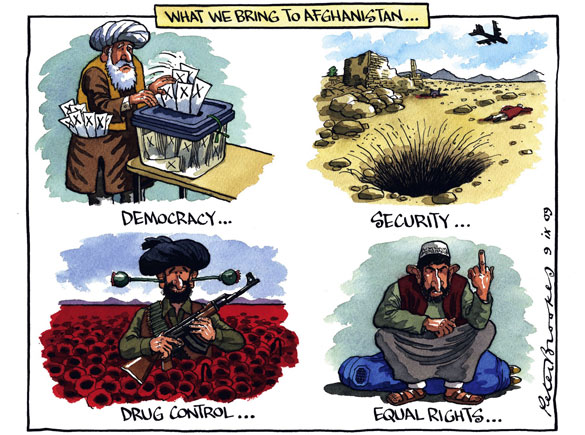 Peter Brookes
Foreign Policy run an Afpak blog for those interested in following the debate around Afghanistan and desiring more than what is offered by Australian newspapers.
In Canberra foreign policy circles it is axiomatic that, as increased Taliban control over Afghan territory would lead to new attacks in the United States, so Australia must stand by the US.There is not much critical thinking going on in Canberra about Afghanistan --even to recognizing that the Taliban and al Qaeda are distinct groupings with autonomous, though sometimes overlapping, agendas.
Posted by Gary Sauer-Thompson at 1:41 PM | Comments (2) | TrackBack
May 8, 2009
Fiji
Small Pacific Island nation.
Capital: Suva.
Features: Skirt-wearing men, mixed Indian/Native Fijian population, resorts with palm trees.
Primary exports: Kava, rugby (League and Union) players, UN peacekeepers.
Primary national pastime: Military coups.
The big knobs of the world have recently decided to get tough on Fiji and coup leader Frank Bainimarama for failing to hold democratic elections when he was told to. Fiji has been expelled from the Pacific Island Forum, kicked out of our temporary work visa scheme and won't be allowed to contribute to UN peacekeeping forces until they shape up and show democracy the sort of respect it deserves.
Anthony Bergin argues that punishment is the wrong approach. Sanctions like these only serve to hurt an already frail economy and dud the civilian population. We know this to be true because we've seen it so often before. Driving the civilian population into poverty and desperation hasn't worked anywhere that I can think of. The only positive outcome that comes to mind is the benefits that accrued to select individuals involved in the AWB setup.
Speaking of Iraq, Fiji was apparently the first country to offer troops to protect UN officials there. Call that sort of thing stupid or heroic, but it seems the UN owes Fiji a debt of gratitude for an endless supply of troops to wherever UN peacekeeping missions care to venture. Like the Fijian military at home, it's one of very few career choices available for Fijian men with families to support. There's not a lot else to choose from. The military, football, or seeing to the needs of white people in resorts.
Still, military coups are undemocratic and shouldn't be allowed to happen. It's not the Pacific way.
Years ago I met a Fijian family who had moved to Australia to find a better life for their numerous kids, and because they felt the race divide between native and Indian Fijians was getting a bit too scary. Yes, the Indians owned everything and had all the money, but Fijians were too lazy to work like Indians did. Still, Fijians were resentful and there were politicians willing to exploit that resentment.
Peter Black has a guest post from Dilan, someone far better informed than me, arguing that the latest coup was about containing racist political opportunism. It's preferable to ditch democracy for a while if it entails the risk of ending up like Sri Lanka.
It sounds like a reasonable argument to me.
Posted by Lyn Calcutt at 1:38 PM | Comments (2) | TrackBack
April 15, 2009
Somali, pirates, war on terrorism
The British are leaving Iraq. Basra--with its open sewers, uncollected garbage and shortage of electricity---has been handed over to the Americans. It has been cleared of Shia gunmen who had imposed extremist Islamist views on the population. That leaves the rationale of the threat of international terrorism -- specifically al Qaeda -- justifying the costly, long-term engagement in Afghanistan and Pakistan that threatens to turn into a walk into a quagmire.
 Steve Bell
If the US is still the only imperial power (American servicemen and women are stationed in the 153 countries to protect its imperial interests), then the Somali pirates indicate the limits of the US's military power. Somalia has been a collapsed state for nearly 20 years, it harbours bands of men in light craft armed with rifles who can seize 50,000-tonne tankers flying the flags of western states in the Gulf of Aden. Piracy is Somalia's biggest industry.
Though the Americans could nuke Somalia flat in a few minutes, they are unable to protect the 25,000 commercial vessels every year that transit the Suez Canal, Gulf of Aden and Indian Ocean while travelling between Europe and Asia.
The outraged conservative Republican blowhards in the US, who love sabre rattling on their little papier-mâché Mount Olympus, yearn to blow the pirates out of the water and assert the imperial fist against the Islamists. American sovereignty rules the waves, and to make this point the US needs to hit--nay wipe out-- a few countries.
Somalia is of key geo-political importance for the US. It lies at a commercial crossroads between the Middle East and Asia. A large portion of the world’s oil tankers, particularly European and Chinese, pass along its coast. It has had no central government since 1991.
It was the fear that Somalia could end up as yet another Talibanised state and a safe haven for al-Qaida terrorists prompted the Americans to support the Ethiopian invasion of Somalia in 2006. In this war Ethiopia was perceived as fighting America’s war against Islam--- a partner with the United States in the “war on terror� in Africa.
The rationale for the Ethiopian military deployment to Somalia was to oust Islamist forces Ethiopia believed represented "a clear and present danger" to its national interest. The Ethiopian forces, who spent the next two years fighting a deadly Islamist-nationalist insurgency to prop up a pro-U.S. "transitional" government, withdrew under fire from the same Islamists they came to crush. The client transitional Federal Government (TFG) of warlords collapsed following the Ethiopian withdrawal.
The US now tacitly welcomes an Islamist government that is not markedly different from the one that the US/Ethiopian invasion of Somalia helped to overthrow 2 years ago.
Posted by Gary Sauer-Thompson at 7:54 AM | TrackBack
January 28, 2009
Afghanistan: pressure builds
The pressure is building to do something about the forgotten war in Afghanistan. There is an increase in the flow of information through the media from the American talking heads about the "deteriorating situation" in Afghanistan and Pakistan, and idea of Australia sending more troops to Afghanistan. Will the "surge" strategy" in Afghanistan under Obama represent a new start? Or will it be the continuation of old policies even though Bush's "war on terror" has been displaced by liberal internationalism?

The Predator attacks over Pakistani territory will continue and there is ta doubling of the US troop level in Afghanistan to 60,000. This is what Obama said he'd do during during the campaign. It looks like more troops in Afghanistan is to make it easier to guard threatened supply-lines, while at the same time allowing more forces to be available in an effort to curb the extension of Taliban influence in the regions and their control over opium production.
Will Washington cut Afghan President Hamid Karzai adrift in the name of regime change? Or will Kabul try to get out of Washington's stranglehold?
Posted by Gary Sauer-Thompson at 7:20 AM | Comments (4) | TrackBack
December 14, 2008
Afghanistan: disaster looms
It is increasingly obvious that the NATO (American) backed Afghan government of President Hamid Karzai is increasingly isolated. The Taliban and other related groups enjoy de facto control in large parts of the country's south and east. Insurgent attacks have increased by 50% over the past year and foreign soldiers are now dying at a higher rate here than in Iraq. Disaster looms for the Americans.
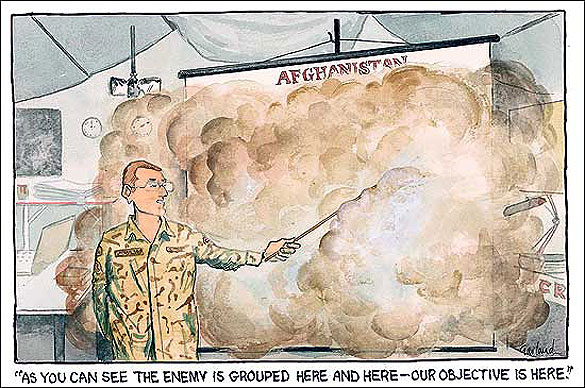 Garland
It looks as if President Hamid Karzai will have to begin negotiations with sections of the insurgency. The more moderate sections of the neo-Taliban presumably, as they have entrenched support from among the wider Afghan population. With a military solution to the conflict looking increasingly unlikely, there is little to be lost in negotiations.
Posted by Gary Sauer-Thompson at 8:44 AM | TrackBack
December 2, 2008
The Howard Years: episode three
I watched Episode Three of the ABC's The Howard Years last night. It was on 9/11 and it looked as if it was about another time, even though the events were very recent. Why another time?
Tony Karon writing in The National gives us a clue. He says that Washington’s dominance of the global financial system and the institutions that manage it, such as the International Monetary Fund (IMF) is coming to an end, and this means that:
the US can no longer shape the global financial system on its own terms, and it will be forced adopt international standards anathema to the conventional wisdom of post-Reagan Washington if it wants to keep playing the global financial game on which its economy depends....And the erosion of the financial hegemony of the US will accelerate the decline of its geopolitical hegemony. a bailout that already looks likely to cost a lot more in the end than the Iraq war will prompt the US to begin wrapping up a military commitment that may already have achieved as much as it’s going to achieve politically. The Iraqi government has demanded that the US begin scaling down its involvement next year and be gone by the end of 2011. Given the dire state of the US economy, Washington may oblige.
There ends the era of the Bush administration and the 9/11 scenario whose end game is Afghanistan. In Iraq everyone is in wait for ''the Americans to leave' mode and it will soon be a similar situation for NATO in Afghanistan.
If the business-friendly bailout Wall Street Bush administration has left not just its own projects, but the nation it ruled, in ruins, then the incoming Obama administration looks to be recycled Clintonism that endeavours to recapture the lost hegemony by muscle and leverage. Yet there has been a radical break with the "Washington Consensus" of the Clinton years in which the United States insisted that the rest of the world conform to its free market model of economic behavior.
Posted by Gary Sauer-Thompson at 7:07 AM | Comments (3) | TrackBack
October 13, 2008
US decline
The financial crisis is an indication that the US is in decline as a superpower. It is ensnared in Iraq and Afghanistan, is unable to resolve the financial crisis and is in debt. That means a very different geopolitical landscape is forming as the tectonic plates of geopolitics shift.
If we recall the Bush administration's dreams of only five years ago, then, they were convinced that they would create a Pax Americana globally and a Pax Republicana domestically that would last generations. Pax Americana has come unstuck due to unsustainable economic and military policies; an overextending itself and doing so by running up a lot of debt.
Now the US's economic position looks precarious, it does not look as if the US is willing to get at some of the root causes of its problems even though we now have a multipolar world.
Eight years of Republican administration has meant that America is poorer, weaker, and more isolated and vulnerable than it has been in several generations. The Republican base, which has been in a rage for some time, is looking around for someone or something to blame. So the Republican strategists persuade them through smears to hate black people. Will the strategy work as the economy heads into recession?
Posted by Gary Sauer-Thompson at 5:50 AM | Comments (7) | TrackBack
September 21, 2008
Russia's return to great power status
George Friedman in an op-ed in the New York Review of Books makes some interesting observations of Russia, Georgia and the US. He argues that Putin did not want to reestablish the Soviet Union, but he did want to re- establish the Russian sphere of influence in the former Soviet region.
To accomplish that, he had to reestablish the credibility of the Russian army as a fighting force, at least in its own region and secondly, he had to establish that Western guarantees, including NATO membership, meant nothing in the face of Russian power. Georgia was the perfect choice. Georgia is a marginal issue to the United States; Iran is a central issue.
Friedman says:
The war in Georgia, therefore, is Russia's public return to great power status. This is not something that just happened—it has been unfolding ever since Putin took power, and with growing intensity in the past five years. Part of it has to do with the increase in Russian power, but a great deal of it has to do with the fact that the Middle Eastern wars in Iraq and Afghanistan have left the United States off-balance and short on resources. This conflict created a window of opportunity. The Russian goal is to use that window to assert a new reality throughout the region while the Americans are tied down elsewhere and dependent on Russian cooperation. The war was far from a surprise; it has been building for months. But the geopolitical foundations of the war have been building since 1992. Russia has been an empire for centuries. The last fifteen years or so were not the new reality, but simply an aberration that would be rectified. And now it is being rectified. Whether the US and its allies can mount a coherent response has now become a central question of Western foreign policy.
Posted by Gary Sauer-Thompson at 7:08 PM | Comments (2) | TrackBack
August 31, 2008
a new cold war?
In response to Russia's recognition of independence for Abkhazia and South Ossetia from Gerogia the West's talk is "cold war" and condemns Russia over the conflict with Georgia, and Russia's de facto control over two major Black Sea ports. In doing so the West has ignored--or forgotten-- the fact that Georgian armed forces attacked the peaceful city of Tskhinvali in South Ossetia or that Central Asia is close to Russia's borders.
As M K Bhadrakumar says in Asia Times Online:
The emergent geopolitical reality is that with Russia's recognition of South Ossetia and Abkhazia, Moscow has virtually checkmated the US strategy in the Black Sea region, defeating its plan to make the Black Sea an exclusive "NATO lake". In turn, NATO's expansion plans in the Caucasus have suffered a setback.
the Georgian crisis is bound to linger for months, if not years, without resolution, particularly if the US continues to push for Georgia's inclusion into the North Atlantic Treaty Organization (NATO). Theoretically, with Germany dropping its opposition to Georgia's bid to join NATO, as it did at the recent NATO summit in Bucharest, nothing stands in the way of NATO's expansion to the South Caucasus, or Ukraine for that matter,
A core issue is energy security, given the fierce pipeline geopolitics in the Eurasian landmass. The US's traditional turf is the oil-prized Persian Gulf, hence the US antagonism to a feisty Iran.
Posted by Gary Sauer-Thompson at 6:40 PM | Comments (10) | TrackBack
August 14, 2008
Georgian blowup
It is clear that the crisis in the Southern Caucasus that has arisen from Georgia's invasion of South Ossetia is caught up in the strategic conflict between the US and Russia in the post Cold War era that undercuts the spin about the Russian bear bullying democratic Georgia. That spin downplays the history of the region, Georgian provocation in recovering lost territory, Russian national interests and an anti-Russian media bubble.
M K Bhadrakumar in Asia Times Online says:
Georgia and the southern Caucasus constitute a critically important region for the US since it straddles a busy transportation route for energy - like the Indian Ocean or the Persian Gulf. It can be used as a choke point. Simply put, keeping it under control as a sphere of influence is highly advantageous for the pursuit of US geopolitical interests in the Eurasian region. A rollback of Russian influence therefore becomes a desirable objective. The geopolitics of energy lies at the core of the conflict in the Caucasus.
Bhadrakumar says the US has suffered a series of major reverses in the past two years in the great game over Caspian energy.
Bhadrakumar says:
Moscow's success in getting Turkmenistan to virtually commit its entire gas production to Russian energy giant Gazprom for export has been a stunning blow to US energy diplomacy. Similarly, the US has failed to get Kazakhstan to jettison its close ties with Russia, especially the arrangement to route its oil exports primarily through Russian pipelines.
Ghia Nodia in Open Democracy says that Russia is making a preventive strike against Nato, which happens to take place on Georgian territory. Moscow wants to teach Georgia a lesson for Tbilisi's open and defiant wish to become part of the west; it wants to send a message to the United States and Europe that it will not tolerate further encroachment on its zone of influence; and it wants to make clear to other countries in its neighbourhood (Ukraine first of all) that they are in Russia's backyard and should behave accordingly.
Thus, on the global scale, this war poses serious questions to the west and to Georgia: for the west, whether it will accept its strategic retreat vis-Ã -vis Russia, and concede that the former Soviet Union is a territory where Russia can effectively dominate without formally restoring its erstwhile empire; for Georgia, whether it retains de facto sovereignty and effective statehood. The Russian calculation appears to be that Georgia will descend into chaos as its people express anger at their government for starting a wrong war and wrongly relying on the west, leaving Georgians with but one option: to embrace a new government that will be formally independent but effectively a Russian satellite.
So much for the end of nationalism that would happen as the whole world gets online and starts clicking.
.
Posted by Gary Sauer-Thompson at 8:00 AM | Comments (4) | TrackBack
August 10, 2008
China: the new global power
The Opening Ceremony of the Beijing Olympics successfully expressed China's arrival of the global stage as a global power. The new China made its presence felt with grandeur that is the Olympic movement's parodic symbol of excess.The excess ($40 billion of public expenditure) signified that China has successfully modernized from being a backward power a century ago.
But the rules of the game of global power are set by the West and they have been changed in the last couple of decades. Progress in the form of modernization is no longer enough.The expectation that China should be like the West, because it is getting rich like the West, is as facile as the thesis that capitalism necessarily leads to liberty.
 Martin Rowson
China, we are reminded, is a one-party state, a totalitarian regime with a poor human rights record. One account holds that Communists in China needed success in sports to highlight the people's ability to adapt to outside forces, that is, those of the market; and also for enhancing the pride of Chinese people globally. The legitimacy of the dictatorship rests on its ability to deliver ever-rising living standards now that its Marxism is dead. Environmental concerns will always be trumped by the Communist Party's survival instinct.
Chan Akya in Asia Times Online says:
The reason for the communists to want sporting success is indelibly associated with their own lack of political legitimacy. Puffing up national pride from such victories is a sure-fire way of diverting criticism of the center: in other words, the logic of "this government prepares world-class athletes, so don't blame us for bread shortages but look instead at the incompetence of your local officials". All of this is part of the game played by communist governments on their people by creating a perverse system that depends on socializing successes in the world of sport and personalizing failures in all other areas.
China hasn't changed. Change is impossible without democratic reform - which is as far away as ever. Olympic Games has not led to political liberalisation.The curbing of dissent over the Games fortnight has been strengthened and are unlikely to be eased when they are over.
Posted by Gary Sauer-Thompson at 11:43 AM | Comments (3) | TrackBack
June 27, 2008
the farce begins
The polls have opened in Zimbabwe. The result is no mystery, but the process is likely to be quite unpleasant.
Tsvangirai's name will be on the ballot, which is one question answered, but he's apparently telling supporters not to vote. And according to the ABC's report the statement he made in the Guardian asking for military intervention wasn't him at all, which is one of the problems we face trying to understand what's going on here - how can we know what's really going on with so much disinformation circulating?
I don't understand the history of this mess, or why Zimbabwe's neighbours do nothing, or why it's the Left's fault, or Malcolm Frazer's fault, or how it's possible for inflation to run at billions of percents, or how it's China's fault, or how come Zimbabwean diplomats are still sitting around in embassies around the joint, or how anyone can still have further sactions to think about imposing at this point, or what the ramifications for the region might be, or why Mugabe bothers having a poll at all, or why this doesn't count in the otherwise ubiquitous warr on terrorr.
The only thing I do understand is that this is not right. It is not OK for a leader to use a veneer of democracy in this way. Be a dictatorship or a monarchy or a pope or a feudal lord or a terminal liar if you want, but don't use democracy as a cover for something else.
Posted by Lyn Calcutt at 5:16 PM | Comments (2) | TrackBack
June 16, 2008
Bush's farewell to Europe
I guess that many Europeans in Berlin, Paris and London can't wait for lame duck George Bush to go. Who cares if this anti-intellectual President, who insist that virtue is ignorance, has regrets about the macho language he used to win support for the war, such as "bring 'em on" and "dead or alive" and preemptive strike. Life after Bush is what we yearn for. He is bad news.
 Steve Bell
His presidency has been a disaster in terms of climate change, Middle East, ,Afghanistan, Iran. His administration continues to both talk about bombing Iran and support Israel's decision to escalate the threat levels against Iran, even though Iran has not breached its nuclear Non-Proliferation Treaty obligations, Isn't this a continuation of warmongering policies based on the realism of empire realpolitik?
What else is the US attempt to impose a "security pact" on Iraq that would allow upwards of 50 or 60 US military bases in Iraq, together with the judicial immunity of US personnel, no time limit on access to Iraqi bases nor any restrictions on the US to "conduct military operations in Iraq and to detain individuals when necessary for imperative reasons of security?
Why else talk in terms of an ''irrational'' and thus untrustworthy Iranian regime? Doesn't that imply that the Bush administration can't trust isrrational regime because they are not deterred by threat of annihilation. Therefore, extraordinary actions such as pre-emptive attack might be not only justified but necessary. Isn't that the Bush Doctrine?
Posted by Gary Sauer-Thompson at 8:21 AM | Comments (5) | TrackBack
June 13, 2008
Pacific Rim: strategic alliances
Hugh White has a good op-ed in The Australian about the strategic balance of power in the Asia Pacific Rim. He says that Tokyo's vision of is a regional alliance to constrain China. The Japanese, he says:
... are deeply anxious that China will use its growing regional influence to push Japan into a permanently subordinate place under China's strategic thumb....they seem to expect that as China's power dilutes and perhaps eventually eclipses US primacy in Asia, China will exercise some kind of hegemony over Japan. No one in Japan could accept that. That is why Japan is keen to build, with America, a coalition in Asia to resist China's challenge to American primacy. It very much wants Australia to be part of this coalition...Terrified that better Sino-US relations may leave them unprotected, Japan now believes that its security depends on suspicion and hostility between Washington and Beijing.
Australia's strategic interest lies in a vibrant, strategic relationship with a strong and active Japan and the same kind of relationship with China. White argues that Rudd missed an opportunity to start a serious conversation with Japan about our future relationship, to address the differences over the shape of the new Asia, and how Tokyo's vision of a regional alliance to constrain China carries immense risks for the region.
White argues that there is no alternative but to work towards a new political and strategic order in Asia based on the maximum convergence between Washington and Beijing as well as providing a substantial and secure place for Japan.
Posted by Gary Sauer-Thompson at 8:17 AM | Comments (5) | TrackBack
April 9, 2008
Rudd's diplomatic talk
Rudd's big overseas trip is different from that of Howard. The style is that of a diplomat who has a grasp of foreign policy issues, who thinks beyond the role of lap dog to the US and the conservative scenarios of a future face-off between Australia and an Asian (Chinese) juggernaut, and doesn't act as the US 's stalking horse in the Middle East.
 Alan Moir
There is an element of smoke and mirrors in all of this diplomatic discussion. The classic example is the talk about NATO when the alliance is bleeding itself white in Afghanistan. NATO has big problems there--- international terrorism, unchecked increase in drug trafficking, building a strong state and the economy-- and its military approach is going to solve these. How NATO is going to be able to extricate itself from the colossal muddle in Afghanistan is an open question. No one is talking about an exit strategy.
Rudd's talk about a more coherent strategy in the war in Afghanistan---eg., addressing the unchecked increase in drug trafficking----fell on stoney ground, despite the boom in opium-poppy cultivation and Afghanistan now suppliing 93% of the world total, the bulk of it grown in Helmand and other southern provinces that are most under the influence of the Taliban.
Rudd wasn't willing to address the realistic view that NATO is losing the war through backing the Kabul regime of of Hamid Karzai. The Taliban are not a spent force consisting of a bunch of naive young lads with no credible leader left. The government of Hamid Karzai controls barely 30% of the country. Most of the country is in the hands of warlords and other local leaders, with a tenth under the sway of the Taliban. A transformative victory by NATO is not at hand.
As Paul Rogers observes at Open Democracy
The term "occupying" and "occupation" are not in the vocabulary of the White House or 10 Downing Street: from their perspective what is happening is a major security operation to win the war on terror while bringing two key countries [Afghanistan and Iraq] safely into the western orbit. Krauthammer's "benign imperium" may look a little tattered around the edges but it remains the basis for coalition action
He argues that the reality is that the United States cannot continue - militarily, financially, or politically - to occupy countries such as Iraq and Afghanistan for years to come. The occupation of countries in the middle east and southwest Asia by western military forces is no longer politically feasible. The starting-point for any new policy will have to be complete withdrawal.
Posted by Gary Sauer-Thompson at 9:02 AM | Comments (10) | TrackBack
March 30, 2008
China's heavy Tibetan hand?
China's heavy handed repression of Tibetan desires for greater autonomy and cultural independence includes imprisoning those who engage in peaceful demonstration as well as rioters, whilst attacking t the Western media, the Dalai Lama and all those taking part in the protests in language that is reminiscent of the Cultural Revolution.
 Martin Rowson
No doubt Rudd will say little about this, even if he is aware of the history of the region. Will he make the distinction as to whether the crackdown was merely oppressive (hundreds of thousands of troops pouring in) or repressive as well (protestors fired on, protesters killed, monks and lay people taken away and beaten). Economics will ensure that Rudd says little.
So Rudd will go along with China's strong armed attempts to control Tibet and its welcoming the world to a peaceful, orderly and more open China for the Games. Will he challenge the widespread view that the events in Tibet represent just another Tiananmen?
Will Rudd argue that the citizens of Τibet, as with those in the rest of China and the world, should be free to speak and write and criticize without fear of censorship or government suppression, and to demonstrate peaceably if necessary? Will Rudd argue that the citizens of Τibet should be able to worship and participate in cultural practices as they see fit, to be educated in the language of their choice, and to be able to pursue these rights in free, unbiased, and independent courts?
Posted by Gary Sauer-Thompson at 11:03 AM | Comments (29) | TrackBack
March 29, 2008
Mr Rudd goes to Washington
So Australia is off to play its dutiful respects to the imperial Presidency. It's a bit like the old Roman Empire days is it not? Rudd has reaffirmed the commitment to Afghanistan, promised other means of support for Iraq, and helped the US by ramping up the pressure on NATO for the Europeans to do more of the heavy lifting in Afghanistan.
 Alan Moir
At least there won't be a echo of the paranoid sound bites from the White House about fighting the Islamic terrorists in Iraq until the last man in order to defend Anglo-Saxon civilization so that we don't have to fight the Islamo-fascists on our beaches. It was only six months ago that John Howard and the Liberals were warning that Labor's Iraq policy would be the end of the free world as we knew it because it would send the wrong signal to terrorists everywhere.
As for Australia withdrawing its troops from Iraq, why even the US is doing so because Iraq has been such a success. The reality is that Iraq is already lost and that current US military strategy is failing to reach a workable political settlement.
What else can Australian PM's say when they are in Washington visiting the imperial Presidency, other than US and Australia foreign policy interests are aligned and there are shared goals? Rudd will add that Australia would continue to stay and fight in Afghanistan.
Rudd probably knows that Bush will "stay the course" in Iraq, hand off the mess to president Obama, and then, when Obama has to make the necessary choices for withdrawal (which could usher in a period of increased violence) the right-wing will blame Obama for "losing Iraq."
Hopefully Rudd will argue the benefits of multilateralism in Washington as well as trying to restore Australia as an activist middle power that would agitate for global good through such bodies as the United Nations.
Posted by Gary Sauer-Thompson at 12:28 AM | Comments (20) | TrackBack
January 29, 2008
Bush: State of Union 2008
Bush's lameduck status can be seen in his 2008 and final State of Union speech. Bush is part of the backdrop of American politics now, eclipsed by the primaries in South Carolina and Florida. If most of the speech was taken up with the economy, then Bush is struggling for airtime even in the foreign policy field.
He has little new to say It's the same tired simplistic narrative about the enemy ( evil men who despise freedom, despise America) still being dangerous, more work remains, the surge is working, Al-Qaeda is on the run in Iraq, and this enemy will be defeated. Freedom advances in the Middle East, but the Iranian regime is there to oppose it.
 Alan Moir
So what did Bush says about peace and freedom in the Gaza Strip, given that the US is seen as supporting and paying for Israel's occupation of the Palestinian territories?
The narrative from Bush is this:
In the long run, men and women who are free to determine their own destinies will reject terror and refuse to live in tyranny. That is why the terrorists are fighting to deny this choice to people in Lebanon, Iraq, Afghanistan, Pakistan and the Palestinian territories. And that is why, for the security of America and the peace of the world, we are spreading the hope of freedom.
Didn't the Palestinians determine their destiny by voting for Hamas in democratic elections? For Bush all that matter is that Hamas, along with Hezbollah in Lebanon, is an arm of Iran. So they are terrorists who oppose the march of freedom in the Middle East.
Bush's simplistic narrative about the Middle East--the noble "war on terrorism"-- has turned out to include keeping a million and a half people locked up indefinitely in an open air prison and denying them their freedom. The Washington Post editorial is an eyeopener: it talks in terms of a "humanitarian crisis" in scare quotes, scolded Gazans for "blowing up international borders," and concluded by demanding that they stop making trouble and wait for the "peace process" to go forward.
So the Palestinians have to go back to jail and suffer under a brutal occupation for another few decades. There is more critical thinking happening inside Israel.
Posted by Gary Sauer-Thompson at 5:30 PM | Comments (6) | TrackBack
January 10, 2008
Bush in the Middle East
The lameduck President is concerned about his legacy and he reckons that a quick visit to the Middle East will nudge along the peace process even though Hezbollah will be excluded, Bush is Israel's best friend, Iran is defined as the enemy, and Bush's Roadmap requires Mahmoud Abbas to dismantle Hamas. No worries, Bush's very presence is enough, apparently, to shift things along:
 Alan Moir
Israel has premised its actions on the assumption of U.S. primacy. So what happens withe slow demise of Pax Americana? The U.S. National Intelligence Estimate on Iran is a blow to the Israeli leadership,as it argued that Iran terminated their efforts to produce a nuclear bomb, and they have not resumed them since.
Israel has been using the “Iran threat� as a political organizing principle at home and abroad. Even when the Bush Administration makes feeble attempts to put the Israeli-Palestinian question on the agenda, the Israelis make sure that it all takes place in the context of a conversation about Iran as an “existential threat� to Israel. However, Washington no longer has the capacity to take the steps required to stabilize the region.
Posted by Gary Sauer-Thompson at 5:40 AM | Comments (7) | TrackBack
December 15, 2007
neo-con tales out of season
Remember in the days of the former Howard Government the Washington Republican tales about the Iranians will produce a bomb that threatens Israel's very existence, and that the Iranians had to be stopped at all cost by the US because Iran is one of the greatest threats in the world today. This was the justification the Bush doctrine of pre-emptive war against Iran, the building of an an international consensus, led by the US and the UN Security Council decreeing sanctions against Tehran.
Well, there has been a U-turn in American intelligence.The American intelligence community, comprising 16 different agencies, has reached an unanimous verdict in the National Intelligence Estimate (NIE) on Iran: already in 2003, the Iranians terminated their efforts to produce a nuclear bomb, and they have not resumed them since. Even if they change their mind in the future, they will need at least five years to achieve their aim.
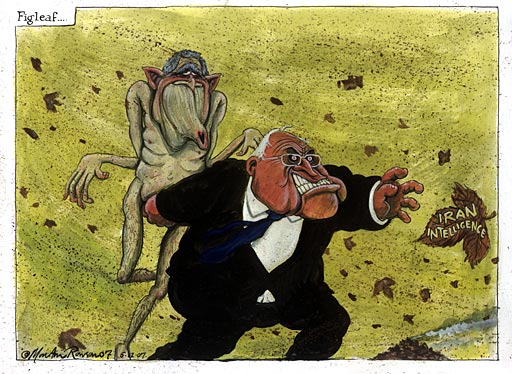
It may be the case that Tehran was no longer developing nuclear weapons, but that hasn't changed the views of Bush and Cheney towards Iran; or Israel for that matter. Yet the possibility of an independent Israeli military strike against Iran has vanished and Israel cannot wage war without the unreserved backing of the US. And that backing is no longer guaranteed by Washington.
Posted by Gary Sauer-Thompson at 11:00 AM | TrackBack
October 24, 2007
an "enduring relationship"
Spencer Ackerman In Iraq Forever in American Prospect argues that the construction of permanent U.S. bases along with long-term plans for troop presence continues apace:
The war in Iraq can sometimes feel like a military commitment in search of a rationale. Yet there has never been any doubt among insiders that the Bush administration intended Iraq to become an outpost of U.S. power projection throughout the Middle East.....The assumption made by advocates of an enduring U.S. presence in Iraq is that the U.S. can improve security to the point where a reduced American presence would no longer be provocative to Iraqis.
It is similar to the British in Egypt says John B. Judis. The Bush Republican Washington view is that Iraqi leaders who owe their positions to the U.S. occupation want the Americans to stay indefinitely, and Bush is ready to oblige them, albeit with a smaller force. What Bush has done in Iraq, rather than what he says he has done, is to revive an imperialist foreign policy, reminiscent of the British and French in the Middle East. It's called an enduring relationship.
Judis says that:
Indeed, this brand of imperialism, as practiced by the Bush administration, is remarkably similar to the older European variety. Its outward veneer is optimistic and even triumphalist, when articulated by a neo-conservative like Max Boot or William Kristol, and is usually accompanied by a vision of global moral-religious-social transformation. The British boasted of bringing Christianity and civilization to the heathens; America's neo-conservatives trumpet the virtues of free-market capitalism and democracy. And like the older imperialism, Bush's policy toward Iraq and the Middle East has been driven by a fear of losing out on scarce natural resources. Ultimately, his policy is as much a product of the relative decline of American power brought about by the increasingly fierce international competition for resources and markets as it is of America's "unipolar moment."
Even if waging a imperial war in the post-imperial age is self-defeating, Bush and Cheney continue to beat the drums of war with Iran ever louder. An all-out attack against Iran's nuclear sites is what I assume Bush and Cheney are after. Hence all the chest-thumping and belligerent bellowing.
Posted by Gary Sauer-Thompson at 7:41 AM | Comments (5) | TrackBack
October 10, 2007
Afghanistan: six years on
The political narrative in Australia is that Iraq is the bad war whilst Afghanistan is the good war. If the Coalition and the ALP are at odds over the invasion of Iraq, then they are united over intervention in Afghanistan. The Taliban regime overthrown in 2001. So why is Australia still in Afghanistan fighting the Taliban, and so caught up in a civil war between the Karzai regime in Kabul and the Taliban?
The official rational is that the Taliban insurgents have links with Al Qaeda and the Taliban can only be beaten by force. This is part of the war against Islam terrorism. If so what is the exit strategy? Or is the NATO-led war endless?
It's all so vague and tenuous is it not? It's very unclear when Taliban militias are now avoiding open conflict with coalition forces and moving instead toward the more frequent use of roadside-bombs and suicide-attacks. Should not Taliban be involved in the peace process because the are not going away. That they are not going away is pretty obvious, since it is their country they are fighting in, with half of the fighters being locals who believe they are defending their livelihoods.
Posted by Gary Sauer-Thompson at 3:18 PM | Comments (4) | TrackBack
September 3, 2007
APEC, Howard's vision, climate change
John Howard is touting the 2007 APEC summit as the most important international meeting to discuss climate change since the 1992 Rio Conference.

Bill Leak
Okay, Rio gave birth to the Kyoto Protocol and binding targets. What does APEC give birth to? A promise by the member nation-states to cut greenhouse emissions? Isn't that what is on the table? A flexible regime is the key word; a regime based on talking down binding targets and talking up technology, free markets and prosperity through trade.
So where is India? Why isn't India a member of APEC? APEC without India makes little sense as a regional grouping.
The flexible approach to climate change is being spun as Howard's vision for a post 2012 -Kyoto international agreement and policy regime. It's a long way from an international emissions market. Howard wants the end of the Kyoto approach to international action on climate change. Not that the final communique will say this.
I guess the importance of APEC for Australia is a symbolic one --its a recognition that Australia's place is in the Asia-Pacific region, and that its economic future as a vibrant multicultural nation-state lies in Asia. So it offers a chance to set Australia on the right course and to help shape the issues for the region
Will Howard be able to use APEC to drink from the wellsprings of partisan feelings? Will he be able to tell emotionally compelling stories about who they are and what they believe in to use it to run on who he is and what he genuinely cares about, and to show that he knows hisr constituents well enough to know where he shares their values and where they don’t. Can be speak at the level of principled stands and provide emotionally compelling examples of the ways he would govern, and to use this as a signature issue that illustrates his principles and fosters identification.
Posted by Gary Sauer-Thompson at 12:00 PM | Comments (6) | TrackBack
July 31, 2007
liberal interventionism
George (ooops Gordon) Brown, the British PM, goes to America and talks to the child-President about their rspecial relationship. Does that mean the UK will no longer be the poodle of the Republican administration that has only 18 months to run?

What about liberal interventionism and Iraq? Isn't Iraq a key factor in global oil supplies? Isn't Britain in the process of withdrawing from Iraq? What is the US going to do?
Does the conflict shaping up around Iraq--civil war and ethnic cleansing -- indicate that the US no longer has the ability to mould events in the region? John Gray, the British political philosopher, argues aginst liberal interventionism in The Guardian. He says that:
The era of liberal interventionism in international affairs is over. Invading Iraq was always in part an oil grab. A strategic objective of the Bush administration was control of Iraqi oil, which forms a key portion of the Gulf reserves that are the lifeblood of global capitalism. Yet success in this exercise in geopolitics depended on stability after Saddam was gone, and here American thinking was befogged by illusions. Both the neoconservatives who launched the war and the many liberals who endorsed it in the US and Britain took it for granted that Iraq would remain intact.
Gray adds that as could be foreseen by anyone with a smattering of history, things have not turned out that way. The dissolution of Iraq is an unalterable fact, all too clear to those who have to cope on the ground, that is denied only in the White House and the fantasy world of the Green Zone.
What then of liberal internventionism? He says that whilst neoconservatives spurned stability in international relations and preached the virtues of creative destruction. Liberal internationalists declared history had entered a new stage in which pre-emptive war would be used to construct a new world order where democracy and peace thrived. He adds:
Many will caution against throwing out the baby of humanitarian military intervention together with the neocon bathwater. No doubt the idea that western states can project their values by force of arms gives a sense of importance to those who believe it. It tells them they are still the chief actors on the world stage, the vanguard of human progress that embodies the meaning of history. But this liberal creed is a dangerous conceit if applied to today's intractable conflicts, where resource wars are entwined with wars of religion and western power is in retreat
He says that the liberal interventionism that took root in the aftermath of the cold war was never much more than a combination of post-imperial nostalgia with crackpot geopolitics. It was an absurd and repugnant mixture, and one whose passing there is no reason to regret. What the world needs from western governments is not another nonsensical crusade. It is a dose of realism and a little humility.
Gray seems to have spoken too quickly as we have liberal interventionism in Darfur. Or is this a case of the US and the UK's case for foreign intervention in Darfur being based on the fighting Arabs in the war on terrorism?
Posted by Gary Sauer-Thompson at 5:09 PM | Comments (8) | TrackBack
July 23, 2007
the war on terror broadens
The war on terror is not looking good for the US. The Bush administration's contention that Iraq constitutes the "central front in the 'war on terrorism' is undercut by the resurgence of the Taliban in Afghanistan. This has been made possible primarily by the "safe haven" it has enjoyed in the tribal areas of western Pakistan, and also by its association with al-Qaeda in Iraq. Pakistan is now a key military and political hub in the war on terrorism.
The Bush administration has long pressured President General Pervez Musharraf's government in Pakistan to attack suspected al-Qaeda bases in the tribal areas that border Afghanistan. The Pakistani army's recent military departure from this region after the peace agreement left the region in the control of the Pakistani Taliban, who have provided al-Qaeda the kind of safe haven it needed not only to rebuild its capabilities, but also to begin to exert its influence aggressively over neighboring territories and even into Islamabad.
The Bush administration is exerting more pressure on Musharraf in the effort to encourage him to send his troops into the border districts and attempt to take control at a time when Musharraf has domestic problems. Will he suspend the constitution and declare an emergency in the country?
Is Musharraf in a position to please Washington to carry out a full-fledged crackdown on Islamic militants?
The radical armed insurgency is dedicated to an Islamic revolution with the aim to establish a firm base in Pakistan from where it can fuel the Taliban-led insurgency in Afghanistan and ultimately announce a regional caliphate. Can Pakistan prevent this, given the attacks by radical Islamists on Pakistani army and government facilities in districts bordering Afghanistan districts after the siege of the radical Red Mosque in Islamabad? The Washington Post reports that the fighting intensifies between the Pakistani army and insurgents in a volatile tribal area near the Afghan border.
Washington is becoming ever more involved in western Pakistan as the Pakistan security forces find the going tough. The Americans are intervening by building a large US base on a mountaintop at Ghakhi Pass on the Pakistan-Afghanistan (Bajaur) border. As Paul Rogers at Open Democracy highlights, the US is also intervening in the form of automated warfare based on an armed pilotless drone.
Posted by Gary Sauer-Thompson at 12:16 PM | Comments (3) | TrackBack
July 9, 2007
Australia on the world stage
The defence of Australia doctrine been put to rest. This doctrine revolved around structuring the Australian Defence Force to protect the continent and Australia's northern air and sea approaches, maintaining a strong navy and air force to deter enemies in Australia's sea-gap before they gained a foothold on the continent. Australia is no longer threatened by Indonesia or Russia.
So how do we understand the new defence strategy? One suggestion:

The main preoccupation of an Australian defence policy is fighting Islamist terrorism as part of fighting the war on terrorism. In this war the alliance with the US is primary, whilst Japan is deemed to be Australia's closest ally in the Pacific region.
National security was once in the iron grip of Howard. He owned the issue. But, suprisingly, it is becoming a policy background, especially around Iraq.
Posted by Gary Sauer-Thompson at 8:09 AM | Comments (7) | TrackBack
June 2, 2007
Blair + liberal internationalism
Christianity matters to Tony Blair. There was a missionary element to his rhetoric. He looked and sounded like a preacher man. True, there was less religion in Blair's public rhetoric of an 'ethical foreign policy' than the good and evil rhetoric of the Bush administration.
Like many Europeans I always found the religion of the Bush administration a big problem. I just switched off when I heard the God squad talk. If a bellicose nationalism is one of the reasons American political culture is alien, then another reason is the deep religious current in American political life.

Peter Brooks
I was initially attracted to Blair's respect for international law, his desire to go through the United Nations, his emphasis on aid, on the Third World, his support for the welfare state, for social justice, and his approach to Israel and Palestine. Blair was a good advocate for liberal internationalism--- that the West should try consistently to promote respect for human rights, pluralism, democracy.
During the 1990s Blair's Christian ethos of the good Samaritan who should help the stricken suffering from despotism, looked good. Military intervention has a place, particularly in order to forestall humanitarian disasters.
Liberal internationalists see the moral case against despotism abroad as a principle that trumps sovereignty. They reject the monopoly of states over international relations, pointing to other actors, the many international non-governmental organisations, like Human Rights Watch. They want to see international institutions enforce justice against recalcitrant states. So we ought to send troops to Darfur, and that it was right to send soldiers into the former Yugoslavia.
They are in contrast to he realists in international relations who take the nation state, pursuing its interests, to be the irreducible element of international relations, and so set a relatively high store by the concept of state sovereignty. They tend to be sceptical of state-building and democratisation programmes. They counsel the foreign policy objective of maintaining a 'balance of power' and rejecting the idea of permanent alliances.
Yet when liberal internationalism was put into practice by practice it looked seedy, tacky and compromised when it aligned itself with the destructive unilateralism of the neo-conservative Bush administration under the banner of the values of the United West. It became a pro-American stance---an acceptance of American exceptionalism ---because Bush never really listened to Blair and his advocay that international legitimacy should be delivered through a new multilateralism.
Posted by Gary Sauer-Thompson at 4:38 PM | Comments (2) | TrackBack
March 29, 2007
Iran: just a game of poker?
Timothy Garton Ash in The Guardian says that the British forces, captured by the Iranians in the Persian Gulf, were operating as part of a multinational force under an explicit UN mandate, to protect oil installations and prevent the smuggling of guns into Iraq. I would presume that the British neo-con hawks are calling for some good old fashioned gunboat diplomacy to teach the Iranians a lesson. Might is right.
Other's question the U K's presence in the Gulf: what business does the UK have in the disputed Iran/Iraq waters in the Shatt-al-Arab waterway searching Iranian ships for smuggled cars?

Many in the Middle East would question the legitimacy of the western military presence in Iraq and its claimed territorial waters and the naval build up in the Persian Gulf and see Iran attempts to acquire influence and power in the Middle East as legitimate. They would see the Iranian provocation as another event in the the 20th century history of the Britain and the USA in relation to the Middle East.
No doubt they remember the Persian Prime Minister Mossadegh and how MI6 and the CIA conspired to overthrow a democratically elected leader Persian because he nationalised the oil industry and replaced him with the Shah? They would see the US-Israeli-UK alliance as actively seeking a confrontation with Iran.
A tit-for-tat game---American special forces are operating within the Iranian border since late last year whilst spy drones are overflying and photographing targets---is now being played out in the Persian Gulf. In this political chess game United States and Britain have bolstered their presence in the Persian Gulf to confront an ascendant Iran flexing its muscles throughout the region and developing nuclear technology. More provocative events will follow.
I watched Fox Television last night and was surprised by the second generation neo cons deep hostility to the UN.---The talking head from the heritage Foundation said the UN was protecting a totalitarian regime. Their advocacy of international hegemony, preemption and regime change by the US is a policy that undermines the UN. The neo-cons in America are dedicated to regime change in Iran and have been ever since the Iranian revolution.
Posted by Gary Sauer-Thompson at 9:30 AM | TrackBack
February 28, 2007
Afghanistan: sobering
Intervention in Afghanistan, unlike Iraq, is seen to be justified and it has bipartisan support, even though it is unclear why Australian troops are there; or even what NATO is trying to achieve. It is a low key war and the strategic aims are fuzzy. What sits in the background is the nation-building neo-conservative program of regime change, the ostensible purpose of which is to "drain the swamp" that supposedly nurtures the terrorist pestilence Al Qaeda who was given a home by the Taliban. Islamic fundamentalism rules.
The usual answer for NATO being in Afghanistan is the need to defend a secular liberal democracy by taking the fight to the Taliban and Al Qaeda. The justification ends there. Mission creep continues in the face of a Taliban resurgence and control in the south of Afghanistan, even as we are told about the great "progress" that is being made in Afghanistan. Yet economic reconstruction—especially in some of the deprived southern provinces where there are security challenges—has hardly taken place, bin Laden seems to have become yesterdays villain in the process, and the existing government of President Hamid Karzai is weak and divided.
The gap between Western rhetoric supporting democratization and development in Muslim societies and the actual commitment that Western countries are prepared to make is large. Tariq Ali, in this article in Counterpunch suggests that all is not as it seems:
What was initially viewed by some locals as a necessary police action against al-Qaeda following the 9/11 attacks is now perceived by a growing majority in the entire region as a fully-fledged imperial occupation. The Taliban is growing and creating new alliances not because its sectarian religious practices have become popular, but because it is the only available umbrella for national liberation. As the British and Russians discovered to their cost in the preceding two centuries, Afghans never liked being occupied.
The American's victory in Afghanistan is beginning to unravel, and it increasingly looks as if President Hamid Karzai is ruler of little more than the capital city of Kabul. If a growing numbers of Afghans see the NATO-led forces as an enemy similar to the Russians, then there is no way NATO can win this war, given the rising anti-American insurgencies. The solution is political, not military. Is U.S. foreign policy fueling the very Taliban insurgency that the U.S. force is there to combat?
Update: 28 February
An account by Mark Silva from the Chicago Tribune of what it is like being a journalist traveling with the Dick Cheney, the US Vice President, to Afghanistan, after he'd left Australia. It highlights the rules for the press on these trips.
I presume that the objective of NATO in Afghanistan is to establish a long-term presence in the region and that Afghanistan and Pakistan is a base used by the US to launch covert operations into Iran. Western development strategy should concentrate on two areas: helping the Kabul government establish health and education facilities, which do not directly threaten regional rulers, and using the U.S. military to repair infrastructure, beginning with roads.
Posted by Gary Sauer-Thompson at 6:29 AM | Comments (8) | TrackBack
February 24, 2007
Pax Americana
The Bush administration continually talks in terms of ending tyranny and replacing it with democracy in the world of nations. Vice President, Dick Cheney, who is currently visiting Australia, is talking in terms of the war on terrorism and the unprecedented struggle between civilization and barbarism.
The US actions to achieve this goal of advancing civilization include internationally illegal, unilateralist, and preemptive attacks on other countries, accompanied by arbitrary imprisonments and the practice of torture. The US defends its pursuit of regime change and advancing civilization by making the claim that the United States possesses an exceptional status among nations that confers upon it special international responsibilities, and exceptional privileges in meeting those responsibilities.

Garland
Few other nations accept this manifest destiny claim, as they see it as a national myth of divine election and mission. Even the British realize they were fighting for the United States, not Britain, in Iraq.They are leaving a local civil war in Basra, and their departure looks like retreat.
William Pfaff in Manifest Destiny: A New Direction for America in the New York of Books says that instead of the stability promised by the proponents of American military and political deployment in the form of Pax Americana we have:
The doomed and destructive war of choice in Iraq, continuing and mounting disorder in Afghanistan following another such war, war between Israel and Hezbollah in Lebanon, between Israel and Hamas in Gaza, as well as between Hamas and Fatah, accompanied by continuing crisis in Palestine, with rumbles of new American wars of choice with Iran or Syria, and the emergence of a nuclear North Korea —all demonstrate deep international instability.
American international hegemony is considered a threat in the Middle East, where it's interventionism is seen in terms of a war against Islamic "nationalism" and as creating an creating an "arc of instability" stretching from Iraq to Pakistan and Afghanistan.
Posted by Gary Sauer-Thompson at 7:28 PM | Comments (2) | TrackBack
February 11, 2007
that close and special relationship
Tony Blair and John Howard are increasingly lonely voices when they plead that Britain or Australia and America must remain each other's indispensable allies. The defining characteristic of both leaders has has been to get as close as he could to the American President--they became George W Bush's best friend and helped lie their countries into war in Iraq. What they or their country have got in return is not clear.

Peter Brook
So far there is no accountability for these leaders to lie us into a war of their choosing. The federal ALP is not talking about accountibility if it wins government this year. Yet Parliament can win any battle with the executive as long as it has an informed public opinion behind it.
Presumably, when both Blair and Howard leave office their successors will have to fashion a new foreign policy for Britain and Australia which recasts their relationship with America and reorient their approach to the rest of the world. Such a foreign policy will no doubt be structured around to adeclaration of greater independence from the US.
The tombstone of that special relationship is Iraq, and as the Brooking 's Institute's recent Things Fall Apart study states, Iraq now exhibits the six patterns from other civil wars: large refugee flows, the breeding ground of new terrorist groups, radicalisation of neighbouring populations, the spread of secessionism, regional economic losses, and intervention by neighbours. Saudi Arabia, Jordan, Kuwait and Turkey are said to be "scrambling to catch up" with rival Iran.
This is the Bush administration path toward "the gates of hell." They bought us Iraq (a jungle world of a failed state), now they are are preparing to do the same for Iran.
Posted by Gary Sauer-Thompson at 2:32 PM | TrackBack
December 1, 2006
talking sense on foreign policy
If the ALP is not going to engage in a debate on foreign policy beyond bringing the troops home from Iraq for fear of upseting the great and powerful Americans, then we need to turn elsewhere. Owen Harris has an interesting article in todays Australian It is a summary of a speech entitled After Iraq given to the Lowy Institute.
Harris begins by stating the hegemonic Australian foreign policy tradition:
If you consider the grand strategy of Australian foreign policy over the past century, what stands out is its essential simplicity and consistency. It has always consisted of allying our country closely with a great power that is committed to preserving the existing international order against those who want to change it radically. For the first 40 years of Australia's existence, that power was Britain. After 1941 it was for a period Britain and the US. For the past half-century it has been the US alone. Between them, those states strove to maintain the international status quo against those revisionist states - Nazi Germany, militaristic Japan, communist Russia - that sought to change it radically.
Howard has continued this tradition with its muted or limited independence for Australia when he gave his support to the US after 9/11. However, as Harris points out, a neoccon Washington was not concerned with maintaining the staus quo in international affairs. The US, to speak a different language, was the imperial power.
Harris states it this way:
The Bush doctrine, formally proclaimed in the presidential national security strategic document of September 2002, committed the US not only to combating terror but to actively promoting democracy and a market economy in "every corner of the world" - that is, to transform the whole international system to conform with American values. To that end it would, where necessary, use its vast military force, not only defensively to contain and deter its adversaries, but actively, assertively and pre-emptively.
That is what Howard signed up to, and continues to support in Iraq and Afghanistaan. It's time for a reassesment since we are now close to the end game in Iraq. By almost common consent, and even in the opinion of Tony Blair, America's Iraq venture is a disaster. So what now? Harris is cutting in a way that the little Americans in the ALP never are:.
There is plenty of scope for discussion as to what is the best course of action from here on, the order and tempo of events. But simply yelling "No Cut and Run" and having no apparent plan for ending participation in the business, beyond making our decision entirely dependent on the decision of an inept and demoralised Bush administration, is surely a pathetic sign of political and intellectual bankruptcy.
The danger is that because the relationship is inherently unequal the weaker party may well become so enmeshed in the affairs of the senior partner as to lose its autonomy. That is the case now. Iraq highlights how Australia has committed itself to marching in lock-step with a superpower that is committed to an incredibly ambitious program of global change. What is given in return? The US typically ignores Australia and take no notice of Canberra. There is no sense of reciprocity in the so called special relationship.
Does not the "special relationship" need to be rebalanced and rethought?
Posted by Gary Sauer-Thompson at 5:41 AM | Comments (0) | TrackBack
November 16, 2006
contrasts
This image captures the reality of power in the world of nations. The US is the hegemonic imperial power and the UK, a former imperial power, is the subordinate power, which tailors its national interest to that of the US. In this case it was the neo-con strategy in favour of the Iraq war. The logic was that the road to Jerusalem led through Baghdad: an invasion would install an Iraqi democracy that would force the Palestinians to submit to the Israelis.

Steve Bell
This is a fairly standard interpretation of Tony Blair in the UK and it is argued that a little more independence is required. It is held that the British Prime Minister should have taken a firm stand against US policy in Iraq and Lebanon. Tony Blair now finds himself begging President Bush to make a serious effort to broker an Israel-Palestine deal. Bush continues to maintain a stony silence. Neither dares to talk about Israeli state terrorism.
This cartoon depicts the conservative mythmaking constructed around the subordinate power relationships to disguise the subservience that is expressed in John Howard merely echoing President Bush in foreign policy:

It is the neo-cons' warrior-heroes last stand amidst the wreckage. It's just a question of political will. The neo-conservatives see things thus:
We face a stark choice now. We can either maintain bases and large forces in Iraq, or we can withdraw. If we withdraw, the Iraqi Army will collapse, and we will not be able to help it except by re-entering the country in large numbers and in a much worse situation. Attempts to mask this reality with militarily nonsensical solutions are dangerous. They will lead to higher U.S. casualties or to defeat-and quite possibly to both.
These hawkish conservatives are right when they say that a U.S. pullout would be a disaster for Iraq. However, their option of "One Last Push" ---more troops to get things sorted-- won't make that much of difference. Most of Iraq's trouble is homegrown, caused by the occupation and its gross recklessness, carelessness, and indifference to the range of possible consequences.
Any questioning of the power relationships, the myths, or the Canberra-Washington relationship is still routinely denounced as anti-Americanism by the spinners for the ideologically driven US imperialists in Washington. What cannot be questioned is American nationalism - a blind belief in America's right and ability to spread its values in combination with the expansion of American power. What is endlessly reproduced is the reproduction of vicarious hatred of the "other".
Posted by Gary Sauer-Thompson at 7:28 AM | Comments (0) | TrackBack
October 25, 2006
Pacific happenings
Canberra now has a muscular foreign policy in the Pacific. It is one of intervening in trouble spots, helping to maintain law and order in troubled and impoverished nations (eg., Solomon Islands) and driving reform across a region composed of tiny Pacific nation-states. In its first six months RAMSI successfully cleaned up the outlawed armed gangs that were terrorising some parts of the islands. With basic law and order re-established, what was then required was nation-building.

Bruce Petty
This reform process in the region will not be easy. This is not just because of the sensitivity in the Pacific towards Australia or regional concerns that the Howard Government has overplayed its hand in the region with Australia's regional assistance mission to the Solomon Islands (RAMSI).
As Scott Burchill points out in The Age the accusations of Canberra's "arrogance", "bullying", and "sovereignty violations" only mask a series of long-term and seemingly insoluble problems:
In economic terms, many states in the south-west Pacific are either marginally viable or technically insolvent. They retain extremely narrow economic bases and are aid dependent. They were inadequately prepared for independence and have few if any prospects for a more affluent future. They remain underdeveloped and are largely excluded from the winds of change that have blown economic globalisation into other parts of the world. Accordingly they are susceptible to organised crime and groups that practise politically motivated violence. If sea levels in the Pacific continue to rise, some states in Micronesia and Polynesia may disappear entirely in the not-too-distant future.
Burchill ends by saying that it is in the interests of both the large players - Australia and New Zealand - and the islands of the South Pacific to make the region stable and viable. True, but the overall trend in the Pacific Islands is low/negative economic growth, low/negative investment flows, limited access to communication and external trade and aid dependence coupled with increasing population growth and pressure on resources.
How is that going to be addressed through regionalism?
Posted by Gary Sauer-Thompson at 8:44 AM | Comments (6) | TrackBack
September 28, 2006
Iraq: some honesty required
John Howard along with Tony Blair must be one of the few people left who do not think that the Iraq war has fuelled terrorism. Even the CIA now concedes that the invasion of Iraq has fuelled terrorism rather than curbed it. it acknowledges that the number of terrorists identifying themselves as jihadists "are increasing in both number and geographic dispersion".

Leunig
Iraq broke the link of trust between Blair and many Labour supporters in 2003. Tis time for the ALP to address the Iraq issue in an honest way.
Posted by Gary Sauer-Thompson at 8:17 AM | Comments (0) | TrackBack
June 16, 2006
geopolitics & Iran
A quote from the Defense Planning Guidance for 1994-99," which was written by then Undersecretary of Defense Paul D. Wolfowitz around 1992. This laid out the strategy recommended by the Pentagon to ensure the U.S. held the position of the singular superpower in a post-Cold War world:
Our first objective is to prevent the re-emergence of a new rival, either on the territory of the former Soviet Union or elsewhere, that poses a threat on the order of that posed formerly by the Soviet Union.
This Pentagon document articulates a clear rejection of collective internationalism. It held that America’s political and military mission in the post-cold-war era was to ensure that no rival superpower is allowed to emerge in Western Europe, Asia or the territories of the former Soviet Union.
This remains the principal aim of U.S. strategy today, but it has now been joined by another key objective: to ensure that the United States -- and no one else -- controls the energy supplies of the Persian Gulf and adjacent areas of Asia.To assert U.S. influence in this region, once part of the Soviet Union, the White House has been setting up military bases, supplying arms, and conducting a sub-rosa war of influence with both Moscow and Beijing.
So argues Michael T. Klare in an article entitled The Tripolar Chessboard: Putting Iran in Great Power Context. He says that It is in this context that:
... the current struggle over Iran must be viewed. Iran occupies a pivotal position on the tripolar chessboard. Geographically, it is the only nation that abuts both the Persian Gulf and the Caspian Sea, positioning Tehran to play a significant role in the two areas of greatest energy concern to the United States, Russia, and China.
The article is worth reading because of its emphasis on the geopolitics as a grand game of chess makes a welcome change from the spin of US news feeds that are recycled by our media as news.
Posted by Gary Sauer-Thompson at 2:59 PM | Comments (0) | TrackBack
May 26, 2006
limits of power
It would appear that the 'Coalition of the Willing' won the battle for the control of Afghanistan but not the war. The Taliban are resurgent, are conducting a spring offensive that is turning into a strong resistance against the foreign presence all over Afghanistan, with the possibility of the simple Taliban-led insurgency to evolve into a powerful Islamic Afghan movement. An ugly aftermath looks sure to follow. It has been 4 years into the neocon project and it is still ongoing conflict in Iraq and Afghanistan, with Iran casting a dark shadow in the background.
This should raise questions about the whole military enterprise. It does for Andrew Bacevich, who says:
For those who believe in the American imperial project, and who see military supremacy as the foundation of that empire, this ought to be a major concern: What are we going to do to strengthen the sinews of American military power, because it's turned out that our vaunted military supremacy is not what it was cracked up to be. If you're like me and you're quite skeptical about this imperial project, the stresses imposed on the military and the obvious limits of our power simply serve to emphasize the imperative of rethinking our role in the world so we can back away from this unsustainable notion of global hegemony.
Tis imperial overreach with little direction or rationale after the ballon of triumphalism has been pricked.
The overreach discloses the expansion of the American empire and the limits of American military power and the capacity of the Bush administration to shore up, expand, and perpetuate U.S. global hegemony that is dependent on Persian Gulf oil. What the Muslim nations see is empire & power; the US trying to establish relations that maximized the benefit to the United States and American society.Theirs is the narrative of Hiroshima, Nagasaki, Dresden, Hanoi, Haiphong, and Abu Ghraib.
Bacevich says that the crusading neoncons really:
..believed that American omnipotence, as well as know-how and determination, could imprint democracy on Iraq. They really believed that, once they succeeded in Iraq, a whole host of ancillary benefits were going to ensue, transforming the political landscape of the Middle East. All of those expectations were bizarre delusions and we're paying the consequences now.
The situation now, with respect to the imperial strategy, is that any relationship having any discord or dissonance requires a security -- i.e. a military -- response. Hence the containment of China through alliances with India and Australia.
Bacevich says that neo-con imperial strategy needs to be replaced with one of the US learning to live within its means. I cannot see that happening.
Posted by Gary Sauer-Thompson at 1:53 PM | Comments (0) | TrackBack
May 11, 2006
a diplomatic letter
Iran's President Ahmadinejad, who is currently in Indonesia in response to American efforts to isolate Iran, has written an open letter to President Bush.
The opening paragraph of the letter poses a good question:
Can one be a follower of Jesus Christ (PBUH) [praise be upon his name], the great Messenger of God, feel obliged to respect human rights, present liberalism as a civilization model, announce one's opposition to the proliferation of nuclear weapons and WMDs [weapons of mass destruction], make war and terror his slogan, and finally, work towards the establishment of a unified international community - a community which Christ and the virtuous of the Earth will one day govern, but at the same time have countries attacked; the lives, reputations and possessions of people destroyed and on the slight chance of the ... of a ... criminals in a village or city, or convoy, or for example the entire village, city or convoy, set ablaze.
That gives you the flavour. It puts lots of uncomfortable questions on the table as it ranges across an array of international issues, including Third World poverty, superpower militarism, multinational exploitation, the plight of Palestinian people and, of course, Iran's right to civilian nuclear technology.
The letter opens up a different front in the war to the stance of defiance---an ethical critique of US foreign policy. The US is being judged by its own Christian values. The criticism is also pointed: United States' global policies, particularly in the Middle East, have made "people of the region increasingly angry with such policies".
Have a read of the letter if you have a moment. It is an interesting document. Some commentary.
Posted by Gary Sauer-Thompson at 5:12 PM | Comments (16) | TrackBack
May 3, 2006
hard, dirty times
According to this report in Asia Times Online the Wilsonian freedom/democracy agenda of the beleagured Bush administration is giving way to the traditional realist concerns of geopolitics, and the realpolitik that goes with it.
This is unsuprising really, given the messy chaos in Iraq, the country falling into disorder and becoming stuck in ethnic passions and loyalties. It still looks as if Iraq will be a very loose federation of three big ethnic enclaves rather than a united nation-state.

Geoff Pryor
Washington's geo-politics is about energy (ie., oil and gas resources) with the emphasis on stability and co-operation with those "friendly" autocrats who have both plentiful oil and gas resources and strategically placed real estate with regard to emerging foes, be they Russia, Iran or China. Good old realism: the world is a dangerous place, good intentions don't mean very much, and the key to international order is a balance of power among armed nation-states.
The Bush Administration could sure do with a dose of realism about starting a war with Iran. If the US lived with a nuclear Soviet Union, and currently lives with a nuclear Communist China, then it could live with a nuclear Iran. Iran is nowhere near being a greater military threat to the United States than Communist China. Is that not so?
Surely Washington’s current fixation on preventing Iran from pursuing its nuclear energy research under the Non -Proliferation Treaty is not due to pressure from the Israel lobby? Mearsheimer and Walt longer footnoted paper is archived at the Kennedy School of Government.
The Israel Lobby? A critical response An interpretation and assessment by BTC News of the historical background. An interpretation by Juan Cole of the excellent Informed Comment.
Certainly, Israel and its hawkish supporters are strongly advocating sanctions and military strikes against Iran. Is this another example of the close US alliance with Israel damaging American relations with other nation-states?
It was once held by the Washington neo-cons that the road to peace in Israel/Palestine led through Baghdad. By that it was meant that if give Israel a greater sense of security then you can solve the Palestinian issue later. Does the road to peace now lie through Tehran? Does the new concern with geopolitics, and the realpolitik that goes with it, mean that the US will no longer identify its interests with those of Israel? Surely there is more to the U.S. opposition to Iran possessing nuclear weapons than the protection of Israel?
Posted by Gary Sauer-Thompson at 4:00 PM | Comments (4) | TrackBack
April 29, 2006
US v Iran
The negative report from the International Atomic Energy Agency (IAEA), the UN nuclear watchdog, saying that Tehran had ignored demands to suspend uranium enrichment puts the ball squarely in the UN Security Council 's Court. It will discuss the possible imposition of sanctions against Iran, even though it is not in breach of any international treaty or law. Iran's exercise of its right under the Non-Proliferation Treaty to acquire full nuclear technology under the IAEA's inspection regime can hardly be called "aggression" or "defiance".
Although the Bush administration talks diplomacy, it is evident that the US is planning some kind of military strike against known, and suspected nuclear sites in Iran, with some kind of covert operation to overthrow President Mahmoud Ahmadinejad. Though sanctions would hurt the Iranian regime the chances of diplomacy succeeding are little, given the resistance of Russia and China to the imposition of economic sanctions.
Though Iran has yet to achieve technological sophistication as regards uranium enrichment--it is understood that the Isfahan and Natanz facilities are rudimentary---Iran is definitely gaining strategic power in the region. As Martin Woollacot observes in the Guardian:
Iran is a threat to is the unusual degree of power and influence possessed by the United States and Israel in the region. But has that preponderant influence been all that good for the people concerned, including the Israelis? Iran is a case of what happens when rising powers bump into established powers.
The US strategy of containing Iran is part of its superpower hegemony that involves building several large military bases in Iraq, and beefing up its military presence in various southern Persian Gulf states that are members of the Gulf Cooperation Council (GCC).
William Kristol at the Weekly Standard reckons the US is already in retreat. Gerard Baker of the Times doesn't hear the US drumbeat or a pre-emptive strike.
Posted by Gary Sauer-Thompson at 9:31 AM | Comments (0) | TrackBack
April 10, 2006
destination Iran
In an article entitled Iran & the Bomb in the New York Review of Books Christopher de Bellaigue explores the possibility of members of the international community imposing sanctions on the Islamic Republic of Iran. He then spells out the consquences. If an embargo similar to the one imposed on Iraq were repeated, the result would be an increase in poverty in Iraq, an increase in oil prices, Iran blocking oil tanker traffic through the Strait of Hormuz and destablization of the world economy.

de Bellaigue states that these consequences would make China and Russia, as members of the the Security Council, reluctant to agree to the US/UK request to impose sanctions. This then increases the likelihood of an Israeli or US air strike against Iran's nuclear facilities.
The likelihood of the US bombing Iran to deprive it of its nuclear fuel cycle is increased by the Bush administration's division of the world into "friends" and "enemies"; those who are "with us" and those who are "against us". Buried beneath this division are double standards and a disregard for the nuclear Non-Proliferation Treaty (NPT). Thus Washington's "friends" - eg, India, Pakistan, Israel - are allowed to enrich uranium, and/or even to possess nuclear weapons, whether they are signatories to the treaty or not. But Iran is part of an "axis of evil", despite being an NPT signatory with a perfectly legal right to develop a uranium fuel cycle. Therefore Iran has to be forced to submit to Washington's will.
Posted by Gary Sauer-Thompson at 9:15 PM | Comments (0) | TrackBack
April 8, 2006
real men go to Tehran
By 2003 it had become clear to many that there were no weapons of mass destruction in Iraq, and that Bush, Blair and Howard had invaded the wrong country for the wrong reason in their long war against international terrorism. The inference is that the Bush administration officials, led by Cheney and Rumsfeld, had systematically misled the US nation into a disastrous war.

Of courses, the stated reasons were not the real ones, as the stated reasons kept changing to take account of the shifts in the wind. The American empire required a solid foothold in the Middle East---Iraq would be the anchor for a long-term US military and economic presence in the Persian Gulf region. Americanizing Iraq would be a step in establishing US hegemony in the Gulf.
Alas, as Robert Dreyfuss points out, power in Iraq comes not from acquiescing to US might, but from resisting it. The insurgency is now a Sunni-led resistance of Ba'athists and army veterans and a growing Shi'ite-led, Iranian-linked resistance. What is worse is that 'Iraq has now gone from a country with a shaky US-backed regime fighting a resistance movement to a country in which sectarian killings and ethnic cleansing predominate. '
The neo-con mission has not been completed in the Middle East; not by a long shot.
The target is now Iran. Real men go to Tehran to overturn the Islamic regime, not to fight the insurgency in Baghdad. The civil war in Iraq is the result of the Iranian military and secret service of sponsoring the militias, paramilitary forces and death squads wreaking havoc in Baghdad and across southern Iraq. The US already has clandestine activities inside Iran and its nuclear confrontation with Iran is really about regime change. For the gun totting neo-cons Iran had no choice other than to accede to America’s demands or face a military attack.
The nuclear issue is the public rallying point--just like WMD in Iraq. The real geo-political issue is who is going to control the Middle East and its oil in the next ten years. All the signs are that the doctrine of pre-emptive strike is being rolled out again. Read Seymour Hersh's latest on Iran---THE IRAN PLANS---in the New Yorker. Hirsh says that:
A government consultant with close ties to the civilian leadership in the Pentagon said that Bush was “absolutely convinced that Iran is going to get the bomb� if it is not stopped. He said that the President believes that he must do “what no Democrat or Republican, if elected in the future, would have the courage to do,� and “that saving Iran is going to be his legacy.�
Saving Iran? Saving Iran from what? From their own regime? Hirsh continues:
One former defense official, who still deals with sensitive issues for the Bush Administration, told me that the military planning was premised on a belief that “a sustained bombing campaign in Iran will humiliate the religious leadership and lead the public to rise up and overthrow the government.� He added, “I was shocked when I heard it, and asked myself, ‘What are they smoking?’ �
The neocon illusions continue. Do read Hirsh, as he places the 'nuking Iran' to destroy the nuclear infrastructure option squarely on the table.
Posted by Gary Sauer-Thompson at 5:13 PM | Comments (3) | TrackBack
March 26, 2006
Tony Blair + liberal interventionism
I see that Tony Blair, the British Prime Minister, has arrived in Australia. Blair, who is walking into the political twilight, should be included in this image:

Blair has been fatally wounded by the continuing and deepening unpopularity of the Iraq war and is now despised by two-thirds of Labour voters, three quarters of Conservatives, and a clear majority of independents. He is in the process of giving series of three detailed speeches in defense of the Iraq war and the broader struggle against Islamist extremismin the context of liberal interventionism. Blair says:
Over the next few weeks, I will outline the implication of this agenda in three speeches, including this one. In this, the first, I will describe how I believe we can defeat global terrorism and why I believe victory for democracy in Iraq and Afghanistan is a vital element of doing that. In the second, I shall outline the importance of a broad global alliance to achieve our common goals. In the third, in America, I shall say how the international institutions need radical reform to make them capable of implementing such an agenda, in a strong and effective multilateral way. But throughout all three, I want to stress why this concept of an international community, based on core, shared values, prepared actively to intervene and resolve problems, is an essential pre-condition of our future prosperity and stability.
Blair gives thoughtful speeches to be sure. He gives the second speech to the Australian Parliament today. He does have a lot of ground to makeup, since his conception of an international community, based on core, shared values, actively to intervening and resolving problems has gone off the rails in Iraq.
In the first speech; he lays out the principles of his foreign policy: the doctrine of liberal interventionism - the view that democratic countries can no longer stand by while dictators commit hideous crimes against their own peoples. He offers a new ethical, rather than realpolitik, ethos in foreign policy, one that would no longer see the principle of state sovereignty trump all other moral considerations.
Has not Blair savaged this principle with Iraq? Did not Blair invent a threat that was not there? Blair is damaged goods, and responsible for a large foreign-policy disaster. Blair characterises his critics as adhering to a view:
"...which sees the world as not without challenge but basically calm, with a few nasty things lurking in deep waters, which it is best to avoid; but no major currents that inevitably threaten its placid surface. It believes the storms have been largely self-created....This world view - which I would characterise as a doctrine of benign inactivity - sits in the commentator's seat, almost as a matter of principle."
It is 'benign inactivity' as its basic posture is not to provoke, to keep all as settled as it can be, and to cause no tectonic plates to move. Blair says that it has its soft face in dealing with issues like global warming or Africa; and reserves its hard face only if directly attacked by another state, which is unlikely. Blair, in contrast, is for action and intervention with a moral imperative.Liberal interventionism worked well in 1999, when NATO planes were dispatched to bomb Belgrade in an effort to stop Serbs from "cleansing" Kosovo.
It is Blair's thesis, that the struggle in Iraq is pivotal to the defeat of global terrorism, where things unravel. On Iraq he says:
This is not a clash between civilisations. It is a clash about civilisation. It is the age-old battle between progress and reaction, between those who embrace and see opportunity in the modern world and those who reject its existence; between optimism and hope on the one hand; and pessimism and fear on the other...We can no more opt out of this struggle than we can opt out of the climate changing around us. Inaction, pushing the responsibility on to America, deluding ourselves that this terrorism is an isolated series of individual incidents rather than a global movement and would go away if only we were more sensitive to its pretensions; this too is a policy. It is just that; it is a policy that is profoundly, fundamentally wrong.
Persuasive huh. Then I remember the images of torture in Abu Ghraib:--that is progress? That is civilization? That stands for optimism and hope?
It gives another meaning to Blair's claim that in the era of globalisation where nations depend on each other and where our security is held in common or not at all, the outcome of this clash between extremism and progress is utterly determinative of our future here in Britain. Blair has too much Iraqi blood on his hands to be credible about the "battle for modernity".
It is true that the Iraqi people want their government decided by the people. But the US and the UK have failed to deliver securityand basic services such as health, electricity, sanitation and infrastructure. Nor can I see Blair fostering this democratic desire with his support for systematic torture in Abu Ghraib and the actions being blamed on a few lower-level grunts. Blair's credibility is shot. Look at how defends himself:
Of course, and wholly wrongly, there are abuses of human rights, mistakes made, things done that should not be done. There always were. But at least this time, someone demands redress; people are free to complain.
That shrug--'people are free to complain'--- is made worse by the fact that Saddam Hussein had no link with al-Qaida and its terrorism before the invasion--something Blair well knows. It is thanks to Blair's policies that Iraq has become a fertile recruiting ground for jihadists.
Blair is skewered by the gap between between his rhetoric and the reality on the ground. His view that Islamist extremism should be fought through intervention would be more credible if Blair acknowledged that extremism and hatred has been fuelled by the disastrous war in Iraq. This is a necessary admission by those responsible for the war; and a good place to start is when Blair addresses the Australian Parliament tomorrow morning. Don't hold your breath. My guess is that he will portray the Iraq war as part of a global struggle between "democracy and terrorism ", which warrants the continued US-led interventions in Iraq and Afghanistan.
Posted by Gary Sauer-Thompson at 3:32 PM | Comments (0) | TrackBack
March 10, 2006
nuclear games-US style
I'm not all that comfortable with the results of Bush tour of India and Pakistan:

India has not even signed the Nuclear Non-Proliferation Treaty (NPT), but the US has, and in doing so it's agreed to not help any other countries in their nuclear-weapons prgramme.
Bush's tour indicates that the US now regards India as a key partner in its regional security interests, not least because India is seen as a powerful counterforce to the growth of Chinese influence. Presumably, the Bush administration is aware that good relations with India will cause internal problems for the regime of President Pervez Musharraf, but it considers that benefits of having India on side outweighs any negative effects this will have in Pakistan. So Pakistan plays another card--an alliance with China and Russia.
I'm uneasy because things are getting real messy on the Pakistan/Afghanistan border. The Taliban units inside Afghanistan are building their supplies to take the offensive on a large scale inside Afghanistan. To do this they require safe access to and from Pakistan. Musharraf is under considerable pressure from Washington to sustain military activity on the Pakistani side of the border; yet the more he does this, the more he is likely to provoke local antagonism to his regime.
The pro-American Musharraf regime is caught in a trap and is being squeezed. Either General Pervez Musharraf plays along with a Taliban plan for access into Afghanistan, or he comes down firmly on the side of the US. Neither option offers much respite from the pressures mounting against the regime.
Are not Muslims coming out in large numbers to protest against US policies in Iran, Iraq and Afghanistan in both India and Pakistan. How long will the Musharraf regime last? What happens if it falls? An Islamist regime takes its place, one connected to Iran? Has the Bush administration factored the consequences of this into its great state politics?
What does all this mean for Australia. Our troops are currently helping the US fight the Taliban in Afghanistan. This is an unstable region. I cannot see that it is Australia's national interest to be involved in a civil war in Afghanistan.
Posted by Gary Sauer-Thompson at 11:22 AM | Comments (0) | TrackBack
February 8, 2006
wither West Papua?
Will Canberra put concerns for the bilateral relationship with Jakarta ahead of growing public support for Papuan independence, and do so in the name of support for Indonesia's territorial integrity? That is the issue raised by the 43 Papuan asylum seekers now being processed on Christmas Island. A grant of asylum by Australia would mean that Canberra accepts their claims of repressive persecution.
The history of the relationship between Indonesia and Australia is one of foreign policy elites ignoring public sentiment and appeasing Jakarta over East Timor. Will the same happen with respect to West Papua? In many ways it depends on what Indonesia does. Independence for Papua is out of the question for Indonesia, and Australia does not support Papuan independence. However, Hugh White says that:
In last year's state of the nation address, President Bambang Susilo Yudhoyono listed it as agenda item one in his program, along with the peace agreement in Aceh. He has been prepared to promote a quite far-reaching special autonomy package for Papua. But others in Indonesia are less accommodating, and there is significant evidence that elements of the Indonesian military are repeating some of the repressive tactics that have done so much damage elsewhere.
That kind of autonomy implies a political shift from a unitary state to a federal one, which, presumably, is what the hard line elements in the Indonesian military resist and oppose.
Posted by Gary Sauer-Thompson at 12:10 PM | Comments (0) | TrackBack
January 6, 2006
America's global hegemony
When the cold war ended in the 1990s there were many who expected that the fall of Soviet communism would enhance American power, which they welcomed with much hype about the end of history. Some even talked in terms of history has given America an imperial role, that an imperial reality should dominate US foreign policy, that the US is the final guarantor of global security and that it is engaged in policing the world. A few even signed up to empire as some sort of grand messianic adventure.
What has happened a decade latter is that the actual effect of the end of the cold war has been to reduce to US power in the world of nations. This quote by John Gray says it well:
The cold war was not the kind of competition that could have a winner. It could have only one loser---the USSR, with its enormous military-industrial rustbelt, stagnant economy, and devastated environment. The true beneficiary is not America but Asia. The Soviet collapse quickened the pace of globalization, which is enabling China and India to become great powers whose interests may conflict with those of the United States. The era of Western primacy is coming to a close. It is this fact more than any other that precludes the formation of an American Empire and rules out any prospect of the United States being accepted as a de facto world government.
Well said. That creates difficulties for Australia, as the Howard Government signed up to the American empire to the extent of becoming its deputy sheriff in the Asia Pacific region. Yet China is increasingly becoming Australia's main trading partner, whilst the much hyped Australia-US Free Trade Agreement is turning out to be a fizzer.
Posted by Gary Sauer-Thompson at 11:05 AM | Comments (3) | TrackBack
October 28, 2005
exiting Iraq
Owen Harris says that the Bush Doctrine was the :
....product of three interacting conditions: American hegemony, American exceptionalism and American outrage. The first encouraged the belief that anything the United States willed was achievable. The second insisted that what should be willed was the remaking of the world in America's own image. The third created an enormously powerful pressure for immediate and drastic action.
Bush, in giving this doctrine authoritative voice, reduced the complexity of the international situation to the simple and dangerous Manichean terms of either you are with us, or you are with the terrorists.
Hence this:

This is the result of linking the promotion of freedom and democracy to the active use of American military might and imperial overreach. Failure.
Posted by Gary Sauer-Thompson at 1:57 PM | Comments (0) | TrackBack
October 3, 2005
China-US relations
In a recent speech to the National Committee on US China Relations Robert Zoellick, the Deputy Secretary of State, was critical of China----many Americans worry that the Chinese dragon will prove to be a fire-breather. China is an emerging new power and some American Republicans are more than uneasy.
Zoellick said that the templates of the past do not apply to US China relations these days:
If the Cold War analogy does not apply, neither does the distant balance-of-power politics of 19th Century Europe. The global economy of the 21st Century is a tightly woven fabric. We are too interconnected to try to hold China at arm’s length, hoping to promote other powers in Asia at its expense. Nor would the other powers hold China at bay, initiating and terminating ties based on an old model of drawing-room diplomacy. The United States seeks constructive relations with all countries that do not threaten peace and security. So if the templates of the past do not fit, how should we view China at the dawn of the 21st Century?
His response was in terms of there being a cauldron of anxiety about China in the US. Zoellick referred to mercantalism, Chinese competitiveness, which is devastating US industry (textiles and machine tools), its military buildup, and its rise as a military power in its own region. China, he says, needs to act as a responsible major global player.
Zoellick then added that:
The United States will not be able to sustain an open international economic system ---or domestic U.S. support for such a system –---without greater cooperation from China, as a stakeholder that shares responsibility on international economic issues.
That's a shot across the bows.
Tony Walker, the Australian Financial Review's Washington correspondent, comments that Zoellick did not refer to the US not acting responsibly when it erroneously blames China for America's ballooning trade and current account deficits. Walker rightly says that a larger revaluation of China's currency within realistic parameters would not make the slightest bit of difference.
Posted by Gary Sauer-Thompson at 6:25 PM | Comments (1) | TrackBack
August 24, 2005
rhetoric and reality
Alan Moir tends to repeat himself with his representation of Australia's relationship with the US. He accurately depicts the power relationships between the two nation-states, but he does not capture the tensions or nuances in the relationship:

And there are tensions in the triangle between China, America and Australia: between China as a threat to the US as an empire and China as a trading partner for Australia.
These tensions are often overlaid by the conservative rhetoric of the deep anti-American feeling in Australia that is located on 'the left.'Then we are straight into the culture wars of bashing the left.
In his recent speech to the Australian American Leadership Dialogue Forum Treasurer Costello says that:
The history of the world is replete with powerful states and empires–Rome, the Ottomans, Great Britain. These were powers that ruled large areas of the globe, generally by force. There always has been and, in likelihood, always will be great powers---even hegemons. But if the world is to have a hegemon the modern United States is the kind of hegemon we would like to have--democratic, respectful of human rights, with strong and genuine belief in individual liberty.
Costello accepts the reality of political power in the world of nations, and he acknowledges that the US is the top global power. (the issue of the US aS hegemon or empire is still to be resolved). We can also agree with the Treasurer's claim that:
A stable international order which recognises these values is far preferable to one where great powers seek to extinguish these values, or to an unstable international order where these values cannot be guaranteed or enjoyed.
The issue of the rule of law is put to one side in terms of 'recognition.'
What needs to be put into question about Costello's speech is whether the US under the neo-cons around George Bush is an imperial power that is actually respectful of human rights with a strong and genuine belief in individual liberty. Does the conservative practice accord with the liberal rhetoric?
Actions speak louder than words here. Vietnam was an example of not respecting human rights; nor were the frequent interventions in Latin American to overthrow demcratically elected governments, such as Chile. Okay that was the past. Today we have the Abu Ghraib atrocities in Iraq on the road to democracy in Iraq. The actions do not accord with the words.
Posted by Gary Sauer-Thompson at 2:41 PM | Comments (4) | TrackBack
June 27, 2005
rhetorical flourishes
The Bush administration usually puts on a good rhetorical show around foreign policy. It's central theme is that it has a manifest destiny to bring democracy and freedom to the rest of the world. It then lectures the Arab states in the Middle East about how bad they are, and how they need to fundamentally lift their game.

The continuing military occupation of Iraq, Washington's unwillingness to win greater concessions from Israel on the West Bank settlements, the ugly practices of Abu Ghraib and the incarceration of Muslims at Guantanamo Bay undercuts the message.
This feeds the deep anti-US resentment in the Middle East. So does the traditional US policy in Middle East that favours stability at the expense so democracy.
Then we have this kind of partianship shown by Karl Rove, the architect of Bush's two presidential campaigns and now White House deputy chief of staff, expressed in these in recent comments about 9/11:
"Conservatives saw the savagery of 9/11 in the attacks and prepared for war. Liberals saw the savagery of the 9/11 attacks and wanted to prepare indictments and offer therapy and understanding for our attackers."
I heard on the news this morning that the Bush administration was now talking to the insurgent Sunni rebels in Iraq.
The military are trying to find a way for the US to extract itself from the Iraq quagmire now that US public opinion has turned against the occupation of Iraq.
The success of the Iraqi forces is the linchpin of the US exit strategy from Iraq. That means that Iraqi forces, not foreign troops, would have to defeat the insurgency. Consequently, Iraq will slip into a civil war if the US withdraws large numbers of troops before Iraqi forces are ready to take over. This situation looks more and more like the Vietnam one to me.
Posted by Gary Sauer-Thompson at 9:53 AM | Comments (4) | TrackBack
April 19, 2005
These guys have got problems
Well, I guess its all right to go around the world kicking butt whilst playing at being the deputy sheriff in the Pacific Rim. But, suprise suprise, some of our neighbours do not like their butt being kicked:

All that macho pre-emptive strike cowboy stuff just hasn't gone down well around the Pacific Rim. Australia has been ostracised. It merely echoes the neocons in Washington.
Hell, what if China embraced the pre-emptive strike doctrine with enthusiasm? What then? I recall that Downer stuck his neck out in Adelaide during the federal election when he said that he had no problems with our neighours employing pre-emptive strike to hit the Kimberley's to wipe out the terrorists. For China terrorists means the Tibetians, does it not? And that means....
Let us just say that problems begin to abound everywhere with that kind of reasoning. So it is good to see that others in our region have more sense and are willing to bring the hot heads to heel.
Posted by Gary Sauer-Thompson at 11:11 AM | Comments (0) | TrackBack
February 2, 2005
living in a neocon world
This is a world in which the US cop on the international beat creates conflict:

Heng Kim Song, Editorial Cartoons, Lianhe Zaobao, Singapore.
This is a world order imposed by US power that aims to remake the world in the image of the free society in the US: a combination of law, liberal freedoms, competitive private enterprise and regular, contested elections with universal suffrage.
It is a world order in which Saddam Hussein's Iraq did not represent a substantive existent threat, but the US deposed Saddam and occupied the country anyway.
Iran and North Korea are now marked for regime change. Iran is seen as a regional threat that needs to be contained, destabilized, and rolled back as part of the strategy to permanently transform the regional balance of power in favour of Israel. So is Syria. Is the US exit strategy from Baghdad through Damascus?
Posted by Gary Sauer-Thompson at 5:20 PM | Comments (4) | TrackBack
January 21, 2005
speaking the truth
I've been critical of Richard Armitage, the US Under Secretary of State, for his partisan interventions into Australian politics on behalf of the Howard Government during an election. But the man is leaving his post and is speaking his mind. So the Washington spin has been dropped and the mask taken off.
In an interview with Greg Sheridan in The Australian Armitage says:
I'm disappointed that Iraq hasn't turned out better. And that we weren't able to move forward more meaningfully in the Middle East peace process.The biggest regret is that we didn't stop 9/11. And then in the wake of 9/11, instead of redoubling what is our traditional export of hope and optimism we exported our fear and our anger. And presented a very intense and angry face to the world. I regret that a lot.My my.
The US presented more than an intense and angry face. It also presented a very self-righteous fundamentalist one. The invasion and occupation of Iraq is the outcome of its unilateralism: a messy civil war, increasing Sunni and Shia fundamentalism, body bags and the rise of a defensive jihad around the world.
Will the unilateralism be toned down in Bush's second term? Isn't Iran being lined up?
Seymour Harris thinks so. More regime change of countries in the Middle East based on more fictions? What way will it be done in Iran? What we suspect is that the Bush administration has some sort of a plan about destabilizing, or even bringing about regime change, in Iran.
Ehsan Ahrari writing in Asia Times Online says that:
What hasn't been clear, however, is whether [the Bush addministration] would follow the Afghan model of a military campaign, or the Iraqi version of it. Considering the fact that the US military is innovative and prolific about coming up with sui generis campaigns for different military operations, chances are that if Washington indeed has plans for regime change in Iran, it might not follow either of the two preceding operations. That is why the recently published essay of Hersh about a potential US military action against Iran is read with considerable interest and attention worldwide.
Eshran says that it is necessary to factor Israel into the equation as the core of Israel's position is that no Middle Eastern country, save itself, has the right to possess nuclear weapons. He adds:
Israel is afraid that if a Middle Eastern country becomes a nuclear power, it could forever lose its freedom of action in the Middle East. The specifics of such a scenario are not important because Israel will do everything in its power, including preemptive attacks, to make sure that no Middle Eastern country ever develops nuclear weapons. The US, regardless of who is sitting in the White House, has no problem with such a frame of mind.
Richard Armitage is silent on all this, even though Washington would not rule out military action against Iran. US Vice-President Dick Cheney is not silent though.
Maybe in the next interview Armitage will engage in more truth telling to his friends. He could, for instance, acknowledge that it is legitimate for Australia to have an independent foreign policy. He could pause, then add that this option would be better for Australia's national interest than being a deputy sherriff of the US in Asia Pacific Rim.
Now that would be speaking the truth.
Posted by Gary Sauer-Thompson at 2:21 AM | Comments (0) | TrackBack
December 3, 2004
Ukraine: power politics
Ukraine is conventionally seen as part of the Russian sphere of influence, subordinated to an autocratic Russia's imperial interests, and a problem in east–west relations. It is not seen as an independent country in its own right.

Martin Rowson, Ukraine's Election Crisis
The political struggle in Ukraine is more than one about an election it is a geopolitical struggle. The traditional response is these kinds of European views, criticised by Timothy Garton Ash in The Guardian.
Standing up against an autocratic client regime is people power, in the form of massive, peaceful protests protesting election fraud. From what I can gather the “orange revolution”, formed from a desire for statehood independent of Russian tutelage, connects back to Solidarity in Poland, autonomous social institutions of civil society and Poland's escape from the old Soviet empire. If this interpretation is on the right lines, then the old dictatorial, communist, political class in Eastern Europe is once again resisting a popular, democratising wave.
The conflict around the push for democracy in the Ukraine continues. Whilst the Supreme Court cosniders the election results, the manoeuvring between the main protagonists in the crisis continued. The forming consensus is that some kind of solution to the election impasse appears to be edging a little closer.
The tense situation is still in a standoff. It is one of dual sovereignty: a corrupt, authoritarian client regime backed by the population in Ukraine’s Russian-speaking eastern provinces and Russia’s political elite; and the opposition candidate Viktor Yushchenko backed by millions of ordinary citizens- ethnic Ukrainians, Russian-speaking Ukrainians, ethnic Russians, and other minorities---who want a more democratic, independent Ukraine.
Australian commentary on this issue of Ukrainian democracy can be found over at John Quiggin's place here and here and here.
My judgement is that the best option for the authoritarian regime of the old communist political class of the Kuchma-Yanukovych regime is an ordered withdrawal, under some consensual compromise, which will allow a more liberal democratic, market-oriented and western–oriented Ukraine.
Update:4 Dec.
On Friday the Supreme Court declared the results of Ukraine’s disputed presidential run-off election invalid, and ruled that the run-off should be repeated by Dec. 26. The court said its ruling was final and could not be appealed.
The space for democratic freedom is opening up. More news here, as interpreted from the orange revolutionary perspective.
Is my interpretation a fairytail narrative?
Posted by Gary Sauer-Thompson at 9:26 AM | Comments (0) | TrackBack
November 23, 2004
mix 'n shake
Let us put three things into the mixer.
First, this news account of Colin Powell's resignation. According to this report Powell thought he could use the credit he had banked as the President's 'good cop' in foreign policy to rein in Ariel Sharon (Israel's Prime Minister) and get the peace process going. He was wrong:
"Colin Powell, the outgoing US Secretary of State, was given his marching orders after telling President George Bush that he wanted greater power to confront Israel over the stalled Middle East peace process...Vice-President Dick Cheney and his fellow hardliner, John Bolton, an Under-Secretary of State to Mr Powell....wanted to make Iran's alleged nuclear bomb aspirations and support for Islamic terror groups the foreign policy priority and believed that Mr Powell would back away from a confrontational approach...Prominent neo-conservatives in Washington make no secret of their desire for regime change in Tehran, although few believe that a full-scale military operation is a viable strategy. Instead, the emphasis is on establishing economic sanctions as a means to squeeze the ruling mullahs."
This probably means that the US may tacitly back some Israeli air strikes on Iranian nuclear plants.
Then we can put this ingredient into the mix:

Tandberg
And then put this opinion piece by Amin Saikal into the mix:
"American voters, by re-electing George Bush with a clear mandate to pursue his first-term policies, have potentially set the scene for more confrontation between the United States and its close allies, and the forces of radical political Islam. The outcome will be critical in determining the future of world order....many ordinary Muslims around the world are now bound to become more wary of US policy behaviour than ever before.They are likely to take extreme exception to Bush's now well-known personal identification with Christian evangelism, his faith-based domestic and foreign policy priorities, his division of the world in terms of "good" and "evil", and his uncritical support of Israel...."
Saikal says that Bush's agenda of building bridges to moderate Muslims has failed, because moderate Muslims do not want to be seen in his company.
If we mix the three ingredients up, shake gently, then we get a sense of US foreign policy over the next 4 years: a unilateral go-it-alone strategy that will polarise the world. This is justified by a carefully targeted ideological campaign of a clash of civilisations between Islam and the West. As President George Bush put it, civilisation is at war with barbarism. The barbarians hate us for who we are (our roots are Judaeo-Christian) and they reject our ideas of liberty and democracy etc etc.
Now read the burden of war if you have time.
Posted by Gary Sauer-Thompson at 5:52 AM | Comments (1) | TrackBack
November 18, 2004
hard policies--Iran?
The press reports indicate that Condolezza Rice role is to present a more assertive and a more unilateral US foreign policy to the rest of the world. Her appointment is interpreted as consolidating the control over US foreign policy by the coalition of hawks that promoted the war in Iraq.

Wilcox
This means global US military dominance, preemption against possible enemies, the aggressive promotion of democracy overseas and the rejection of multilateral mechanisms or treaties that might constrain the exercise of US power. It also means that the international community is "illusory" and that US national interest comes first.
I presume that this Bush doctine means that the current containment and mulitalteral negotiations with Iran, which aim to constrain Iran's nuclear ambitions, will soon be replaced by the US push for tougher sanctions, and then regime change. Condoleezza Rice has previously said that the US will not tolerate a nuclear-armed Iran.
Mathew Yglesias asks: "Is a nuclear Iran such a bad thing that it is worth preventing by any means necessary?
The US reckons that it is okay for Israel to be a nuclear power. Would not a nuclear Israel be a threat to Iran? Is it not the case that Israel would not want to lose its nuclear monopoly over the other Middle Eastern states?
So I presume that the United States perceives Iran's quest for nuclear energy as a threat to its interests in the Middle East. I also presume that this means the security of Israel is the most important issue in the Middle East for the US.
Iran's security interests, how Iran views its regional strategic environment, and Iran's genuine fears regarding its security, have little traction with the Bush administration. Does it not have a legitimate claim to deterrence?
Despite deep internal divisions in Iran over its future (Western or Islamic), nearly all of Iran's significant political forces are nationalist; and so they are united on the premise that any US attempts to change the Iranian regime and its revolutionary heritage are unwelcome and to be firmly resisted.
Update 20/11
Colin Powell has gone public on the issue. U.S. credibility is at stake on this, given that the information about Iran's nuclear program was classified and based on an unvetted, single source.
For some good background comments on this proliferation issue read Roger A. Payne's blog
Posted by Gary Sauer-Thompson at 1:32 PM | Comments (2) | TrackBack
October 7, 2004
confirmation
The news reports are carrying a story saying that the top US arms inspector has reported that he found no evidence that Iraq produced any weapons of mass destruction after 1991. Saddam Hussein's weapons capability was weakened during a dozen years of UN sanctions before the US invasion in 2003; Saddam did not have chemical and biological stockpiles when the war began; and his nuclear capabilities were deteriorating, not advancing.
So Hussein had the desire but not the means to produce unconventional weapons that could threaten his neighbors or the West.
So says Charles Duelfer, head of the Iraq Survey Group.
Our intelligence said otherwise, John Howard responded on Radio National Breakfast this morning. The Prime Minister added that he had acted in good faith on the basis of that intelligence. Well, that intelligence from the US and the UK was dead wrong. It did not even come close to the truth of the matter. However we know that the the Defence Intelligence Organisation advised that Iraq could only have limited, degraded stocks of WMD; not enough to constitute a significant threat.
The prewar justifications for invading Iraq, which centered largely on the contention that Hussein possessed weapons of mass destruction, are without foundation.
What the Duelfer Report also says is that the U.N. sanctions that prevented Saddam Hussein from getting the materials neeeded for his weapons of mass destruction programme; Hussein intended to reconstitute weapons of mass destruction programs if he were freed of UN sanctions; that Hussein had hindered and evaded international inspectors to preserve his weapons of mass destruction capabilities.
Iraq did not pose a serious threat to Australia. Hence the war was not a just one.
Meanwhile, the PM is continuing to run fiction that the war in Iraq is the centre of the war of the war on terrorism. Evoking 'national security' in relaton to Iraq (eg. its terrorist threats to us) is meaningless. The job national security is really doing is to evoke fear within the Australian people--and then harness it as part of a huge fear campign run by the Coalition to retain power.
Posted by Gary Sauer-Thompson at 9:21 AM | Comments (6) | TrackBack
September 26, 2004
Bush at the UN
I realize that the Iraq has a low presence in the current election campaign in Australia. Intervention in Iraq been a bad mistake, but we are not going to get that admission. The current spin from Senator Robert Hill is that there is no civil war, security forces are growing, infrastructure is being rebuilt, etc etc.
We should pay attention though to what is happening behind our backs. Iraq is being reinvented as the crucible for the big conflict between Islamic terror versus Western freedom. Iraq is the battleground between evil and good. And God is on our side.
President Bush's recent speech to the UN can be found here. The imperial president had returned to an institution, which embodies the rule of international law, and has said that the U.S.-led war that toppled Saddam Hussein was illegal. It is worth reading as it has all the spin that will son start to come out of Canberra.
Remember Bush despises the UN, asserts that the US is above international law and has pushed the UN to one side in the Middle East. The neocon ideologues in Washington have consistently said the US does not need the United Nations, as the US can, and will, operate as a lone superpower. They have acted to cripple the UN.

Steve Bell
And there was Bush appealing to the UN to help rebuild democracy and freedom in Iraq. In doing so the imperial president made a big spin of Wilsonian idealism:
"Now we have the historic chance to widen the circle even further, to fight radicalism and terror with justice and dignity, to achieve a true peace, founded on human freedom. The United Nations and my country share the deepest commitments. Both the American Declaration of Independence and the Universal Declaration of Human Rights proclaim the equal value and dignity of every human life. That dignity is honored by the rule of law, limits on the power of the state, respect for women, protection of private property, free speech, equal justice and religious tolerance. "
So what did the imperial president say, apart from a cynical appeal to the human dignity of Wilsonian idealism? He pretty much defended his Iraq policy by saying a ruthless dictator had been toppled and Iraq is now on the path to democracy and freedom:
"Not long ago, outlaw regimes in Baghdad and Kabul threatened the peace and sponsored terrorists. These regimes destabilized one of the world's most vital and most volatile regions. They brutalized their peoples in defiance of all civilized norms. Today the Iraqi and Afghan people are on the path to democracy and freedom. The governments that are rising will pose no threat to others. Instead of harboring terrorists, they're fighting terrorist groups. And this progress is good for the long-term security of all of us."
Maureen Dowd reports that when he was in Washington last week the imperial president's puppet, Prime Minister Ayad Allawi of Iraq, parroted, the stock claims: that the fighting in Iraq was an essential part of the U.S. battle against terrorists that started on 9/11; that the neocons' dream of turning Iraq into a modern democracy was going well: and that the worse things got in Iraq, the better they really were. And a big military push will end the insurgency by a few dead-enders and foreign terrorists. Allawi is just an advertisement for Bush.
Give me old Hegel anyday.
Bush's discourse really is the stuff of fantasy---grandiose visions and wishful thinking says Paul Krugman. However, it is fantasy that is being used to help Bush's re-election, by defining John Kerry as being soft on terrorism.
The Bush administration blew smoke about the "tremendous" threat posed by Saddam Hussein. He was supposedly dangerous to the US because, he was trying to develop an atomic bomb. But whatever nuclear program Saddam had it was so primitive as not to be worth mentioning. Nor was there any evidence that Saddam posed any threat at all to the United States' homeland.
Iraq had very little to do with terrorism, as John Kerry pointed out:
"The president claims it [Iraq] is the centerpiece of his war on terror. In fact, Iraq was a profound diversion from that war and the battle against our greatest enemy. Iraq was a profound diversion from that war and from our greatest enemy, Osama bin Laden and the terrorists.Invading Iraq has created a crisis of historic proportions and if we do not change course, there is the prospect of a war with no end in sight."
Does not the U.S. treatment of detainees at Abu Ghraib prison near Baghdad represent a flagrant abuse of human dignity?
And Iraq burns. See Juan Cole's map. And these photos indicate how the US sees terrorists. The insurgency in Iraq is getting worse and the U.S. occupation there has increased anti-American sentiment in Muslim countries.
Where freedom is promised chaos and carnage now reign. Iraq is a dystopia, not an utopia. The poor neo-cons have got things the wrong way up. They live in an inverted world.
27th September
The imperial president's Wilsonian platitudes are matched by the rhetoric of Tony Blair, the British Prime Minister. He has defended his stance against "terror and chaos" in Iraq and compared the situation in Iraq to the darkest days of World War II.
Huh? It is the British who invaded Iraq, not Iraqi's. It is their country. It is the US trying to turn Iraq into a docile client state. The reality of Iraq's insurgency is that Iraqis are killing Iraqis. The Iraqi resistance to the US/UK occupation is resulting in the insurgents killing those who collaborate with the Americans - the police officers, would-be police officers, translators, governors and government officials.The situation there is beginning to look and feel like civil war.
Posted by Gary Sauer-Thompson at 9:58 PM | Comments (0) | TrackBack
August 14, 2004
campaign nonsense
In the previous post I mentioned that in this election campaign we are now witnessing outrageous misrepresentations that get up people's noses. Here is an example. It is the silly shrills of Alexander Downer.
This is the transcript of the interview with Alan Jones at Radio 2GB:
JONES: "Does anyone know how much nuclear capacity they've [North Korea] got?
DOWNER: Well, we know a bit about it but we don't know the full story, no.
JONES: They are developing long range missiles, they've said that, haven't they?
DOWNER: Exactly. They have developed long range missiles. They probably haven't developed many of them but they have developed long range missiles and we believe they have developed a long range missile that could go all the way from North Korea to the United States …
JONES: Yes. Land on continental America.
DOWNER: … or for that matter …
JONES: Here?
DOWNER: … here.
JONES: Australia.
DOWNER: They could fire a missile from North Korea to Sydney.
JONES: Yes, that's right. I read where North Korea makes between US one million and two billion a year smuggling missiles, weapons of mass destruction, technology and drugs, and indeed, is their main source of money.......
DOWNER: ..... If North Korea develops a substantial nuclear stockpile, the Japanese in particular are likely over time to respond to this with the building of their own nuclear weapons system and that would, of course, cause enormous alarm in China and it would lead to a dramatic deterioration in the security environment in North Asia.
JONES: And here we are, a tiny little country, most of our population centred around a few cities and ill-equipped to survive any nuclear exchange.
DOWNER: We have no capacity to do that."
This is such complete nonsense. North Korea is developing two new classes of long-range missiles, whose furthest reach is judged to be about 4000 kilometres, with limited accuracy. Sydney is around 10,000 kilometres from North Korea. So we have a macabre joke.
The interview about the communists in north Asia highlights the conservative's scaremongering tactics in international affairs; as part of a strategy to create a climate of fear that is designed to rework their 1960s scenario of Australia being under threat Alan Jones, the conservative shockjock, is a willing participant in whipping up public fear by the national security state. Jones is their lapdog publicist.
The strategy can be seen in the interview. Look at how Downer hooks Islamic terrorism onto the old communist threat to create the big bogey Other that is disconnected from Australia's actions in the Middle East.
Posted by Gary Sauer-Thompson at 11:24 AM | Comments (1) | TrackBack
July 27, 2004
same old song
I heard on the news that, Alexander Downer, our wonderful go go foreign minister has been on the airwaves accusing Spain and the Philippines of being soft on terrorism because they have pulled their troops out of Iraq. Downer said the withdrawal of Spanish troops from Iraq had encouraged terrorists to issue threats. This send the wrong message and placed Australia at greater risk.

Alan Moir
Doesn't Downer recognize the principle of national sovereignty any more? The Spanish people had wanted their troops out, and an election had been fought on that issue. They were also figting terrorism. Their judgement was that the war in Iraq had very little to do with the war on terrorism.
This event would indicate that the only interests Downer recognizes are those of the imperial presidency in Washington. According to Washington America is at war. It is fighting a monolothic Islamic ideology out to destroy America. Little distinction is made between the differences within Islam --between Iran or Iraq, Sunni's or Shi'ites.
It is like the good old days of fighting the monolothic communist ideology bent on world domination, when US & Australian troops were in Vietnam whilst China and Russia were at each others throats.
Guys like Downer have their head in the sand. They refuse to acknowledge that any heightened terrroist threat to Australaia is caused by the Government's decision to keep troops in Iraq.
Should we not be building good relations with our neighbours (Indonesia, Malaysia & Philippines) in the war against internaitonal terrorism?
Posted by Gary Sauer-Thompson at 10:38 AM | Comments (1) | TrackBack
July 22, 2004
no political courage
I see that the UN's General Assembly passed a resolution Tuesday night demanding that Israel abide by a world court ruling to dismantle a 451-mile "security barrier" that cuts through Palestinian territory. The Washington Post reports that:
"The resolution in the 191-member assembly passed by a vote of 150 to 6, with 10 governments abstaining. The United States opposed the resolution, saying that the international court and the General Assembly are inappropriate venues for resolving the Middle East crisis. Israel, Australia, the Marshall Islands, Micronesia and Palau also opposed the resolution."
Good old Australia. It really is all the way with the USA these days. Australia did not even have the political courage to abstain. Obsequiousness to America describes Australia's relationship to the US.Even Bush's poodle, Tony Blair, sided with Europe against the US.That leaves the US and Israel without any significant allies.
Australia's Foreign Minister, Alexander Downer, justified siding with the US by saying that it was wrong to take the matter to the International Court of Justice and that Israel must find ways of defending itself against terrorists. What, no role for international law in settling disputes? If you do not acknowledge international law, then you do not have to recognize that the Israeli settlements in the occupied territories are considered illegal under international law.
Downer went on to say that:
"It isn't reasonable to Israelis that they can't erect a security barrier to protect the people of Israel from suicide-homicide bombers."
Isn't it unreasonable that Israel uses a security wall to take Palestinian land in the occupied territories? The Wall is not being constructed along the Green Line. In places it goes into deep in Palestinian territory, de facto annexing to Israel a great part of it (one-third?). Why is that not wrong? If there is no recognition of international law, then does that mean might is right?
This article describes how the wall gains territory by encircling and squeezing Palestinian villages. Ran HaCohen says that to all intents and purposes liivng within the encircled villages is equivalent to living within a:
"...cage, with no public facilities, no land reserves for housing, no fields, and with a gate guarded by a hostile army, is a viable place to live in. The Israeli authorities know this very well.... Their intention is clear: sooner or later, the hopelessly caged population will have to leave simply to escape starvation...The nearer we get to the Green Line and to major settlements, the smaller the cages get. These are the areas that Israel wants most, so living conditions should drive away the indigenous Palestinian population there as soon as possible."
The wall is one instrument in the old Israeli strategy to vanish the Palestinians out of their territory, yet Alexander Downer turns a blind eye. All that matters is supporting the US.
Israel's key problem is to keep the new land without the people. Since physical expulsion is no longer an option, so the alternative has been to make the Palestinians disappear as a nation by destroying their society. The history of the last 37 years of Israeli occupation is one of the colonisation of the land and resources that aims to strangle the Palestinian economy and makes statehood unviable.
July 23
This piece by Ted Lapkin, from the conservative Australia-Israel & Jewish Affairs Council, shows the way they play politics. It refers to the NZ PM's (Helen Clarke) decision to place diplomatic sanctions on Israel, on the grounds that the two Israeli's who recently obtained a genuine NZ passport under false pretences were Israeli intelligence agents.
Lapkin says that:
"....passport affair is political manna from heaven for the beleaguered Clark. She gets to look like a strong leader by fulminating on the cheap against a country that represents no threat to New Zealand's national security....the official Hamas website has just declared its appreciation for "the daring position of the New Zealand Government against the Zionist entity". This glowing endorsement by a bunch of Palestinian suicide bombers reflects the moral bankruptcy of Clark's Middle East policy. Under her guidance, New Zealand has made common cause with bedfellows who are not only strange, but downright repugnant."
What is covered up and justified by Lapkin is that Israel has a right to do this. He never says that it is wrong. He just says that Clarke is soft on--nay supports--- international terrorism.
Posted by Gary Sauer-Thompson at 8:35 AM | Comments (0) | TrackBack
July 17, 2004
a funny ole business
Politics is a funny old business. Consider the big picture stuff.
The foreign policy arguments have all been about Iraq. They have been about the ALP following Spain and pulling its troops out of Iraq. The debate has not been about the intelligence used to justify war on Iraq being wrong; or that the intelligence used to justifiy the war was not what the Coalition politicians claimed it to be. The Coalition's case for going to war was deeply flawed, yet it was the ALP in the firing line, not the Howard Government for seriously misleading the public.
What was really being debated was the alliance with the US. But no one openly said so. It was all code. Secret men's business on SS Australia, so to speak.

Bill Leak
The consensus is that with Beazley coming in from the cold Howard's assault on on the ALP's anti-Americanism and its national security creditionals has been blunted, whilst resisting the embrace of an unquestioning acceptance of Washington's decsions to reshape the world to further its own interests. The unquestioning pathway is the one taken by the Howard Government and it leaves no room for Australia to develop its own independent foreign policy.
We should remember that in putting the case for war to Australians, the Howard, pretty much repeated US and British claims that Saddam Hussein had weapons of mass destruction that could be used by terrorists. It was this that constituted a substantive threat to Australia's national interest, and constituted the compelling justification for war. The moral imperative of changing a clapped-out regime in Iraq was explicitly rejected by Howard as an adequate justification for war before the war began. It was otherwise after the war, of course.
Yet Howard's credibility problem is not an issue in Australia, as it is for Bush and Blair.
The reality of politics in our daily lives is not this shadow boxing within the big picture politics. We citizens vote on the basis of small picture politics and not because of our involvement the war in Iraq. Our politics is more fine grained and concerned with little things, such as being able to pay the mortgage, having a job, being able to see the doctor, desiring affordable health care, safety on the streets, etc etc.
Yet we citizens are dismissed as being selfish: only concerned with what's in our pockets. Our concerns about community, values, or culture are see as a mask that we citizens wear to look good to pollsters because we do not want to appear to be selfish.
Posted by Gary Sauer-Thompson at 12:04 PM | Comments (0) | TrackBack
July 9, 2004
US beats up ALP again
The US is at it again. Richard Armitage is criticising the ALP. Only this time it is not the ALP policy on Iraq that is being criticised. Armitage is directly helping Howard's Liberals get re-elected by seeking to damage the ALP within the context of a domestic election. He has a become a participant in the election.
From the ABC's Lateline programme last night:
TONY JONES: "Richard Armitage has now made two forays into Australian politics in the last month.
Has he crossed the line between legitimate commentary and interference?
MALCOLM FRASER: I think Richard Armitage crossed the line quite a long while ago because it's not the first time he's done this.
It's worse because we're approaching an election but he has, on a number of occasions, said, for example, that if there is a war between China and America over Taiwan, Australia would have to do a good deal of the dirty work.
Now that's not his decision to make.
It's Australia's decision as, hopefully, an independent country.
And the intervention, not only of Richard Armitage but his bosses, in our political scene, I think, are quite unforgivable."
The former Liberal Prime Minister says it simply and well. Paul Keating's language was more colourful. But he reinforced Fraser's position by saying that "Mr Armitage has made yet another unwarranted and untimely partisan intervention in the Australian political debate."
From this event I suspect that the US-Australia alliance is bing used by both Howard and the Bush Adminstration to keep Howard in office.
Even the friends of the US in the ALP are dismayed at the partisanship being displayed.
Posted by Gary Sauer-Thompson at 11:39 AM | Comments (0) | TrackBack
June 18, 2004
do you hear the echo?
There is a paragraph in an article on Iraq by Tony Walker in the Australian Financial Review (subscription required, 18 06 04, p. 27) that describes the Howard Government's foreign policy. Tony says:
"...the Howard government will trim its sails to correspond with whatever tack Bush embarks upon. Thus, if Bush is for pre-emption, Howard and Downer are for pre-emption; if he's for the United Nations role, then Howard and Downer are for a UN role, then Howard and Downer are for that too; if Bush wanted to give every Iraqi $1 million then that would probably be okay, as well."
It is pretty accurate don't you think? Of course the Bushies continue to imply that Australia is obliged to support everything that the US says and does. Not doing this is being anti-American. Howard and Downer just follow the script that has been written for them in Washington.
And Bush? Well he has changed tack from America excluding the UN in Iraq to now including the UN. That tack brings the Bush administration close to the original ALP position, does it not? Yet Howard accuses the ALP of increasing the risk of a terrorist attack by promoting a foreign affairs policy of isolation and retreat:
"The narrowly defined defence doctrine that would circle the wagons and deny Australia a capability to co-operate with allies beyond our shores. The tired and deeply-flawed view that implies some inconsistency between a close alliance relationship and good relations with Asia."
The position of those who are critical of Howard's foreign policy is misrepresented as putting a fence around our country or our region. They are deemed to running back to the illusion of Fortress Australia.
It is campaign rhetoric. Like Bush Howard's re-relection game plan had assumed the Iraq war would be a huge plus that would sweep aside the domestic issues of health, education and the environment. Iraq has turned out to be bad news because the occupation is going badly.

Leunig.
So Howard, like Bush, is setting out to undermine his opponents by challenging their patriotism. The aim is to neutralize and destroy the opposition whilst pufffing up Howard's courageous actions in defending the homeland from the international terrorists.
Posted by Gary Sauer-Thompson at 11:35 PM | Comments (2) | TrackBack
June 10, 2004
US/Australia alliance
The US/Australia alliance has become an election issue in Australia as a result of the interventions by the imperial president and Richard Armitage, the US Deputy Secretary of State.
The significance of these remarks is that Bush administration is not prepared to accept that the US and Australian governments can differ over Iraq, and yet still maintain a strong and mutually beneficial alliance. Those remarks by the Bush adminstration about the fragility of the alliance---it will fall apart because of the withdrawal of several hundred troops ---are nonsense. As Geoff Kitney points out in the Australian Financial Review (subscription required, 10, 6, 2004, p. 14) Latham's policy does not pose a dangerous threat to Australia's national security, or a threat to the alliance.
The political significance is that the remarks by the Bush administration enable John Howard to play 'the ALP is anti-American card' to help him get re-elected. He is strongly asserting the significance of Australia's alliance in an attempt to neutralize the electoral damage from the emerging public unease about the Iraq fallout. Bush has given him what he needs.
Hugh White digs a little deeper on the ground of the escalating conflict between the ALP and the imperial presidency. He says:
"Fault lies on both sides. Latham's policy on troop withdrawal has always been flawed. But it is Bush who has escalated the dispute to this level. By declaring Australian willingness to keep forces in Iraq a make-or-break issue, he has raised a fundamental question: does our alliance with the US require us to send forces wherever and whenever the US asks? Bush's strident response to Latham's policy suggests he thinks it does. That would be in line with the views of some of the President's neo-conservative advisers, who are fond of saying there is no such thing as an a la carte alliance - one where you can pick and choose what bits you want and what bits you do not."
I presume this is also the position of Australian neo-conservatives. They would claim that it is the price that Australia has to pay for its security insurance policy. The fervered imaginations of the gut reacting, knee jerk conservatives would say that those who think otherwise are fools, anti-American, appeasers and supporters of Al Qaeda.
The strength of High White's piece is that he looks at the strategic implications of the neo-con understanding of the alliance. He says:
"....that model of the alliance is unworkable. In Australia, neither side of politics could sign up to it. Many Liberals, for example, doubt Australia would want to send forces to help America fight China over Taiwan. So the alliance must allow scope for disagreements about individual policies and issues. That is the way the alliance has always been understood - until now."
In other words the alliance is bigger than Iraq, or Taiwan or North Korea for that matter.
We can add to White's piece by saying that the US has made it perfectly clear that it will only put the lives of its soldiers on the line where it reckons it has a strong national interest in doing so. Consequently, Australia cannot expect US military assistance in the event of a major threat to Australia's national interest but not that of the US.
It is time to drop the fantasy about expecting US protection if Australia is threatened and get real.
June 12
Alan Ramsay puts his finger on the "ALP is anti-American" media campaign. Chris at Backpages fingers Murdoch's Australian. And Shaun Carney, writing in The Age, asks a good question:
"But the truth is that the Bush Administration has no interest in hearing Australia saying "no" to anything at all. And those who trumpet the American cause on the Australian political stage and in our media have so far failed to produce a credible answer to this question: at what point is it OK to differ with the US, or to simply say "that's enough, we've done our bit"?
Carney goes on to say that:
"The subtext of Armitage's comments in an interview with ABC TV's Lateline, in which he said allies could not pick and choose the parts of their relationship they liked, suggested that if Australia wanted a close relationship with the US it had to accept that it would have to go along on any military adventure America chose to undertake. There is no other way to interpret the comments."
He then makes the point that Australian governments have an central "responsibility to protect and further Australia's interests ahead of any other country. As in any relationship, nations pick and choose the parts that most benefit them. When they stop doing so, they cease to be genuine sovereign nations and instead become client states."
The central question is:“would an Islamic regime in Indonesia be tolerated by Australia? Would it be tolerated by the United States? If not, then is the only way for Australia and America to proceed is to exert military authority, force and occupation in an Islamic Indonesia that is held to be dangerous to the national interests of Australia and the United States? Yes is the answer of those neo-conservative hawks who advocate preventive wars.
Posted by Gary Sauer-Thompson at 7:47 PM | Comments (15) | TrackBack
May 11, 2004
contrasts
Link this photo of an Iraqi detainee about to be attacked by US military dogs in Abu Ghraib prison in Iraq:

with this commentary by Newt Gingrich.
Isn't this what Prime Minister Howard has been saying?
In the Senate today the Robert Hill said the Howard Government knew about what was going on around January and February 2004, due to the report of the International Committee of the Red Cross. That claim is at odds with this claim by Robert Hill, the Defence Minister, that he only became aware of what was going on through the public domain in the last few days.
All that talk by Hill about the "transfer of sovereignty" in Junesounds more and more akin to a publicity stunt.
After listening to question time in the Senate today the Howard Government's way of trying to killing the story became clear. It is to say that the abuse of prisoners was the isolated work of a few bad apples, and that appropriate action is being taken by the US and UK Governments. In other words the system is working. No problems here, as it was called abuse not torture.
It was all said with a straight face and deep sorrow, disgust and regret about the photos of the isolated bad ones, even as media reports circulated about how widespread the torture was.
And, it was added during the urgency motion, Australia is not an occupying power. So it all had to do with the UK and the US. Hence Australia has no legal or moral responsibility. It has no involvement in the torture. So said Senator David Johnston. He is washing his hands of Australia signing a document for the transfer of prisoners of war; one that contained a commitment to the protocols of the Geneva Convention.
So what was the action by the Howard Government in response to the knowledge of what was going in the prison system? At that point we got diversion, diversion, diversion. Then we heard a story about all the good things happening in Iraq and the anti-Americanism of the critics told by Senator Sandy MacDonald. Nothing was said about the Red Cross estimating that 90% of all prisoners held by the US were innocent.
Nothing was said about the Fallujah and Najaf sieges in Iraq by Senator Lightfoot when he defended the Government. He seemed to think that military occupation by a foreign power is freedom for the Iraqi's. He showed no awareness of the uprising by forces of the radical Shiite Muslim cleric Moqtada Sadr.
This is a government in denial.
Posted by Gary Sauer-Thompson at 5:07 PM | Comments (9) | TrackBack
May 5, 2004
it's the media's fault
The racism marks the attitudes of the western occupiers has effects:

Alan Moir
A round-up of the media can be found here.
If you read Abu Aardvark then you know that the imperial presidency reckons its the Arab media that's at fault, not the US policies in the Middle East. Abu says:
"...according to the Bush administration - the Arab media is a hostile cesspool of hatred and propaganda, one of the main problems facing the United States in the region, the primary reason for anti-Americanism, and an irresponsible source of incitement."
In contrast, the imperial presidency finds Murdoch's Fox News Channel 's coverage "fair and balanced."
As the New York Times says, with "each setback and blunder in Iraq, the administration has ... cheerfully [denied] that anything happened and sticking to its original plans while international support for the occupation has steadily fallen to its current minimal level."
Posted by Gary Sauer-Thompson at 7:42 PM | Comments (0) | TrackBack
April 26, 2004
contradictions
Australia under the Howard Government goes all righteous about Iraq by saying that it is doing the right thing there. A big play is made of the ethics. Then the Howard Government puts the ethics to one side when it is dealing with East Timor-Leste over shared seabed resources. Australia is seen to be doing the wrong thing by some.

Bruce Petty
Of course, those who defend Australia's actions to limit East Timor-Leste's access to the oil and gas resources talk in terms of international law not ethics. But they continue to talk in terms of ethics not international law to justify the occupation of Iraq.
Funny the way that acting in the national interest is framed differently from issue to issue, isn't it? It makes you wonder if 'the national interest' is not just an empty container into which anything can be poured.
Some comments on the issue by Australian webloggers here and here.
Our foreign policy is meant to advance Australia's national interest. Conservatives talk about advancing the national interest; with the 'the' implying that there is only one real account of the national interest. For the conservative politicians that appears to mean economic security, border security and helping to shape a more secure world.
So we give East Timor-Leste a good kick to protect our economic security?
What does economic security mean? Getting the resources to ensure our economic growth? Is that what is meant by maximising opportunities to maximize our jobs, increase our standard of living and protect our way of life?Is the national interest framed in terms of a narrowly conceived utilitarian calculus of national welfare?Is it what the bean counters mean?
Posted by Gary Sauer-Thompson at 9:21 AM | Comments (0) | TrackBack
March 26, 2004
it's not his role
I heard Tom Schieffer, the American Ambassador to Australia, on the radio yesterday morning in between the shrills from a rattled and edgy Howard Government laying it on about the ALP snuggling up to Osama bin Laden. Canberra rhetoric is often so politically simple-minded. Some Canberra politicians actually think that those of us living west of the capital are like little children who will swallow any tall tale fed to us by their glamourous media machine.
Did you catch the one by Ross Cameron about Osama bin Laden in the caves of Pakistan celebrating the advent of Mark Latham? Did you get the moral of the story? That the evil one's comments about bringing the troops home was an invitation to terrorists to belt Australia up?
The plan by Mark Latham to withdraw Australian troops from Iraq by Xmas is a reasonable decision. Australia is an occupying power in Iraq. The troops need to come home when Iraq forms its own government. And Australia is not an imperial power.
Tom Schieffer made a clear intervention into domestic Australian politics as an American Ambassador. He was commenting at length on Latham's decision. Here is part of the transcript from Radio National's AM programme:
"MATT BROWN: Just to be clear though, are you saying that Mark Latham's decision is a signal that could invite political bombings that target Australians specifically?
TOM SCHIEFFER: I'd hope that it wouldn't. What I'm saying is that a precipitous withdrawal of troops by the international community now could have very serious consequences and we have to be very careful in that, because that's not what we want… we don't want terrorists to get the wrong message here.
We don't want them to think the bombing in Madrid has paid some sort of political dividend, whether it is Spain or elsewhere and that's just something that we have to be very careful about and I hope that Mr Latham will take that into consideration before he makes a final decision.
....MATT BROWN: When the Prime Minister said those words last year – "I'm not talking about a period of twelve months or two years" – if he'd stuck to that, that would mean Australian troops would be coming out a few weeks from now?
TOM SCHIEFFER: I'm afraid that I just don't know what you're talking about, so you'd have to ask the Prime Minister about that.
MATT BROWN: It didn't register with you then?
TOM SCHIEFFER: I'm not familiar with that statement."
Criticize one side. Block on the other. Schieffer has directly challenged the ALP and supported the Coalition.
Schieffer has done this before. He was told to butt out then. He should butt out now.
It is partisanship and a public interference into domestic Australian politics.
Update
The shrills continue:

Bruce Petty
Petty captures the atmosphere of the House of Representatives on Thursday
And then there's the hysteria. Latham's troop's home by Xmas decision will brand Australia as a nation on the run thunders Paul Kelly It is hysteria because the Latham decision is based on a questioning of the Bush administration's claim that the US occupation in Iraq is central to its war against international terror.
A reasonable questioning I would have thought, given this sort of testimony to the US Congress by Richard Clarke that the imperial presidency president had diverted the focus on hunting terrorists to fighting an unnecessary war with Iraq.
Posted by Gary Sauer-Thompson at 11:03 AM | Comments (24) | TrackBack
March 19, 2004
no blank cheques
I've been watching the general conservative reaction to the Madrid bombings and the Spanish elections with interest. The issue for then is the global conflict between free states and fundamentalist terrorists.
This conservative discourse overlooks the domestic context in Spain. The conservative Partido Popular (PP) government had the economy humming along but turned a blind eye to corruption and administrative dysfunction. Economic growth has been viewed in the context of European Union (EU) enlargement and EU subsidies. The Spanish people were overwhelmingly against the Iraq war and the Aznar government’s support of it even though they oppose the threats posed by terrorism.
However, there is a also the international context. The bombings look to be the largest terrorist attack on European soil in the continent's modern history.Something has just shifted in the international relations, though I'm not quite sure what the fallout is. The tides are starting to flow differently? The chickens coming home to roost in Spain? A tectonic plate has shifted? A watershed?
Peter Hartcher over at the Sydney Morning Herald suggests that the occupation of Iraq is seen as something diferent from the war on terror. The war was not fought as a counter measure to 9/11. Does this mean a more isolated Washington?
Behind the conservative's “al-Qaida victory” interpretation of the Madrid bombingsthat has shaped responses here in Australia, we can see the new conservative discourse more easily. It is a combination template of a watered down "free market"+ a strong security state at home and empire abroad. The social conservative culture is one of patriotism, the flag, suburbia and the nation united. As the recent election commercials of President Bush illustrate, this conservatism creates fear about hostile external threats:
"The ad claimed (falsely) that Kerry had a plan to raise taxes by $900m. Then came a triptych of rapid images: a US soldier - was he patrolling in Iraq? - a young man looking over his shoulder as he runs down a city street at night - was he a mugger or escaping an attack? - and a close-up of the darting eyes of a swarthy man - was he a terrorist? The voiceover: Kerry would "weaken America". The images were racial and subliminal, intended to play upon irrational fear."
The empire acknowledges no limits on its global ambitions, has a preference for unilateralist initiatives, discounts consultations with its friends, is hostile to the United Nations and talks in terms of the "war of civilisations". The empire's allies- those who act as a proxy for the U.S. such as Britain, Australia, and Canada--are compelled to give Washington a blank cheque.
Washington allows a loyal Australia to do the onerous chores of policing the vast South Pacific, and even taking some initiative on Indonesia. Policing is another name for deputy sheriff.
The Spanish people said no to the blank cheque. They said no to the uncritical faith in fictions and to a flamboyant unilateralism premised on false promises and information.
The upshot for Australia? We need to cut through the extensive media manipulation and conceptual confusions around the war with Iraq has made the fight against terrorism synonymous with a project of empire, territorial occupation and unnecessary violence.
Posted by Gary Sauer-Thompson at 4:35 PM | Comments (10) | TrackBack
January 5, 2004
Foreign policy: Howard's use by date
Stephen Fitzgerald had an article in Saturday's Australian Financial Review (subscription required) on Australia's foreign policy, or rather on John Howard's 'all the way with the USA.' Fitzgerald says that:
"John Howard certainly has a grip on foreign policy and has imposed a discipline on his party. DFAT appears to support him. The media, with honourable exceptions is largely unquestioning. Polls suggest popular support. There's also what Richard Woolcott recently called an unhealthy detachment by Australians about whether they are being told the truth about foreign policy."
Fitzgerald argues that this personality-driven foreign policy of locking Australia into the Bush administration and its global projects is not locked into the long-term. He gives several reasons.
First, there is widespread disagreement with Howard's policies amongst the elite foreign policy community( political, bureaucratic, business, academic) who have the power and influence to make foreign policy. There is widespread dissent on issues such as, seaborn refugess, Iraq, Indonesia, Asia, the US, internationalism etc. even if the dissent within government and the bureaucracy is not being publicly aired.
Secondly, some of the disagreements are substantive not those of emphasis. A key one has to do with how deeply Australia should integrate with Pacific Asian region in the sense of being a part of Asia. This has to do with being inside the Asian tent to take advantage of a multilateral Asia and an Asian regional economic and trade community. It has to do with a hegemonic China in a multilateral region of enormous economic and political power. It also has to do with expanding our knowledge horizons to manage this regional reality and vastly increasing investment in Asia education, research, and Asia-skilled people.
The dividing line is that in the 21st century Australia's relationship with China is as equally important, if not more so, as our relationship as the US. In making the US the exclusive focus the Howard policy appears as illogical, eccentric and old fashioned.
Update
I see that Mark Thirwell from the newly formed Lowy Institute supports the above line of argument: that the distribution of economic weight in the world economy is moving back towards Asia and that Australia woudl benefit from a policy of global re-orientation to China and Asia.
Posted by Gary Sauer-Thompson at 7:43 AM | Comments (1) | TrackBack
November 27, 2003
what should have been said

Leunig
These guys are about spin.Their real reasons for going to war with Iraq were either a determination to display Australia and Britain as totally loyal allies of the US empire; or they were aware of the real agenda of the US's wider strategic interest in the Middle East, and persuaded themselves that to join the imperial presidencies war would be in Australia and Britains' overall commercial and security interests. But they never came clean. Their political practice was to mislead and manipulate public opinion.
The US plan for democracy in Iraq is for regional caucuses to select a national assembly by the end of May, and this will pick a transitional government by the end of June. The government would take over sovereignty from the occupying power in July, a constitution would be written and democratic elections held by the end of 2005.
What is being said about this plan by Grand Ayatollah Sayyid Ali al-Sistani, widely revered as Iraq's most influential Islamic leader is that it does not give any real role to the Iraqi people. Sistani has also said said that as an appointed body the Interim Governing Council lacks legitimacy. From reading Juan Cole, it would appear that Grand Ayatollah Sistani probably has the power, prestige and authority to scuttle the US plan for transitional government, and pressure the US to stay the course to produce a soundly based, decent and democratic government in Iraq.
Posted by Gary Sauer-Thompson at 11:20 AM | Comments (0) | TrackBack
November 17, 2003
Iraq war
The Australian Prime Minister continues to build a firewall around the reasons for Australia jumping on the US imperial adventure in Iraq. 'WE ACTED ON THE ADVICE given by the intelligence organizations', Howard says. We citizens cannot see that advice to make our own judgements, since the intelligence advice remains secret.
So the name of the game is to shut out the general public, muffle the debate and forestall the judgements of citizens. The name of the game is to keep the lid on democracy.
We know that it basically came from the US, as Howard pretty much parroted the Washington line. Here is a good evaluation of that US intelligence advice by Thomas Powers in the New York Review of Books. What we have is:
'...the insistence of the President that Iraq threatened America, the willingness of the CIA to create a strong case for war out of weak evidence, and the readiness of Congress to ignore its own doubts and go along..."My colleagues," Colin Powell said at the UN, "every statement I make today is backed up by sources, solid sources.... What we're giving you are facts and conclusions based on solid intelligence." But now, only six months later, we have ample reason to conclude that the intelligence wasn't solid at all, there was no need for war, Iraq's weapons of mass destruction didn't exist.'
What then of the aftermath?:---- the argument that the war was worthwhile since the repressive regime of Saddam Hussein is history. Well, the postwar planning is a disaster. We have ongoing war with US occupation and nationalist resistance.
And the US is looking for a quick exit strategy that will restore sovereignty to the Iraqi people, whilst arranging things so that the Iraqi's do not elect an anti-American government.
Posted by Gary Sauer-Thompson at 9:14 AM | Comments (5) | TrackBack
November 3, 2003
China & Japan or China v Japan?
There is an opinion forming in the Australian Press that Japan is being passed by China as the top economic power in the Asia Pacific region. Japan is in decline whilst China is booming. The symbolism of China putting humans into orbit says it all. China may be a form of primitive capitalism, but it has arrived.
This article in the International Herald Tribune (via Peking Duck) strikes a deflationary note. It says:
At the same time, the space flight is an apt metaphor for the risks inherent in China's economic rise. It is representative of the economy's worst element: its top-down nature.
This is what the world's most populous nation needs: bottom-up entrepreneurship that creates new businesses and jobs; a strong regulatory infrastructure for its equity and bond markets; aggressive education programs so that the tens of millions of workers being displaced by an opening economy can compete in the age of globalization; a plan to tackle a worsening AIDS crisis; and a greater effort to protect the environment.
What is Beijing offering? Vanity projects, and a fast- growing number of them. Aside from the ambitious, headline-grabbing space program, Beijing has been busy building the world's biggest dam, its tallest building, its longest bridge, its highest railway (to Tibet), its biggest stadium for the 2008 Olympics and, yes, its fastest-growing economy....
China has been to space, and it is getting the headlines it wanted. But Beijing had better begin expending the same amount of time and resources shoring up its high-flying economy."
Things are not that rosy with a primitive capitalist economy. A key problem is the banking system:
"China's banking system, however, is a clear and present danger, not only to its economy but also to social stability. Its state-run banks are harboring a bad-loan problem worse than Japan's, explaining why China isn't attracting as much institutional money as foreign direct investment."
So its rockets, space capsules and skyscrapers rather than human rights issues, financial-system transparency, and democracy.
Posted by Gary Sauer-Thompson at 10:38 PM | Comments (0) | TrackBack
October 17, 2003
Australia's promotion
I see that the imperial presidency in Washington has upgraded Australia from Deputy sheriff to sheriff for the Southeast Asian region. We are no longer a part of the Texan's posse. We are the sheriff fighting the war on terror in our region with our own posse.
Why the promotion? The imperial presidency says that we have what it takes to do the job. I give you President Bush:
"The great thing about Australians is they're not afraid... When I go to Australia I'll be speaking to a country which does understand the consequences of sacrificing for something greater than themselves...No. We don't see it as a deputy sheriff. We see it as a sheriff. There's a difference ... Anyway, no, equal partners, friends and allies. There's nothing deputy about this relationship...the alliance in this relationship is going to be critical in the future because the war on terror goes on. ... John Howard understands that. It's important to have friends and allies who understand that the war on terror is a long-term issue that requires decisive action and close co-operation... He's a good guy, he's a very strong leader."
We Australians are willing to put our bodies on the line to ensure the American peace.
But who will be part of our posse? Indonesia? Philippines? New Zealand? Certainly not China, Japan or Malaysia.
I'm sure that Australia's new image/role will go down a treat in Southeast Asia. It will be interpreted as loaded with provocative connotations. It has the Texas cowboy imagery of riding tall in the saddle and shooting the non whites to enforce security and stability of Roman peace. Sheriff means that Australia has a dominant role. Australia is in charge of the war against terrorism region. It calls the shoots as the voice and arm of of law and order taking out the bad guys to ensure stability and security.
Howard will have to fog it, but that is his style: he will emphasis the equal partnership bit--- but that won't fool the other nation-states in the region. The Malaysian Government, for instance, quickly commented that Australia was really acting as a United States puppet dancing to George Bush's tune in East Asia.
Did they also mean a stalking horse for the US?
For all the neo-con fanatasies about Australia walking tall and proud on the world stage harboured by the hard boys in the Howard ministry Australia does not have the military muscle to walk the sheriff's walk. The sheriff is really the US. Maybe the role of Australia is put down the local flare ups on the edge of the boundaries/perimeter of the American world.
Politics operates through the effects of power. One of the ways it does this is through images which can have powerful affects and intensities that disjoin or rupture the normal flow of events, information and meanings. The image of 'Australia as sheriff' in Southeast Asia is one of those moments of disruptive effects.
Another one is identified by Margo Kingston and Geoff Kitney. It is Howard's decision to expel the public from their own parliament when the imperial president addresses our representatives. Now that we are the US President's sheriff in South East Asia, the:
"...symbolism is obvious. Democracy has no place in the world of Bush, supreme commander and Howard, sheriff. The world as fashioned by Bush - Howard as echo chamber - is too dangerous for democracy. They're creating a world in which they wield absolute power."
I would add absolute power in the sense that the imperial Rome had absolute power. Rome signifies something else: the imperium meant the hollowing out of the power of the Senate, the end of the republic and controlling the masses.
But the power effect sheriff inside Australia will be reassuring. As Geoff Kitney observes:
" We are more fearful of our neighbourhood and more convinced than at any time since the height of the Cold War that our physical security depends on the United States. We are also more fearful in our own communities of neighbours of different cultural upbringing and religions we do not understand. And, with our fear, we have become less comfortable with dissent and division of opinion."
We are worried and anxious because we are battling for our lives against the terrorists. From this perspective Australia's involvement in the war in Iraq has been justified by the credibility it has brought us with the US. Underneath that sentiment is the hope that this new credibility with the imperial power will buy us a stronger security guarantee in a mean and nasty world. In our hearts we know that supporting the US in Iraq means that Australia may have contributed to feeding the security threat it most fears: a radicalised, unstable Indonesia.
But never fear the war on terror will keep us all safe and secure.
Posted by Gary Sauer-Thompson at 3:22 PM | Comments (1) | TrackBack
October 14, 2003
US strategy in the Middle East
Juan Cole has a great article on American geopolitical strategy in the Middle East over at the Boston Review. It is big picture stuff and it pulls a lot of things together.
Juan says that:
The ambitious aim of the American war in Iraq—articulated by Richard Perle, Paul Wolfowitz, and other neoconservative defense intellectuals—was to effect a fundamental transformation in Middle East politics. The war was not—or not principally—about finding weapons of mass destruction, or preventing alliances with al Qaeda, or protecting the Iraqi population from Saddam’s terror.... In response to this challenge [the events of September 11] the Bush administration saw the possibility of creating a new pillar for U.S. policy in the region: a post-Baathist Iraq, dominated by Iraqi Shiites, which would spark a wave of democratization across the Middle East."
Juan then provides a historical context. He says that from 1970 until the end of the Cold War:
"U.S. policy in the Middle East was based on three principles and two key alliances. The principles included fighting against Communist and other radical anti-American influences; supporting conservative religious and authoritarian political elites; and ensuring access to Middle Eastern petroleum supplies. The two principal allies were Israel and Saudi Arabia. The centrality of the anti-Soviet pillar to regional policy...helps explain the others."
With the end of the Cold War and the collapse of the Soviet Union, Paul Wolfowitz and other national security hawks later grouped in the Project for a New American Century saw the principal security challenge to the United States to lie with the anti-American Middle Eastern states, including Iraq, Syria, and Iran. After some hesitation the Bush administration remained committed to standing behind Israel and acquiescing in the substantial expropriations of Palestinian land by the Sharon administration.
It was the other central pillar, Saudi Arabia that remained in doubt. Juan says:
"The hawks came to see an Americanized Iraq as a replacement for Saudi Arabia...The two key alliances were now to be with Israel and a Shiite-majority “secular” Iraq. Saudi Arabia would be marginalized and the allegedly pernicious effects of its Wahhabism fought... Iranian Khomeinism was still seen as an enemy, along with its allies, the Hezbollah in Lebanon and the remaining wing of the Baath in Syria. All three were seen as threats to Israeli expansionism, so their elevation in the firmament of evil dovetailed with the U.S. decision to acquiesce de facto in hard-line Israeli policies of settlement expansion. Iran and Syria were to be forestalled from developing biological or nuclear weapons, from cooperating in this endeavor with the East Asian Communists, and from interfering in a final settlement of the Palestine issue on whatever terms Israel found favorable. Fighting al Qaeda, which one would have thought would have the highest priority in the new policy, actually appears as a minor and subordinate consideration, relegated to a sort of police work. And mollifying outraged Muslims by pressuring Israel to return to the 1967 borders was out of the question."
The weakness of the plan is the secular Iraqi Shiites as allies for the US in region.
Posted by Gary Sauer-Thompson at 2:57 PM | Comments (2) | TrackBack
Responses to Bali
I agree with Scott Burchill's descriptions of the two different responses to the Kuta Beach atrocity in Bali within Australian political circles.
First, we have the conservative 'clash of civilizations' response I have previously noted. Scott describes the conservative interpretation as arguing:
....'that cultural hatred is the only legitimate explanation for the current wave of Islamic militancy. Prime Minister Howard has repeatedly stressed that Australians are targeted by extremists "because of who we are, not because of what we have done. We are a western country and what these terrorists hate is western civilisation". According to this argument, no rational account of the behaviour of terrorists can be found and no dialogue with individuals willing to commit such heinous acts is possible.'
This rejects the view that there are reasons or social conditions for why terrorists act in the way that they do. Scott decribes it as follows:
.... 'Attempts to identify the sources of grievance which drive people to commit these crimes are, according to Mr Howard, "convoluted argument[s] about the alleged dispossession or prolonged disputes in other parts of the world" and constitute "obscene rationalisations that the apologists for terrorists have engaged in"'.
The central solution is the military one. Take out the terrorists and the regimes that support them in the name of pre-emptive strike. Become warlike. Such a view then gives rise to Australia's image problem in Asia. Australia is now seen to be both aligned with the US (its deputy sherrif) and being anti-Islam or anti-Asia.
The other response to the Kuta Beach atrocity in Bali is to connect the Islamic hostiility to the West to Washington's support for Israel's brutal occupation of Palestine, and to the range of venal and repressive client regimes across the Arab world. Scott says that this response seeks
.... "to understand and explain why such an attack took place does not condone it or imply in any way that it was deserved. To excuse is to defend, to justify and exculpate. To explain is to examine and to understand. They are very different responses, though since 9/11 and Bali they have frequently been conflated."
This second response is muted in Australia. It is frequently dismissed as condoning terrorism, when it is more a questioning of the confrontation of civilization thesis. It is the conservative one that is hegemonic as it taps into the unconscious emotional structure of the old yellow peril that forms so much of Australia's political unconscious. That unconscious is now being expressed by Andrew Bolt
Posted by Gary Sauer-Thompson at 12:46 PM | Comments (7) | TrackBack
September 25, 2003
just a tiff
The news in Australia this morning about the UN and the US is all about forgetting the past, looking to the future and working together.
It's make-up time. Everybody is getting behind the US apart from France of course. But they are wilting under pressure. Of course, the UN has to pull its socks up pronto
The New York Times reports it differently. And Juan Cole sees it differently. So does Abu Ardvaark. And billmon sums it up succinctly.
Posted by Gary Sauer-Thompson at 10:51 AM | Comments (0) | TrackBack
September 23, 2003
Onward to the UN
I heard on Radio National this morning as I was writing about the Constitution and citizenship that President Bush is to go the UN and challenge it to be relevant by giving the US a helping hand in Iraq. Bush wants money and troops since the Empire is overstretched.
Well, that's the gist of his speech according to the publicity coming from the White House. And this report in the Washington Times suggests that the problem has to do with the UN not the US. According to the imperial presidency,
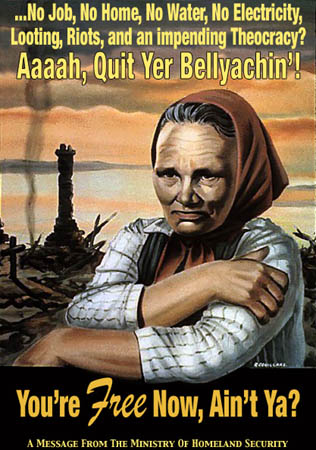 (Link to image courtesy of Three River Tech Review)
(The image is part of the brillant propaganda remix project of one Micah Wright. What a great homepage.)
As these advanced leaks indicate the question mark is over the UN. It is obligated to clean up the mess caused by the imperial presidency.
I concur with abu Aardvark on this. The UN proved its relevance by standing up to US pressure to invade Iraq. It increased its standing and reputation in world opinion that values values international co-operation.
Abu links to this interpretation of those events to justify the relevance of the United Nations.
As Juan Cole reports there was another bombing of the UN headquarters in Baghdad. He says that "the Sunni Arab nationalists just want to get the UN out, and to make the point to the UN that trying to rescue Bush in Iraq would be a very, very bad idea." And just to balance things consider this little snippet found by billmon about the conduct of US troops in Iraq. It does make you wonder about the US occupation doesn't it.
Juan helpfully provides a links to this academic research work on the roots of terrorism by US researchers as they respond to 9/11.
Posted by Gary Sauer-Thompson at 1:41 PM | Comments (0) | TrackBack
September 8, 2003
repairing bridges?
An article in The Australian Financial Review by Madeline Albright entitled 9/11:Two Years On is of interest over and above the defence of the Clinton administration's foreign policy to counter the Republican disdain for all things Clintonian. (If the AFR links go, then the article can be found here at Foreign Policy.)
A key point in this text is the way the view of the world structures choices in national security policy. The Bush administration has a simple view: it is America versus the international terrorists. In this view other nation-states are either with America or with the terrorists; America can go it alone in the fight against terrorism; the axis of evil has to be confronted; anticipatory self-defence is the cornerstone of national security policy; America would act against threats regardless of international law, the doubts of allies and world opinion. The pre-emptive strike doctrine was a replacement for international law.
This 'Bring them On' view of the world that is highly divisive. Australia may concur, but many nation states, especially those in Europe, do not see international relations the way Washington currently does.
Albright is critical of the French view that that the power of the US endangers the interests of European democracies, and hence there is a need for Europe to counter balance the hegemonic power of the US.
Albright's concern is with the shift by the Bush Administration from fighting al Qaeda in Afghanistan to invading Iraq. She says:
"The problem is that Bush has reframed his initial question. Instead of simply asking others to oppose al-Qaeda, he now asks them to oppose al-Qaeda, support the invasion of an Arab country and endorse the doctrine of pre-emption - all as part of a single package. Faced with this choice, many who staunchly oppose al-Qaeda have nevertheless decided that they do not want to be "with" the US, just as some Iraqis are now making clear their opposition both to Saddam and to those who freed them from him."
Iraq was a war of choice not necessity for the US. There was little to be gained by creating the impression that the US did not care what others think. Albright's concern is to narrow the divisions between the US and Europe.
How so? Albright says drop the demand that others follow where the US leads; focus more on al Qaeda; allow the doctrine of pre-emption to disappear quietly; separate out the problem of al Qaeda from halting the proliferation of WMD; become more serious about nation-building in Afghanistan; work with allies not against them.
Somehow I do not think that Bush will heed this advice judging by what I've heard Condaleeza Rice saying on Radio National this morning. Pacific Views says the speech is all about making sacrifices for freedom, defeating the enemies of freedom making their big stand in Iraq and doing whatever is necessary to achieve victory in the war on terrorism.
Iraq is the new frontier in the Hollywood view of things that is being articulated by President Bush.
A transcript of the Bush speech can be found here. It's about America fighting to defend the freedom of the civilized world with courage and confidence. America accepts the duties of to defend the civilized world. Opposing the terrorists must be the cause of the civilized world. So members of the United Nations have an opportunity and the responsibility to assume a broader role in assuring that Iraq becomes a free and democratic nation.
That is a bit of turn around. Is it genuinely repairing bridges?
Comments on the Bush speech can be at Road to Surfdom.
Posted by Gary Sauer-Thompson at 12:31 PM | Comments (0) | TrackBack
September 6, 2003
Iraq & US diplomacy
In the light of comments such as this on flawed US planning in Iraq, this article by James P Rubin in Foreign Affairs is very useful. The link is courtesy of Logjam over at High Desert Skeptic.
The article is a diplomatic postmortem that analyses the failure of US public diplomacy to persuade world opinion about the need to invade Iraq. Instead the neo-cons in the US infuriated world opinion, especially in Europe where France and Germany, were treated with disdain and contempt. Ruben puts it well:
"....most of the same countries that had backed the United States in Afghanistan bluntly opposed the campaign -- as, indeed, did most of the world. Washington's failure to muster international support to depose a despised dictator was a stunning diplomatic defeat -- a failure that has not only made it harder to attract foreign troop contributions to help stabilize post-Saddam Iraq, but will more generally damage U.S. foreign policy for years to come."
And Ruben asks the right questions:
"What went wrong? Why, when the leader of the free world went to war with a brutal and hated dictator, did so many countries refuse to take America's side? How much collateral damage was caused in the process? And what lessons can be learned from this debacle?
And he gives good answers:
"First, the fact that Washington's justification for war seemed to shift as occasion demanded led many outside observers to question the Bush administration's motives and to doubt it would ever accept Iraq's peaceful disarmament. Second, the United States failed to synchronize its military and diplomatic tracks. The deployment of American forces in the Middle East seemed to determine American policy, not the other way around, and diplomatic imperatives were given short shrift. Third, the failure to anticipate Saddam's decision to comply partially with UN demands proved disastrous to Washington's strategy. Fourth, the belated effort to achieve a second Security Council resolution could still have succeeded, had the United States been willing to compromise by extending the deadline by just a few weeks. But such a compromise was not forthcoming, which leads to the last lesson: the Bush administration's rhetoric and style alienated rather than persuaded key officials and foreign constituencies, especially in light of Washington's two-year history of scorn for international institutions and agreements."
The Howard Government in Australia turned a blind eye to all this. Its position was simple. The US was right. The critics were wrong. It says that it is all in the past---just so water under the bridge. The US was all powerful. It would destroy the ememies forces. No matter that the moral case was weak and the invasion failed to win legitimacy in the eyes of world opinion. To hell with world opinion. The Coalition of the Willing could stand alone in following the neo-cons unilateral strategy of hegemony and preemption.
Today things are looking so different. The US has big problems in Iraq. It cannot rebuild Iraq alone. It needs the UN. The Howard Government now supports the US as it seeks help from a UN for a multilateral force in Iraq. Was it not so long ago that both the US and Aust dismissed the UN with contempt? People will not forget that history, even if the Howard Government does.
As James Ruben says:
"...troops operating under a UN mandate are far less likely to be regarded as invaders by the local population. Had Washington considered the diplomatic consequences of war as carefully as the military components, much of the collateral damage could have been avoided."
Oh, and do take some time to read Logjam's High Desert Skeptic. It's a great weblog.
Posted by Gary Sauer-Thompson at 10:50 AM | Comments (0) | TrackBack
August 14, 2003
The West holding the line: two views
This post from yesterday was accidently deleted by me. I am reposting it with new material and have reworked it a bit. The comments on the original post have been lost.
Hugh White argues that Australia's foreign policy under John Howard is realistically based on its national interest and that it is conducted with prudence and restraint. White says that it has less "to do with following George Bush's lead around the world ...[and] much more about taking the lead ourselves in our own backyard."
Hugh White says that means:
"...there have always been clear limits to how far Howard has been willing to engage Australia in American global strategy. One demonstration of this has been in Asia itself, where Howard's consistent priority has been to build up Australia's relationship with China. This placed him at odds with many in the US, and especially in the Bush camp, who have seen China until recently as a strategic competitor."
So Howard, on White's interpretation is trying to reposition his country in terms of its national interest as best he can in the light of American global dominance. His key strategy priority is neither Asia nor America, but Australia's immediate neighbourhood.
I find this White's account of Australia as a regional power acceptable in contrast to the claim that Australia is a global power and that it should act globally. It is similar to Kim Beazley's account of a distinctive Australian approach to the region around us. It opens up for public policy discussion the question of well the Howard Government has prepared Australia for its new strategic role after Spetember 11. And this is what Kim Beazley does. He not only matches the government on national security, but he also criticizes the government for not doing enough to counter terrorism, boost our intelligence capacity and strengthen the defence forces. Very effective.
However, White's realistic account is not the only one on the table since we have a fluid situation in the making of Australia's foreign policy. Consider Tony Abbott's recent speech on the West holding the line against the Muslim world to the Centre of Independent Studies at the annual public policy conference or Consilium (it is listed under events).
A CIS consilium is the conservatives taking counsel with their associates in a group. It is closed to general citizens and the media but you get the sense that they reckon they are on the cusp of conservative intellectual renaissance.
So what are they saying? Abbott's speech provides a way for us ordinary citizens to glimpse inside the consilium. Why Abbott? Abbott is a Burkean conservative and he's known as a solid thinker who goes beyond the sneer of dismissal of a Tim Blair. So 'taking counsel as a group' means that Abbott phrases what he has to say in a common language.
This common language has three parts. Abbott's talk is premised on the clash of civilizations. I have previously argued that this underpins the conservative's understanding of the post 9/11 world. Abbott says:
"The hallmarks of Western Civilisation are scientific and cultural curiosity, belief in the equality of man, freedom under the law, and a sense that diversity is a potential source of strength not weakness. Unfortunately, what the contemporary West takes most pride in: pluralism, libertarianism, feminism and multiculturalism, is what much of the Muslim world most stridently rejects, even to the extent of cheering when passenger jets are flown into civilian skyscrapers."
The West must stand firm in the face of this challenge says Abbott:
"It's not enough for Western Civilisation to demonstrate its technological prowess, military strength and material abundance. It needs to show moral strength which even its critics can recognise and come to admire....The war on terrorism is not primarily a test of military technology or of social service delivery. It's a test of character."
How is the enemy defined by the conservatives? I suggest this account by Daniel Pipes constructs the picture of the enemy of western civilization.
In so arguing Abbott implies a unitary Western civilization, another key conservative theme. According to Abbott the Iraqi war showed a sharing of the burden of upholding common values. And:
"Historically, America, Britain and Australia's instinctive responses to foreign challenges are almost identical. A common language, similar cultures, entwined histories and countless personal links mean that there will be a tendency to think and act as one people rather than three countries."
This unitary theme of 'The West' is difficult to maintain given that historically, the West has often been historically characterised by discord, conflict and wars, not to mention the current fractures between America and the leading European nation states such as France and Germany? Abbott does not address this. So 'The West' refers to a particular interpretation of the West.
Abbott does address the divisions on the domestic front. It is here that the particular conservative definition of The West as a civilization is challenged and so have the conflict of the culture wars. Abbott refers to the "down with us" brigade--by which he means the cultural left, its political correctness and its negative historical narrative of the nation (as a people).
The cultural wars is the third key conservative theme. Abbott says that the influence of the 'down with us' groups in civil society has been marginalised because:
"...there is a new tendency to stress responsibilities over rights and unity over diversity.... The sensuality, licence and frivolity... is still on display but at least some countries have shown a newfound ability to call things by their true name and take commitments seriously...[and there is] a rediscovery of sterner and higher virtues... "
Its a bit thin. It begins with Edmund Burke and ends with T. S. Eliot. Unity is the overriding theme. It is unity at home (social stability) and abroad (the Anglo-American Coalition that pulls together.) The West holds the line through unity. That is the common language of the conservatives who cast themselves as the protectors of the nation in a terrifying and evil world.
What are we to make of it in terms of a different account of foreign policy to the one given by Hugh White above? In contrast to White's realist interpretation of Howard's foreign policy based on national interest, Abbott is all about culture and values. There is no mention of what Owen Harris addresses: namely, national self-interest, prudence and restraint, or Australian and the US national interests diverging. Harris, for instance, says that if there was conflict between China and Taiwan over the US military supporting Taiwan, and the US asked the Australian government for help, then we should say no. And say it firmly. If asked for a justification we would say that Taiwan is not like East Timor, and that Taiwan's independence vis-a-vis China has little to do with our national interest.
That example nicely highlights the constraints for the Howard Government's foreign policy: is it to be prudence and restraint in the national interest rather than tokenism? Or are we obliged to do the token number to cover the divergence between the national interest of the US and Australia? Or are we obligated to do the biddign of the US?
What Abbott's common culture and history account tacitly embraces the way the US turns the 'common character' of the US and Australia into Australia taking an international role. This is what is being argued by Richard Armitage, the US Deputy of State, (The Australian Financial Review, subscription required, 14 08 03, p.63) in a speech to the Asia Society in Sydney. Armitage says that Australia is a global power with a global role and global responsibilities. Thus the US and Australia stand together against the international terrorists and break new ground in freedom's defence. This is imperial conservatism that presumes the world is there for the US to remodel and redeem as it pleases.
That Washington Beltway “Hard Wilsonianism” is quite quite different from Hugh White's account. Since I much prefer White's account, I think we should tell Richard Armitage to get lost. We have no desire to coerce other peoples to be free. We should rip into him for telling Australian critics of the US
Posted by Gary Sauer-Thompson at 3:20 PM | Comments (0) | TrackBack
August 5, 2003
no nuances here
I noticed these remarks in The Australian's Scrapbook. It is unclear who is making the remarks about the emotionally-driven mob. So I traced the article by Ross Terrill to the Los Angeles Times
That makes it clear. It is Alexander Downer, Australia's Foreign Affairs Minister, who makes them whilst spelling out Australia's foreign policy to the Americans. The points Downer makes to Terrill are: that Australia rejects a purely regional role, since Australia's interests are global; that Canberra is willing to act unilaterally on occasion; that sovereignty in our view is not absolute, since acting for the benefit of humanity is more important; and that ultimate security against terrorism will come from the spread of democracy and freedom. It is pretty much an affirmation of the Anglo-American position that comes out of Washington these days.
Downer thinks that Australia should be a leader on the world stage. His dream of a powerful Australia interverning in the world as the deputy sheriff of the US is underpinned by an economy to make it happen.
According to Terrill the Howard Government faces opposition at home. Then the whole tone changes when the opposition is described. Thus:
'Professors and columnists accuse Howard of "military adventurism," "slavishness" toward Uncle Sam and moving toward "a repressive national-security state." These angry scribes disliked Howard before Iraq; now they hate him. They do so above all because he is close to Bush.'
Nothing there about the opposition having a different conception of Australia's foreign policy; that some of the assumptions of Howard's foreign policy may be questionable; or that the various ideas are being debated including a re-engagement with Indonesia. Nope. The critics views are reduced to hating John Howard.
Alexander Downer then makes explicit what is implicit in this text. He says:
"The left-wing intellectuals] are obsessed with anti-Americanism...It doesn't worry me, to tell you the truth. But if you're a policymaker, you have to think about consequences. What sort of world would we live in if the U.S. took the advice of the gratuitous left and said it would wash its hands and go back to an earlier tradition of isolation? What would happen to nuclear proliferation? The anti-American mob are emotionally driven, not intellectually driven."
That makes it pretty clear: it's anti-Americanism, isolationism, mob, emotionally-driven. It confirms the argument made on philosophy.com that conservatives have become anti-democratic; deeply anti-democratic.
How ironic. It was only yesterday that Tony Abbott, the Minister of Workplace Relations, was talking about civility as one of conservatism's most attractive features. That was part of his Foreward to David Flint's, Twilight of the Elites. If we accept Abbott's claim that conservatism champions traditional Australian values, then one of those traditional values is anti-democracy.
A key problem with the Howard/Downer view of international relations is the way it constructs the enemy as the Other. The other is based on a simple taxonomy that has been outlined over at EastSouthWestNorth:
'...the new script seems to that they must be foreign terrorists ....Within the reportoire of the United States, there seemed to be mainly three types of bogeymen:
(1) The communist 'red menace' in the domino theory, as in places like Russia, China, Korea, Laos, Cambodia, Vietnam, Grenada, Argentina, Chile, Cuba, Guatemala, El Salvador, Nicaragua, Venezuela ....
(2) Mad and/or evil leaders, as in Iran, Iraq, Libya, Panama, Venezuela, Yugoslavia, .[and North Korea].......
(3) American-haters, as in Al Qa'eda (as in "Why do they hate us? They hate our freedoms--our freedom of religion, our freedom of speech, our freedom to vote and assemble and disagree with each other.")'
You just need to replace 'communist' with 'international terrorists' to bring the script up to date. This enemy of Australia is supported by evil leaders (Saddam Hussein) and they are American haters. We need to limit our freedoms because the American haters are living inside inside Fortress Australia. What pops out is the new version of the reds under the bed.
What does it amount to? The subliminal level of the text arouses fears about the growth of Islamic extremism and terrorism; it connects this to Indonesia; then so constructs Indonesia as a potential threat to Australia. And they are on our doorstop. And if those who live in the dark under rocks become critical of the conservative government through the use of public reason, then that is UnAustralian.
There is a lack of nuance here in the neo-con political unconscious.
No need to worry says Anne Coulter. Conservatives don't need nuances. Its a liberal thing. They remember the time before angry barbarians threatened our national security. They have the moral clarity to punish outsiders who threaten our cherished Anglo-American worldview with savage terrorist attacks. Its all about loving Australia and kneecapping the left-liberal traitors who hate America. Conservatives have no need for nuance because they are right. (Another softer side of Anne Coulter can be found here.
That redescription of Coulter makes contact with the political unconcious embedded in Downer's text. You can see an analytic philosopher---an ex-Marxist---preparing the ground here. It is done through an argument about the moral failure of the left.
Posted by Gary Sauer-Thompson at 10:01 AM | Comments (2) | TrackBack
August 4, 2003
OZ Foregn Policy: Debate Continues

Kim Beazley, the former Federal ALP Opposition leader, intervened into the spluttering foreign policy debate late last week. His key argument is that Howard's foreign policy has damaged Australia. It is a different argument to the one put forward on these pages, that Australia foreign policy is too tied to supporting the US and that it is not independent enough. The above cartoon by
It's an important argument. It is a counter to the neo-con claim that a deep silence exists among Australia's Left cultural gatekeepers on the Howard-Downer success in achieving equal vigour in US and Asia relationships. The neo cons, such as Ross Terrill, argue that Australia's national interests are global and not bound by geography; that regionalism has faded within the past decade; that Australia's leadership steps in Asia are called "aggression" and "military adventurism" by the lefty gatekeepers; that the left are isolationists who hold that an inferior Australia is not worthy of a leadership role on the global stage; that the left's creative imagination holds that the Australian national security state is repressive.
Terrill basically argues that our future lays with the US because of the need to confront China by acting to maintain a balance of power equilibrium in the Asia-Pacific that "keeps in check a still-authoritarian China that may be tempted to substitute national glory for political liberalisation." A strong US presence in East Asia would forestall any danger of renewed China-Japan rivalry. Hence a balance of power equilbrium.
I will lay out Beazley's argument out so that we can still access it when the links to The Age go.
Beazley begins by acknowledging the strengths of political opponent--John Howard, the Australian PM. Beazley says:
"John Howard is a skilled political counterpuncher. Years in the business have taught him how to empathise with community fears, tweak them to advantage and rapidly produce apparent solutions that wrong-foot opponents."
Kim Beazley then acknowledges the threat to Australia's national security:
"We confront real problems in our region now characterised correctly as an "arc of instability" around our north. The al-Qaeda extreme Islamist campaign against our allies and us is serious, and is manifest in the South-East Asian region. The troubles with the regime in North Korea could produce outcomes that seriously damage the Australian economy and draw us into a fight."
So far this is common ground on which most of us stand:--the current consensus of public opinion, if you like. Beazley then highlights the flaw in John Howard's strategy:
"This Government's shrewd counterpunching has concealed an erratic course on foreign policy that has diminished, not eliminated, our effectiveness in the region within which we must secure our future."
He then makes two points to justify this claim. The first is about the losing the coherence of the structure of our defence forces through overachieving on the expeditionary side (eg., Iraq, Solomon Islands) and under-achieving on the organisation of our intelligence and policing responses, which are critical for addressing short-term problems.
The second and more substantive point is about the long-term strategy for all seasons in our relationships with our allies and the nations in this region. Beazley argues that Australia could, and should not, shift our burden onto other nations in the region:
"Australian security also [lies] in the goodwill of our neighbours; particularly those in South-East and East Asia, and that military and diplomatic policies should be combined to achieve this."
Beazley argues that Howard drew down on the good will in the region established by the Hawke/Keating Labor Government for short-term domestic political gain. Howard painted the ALP as soft on national security. Suddenly Beazley's tone changes:
"There was no flaw in the US-Australian relationship he [Howard] inherited, and yet he invented one. Straining for a demonstration effect, he temporarily damaged relations with China and, with his deputy sheriff notion, cast doubt over the independent bona fides we had established in South-East Asia. The domestic flirtation with Hansonism, the careless talk about pre-emption, the dismissal of the relevance of the South Pacific Forum, the casual acceptance of our exclusion from many of the emerging regional organisations, such as the ASEAN-plus-three group, would not have been so lightly done. There was a generous response from the Government to the Asian economic crisis, but it was accompanied in the bureaucracy and the body language of the Government by a certain "there, I told you so - they weren't worth much, anyway".
Howard has been using up Australia's good will in the South-east Asian region by turning his back on Asia. And that is crucial mistake because the region is vital to our national security. Our national security lies within Asia and the Pacific and not from it. Beazley puts it this way:
"Security within our region is everything to us. We have to again convince them that we matter. We need to convince them that our relationship with the US is valuable, not as our umbrella or as a statement about our difference, but as an opportunity for the region to have a further channel to the most powerful nation on earth."
Howard, in short, has neglected the nation states in our region. That neglect is costly because our national security depends on the good will of our neighbours.
Posted by Gary Sauer-Thompson at 12:17 PM | Comments (5) | TrackBack
July 31, 2003
Iraq: nice if this happened in OZ
Iraq does not figure on the Australian radar screen these days. When it does the level of debate in Australia is low as it remains caught up in the partisan polemics in which warriors yell at one another across the right/left divide. The lefty polemics do little more than demonize their opponents. This does not engage with individual positions or particular arguments. Likewise the righties. The characteristics of this culture are described by Joe Cambri in terms of "pettiness, snobbishness, selfishness, backstabbing — and even blacklisting. Perhaps worst of all, absolutely no sense of shame."
It is time to move on and do something different. How can this be done? The debate considered below is quite different from partisan polemics based on prejudice. I introduce it to show another way of debating.
On the one side of the debate we have Juan Cole. His position is:
"....I want the US to succeed in Iraq, just as I think all responsible Americans do. The war was not justifiable on grounds of an immediate threat to US security. But it still may have been a worthwhile enterprise if it really can break the logjam in the region created by authoritarianism, patrimonial cronyism, creaky national socialism in the economy, and political censorship and massive repression."
Juan says that success can be judged in terms of the:
"Iraqis replicating India's success in holding regular elections and in maintaining a relatively independent judiciary and press, they would pioneer a new way of being Arab and modern. (The earlier experiments with parliamentary governance of the 1920s, 30s and 40s were marred by the dominance of very large landlords, a class now largely gone, who did not permit genuine democracy).A little humility, [by the US] a little seeking of redemption, a little doing good for others. Those things could make a convincing rationale for the current project. But not a war on terrorism."
Unlike many Australians, Juan rightly acknowledges that the threat to the US (and Australia) by Saddam Hussen was not a sufficient justification for war. (The case is made with great clarity by George Paine over at Warblogging.com). Juan supported the war on Iraq because of the brutal way that Hussein regime treated the Shi'ites. The war is over and Juan now makes a case that rebuilding Iraq is a worthwhile enterprise.
This is a position one can engage with. Though I opposed Australia's involvement, (but understood that the US as a world power had geopolitical grounds for intevention) I too would like to see a free and democratic Iraq. There are positive signs. But I have great reservations that it will happen, because of incidents like this.
On the other side of the debate, we have Helena Cobban over at 'Just World News'. She engages with Juan by questioning the redemptionist undertone and asking him three questions. I will leave "redemptionist" undertone with its connection to guilt about past US betrayals to the Iraqi people---its a very American thing--- and turn to Helena's three questions. Helena says:
"So okay, here are some of my other questions for Cole:
He seems to be arguing that a state of affairs in which Iraqis can replicate India's success" would, for him, constitute a US "success" in Iraq. Does he have any reason to believe that that goal is the one that this US administration is actually pursuing there? In particular, does he have any reason to believe that the political empowerment of the Iraqis themselves is what the Bushites are aiming at?
How does he assess the considerable weight of counter-evidence that there is out there, regarding this administration's policies in Iraq, elsewhere in the Middle East (where "empowerment" of local pro-democracy forces seems nowhere to be on the effective agenda), or at home here in the US (ditto)?
Equally or even more importantly: How about the precedent set for Iraqis, for that 96 percent of the world's people who are not US citizens--and for the four percent of us who are US citizens-- if the US administration is seen as "successful" in imposing its will on the actions of a large and distant sovereign nation purely through the force of arms and the waging of a war that was quite unjustified by any criteria of "just war" or international law?"
These are good questions. Helen's first one puts the finger on an ambiguity. It is unclear whether the Bush Administration wants an independent democratic Iraq or a liberal Iraq that is a vassal state of the US. And the second one follows because the Bush Administration does appear to be limiting democracy to prevent the Shi'ite majority from forming a theocratic state. And the last question introduces the issue of breaking international law by the US's pre-emptive strike and the US then being seen to be imposing freedom by force.
Suddenly we are a long way from this polemical style of journalism. Though many journalists consider themselves to be little more than attack dogs, I suspect that many journalists do not know how to argue. Hence we can learn from how Juan responds to the questions.
Juan responds here by answering the questions in a way that enables a considered reply. On the first question he is clear about what is meant by 'success':
"...it is important that Iraqis aren't double-crossed yet again by the US. Americans, having caused the old order to collapse, have a responsibility to nurture a new one before they decamp. The new order should be a parliamentary democracy with an independent judiciary and press...It would be unfortunate if Iraq were just delivered to nouveau riche robber barons, as happened in post-Soviet Russia...It would be highly irresponsible for the US military simply to suddenly withdraw from the country at this juncture. I have called...for the US to get a UN mandate for its reconstruction efforts and to conduct them multilaterally."
Juan then says something that clears up my confusion and unease about the Bush Administration. He says the administration is divided on democracy. His judgement is that Bremer, Powell and Bush (but not Rumsfield and Wolfowitz) all favor Iraq having a parliamentary democracy in the short-term.
In responding to Helena's second question about the Bush administration limiting Iraqi democracy, Juan argues that the administration's Iraq policy represents a break with the past efforts to shore up regimes like the royal family in Saudi Arabia:
"The Washington elite has decided that those regimes are breeding Islamist terrorism that targets the US, and that they have to be reformed in the direction of parliamentary democracy...Of course, parliamentary governance can be more or less democratic. Domestically, the Bushies favor a form of it that melds it with plutocracy."
Okay. I can buy that. It makes sense of the Americans trying to limit democracy in Iraq. Juan then argues that the plutocrat card is a no goer in Iraq because there are no haute bourgeoisie and Iraq was a welfare state under Hussein. What then? Juan says that parliamentary governance is a good start, and it is a system that has the potential to become more democratic if the Iraqi's come to own it.
But will the Americans allow the Iraqi's to own it? I have my reservations on this.
In reponse to Helena's third question---about breaking international law through the use of a pre-emptive strike--- Juan says that:
"If the US acted illegally in international law, then the international community should punish it. (In fact, the refusal of India, Egypt, France and Germany to send troops despite US pleading is already a form of punishment). But the Iraqi people do not deserve to be punished, and the rebuilding of the country so that it ends up being a parliamentary democracy with a free press and an independent judiciary would be a good thing for Iraqis, the world, and even for the US."
I concur. It would be a good thing if the US helped the Iraqi's to build a democratic Iraq. It is a much better model that US occupation or Iraq being a vassal state of the US empire.
So what we have here are reasonable responses to good questions that allows for further responses. It is a pity we cannot conduct a debate like this in Australia. Though some journalists do not know how to argue, I suspect that many journalists have no intention of doing so. They see themselves as the attack dogs in the culture wars. Destroying the enemy is the reason they write.
Update
This piece by Michele Costello is about the best you get in Australia. What does it say? That democracy is hard and that the US is achieving some successes. Why bother to write if that is all you've got to say?
Posted by Gary Sauer-Thompson at 10:03 AM | Comments (1) | TrackBack
July 30, 2003
lurching to a Mad Max world
I mentioned earlier that there has been little debate over the changes to Australia's foreign policy by the Howard Government.
One of the issues that has been raised is imperial overreach with the US donning the mantle of empire and running the world from Washington. Paul Kelly had mentioned three lines of criticism that had been made of the Bush administration's geopolitical strategy: its aggression provokes rogue states; it exaggerates what the US can achieve alone; and it downplays the importance of winning the battle of ideas.
Paul Keating, the former Australian Prime Minister, takes the imperial overreach in an article in the Australian Financial Review (subscription required, 29 July, p. 55) He addresses the unilateral American policy, which he says rejects any notion of co-operation and eschews resort to multilaterial frameworks. Keating is a liberal internationalist who hold that the world should be run co-operatively, and so he is critical of the unilateralism, the pre-emptive first strike doctrine and the militarism of US foreign policy.
Keating's criticisms are directed at the consequences of this foreign policy. He says:
"The really bad news in all of this is that by walking away from multilateral arrangements, such as the Comprehensive Test Ban Treaty, and the anti-Ballistic Missile Treaty, and by their failure to live up to commitments made under the Non-Proliferation Treaty the Americans have given a signal to the rest of the world that they, too, can be part of a resumed nuclear arms race."
Keating then argues that others have taken this message to heart.
"Believe you me, this has well and truly begun. Not just in India or Pakistan, or Iran and North Korea or even Israel, but in lesser states which believe they need their pocket nuke to make the world deal with them respectively. I hope the Americans have not lead us into a Mad Max world--while they seek to shield themselves in the cocoon of national missile defence."
The Mad Max image is an appopriate one to express our fears and anxieties.
The other line of debate has been about the independence of Australia's foreign policy. Ross Garnet had argued that the new interpretation of the US alliance under the ANZUS Treaty, which represents a shift from the regional to the global, seems to allow no room for independent judgment. Garnett then illustrates what he means:
"This could have fateful consequences. At the Australia-US Leadership Dialogue in Sydney in 1999, Armitage, then a foreign policy adviser to candidate Bush, challenged the Australians present by asking whether they were "ready" for war with China. War may be necessary under a Bush administration, he advised, to secure Taiwan's interests in the event of conflict with the mainland. Some Australians present responded that they were not ready. Australia's response should depend on the circumstances that give rise to war."
Observa, in commenting on the earlier the lie of the land post, argued that by breaking with the previous Keating Government's multilateral foreign policy the Howard Government had shown independence. He says:
"Now you might criticise the policy of Howard, but it could well be said that it is the most in your face, like it or lump it foreign policy stance in decades. Perhaps this is a sign of maturity in Australian foreign policy now. We are not afraid to offend some countries in order to do what we think is right. That may be a sign of true independence."
So we have a tough, no nonsense foreign policy whilst we all lurch to a Mad Max world.
Posted by Gary Sauer-Thompson at 12:10 PM | Comments (0) | TrackBack
July 27, 2003
Another nail in the coffin
Here is another plank in the case against war with Iraq falling apart. This time it is the non-existence of the key link between Iraq and Al Qaeda that turned the possession of WMD by Iraq into an imminent threat against the US, the UK and Australia.
The Full Congressional September 11 report is here The summary of the findings and conclusions can be found here. Se this report from the New York Times the deletions about the involvement in Saudi Arabia in 9/11.
George Paine over at Warblogger.com has a good coverage on this for the US.
The public policy implication is the need to curb the power of political advisors, such as Tony Blair's Alastair Campbell. In Australia the power of ministerial advisors also need to be curbed. There is a Senate inquiry into Members of Parliament Staff going on at the moment.
In reporting on the submissions Tony Harris, in The Australian Financial Review (subscription required, July 22, p. 54), argues that curbing the power of Ministerial staff by setting limits to their power, making them accountable to Parliament and citizens, setting out expectations of their behavour through a legislated code of conduct, and mechanisms of reinforcement.
It is the Ministerial staff who distorted the intelligence to justify Australia's involvement in the Iraq war. And they continue to avoid accountability. As Harry Evans, the Clerk of the Senate observes in his submisison to the above inquiry:
"The role of ministerial personal staff in theory, if there is a theory, is that of advisers, assistants and agents of their employing minister. This theory has long been belied by the reality. Their role has long gone beyond advice and personal assistance. As active participants in the political process, they can:
control access to ministers;
determine the information which reaches ministers, particularly from departments and agencies;
control contact between ministers and other ministers, other members of the Parliament and departments and agencies;
make decisions on behalf of ministers;
give directions about government activities, including directions to departments and agencies;
manage media perceptions and reporting."
As Harry Evans points out, the politically partisan Ministerial staff can interpret the above functions along the following lines:
'ensure that those who would tell ministers what they do not want to know do not have access;
provide “deniability” by ensuring that ministers can profess ignorance of information which becomes politically inconvenient to know;
ensure that persons out of favour for political reasons are denied contact, and those in favour are provided with contact;
provide “deniability” for decisions which ministers may claim not to have made themselves;
browbeat and intimidate public servants to ensure that public service performance accords with political objectives;
put out misinformation and partial and selected information to ensure that the “right story” is reported, and ensure that journalists who recount the “right story” are favoured with further information, while those who do not are punished with lack of information.'
Neither Liberal nor Labor are willing to change the situation by making Ministerial advisors more accountable to Parliament. They both like this weapon of executive dominance. They have no intention of curbing the power that is currently played by the highly partisan and politically active "junk-yard attack dogs" on the Minister's staff. They are to useful since they are able and willing to do anything to assist the political cause of their minister and the government.
Posted by Gary Sauer-Thompson at 12:49 PM | Comments (0) | TrackBack
July 16, 2003
swings and roundabouts
North Korea has more relevance to Australia's long term strategic interests than Iraq ever did. It is all about ensuring regional stability and the balance of power by preventing civil war on the Korean Peninsula and ensuring that Japan and China are not threatened.
First we had the tough talk on the "rogue" North Korea about the possibility of nuclear war and military intervention; then the backpedalling by Alexander Downer when a North Korean spokesperson said if you bring the interdiction on we'll nuke ya; today the Iraqi-style war rhetoric has been replaced by the diplomacy through China and the despised United Nations.
In the backdown Alexander Downer, the gungho warrior posing as a diplomat, was reported as saying on Melbourne radio station 3AW that:
"We don't believe for a minute North Korea would launch some kind of nuclear attack against Australia, or have the capacity to fire nuclear missiles that sort of distance... "That's if they have any capacity to fire nuclear missiles at all."
Meanwhile in the US the war talk is about the US and North Korea drifting towards war, with an imminent danger of nuclear explosions in American cities.
Another tangled web is being woven, even if one agrees with Hugh White's argumentthat "Australia is right to support American plans for international co-operation to intercept exports of weapons of mass destruction."
I heard the American Ambassador on Radio National this morning stirring the fear factor by saying that Australia is threatened by missiles from North Korea.
This is more than the Howard Government being all over the place in their rhetoric. Blowing hot and cold on war is a familar pattern from Iraq to create the new bogeyman to shape public opinion.
Underneath the twists and turns the neo-con strategy is to allow provocative actions by US forces to destabilise and topple the dictatorial regime of Kim Jong-il. It is deploying aggressive military tactics to back the regime into a corner. Its the first steps in the new doctrine of pre-emptive strategy in which the US will respond to a belief that its security may be under threat.
"Belief" and "may be" are pretty vague terms, so the spin doctors create the image of the world beign a very dangerous place. So they talk in terms of rogue states, invading missiles, imminent threat, nuclear war for domestic consumption, security umbrellas, and ballistic missile defence programmes. On the domestic front the strategy is one of using national security issues to out manoeuvre their political opponents.
Posted by Gary Sauer-Thompson at 11:59 AM | Comments (1) | TrackBack
July 15, 2003
Foreign policy matters
Margo Kingston has posted an article from Geoffrey Barker from the Australian Financial Review, called Let loose the dogs of war on her Webdiary. (Scroll down the page).
Barker opens with this:
"Australia under the Howard government is drifting dangerously towards aggressive military adventurism and the establishment of a repressive national-security state."
I think so too. It is what this weblog has been arguing. Barker continues:
"The most dramatic manifestation of this trend is the federal government's enthusiasm for military deployments to meet what it perceives as its obligations under the US alliance and to deal with regional and domestic security issues."
Spot on. There has been a fundamental rupture with the foreign policy of the past. It is a retreat from Australia's commitment to multilateral diplomacy, international law and working through the UN. It is a turn to joining coalitions of like-minded nations willing to fight to achieve outcomes with or without UN backing.
As Hilary Charlesworth observes such a policy "asserts the right to intervene in other countries on the basis of Australia's own assessment of its national interest, and rejects the constraints of the collective views of the international community."
It's might equals right. As Scott Burchill notes Bush, Blair and Howard decided to invade Iraq then hunted around for the justifications:
"Bush, Blair and Howard assembled arguments to support a case for war after they had decided to attack Iraq. They did not arrive at a conclusion after a judicious evaluation of the evidence. Like barristers, they selected and highlighted material favourable to their argument and ignored anything that undermined it."
The justifications selected were the ones most likely to persuade public opinion and they were ones based on arousing fear.
Barker then introduces a new theme. He says:
"Most disturbingly the drift is occurring with little comment, little debate and apparently unconstrained by the countervailing pressures that limit policy extremes in fully functional liberal democracies."
No doubt about it. Few care about foreign policy in Australia. And you can see what passes for debate here. with Piers Ackerman 's response to Malcom Fraser's criticism of the Howard Government's foreign policy. And you don't hear much from the academics.
Barker finishes on this note:
"With independent public service advice compromised, academic criticism muted and much media inquiry limited, the Howard government's remaking of military and human-rights policy is a cause for grave democratic concern."
And few seem to be guarding democracy.
Posted by Gary Sauer-Thompson at 7:41 PM | Comments (0) | TrackBack
July 14, 2003
hard not to agree
In this article the ex-Liberal Prime Minister Malcom Fraser addresses some concerns raised at public opinion. Addressing the David Hicks case (ie; the detention and military trial in the US of the alleged al-Qaeda member David Hicks, who is an Australian citizen) Fraser says:
"It is clear the Australian Government has determined that Australia's interests will be best served by avoiding any argument with the US and supporting its policy. This change in Australian foreign policy is even more fundamental than the Government's announcements some weeks ago would indicate. They go to the heart of what we are about as an independent nation. They raise more starkly than ever the question of identity and purpose."
He then asks:
"Are we indeed able to stand for Australians who may need the protection of their nationality?"
And he answers:
"The present answer is clear. Not if such actions cut across relations with the US. Some would believe that we are now a completely subservient ally. It is time Australians started to ask what additional interests are we going to forsake in our support of this current American administration."
Clearly and rightly spoken. Why? Fraser is very clear:
"Great powers have a history of pursuing their own interests to the exclusion even of the interests of states that have been close friends and allies... I do not believe that America, however benign the exercise of its current power, would necessarily use that power for Australia's protection. It has, in fact, become a fundamentalist regime believing fervently that what it judges to be right, is in fact right, and that others do not have anything much worthwhile to contribute. Such an America will not make friends."
It is hard not to agree with Malcolm Fraser on this. I can't wait for the attack dogs to snarl and snap.
Update
One attack dog has come forth. Piers Ackerman from the Daily Telegraph. Its quality work, as we have come to expect from Piers.
Ackerman sets the scene with a personal attack on Fraser. Thus
Fraser lost his trousers in questionable circumstances in a sleazy Memphis hotel; is a discredited figures of no standing who champions intellectually meagre views and has predictable opinions. Fraser "regresses into a state of immaturity where hysterical criticism and an irrational apportioning of blame is offered as an excuse for reasoned argument."
Then we engage with Fraser's argument. Ackerman describes it as the view 'that the Howard Government is endangering the integrity and independence of Australia's foreign policy by making the nation a "completely subservient ally" of the US.'
Then we have the "knockout" punch. Ackerman says that Fraser's remarks seem exceptionally stupid. Why? Because completing the negotiation of a free trade agreement with the US would guarantee the economic stability of Australia well into this century.
After considering Fraser's argument that Australia is losing friends in Asia under the Howard Government, Ackerman comes back to the personal abuse to wind up the attack. Thus:
Fraser "clearly carries a huge grudge against Mr Howard"; Fraser "has always held an exalted view of his own abilities and place in society";and the "world in which he was a figure of some importance has passed him by leaving nothing but an image of a bitter, ageing trouserless figure wandering in the dark."
Apart from one killer line about Free Trade Agreement "refuting" the subservience to US argument the article consists of paragraphs of personal abuse.
Thats conservative journalism. It is not an example of reasoned argument, which is the criterion Ackerman uses to judge Fraser's remarks.
Posted by Gary Sauer-Thompson at 11:43 AM | Comments (1) | TrackBack
July 13, 2003
Trying to implode North Korea
This old article from the Japan Times makes two interesting comments in the light of the Howard Government saying that a planned international operation to intercept its vessels could be a precursor to "other action" against the rogue state. This opens up the option of Australia going to war against North Korea.
The first comment is that North Korea is not as much of a military threat as the hawks have made out. It military machine has pretty rudimentary training. It is unlikely the regime has a large arsenal of usable modern missiles that are capable of presenting a long-term threat to regional peace.
And the second comment is that the aim of the hardline, neo-con strategy (that Australia has just signed up to) is to implode North Korea. The result would that the North Korean people would starve to death. But it would also achieve the required regime change.
Japan is quite nervous about the trip wire strategy. Reasonably so.
It seems to me that economic aid is what is required, coupled with dialogue and economic development. It is better than beating the war drum in response to North Korea playing the nuclear card for international assistance.
Update
As Glen Milne asks:
"What's wrong with North Korea's offer to de-nuclearise in return for US guarantees of its sovereignty? Why is Australia supporting Washington's refusal for bilateral talks aimed at defusing the growing crisis in the Korean peninsular?"
Reasonable questions.
Beating the war drum on North Korea by the Howard Government involves raising the spectre of nuclear war. The spin is to let Australians know that in Howard's judgment, nuclear war in our region may happen, and that Australia may be involved. The ante on the 'world is a dangerous place' script for domestic politics keeps on getting raised. Nuclear war is a long way from Tampa.
Posted by Gary Sauer-Thompson at 10:51 PM | Comments (1) | TrackBack
July 12, 2003
Yet another war to fight
Its like a rerun off an old movie. Alexander Downer has begun to make the case for Australia's next war as Australia joined up to a US-led plan to intercept North Korean ships and aircraft suspected of trafficking in weapons of mass destruction in international waters. Urgent action is necessary against the menace of maverick states.
And the menace? There is a beat up about North Korean nuke missiles falling on Darwin or Cairns. The very possibility is enough for Australia to agree to the US plan to stop North Korean ships and planes carrying nukes, missiles, drugs with military force.
With Downer and Howard we have a new foreign policy based on overt hostility as a response to security threats. It is one that works outside the UN and as it premised on a dismissal of the UN. And the security threat to Australia? Here is Downer:
"We need to send an unambigous message to proliferators: acquiring and pursuing weapons of mass destruction violates basic standards of responsible international behavior and will not be tolerated. We have a shared responsibility to hold cheats to account."
(no link AFR, July12-13, 2003, p. 48)
There needs to be a qualifier here. Downer's 'we' is the interantional community. However, it is 'basic standards of responsible international behaviour' as interpreted by the US. After all there is no suggestion of holding Israel to account. Or Pakistan or India.
Downer's statement, that the "international community must work together to reinforce adherence to non-proliferation norms---take firm action to counter proliferation whenever and wherever it ocurs" has to be taken with a grain of salt.
Would not North Korea see the blockade of its ships on the high seas and the forcing down of aircraft in airspace as a threat to its national sovereignty? I cannot see Japan, South Korea and China going along with this military adventurism. (subscription required, AFR)
No matter. Australia's security interests are now identical with those of the US. Australia's participation in US military operations around the globe is the price Australia must pay to preserve the US alliance. Australia now sings Washington's tune. So we have to expect lots more song on the airwaves about needing to protect Australia from missiles with nuke warheads. The chorus will be about the missiles falling on us coming from northern Asia.
Posted by Gary Sauer-Thompson at 4:39 PM | Comments (0) | TrackBack
a bit of a vacuum
This old article is quite interesting. It says that Liberals are not really interested in the world outside the US, but conservatives are. Michael Totten says:
"It's easy to find writers on both the left and the right who lack historical knowledge. But I find this far more often on the left. This is not a partisan point I'm making. I've been on the left forever, and I have no reason whatever to shill for the right."
However, Totten says that in the US liberal intellectuals are less interested in the history of foreign countries than conservatives are. My interest is not the US but Australia.
Its all a bit different here. There is hardly any interest at all in foreign countries----not even in the Middle East where we went to war twice. We are happy to have events there refracted through the American media. There is little to no concern about the history of the different nations in the region.
In Australia Liberals are basically idealists. They believe in international law and the United Nations. Conservatives are generally realists and so foreign policy is to further the national interest.
So what is the national interest? Conservatives go vague, apart from muttering something about national security. Consider the Iraq war. It was held that we supported the US because it was in the national interest to do so. And the national interest was what? What were we defending considering Iraq did not pose enough of a significant threat to Australia for us to invade the country?
Silence. There things pretty much end. Polemics then generally start in terms of good and bad with the old appeasment/hairy chested script that is rolled out to cover up the emptiness of "the national interest."
So let us probe a bit. How about the Solomon Islands? For instance, why are we intervening in the Solomon Islands? Conservatives would answer that we did so because of national security reasons. It sounds good. Nice and strong.
So what is Australia's national interest then?
Well the Solomon Islands is a failed state. Criminal gangs are rampaging out of control on the Solomon Islands.
How does that affect Australia's national security?
Well, you know........its aaah unstable there. There have been years of ethnic violence leading to a state of lawlessness.
Why is that is bad for Australia?
You know, it's got to do with international terrorism. The intervention is related to the war on terrorism or the invasion of Iraq. Its all the one and the same.
How come?
Well, failed states are a haven for international terrorists are they not?
You mean Muslem fundamentalists, such as Jemaah Islamiah? Is there any evidence of these setting up a base in the Solomon Islands to justify a pre-emptive action?
It is bad for Australia because it upsets the balance of power.The Islamic fascists reject out of hand a secular liberal state in favour of a Islamic theocracy, just like Iran.
What's wrong with upsetting the balance of power?
Stability from balanced relations between the great powers is good. It cannot be achieved through the pursuit of dominance.
Is not Australia acting as the dominant power by acting as regional cop?
It is necessary because the Solomon Islands is a failed state.
It is an imaginary conversation that goes around in circles. The reality is that foreign policy in Australia only gets talked discussed when it is personalised. See the excellent post by Gummo Trotsky on this. Apart from the personalization foreign policy is seen in the simple terms of fighting the good fight in the war against international terrorism. That has become the prism through which everything is now viewd.
Is it possible to give a different account of the national interest? Is not Australia acting offensively to gain regional hegemony and to eliminate the possibility of regional imbalancing? Is it not taking action in the region to counter Chinese power in Oceania? China is becoming a major Asia-Pacific power. So is not Australia acting more as the deputy sheriff of the US in Oceania, and less as an independent power with an independent foreign policy?
Is that not what Howard's close embrace of the US as the hegemonic power really implies? If so then we can ask: whose national interests is the Howard Government serving?
Posted by Gary Sauer-Thompson at 12:19 AM | Comments (3) | TrackBack
July 9, 2003
a different voice
This is the voice of American paleoconservatism. It is Pat Buchanan from The American Conservative. The full article is here. I have linked to this article before
Not how different this voice is from Australian conservatism. Buchanan says:
"Iraq, in retrospect, was no threat whatsoever to the US. We fought an unnecessary war, and now we must rebuild a nation at a rising cost in blood and treasure."
You do not hear Australian conservatives saying that. They do not say that Iraq, in retrospect, was no threat whatsoever to Australia. You do not hear them questioning the US engaging in an imperial war.
In contrast to Buchanan, Australian conservatives are happy for Australia to go along with whatever the US does. The US policy in Iraq is Australia. The US policy on North Korea is also that of Australia. There is little questioning by Australian conservatives of the Howard Government's embrace of US neo-con strategies as their own.
Posted by Gary Sauer-Thompson at 9:57 AM | Comments (5) | TrackBack
July 8, 2003
Strategic shifts in OZ foreign policy
This article by Paul Kelly is good. It is a lot better than the US conservative junk now floating through our media circuits.
Kelly successfully outlines the shift in Australia's foreign policy under John Howard. Kelly argues that Howard has reshaped Australia's role in the world and done so in opposition to the orthodoxy and conventional wisdom of the foreign policy establishment.
Public opinion has worked from this tradition in its criticisms of the new foreign policydeveloped by Howard. I will summarize Kelly's argument.
Kelly says that orthodoxy, which was built over 50 years, was about Australian independence. It broke with the old 'All the Way with the USA" of the 1950s and 1960s. What Kelly calls the foreign policy orthodoxy defined the conditions of Australian independence.
"Our independence was linked with three big ideas: a successful engagement with Asia, a constructive role as multilateralist middle power and less dependence than before on our great and powerful friends."
This was then unpacked in the following way. Engagement with Asia, which was seen as integral to Australia's rise to maturity as a nation state, stood for a:
"...reformed and open national economy, the need for a liberalising multilateral global trade system and a comprehensive integration between Australia and its region. It was a path to prosperity and a new destiny."
A constructive role as multilateralist middle power was developed in terms of a bilateral security agreement with Indonesia that was seen as a statement of shared interests and political trust. As Paul Keating put it, 'Australia now sought its security "in Asia, not from Asia".'
And less dependence than before on our great and powerful friends meant displacing the US alliance as the priority in Australian polity in favour of backing the UN, not the US in the name of protecting the international rule of law.
Kelly then says the Hawke-Keating-Beazley strategy in the 1980s and 1990s was to exploit the alliance to promote an independent Australia, and "realise our goals of defence self-reliance, global free trade and regional engagement." Australia's foreign policy "was no longer to be shaped by US imperatives or its world view."
Howard rejected this strategic shift under The Australian Labor Party. As Kelly said Howard did so instinctively. He
".. excused [the paleoconservatism of] Hansonism, endorsed the deputy sheriff [of the US] line, implied he would pre-empt threats within the region and presented as an Anglo-Saxon cultural champion."
But then 9/11 came. Howard accepted the US position that the world had changed. Howard's response to September 11, 2001 was to state:
"... that it was equivalent to an attack on Australia. How could this be? Simple – because we shared the same values. So, like the US, we were at war."
Howard's strategic shift highlights Australia's cultural distance from Asia and our cultural unity with the US and Britain; rejects Australia's economic future lies solely or even largely in Asian terms and so undermines the multilateral system in support of a bilateral deal with Bush; and sides with the US over the UN.
And the criticism that public opinion has developed of Howard's strategic shift? Like the orthodox foreign policy establishment, it holds that the Bush administration's geopolitical strategy is to reshape the world to its own advantage. Howard, by following Bush under the cover of fighting world terrorism, will leave Australia exposed and vulnerable in the Asian region.
Posted by Gary Sauer-Thompson at 1:00 PM | Comments (0) | TrackBack
July 2, 2003
Foreign Policy in the Age of Terrorism
This is the text of John Howard's foreign policy speech that was given to the Sydney Institute last night.
Here is the big picture. What Howard says does nothing to challenge the concern that Australia has become Washington's stalking horse. His speech reinforces it.
A key theme of the PM's speech was that we in Australia are faced with a shadowy enemy who is everywhere and nowhere.
"Today the most fundamental challenge facing Australia and the world at large - especially those like us who value openness, who value freedom – is how to protect our citizens and our society from a shadowy enemy, who is closed to negotiation, who has no fixed base and no transparent political structure."
The enemy is identified by the PM as "those who seek to destroy and debase our way of life – the global terrorists and the transnational criminals who capitalise on human misery, trading in people, drugs and weapons."
The enemy of Australia seeks haven in rogue and failed states. These "become the base from which terrorists and transnational criminals organise their operations, train their recruits and manage their finances. If we want to be secure, we need to work with other nations to ensure collective stability. And sometimes we will be called upon to take action."
How does Australia do that?
"In this ‘age of terrorism’ it is essential in our national interest that we further build and strengthen Australia’s links with all the major centres of global power and influence. Achieving this will be greatly aided by the unique intersection of history, geography and culture occupied by Australia."
Howard is with the USA. He turns away from the UN in favour of being loyal to,and dependent upon, the USA as global cop. We back the global cop up and as a deputy cop in the Asia Pacific region defending the security concerns of the national interest.
Why these security concerns? Presumably, we defend Australia because Australia is worth defending. Why? Because Australia stands for openess and freedom in the international order. Thus the security concerns are the core of national puposes defined in terms of promoting openness and freedom.
Openness? Why if you criticise this account of our foreign policy because it means following the US wherever it takes us (eg.,the United Nations, the Israel-Palestine conflict, the Anti Ballistic Missile treaty, Kyoto, strategic pre-emption etc), you are said to be anti-American.
Freedom? Sorry. That has to be curtailed to ensure security at home from eunseen shadowy enemy within.
Posted by Gary Sauer-Thompson at 2:44 PM | Comments (2) | TrackBack
June 24, 2003
Foreign policy: Realists v Idealists
This may help with the spluttering debate about Australia's foreign policy.You need to scroll down the right side of the page to the Symposium on Advancing the National Interest and then to 'Looking for Theory in Australian Foreign Policy' by Rawdon Dalrymple.
His main thesis is that:
"Differences between the conservative Coalition and Labor sides on foreign policy up to 1983 corresponded broadly to the differences in international relations (IR) theory between ‘realism’ and ‘idealism’."
On the conservative side politicans, such as Menzies:
"...understood international relations as a matter of interests and power. Australia had a small population and little direct power, so it needed to attach itself to ‘great and powerful friends’. This accords generally with ‘classical’ realism as enunciated by Morgenthau (1948), Carr (1939), and others. Australian conservatives distrusted — indeed privately rather scorned — the moralism and legalism of international idealism."
On the Labor side politicians such as Whitlam:
"....stressed Australia’s independent role in the world under his government, his attachment to the United Nations and to the peaceful resolution of conflict, to détente, and so on. His own agenda was broadly idealist and multilateralist.... Whitlam had reoriented Australian policy towards the moral and legal principles that had such easy currency in the United Nations."
What the article argues is that the conflict between the conservative and Labor sides of Australian politics embody two contrasting views of how Australian foreign policy should be shaped. These views are derived from two contrasting philosophies of how nation states do and should operate:
"On one hand is the theory that there are universal moral imperatives and laws of nations that all nations should follow to produce and maintain peace and progress. On the other there is the theory that interests will always compete in the international system and that strong states will always seek supremacy so that they can advance their interests. On this view, the only way to achieve stability is by maintaining a balance of power so that no one state or group of states is tempted to seek to advance its interests by imposing its will on others by force or the threat of force."
It makes sense to me. Howard remains firmly in the realist mould, a Menzies conservative in foreign policy. He also accepts Huntington's idea of a clash of civilisations as an account of Australia’s place in the world. This places Australia on US/UK side of the fault line in the world’s geopolitics. It places increasing emphasis on alliance with ‘great and powerful friends’ at a time of rising global uncertainty and insecurity from international terrorism.
The ALP cotinues to work within the idealist mould as it push us towards increasing efforts to strengthen multilateral mechanisms for underpinning security — the United Nations and arrangements with our Asian neighbours.
Public opinion accepts the realist account of the workings of international relations but considers the UN to be a counterbalance to US hegemony.
Posted by Gary Sauer-Thompson at 12:17 AM | Comments (2) | TrackBack
June 12, 2003
the mask of naivety
I haven't read much of the work of Pamela Bone, an associate editor of The Age. For some reason they never caught my eye. But this piece needs a response. Pamela Bone says:
"Thomas L. Friedman is right. The humanitarian reason was the one on which the war coalition should have relied. Indeed, in not relying on it they probably underestimated their publics. Many people who initially opposed the war simply did not know the extent of the atrocities carried out by Saddam's regime. Now, as the stories of torture and disappearances are told, as the graves of thousands of executed Iraqi people are found, everyone does know."
The humanitiarian reason for invasion wasn't the reason for the US invasion because the primary reason was, and still is, about global power: US power in the Middle East. It is global power that is now being expressed in terms of empire.
And the left did not take the high moral ground. Some sections of the left, including public opinion, took the position that that Australia had no geo-political reason for invading Iraq. The grounds or reason for this position was that the repressive dictatorship in Irag (however bad) represented no threat to Australia's national interest. So there was no reason to invade the country. Australia did so to pay a premium on an insurance policy--- for future US backing for Australia's pre-emptive action in its own region.
Check this piece out by Peter Cosgrove, wgho is in charge of Australia's defence forces. Cosgrove's text talks the language of national interest and so highlights the humanitiarian mask that is so lightly worn by our federal politicians.
That national interest argument was never really addressed, nor even engaged with. And it is still not addressed by Pamela Bone. It is as if geo-political national interest concerns are too grubby to address.
update
This article, which tackles Thomas Friedman is courtesy of Glenn. It is by Martin Shields who says:
"In a democracy, the informed consent of the people depends upon citizens' free access to the truth. If Friedman is right that the administration's weapons of mass destruction "imminent threat" was primarily a political cover story, then Americans were urged to make the most solemn of all judgments -- the decision to go to war -- primarily for reasons more synthetic than authentic. Now, after the fact, supporters of the pre-emptive war argue that it is OK if even for demonstrably wrong reasons the United States did the "right" thing.
As the duplicity and deception of Vietnam and Watergate remind us, the credibility of an American leader is indeed perishable. A leader who misleads his countrymen reaps the whirlwind. The leader's punishment is the people's mistrust. Mistrust breeds cynicism; cynicism breeds alienation. That could harm the United States more gravely than any "unmanned aerial vehicles" from Baghdad."
This issue is what Pamela Bone misses.
Posted by Gary Sauer-Thompson at 11:26 AM | Comments (3) | TrackBack
June 8, 2003
the pressure builds
The 'where are the Iraqi weapons of mass destruction?' issue continues to build as a political issue. For the UK see here, and here and here.
In the US the New York Times says:
"The urgent need to disarm Saddam Hussein was the primary reason invoked for going to war in March rather than waiting to see if weapons inspectors could bring Iraq's chemical, biological and nuclear weapons programs under control.It would still be premature to conclude that Iraq abandoned its efforts to manufacture and stockpile unconventional arms after the first Persian Gulf war in 1991. But after weeks of futile searching by American teams, it seems clear that Iraq was not bristling with horrific arms and that chemical and biological weapons were not readily available to frontline Iraqi forces."
True, this is a liberal newspaper and so it is hostile to the Bush administration. But US creditability is at stake. The NY Times again:
"The issue goes to the heart of American leadership. Mr. Bush's belief that the United States has the right to use force against nations that it believes may threaten American security is based on the assumption that Washington can make accurate judgments about how serious such a danger is. If the intelligence is wrong, or the government distorts it, the United States will squander its credibility. Even worse, it will lose the ability to rally the world, and the American people, to the defense of the country when real threats materialize."
That the creditibility of the US is at stake is denied here by Gary Schmitt, the executive director of the Project for the New American Century.
Cooking the intelligence is not an issue here in Australia. But it is in the region, given the way that Australia has identified itself as a part of the USA. John Howard gloses over the gap when he says:
"Australia must inevitably find its destiny with a series of partners and friends rather than one single relationship. And close though our relationship with the United States is, important though it is, based on the common values that it is, it is not the only relationship that Australia needs or will have for her economic future."
The Iraq problem is not a creditibility issue in domestic sense----in the sense of a hollowing out of trust between the governed and govenors----in Australia. But it may well be regionally. The scenario of Australia's common values with the US means that Australia has uncommon values with our near Asian neighbours. Uncommon means hostile in the sense of a clash of civilizations.
Posted by Gary Sauer-Thompson at 4:29 PM | Comments (3) | TrackBack
June 5, 2003
definitely not for us
Judging by this report Tony Blair has big problems with Europe. Britain, after all is an island nation, which one had an empire and fought many a long war with the nations of Continental Europe. It seems the British have no time for the European Union or European integration.
And probably for good reason. European integration is seen as a move towards a centralised superstate with little in the way of substantive checks and balances to the executive in terms of judiciary, legislature, or regional states. It seems as if federalism has been sidelined in the new draft constitution.
Posted by Gary Sauer-Thompson at 12:38 AM | Comments (0) | TrackBack
June 3, 2003
Downer's 'last' stand?
So Alexander Downer is standing firm on both the issue of Iraq's weapons mass destruction and the gap between intelligence advice about the threat posed by Iraq and the Government's war policy.
No surrender. Stand firm. That's Downer. Why? Because he is blocking any calls for a searching parliamentary inquiry. But the waters are lapping around his feet.
The implication of Downer's stand? Though the Bush administration beat up CIA intelligence advice and the Blair Government sexed theirs up, Australia did not. Everything was A1. It was all played straight as straight. Up the minute and totally convincing was the intelligence from the Office of National Assessment, and they did it with little in the way of resources too.
How come the Australian Government didn't inform the British and the Americans? Why keep it a secret? There was nothing to keep secret. Canberra didn't have much intelligence that was different.
Canberra basically relied on Washington for its cues and script. The boy from the Adelaide hills, who became a Minister for Foreign Affairs, looks more like a clown in a madhouse everyday. The reality of the situation is that Canberra was locked into a commitment to stick with Bush, come what may. That commitment was made quite early on. Canberra was ensnarred on an American geo-political strategy that ranked the weapons as a quite secondary pretext. Canberra was in a similar situation to London
For a bit of sanity on all of this have a look at Jack's post here at Catallaxy Files on the geo-political reasons for war. Jack and public opinion concur on this point: it has to do with hegemonial geo-politics. For Jack its cutting the ties with, and dependancy on, Saudi Arabia. For me it is the geopolitical consideration is US hegemony in the Middle East and identification of US strategic interests with those of Israel. Israel is the lynch pin.
For a bit more sanity read Andrew Sullivan's post. He concedes the possibility among others that US & UK intelligence was radically wrong - or politically manipulated for effect. Sullivan can concede this. Sullivan can avoid getting all tangled up like William Safire here at The New York Times with his line that "the crowd that bitterly resents America's mission to root out the sources of terror whips up its intelligence-hoax hype." Sullivan can sidestep this since he rightfully holds that the WMD's:
"....don't get to the heart of the matter. The fundamental case for getting rid of Saddam was not dependent on the existence of a certain amount of some chemical or other. It was based on a political and military judgement.... if you see the rise of Islamo-fascism as a broad and terrifying phenomenon, with clear animosity toward the West, you'll take a different view. If you believe that a chemical or biological 9/11 is on the terrorist agenda and that an avowed enemy of the West and ally of terrorists is capable of creating such weapons, you'll shift the burden of proof toward those who deny the danger, not to those who fear it. And barring clear evidence that the regime itself has changed its nature, you will prepare to get rid of it."
The key here is that the rise of Islamo-fascism is a broad and terrifying phenomenon with clear animosity toward the West. It is the clash of civilization's thesis--or Jihad v McWorld. Something along those lines is what Downer and Howard hold but won't say publicly. Why not? Because the logic of the argument from an Australian geo-political perspective is that it points a finger at Indonesia. Since that is too close to the bone so the Coalition Ministers duck and weave: they say Australia is not a terrorist target; deny that going to war with Iraq did not up the ante in hostilities towards Australia; then warn us about all the terrorist threats inside the country.
Since a bit of fresh air is now being let into the madhouse of the national security state how about a shift the rhetoric of Left-appeasing attempt to co-opt the UN to considering the UN as a countervailing power to US hegemony.
Posted by Gary Sauer-Thompson at 1:17 PM | Comments (1) | TrackBack
If it works don't fix it
Gerard Henderson, as is his wont, offers some advice to the PM. He says the PM now has the opportunity to sort out the blunders that have been made:
" Australia's changed status, after the Iraq war, provides a convenient possibility for a policy adjustment...Howard's current high profile gives him an opportunity to restate Australian foreign policy with respect to the Asian region in a way that junks the old (and dated) obsessions with the (alleged) Keating legacy....This provides an appropriate opportunity for Howard to refocus Australia's position, after Iraq. By doing so, he can make significant progress towards burying the "deputy sheriff" misnomer and clarifying the "pre-emptive strike" confusion. It would be a convenient way of correcting a couple of the Prime Minister's relatively rare verbal blunders."
My advice? Don't do it John. No need. The foreign policy lines of deputy sheriff of the US and pre-emptive strike against South East nations are great. They work fine. The lines accurately state our tough foreign policy stance. Our neighbours (Indonesia in particular) are in no doubt that Australia stands shoulder to shoulder with the USA come what may.
Henderson's advice would only confuse things by softening the muscular stance.
If there is a desire to tinker with what works then just muscle up some more. The nation can do with a strong dose of a military culture. Being more warlike is what will give us respect in the region.
Posted by Gary Sauer-Thompson at 9:59 AM | Comments (2) | TrackBack
May 31, 2003
Life imitates the movies?
This is a great article by Paul Krugman. It appears that he has been re-reading the screenplay of the 1997 Hollywood movie Wag the Dog. He says that in this political satire:
"An administration hypes the threat posed by a foreign power. It talks of links to Islamic fundamentalist terrorism; it warns about a nuclear weapons program. The news media play along, and the country is swept up in war fever. The war drives everything else — including scandals involving administration officials — from the public's consciousness."
It got quite good reviews too.
Just sounds like real life huh? Do you think that the Bush administration got the idea of the Iraqi war from Hollywood? The movie is premised on the bold and cynical assertion that truth is unimportant since it is only what people believe to be true that matters. (I haven't seen the movie. I wil try and get a DVD tonight and watch it.)
Well, the unimportance of truth looks like what happened. It is what people believed to be true with respect to Iraq's weapons of mass destruction being the central reason for going to war. There are lots of doubts now; even amongst Generals. Columinists are now suggesting that government officials leaned on the intelligence agencies to exaggerate the Iraqi threat and deceive the public?
And worse. Officials in the American administration (eg., Paul Wolfowitz) are now admitting that though the oppressive treatment of the Iraqi people by the Iraqi regime was a reason to help the Iraqis; it was not a reason to put American kids' lives at risk-----certainly not on the scale they did. So much for that reason.
I cannot access the US Defence Department website for the Wolfowitz Vanity Fair transcript. But Tim Dunlop over at Road To Surfdom has the core bits and an extended commentary and analysis.
If what Wolfowitz says is so, then that leaves us with Iraq's alleged links with al-Qaida as the reason to go to war. Well, that was never adequately established.
So what was the reason for war again? That Iraq was an imminent threat to the US? How so? Because Saddam was actively supporting the Palestinians against the Israelis, threatening to light up the whole region with war and so was the prime source of instability in the region?
None of that has much to do with Australia's national interest at all. No one every bothered to argue it in Australia.
There ought to be a Senate Inquiry into how and why Australia went to war with Iraq.
Posted by Gary Sauer-Thompson at 4:40 PM | Comments (5)
May 27, 2003
travelling with the neocons
I thought that the ABC's 4 Corners show on the failure of diplomacy leading up the Iraq War--Road to War---was a pretty poor effort. Billed as an inside story by the BBC, it was both very uncritical of the main players and offered little in the way of deconstructing the war text. Classy gossip ---eavesdroppping on the big names and main players, some of whom performed for the camera.
This and this from the New York Review of Books are much better. And this from the American Enterprise Institute (AEI) puts regime change in Iraq into a context of regime change in Iran, Syria and Saudi Arabia.
These neo-cons have big ambitions.
Posted by Gary Sauer-Thompson at 12:49 AM | Comments (1)
May 20, 2003
A roadmap to where
The news from the Middle East just seems to get worse according to the the news on television. The images are contra to all the spin about the US and its allies winning the war on terrorism in the face of bombings in Riyadh and Casablanca. Maybe the spinners mean that US military forces that occupy Iraq are now moving onto the next battle; instead of nation-building democracy there. Maybe the spinners can see the progress being made in converting the Middle East to liberalism.
Well I don't. Neither does the New York Times and the Washington Post But I guess they would not see the Bush administration in a positive light.
Maybe the spin doctors mean progress is being made because the day of reckoning between Saudi Arabia and the US draws ever closer? Is not the war on terrorism going to last years and there will lots more attacks on western nations. Do not the spin doctors say that this war against a fundamentalist Islam is one that western liberalism cannot afford to lose? Its all a matter of life and death.
The performance-based roadmap for peace in the region crumbles in the face of mutual hostility and hatred between Palestinians and and Israeli's. Is this just a stretch of bumpy road for the Americans? This is a road that bypassess all the tough issues: the future of Israel settlements, the return of Palestinian refugees and the drawing up of national borders.
President Bush is gearing up to get re-elected not brokering peace in the Middle East. The Israeli's do not want a road map to peace. Its too full of concessions about evacuating the territories. And the Palestinians have launched a second intifada on the grounds that violence is the only way to get the Israeli's to leave the territories.
Posted by Gary Sauer-Thompson at 11:47 PM | Comments (0)
May 14, 2003
Iraq: the spin
Why am I not suprised?
The US has not found weapons of mass destruction in Iraq. Yet it said it had good evidence gained from intelligence sources that indicated where they were. But no smoking gun was found. So what happens to Iraq's supposed links with al Qa'ida, which werre the basis for the US attack and Australian support? The links look threadbare. The threat looks mythical.
Can we infer that the US did not know what is going on? Or that the Bush Administration knew what was going on but it did not level with the rest of the world?
No doubt that story will continue to unfold. So will the terrorist attacks in response to the US presence in Iraq.
Posted by Gary Sauer-Thompson at 1:00 PM | Comments (0)
May 12, 2003
Neocons & US regime change in Iraq
We are aware of the important role played by the neo-cons in justifying the regime change in Iraq by the US, the proposal to install democracy there and the democracy domino theory of the region.
This paper by Robert Blecher charts the way the neo-cons changed their minds about democracy in Iraq between 1991 and 2003. No chance in 1991. Every chance in 2003. It shows this in the context of the US becoming an empire.
Reading does not change my mind that the US-style democracy in Iraq will come down to a notion of democracy built around limited government and personal freedoms, not a robust democracy with majority rule that woudl allow the Shi'ites to gain power. The new democratic Iraq will also be a compliant state that will further US strategic interests in the region.
Posted by Gary Sauer-Thompson at 2:05 PM | Comments (1) | TrackBack
April 19, 2003
Being modern
I have previously mentioned in passing the fracturing of Reaganite conservatism in the US between the neo-cons running the foreign policy and the paleo-conservatives (one nation conservatives). It is a fault line judging by Among the Neocons, which was a response to this attack.
In contrast, Australian conservatism remains cohesive. Both the One Nation conservatism of Fortress Australia, (centred around Tampa, detention centres for asylum seekers and closed borders to refugees) and the neocon's (with their all the way with the US to manage the terrorist threat, war with Iraq and Australia's role as loyal ally of the US in the world of nations) are both firmly locked in behind John Howard. It is the left liberals who are on the defensive. They hold the Iraq war to be wrong and the closed borders refugee policy to be immoral; see the US superpower to be a threat; claim that Howard is a racist populist, and argue that Australia's liberal values are being corrupted. These left liberal views, which are articulated by the ABC and the Fairfax Press, have a beseiged air about them.
Australian conservatives are not a very good guide to the conservative understanding of the geopolitics of the Middle East. It is more fruitful to turn to those American One Nation conservatives, such as Pat Buchanan, who are dissenting from the US neo-con stategy. In his To Baghdad and Beyond Pat Buchanan explores the consequences of the first war of American empire. He makes 3 points re US neo-con foreign policy.
1. To the neoconservatives Iraq is but the first engagement of a long war for glory, empire, and “democratization” of the Islamic world;
2. The neocons will fight to kill Tony Blair's proposed road map for the Palestinian/Israeli conflict to implement peace in the Middle East. Sharon and his right-wing Israeli regime reject this idea utterly and were elected to resist such a peace.
3.Turkey holds that an independent Kurdistan is a mortal threat to the unity and territorial integrity of their country, Turks are determined not to let the Kurds take over the oil fields that could make a Kurdistan a viable state. To prevent it, Turkey is prepared to invade.
Buchanan says that with victory and the occupation of Iraq by American troops, America's time of troubles in the region have only just begun. He 's right. The signs of the troubles are the pressure for a conservative or fundamentalist Shiite regime; conflict with Syria and calls by Iraq's neighbours for the US to let Iraqis form their own government..
Buchanan does not say what the neo-cons have signed up to in terms of understanding history. We can gainan insight here if we turn to English conservatives, such as John Gray. He argues that the neocons believe:
"...that modernisation is a process that can have only one result, the universal spread of American-style market states - and that anyone who resists this happy outcome is struggling against the irresistible forces of history."
The neocons assume that there is only one way of being modern and it is American. Thats what John Howard style conservatism presupposes.
Posted by Gary Sauer-Thompson at 5:42 PM | Comments (2)
April 18, 2003
signs of a civilization
There has been much rejoicing over Saddam's downfall this week in the US which continues to celebrate its own particular values as if they were universal ones. Though some in the US media are sceptical.
On the one hand, we have the push for democracy in Iraq. On the one hand there is a push to target of Syria; on the other hand a veil of silence is drawn over Israel. Our interpretation? The Middle Eastern map is being redrawn by the US in terms of the division of the region into 'good' and 'evil' regimes to futher Israel's strategic objectives.
On the one hand, we have American troops guarding the Oil Ministry in Baghdad; on the other hand the Americans allow the looting of the National Museum of Iraq to go unchecked. Lots of interest in oil but none in the protection of cultural heritage.
Are these the signs of civilization and barbarism? Well,I read somewhere that the Anglo-Americans allowed the general looting to happen to show the Hussein Iraqi regime that it was all over.
Posted by Gary Sauer-Thompson at 5:16 PM | Comments (0)
April 14, 2003
And so the war continues
I have been struggling with Michael A. Ledeen's The War against the Terror Masters as a relief from renovations to the electronic cottage and making the shift to a new city pad. Ledeen is a freedom scholar at the American Enterprise Institute think tank. I'm finding the book boring, tedious and deeply disturbing.
What is disturbing is Ledeen's philosophy. It presupposes that human beings are evil and so virtue must be imposed; that winning is everything (might is right), that decisive military action is what is required not diplomacy; that it is best to order the world through the US being feared; and though luck plays havoc with plans, the strength of the US wil overpower the terror masters.
This gives a particular perspective on the Middle East. Ledeen says:
"We should not have left the Middle East battlefield without bringing down the regime of Sadam Hussein. Had we seen the war through to its proper and logical conclusions, and installed a representative government in Baghdad, we would probably not be facing the challenge of the terror masters. We certainly would not have to worry about Iraqi weapons of mass destruction being unleashed on us or other Western countries. "
Well, that was the reason for the war even though little public evidence was ever presented that the terrorists masters ruling Iraq were responsible for 9/11 or stood behind and supported Al Qaedi and Islamic Jehad. The reason doesn't really matter for the neo-cons. It is enough that the regimes in the Middle East are hostile to the US and threaten its strategic interests in the Middle East.
Ledeen then says:
"We must hope that our leaders will not repeat these mistake, and that, once the tyrants in Iran, Iraq , Syria and Saudi Arabia have been bought down, we will remain engaged, just as we must remain active in Afganistan."
The policy is to establish a new regional order in the Middle East through redefining the regional nexus of power. As Ledeen says:
"...the ultimate targets are tyrannical regimes. We will require different strategies in each case. We will need one method and one set of tools to bring down Saddam Hussein, another strategy to break the Assad family dictatorship in Syria, a very different approach to end the religious tyranny in Iran, and yet another to deal with Saudi-Arabia's active support for fundamentalist terrorism and the terror network."
This is what sits behind the Australian neo-cons, such as Christopher Pearson and Miranda Devine, when they advocate the doctrine of pre-emption in opposition to a conservative internationalism. In an article called Syria and Iran Must Get Their Turn, was was written after the book was published in 2002, Ledeen ups the anti in the war talk. His reading of recent events is that Syria and Iran:
'...are coming to kill coalition forces, which means that there is no more time for diplomatic "solutions." The United States will have to deal with the terror masters, here and now....This is the path--the correct path--that President George W. Bush has charted, despite the opposition of so many of his diplomats, and despite the near-total indifference of the Western press to the plight of the Iranian, Iraqi and Syrian people."
So the diplomats need to be shoved aside because "It's time to bring down the other terror masters" as fast as possible.
Posted by Gary Sauer-Thompson at 10:03 AM | Comments (0)
April 11, 2003
have we forgotten something.
Lets face it. Australia has done its job, or served its purpose, as the 'loyal ally'. Australia can be effectively sidelined by the Americans in the aftermath of the mopping up after the war.
We can get back to the concerns of our own region. Intellectual bloggers can discuss whether Australia even has a foreign policy, the Howard Government can fire pots shots at the UN and the Labor States and conservative bloggers can continue laying seige to the left.
Did I hear otherwise on the news? That Australia may be involved in Iraq after war? What was it ? Looking for all those weapons of mass destruction that have disappeared. Being a partner in the coalition's transitional authority in Iraq? Weren't we meant to come back home once we'd paid the premium on the the insurance policy?
Now don't tell me. Did I hear right? That the UN are the good guys and are needed in reconstructing Iraq? Heavens I thought they were the bad guys. That there can be no compromise.
Oh, and what was that about Osma bin Laden?
Posted by Gary Sauer-Thompson at 12:25 AM | Comments (0) | TrackBack
April 7, 2003
Sigh
I guess we should have expected this sort of stuff from the right. This is Paul Sheehan's piece in the Sydney Morning Herald called the 'Rise of a dangerous nationalism.' He says:
"After just two weeks, all that remains of Saddamistan is a shrinking, ranting, desperate, isolated rump collapsing down to its essence - guns, terror and hatred. There's nothing else left. Oil wealth: gone. Economy: gone. Territory: almost gone. Ports: gone. Airports: gone. Border control: gone. Credibility: gone. Ideals: never existed."
Its the last bit, 'ideals never existed' that caught my eye. It basically means that the Iraqi regime of Saddam Hussein was just a stalinist terror machine. But Iraq under Saddam was more than a concentration camp. So why did the Iraqi regime try to use the oil money in the 1970s to modernize the economy? Why did they fight a war with Iran? Was not the ideology of the Ba'ath party pan-Arab? Are there not ideals embodied in these actions?
Sheehan does see this in a distorted way, when he says:
"Ethnic solidarity, not Islamic fundamentalism, is the force driving continued support for Saddamistan and hatred of the US.The emotional drive and intellectual energy comes from something deeper than espousing the righteous of Islam - the sense of rage that the Middle East is being colonised all over again, an anger exacerbated by self-pity, envy and racism. It takes precedence over all other narratives, including Islam, including even the atrocities committed by Saddamistan against Arabs on a large scale."
There are ideals here---eg., those of ethnic solidarity and freedom from foreign colonizers (now the good ole Anglo-Americans.) What Sheehan does is to collapse these ideals into the wild negative emotion of rage. What pops out from this reduction is that Arabs, as the under or colonized class, are ruled by their passions not by their reason.
There is an old marker lying on the side of the road here. It is one that says Arabs are lowly under-developed types soon to be ruled by superior developed Anglo-American types. Why under-developed and develpoed? Because the former are ruled by violent emotion the other acts according to reason. That one reaches back to Plato. The new white occupiers are the guardian class with all the knowledge to run the country.
The cultural marker on the side of the road is also a part of a history of the 20th century whose heritage can been in the lines of the map of the Middle East which are are the legacies of colonialism. Sheehan knows the legacies well. He identifies them as those "dividing Iraq and Kuwait, Syria and Lebanon, Saudi Arabia and Yemen, the four-nation territory of the Kurds and the white-hot lines dividing Israel, Jordan and the Palestinian territories."
The colonial history reaches beyond the Anglo-Americans to centuries of occupation by the Ottomans, Persians and Mongols. They understand what it is to have their country occupied. So the old marker indicates a colonial discourse that still haunts the Middle East.
This discourse locates the current war within a colonial history that sees the parallels between now and then.
This colonial discourse constructs the Anglo-Americans as foreign invaders, the Americans as being in the empire business. Thus the Iranian leadership observes the encroaching US military presence on its borders as Afghanistan, Turkmenistan, Azerbaijan, Pakistan, Qatar, Saudi Arabia, Kuwait – and soon Iraq too – host American troops. The occupation of Iraq will lead to the completion of a military ring around Iran which has been targeted as part of the axis of evil. If that does not cause concern in Tehran’s political circles, then the prospect of the prospect of a ‘clientised,’ pro-US Iraq being used as a launchpad to foster tension against the Islamic republic woudl set nerves on edge in Tehran.
Sheehan constructs the response to the new empire ---Arab nationalism or pan Arab/Islamic nationalism as dangerous. He uses the imagery of earthquake to imply destablizing the region.
But dangerous to whom? It can only be to the new American empire and the old Arab states that have supported the Americans.
So Sheehan is writing within a colonial discourse as he sees this nationalism in negative terms. The critical intellectuals then contest, deconstruct, expose, reject and condemn this newly forming colonial discourse.
Posted by Gary Sauer-Thompson at 12:41 PM | Comments (5)
April 6, 2003
All the way with the USA?
There are a couple of lines in thsi piece in Australian Financial Review that are of interest in trhe light of the previous post. The four paragraphs are:
"The top US military commander [Richard Myers, chairman of the Joint Chief of Staff] has publicly asked for Australian forces to help stabilise Iraq after the war is over, even though the Howard government has ruled out a peacekeeping role...The potential tension between Australia and the US over a longer-term deployment to Iraq came as US forces seized control of Baghdad's international airport on Friday....Defence Minister Robert Hill has started to adjust the government's public rhetoric about Australia's postwar military presence, apparently in anticipation of a US request...
....After repeated government declarations that Australia would not participate in a peacekeeping force, Senator Hill said on Tuesday: "While we don't see a major role for the ADF in the postwar environment, Australia is committed to playing a worthwhile part in the rebuilding of Iraq." It was an ambiguous remark, but an apparent acknowledgement that a US demand was likely and that Australia would have to offer to play some postwar role in Iraq."
Note the little words 'have to'. It implies that Australia will be required to go along with US requests. The two journalists, Peter Hartcher and Geoffrey Barker, then say:
"Politically, the government is aware that its US ally is becoming more demanding as the world's hyperpower, and Canberra has shown no sign of daring to say no to any US demand."
Canberra has an opportunity to stand up to Washington by refusing to be part of an occupying force, limiting its role to humanitarian aid and advocating that the UN should be in charge of nation-building Iraq. Canberra does not have the courage to say no to the Bush Administration.
The lack of resolute political will of the Howard Governemnt will reinforce its image in the Asia Pacific Rim as the deputy sheriff of the USA posse.
Posted by Gary Sauer-Thompson at 2:27 PM | Comments (2) | TrackBack
April 3, 2003
Over the top?
In this piece Tony Parkinson, the international editor of The Age, warns about the oppositon to the war going one step too far. He says:
"Principled opposition to the war in Iraq is one thing. Wishing defeat and humiliation on the United States and its allies is another."
The incident upon which his comments are based on a statement made by Nicholas de Genova, an assistant professor of anthropology at Columbia University, who told a campus protest meeting/ teach in last week that, "The only true heroes are those who find ways that help defeat the US military...I personally would like to see a million Mogadishus."
At Mogadishu in 1993 there was a firefight between US intervention forces and the Somali militia. The enduring image that Mogadishu now stands for is the corpses of two American soldiers being dragged through the streets of Mogadishu after their helicopter was brought down by rebel rocket fire. It is an image of barbarism.
For one response to this from the left, see the post, Moral Idiocy by Invisible Adjunct:
"What concerns me is something far more serious than mere intellectual stupidity: namely, the moral idiocy of his stance. There's no need to belabour the point, which is simply this: To call for the slaughter of the young men and women who are currently serving as American soldiers is to speak from a position of utter and absolute moral bankruptcy."
Is Parkinson seriously saying that the broad response by the anti-war left is one of desiring, or calling for, Australian soldiers to be dragged through the streets of an Iraqi city? I have come across no such public statements. We can redescribe the image of Mogadishu. It could be an example of urban warfare along with Belfast, Beruit and Grozny another. it is a style of warfare the Americans are not comfortable with, and do not have a good track record in.
Parkinson says that this stance by de Genova represents an extreme variant of a broader phenomenon that is at work in the Iraq debate. What is this broad phenomena? He says:
"...this atrocity has become not only a triumphant symbol for Third World gangsterism - but also a new mantra for those in the ganglands of the Western intelligentsia who seem anxious for the superpower to get its comeuppance whenever it engages with the outside world."
Ganglands of the Western intelligenstia? That's a neo-con fantasy. Gangland implies that the academic left is ethically vacuous or morally bankrupt as distinct from just raising questions about Anglo-American patriotism. Is this the case?
In response to criticism Nicholas de Genova puts his remarks in historical context here. The context is one in which:
"...Iraqi liberation can only be effected by the Iraqi people themselves, both by resisting and defeating the U.S. invasion as well as overthrowing a regime whose brutality was long sustained by none other than the U.S. it is an anti-colonial struggle for self-determination might involve a million Mogadishus now but would ultimately have to become something more like another Vietnam. Vietnam was a stunning defeat for U.S. imperialism; as such, it was also a victory for the cause of human self-determination."
The bit about freedom is what Parkinson ignored when he said that the opposition to war translates into something more insidious a desire, subconscious or otherwise, to see US, British and Australian forces falter in their mission. What is not addressed by Parkinson is the clear distinction made between the brutal Iraqi state and the Iraqi people; the determination of freedom being placed in the hands of the Iraqi people; and seeing the US as constraining positive freedom.
That's hardly ethically vacuous or bankrupt. Isn't freedom what the Anglo-American coalition is fighting the war for? To free the Iraqi people?
The left reads that goal in terms of both freedom for the Iraqi people from the tyranny of totalitarianism and freedom for Iraqi's self-determining their own democratic nation-state. A question mark is placed over the Anglo-Americans because it is feared that the technocratic Enlightenment will falter in terms of achieving these democratic goals. It is more a case of the the military methods undercutting the stated political goals of freedom, than desiring that a superpower gets its comeuppance through military defeat.
If we read the events in Iraq in tragic terms then we can interpret the current actions of the militarized Enlightenment in terms of a hubris or arrogance that will have disastrous long-term consequences in the Middle East and in Indonesia. That's very different perspective from the wishful thinking of the comeuppance perspective attributed to the academic left by Parkinson.
Posted by Gary Sauer-Thompson at 8:50 AM | Comments (5) | TrackBack
April 1, 2003
On a lighter background note
Here is a bit of humor about financing the war on Iraq from The Arab News that is published in Saudi Arabia. It makes a welcome difference from the exclusive reliance on embedded Anglo-American sources of AM on Radio National. AM has an air of unreality about its commentary, as it shies away from looking at the war from the Arab side.
A cartoon from the same newspaper that captures the history of economic sanctions over the last decade. A minute by minute account of the war is provided by Sean Paul Kelly at the Agonist
This is a review of three books on the war and its consequences from the New York Review of Books. Here are some interesting quotes. The first one says that in the US:
"...the military is the only generously funded institution in American public life. Over recent decades just about every other form of discretionary public spending has been allowed to lag—for education and health care, for environmental and social programs, for parks, schools, libraries, museums, and symphony halls. Only the military seems able to squeeze from Congress funds for the newest, the most sophisticated, the most expensive, and the best of everything, in generous quantity and pretty much on demand."
And the second quote is about the The US conception of nation building Iraq. Controlling Iraq will require a major military presence and support structure —that is, a base, and what is being put into place is:
"...an arrangement which makes it clear that postwar Iraq will be under American military occupation until the President decides the time is ripe to return the country to Iraqi control. This is not a minor point; every Arab government has now been put on notice that the Americans are coming to stay....Feith promised only that the United States would stay "as long as required" and leave "as soon as possible." But Feith's colleague Marc Grossman, repeatedly pressed by the senators to fill in the blanks, at last conceded that the many tasks facing ORHA were going to take time— two years or more before control of the country could be surrendered entirely to a new Iraqi government."
This puts a question mark on Australia's claims that it is deeply engaged with the American and British governments in plans for postwar, post-conflict reconstruction; and that it will make a significant contribution to the reconstruction effort, including helping identify the best possible interim structures to ensure the quickest and most sustainable transfer of authority to the people of Iraq themselves. As Tony Blair found out on the weekend, the US are going to run Iraq themselves and they do not want the UN around.
The review article says that the government of Saudi Arabia intends to ask American forces to leave the kingdom. A defeated Iraq can be expected to provide a permanent base that would make it clear to other governments in the neighborhood—Iran's in particular—that American demands for an end to WMD programs or support for terrorist groups like Hezbollah and Hamas, are goign to backed by military muscle next door and that America is in for the long haul.
Does this mean that an American war to achieve its goals in Iraq will be only the first in a series of wars in the Middle East?The book review doesn't say. What it says is that:
"Iran remains a serious concern because of its across-the-board pursuit of WMD and Missile capabilities," because Iran is developing ballistic missiles which might reach the US mainland by 2015, and because of "Iran's support for terrorism"—all charges of the kind made against Iraq as justification for war."
It is likely that the Bush administration is planning to remove by force the legal government of Iran in order to end state support of terrorist organizations, and to transform the political landscape of the Middle East by introducing democracy of a kind friendly to the West.
Posted by Gary Sauer-Thompson at 8:12 AM | Comments (1) | TrackBack
March 31, 2003
Has the War changed?
The American military command is saying that they are on plan, have had great success, that there are only pockets of resistance and they have control over large tracts of Iraq. By all accounts the dash to Baghdad for coffee has stopped 80 kilometres short of the gates of the city, where it waits for supplies and reinforcements. The battle for Basra is a stalemate. And is the northern front all show and no go? Its time for re-assessment. There is less swagger and arrogance by the militarized Enlightenment machine.
There has been a shift in the way the war is being fought, and governments are worried.
What has changed is an awareness of Iraq's capacity to counter of the American strategy for conventional engagements in which the US forces Iraq into fixed-position warfare where American technological superiority and air power can then destroy Iraq's best fighting force. They are now aware of Iraq's strategy to fight a partisan war; a guerrilla warfare across Iraq that is motivated by Iraqi nationalism resisting a foreign invader. Consequently, the strategy of street-to-street fighting that the American strategists had sought to avoid now looks more likely.
A guerrilla war undermines the key strategic goal of American Military Command: the acceptance by Iraq's people of an invasion intended to change their government. The Iraqis people were characterized by the militarized Enlightenment as being so brutally repressed by Saddam Hussein's regime that they would quickly rise up to overthrow the dictator when the Americans arrived. A guerrilla war indicates that, rather the Coalition soldiers being welcomed as liberators, they are often confronted with resistance and the possibility of street-by-street fighting in the rubble of Baghdad and other cities.
The military strategy of the Bush administration response is to escalate and keep escalating to destroy the Iraqi regime. That wil reinforce the dominant Arab view that it is war on Islam; may result in a Muslim jihad against the US and Australia, and undermine the long-term goal of stability in the Middle East and in Indonesia. Australia may well need to deal with regional instability and threats alone --there is no guarantee of US support.
Many ex-military types only see the military campaign in Iraq and continue to thunder away. The pro-war media continue to concentrate on the narrow goal of destroying a dictatorship for good: finishing the job and destroying Saddam Hussein's apparatus of terror forever. They are oblivious to, or simply ignore the political fallout. For Australia the political fallout comes from the shift from the internationalist position of supporting the UN and independence from the United States to a foreign policy selfish national interest defined in terms of falling into the template of knee-jerk support for the United States. Within the Asia Pacific region Australi's creditibility is on the line.
Posted by Gary Sauer-Thompson at 8:34 AM | Comments (0)
March 30, 2003
Strategic Implications of War on Iraq
A report by Geoffrey Barker, 'Australia at war', in The Financial Review (subscription required) says that:
"The federal government's top advisors are acutely sensitive to the long -term strategic implications of the war in Iraq and of Australia's decision to fight alongside the US and Britain. To the extent that they can, they alert the Prime Minister, John Howard and senior ministers to the implications of the war for the Western alliance, the United Nations and regional relations."
What are these implications? Barker doesn't say that much. He mentions the post-Cold war division in the world of nations between those nation states who have jumped onto the US bandwagon and others aligned against it; Australia being dragged into subsequent wars waged against other "rogue states" that form part of the axis of evil such as Iran and North Korea; and how such serial entanglements impact on Australia's relations with important regional nation-states.
He implies that Canberra is not really listening to the strategic advice because it is too caught up in the war on Iraq. It also appears that the advice is at odds with the politics of Canberra jumping on the US bandwagon currently driven by the neocons. Australia should endeavour to persuade the US to stay within UN processes; and to ensure that Australia's commitment to the reduction and elimination of weapons of mass destruction works through UN processes.
What can we infer from this? One implication is suggested by Barker. He says that the strategic advice is at odds with Canberra's signing onto, and acceptance of, the US doctrine for pre-emptive strikes and preventive warfare. They intelligence and strategic community are reluctant to buy into Canberra use of this doctrine in the region.
That reluctance is reasonably. Pre-emptive strike has the potential to badly backfire by radicalising the Muslem world and formenting terrorism. The use of force agaisnt another nation state without the backing of the international community opens a Pandora's box. But Canberra is not listening. When the French raise such concerns about the effects of the Iraqi war, such as radicalising the Arab middle class, toppling regimes in the Middle East saand the formation of new terorists organizations, Canberra dutifully follows the Washington script and attacks France.
Posted by Gary Sauer-Thompson at 1:45 PM | Comments (0)
Taking a reality check
John Howard, the Australian Prime Mnister and leading Coalition hawk, is reported to have said that the Iraqi war is going extremely well. He says:
"I believe in all the circumstances the war is going extremely well. To those who are suggesting that because it hasn't in effect resulted in complete victory in the space of a week, I suggest they take a reality check."
Well, I have been taking a reality check--- I watched BBC World News for several hours in the small hours of the morning until I fell asleep. I am not persuaded that the war is going extremely well.
The hawks confuse the issue as usual. On their terms the war in Iraq is a part of the overall war on terrorism that is target at a militant Islamic fundamentalism. On this account the war in Iraq is just one battle in a wide-ranging long-term war. All that Howard is saying is that this particular battle is going okay despite the need to change military tactics.
But the war itelf is not going extremely well. This paragraph indicates why:
"Large civilian casualties in Baghdad will cost the US not just Iraqi hearts and minds but the goodwill of the international community and entrench hostility in the Arab world, where support for Iraq has risen with the bloodshed."
Entrenched Arab hostility means an increase in Arab resistance to the hegemony of the US, a rise in Arab fundamentalism, increased instablity of those despotic Arab regimes that support the US and a targeting of Syria and Iran as enemies. Thus we have a deepening of the perception among Arabs that this is a war against Islam and the construction of Islam as being anti-Christian and anti-western amongst the Anglo-American nation-states.
This is going badly. It is the hawks who ought to take a reality check.
Posted by Gary Sauer-Thompson at 10:28 AM | Comments (2) | TrackBack
March 26, 2003
Reverberations
There is a concerted effort by the Anglo-American war machine to control the flow of media images and words about the Iraqi war. The central message that comes through all the spin and disinformation circulated by the media is that it is only a question of time before Saddam Hussein falls. This will happen through the dictator being ousted from power by people tired of his tyranny. This scenario is held to be beyond doubt.
There is little space for a bit of Derridean difference in the US media's version of the Iraq war. What we get is eclipse of difference. Can we open things up by introducing the play of difference.
What is not wanted by the militarised Enlightenment are graphic TV shots of civilian air raid shelters bombed, incinerated corpses in burnt-out tanks, or badly disfigured bodies of children on Anglo-American television. So it controls the media through embedding journalists. As Philip Knightly puts it:
"... the fear in the broadcast news business is that the Pentagon is determined to deter western correspondents from reporting from the Iraqi side and will view such journalism in Iraq as activity of "military significance" and bomb the area.....My assessment of these early days is that the Pentagon is winning hands down. Its plan for "Managing the media in the war against Iraq" is up and running and aiming for tightly controlled, patriotic reporting of a "clean" war with minimum casualties – no matter what really happens. "
So we have to look elsewhere for the reverberations from the war. Well, for starters, lets ask:how is the war going? Russian intelligence reports paint a different picture to that of the tabloid Fox News. The initial dash to Baghdad strategy is not working.
This extract from the ABC's 7.30 Report creates some distinctions that the Americans have overlooked. Ian Mcphedran, an Australian correspondent in Baghdad, is speaking:
"I think there's been a lot of bombing of the Republican Guards to the south of the city, a lot of aerial work and some reports of artillery work, which I haven't been able to verify yet, so the campaign is getting ready to move forward and the people of Baghdad are getting ready to defend their city.
KERRY O'BRIEN: When you say "the people of Baghdad", to what extent is it your sense that it is Saddam Hussein's militia ... I mean, where are the civilians in all of this?
We're hearing some reports of an uprising in Basra, but what is your sense of where the civilians are in Baghdad?
IAN MCPHEDRAN: My sense of it is that they're behind the defence of their country.
I spoke to one guy yesterday who's definitely not a Saddam supporter, but he is an Iraqi and a proud Iraqi, and he said he will fight to defend his country's sovereignty.
He will not fight to defend Saddam Hussein.
He will fight to defend Iraq.
Now, I think there's quite a lot of people in that position here and just how they react when it comes down ... when push comes to shove ... will be crucial in the outcome."
This patriotism will be dismissed as paranoid nationalism by those suffering from compassion fatique but it means that ordinary Iraqi's will stand and fight for their country.
And this article is from the ArabNews in Saudi Arabia> It is filed by a correspondent in Amman Jordan. War will be easy compared to the peace. These perspectives give us an insight into the blowback of the Iraqi war in the Middle East. And this piece,Region braces for political shockwaves of a drawn-out conflict is a reasonable scenario. Shahram Akbarzadeh says:
"The unexpected resilience of Iraqi defence against the US-led attack is complicating the Pentagon's military strategy. It has thrown expectations of a quick victory in doubt and does not bode well for the US exit strategy. It looks as though US forces will be required to stay in Iraq; first, to subdue Iraqi resistance and, second, to protect the post-Saddam regime against internal malcontents.The latter challenges are yet to crystallise, but all indications point to their inevitability. "
The eventual success of US-led military forces in the war against Iraq could come at the expense of political reforms in post war Iraq and greater regional stability in the Middle East. Its the long politics that's crucial here.
All is not well in Washington either, with new fault lines opening up amongst the conservatives. Neo-cons and paleocons are going one anothers throats. The faultline? Israel.
And Australia? The policy makers in Canberra must have got beyond the dream of guns and roses by now. The would be in a state of security anxiety as they learn that what they dreaded is looking ever more likely to happen. This is a big backlash from the Islamic countries in our region as the US merges from its war with Iraq with control over of postwar Iraq; a US military protectorate running a divided country; and the UN sidelined in the re-building of Iraq.
Thase reverberations open up the space for difference to appear. Difference is the key to understanding what is happening not identity. This is how difference appears in the liberal media. It arouses a desire to step into the beyond and read the original articles, rather than make do with a summary. But no links are provided in the old media.
Posted by Gary Sauer-Thompson at 9:57 PM | Comments (1)
Cartoon
Do you think the relationship between the current Iraq regime and the US was prior to 1991 was like this?

Posted by Gary Sauer-Thompson at 9:04 PM | Comments (1)
well well well
I haven't read The Australian for a couple of days. I remembered it as pro-war and pro-Bush. So I was suprised to see this article by Paul Kelly. In it he argues that:
" ...a theory of pre-emption at state-to-state level will not endure because its political gains cannot outweigh its costs and a democratic society such as the US will adjust accordingly."
Kelly argues against the neo-conservative Washington global strategy on the grounds that:
"Far from Iraq being the precedent that launches a new US global strategy this war will represent the best and last demonstration of the pre-emptive faith that has guided America's neo-conservatives. The truth about pre-emption is that such a doctrine has severe limits – strategic, economic and political. America's neo-conservatives, in denial about the costs of pre-emption, are about to be hit by their full force. "
Howard, Hill and Downer in Australia have signed up to the neoconservative doctrine of pre-emption against enemies even though they routinely publicly cast doubt on it. I have no doubt they would support US surgical strikes against Iran. After all, they classify Iran as a rogue state.
Pre-emption for Kelly stands for empire:--the hegemonic US as a new empire, a pax America. Americans generall recoil from this:---the latest example is Martin Walker, "Power prevails but what of the glory?", in the Higher Education supplement in The Australian (26 03 2003, pp 26-27). Walker does not like the America as Rome analogy-- too brutal, triumphalist, go it alone. The Rome analogy is rejected because of its connotations of emperor and imperial ambition. Walker prefers America as the new Athens. By America as Athens he means that the US:
"...would join allies and partners in collaborative ventures with a common purpose, such a sglobal warming treates ndf interantionalist legal structures. It would be extrovert, and open, encourage the growth of democracies and trading partners, and help to build a world where all can enjoy and dream of prosperity."
He contrasts this Clinton Liberal vision of empire with the Bush one, which he calls America as Sparta. This empire would be:
"...introspective, defensive, protectionist and unilateralist. It would prefer clients and satellites to allies that might someday challenge its primacy. It would seek to maintain military superiority at all costs and be suspicious of the erosions of national sovereignty that might result from cooperation with other states. "
These are nice and nasty versions of empire. But America as empire is taken for granted. (Note the absence of the UN.)
Posted by Gary Sauer-Thompson at 1:15 PM | Comments (0) | TrackBack
March 24, 2003
Grand plans and precision campaigns
It would seem that 'the Baghdad for coffee' scenario has meet with a few hiccups on the way. Iraqi resistance is being encountered at Nasiriya. Despite all the shock and awe the Iraqi regime has yet to collapse, and the Coalition faces the prospect of a long standoff at the gates of Baghad. The Americans have the desert but not the towns.
The military are giving very little away other than emphasising the idea that the campaign is essentially going to plan, that everything is hunky dory apart from a few minor difficulties. Is it?
Reading these BBC journalist weblogs indicates a fracturing of the campaign based on a 'quick and clean' high-tech war.
A messy picture is emerging from southern Iraq. It was meant to be the easy part of this war. Despite intensive bombardment and despite water and electricity being cut off for at least 48 hours, Basra has not been taken, urban warfare is happening and a guerilla war is begining to form. The high expectations of the British, that Basra would welcome the troops as liberators and that they would be able to wander in lightly armed havde been dashed.
And northern Iraq? The American plan is a total failure. Turkey blocked the American's northern front, and it appears that Turkey is about to enter the war to whip the Kurds into shape. Why? This article, TURKEY’S TWO GREAT CHALLENGES IN IRAQspells the case out:
"Turkey wants to participate in this war... to protect its territorial integrity and control a possible rush of Iraqi refugees towards its borders...... the Turkish Armed Forces (TSK) is very determined to hold back the flow of Iraqi refugees in northern Iraq. Turkey will allow only 80,000 Iraqi refugees to enter its territories. That’s why Turkey has to deploy its troops in northern Iraq and provide Iraqi refugees with humanitarian aid at the refugee camps established there."
And the Kurds? How do they see all this? They are only to happy to see the End of Saddam. Life under the current Iraqi regime was a nightmare for them. However:
"Winning the war will be easy. Winning the peace will be much more difficult. The standard for success will be the attainment of stability, democracy and federalism for the two main nations that make up Iraq: the Kurds and the Arabs. But stability will be elusive if the Kurdish and the Arab agendas are discarded by the liberating U.S. army and its provisional rule."
This Open Letter to President Bush talks in tems of US betrayal and the US government not really caring about the Kurds.
Posted by Gary Sauer-Thompson at 10:46 PM | Comments (2)
March 23, 2003
Sobering thoughts
Its not all kisses, roses and cheers in the Middle East, despite the general retreat by the Iraqis, the 'see you in Baghdad for breakfast' scenario and the beautifully violent shock and awe spectacle provided by the network's live footage.
There is the usual disinformation. Lots of violently pretty images and streams of live feeds that are hard to make sense of. As expected 'the Arab street' is not too happy Behind the dash for Baghdad the carve up of Iraq into military zones begins. There is along history of western powers doing this.
There is the Israeli state's policy of the transfer of the Palestinian people mentioned in Whither Israel?, then this site may be of help.( Link is courtesy of Not in my name.)Its a bit sobering and it will only fuel the Arab anger towards what they see as the American tolerance of Israeli aggression against the Palestinian people.
This is a sobering account of the possibility of the US losing its leverage over Turkey, with the Kurdish people being worse off after a war by Martin Woollcott. Is this the first step into a quagmire where Kurdish dreams Kurds’ dreams are Turkey's nightmares?
And this sobering piece on Americans as sitting ducks explores the negative possibilities of the American occupation of Iraq.
Are we opening the gates of hell to a world of anarchy as many Arabs fear?
Perhaps it is a bit too early to get all teary eyed about the flag, roll out the red carpet and break open the champagne.
Posted by Gary Sauer-Thompson at 3:12 PM | Comments (2) | TrackBack
March 22, 2003
Such a rag tag army
I surfed tv. channels and watched the media representation of the war on Iraq last night until 1pm. We are now living inside this mediascape and so are obliged to assess the images, words, and interpretations flowing into our living rooms.
I caught Simon Crean's speech on Friday night (21 03 2003): it was pretty good---one of his best. Alerion over at Southerly Buster thought that Crean had found his voice. He did. He clearly set out the three reasons why Labor opposed Australian involvement in the Iraqi war. Though Crean didn't address the regional implications of going to war with Iraq--a destablised Indonesia.
The ABC's 7.30 Report was a big disappointment---too one dimensional. SBS World News Special (limited online service) offered by far the best the coverage as it was the most diverse. It introduced the Arab perspective by looking at what was happening in the Arab media in the Middle East and Australia through Arab eyes. This showed the limitations ABC's Australian perspective up no end.
I'm reading the BBC. And Electronic Iraq.
Christopher Allbritton is still returning to Iraq but he is filing good stories on the way. Have you read Raed The Baghdad blogger?
Within the mediascape I saw the tanks rolling onto Baghdad unchallenged stopping only to give the crews a rest; Iraqi soldiers with little or no equipment surrender; heard that the scud missiles launched by Iraq to hit Kuwait had fallen harmlessly in the desert. Most of the commentary was about needing to secure the oil resources in the north and south. This was before the shock and awe tactics (blitzkrieg) had been deployed on Baghdad.
My initial response? This was the nation that threatened the US and Australia big time, so big--a threat to world peace remember--- that it had to be taken out? Its a macabre joke. Cynics would say it was a big lie. Looking back we realize that much of it was what we had suspected: it all publicity and spin to create an enemy.
Do you recall the commentary that assured us on mother's heart that this was not a war about oil? That was just the left being crude and vulgar as usual. Now the commentators cannot stop talking about oil. Its oil oil oil oil oil. So who was kidding who?
Do you recall the PM repeatedly saying that Australia would not be a target of terrorists attack even though it had it had hitched its wagon to the US war train? Day 2 of the war and we this on the wires.
And the claim by those who convinced that a central purpose of the Iraqi war and US occupation of Iraq is to foster a free, democratic and prosperous Iraq; and that this stable democracy is a model for the rest of the Middle East---the democratic domino effect. This push is going to be resisted by Saudi Arabia, Iran, Kuwait, Syria, Lebanon etc:---nearly everybody wants the least possible change in Iraq to ensure regional stability.
Realpolitik folks, realpolitik. These regimes have populations who see the war as an act of US imperialism or neocolonialism that will benefit Israel; and these regimes are at adds with whose of their citizens who want democratic reform. Do you think these regimes wil sign their death warrant?
Its going to be a long bumpy ride. Oh, and I'm still wondering about a central political problem about this war: most people in Australia still find it hard to understand why Iraq is such a threat to us.
Posted by Gary Sauer-Thompson at 4:15 PM | Comments (4) | TrackBack
Pillars of security shaking
The Australian has a go at addressing what the new international order will look like post Iraq. It is about time.
The attempt by Harlan Ullman, 'Pillars of security shaking', (no links) is a pretty poor effort. He does sense the coming of a new world order. And he gets the risk of the dismantling of the 4 pillars that underpinned US security---the 3 regional pillars (NATO, northeast Asia and the Middle East) and the world economy----bit right. But then leaves it at that. He says:
"Until the Bush administration recognizes what is at stake, and acts to reinforce or replace these pillars, the image of a blind Samson bringing down the temple on top of himself will not go away."
We can say more than that! The US knows what it is doing. It is not clear that Canberra does.
As Paul Dibb observes in his 'Loud, and carrying a big stick' piece in The Australian (no link) we can discern what is taking place in the interrelationships in the world nations. What we are witnessing is:
"...a dramatic shift in the international system between those who identify with Washington's intention to change the international order, including by military pre-emption of necessary, and others determined to resist what they see as US hegemony."
According to Dibbs we aa return to classical Realpolitik, which emphasizes the primacy and legitimacy of power struggles in world politics. So the US is more unilateralist, more interventionist, and more willing to use military force; and this becomes the defining feature of the security architecture of the future. This is the wagon train that Canberra has hitched its wagon to.
What is most worrying is Dibb's assessment of Canberra's understanding of what is happening in the world of nations. He says:
"...there is no evidence that Canberra understands the implications of the course upon which we are entered. Instead we get surreal pronouncements in the foreign policy white paper and its defence update document that 'relations between the major powers are now more stable than they have been for many years' and that the focus of the major powers is on 'co-operating to advance shared interests.'"
As Dibbs rightly points out the new world order is more likely to be world divided and a return to the essentially tragic history of international affairs.
Posted by Gary Sauer-Thompson at 3:52 PM | Comments (0)
March 20, 2003
WAR: Japan sides with US
So the US-led war against Iraq has begun. Planes and cruise missiles over Baghdad. Air raid sirens wail. Smoke fills the air.
This is a local strike, not the opening of a massive rain of cruise missiles and bombs. These are expected in the next fews days. I guess the Americans are going to try to knock out the command and control, communications systems of the Iraqis. That means the Ba'ath party head-quarters and the leadership of the Iraqi regime will be targeted.
How is the war seen in the Asia Pacific?
Japan has changed its position on the war with Iraq. It's initial position emphasised the importance of international coordination on the Iraq crisis and that the U.N. Security Council should adopt a fresh resolution authorizing a war on Iraq. Now it supports a U.S.-led war on Iraq without a fresh United Nations resolution.
So Koizumi puts U.S. alliance ahead of U.N.
Why? Same reason as Australia. Security. It cannot defend itself. What if North Korea launches missiles at Japan? it would have to put a call through to Washington.
So it was not rational for Japan to oppose the US on Iraq and to then depend on the US for protection against North Korea.
At least the Japanese are honest about their foreign policy realism. You never get this realist reasoning by Australian politicians in public. And they are more realists than revisionists.
So how does the inner wheels of the national security apparatus work? What would we see if we were to peep inside behind the closed doors and windows? This is one one account that draws on Australian experience. In the light of that clearing read this account of a Deprived, ignored and scorned North Korea is driven into a corner Washington refuses to engage in dialogue with Pyongyang.
China has keept a low profile but supports the UN on Iraq. And the Americans don't like it China Blows a Big Chance by Playing It Safe This is a more realistic analysis of China's geopolitical concerns.
Posted by Gary Sauer-Thompson at 1:14 PM | Comments (1)
The New American Century
Scott over at the Eye of the Beholder has a good post on the UN. He argues that the UN has been a failure in terms of ensuring global security. That case has also been made by F Gareth Parker here in relation to the Australian Labor Party's support for a UN sanctioned war with Iraq. Basically the case is that the UN is nothing but a bunch of countries arguing for their interests. Gareth's is a good post with interesting comments.
This is a fuller statement of the demise of the UN by Richard Perle, a US neo-con. The security council of the UN is not capable of ensuring order and saving us from anarchy is the case argued.
Scott accepts the demise of the UN then goes beyond this to talk about a new international security order. He says:
"The point is that nations will above all else protect what they perceive to be their vital security interests. And if nations perceive that the UN is inadequate for the task, then they will act unilaterally.
In the case of the US, this of course has knock-on effects elsewhere. North Korea and China being prime examples. But this is illustrative of the need for an effective international security system, rather then a need to go back to the obviously inadequate UN.
If we are to build a workable order for the future we need to ask hard questions of the international community and face a few unpalatable home truths. Pretending that 'everything is ok, it's just those reckless Americans' is to be in denial."
Well, we do have a new world order. it has been outlined by the New American Century thinktank as a global pax America, neo-con style. According to the document Rebuilding America's Defences the world order in the American century is to be structured around maintaining global US pre-eminence, precluding the rise of a great power rival and shaping the international security order in line with American principles and interests. It is defended here and criticised here For a commentary A Wilful Blindness
These global strategic concerns of a hegemonic US involves the US fighting and winning simultaneous major theater wars---eg., Iran and North Korea--- and performing policing duties to ensure that the security environment in critical regions (eg., South East Asia, the Middle East) is under control.
Given this the politicians hope for a clean and swift war through shock, awe and annihilate to cause the Iraqi regime to collapse like a house of cards is disingenious. Australia has signed up to The Long Haul (subscription only)---- 40 years plus.
Its going to be a bumpy ride.
Update Some Australians are begining to spell out thebumps ahead
Posted by Gary Sauer-Thompson at 10:33 AM | Comments (3) | TrackBack
March 19, 2003
A quote
'All warfare is based on deception'.
The Sun tzu Art of War
Today we add including the deception of public opinion.
Posted by Gary Sauer-Thompson at 11:49 PM | Comments (1)
Time will tell
Accepting that the war will be over quickly American liberals are turning their attention to the long-term consequences of their actions. Paul Krugman in his 'Things to Come column' says:
"What frightens me is the aftermath — and I'm not just talking about the problems of postwar occupation. I'm worried about what will happen beyond Iraq — in the world at large, and here at home."
He makes two points. First the distrust of the Bush administration as a result of its actions over the past two years:
"Victory in Iraq won't end the world's distrust of the United States because the Bush administration has made it clear, over and over again, that it doesn't play by the rules. Remember: this administration told Europe to take a hike on global warming, told Russia to take a hike on missile defense, told developing countries to take a hike on trade in lifesaving pharmaceuticals, told Mexico to take a hike on immigration, mortally insulted the Turks and pulled out of the International Criminal Court — all in just two years."
Secondly, the consequences of the US strategy in the Middle East:
"It's a matter of public record that this war with Iraq is largely the brainchild of a group of neoconservative intellectuals, who view it as a pilot project...In February 2003, according to Ha'aretz, an Israeli newspaper, Under Secretary of State John Bolton told Israeli officials that after defeating Iraq the United States would "deal with" Iran, Syria and North Korea.
Will Iraq really be the first of many? It seems all too likely — and not only because the "Bush doctrine" seems to call for a series of wars. Regimes that have been targeted, or think they may have been targeted, aren't likely to sit quietly and wait their turn: they're going to arm themselves to the teeth, and perhaps strike first."
All this means more hostility and ill will towards the US. This will not go down well within the US once the cracks in the US media appear and US citizens begin to doubt the 'its all just anti-Americanism. story that was spun by the media.
And Australia as the loyal ally of the US? Well, the Howard Government's foreign policy of throwing our lot in with our powerful friend for the sake of the alliance means that Australia is definitely offside with our Asian neighbours. Australia is isolated in the region once more. It is useful to look at the Howard Government through Indonesian eyes:
"Australia's Prime Minister John Howard, who is a strong supporter of Washington's hardline policy towards Iraq and is contributing troops and warships, was not even invited to the meeting. This painfully reveals to Australians that in the framework of current American geopolitics, it only occupies a marginal position. "
So speaks the Jakarta Post
We Australians seem to have closed our minds to the conseqences of a stark defiance of the balance of regional opinion. Blocked it out. Somehow we don't live in the region anymore.
If the nation states in the region--Indonesia, Malaysia China---are the Other, then Australia has become a fortress in a hostile geopolitical landscape. That confirms the conservative view of the world as a nasty brutal place. They are convinced that their view of things reflects the fundamental furniture of the world.
What are Australian liberals saying about this? Are they "sleepwalking through history"? Do they have their finger on the fragile political order in Indonesia? Do they fear that this order will easily be destabilized in a serious manner?
Posted by Gary Sauer-Thompson at 8:14 AM | Comments (4)
March 18, 2003
Whither Israel?
The revolving doors of diplomacy have stopped turning. We are all slouching to Baghdad and trying to forget about the monster of history. As we do so we become aware that the Israeli-Palestinian conflict presses itself increasingly into the foreground. This provides both Israeli and Palestinan comment on the recent power sharing in the Palestinian Authority and so it offers a different from the war talk of say Silent Running
In Australia Ken Parish has posted on this Israeli-Palestinian conflict. In his Middle East Dilemnas post here Ken says:
"To the extent that Israel's legal system fails to protect the property rights of Palestinian Arabs in the West Bank and Gaza, and instead protects Jewish settlers who seize and retain their land by force, it cannot claim to be a liberal democratic state (as its apologists are in the habit of proudly boasting). Instead, it is a state which condones and practises serious institutional discrimination based on race and religion. That fact doesn't in any sense justify suicide bombings of innocent Israeli men, women and children, but it does help us begin to comprehend the bitterness and despair that lead to such desperate acts of callous butchery."
That post is five months old. Since then the elections within Israel have witnessed a shift towards a nation-state based on ethnicity and religion. This is a good and informed description of the political shift, as signifed by the electoral shift in support for political parties. This event supports Ken's claim that a question marke needs to be placed next to Israel claim to be a liberal democratic state.
There are four things highlighted by this report that indicate the historical movement of Israel away from a liberal democratic state. First we have the acceptance of the forced movement of a people from the nation state.
"All settlers vote in their settlements: they are citizens of Israel, and their settlements are part of the Israeli democratic state. They voted en masse for the Right, of course, mainly for the parties that solicit 'transfer', which is the term for the expulsion of the Palestinians."
Secondly, it is blind to the effects of occuption or colonization:
"Israelis, in general, are deaf to Palestinian suffering - this isn't just a 'tactic' and a 'strategy', but a way of life. Mainstream Israeli literature was never militarist or chauvinist, but except for a few rare cases it never dealt with the Palestinian tragedy."
This deafness----the non-existence of the Palestinians in the Israeli consciousness----is part of the Israeli view that the Palestinians are a danger. So they have to be excluded from Israeli territory. This turn towards a form of separation now involves is a process of apartheid which is becoming more entrenched:
"....if one travels to see those parts of Palestine already 'separated' by the fence (the town of Qalqilya), one can see how it separates Palestinian towns and villages not only from Israel but from the rest of Palestine as well. And of course the separation is one-sided. Israelis have the right to enter the Palestinian side, but Palestinians cannot enter our country. The same logic works everywhere here. The 'separation roads' have always meant separation not between Israel and Palestine but between Palestinian and Israeli destinations. And now, as the process of apartheid becomes more entrenched, Palestinians cannot drive on those roads or indeed on many other roads in the West Bank. The 'separation roads' create a real continuity between Jewish settlements, while simultaneously destroying any form of Palestinian territorial continuity."
Third, ethnicity is primary form of identification and political ethnicity is no longer deemed to be unacceptable:
"Since 1967, Sharon, and before him Binyamin Netanyahu, and before him Menachem Begin, have been offering the 'new Israelis' a simple way of identifying with the state: by hating the Arabs. This requires a brief explanation. The East-West divide is deeply traumatic for us. There is no part of Israeli life where this tension does not threaten to erupt. Jews from Iraq, or Egypt, or Yemen, or Morocco, in order to be Israelis, must first become 'Eastern Jews' - that is, have a common 'Eastern' identity which did not exist prior to their being Israelis. Then they have to become 'Israelis' - i.e. having become 'Easterners', they immediately escape this definition. The hatred that the state - and even more so the Right - offers them has always been the hatred of one minority for another."
And lastly there is no seperation between church and state:
"This is a state where no one can marry outside the religious establishment. But will Shinui bring about a change in the legislation? Of course not. Most laws have a political, even racist, objective: to define Israel as a Jewish state, and to define Judaism in religious terms. Not one Jewish party supports a real democracy, where the state is the state of all its citizens."
Israel is in transformation away from its roots in western liberal democracy.
Posted by Gary Sauer-Thompson at 11:40 AM | Comments (9) | TrackBack
Howard's historical hand
War weighs heavily on my mind these days; even when I'm painting the electronic cottage, walking the dogs in the parklands, or relaxing with a glass of wine. My sentiments are similar to those of Timothy Burke over at Easily Distracted. In his March 11 post, Crazy Taxi, he says:
"I had not meant to write as much in this space about the coming war as I have written. It is on my mind more than any event or issue has been in my life, including September 11th. But the coming war, well, I am having trouble sleeping because of it.
What haunts me is an overwhelming feeling that everything about our lives is about to change, and a strong sense of certainty that whatever the short-term results, the long-term changes are going to be for the worse. Perhaps in subtle ways, perhaps in gross and obvious ones.
What grips me is the sense that an extraordinary compound mistake is about to be made, the kind that shifts the forward motion of history onto a new track. It is like being a passenger in a car driven too quickly and erratically by someone who won’t listen to anyone else in the car. Even when you want to get to the same destination as the driver, you can’t help but feel that there’s a way to go there which doesn’t carry the same risk of flying through the guardrails and off a cliff."
The melancholy cultural critic over at a heap of junk for code uses the terms 'the hand of history', or the world spirit for this sense of history. He not only sees world history in terms of the catastrophe that has been and is to come: as permanent catastrophe. It is a form of thinking otherwise to those neo-cons who a think that their plan for a better world is manifest in history and unites it.
John Howard, the Australian PM, has a hand of history. It is about the special relationship and closeness between the American and Australian people; the close connection between the US and the UK as nation states; the sharing of common culture and values; and it being in Australia's 'national interest to remain a close ally of the US.
But Howard's hand includes a joker. His version of the special relationship not only insists on being the closest ally of the American people or the US state; it involves identifying with the current neo-con Bush administration that is in power in Washington. The joker in the hand says that Howard would stick by the Bush Administration, even if it were opposed by the American people.
What is the point of Howard's commitment to the Bush Adminstration. Unlike Tony Blair it has nothing to do with influence to broaden the neo-con agenda:---say developing a new basis for international law, reforming international institutions with which to apply them, ensuring a world ruled by law and by international co-operation, and supporting the UN as its central pillar. Nope Howard just goes along with Bush. He declares his intent to engage in aggressive military war in the name of a pre-emptive strike. and then inviting the UN to choose between sanctioning the inevitable action or standing by and watching it happen.
The point of Howard's special relationship is to take out a simple insurance policy. We need the US because we cannot face the tricky issues in our region alone. And, these days, with the insurance market being what it is, Australia has to pay a high premium for that insurance. John Howard travels to Washington to take his instructions on to to assist the US in an aggressive military action that will take place thousands of miles from home.
This is how the joker in John Howard's hand understands 'the international community' and Australia's special relationship with the US. It is one that says John Howard would stick by the Bush Administration's war in the Middle East even if it were opposed by the Australian people.
Posted by Gary Sauer-Thompson at 9:50 AM | Comments (2) | TrackBack
March 17, 2003
Simple truths
Finally we have some honesty being spoken in the media about why Australia is going to war with Iraq. Paul Kelly, in Hapless persauder says it simply:
"First Australia is going to war because of the US alliance, not because the Iraq represents a direct threat to this country. Second, the Australian public, like much of the world, does not accept his [Howard's] argument that the risks of doing nothing outweight the risks of war. "
Yet Howard has said very little about the alliance in selling the message. The message is that rogue regimes are too dangerous to be allowed to have weapons of mass destruction because they might use it or give weapons to terrorists. Hence the need for a pre-emptive strike. This is a 'what if' argument since no evidence has been given that this is indeed the case. It is a Howard's nightmare scenario.
This mesage has some backbone: it is the assumption that containment----which once worked against the Soviets yesterday --- will not work against Iraq toay. Since containment does not work the pre-emptive strike is necessary. But if Howard really accepts this then why are we not launching an pre-emptive on North Korea? Its more a threat to Australia than Iraq.
So Howard is willing to undermine the western alliance, marginalise the UN as a governing institution, fan the hostility of the Islamic world and destablise the Middle East for the sake of the US alliance.
What is most astonishing is that the Australian Liberal Party goes along with this. A few journalists, such as Matt Price, are starting to ask questions. Surely the Liberal party room sees the shoddy reasoning, the credibility gap, the simplifications, the failure to engage the lies about withdrawing troops should the UN fail to reach agreement on going to war. Yet they remain silent even when they know it is an unpopular war. There is no criticism, no public debate, no defence of the UN, no public considerations of the consequences of the US -led invasion, no doubts about US & Australian acquiescence in Israeli extremism?
The Liberal Party room remains mute. The silence is deafening. Are they afraid to rock the boat by expressing their doubts about a member of Bush's posse? Or are they quite happy about being the deputy sheriff suppressing terrorism in our region? Happy to be on the global cops team taking on militant Islam.
Or is the Liberal partyroom genuinely convinced by the US neo-con case that he UN is history and the time is ripe for US unilateral world hegemony. They wil acept that the US can best protect itself by ensuring the non-proliferation of weapons of mass destruction and the suppression of terrorism by means of preventive wars waged solely by the US and whatever allies tag along on the policing action. They are willing to accept that all important decisions about global security and collective action are made in Washington and that the only thing required of Australia is acquiescence?
The Liberal Party room is quite willing to turn its back on the option of solving problems in our region through regional cooperation with Indonesia, Japan China.
Posted by Gary Sauer-Thompson at 9:11 AM | Comments (2)
March 16, 2003
More flawed arguments
There is more flawed war logic circulating through the media. The one I spotted on Saturday morning over coffee is Greg Sheridan's, French train goes crashing through the West, in the The Australian. Greg's a soft touch I know but he loses it this time.
First he announces his position as an apologist for US hegemony in the world of nations:
"Commentators talk of the breakup of the UN security system, but there has has never been a UN security system worth a used packet of Marlboros. The real global security system of the past 50 years or more has been the US alliance, which has ocassionally had a multilateral cover provided by the UN. It was the US alliance system, not the UN, that kept global order."
Funny, I thought it was the balance of power between the US and Soviet superpowers that kept global order from 1945 to the 1990s. It was the end of the Cold War that changed the security landscape as it left the US as the only superpower.
Greg powers on spining the American neo-con case. He says that aspects of the US alliance system that kept world order has broken down. This is not due to US unilateralism. It was because
"...France saw an opportunity instead to stymie US influence and aggrandise European and French influence through French determination to blow the system apart...They have succeeded in destroying NATO, which no longer seriously mediates force, and that can be seen as weakening US influence in Europe, France's aim. But they have also destroyed the idea of a common European security and foreign policy."
This does not make sense at all. France was not a part of the NATO command structure. France stood outside it, stood as an independent power within the Western alliance. And the common Europen security and foreign policy that they have destroyed is one that was under the US umbrella; one run by the US for the US against the old Soviet super power. Since that threat is gone NATO has lost its reason and purpose.
Greg ploughs on defending the Washington view of the world.
"...So NATO has been destroyed as an effective institution, but so has any pretension of European political integration, especially in security and foreign policy. What is clear is the US is unlikely to take a serious security question back to the UN, so the UN is another institution the French have damaged gravely."
Once again this is a distortion of the situation. It is the US push for using its power as it sees fit that has displaced the United Nations. The US republican necons have no time for the UN because it acts to constrain US power, and that constraint on its power to pre-emptively strike another nation is unacceptable. They desire absolute freedom and they are only willing to use the UN if it is an instrument to further US security interests. If the UN resists or blocks that, by asserting its independence from the US through arguing that the fostering of global security through international law, then the US will act on its own.
Most of the other nations at the UN do not accept the US case that the Iraqi regime represents an imminent threat to gloabl security and that there needs to be war in the next week. No evidence was present to the UN to warrant that case.
Posted by Gary Sauer-Thompson at 8:50 AM | Comments (1)
March 14, 2003
PM's National Press Club Speech on Iraq
My personal reaction to the PM's case for war delivered to the National Press Club now can be found What can you say. My reaction? I was not persuaded by the passionate rhetoric that Australia should go after Saddam Hussein because he might arm the likes of international terrorists, such as al Qaeda, with weapons of mass destruction
But still, full marks for Howard for engaging in debate at the Press Club and on the ABC's 7.30 Report. There was genine engegement this time not the crude attack on the critics that has been the policy in the past. THe PM was given it his best shot. A very good and critical account of this speech is given by Tim Dunlop How the Australian PM made the case against war with Iraq. On Tim's account the PM's argument is that:
"we go after Saddam because terrorism is a threat and Saddam has WMD. The question is really, then, are the two matters linked in any meaningful way that justifies war now with Iraq? My opinion is that he didn’t make this case....The argument that there is a link between the two, and that therefore attacking Iraq is attacking al Qaeda simply isn't credible."
I concur. The PM's best shot was not convincing. He did not persuade a sceptical audience that we ought to take invade Iraqi regime rather than than attack al Qaeda, because Saddam Hussein has, or is likely to pass his weapons along to al Qaeda.
I would like to come at this speech from a tangent. What struck me from a public policy viewpoint was the PM's one-sided remarks on the Palestine-Israel conflict. John Howard said:
"Israel is also a special target of terrorism. Israel’s legitimacy has been denied for almost fifty years by many of her neighbours. And even the steadfast support of the United States for Israel has not altered that situation. In that setting, many extremist Middle Eastern groups have mounted terrorist attacks on Israeli interests over the decades. And in the 1990s, these murderous methods have spread to other Middle Eastern and Islamic extremist circles. All of this in part emphasises the need for the world to try even harder to achieve a lasting settlement of the ongoing dispute between the Israelis and the Palestinians - a subject to which I may return in a moment."
That, as it stands, tacitly gives support to the Israeli state using military power to crush the Palestinan people and dispossess them of their homeland. (occupied territories) Equally one sided? Maybe. It depends on what John Howard says next.
Before we come to that we should note that John Howard did not address the official acceptance of the ideology of ethnic cleansing by the Jewish state, and its practice under the cover of the US war with Iraq. See this Position Paper Against the Transfer/Ethnic Cleansing of Palestinians (scroll down to 1.31. 03.)
Sharon's new Israeli coalition government includes the racist National Union, which is an alliance of three small parties: Moledet, Tekuma and Yisrael Beitenu. Moledet calls openly for "solving" the Palestinian-Israeli conflict by forcing millions of Palestinians out of their homeland, while the National Union's joint platform states that all three parties espouse "transfer" and "population exchange." This is an open call for the ethnic cleansing of the Palestinians. It received no recognition in the PM's speech, only muted coverage in the Australia media and has passed largely without comment in thsi country. For the US see this report.
If the PM is rightly concerned about the brutality of the Iraqi regime then he should be concerned with the policy of “solving” the Palestinian-Israeli conflict by ethnic cleansing of the Palestinians. As he promised, the PM returned to Palestinian-Israeli issue in his speech. He said:
"Israel has no stauncher friend or ally than Australia in her legitimate aspiration to exist behind secure internationally recognised boundaries. We also support the establishment of an independent Palestinian state and it remains one of the great disappointments I’ve witnessed in the time that I’ve been Prime Minister that the courageous attempt of Ehud Barak, offering so much of what had been asked of him by the Palestinians was not successful. But we have to move on and I would again renew my appeal to Ariel Sharon to use the authority of his re-election to take every opportunity that may be there to move towards peace. And I welcome Arafat's appointment of a Prime Minister and I hope he or she has a good negotiating mandate. But could I just say one thing to the Palestinian Council and any who may be responsible or who may exert influence, how can any Prime Minister of Israel take the steps I’m talking about while the murderous pattern of suicide bombing continues to be inflicted on their people."
Note the position. Though Australia is a staunch ally of Israel, it supports the establishment of an independent Palestinian state. Reasonable enough. However, the Howard government sides with the Israeli state against the murderous use of terror by the Palestinians. Note the complete silence about ethnic cleansing. That is what is shocking, given the critical response to the same practices in Europe when practised by the Serbs.
Posted by Gary Sauer-Thompson at 10:25 AM | Comments (13)
March 13, 2003
Bad diplomacy?
For some implications of what can only be called incompetent US diplomacy over the last few days Will the US Have to Fight Alone? and Promise to Blair .
For an account of the 'transfer' of Palestinians from Israel-Palestine (ethnic cleansing?) under the shadow of war seeLiving on the Edge. Transfer operates on the assumption that the very presence of Palestinians in Israel and the West Bank constitutes a threat to the future of the Jewish state.
Using and Abusing the UN, Redux is an account of the US relations with the UN and provides a good background to the PM's rehearsed lines at today's National Press Club speech.
Posted by Gary Sauer-Thompson at 7:56 AM | Comments (0)
March 12, 2003
UN: a different view
The UN is seen to have its future in the balance. Will it fracture from conflict and the US, backed by its coalition of the willing take the policing of the world of nations into their own hands?
Thats what the neo-cons want because they see the UN as a total failure in terms of enforcing global peace and security. The US is best off doing the job itself. They have no time for Kofi Annan view of the UN as providing a common framework for securing peace.
There is another way of looking at the UN. The West has long used the UN along with other international institutions (IMF & World Bank) as an instrument to run the world to maintain Western predominance, protect western interests and promote western political and economic values.
I reckon thats how it would look from the perspective of the Arab states.
Posted by Gary Sauer-Thompson at 8:21 PM | Comments (0)
In the national interest
We have argued against Australia going to war with Iraq as part of the US posse on the grounds that it is not in our national interest to do so. This argument has never been much credence, or given much of a hearing, let alone engaged with. What we get from the neo-cons is the charge, and ocassionally the argument, that those who oppose going to war with Iraq are anti-American or peaceniks.
So it is good to see the national interest case being argued in the national press. John Hewson, the former Liberal Party leader, has done just this in the Financial Review (subscription required, Friday 7 March, 2003, p. 82) He says:
"Saddam Hussein needs to be stopped, But leave George Dubya and a handful of his other deputies to do it, and only with United Nation's sanction. This is not our war. This is not one where Australian lives should be sacrificed, nor our diplomatic efforts concentrated."
Hewson goes onto to argue that:
'Surely, ensuring a sensible outcome on North Korea ---that is, avoiding a potential Asian disaster---is much more in our "national interest."'
Hewson has become so sensitive to the abuse of national interest under the Howard Government that he sees it similar to 'patriotism, as the last refuge of ihe scoundrel.' Dumping national self-interest leaves you nowwhere to go. Nation-states do have interests that affect them deeply in a world of nations. It woudl not be in Australia's interests to have Papua New Guinea collapse and disintegrate; or for Indonesia to become a militant Islamic state.
National interest is too good a word to let go.
Posted by Gary Sauer-Thompson at 7:11 PM | Comments (5)
March 11, 2003
War
War is almost upon us. The UN is doing its job of constraining the war party. Russia and France continue with their proposals. John Howard pushes for war In the US Anne Coulter continues to fume; Charles Krauthammer has a case of the historical shudders; Peggy Noonan dreams on; but Mark Steyn's spirits sag.
So we need to think about war. Why not turn to someone who has written extrensively on war?. This historical account by the military historian Martin Van Creveld, called 'Through a Glass Darkly' is to one way to transgress the heroic machismo view of war of the top guns.
His views on the Israel/Palestinian conflict can be found here in a interview with the ABC's Foreign Correspondent and here
Martin Van Creveld's views are controversial, as can be seen by this Interview
And for those with a big optimism about peace through war should read PROFESSOR VAN CREVELD’S TERRIFYING WORLD to understand why some of us get the historical shudders.
This interview suggests a way to avoid war. This link is courtesy of Loren Webster's Planting seeds of hope. My personal response to the historical shudders is inspired by Loren and can be found at forever young
Posted by Gary Sauer-Thompson at 9:55 AM | Comments (0) | TrackBack
March 10, 2003
Four Corners on neo-con US global strategy
The ABC 4 Corners programe tonight, American Dreamers was on the US neo-cons, their geopolitical strategy in the Middle East and the war with Iraq. It defined the neo-cons more narrowly than public opinion has done---4 Corners preferred anti-totalitarianism & pro-Israel with their strategic thinking defined by the 1930s scenario of appeasement and holocaust. This misses the whole dimension of the shift from the left liberalism to conservative liberalism during the 1980s and 1990s-- the culture wars. This is a jaundiced view of the neocons from a conservative perspective.
But the focus was on the neo-con geopolitical strategy: the US keeping its hegemony; pre-emptive strike; see the UN as undermining US power; unlimited power is the destiny of the US; regime change; the long-term scenario of taking out Iraq, Iran and Syria. This provides a background a background and commentary.
The programme concentrated on a few key individuals---Richard Perle & Paul Wolfowitz and was more or less an elaboration of this.
Key documents mentioned in the strategic thinking of the crew behind Defence Secretary Donald Rumsfield are Letter to the President’ on 20 September 2001, circulated by the Project for the New American Century; the Clean Break document coauthored by Perle and Feith as advisory paper for the newly elected Likud Prime Minister Netanyahu, which called for ‘a clean break from the peace process’, by Israel.
The American Enterprise Institute (AEI) came up a lot in the programme as the neo-think tank. They hold reguar briefings on the road to war with Iraq. Here is a transcript of one from early March. It is very informative talks on US military preperations, the post-Saddam scenario in Iraqi, how the UN works and the West providing the Iraqi regime with its military arsenal.
There is very little of this quality (I'm a leftie talking about righties remember) being produced in Australia. What we get is its all about a neo-conservative conspiracy But we do have this but they have yet to step into the public arena like the AEI. Nor are they likely to. We need more think tanks in Australia.
Posted by Gary Sauer-Thompson at 11:21 PM | Comments (0) | TrackBack
The UN: Where to now?
A large part of the conflict around the forth-coming war on Iraq centres around the role of the United Nations as a governing institution in the world of nations. We are in the first skirmishes in a long battle about the role that should be played by international institutions in a global world. Is the UN a debating club; an instrument of the national interest of sovereign nation states; a governing institution that tempers or constrains the power of hegemonic states; or the first step toward world government.
This puts the issue squarely on the table. There were some interesting remarks made on this issue in the Freedom and Terror post at philosophy.com in the comments section.
The role of UN needs to be discussed in the context of American global hegemony in which the US as the dominant power retains its no.1 position in the world of nations, seeks to push aside obstacles to advancing its own self interest, and counters all attempts to develop countervailing power (eg. by Europe).
But too much power byone state activates resistance amongst other states due to fear of their own security (eg. North Korea). Nation states like Russia China, or Europe fear that a hegemonic US will use its power to aggrandize itself and get its way at their expense. So they will act defensively to offset hegemonic power, seek to become a great power, and form counterbalancing coalitions against the US and its subservient allies. Hegemony contains the seeds of its own destruction.
Why not view the UN as one way to counterbalance US hegemony? Why not counter this hegemony with greater Australian independence within Asia, rather than the current policy of cuddling up to America and independence from Asia.? But such talk these days meets with the charge of anti-Americanism, seeing the US as a malevolent force; automatically choosing to disbelieve everything US officials say; and putting the most sinister interpretation on every American action.
Posted by Gary Sauer-Thompson at 10:58 AM | Comments (0)
March 9, 2003
Turkey backtracks
It appears that Turkey will soon consent to US forces using Turkey to launch a second front within a week or so. See DebkaFile
What do you think the Iraqi regime is doing? Buying time? Playing poker? Does Saddam Hussein reckon he has between two and three weeks to play with before deciding which way to jump to survive? Going for him are the Putin plan, the Franco-German counter-initiative to the US-backed Security Council motion – which offers the arms inspectors another four months for their mission and the spiraling controversy between Turkey and the Kurds of northern Iraq, who threaten to fight any Turkish troops entering Kurdistan.
The Arab summit, which convened in Cairo Saturday, March 1 – amid sore divisions over Iraq- didn't help him much. So Iraq reckons sit can play for time by dribbling out concessions.
This is a good account of the current mood in Washington. The full text of the March Blix report to the UN can be found here. This is Fisk on Blix. This is the New York Times judgement about the impact on the UN Security Council of the latest Blix Report. This is an interpretation of how thing are being played in Moscow
Posted by Gary Sauer-Thompson at 10:25 PM | Comments (2)
March 7, 2003
Glimpse into another world
This private email to a few friends is by a journalist participant at the recent World Economic Forum at Davos. It was leaked and it is currently circulating through the internet.
Have a glimpse into a world we will never see in person. Called 'Big bourgeoisie distressed': Laurie Garrett's notes on Davos, it is well worth reading. It is very interesting.
I like this bit:
'The WEF was overwhelmed by talk of security, with fears of terrorism, computer and copyright theft, assassination and global instability dominating almost every discussion.
I learned from American security and military speakers that, "We need to attack Iraq not to punish it for what it might have, but preemptively, as part of a global war. Iraq is just one piece of a campaign that will last years, taking out states, cleansing the planet. The mood was very grim.'
The US reaaly does see itself as a trigger happy sheriff.
Thanks to Hector Rottweiller Jr's Weblog for the link.
Posted by Gary Sauer-Thompson at 12:06 AM | Comments (2) | TrackBack
March 6, 2003
Condoleezza Rice
Condoleezza Rice is the National Security Advisor to George Bush and an exponent of realism in international relations---it all comes down to national interest in the end--- and unilateralism. I was looking for some articles on the net that woudl give the intellectual rationale for current US actions but I could not find any apart from this
What I got was an early profile Condoleezza Rice George W. Bush's celebrity adviser. And an interview part I and Part 2
Then time ran out.
Posted by Gary Sauer-Thompson at 11:37 PM | Comments (0)
Timor Sea Treaty Ministerial Meeting
Ever wondered what went on behind closed ministerial doors? Ever wondered how our political representatives conduct themselves on behalf of Australia citizens with foreign states that our neighbours.
Then read this transcript of Timor Sea Treaty Ministerial Meeting between Alexander Downer, Australian Minister for Foreign Affairs, Ian Macfarlane, Australian Minister for Industry, Tourism and Resources, and H.E. Dr. Mari Alkatiri, the Prime Minister of East Timor. It is courtesy of crikey.com.au
For a comment on the way the negotiations were handled see East Timor bows to PM on gas by Mark Baker
For some background to the conflict over gas reserves, see this or this or this or this
Posted by Gary Sauer-Thompson at 1:07 PM | Comments (2)
March 3, 2003
An interview with Tony Blair
This is an interview that Tony Blair gave on the weekend in which he, like John Howard, brushes aside the mass anti-war demostrations. Blair takes the big picture approach--history will be the judge of his actions not public opinion. He comes across as a true believer; he cannot resist running the 1930s appeasement against the anti-war movement; he spins the line that criticism of the government sends mixed messages to Saddam Hussein.
The lines are similar to John Howard's.
An excellent close reading, and critique, of Blair's interview can be found here by John Smith.
Posted by Gary Sauer-Thompson at 11:03 PM | Comments (0) | TrackBack
February 28, 2003
North Korea
I have been waiting for this to come out of Canberra. I am suprised that it has taken Canberra so long to echo the Washington script: that we need a defensive shield to counter the threat of missiles launched by North Korea. It is becoming rather predictable now: neo-con Washington speaks, neo-con Canberra echoes. Canberra has learnt its subservient role well.
For those who are sceptical about the nature of this threat to Australia, see this piece in the Washington Post called N. Korea Reactivates Nuclear Reactor. It argues that:
"While it would take years for the reactor at Yongbyon to produce enough spent fuel to provide a significant source of weapons-grade plutonium, North Korea's action is another indication that the Pyongyang government is pushing its nuclear program to increase pressure on the Bush administration to agree to hold bilateral security talks."
This is a Fortress Australia. Paranoid neo-cons scanning the world looking for threats; a scared population inside; the federal government playing the role of big daddy promise to keep us secure and safe; and increasingly alarmed nation-states in the region about the police actions launched by Australia as the Deputy Sheriff of the US.
Posted by Gary Sauer-Thompson at 10:09 AM | Comments (0)
Unilateralism
This is a good essay by Tony Judt on American hegemony and power and the unilateralism in American foreign policy ( Link courtesy of The Agonist).
I introduce the essay as a counter to the new script of the White House. This script says that they are Wilsonian idealists at heart and their foregn policy core is to bring freedom, democracy and civilization to the rest of the world. The script of bringing democracy through war and military occupation appears to be accepted by Ken Parish in his Bush promises democratic Iraq post.
One countertone says Arabs in the Middle East, don't need to be civilized by the US as they are civilized; and they are fighting their governments to create a vibrant civil society themselves. In contrast, the countertone of Judt's article is a reminder of the unilateralist creed of the Bush administration and its supporters. This strategy instrument states that:
'We know who we are, and we know what we want. Foreign policy is about national interests. National interests are served by the exercise of power. Power is about arms and the will to use them, and we have both.'
The Washington Post columnist, Charles Krauthammer has articulated the new unilateralism:
'...we now have an administration willing to assert American freedom of action and the primacy of American national interests. Rather than contain American power within a vast web of constraining international agreements, the new unilateralism seeks to strengthen American power and unashamedly deploy it on behalf of self-defined global ends...[It involves] Intervening abroad, not to "nation-build" where there is no nation to be built but to protect vital interests.'
Tony Judt says that under unilateralism:
'Powell notwithstanding, the realist (some might say cynical) consensus in the administration was that since America's allies are irrelevant to its military calculations and have no political choice but to tag along, nothing is gained by consulting them in advance or taking their sensitivities into consideration.'
The strategy is one of "going it alone," and paying a minimum of attention to the wishes and interests of others. What does that mean in terms of the emerging post-Iraq strategy for the Midldle East. One account is given by Sean Paul at The Agonist. It states that:
'The goal of being in Iraq is to compel nations in the region to act in our favor. It puts pressure on the Saudi's, the Iranians, and the Syrians because we are there, patrolling the neighborhood.'
The Judt essay is a review of Joseph S. Nye Jr, The Paradox of American Power: Why The World's Only Superpower Can't Go It Alone. Nye is not embarrassed by the reality of American supremacy and he has written a strong critique of unilateralism in American foreign. Nye is also implicitly skeptical of "realism," the approach to international relations that disparages a priori concern with rights, transnational laws, or moral objectives and confines diplomacy to the advance of American interests by all appropriate means.
Posted by Gary Sauer-Thompson at 12:57 AM | Comments (4) | TrackBack
February 24, 2003
After the War: peace in our time?
The recent moral justification for war, advanced by those on behalf of the Coalition of the willing, is to liberate the Iraqi people from oppression by a tyranical regime. This justiifcation has been added onto Iraq possessing weapons of mass destruction and posing a threat to world peace. It means that the talk of endgame and regime change implies a liberated Iraq and the flowering of liberal democracy in the Middle East.
Is scepticism warranted? Is this a rosy scenario of peace through war a siren song designed for domestic consumption in the US, the UK and Australia? Nobody wants another Vietnam yet that spectre casts a long shadow that is a key reference point that enables us to get a handle on a very complex state of affairs.
The rosy scenario has been recently defended by Ken Parish Gazing into a crystal ball. Ken writes:
"The most benign outcome... is that the US will prevail with relatively low Iraqi civilian casualties, will immediately proceed to pour in massive foreign aid and rebuild the country's infrastructure, and move purposefully towards the establishment of the rule of law and, over 5 years or so, a complete handover to an indigenous democratically elected government....I believe the prognosis for the spread of liberal democratic freedoms in the third world is very good under a triumphant US hegemon."
Ken qualifies this but leaves the scenario on the table. Some scepticism about this rosy scenario was expressed by Paul Krugman in his latest New Times column The Martial Plan. Krugman says:
"On Tuesday Ari Fleischer declared that Iraq could pay for its own reconstruction — even though experts warn that it may be years before the country's oil fields are producing at potential. Off the record, some officials have even described Iraqi oil as the "spoils of war." So there you have it. This administration does martial plans, not Marshall Plans: billions for offense, not one cent for reconstruction."
And John Quiggin in his After the war post has expressed doubts about the democratisation bit. He says that "the implied position is one of indefinite occupation until the position of a pro-US government is secure, regardless of whether it has any democratic legitimacy." On this scenario, as suggested in an article in the Washington Post Full U.S. Control Planned for Iraq the US will govern Iraq as an American protectorate for some years, possibly in terms of a military governership. Its job would be to build a government that could be relied on to protect US imperial interests in the region.
Ken acknowledges this protectorate scenario and says that it means a 5 year interim administration period, rather than "negating earlier more general commitments to long-term democratisation by senior Administration officials like Powell and Rice." However, much scepticism is warranted here. for several reasons. A bit of crystal ball gazing identifies the following problems connected with the newly-formed US empire:
Keeping the peace would be a major problem given the ethnic divisions amongst the "Iraqi people". A possible scenario is insurrections from the Kurds in the north and Shi'ites in the south as they liberate themselves from the Sunni domination of the Hussein regime Sunni domination.
This internal liberation then feds into the concerns of Turkey in relation to the Kurds (no autonomy for the Kurdish people) and Iran gaining influence over the Shi'ite dominated south. Regional instability is the scenario here.
Ken's flowering of liberal democracy diagnosis means the imposition of an alien political culture with big qualifications on the democracy bit since a democratic constitution with a Shi'ite majority that come under the influence of Iran----an Axis of evil enemy the US that needs to be severely contained.
Going to war with Iraq means occupation and that means a lot of US troops stationed in Iraq. There will be an impact from a US presence as an occupying power in Iraq have on the domestic politics (Saudi Arabia and Egypt) other nation-states in the Middle East and on regional stability. What would the US imperative of cheap oil from Iraq do for the economies of OPEC?
All this is far cry from a rosy scenario. And the gloomy scenario has implications for Australia. If the US gets bogged in the Middle East then wil it intervene in southeast Asia to fight the war on terror?- Or would the hard headed muscular neo-cons running US global strategy expect Australia, as the deputy sheriff of the US, to respond to the crisis of a resurgent militant Islam in this region through a re-emptive strike?
Peace through war. It sounds good. But it looks more like a house of cards built on the foundations of fear and paranoia. It means that the interests of empire, as understood by the neocon hawkes in the Bush administration, dominate those of democracy.
Posted by Gary Sauer-Thompson at 9:15 AM | Comments (8) | TrackBack
February 23, 2003
Christopher Pearson gets serious
In his latest article in the Weekend Australian (Feb. 22, 2003 p. 20) called, 'Security Bordering on farce, CP addresses national security issues. He paints the following scenario:
"About 18 months ago, analysts of international terrorism began using the media to expound alarming developments. The Middle East was becoming too volatile a base for terrorist organizations and they were infiltrating host nations in southeast Asia. Terrorism expert Rohan Gunaratna in particular identified Malaysia, Indonesia, Thailand and the Philippines-all countries with border security problems---and militant Islamist minorities--and described Australia as a soft target for their operations."
So we have terror at our back door. This is the core of the national interest of the national security state in terms of the war on terrorism. That much we know.
The particular threat according to CP? The Indonesian military (TNI) and its support of various terrorist groups, such as JI and Laskar Jihad in West Papua, which had a common objective of territorial expansion into Papua New Guinea.
CP fails to detail the threats to Australia or what this means for Australia's relationships with Indonesia---he explores the impact of refugees and mass immigration of West Papuans to Australia's northern shores.
All he says is that the intelligence services are keeping a close eye on things whilst the political class supports and reassures the Indonesian Government in the interests of regional stability. CP makes no mention of the impact of Australia's involvement in the Iraqi war on regional stability and the war on terror.
Let us take it further.
Surely radical Islamic opposition to US and Australia's regional interests would increase; there would be an increase in the ranks of radical Islamic groups; the sleeper cells in southeast Asia would be activated; and there would be a rise in hostile activities towards Australia. The regime of President Megawati Sukarnoputri would have difficulties in containing the emotions of ordinary moderate Muslems from boiling over. Hence regional instability is the consequence of war with Iraq.
Why is Australia in the firing line? Remember the 'you are either with us or against us' of the good and evil script. Australia is a strategic dependent on the US. Australia has identified itself as the regional Deputy Sheriff for the US, which under the Bush administration, is now acting to ensure that it retains permanent military superiority over any and all of the nations in the world. The US will act to humiliate and intimidate any nation-state considering taking on the US or threatening its global supremacy.
Its strategic policies are structured around a hard unilateralist stance; the assumption that security can only achieved through overwhelming power against adversaries; and preemptive strike --or the first use of military might against the bad guys. Australia signed up to all of this at a moment's notice. on the understanding that allies have an obligation to support unilateral US actions.
The adversaries for the US? Iran, Iraq, North Korea, Syria Libya, China and Russia. For Australia? Indonesia is a potential adversary. Just as Iraq threatens the peace and stability of the Middle East so an Islamic Indonesia threatens the peace and stability of south east Asia. Australia's strategy towards Indonesia is pre-emptive strike using military power. Since Australia does not posess the military power to it will have to rely on the US to conduct the policing operation to ensure regional law and order.
Posted by Gary Sauer-Thompson at 11:35 AM | Comments (3)
February 22, 2003
Good Journalism + some realism
This is an interesting piece by Robert Fisk on the relationship between the moral strance of the academic anti-war left and ordinary people. Conservatives will enjoy it immensely.
Is there an alternative narrative for the anti-interventionist option to the current moral one implicit in the above story? We non-interventionists need one given the PM's view, that though he respected people's right to demonstrate, protesters ought to understand the consequences of their actions. John Howard says:
"I mean, we are all accountable for the actions we take and people who demonstrate and who give comfort to Saddam Hussein must understand that and must realise that it's a factor in making it much more difficult to get united world opinion on this issue, which in the end is the best guarantee there is of finding a peaceful solution if there is a peaceful solution to be found".
The alternative narrative, which has been adapted from AirStrip One, would go something like this. From the point of view of Australia's national interest, there is no evidence that Saddam is a threat to Australia. Why not? Basically he doesn't have the means of delivery to land his missiles on Sydney and Canberra. So clear evidence needs to be provided of Iragi regime intention to threaten Australia, such as supplying al-Qa'eda with chemical weapons. No such evidence has been provided by the Australian Government to date.
So, from the point of view of Australia's national interest, we have no reason to attack Iraq. Crudely speaking , Iraq is not our business since Iraq's weapons can't reach us. If the Iraqis hate their oppressive regime then it's up to them to change it--- in assocaition with the governemtns of the neighbouring nation-states. It is not up to Australia.
So why is Australia going to war so far from home and for what purpose? Thats a question you can imagine an Iranian women asking an Australian journalist in Tehran. The journalist evades answering, mumbling to himself----its not an easy question to answer. (Tony Walker, 'Iraq: The View From Iran', Australian Financial Review, subscription required, Feb. 22., 3, p.22-23.)
The only national interest reason that I can find for going to war with Iraq is to stay on side with the Americans. They have a treaty obligation to defend us in the unlikely event we are ever attacked. It is the Americans who have strategic imperial reasons in the Middle East region and the interest of empire triumphs over national sovereignty. That strategic imperial interest targets Iraq and Iran as the enemy and aims to remake an Islamic Middle East in accordance with the global interests of an imperial US.
Is staying on side of the Americans the reason for Australia going to war with Iraq. We are fearful of a future militant Islamic Indonesia and we need them to come to our aidin such an event. Indonesia is the Other. If we do not help the Americans now they will not help us tomorrow. So the Howard Government is strident in its war talk and follows the lines of the neo-conservative hawks in the Bush Administration.
Is insurance a good enough reason? Or does that smack too much of a utilitarian calculation? Or is it simply realism: that the interest of empire triumphs over national sovereignty and Australia is being dutiful and compliant.
Posted by Gary Sauer-Thompson at 1:12 AM | Comments (1) | TrackBack
February 16, 2003
Just war theory is out of date?
I read Christopher Pearson's, 'Give them graces under fire', column in the Weekend Australian (no link, Feb.15-16, 2003, p. 20) with interest this morning. It is a neo-con engagement with the anti-war position of some of the Archbishops in the Anglican Church (Ian George, Peter Carnley & P. Jensen) and Catholic Church (George Pell and Pat Power). It looked to have a bit more substance than his past columns which have been somewhat light weight.
Maybe, CP. would enlighten us to the Anglican Church's understanding of a just war I thought. I was a bit vague about all that and I was in need of a bit help. I presume that a lot of those marching against the war around Australia would base their actions on the just war doctrine rather than simple anti-Americanism.
The column started off okay. It picked up on the remarks about a just war by Ian George, Adelaide's Anglican Archbishop in an Australia Day sermon. George had said that John Howard's dispatch of troops and ships to the Middle East was "the first time Australia has ever acted in a bellicose way without reference to the principles of a just war".
Good opportunity for CP to say what those principles are. He avoids that completely as he concentrates on 'deployment' bit. So we are left with no idea of what the just war case is. CP says this about 'deployment':
'Plainly this is a forward deployment designed to put pressure on Saddam Hussein to comply with UN resolutions long-breached. The time for debating the principles of just war and whether they are relevant is now, before war becomes inevitable and realises that the jig is up.'
Lets give CP his claim about forward deployment and turn to the just war bit. What are the principles and are they relevant now. CP evades addressing the issue once again. He introduces a wit to undercut their Graces anti-war position:
'As one gallery wit remarked: " Just imagine what they'd made of of the battle of Lepanto, which saved Christian Europe, or when the Turks were at the gates of Vienna," What indeed.'
This is a big point for CP! His column includes a large image this event. The caption says 'the combined forces of Spain, Venice and the Vatican at the Battle of Lepanto, saved Christian Europe from the Turks'.
I have no idea of the relevance of this apart from invoking the clash of civilisations thesis. Saddam Hussein is not planning to invade Europe, the US or Australia. The US, UK and Australia are planning to invade Iraq!
Having made his big point CP then moves to tackle the Arcbishop's argument that UN endorsement is critically important to the just war case.
'Their Graces argument would be more compelling if they paid greater attention to the UN Security Council and the national interests involved. I've heard of no mention of French oil concessions in Iraq (Elf Q Aquitaine) France's trade in supplies of chemical and other arrms or Russia's similar role. The UN is primarily a forum for negotiations. In what circumstances do the French have the right to oppose collective action to recitfy Iraq's internal problems and those it poses to world peace?'
So much for the UN---destroyed by selfish national interest. For the answer to the relevance bit about 'right' we need a bit of help about what the principles of just war would say. See the work on just war theory by Gummo Trotsky. We are not going to get that from Cp because CP is tacitly saying that the just war principles do not apply.(Its a load of old rubbish is what he is really saying). And he makes thsi case with his 'what indeeds' and rhetorical questions---smoke and mirrors.
CP does make his rejection of just war explicit:
'There is a strong case for saying that "just war" [note scare quotes] arguments are irrelevant because the situation is not a conventional war but a matter of international crisis management or police action in circumstances that classical theological argument could not have envisaged or its latter exponents refined with the speed of developing law and technology.'
Australia is a Deputy Sheriff in the US police force. The US is the global cop acting to enforce the law when it is broken by rogue states. I am sure that the US global strategists would understand the US as a global cop. CP reckons he has no need to defend that claim. He moves on:
"A more appropriate starting point might be with St Thomas Aquinas and Grotius, the father of international jurisprudence. Its foundation is the principle of jus cogens---a common understanding of what's right and wrong. Its latter day equivalent is Kant's notion of categorical imperatives.'
That basically means a common understanding of right and wrong universalized for all situations as a sort of moral law which we must abide by. CP then says that this moral law is embodied in legality:
'The concept of legality, as it applies to war, is largely a post World War 11 phenomenon that developed with the Nuremberg trials. In the US, the process of military law derives from international treaties. These are detailed and prescribed terms of engagement, supervised by the US Advocate-General.'
And that's CP's case: displace 'just war' for US military law and global cop.
CP ends by saying that their Graces have little relevance to the ethical case for war with Iraq since, 'their minds are so attuned to chivalrous, premodern solutions.' They are out of date.
My problem with all this is not CPs position per se. It is the way he makes his case for his postion. There is no argument that the just war theory is flawed. It is just pushed away as irrelvant through smoke and mirrors. There needs to be an argument since the US has sent Michael Novak, a conservative Catholic scholar, to Rome to persuade the Vatican that it is pursuing a just war with Iraq. Instead we lots of the rhetorical techniques of ornamentation designed to persuade the reader emotionally without the backbone of an argument.
Thats why it comes across as flim flam.
Posted by Gary Sauer-Thompson at 10:47 AM | Comments (1)
February 11, 2003
Rift Between Europe & US Widens
The rift between 'Old Europe'----Russia, France and Germany--- and America over the war with Iraq continues to deepen. The first wedge was over the threat posed by Iraq to the international community; then we had the France-Germany plan to increase the role of the UN inspectorate to avoid an early war favoured by the US; now the fallout is over an American request for defensive equipment from NATO for Turkey in anticipation of a possible war against Iraq.
For the New York Times editorial see Divisive Diplomacy With Europe. Chris Bertram has some comments on the rift within Europe.
Why the increasing divide? Why the increasing prospect of Moscow, Berlin and Paris collectively opposing Washington? The view from Washington is that it is due to anti-Americanism. See Sneers From Across the Atlantic: Anti-Americanism Moves to W. Europe's Political Mainstream; or Rabid Weasels: The sickness of "old Europe" is a danger to the world; or The Rat That Roared.
This neo-con stuff all starts to get a bit hard to take after a while. Anything critical of the US neo-con Republican position, no matter how worthy or considered, has to be blasted away. Europe becomes the Other. Something a lot more considered, and which rejects the 'its strongly held anti-Americanism' is given by Stephen Den Beste at USS Clueless (Stardate 20030210.1415), where he argues that, "like France the reality is that what Germany really opposes is this particular war, by the US and UK, which will remove Saddam from power."
You work the way through this post only to come to the neo-con conclusion that Anne Coulter had got to earlier---France is an enemy. This is Den Beste:
'For all practical purposes, both nations [France and Germany]are now enemies. Or rather, their governments are not acting like "allies". They're acting like enemies.
There is no alliance, and there is no friendship. This is no longer a deep difference of opinion between friends; it is fullblown opposition. They are actively opposing us and actively supporting our enemies, and there's no other way we can consider them now except as active cobelligerents against us. Their reputations and their influence are now direct threats to us, and we will need to damage them. This is, effectively, war now between the US/UK and France/Germany.'
So what needs to be done? Den Beste is quite clear on this point. He says:
'And it has now reached the point where we (the US, the UK and nations who are allied with us) will actually need to damage France and Germany. They are now revealed as being dangerous to us as long as their diplomatic influence remains at current levels. They must be defanged.'
Not that much different from Coulter's Attack France!
Why the increasing divide between American and Europe? Paul Krugman offers one acount in his The Wimps of War. He says the Europeans do not trust the Americans and for good reason:
"And though you don't hear much about it in the U.S. media, a lack of faith in Mr. Bush's staying power — a fear that he will wimp out in the aftermath of war, that he won't do what is needed to rebuild Iraq — is a large factor in the growing rift between Europe and the United States.
Why might Europeans not trust Mr. Bush to follow through after an Iraq war? One answer is that they've been mightily unimpressed with his follow-through in Afghanistan. Another is that they've noticed that promises the Bush administration makes when it needs military allies tend to become inoperative once the shooting stops — just ask General Musharraf about Pakistan's textile exports."
An alternative account centres around the underground current of fear and distrust of American power, policies and motives arising from the Americans pushing their weight around; and doing it with a rhetoric that goes down well in some parts of the U.S. but rubs Europeans and Australians up the wrong way. This resentment is caused by the rise in American power and the decline of European power --see European Arrogance and Weakness Dictate Coalitions of the Willing.
For a good ongoing discussion of the recent state of play in international relations see Airstrip One. It has a realist orientation, is English, and critical of the Australian preference for working through the UN. For example:
".... any state primarily exists to preserve the security of its subjects and that its role in foreign policy should therefore be to preserve the state's security and independence. This war in Iraq will not improve our security one jot, and will degrade our military, cost us lots of money and increase the likelihood of terrorist action against us. In short all minuses and no pluses. No mystical invocation of the Anglosphere or vapid equations of Saddam to Hitler will change this calculation. We don't need to hate America, or worry about whether she will get a de facto Empire (too late chaps) just as we don't need to hate non-Belgian Europeans or worry about whether the EU will develop into a superstate (again, too late). All we need to do is keep out of those spheres of influence, which surely is not too hard a feat for the next largest economy in the world."
It is refreshingly different. If we accept this realist account of the relations between nation states then why do France and Germany oppose this particular war, by the US and UK to remove Saddam from power?
Is it, as Den Beste suggests, a case of the French and German opposition to the US being motivated by a desire to dominate the EU, or by fear of damaging revelations coming out of post-war Iraq about the support their companies have provided the to current Iraqi regime?
Posted by Gary Sauer-Thompson at 11:12 PM | Comments (0) | TrackBack
The cat is out of the bag
I missed this article by Paul Sheehan when it was first published in the Sydney Morning Herald. It is an important piece in both a negative and positive sense.
Negatively this text works within the conventional terms of the debate: between Howard's position of we have to go it alone with the US and its allies and Crean's we will go to war with the UN mandate. What Sheehan says is that the majority of Australians who oppose the Bush Administration's war should not congratulate ourselves about our moral superiority.
"All those offering a variety of peaceful, patient, reasonable and bloodless options should at least have the honesty to acknowledge that if Saddam Hussein retains power in this stand-off with George Bush, the anti-war movement will have delivered a de facto victory for a psychotic, genocidal tyranny. And not for the first time."
Paul, only a minority of those Australians who oppose the Bush Administration's war are, as you put it, 'moral virgins in this debate who pronounce themselves "against war", and who rail against American arrogance' and avert their gaze from the horrors of the Iraqi regime. The denigration of "prudent, peace-loving people who are against military interventions and American imperialism"---they have blood of the Iraqi victims of Saddam Hussein's repression on their hands----is unwarrented.
Why not? Well, there is a third way that trangresses the narrow limits of the public debate. It is vigilent containment of Iraq under a UN mandate because the Iraqi regime is not a substantive threat to Australia. It is vigilant containment to keep Saddam Hussein in a Box. It has its advocates in Australia There may be other ways, Mr Howard.
And the positive bit? Its the cat that was let out of the bag---Indonesia has been targeted by the Howard Government as a militant Islamic state hostile to Australia and may need to be taken out with the help of powerful friends. This has been gestured to in public debate. eg in Laurie Brereton's interesting Shroud over Guernica speech in the Iraq debate in federal parlaiment. Brereton says:
"Australian involvement in a longer-term US-occupation of Iraq has the potential to cause significant international and regional problems for us. Adverse reactions will likely follow in both the Middle East and South East Asia."
This 'regional problem' is what Sheehan starts to spell out. He says:
'Don't think the Prime Minister is not caught by this dilemma. He knows his political capital is leaking away. As one of his closest advisers told me this week: "The PM is losing sleep over this. He knows this policy doesn't have the feathers to fly with the public. But he thinks it's the right thing to do. He's thinking long-term. If one day we ever have to face a militant Indonesia, we've only got one ally who can do the job."'
Sheehan then adds:
'As if on cue, Indonesia's Foreign Minister, Hassan Wirajuda, speaking to the ABC on Tuesday, warned: "You know, it's very easy for the masses in the Islamic world to conclude that this war against Iraq is, in the end, a war against Muslims."'
For the Howard Government it is a clash of civilizations.
In the light of that insight into the Australian Government's geopolitics we should treat Howar'ds claim thathe US has a very strong case with a grain of salt. Kim Beazley put his finger on it: the strategy of the Howard Government in our region is a military one when it should be a political one.
Posted by Gary Sauer-Thompson at 11:19 AM | Comments (2)
February 10, 2003
Iraq: Regional blowback
If liberal capitalist modernity is indeed the powerful freight train of history, as Francis Fukyama maintains, then there are a lot of people want to derail the US verison.
That freight train is an amoured one. Those driving it are very angry indeed. They feel vulnerable and fearful as the armed train of modernity travels the road to Baghdad. But they are determined that justice has to be done for the terrorists attacks of 9/11. They have been deeply wounded and they have wrapped themselves in their flag.
A state of emergency exists on the train and the passengers have given little time for figuring how to support a new regional architecture for regional cooperation and dialogue in Iraq or the Middle East. They seem hostile to the United Nations playing a major role in managing the transition to a new set of political strutures in Iraq; and they appear to have cast aside the Palestine/Israel issue as not being part of the main game. Justice has to be done for the terrorists attacks of 9/11.
So the war against terrorism is basically a military operation. How is that supposed to work in the South East region where Australia belongs? Is the military solution the right way to address the regional issues close to our home, and to the threats to our security to those who want to derail our version of liberal modernity?
There is no response from those Australians helping to drive the train. Not even a 'no comment'. The messages being sent from the train are tighly focused. Saddam must be taken out to save us from international terrorism.
To his credit Kim Beazley, the former leader of the ALP, raised the regional issue in his speech on the War with Iraq in federal Parliament on February 4th. He said that the Prime Minister was "under an awesome obligation to ensure that he so commended Australian diplomacy to the South-East Asian region that there would be no blow-back from the policy that was being pursued in relation to Iraq."
Beazley adds that one way to do this would be to talk to other regional leaders, reassure them about our objectives and to understand their views & concerns.
"We could have expected a routine and regular visit by the Prime Minister to the nations in the South-East Asian region.
What did we get from the Prime Minister? Fatuous rubbish about pre-emption. It was fatuous rubbish because he knows darn well that, if we decide to intervene in any South-East Asian nation, we have to do it with the permission of the power itself...
...We have interests in this region. Australian lives have already been lost in it; Australian lives and interests continue to be threatened. We have to be able to have people in the region as allies to deal with a terrorist threat. We have to be able to balance what we do in Iraq, what we do to support the United Nations in Iraq and what we do to support the United States in Iraq with what we do to commend ourself to the region around us.
I do not think this has penetrated anywhere in the prime ministerial mind. I just do not think it has. I cannot believe that the Prime Minister has become so complacent that he cannot see this and, if he saw it, would not act on it. It is too late to turn up to Megawati now, I am afraid."
Beazley has not fled from history that points in the direction of regional collaboration.
So we can ask where is the train going? What is the purpose of the journey? Simply to 'polish off' Saddam Hussein and his cronies as quickly as possible?
And where does the freight train go next?
Posted by Gary Sauer-Thompson at 10:18 AM | Comments (0)
February 8, 2003
Colin Powell's UN Speech
Did Colin Powell's presentation at the United Nations convince doubting US liberals about the need to go to war wth Iraq even though there was no "smoking gun"?
One indication is given by the posting of disgusted liberal called Colin Powell lays out the evidence. They say that:
"The Secretary's evidence on Iraq's continued pursuit of nuclear weapons wasn't as convincing as the material on chemical and bioweapons, but in our view Powell's presentation was more than enough to place the burden of persuasion firmly on those -- including the French, Germans, Russians, and Chinese -- who claim that Saddam Hussein can be contained without military action. That proposition -- which in the DisgustedLiberals' view has long been dubious -- is now looking entirely unsustainable."
The New York Times appears to be shifting ground judging from Endgame and The Case Against Iraq
For a point by point analysis of the claims in Colin Powell's speech, see href="http://www.guardian.co.uk/Iraq/Story/0,2763,889846,00.html">Powell's evidence against Saddam: does it add up?
February 14th now becomes a key date. That is when Blix and EL Baradei are due to report back to the Security Council on their work as inspectors. In the meantime expect more concessions from Iraq to buy time; more pressure on the United Nations to both back diplomacy with the use of force and to use force when Iraq fails to comply; and more neo-con criticism from journalists such as Charles Krauthammer of the UN for being captive to small nation states wanting to thumb their nose at Washington's power.
And hopefully more material like this that discredits the standard Bush, Blair Howard claim that here are substantial current links betweenIraqi President Saddam Hussein's government and al Qaeda.
For the sounds of media silence on congressional oppositional voices, see Lisa English's posting "WE DECIDED NOT TO RUN IT..." And courtesy of Lisa there is a good analysis of the different positions on the Iraq war in Douglas McGill's A GLOBAL CITIZEN THINKS ABOUT WAR; in a weblog--- McGill Report structured around the cosmopolitan ideals of global citizenship.
Douglas says that there ' are four basic perspectives on this possible war. Two of them are held by supporters of the U.S. president’s efforts to forcibly oust Saddam, and two are held by those who are opposed to his plans."
He says that: "The war’s supporters define the goal of the war as:
A. To liberate the Iraqi people from tyrannical rule in order to establish a beachhead of liberal democracy in the Middle East;
B. To ensure the long-term stability of the global economy in order to protect the long-term prospects of the U.S. economy;
The war’s detractors meanwhile define its purpose as:
C. Foreign adventurism in the affairs of a brutal regime which nevertheless controls only a small portion of the world’s oil and poses no immediate threat to U.S. national interests;
D. An imperial land grab orchestrated by a handful of scheming oligarchs and fat cats whose goal is to preserve their grip on power, boost their oil company stocks, and protect their lavish lifestyles.
Douglas concurs with the judgement of public opinion that the U.S. Bush administration is pursuing the war to maintain global economic stability (B) whilst publicly justifying the aggression in terms of traditional American ideals (A). He also concurs with out judgement that George Bush has changed his vision of America’s role in the world in the world of nations form; being an isolationist when he was candidate to being aggressively internationalist under the banner of the war on terror as a President. The Republicans are walking the US down the path to being an empire.
Meanwhile, in Australia, the ALP has clearly defined its position: it is standing for something---it will only support a military attack if the UN Security Council votes for it. This has been widely welcomed in Labor ranks.and received the seal of approval from the liberal media commentators. This is the ALP differentiating itself from John Howard's Government, but does so by mining a latent anti-US sentiment and a popular dislike of George Bush, rather than a defence of the role of the UN.
The ALP disappoints. It should be mounting a strong case to see that the UN inspection system works, and that it work in a way that represents a triumph for the UN. Why don't they argue to support a UN war to enforce inspection in opposition to Howard's support for a U. S. led-war for "regime change", for a US-style US "National Security Strategy" and for its doctrine of preemptive war? The ALP could then argue that the Iraqi regime needs changing and so differentiate those on their left who are part of a peace movement and unwilling to acknowledge the brutality of the Iraqi regime or the dangers posed by its weapons of mass destruction.
While the ALP appears to be losing its way, our national newspaper continues to thunder about the appeasers of tyranny and how Saddam cannot save Crean. Its depressing the way public debate in Australia is conducted in cartoon images.
Posted by Gary Sauer-Thompson at 1:24 PM | Comments (2) | TrackBack
February 7, 2003
Once the war is over, what then?
Whilst I was having breakfast and doing the washing this morning I heard on Radio National that people (experts?) are saying that the Iraq war will be over in 10 days or 100 days. I didn't really hook into the media bite and grab it because most of the media flow was about the responses to Colin Powell's speech at the UN. For those interested in Robert Fisk's response it can be found here.
The media bite stayed with me. Once the war is over what then? What is going to happen to the rebuilding of Iraq after regime change? Is Iraq the same as East Timor for us in Australia---involving a long process of rebuilding?
Remember, the war is not just about geopolitics and oil. It is also about making the world safe for democracy and freedom.
What does the process of democratisation and free market capitalism mean in Iraq and the Middle East? We don't hear much about this in Australia. Well, I reckon that democratisation and free market is an explosive mixture in the Middle East.
Someone giving this a bit of thought is d-square digest. Its a bit tongue in cheek but it is also deadly serious.
Maybe Afghanistan is the model of what could happen? Was not the Afghan war the the "successful" role model for America's forthcoming imperial adventure across the Middle East? Here is R. Fisk:
".... the near-collapse of peace in this savage land and the steady erosion of US forces in Afghanistan – the nightly attacks on American and other international troops, the anarchy in the cities outside Kabul, the warlordism and drug trafficking and steadily increasing toll of murders – are unmentionables, a narrative constantly erased from the consciousness of Americans..."
You don't like Fisk and so won't read him?
Well we have to start thinking about after the war sometime. This history of civil society in Iraq can help; as can this voice on a journey to a liberated Iraq or this account of inside looking out and Waiting.
Posted by Gary Sauer-Thompson at 11:18 AM | Comments (0) | TrackBack
February 6, 2003
Very confused neo-cons
The Australian neo-cons have realized that they need to both defend their views on the war with Iraq through public debate, and to publicly address the issue of why the UN should be bypassed in particular.
Peter Reith, a former Defence Minister in the Howard Government, has intervened and an edited version of his speech is published in The Financial Review called, "No more games, Hussein, your time's up', (subscription required). After saying that 'the US has bent over backwards to work cooperatively with the international community and through the UN', Reith says:
"But the UN cannot be the final arbiter of what is rght and wrong. A simple vote cannot determine what is right or wrong. There are some moral absolutes that go beyond numerical accounting. Australians have their own values and their long traditions of basic political and economic rights. These are values and traditions we share with both the US and the UK, which is why have similar views on the issue of Iraq."
Reith is confused. Moral Absolutes are in conflict with a tradition of basic political and economic rights since a tradition is something that has historically evolved. Reith seems to say understand this, because he acknowledges that we share the rights-based values and traditions with the US and the UK. So the Absolutes are quietly shuffled off stage to be replaced by the Anglo-American rights version of the liberal democratic West. Thats a long way from Absolutes.
Nor do Australia, US and the UK have similar views on the issue of Iraq. There governments do but not the public opinion of the body of citizens of these nation-states. A sleight of hand is performed here: the nation state is reduced to the government of the day.
Reith continues:
"As a democracy Australians will be never give up the responsibility, right and privilege to determine such values for ourselves. And certainly, we will not be delegating our assessment of values to the UN."
The implication is that the UN is dictating to Australia its values ---ie., telling Australia what it should believe. Funny, I thought that the UN was committed to western rights and democratic values just like Australia.
The context is that the UN has criticized Australia for not upholding its rights based values and traditions in terms of refugees, mandatory sentencing and indigeneous peoples. This criticism is what is rejected by neo-cons, such as Reith, in the name of national sovereignty.
Here we have the Absolute reappearing in a new guise. National sovereignty is the Absolute. There can be no international authority that stands in judgement of a nation-state.
Of course Reith doesn't really hold this Absolute position either, since he accepts the authority of such internationaal bodies as the IMF, the World Bank and the WTO in governing the global market and even in intervening to discipline particular nation states in the name of good governance.
As I said above Reith is confused--just plain confused.
Posted by Gary Sauer-Thompson at 12:14 PM | Comments (1)