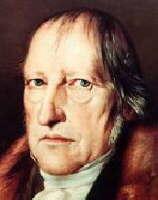
"When philosophy paints its grey in grey then has a shape of life grown old. By philosophy's grey in grey it cannot be rejuvenated but only understood. The owl of Minerva spreads its wings only with the falling of dusk." -- G.W.F. Hegel, 'Preface', Philosophy of Right.
"Philosophical self-reflection assures itself of the non-conceptual in the concept. Otherwise this latter would be, after Kant?s dictum, null, ultimately no longer the concept of something and thereby void. The philosophy which recognizes this, which cancels out the autarky of the concept, strikes the blinders from the eyes.."
"No theory escapes the market anymore: each one is offered as a possibility among competing opinions, all are made available, all snapped up. Thought need no more put blinders on itself, in the self-justifying conviction that one?s own theory is exempt from this fate, which degenerates into narcissistic self-promotion, than dialectics need fall silent before such a reproach and the one linked to it, concerning its superfluity and randomness as a slapdash method. Its name says to begin with nothing more than that objects do not vanish into their concept, that these end up in contradiction with the received norm of the adaequatio."
-"Philosophy has, at this historical moment, its true interest in what Hegel, in accordance with tradition, proclaimed his disinterest: in the non-conceptual, the individual and the particular; in what, ever since Plato, has been dismissed as transient and inconsequential and which Hegel stamped with the label of lazy existence.
"In sharp contrast to the usual scientific ideal, the objectivity of dialectical cognition needs more subject, not less. Otherwise philosophical experience shrivels. But the positivistic spirit of the epoch is allergic to this."
"Rationality itself is to an increasing extent equated more mathematico [Latin: in mathematical terms] with the capability of quantification. As much as this took into account the primacy of the triumphant natural sciences, so little does it lie in the concept of the ratio in itself. It is blinded not the least because it blocks itself off from qualitative moments as something which is for its part to be rationally thought."
"One can no longer paddle along in the mainstream, even the word sounds dreadful of modern philosophy. The recent kind, dominant until today, would like to expel the traditional moments of thought, dehistoricizing it according to its own content, assigning history to a particular branch of an established fact-collecting science. Ever since the fundament of all cognition was sought in the presumed immediacy of the subjectively given, there have been attempts, in thrall to the idol of the pure presence, as it were, to drive out the historical dimension of thought. The fictitious one-dimensional Now becomes the cognitive ground of inner meaning."
'Constant revolutionizing of production, uninterrupted disturbance of all social conditions, everlasting uncertainity and agitation distinquish the bourgeois epoch from all earlier ones ... All that is solid melts into air, all that is holy is profaned.' Marx
As the present crisis has mutated from a banking crisis to a fiscal crisis and a sovereign debt crisis, bonuses continue to be paid, while the people of Greece and Iceland suffer huge cuts in jobs and services. Capitalism survives by purging itself of debt and loading the costs of adjustment on the weak and the poor. The financial crash of 2008 has destroyed the credibility of the financial growth model put in place after the last great capitalist crisis in the 1970s.
There is a growing public desire for critical analyses of global capitalism outside of the mainstream neoliberal consensus.David Harvey:
One of the basic pragmatic principles that emerged in the 1980s, for example, was that state power should protect financial institutions at all costs. This principle, which flew in the face of the non-interventionism that neoliberal theory prescribed, emerged from the New York City fiscal crisis of the mid-1970s. It was then extended internationally to Mexico in the debt crisis that shook the country to the core in 1982. Put crudely, the policy was: privatise profits and socialise risks; save the banks and put the screws on the people (in Mexico, for example, the standard of living of the population dropped by about a quarter in the four years after the financial bailout of 1982). The result is what is known as systemic 'moral hazard'. Banks behave badly because they do not have to be responsible for the negative consequences of high-risk behaviour. The current bailout is this same old story, only bigger and this time centred in the United States.
Harvey argues that Periodically, capitalism over-expands and overshoots, encountering limits it cannot immediately transcend. This is a system which must keep expanding by at least 3 per cent a year. What drives it is the hope of profit, and this impulse comes to shape all social relations as well as nature. During booms, capital accumulates very fast, but the amount of surplus generated becomes harder and harder to absorb. The investments that have been made in the boom fix capital in all sorts of ways, in buildings, cities, regions and countries, as well as in labour forces and ways of organising production.
After a time many of these past investments no longer yield a high return and sometimes no return at all. This is what precipitates the crisis.Capitalism survives by socialising losses and distributing gains to private hands. Harvey devotes a large part of his argument to show how this is done through the close ties of the state and finance. He calls it the state-finance nexus.