|
January 8, 2009
In the Sydney Morning Herald Elizabeth Farrelly makes a good point. She observes that the smog in Sydney and in other capital cities in Astralia will be remembered as one of the great ironies of modern planning, that the system we call suburbia, whose main promise was sunshine and fresh air for all, ended up destroying those things for everyone. Even now, people - thinking people who should know better (and do, in fact, but somehow choose not to) - defend suburbia on the basis of how nice it is to wake up with birds and trees outside the window. And it is nice. There's no denying it. I like. You like it. We all like it. And that's the point, really. Because just as one binge is fine but every weekend means you're an alkie, or one house among the gum trees is fine, but millions? Millions of suburban houses means millions of cars, millions of smog-belching passenger kilometres and millions of kids with chronic asthma and bronchitis.
The states have basically given up in rolling back the car to make our cities more liveable. The Rann Government in South Australia, for instance, does not have the will to close down small streets to the car in the areas of the inner CBD where people gather in public spaces.
As Farrelly points out everything now depends on Infrastructure Australia providing the funds for better public transport and a decent rail system. Don't hold your breathe.
|





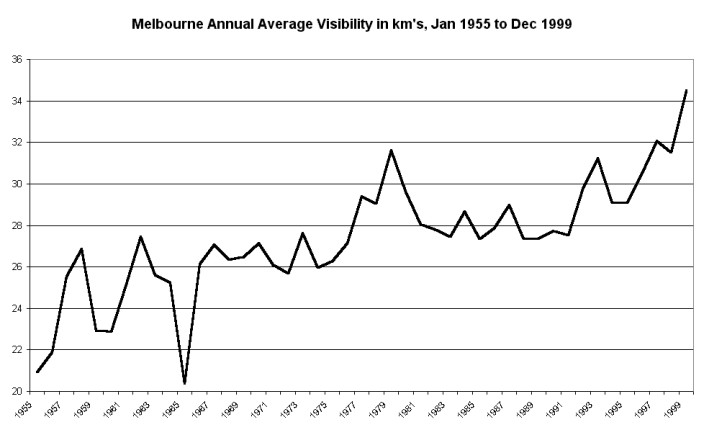
I am a town planner and urban designer by profession and had been working in Hong Kong for years. I was, and am, amazed by the attitude of Melbournians towards the 2030 Plan.
Air pollution in advanced countries like Australia is mostly caused by vehicles while in developing countries like China, is caused by heavy industries. Hong Kong also suffers the industrial pollution from China in winter. Therefore, we need different tactics to solve the same problem for different countries. It is not an exaggeration to say that once we solve the on-road vehicle problem in Australia, we solve most of the on-street air pollution problem.
On the other hand, the heavy use of private transport in Melbourne is correlated to typical American style low density suburb development. This is quite unfortunate as Continental Europe has the better planning/design of city which the Melbournians don’t’ want. I think Melbournians are quite selfish in this respect.
Before the Rann Government in South Australia has the will to close down small streets to the car in the areas of the inner CBD, the Government will need the will to increase the people’s reliance on public transport. In other words, we need to increase living density, improve rail services (I am aware this is difficult as the Connex couldn’t even implement the smart card system in Melourne, a technology installed in Hong Kong decades ago) and offer economic incentives such as road toll, parking levies in CBD, free parking near major suburban rail stations etc. If we close some small streets without addressing the problem in the bigger picture, the problem is not “gone” but will appear elsewhere in the same CBD.