|
March 19, 2009
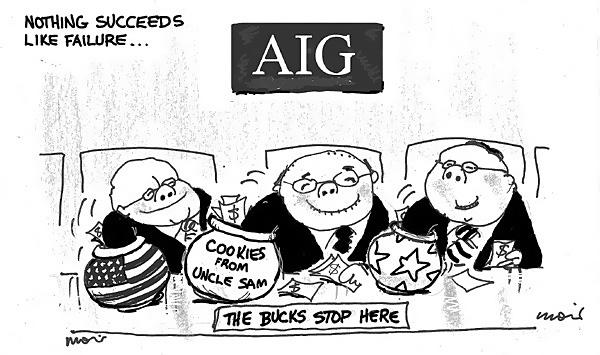
Edward Liddy, chairman of AIG, makes remarks that indicate how the bailout is being used by Wall Street to consolidate their power. He says:
We cannot attract and retain the best and brightest talent to lead and staff the AIG businesses, which are now being operated principally on behalf of the American taxpayers, if employees believe their compensation is subject to continued and arbitrary adjustment by the U.S. Treasury.
The best and brightest?

The US government had to take over AIG to ensure its survival because of the actions of the notorious credit default swap unit.(It was hedge fund grafted onto an insurance company). AIG was bailed out to prevent a cascade of counterparty failures which could kill the entire financial system. If AIG didn't get the money, the entire global financial system would be put at risk of collapse.
The populist moral outrage is directed at the gaming or looting the corpse: ---those large bonus paid to incompetent, arrogant executives that have resulted in the company AIG hemorrhaging red ink. AIG's near bankruptcy was due to hugely risky and irresponsibly stupid investment decisions. The company fundamentally misunderstood the nature of risks that it was underwriting.
AIG now stands for all that is wrong about Wall Street. Six months after the Wall Street bailout it’s still the case that almost no loans are being made to Main Street. It is not possible for the economy to grow until credit markets are working again. A banking system that is substantially impaired will eat your stimulus. If you do not get the banks lending and creating money, then everything else you do will fizzle. So AIG stands for fiasco--both corporate fraud and government fiasco.
Impaired banks lend less. Edaward harrison at Naked Capitalism says:
This is what is happening now. The problem is that while all this is ongoing, the institutions that issue credit, financial institutions, are hemorrhaging losses. After all, de-leveraging means institutions are selling out of necessity, not out of opportunity. And when everyone's a seller and few are buyers, asset prices fall and massive losses are the order of the day. When banks lose money, they have less capital and when their capital gets low enough they can't lend. Less lending = less credit = less growth. So, if we want to get the economy back on its feet, we need to increase lending.
The banks are not lending because they need their capital to service the toxic sludge already sloshing around their balance sheet.
The US government's programs and bailouts have been designed to recapitalize the banks so that they can start lending again. This has limited effectiveness because the extent of the writedowns of assets already on the books is going to be too massive. The U.S. banking system is effectively insolvent in the sense that the banks do not have adequate capital to absorb the likely losses facing them later this year.
That means the policy response should include nationalization or liquidation of a significant number of banking institutions. The US is engaging in ad hoc measures and for the most part, taking the path of least resistance of propping up zombie banks rather than making banks write down bad assets to realistic values.
|





banks on government life support should not be taking risks with taxpayer money; they should be cleaning up the wreckage and focusing on relatively low risk business. Will they? 'They' refers to the the state-finance nexus for that is what Wall Street is becoming.
In this interview David Harvey argues that Wall Street (the financial capitalist class) are working to find a solution to the crisis for the capitalist class and if the rest of us get screwed, too bad. He adds that:
Socialisation of the surplus means money for public education, health and housing and our cities.