|
June 4, 2009
The Brown Labor Government in the UK is in a deaththroes. The smell of corruption around expense claims and allowances of dishonest MP's is overpowering, Labor's polling figures are dismal, there is a concerted backbench revolt to unseat Gordon Brown, there have been four ministerial resignations, and the party is fracturing as it hesitates on constitutional reform.
 Steve Bell
It is expected that Labor will do badly in the county council elections and the European elections this week, which will further destabilise the Brown Government. A national election is due around June 2010. David Cameron and the Conservatives are looking pretty good compared to the wreckage that is Labour. Brown and Labor appear doomed, as there is nothing in the tank. Labor's implosion will make a Conservative landslide inevitable, possibly on the scale of the Conservative defeat of 1997. Labour's fate could be to become the third party.
The Guardian says that Gordon Brown must go:
The truth is that there is no vision from him, no plan, no argument for the future and no support. The public see it. His party sees it. The cabinet must see it too, although they are not yet bold enough to say so....Great causes win the day when people fight for them. A year of lingering emptiness beckons instead..The blunt reality is that, even if he set out a grand programme of reform now, his association with it would doom its prospects. Proportional representation would transform parliament, but if Mr Brown put a referendum on the ballot, it would be defeated because he backed it ....Labour has a year left before an election; its current leader would waste it. It is time to cut him loose.
Brown and co increasingly look like the living dead and faces the prospect of many years in the political wilderness.
 Morten Moreland, The Times
At a deeper level there is a widespread sense that the machinery of representative democracy, legislature and the executive is dysfunctional and the conventions of Westminster politics bankrupted. There is a need for reform. Proposals include super select committees that would counterbalance the unchecked power of the executive and especially of the prime minister; a written constitution; limits on parliamentary sovereignty by electoral reform (proportional representation), devolving more power to more city mayors; greater use of citizen forums with real power to recommend changes direct to parliament. The call is for a citizenship democracy rather than a consumer democracy. Neil Lawson says:
First past the post (FPTP) is the electoral system of the bygone age of Fordism, the age of mass production, of two social classes and therefore just two old political parties. It is the bureaucratic and clunking system of two tribes that go to war; tribes that are controlled and ordered by the party machines. There is no public debate, we just take it or leave it. It is yah boo and adversarial. It feeds the tyranny of middle England whereby a handful of voters in a handful of seats determine every election outcome. It gives all power to the fickle and the people who lead them; Rupert Murdoch of the Sun and Paul Dacre of the Mail. In the process core supporters are taken for granted and ignored.
He says that without proportional representation other democratic reforms are just a technical fix. Will New Labour reform the political system as its last act?
It is unlikely. Though New Labour will have lasted 13 years they have precious little to show for it. Martin Jacques says
So what then of New Labour’s political legacy? From the outset, it was founded on a deep pessimism, the belief that there was no alternative other than to acquiesce in the Thatcherite settlement. The meaning of the “new” in New Labour was that Labour should abandon any claim to a distinctive project, and that at most it could only provide a variant of Thatcherism...Looking back at 1997, one is struck by the sheer failure of intellectual and political courage that informed New Labour. Of course, it was full of fine words – about its radicalism and its project – but these were no more than a smokescreen, designed to conceal the fact that, from the beginning, it did not actually have a project worth the name, and certainly no reforming ambition.
1997 represented a step back into history: a rejection of social democracy and the abandonment of a commitment to and belief in the idea that Labour could be distinctive and original, that its purpose was not simply to offer a variant of Conservatism.
|


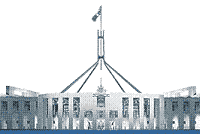


At a deeper level there is is the political reality of the power of the global markets and the chaos caused by the global financial crisis. You could ask where are the new political organisations and structures that correspond to this altered global reality?
What is the shape of a politics that is required to deal with contemporary social and economic storms, from which our nation state will offer us little protection? Haven't our governments made a virtue of their own powerlessness? ---- with their rhetoric about how you can't buck the markets.
The rhetoric of parliamentary reform, doesn't come to grips with the destructive power of the global financial markets.