|
November 17, 2009
As I drive between Adelaide and Victor Harbor I notice how the city is stretching ever southwards. There appears to be no limit placed on the urban expansion. The same urban sprawl is also happening in the northern part of the city as well between Elizabeth and Gawler. In both cases it is low-density housing in areas already under-serviced by public transport, other infrastructure, services and amenities.
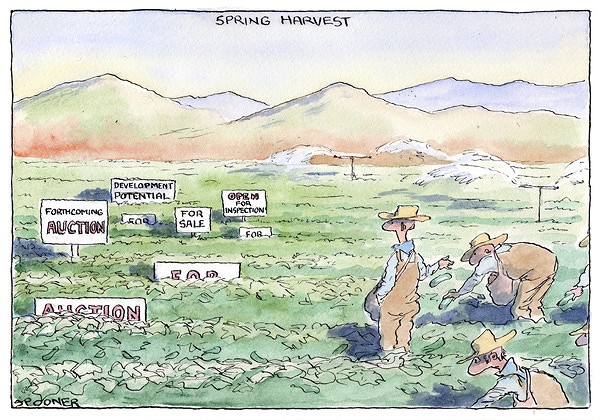
There is little to no sense of an urban policy designed to contain sprawl development. In fact, the sense is one of the continuing hegemony of the sprawl land development paradigm as population growth is placed at front and centre of the Rann Government's economic development and urban design plan--Adelaide 2038. Many people in Adelaide continue to think public transport is a second rate transport option.
The development lobby and the Coalition say that Australians have to accept that urban sprawl is the price they have to pay for affordable housing. The developer's promise is an affordable house and land packages-- the housing dream --on the urban fringe. This requires a steady supply of urban land and ever more freeways to avoid gridlock.
Behind the promise lies the reality of social disadvantage. Adelaide is a city divided by socio-economic fault-lines and entrenched inequality. As the former SA state planning minister Jay Weatherill conceded:
We drive low-income people out to the city’s extremities where services are the most stretched ... The paradox is that governments unwittingly subsidise this sprawl … A Perth study has found that the direct cost to government of providing infrastructure for a fringe block is more than three times the cost of an inner block … So we have a situation in which government is providing high subsidies for low-income people to live in fringe areas where services are low and where building communities is hardest....The paradigm of cheap land on the fringe of the city no longer exists and, in fact, has not for many years. The true cost of urban sprawl has been masked through cross-subsidisation of infrastructure by governments.”
This form of urban sprawl is not just in Adelaide. Melbourne is the same. Plans to contain Melbourne's urban sprawl are "stone dead", the city's green wedge zones are in danger, and urban planning is led by the development community with the Government just rolling over.
In both cities there is urban encroachment (houses and expressway ) on prime agricultural land which threatens the state's food security and export ability at a time when climate change also threaten the sustainability of horticultural industries (eg., in the Adelaide Hills). This will continue --eg. the Rudd Government's thirty year plan for the future forecasted a projected growth in population of 560,000 with most expected to push out of the city limits and into the north, expanding to the Gawler region. The once regional town will be transformed into a metropolitan super-town that impingeson the Barossa winegrowing region.
The Australian Institute of Architects, the nation's peak architectural body wants Australian cities to focus on boosting their inner and middle suburbs' density rather than release land in outer areas, in order to become more sustainable. Rightly so because car obsessed, low density suburban Adelaide is not a compact city, and it is probably not sustainable in its present configuration in a heated up world.
|





Adelaide was founded as a colonial city in the expanding British Empire to exploit the resources of the hinterland. It has become a city where the urban lifestyle is auto dependent and it currently has a big ecological footprint with a small population.
The city is characterised by unnecessary car use, through the urban sprawl of our low density suburbs, to excessive use of our water resources. There is the poor water quality of the Torrens, lack of shade in open space, pressure to intrude on parklands, and urban and architectural design without due consideration of the future environment.
Climate change should be at the forefront of concern here in the driest city in the driest continent. Adelaide's urban environment can begin to be improved by reducing motor vehicle traffic and greening local streets.