|
April 26, 2010
In After the Second Debate: The Clegg Catharsis? in the New York Review of Books Jonathan Raban refers to the recent mood of distrust and contempt for politicians in general in the UK.
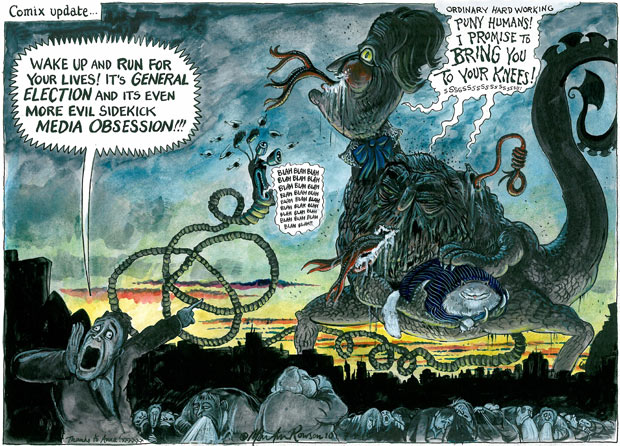 Martin Rowson
This public mood of cynicism and disgust tends to drive the political discourse, and it is coupled with increasing frustration that no effective mechanism exists to enable citizens to convert these sentiments into action. Raban says that there had been a:
breaking wave of fury that had been building in strength from around the midpoint of Tony Blair’s second term in office (2001-2005). The huge unpopularity of the 2003 Iraq invasion (supported by the Conservatives, but opposed by the Lib Dems), followed by the bursting of the property bubble and the steep rise of unemployment and home foreclosures that came with deepening recession, had turned British voters against their political class.
The Labour Party was a cheerleader for the turbocapitalism of the City, but Raban overlooks the Labour Party's descent into authoritarianism – with its appalling record on civil liberties, whether ID cards, 42-day detention without trial, or the creation of 3,000 new offences.
Raban adds that when the great parliamentary expenses scandal broke in the UK last year it seemed:
to ratify everyone’s worst opinion of parliamentarians—that they were all in it for themselves, all had their snouts in the same trough, and none were to be trusted with running the country. Timing was everything. The story happened to come out when Britain was enduring the worst of the recession, when people were baying for a scapegoat to blame for their shuttered businesses and underwater mortgages, and MPs as a class became that useful animal, and more easily targeted than the hated bankers.
He adds that Clegg and the Lib Dems offer the electorate the chance to teach the British parliament a lesson that it won’t forget.
This is what Anthony Barnett calls a historic "Gotcha!" moment ---the public has finally recognised that it cannot trust a system that has long needed to be changed.
Can the Liberal Democrats gain enough electoral support to leverage the electoral reform that many desire? Would Labour under Gordon Brown support electoral reform in order to retain power?
|





Nick Clegg, the Liberal Democrat leader, made it explicit for the first time that electoral reform---a more proportional voting system--- would be an unavoidable precondition of any coalition government. He also insisted that Labour will have forfeited the right to govern if it comes third in the popular vote and that in these circumstances he would not work with Labour whilst Gordon Brown was its leader.
Cleaning up politics isn't going to happen if the two-party duopoly continues. It requires a Lib Dem breakthrough and a hung parliament. Murdoch will do all he can to snuff out what looks to be a a genuine electoral insurgency from below.