|
October 23, 2010
The global credit crunch and economic downturn continues to work it s way through the national economies of Europe and the Americas. Global financial markets remain unsettled, and the recovery that started so vigorously in 2009 seems to be stalling. There has been swelling the ranks of both the working poor and those seeking out social services for the first time. Inequality is increasing due to the politics of austerity from the moves to roll back public spending programs introduced to help shield their economies from recession.
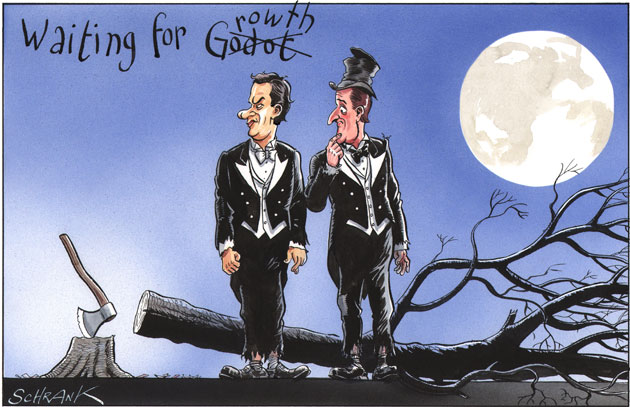
If slow, protracted recovery with sustained high unemployment is the norm in the aftermath of a deep financial crisis, then the future of the world economy is one of long period of low growth:
Devaluation is not available to individual countries within the euro monetary union. They have to adjust to bad shocks to their individual economies either through increased unemployment, reduced wages, or migration of some unemployed workers to countries that are doing better. These adjustments are difficult for Greece, Italy, Spain and other weak members of the EU because their labor markets are inflexible, and because many workers in these countries are reluctant to migrate elsewhere, partly because they would give up generous benefits.
Behind the politics of austerity lies the well-known “set of ideas, beliefs and attitudes” of the free market economics: they strongly believe in the virtues of markets because of their efficiency properties but also for moral-ethical reasons; they believe in the self-adjusting or self-correcting economy and therefore abhor government interventions of all sorts. Along with this core set of beliefs there goes a penumbra of vaguer attitudes with respect to private property rights, the legal system, the overarching value of (particularly) economic freedom, etc. The defense of “the market” involves “starving the beast”, which means pressing for reduction in government by creating binding constraints.
Like Southern Europe, the US economy needs to move away from the consumption/housing-led growth model of the last decade. President Obama has encapsulated this challenge by setting the goal of doubling US exports over the next decade. Daniel Gros points out that this is easier said than done:
Post-bubble economies face a fundamental mismatch between the skills available in the existing work force and the requirements of a modern export-oriented manufacturing sector.Unfortunately, there is very little that economic policy can do to create a strong exporting sector in the short run, except alleviate the social pain. Labor-market flexibility is always touted as a panacea, but even the highest degree of it cannot transform unemployed realtors or construction workers into skilled manufacturing specialists.
Long-run economic growth is determined mainly by improving productivity. This is difficult given America's dire debt situation and it being the heart of the world’s financial and monetary system. George Soros observes:
The US economy badly needs investments that enhance productivity but the private sector is unwilling or unable to provide them. US corporations operate very profitably but instead of investing their profits they are building up their liquidity—accumulating money, not investing it.In these circumstances there is a strong case for government intervention. Admittedly, consumption cannot be sustained indefinitely by running up the national debt. But to cut back on government spending at a time of large-scale unemployment would ignore all the lessons learned from the Great Depression.
The Republicans are campaigning against any further stimulus and they seem to have gained the upper hand by stigmatizing big government. The Obama administration is pushed into the wrong policies by political pressures.
|





From the post: "Behind the politics of austerity lies the well-known “set of ideas, beliefs and attitudes” of the free market economics: they strongly believe in the virtues of markets..."
Well, maybe "they" believe in that stuff or maybe it's just the PR. I haven't read her book (The Shock Doctrine), but I gather from this interview that even Naomi Klein is a bit confused about the difference between actually believing in "free market capitalism" and just using the idea to make a quick buck:
http://www.democracynow.org/2007/9/17/the_shock_doctrine_naomi_klein_on
There has been enough written about neoclassical economics for me, at least, to be highly sceptical of people who profess to be believers; I'm thinking primarily of Ormerod's "The Death of Economics" and Keen's "Debunking Economics". It's become about as convincing as people who say they're bringing freedom to Afghanistan.