|
April 3, 2008
Infrastructure is crucially important for the development of user generated content of Web 2 and the shift to the knowledge economy, yet Australia's telecommunications infrastructure is middling to poor. Consider the implications of the Rudd Government's cancellation of the Opel contract, which was designed by the Howard Government to deliver broadband to regional and rural Australia.
Conroy's cancellation effectively closes down competition, entrenches the power of Telstra, and that leaves us with the fibre-to-the-node broadband network subsequently proposed by Conroy in his magic pudding mode. All those conduits lead to Telstra and it makes it more difficult for the Group of 9 companies in their effort to develop an FTTN plan in competition with Telstra's own FTTN plan.
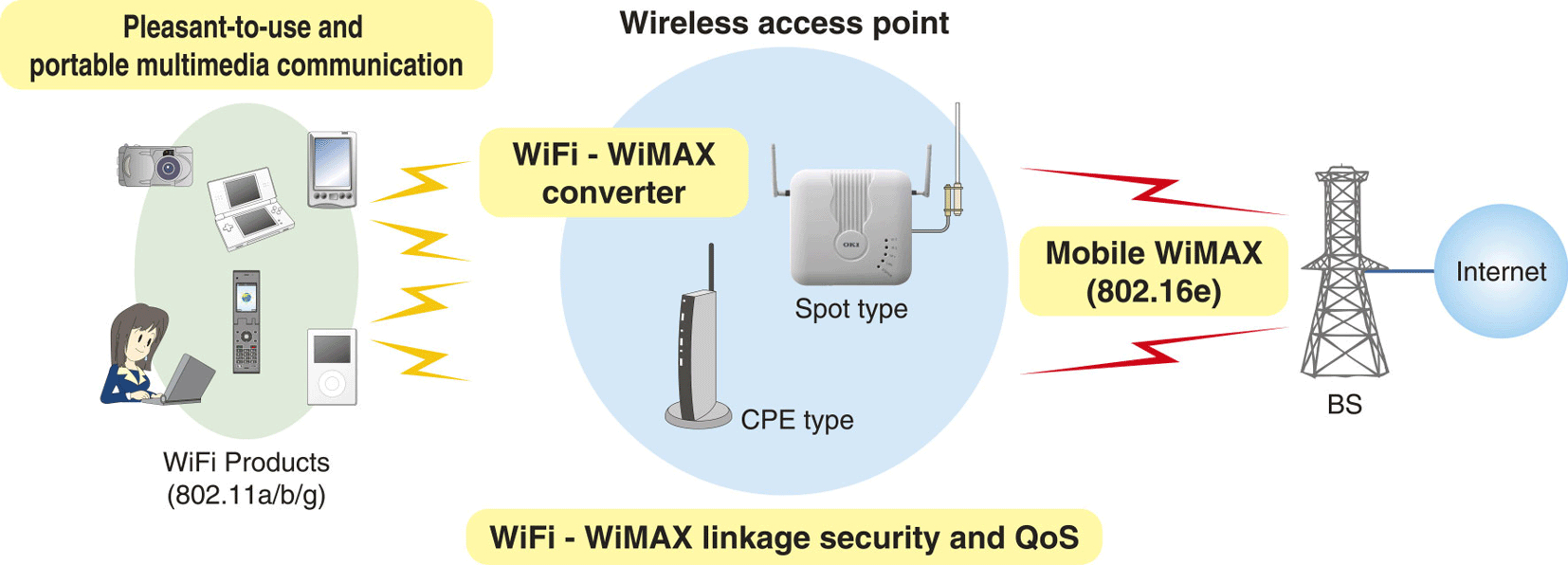
Opel was created by the Howard government, in part, to politically neutralise Labor's own $4.7 billion plan for a national FTTN broadband network. Even though Opel was flawed and politically driven, it did promise real benefit and competition to regional Australia as it offered broadband for those regions Telstra had no interest in.
So all the Government's eggs are now in the FTTN basket, and Telstra looks as if it is now the only party that can deliver the network. Telstra is the logical builder of FTTN, which is not a new network but an extension of its existing national fibre network. What is still being rejected by Conroy is the long-term answer---fibre-to-the-home.
Conroy's decision leaves us with a Telstra that behaves as if it has a God-given right to taxpayer money and to screw both competitors and customers for everything it can get. Telstra is already insisting on capital investment returns at a level that only near-monopolies get.
WiMax can work but the issue is the cost. For instance, Internode's Coorong and Yorke Peninsula network projects were strongly backed by the Coorong District Council and District Council of Yorke Peninsula, underpinned by the SA State Government’s Broadband Development Fund, and subsidised by the Australian Broadband Guarantee. This has enabled Internode to bring metro comparable broadband to several parts of South Australia. Internode have publicly stated that Telstra backhaul is a major limiting factor to further deployments.
One sign of hope is that Internode states that wireless broadband would continue to play an important roll in delivering rural broadband services alongside the Government's planned Fibre to the Node (FTTN) network.
|





Anon,
all the commentary in the media has been about clever Conroy has been in saving the Rudd Government saving $636 million, thereby helping Tanner find the $4 billion in savings.
Will they help the regional ISP's broadband the bush? Or will they turn a blind eye to Telstra driving the regional ISP's out of business