|
August 12, 2009
The politicians on both sides of Parliament are sure crowning themselves with glory and star dust over the way they are implementing an emissions trading scheme. It's called political argy-bargy but behind the hot air the core issues of the scheme's cost on industry and its redistributive impact can be discerned.
Coal is King is the mantra of hustlers behind the curtain who say that Australia's dependence on coal and its abundant reserves require that we should concentrate on aggressively pursue the development of the new coal technologies. Australia should be completely reliant on fossil fuels and other non-renewable resources for its sources of energy.
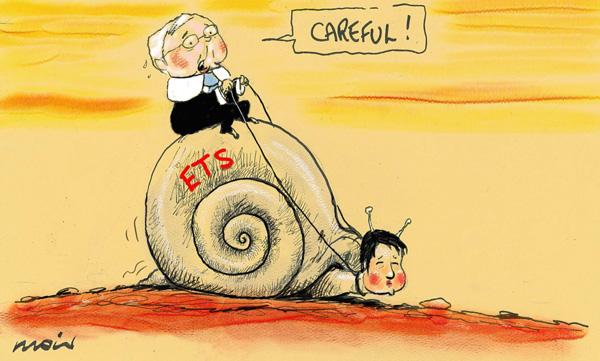
So we have the resolute defence of the trade-exposed industry and coal fired powered electricity generating industries---in the form of free permits instead of an auction, extensive compensation, heaps of spin about all the wonderful things being done to facilitate the emergence of a renewable energy industry and hypocrisy about saving the River Murray and the Great Barrier Reef. Energy policy is pretty much limited to the black and brown stuff that is dug out of the ground.
Yet Rudd's scheme is minimal: a low reduction target of 5 per cent, starts on July1, 2011, there will be a one-year fixed price for carbon until July1, 2012 at an extremely low $10 a tonne, the impact on households and businesses will be minimal, and even more compromise can be expected for the multinational companies that own the heavily polluting coal fired electricity generators in the La Trobe Valley. The CPRS is weak on polluters.
The whole point of an emissions trading scheme is to force polluters to pay for the harm they do to the planet. The rhetoric from the polluters is that an emissions trading scheme is a “sovereign risk”, which the energy corporations say can only be mitigated by the government giving away free emissions permits to companies that might otherwise have to pay to continue to pollute.
What they are saying is that businesses have a right to compensation from changes in government legislation and regulation. Sovereign risk is the risk of the state using its power to alter the established rights of private sector companies. It is a risk to private sector participants that a project's implementation may be hindered or prevented, or its operation adversely affected in that a cap and trade scheme imposes poses a significant economic constraint on the established business activities of business.
Both state and commonwealth governments melt like butter in a heated up world at the very mention of sovereign risk and they grant all sorts of perks to sectional interests even though they know that issuing free permits would reduce the long term incentive to reduce greenhouse emissions.
The basis of the opposition to free allocation is the lower efficiency and less transparency that accompanies free allocations in that an indiscriminate spraying of compensation towards interests that press strongly for it would greatly increase the ultimate costs of mitigation.
What has not happened is that the claim of sovereign risk arising from the implementation of an emission cap on electricity producers in Australia has been tested. Shouldn't the electricity producers have anticipated the introduction of significant emission constraints? Shouldn't investors in electricity generators reasonably be expected to have included this already in their valuation of high emission power stations, including those purchased in privatisations a decade ago?
|





Coal exports are booming especially from the Hunter Valley. They cannot load the black stuff fast enough. And the big companies in the coal industry want handouts/compensation!