|
November 19, 2010
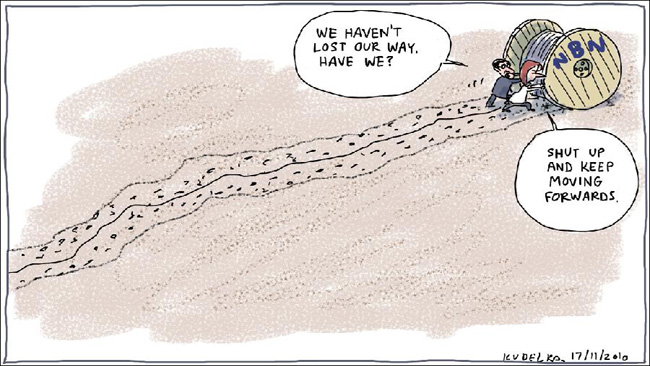
The Gillard Government hasn't lost its way on the national broadband network (NBN). It's strategy is perfectly clear: a future of trying to regulate Telstra as the operator of an effective and national fibre network with open access was unrealistic. The option of creating a public natural monopoly was a better one. This is what the Coalition opposed.
I agree with Rob Burgess' argument in The NBN is in Xenophon's hands in Business Spectator that the Coalitions' attempt to prevent this has failed.
Yesterday, November 18, was a crucial moment in the long push by first the Rudd government, now the Gillard government, for the structural separation of Telstra and the rebuild of Australia's fixed line communications network. It was, in effect, the last stand of the opposition in trying to prevent the rollout of the most expensive infrastructure project in Australia's history – and they knew it...Malcolm Turnbull['s]... private member's bill [for a Productivity Commission analysis of the NBN that] he hoped would force the government to subject its NBN project to a full cost-benefit analysis... was narrowly defeated.
Conroy's Telstra-splitting bill, which ends the long policy battle over the structural separation of Telstra, will be passed by the Senate probably at the price of Xenophon forcing some kind of cost-benefit-analysis on Labor in the name of transparency and accountability.
Update
The political drama is happening in the Senate. The bill to be voted on by the Senate next week is not to enable the NBN, but to separate Telstra's wholesale assets from its retail arm.
The Communications Minister Stephen Conroy survived a gag order in the Senate that would have halted any consideration of NBN-related matters - and stopped the Minister even addressing the issue - until he tabled a series of documents related to the fibre roll-out.
The Greens, Family First's Steve Fielding and South Australian independent Nick Xenophon voted with Government to defeat a motion brought by Coalition leader in the Senate Eric Abetz, which would have stymied any chance of the Senate considering the crucial Testra structural separation bill that is expected to be debated next week. The Abetz motion was defeated 36 -34.
The Greens and the two Independent Senators are unhappy that they are being forced to consider the reform legislation in the absence of an NBN business plan, and they are frustrated at the drip-feed of information on the NBN roll-out being put into the public domain.Senator Xenophon says that he strongly supports the separation while feeling annoyed at not seeing the business case yet. Fielding, Xenophon and the Greens will be getting a private briefing on the contents of the business case next week, with Xenophon saying that he wouldn't sign a non-disclosure agreement.
|





When one examines the real reasons behind the NBN rollout-
the 2008 decision was not about how quickly movies could be downloaded, nor about the social benefits of e-health and e-education. It was about facing up to the increasingly apparent failure of the transition of the public fixed-line monopoly to a privately controlled – albeit highly regulated – monopoly.
then the CBA is done. Irrespective of the cost, this one benefit far outweighs the costs.
the combative management style of Sol Trujillo's reign at Telstra brought all the flaws of a regulated private monopoly to the surface sooner, rather than later.
Unfortunately the genii is out of the bottle and we will probably never again see the quality and service that was the hallmark of the Postmaster General's Department, but it is a step in the right direction. The cowboys will still be there, but at least the network will remain reliable