|
July 26, 2003
The opening of Siv's exhibition at Images Gallery was last night. I slipped in quickly whilst passing by. It was a series of paintings of the country I knew and the images expressed a sense of place.
Alas, regionalism in art---such as representations of the South Australian landscape---have a hard time being accepted in the nation's institutional art world. An example is this painting of Waldegrave Beach (near Elliston on the Eyre Peninsula) by Siv Grava:
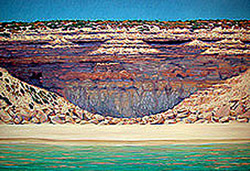
Siv Grava, Waldegrave Beach, Images Gallery, 2003, Oil on canvas
This regional art is confronted by being rejected as unfashionable in the metropolis. The art institution still thinks in terms of avoiding the literal image, defying figurative conventions, the avant garde and being self-referential about art. They are still bound up in the prejudices of the New York avant garde of the 1950s, which held that regionalism was trashed by the forward march of art history. For modernists regionalism meant backward-looking conservatism, whilst being avant grade meant being authentic. It mean the kitschy populism of figuration and gum trees.
Being modern for photgraphers in America and Europe meant this kind of abstraction:

Paul Strand, typewriterkeys, circ 1916, silver gelatin print
It did not mean this kind of kitsch that goes by the name of Australiania:

The early definitive statement on the avant-garde art and kitsch as opposites was the essay 'Avant-Garde and Kitsch' written by the New York art critic Clement Greenberg, which was published in the journal Partisan Review in 1939. Greenberg argued not only that vanguard culture had historically been opposed to ‘high’ or ‘mainstream culture’, but that it also has rejected the artificially synthesised mass culture that has been produced by the culture industry – ie., the commercial culture of popular music, Soap Opera dramas, pulp fiction, magazine-illustration, B movies and advertising. The avant-gard's job is to defend aesthetic standards from the decline of taste involved in consumer society. The New York abstract expressionists were the avant-garde for Greenberg.
Yet in a globalised world regionalism is returning. What causes its rejection this time is that it is about the specifics of place: eg., Maslin's Beach by Siv Grava
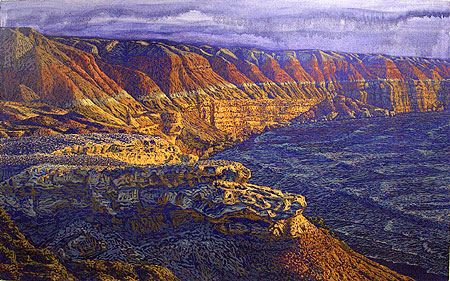
Siv Grava, Maslin's Beach, Images Gallery 2003, Oil on canvas
So anyone producing works to represent the specifics of their place or their country in which they live and belong risks being ensnarred in Australianness, Australiania, and postcard views. Those words mean one thing to the art institution:---kitsch. Today, kitsch means artworks that appeal to popular or lowbrow taste, artworks that are often of poor quality, and cliched artworks. Kitsch causes that aesthetic 'yuk' feeling in the art institution. of course, you can have postmodern kitsch--that is being ironic about the rules that govern art in an art institution.
And the reason for the immediate recoil, if not repugnance, by the art institution to the specifics of regionalism? Art transcends the particularities of place. It does so by either meditating on the [spirit] of the Great Southern Land, or alternatively by becoming a colouristic exercise of aesthetic appeal.
An acceptable strategy to avoid Australiania whilst representign a specific place is to deconstruct kitsch sunset photgraphs of Uluru for tourists. Such a strategy is deployed by David Hume:
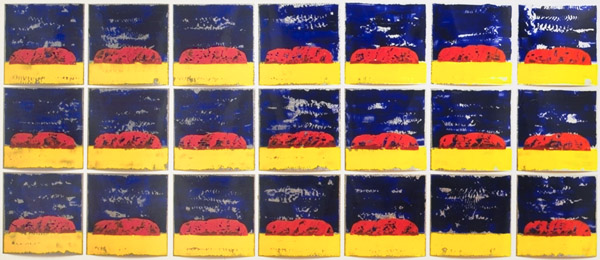
David Hume, Postcards From The Rock, Acrylic on galvanised steel, Beneath the Beyond 2 exhibition, 2000.
This strategy is seen as okay by the art institution because it is art being self-referential. Being self-referential means that the artwork is not a cliche, and it prevents the artwork from become part of the flotsam of mass culture. To be a good modernist you must fear and hate kitsch. For modernists art stands opposed to kitsch.
What happened with modernism was a forgetfulness about place. Place was erased. "Erasure" denote the art institution's tendency to displace, deny, or unrecognizably alter its past; its history of being in a specific place. The traces of the past continued to remain even after the landscapes and buildings had been demolished. What occured was a burial, rather than a disappearance of regional representations of the past and place.
We are now begining to recover the old images of our region:

Hans Heyson, In the Arkaba Country, Arkaba, Flinders Ranges 1942, watercolour on paper
The Hans Heyson representations of the Flinders Ranges, which were once high art, are in danger of becoming kitsch. Reproduced on too many postcards you see.
|


could be a good idea to credit images ie artist name, work title and date, medium...