|
August 22, 2003
I have just come across this interview with Allan----ooops Harold---Bloom called Ranting against Cant in The Atlantic online.
It begins with Bloom being asked a question about which school of literary criticism he now belongs to. It is a good question. Bloom, if you recall, was once was a deconstructionist who hung out with Derrida. Then he saw the light and no longer speaks to Derrida. Bloom answers:
"Well, it's such a complex thing. I left the English department twenty-six years ago. I just divorced them and became, as I like to put it, Professor of Absolutely Nothing. To a rather considerable extent, literary studies have been replaced by that incredible absurdity called cultural studies which, as far as I can tell, are neither cultural nor are they studies. But there has always been an arrogance, I think, of the semi-learned......And, of course, we have this nonsense called Theory with a capital T, mostly imported from the French and now having evilly taken root in the English-speaking world. And that, I suppose, also has encouraged absurd attitudes toward what we used to call imaginative literature."
So speaks the cultural gatekeeper. Note the use of 'evilly taken root'. It implies a cancer in the Anglo-American body; a cancer that has come from a foreign body, namely French Theory (meaning Derrida, Deleuze, Foucault, Bataille etc.).
But deconstruction, as a school of literary criticism that came after New Criticism, was not the end of the matter. Nope. Things got worse, much worse. The foreign bodies connected with unhappy resentful lefties and mutated into cultural studies. Bloom says:
"...we are now in the grip of this dreadful third phase. I've so talked myself to exhaustion with a sort of rant against cant that I'm reluctant to say much about it. Throughout the English-speaking world, the wave of French theory was replaced by the terrible mélange that I increasingly have come to call the School of Resentment—the so-called multiculturalists and feminists who tell us we are to value a literary work because of the ethnic background or the gender of the author."
Dear me. Poor dear. It must be so hard standing on the border of high culture fighting the mutants.
So what does the School of Resentment do that is wrong, according to the conservative view from the heights of high culture? Take feminism. Bloom says:
"Feminism as a stance calling for equal rights, equal education, equal pay—no rational, halfway decent human being could possibly disagree with this. But what is called feminism in the academies seems to be a very different phenomenon indeed. I have sometimes characterized these people as a Rabblement of Lemmings, dashing off the cliff and carrying their supposed subject down to destruction with them."
Oh dear. This is beginning to look like the end of culture as we know it. No more Shakespeare.
Why so? Well, it has to do with connecting political and social concerns to a literary text. We are are dealing with ideologues who have no love of literature. The multiculturalists, for instance, balknize literature. And all the idealogues see is that Walt Whitman is a racist. As Bloom puts it:
"These are ideologues, dear. They don't care about poetry, they don't care about Walt Whitman."
For this disciple of Strauss the School of Resentment (variously, feminists, Marxists, Lacanians, new historians, multiculturalists and semioticians) does not care about poetry, literature or art. Thus the defence of high culture--the Western canon--- in a postmodern age overwhelmed by nihilism, which is exemplifed in the trash or muck of popular culture. The academic leftists have led the liberal academia into barbarism. No doubt about it. Hence the canon wars.
You hear this stuff all the time. I nearly fell of when my chair when I heard a Marxist professor of philosophy utter it with a straight face--he dam well meant it. Someone had to defend high culture from the postmodern barbarians. So this is one way to open up the closure in the academy from within the academy. But that merely loosens things up.
Another way to displace this conservatism is to replace a literary culture with a visual culture. After all, in our everyday lives we live within a visualscape that shapes how we see and understand things. Hence the move to culture studies that interprets what is happening in everyday life, such as shopping malls or our bodies.
Photography is a link between everyday life and high culture since it is part of both. Can we then talk about a canon of Australian photography as part of high culture? I think we can. And making the construction of the canon opens up a way to deconstruct the canon.
The canon of Australian photography was constructed from a modernist perspective by the art institution during the 1970s. Here are two iconic images of the canon:

Max Dupain. The sunbaker.
And here is another:
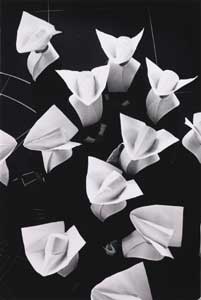
David Moore. Sisters of Charity. Interview here
The canon was put in place by the Australian National Gallery. This was done to make photography a part of high culture through constructing it as a fine art . This art was produced by the expressive heoric artist working in a craft guild studio. It involved sharp focus, strong light and unusual perspectives to capture the modern era. By being placed in the art institution it became art.
Of course, we know that photography is much more than modernist art. It is also a part of postmodernism:

Tracey Moffat
A postmodernism that is takes many of its cues from popular culture.
Photography is also an integral part of popular culture ---part of the muck and shit. As an example we have this personal snapshot of our two poodles in Mallacoota:
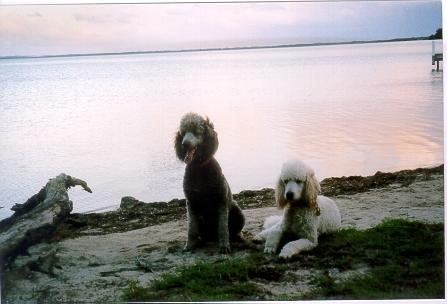
Even though anything can be art that snapshot is not art. It remains a lowly snapshot. Nor will it picked up by art curators and placed in the art gallery as part of the canon of art photgraphy. Not even by a postmodernist art curator.
We should remember that many of the modernist images that became part of the canon were actually selected from commerical practices: Thus:
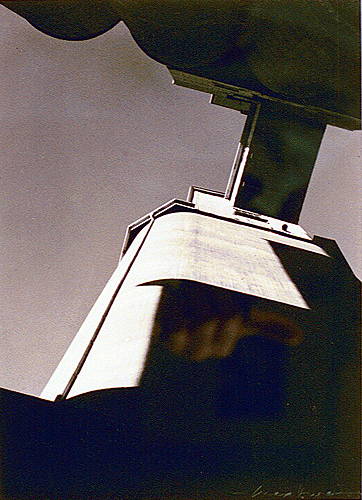
Dupain,Wheat Silos, Pyrmont
A classic modernist image. But it was appropriated from the commercial practices of the studio. So ou canot really look at the photo and discern the quality or feature that sets it off from every other photo that isn't art. It does look pretty much that art is whatever the art institution is talking about.
So why is one photo selected by the art instuitution rather than another? Consider the images of sexual beauty/fetish. This is a part of the world of sexual fetish:

and here is art. Thus:

Spot the difference between the two photos. Why is one non-art and the other art?
And we end up here. It's as good a place as any.
So we have different kinds of popular photography----snapshots, commercial, sexuality---that open up spaces from which we can begin to deconstruct art and the constructed canon. The assumptions underpining what Bloom is defending look to be very shaky indeed. What we get is little more than old-school outrage since there is little in the way of a long narrative of movement from lesser art forms to greater ones.
We can begin to do so by asking naive questions: what is photography for? What do people actually do with their photographs?
|


The School of Resentment may not care about Whitman, or art ("Art"), or literature, but the Embittered Established cares even less about Bush doofs, the Buffyverse, or Bowie. ;)