|
July 12, 2004
The early Europeans reacted to their new environment with hostility and alienation. Their culture viewed the world as a predictable system, with its Cartesian time-space co-ordinates. It was a Gods-eye view that was blind to its own slanted perpective and cultural bias.
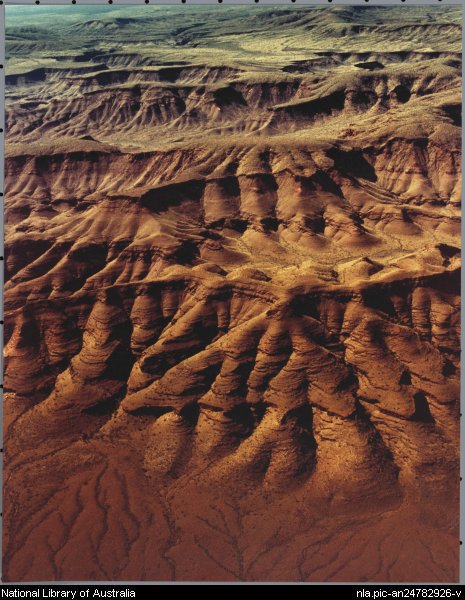
Wolfgang Sievers, The Hamersley Ranges, near Wittenoom, Western Australia, 1975
They lamented the fact that Australia lacked the human associations of a historic past.
The European's scientific method assumed the observer to be disinterested and detached from the object observed.
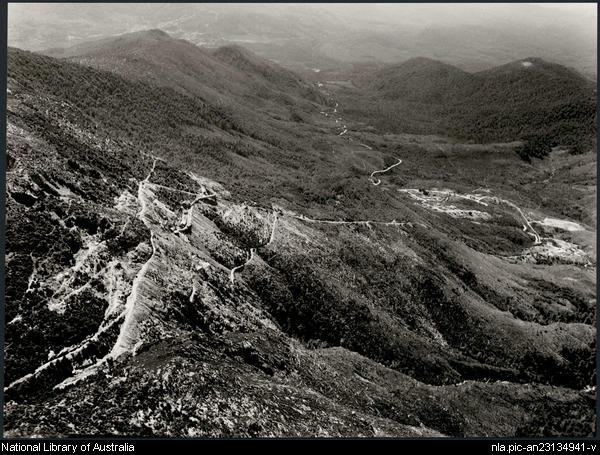
Wolfgang Sievers, BHAS mineral exploration Western Tasmania near Zeehan, 1959
The observer looks down at that landscape from a plane and asks:'what minerals can be mined there'? How much can be made? The concern is with exploiting the resources buried in the landscape with the latest technology.
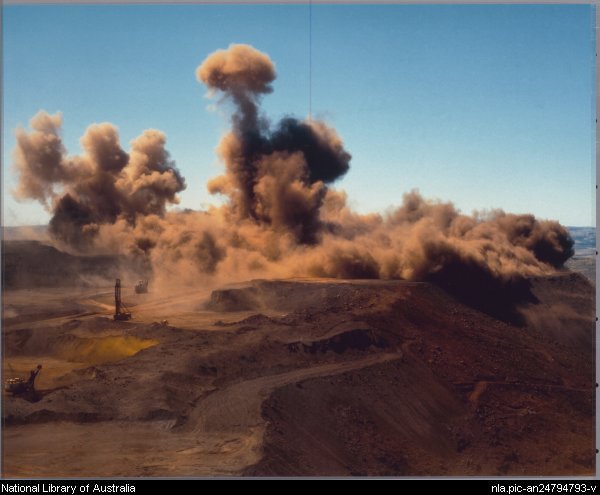
Wolfgang Sievers, Blasting at Mt. Tom Price, the Pilbara, Western Australia, 1974
In contrast, Australian [European] landscape painting represents nature as a background of a legend, myth and a reflection of human values.
You can why there is a need to question the hegemony of this European vision ---a particular way of seeing not the camera eye---that we have inherited; a questioning that avoids taking an anti-visual turn and privileging language over vision.
|


