|
July 16, 2006
W.J.T. Mitchell in Picture Theory (1994) says that ' What we need is a critique of visual culture that is alert to the power of images for good and evil and that is capable of discriminating the variety and historical specificity of their uses.
Consider "Superficial Engagement" at the Gladstone Gallery, New York, a walk-in manifesto Thomas Hirschhorn in terms of challenging a sanitized visual narrative of the war against terrorism in the way the US mainstream meedia covers the war.
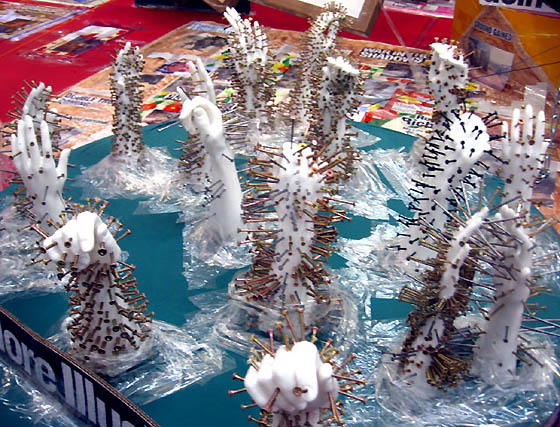
Thomas Hirschhorn, Concrete Shock, 2006
From a review of the exhibition by Jerry Saltz, entitled Killing Fields in ArtNet:
The exhibition is titled "Superficial Engagement," "because," Hirschhorn writes, "to go deep I must take the surface seriously," although an alternative interpretation is that Americans are only superficially engaged psychologically in the carnage pictured. Overall, it is a jungle or junkyard crossed with a supermarket; a homemade temple of the martyrs and Goya's Disasters of War. Its roots are in punk graphics, surrealism, Joseph Beuys, Kurt Schwitters, Edward Kienholz and Warhol's razzmatazz. Formally, Hirschhorn relies on bright lights, amplification, proliferation and multiplication. His individual objects aren't anything special; he's not a sculptor per se but more of an assemblager. "Superficial" is comprised of four large makeshift platforms. Viewers move between them along narrow corridors; everything is in your face. In addition to the gruesome images, each platform has a number of repeating elements, including quasi-primitive wooden effigies with thousands of nails driven into them, mannequins covered in nails à la acupuncture needles or the pinheads in Clive Barker's Hellraiser, along with facsimiles of the works of the visionary Swiss healer-painter Emma Kunz.
Does this kind of art work critique the visual culture of the mainstream media?
The issue of the sanitized visual narrative is considered here at Jim Johnson's (Notes on) Politics Theory Photography weblog.
|


