|
August 29, 2006
This painting was awarded the Archibald Prize in 1976, one of several Archibald prizes Brett Whiteley won in the 1970s. There is no doubt that the genre of portraiture-- and the Archibald Prize---make a cosy home for celebrity in its many forms. The art world is now romantically intertwined with celebrity but Whiteley was a celebrity in his own right; on who expressed a rise in affluent lifestyles and upwardly mobile, middle class aspirations of edgy inner city professionals.
Whiteley's 'Self Portrait in Studio ' is one of my favourite portrait paintings---the artist in his world--- and the work makes the case against those who argue for the triumphant mediocrity in Australian culture and those tabloid folk who decry the elitism of high art and celebrate the commercial enterprise of the culture industry.

Brett Whiteley, Self Portrait in Studio, 1976
I have yet to visit the Brett Whiteley Studio in Sydeny. The self-portrait is seemingly reduced to Whiteley's face reflected in a hand mirror within the vast expanse of his studio at Lavender Bay overlooking the harbour (on the top left). The reflection in a mirror is at the bottom of the picture. The painting is primarily a look at his studio and its collection of objects and is painted in deep, bluish tones. I just love the fluidity of the drawing and the virtuosity of the draughtsmanship.
This portrait stands in contrast the mediocrity---or awfulness?---of the Van Gogh series of art and social politics t exploring drugs, visual experience and musical jams:
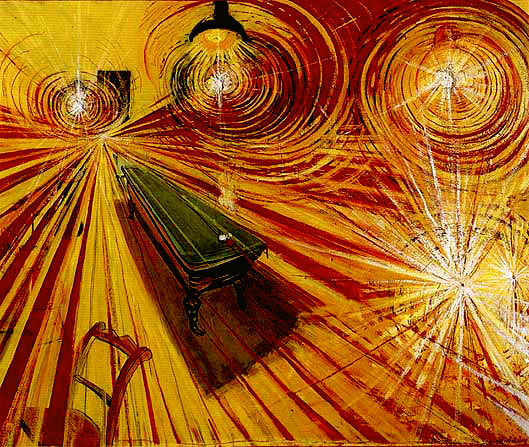
Brett Whiteley, Night Cafe, 1972
Brett Whiteley is the exception to the rule that most late 20th century art is not popular in Australia. Whiteley turned his back on the dominant mode of 20th century art, abstraction and became a key figure in the contemporary Australian canon. As modernism gave way to post modernism in the 1980s, and the explosion of commodification that influenced aspects of everyday life with the individual re-emerging as the ultimate product, Whiteley the 'burned out' artist eventually became commodified. His latter works were judged to be 'tired, overpriced and lazy' rather than a form of culture jamming.
It's a returning to Whiteley by going through the 1990s---- a decade marked by the ascendancy of right-wing
politics, globalisation, free-market trade, the rise of new media technologies and cyber networks and a return to beauty. The decade also witnessed the deregulation of art and the rise of the curator to the sometimes contentious stature of blockbuster or superstar producer in their own right, a status previously unrealised in contemporary art
|


