|
October 22, 2006
Along with jazz music, blues is the other quintessentially American art form. This makes sense of course as blues and jazz music are structurally, culturally, and historically related. So I decided to explore this with Rhino's Blues Masters ---- The Essential History of the Blues Vol. 1& 2.
The blues is America's roots music as it is music that it is strongly grounded sense of place -- specifically, the Deep South:
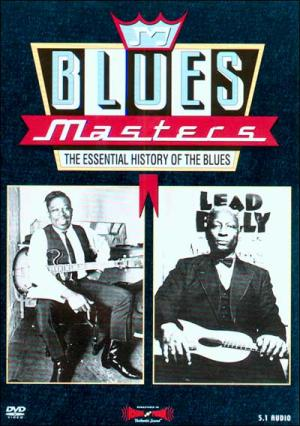
This is an "essential history" of blues music using rare performance and historical clips. The blues legends shown performing include Son House Leadbelly, Bessie Smith on Volume I, and Muddy Waters, Billie Holiday, Buddy Guy, and B.B. King on Volume 2. Though it rejected the idea that the simple and popular music of the black masses the history lacked any genuine musical substance.
It was trash in terms of both exploring musical development (no Robert Johnson, Skip James or Elmore James or Willie Dixon) and aesthetics (reflection theory). It was more about the rare performances of the early masters captured on film rare and archival footage . It is a visual, not a musical history of blues music, and one that discusses the blues in terms of its reflection of the social significance of the black movement overcoming racism and segregation.
The visual history gestured towards a blues aesthetic but never explored it in terms of the voice and guitar.
I wanted to deepen my understanding of the shift from the country blues to the urban blues then the post 1945 electric Chicago blues. The former was recorded in the mid-1920s by a single male singer, self-accompanied on the guitar or piano, with perhaps an accompanying harmonica or simple percussion. (eg., Charley Patton, Blind Lemon Jefferson, Blind Boy Fuller, and Robert Johnson) .Urban blues represents the incorpration of popular music and jazz in the 1930s with combos incorporating piano, guitar, and percussion being developed by Tampa Red, Big Bill Broonzy, Little Brother Mongomery, Leon Carr and Scrapper Blackwell, Lonnie Johnson, and Memphis Minnie.
It was during the 1940s that some blues bands incorporated saxophones amplified harmonicas, with Chicago becoming a predominant center of blues recording in the 1950s. for Muddy Waters, Little Walter, Elmore James, Howlin’ Wolf, T-Bone Walker, and B. B. King. So what was the connection between country and urban Chicago blues-- is it the Mississippi blues style just because many performers had migrated from the Mississippi region?Nor did it explore the how the blues influenced mainstream American popular music through musicians like Bo Diddley and Chuck Berry, in which Diddley and Berry's approach to performance was one of the factors that influenced the transition from the blues to rock 'n' roll.
|


