|
October 24, 2006
When the poodles and I went for our evening walk in the Adelaide parklands today I noticed that a cluster of gum trees had died. The ground was so dry---dirt and dust with tufts of dead grass The landscape I was in reminded me of the paintings of Russell Drysdale:
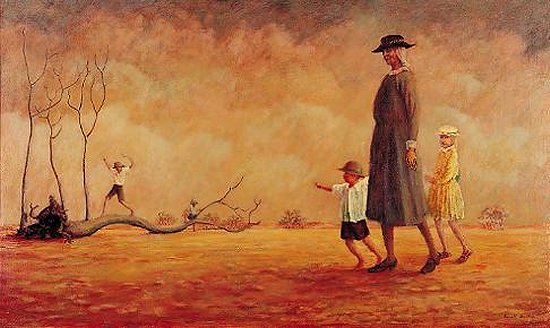
Russell Drysdale, Grandma's Sunday Walk, 1972
Drysdale is very unfashionable these days. He was killed of by an abstract modernism. I remembered some of the images of a series of paintings of drought-ravaged western New South Wales in the 1940s.
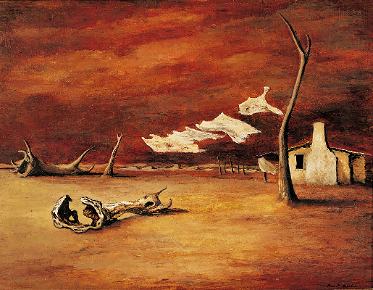
Russell Drysdale, Red Landscape, 1945
An excerpt from (Keith Newman, 'An artist's journey into Australia's "lost world"', Sydney Morning Herald, 16 December 1944, p. 5)
To drive into this country in a dust storm...is like driving into a lost world. The dust-laden air plays eerie tricks with light. The sky appears leaden, like a snow sky in Europe, or is crossed by great bands of black, red and grey... The sun is entirely obscured, or shows like a wan full moon. Dead trees, a tragic number, loom through the hot murk in a variety of fantastic shapes as though they died in agony beneath the axe or tortured by thirst as the wind blew the soil from their roots... Worse than the skeletons of animals and trees are the skeletons of homes.
This is rural Australia today, thanks to global warming.
|


