Thought-Factory.net Philosophical Conversations Public Opinion philosophy.com Junk for code

Mandy Martin, Puritjarra 2, 2005. For further information on MANDY MARTIN, refer here: http://www.mandy-martin.com/
If there are diverse kinds of knowledge and ways of knowing place, then we need to learn to value the different ways each of us sees a single place that is significant, but differently so, for each perspective.
RECENT ENTRIES
SEARCH
ARCHIVES
Library
Thinkers/Critics/etc
WEBLOGS
Australian Weblogs
Critical commentary
Visual blogs
CULTURE
ART
PHOTOGRAPHY
DESIGN/STREET ART
ARCHITECTURE/CITY
Film
MUSIC
Sexuality
FOOD & WiNE
Other
www.thought-factory.net
looking for something firm in a world of chaotic flux

top 50 live albums « Previous | |Next »
November 05, 2006

I think that the art of the live album is much under appreciated these days of the ipod songlists. The live rock album conjurs up guitar wankery--- in the classically show-offy god sense---and the terribly unsavory business of "jamming". It was what turned me off The Who's Live at Leeds in its initial truncated appearance. Yet authenticity in rock has a lot to do with live performance, ability and talent. Music should be for the people and by the people---it can be anything so long as it grabs you, shakes you, and resonates with you. Isn't that what punk said about authenticity?

So I was interested to see that Stylus Magazine has an article on the top top 50 live albums. It's a very diverse and wide ranging list, and I only know a few of them.

I don't care about the best bit---I'm interested in what people consider to be good live albums and why they are are judged to be good. The existence of these albums undercuts the cultural; conservative tradition that says rock & roll is dead. I'm thinking of the nostalgic baby boomer rock critics who say that r ock'n'roll is the essential soundtrack of who we are and have been over the past 50 years, and then add that classical rock is the touchstone for everything else.

Currrently----ie.,when I'm in Adelaide as I have no music here in Canberra---I'm listening to Bob Dylan's - Live 1975 Rolling Thunder Revue and The Allman Brothers' - Live at Fillmore East. The latter is classic southern rock played in a vigorous jam style.
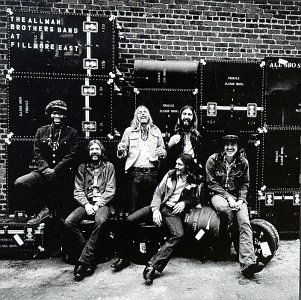
Allman Brothers.jpg Big Star rang me the other and said that my copy of Bob Dylan - Bootleg Series, Vol. 4: Live 1966, "Royal Albert Hall" Concert had arrived. I've only heard bits of it but I was impressed by the raw energy and the intense emotion. This is a defining moment of rock music history----rock's most famous concert.

I would have included the Grateful Dead's Live Dead, rather than their sprawling Europe '72 in the top 50 albums. I am still considering whether or not to buy Miles Davis' Live Evil.

It's noticeworthy that there is no live album by the Rolling Stones on the list. This is understandable because this bands approach to a live album is along the lines of a sloppy greatest hits production, rather than as an artistic statement. It's showbiz. Not everyone believes that 60s/70s rock = real rock = the way music is supposed to be. This sshows that rock needs to get over its delusions of grandeur and stop its rigid, recycled ways.Otherwise it really will be a permanent retro show.

What is a suprise is the appearance of Johnny Cash twice---Johnny Cash - At San Quentin and Johnny Cash - At Folsom Prison--- and near the top of the list. What has happened is that rock has become threatened as the dominant youth culture by hip-hop. Rock has become hamstrung by authenticity issues ---putting ethos before music--- at a time when people's listening habits are changing.

More people are listening to one song at a time or downloading music. The rise of file-sharing and mp3s has increased our listening to music- one song at a time- and created an emphasis on the single. People now view albums as malleable, collections of songs that can be skipped or deleted from burned copies of a disc.

| Posted by Gary Sauer-Thompson at 11:59 AM | | Comments (7)
Comments

Comments

In this tepid, incurious culture, the most conservative and orthodox opinions are the ones given the most attention and, as a result, are uncritically accepted as conventional wisdom. The proclamations of the "nostalgic baby boomer rock critics" you mentioned are a case in point. They are largely cheerleaders for the status quo--mainstream shills who have a vested interest in assuring that the music industry moves as many back catalog units as possible while life-supporting Paleozoic acts well past their expiration dates.

But, as fashionable as it might be to blame the boomers for everything awful, one should not ignore the naked careerism and unrepentant rump stroking of subsequent generations of musical performers whose primary goal and single-minded focus has concerned itself, not with substance or content, but with celebrity status at any cost.

Whatever outsider or "alternative" status rock 'n' roll music might have pretended to have has now inexorably mutated into shallow, mass audience, show business mediocrity. And EVERY generation, from the boomers on down, should be held equally culpable for the uninspired and derivative drek that now dominates the charts.

rocco,
The baby boomer's death of rock'n' roll hook or riff has many nuances.

One common theme is authenticity--once upon a time there was pristine rock uncontaminated by the market.That time is symbolized by Woodstock. But now the music has declined, as it has become tainted by commercial and technological forces and become a wasteland. Some this happened in 1977--after punk.

It has gone from being a popular art, spontaneously arising from the people, to a mass art, a top down product in the entertainment business manufactured by the culture industry without regard for the experiences of the people.

So we need to get back to the garden to a time when rock was about rebellion, the characteristic sincere performer, the romantic notion of artistic originality

Gary,

Woodstock? A time that symbolized uncontaminated pristine rock?

Woodstock was, in reality, a mob of hippie wannabees pretending to be a counterculture. An orgy of self-congratualtory mediocrity, it was more important culturally than musically. It validated and institutionalized, by the impressive number of its participants, the notions of high art pretentiousness and sophomoric philosophizing that have plagued the music ever since.

Whether you think it's a fanciful boomer notion or not, 1977-era punk WAS a brief respite from a music that had become bloated, self-indulgent, irrelevant and increasingly corporatized. But it rapidly became guilty of the same excesses it intended to obliterate--rock star posturing and an overblown sense of its own importance.

Every generation likes to believe in its own romanticized delusions. You can't single the boomers out for that. For instance, the current beloved myth is the concept of "indie" rock. We've already seen how independent a lot of that music really is. And just how derivative, drab and overly earnest it can be.

Look, generational fairy tales aside, there's good music in every period. That's all that matters. Discerning ears will be judicious enough to pick up on something shortly after its inception and long before it becomes a tedious self-parody.

Today's revolution and this week's avant-garde will inevitably become just another wing of the academy. As George Melly once put it--revolt into style!

No generation has an exclusive franchise on abnegating its ideals--boomers or otherwise. it's the natural order of things.

Rocco

Rocco, I was thinking of the frequent Woodstock/Altamont contrast that was once so often made in rock culture that takes its bearings from classical rock. Woodstock was not just counterculture--it was also Jimi Hendrix --Afro-American music--- as the authentic sound of freedom.

You can trace the rock'n'roll is dead through the gonzo style rock criticism of Lester Bangs who championed garage rock and American proto-Punk (MC5) and punk rock is an expression of adolescent music. Authenticity here is being an outlaw and commerce ruins the music.

You can trace the riff through the rock criticism differently with Nick Hornby in Songbook (or 31 Songs) as he struggles with music that is edgy or dangerous or difficult. Radiohead, for instance, is perverse and Kid A, is self-indulgent, too challenging (noise) , too self-conscious and not good. What is good is what fits comfortably into his life.

Gary,

Hendrix wasn't countercultural? He was primarily African American?

At the time, blacks weren't identifying with Hendrix, they were listening to Stax-Volt and James Brown. Middle class white kids posing as hipsters were Jimi's initial audience.

I'm familiar with Lester Bangs and, viscerally, I agree with him. However, on another level, I am disinclined to accept such a narrow definition of "authenticity."

Simply put, if it ain't in the grooves it doesn't mean diddley how "authentic" it is. Successful rock 'n' roll is more about spirit than anything else--some elusive quality that defies definition.

I agree with you. Most critics simply make a case for the the music that, as you put it, fits comfortably into their lives.

Rocco

rocco,
is 'spirit' The creativity of the artist? The performance? Or is it the haunting of death? A a poetic mourning?

Gary,

I'm not certain. It's one of those things you acknowledge when you're lucky enough to stumble upon it but, when the proverbial gun is held to your noggin, you couldn't possibly explain it.

The "haunting of death", as you put it, is a plausible element. When rock 'n' roll is at its celebratory best, it is, if it's anything, a middle finger flipped in the face of Mr. Grim Reaper, a raucous denial of the sloppy and painful end that awaits most of us.

"Poetic mourning" brings to mind some of the work of John Cale, Robert Wyatt, Nick Drake, Marshall Crenshaw or even Brian Wilson. But, in the canon of what is loosely termed "rock 'n' roll," it seems like an ancillary concern.

Rocco