|
November 26, 2006
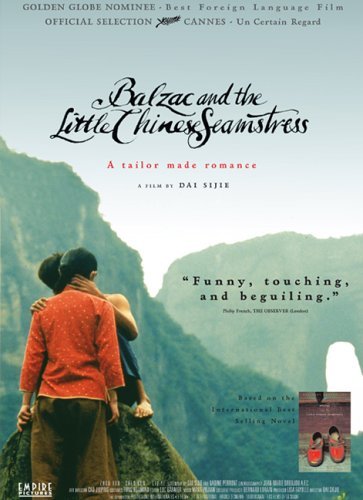
Last night I watched Balzac and the Little Chinese Seamstress (2002)--- a Dai Sijiei film set in China 1971.This was when Mao's Cultural Revolution swept over China, shutting down universities and banishing "reactionary intellectuals" from the cities to work with the "revolutionary peasants" in the countryside as part of their "re-education". The young men and women are taught Chinese propaganda which they must then spread to nearby villagers in the mountains.
 The cultural revolution was seen as a good thing in lefty academic circles in Australia in the 1980s---but it would be the equivalent of going to work in a rural, anti-intellectual Australia and being re-educated in deeply conservative values because green values were seen as bourgeois and opposed to the values of the regional working Australian people. The cultural revolution was seen as a good thing in lefty academic circles in Australia in the 1980s---but it would be the equivalent of going to work in a rural, anti-intellectual Australia and being re-educated in deeply conservative values because green values were seen as bourgeois and opposed to the values of the regional working Australian people.
The film explores two young men being in love with a beautiful Chinese seamstress. The narrative is simple.
The boys discover a fellow student possess European literature, they seize the forbidden 19th-century literature and begin reading Balzac to the seamstress. They end up falling in love with her.
This reading gives the seamstress the keys to her own freedom and she leaves the village for the city.
This simple romantic narrative is well photographed in the way that it depicts a mountainous landscape in terms of its rich, vibrant tones.
Can we talk in terms of a Chinese national cinema and the re-imagining of Chinese history, when Chinese cinema is fundamentally disperse, and the globalization of film production, distribution, and consumption calls into question the notion of "national cinema" ? Some discussion can be found here.
|


