|
December 07, 2006
Clifford Possum Tjapaltjarri is regarded as one of the most famous of the Western Desert Aboriginal artists, and one the first Aboriginal painter to be critically acclaimed by in Europe and North America. He is acknowledged to be one of the most innovative and accomplished of the Western Desert artists. Possum, who worked at Papunya in the dot-painting tradition, blended the trails of his ancestors, certain figurative elements, and Aboriginal iconography.
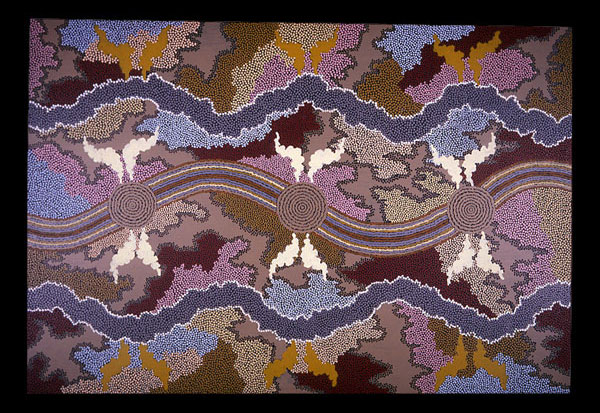
Clifford Possum Tjapaltjarri, Corkwood Dreaming, 1991, acrylic on canvas
The "community" at Papunya was set up in 1959 as an official government settlement 250 miles west of Alice Springs, in central Australia, bringing together nomadic desert people with the aim of assimilation to western living. Many different language groups were brought together away from their traditional lands and faced inappropriate social and cultural structures with the diversity of groups living in such close proximity. They were stationed at Papunya for their supposed advancement, but this settlement was a very unhappy time, a time of wrenching social turmoil; a place with a high morbidity rate, riots and despair.
The restrictions and pressure which arose, also due for example to the forceful prevention of leaving the reservation except with the permission of the whites, as well as the realisation by the elders of the communities that their culture was suffering untold damage, made it essential to seek a way out.
The assimilation process was a tragedy for nomadic peoples who understood their role to be keeping the country. The painting demonstrates the continuing link with their country and the rights and responsibilities they have to it. The paintings are positioned in concerted opposition to white officialdom (Northern Territory) at a settlement built to silence their language and stifle their culture, since by revealing the ancestral designs that invoke power in ritual contexts, they asserted the importance of their culture to the colonisers and controllers of their destiny.
Assimilation held that the training, education and regulation would impact on the manner of living of Aboriginal people in order to encourage (or coerce) Aboriginal people to live like 'other Australians'; 'other Australians' was a term, which essentially meant white people. Ultimately the policy sought to result in a national community, or the unity of a single community.
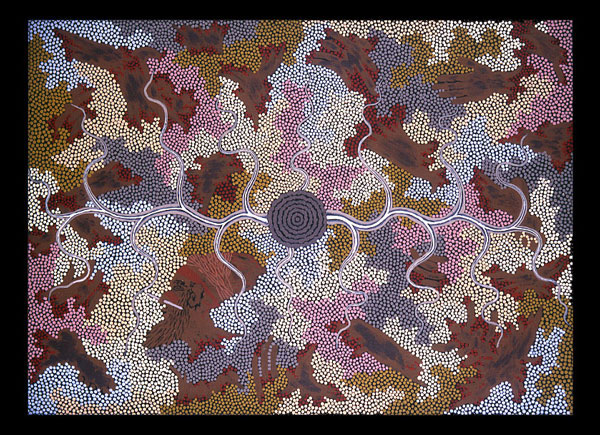
Clifford Possum Tjapaltjarri, The Law, 1991, acrylic on canvas
Central Desert acrylic painting began as a form of political activism produced by male elders experiencing a profound sense of diaspora. Ultimately, it became an art form that has earned its place as important contemporary art in a mainstream context.
previous
|


odd , yet lovely. tx.