Thought-Factory.net Philosophical Conversations Public Opinion philosophy.com Junk for code

Mandy Martin, Puritjarra 2, 2005. For further information on MANDY MARTIN, refer here: http://www.mandy-martin.com/
If there are diverse kinds of knowledge and ways of knowing place, then we need to learn to value the different ways each of us sees a single place that is significant, but differently so, for each perspective.
RECENT ENTRIES
SEARCH
ARCHIVES
Library
Thinkers/Critics/etc
WEBLOGS
Australian Weblogs
Critical commentary
Visual blogs
CULTURE
ART
PHOTOGRAPHY
DESIGN/STREET ART
ARCHITECTURE/CITY
Film
MUSIC
Sexuality
FOOD & WiNE
Other
www.thought-factory.net
looking for something firm in a world of chaotic flux

water for sale « Previous | |Next »
January 19, 2007

It's been lightly raining off and on in Adelaide for most of the day. It is very welcome after the long period of dryness, though it is not enough to green the parklands or bring the dead trees back to life. It's just an interlude in a very dry spell.

I've recently noticed that all the public taps no longer exist. Water is no longer a public good with state governments having a constitutional responsibility to manage it for the public interest or the common good. Water, especially in rural Australia, is now a commodity and state governments use the water market to sell water to those with the deepest pockets during a drought.
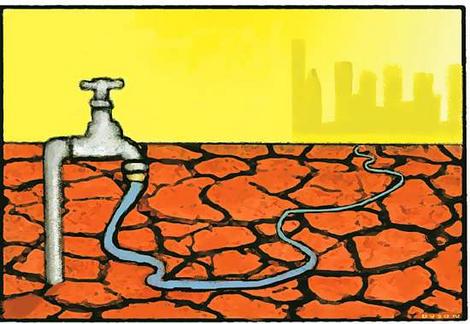
DysonA.jpg
Dyson

Water markets are meant to ensure the efficient allocation of scarce resources, as water use shifts to the highest value user. The scarce water resources are supposedly due to the drought, it is constantly said. Yet the history of water politics indicates that in the 20th century water was once given away to irrigators by state governments to foster economic development and prosperity. Water development was variously called drought proofing the region or making deserts bloom.

Today government ministers rarely say that rising global temperatures cause less rain and that rising temperatures are increasingly caused greenhouse emissions. It's the drought.

The 'Drought' explanation implies that the rains are on the way. It implies that it is just a matter of when the wet cycle replaces the dry cycle and that its all a matter of natural cycle. So, the government authorities say, we just have to make do with less water in the cities those with deep pockets (businesses) excepted of course. And we need to build more and more dams for the next wet cycle. That is gonna be a big one. I can feel it in my bones. Can't you? In fact it's just around the corner, isn't it.

That kind of approach to the water crisis represents a denial of global warming and its effects on our capital cities.

| Posted by Gary Sauer-Thompson at 05:05 PM | | Comments (13)
Comments

Comments

Well building a pipeline across Australia isn't such a bad idea you know.....eventually desalination will become more viable...by that time the pipeline would be finished...do you have any thoughts on where to put it.....of course it wouldn't have to go straight across it could say start above the Ayr and arch down and end up in Vic or the eastern part of S.A.
This would enable later pipelines to come from the westcoast....one to Kalgoorlie could meet up with the existing pipeline to Perth....

Les,
why not recycle grey water and storm water in Adelaide and in the other capital cities? Most of the storm water in Brisbane and Sydney flows out the sea. So why not use it?

Yes...Storm Adelaide by all means and drive all the Adelaidians into the sea....That would save water.

The Australian had a good article in the South Australian Section today on deficient investments on water infrastructure. It is clear that there is a great deal of reactionary planning going on. Another interesting fact was that Australians pay about half what British people pay for water.

Colin,
Often people talk about extra investments in water infrastructure in terms of more dams....The criticism, as Malcolm Turnball points out, is not so much that the state governments should have built a dam but that they did nothing else to make the shift to more sustainable cities.

Dams are not much use if the rain patterns have changed and it no longer rains in the catchment area --as in Brisbane and Sydney. And where would you build a new dam in Adelaide-the River Torrens?

Adelaide really needs to find alternative water supplies: ie embrace investment in recycling storm water instead of building weirs at Wellington at the top of Lake Alexandrina to protect its water supply from the River Murray.

As Mike Steketee points out in The Australian article you referred to, it was only iWestern Australia that has reached the conclusion earlier that it was not good enough to rely on historical rainfall averages to plan for the future. So in the five years to 2005, spent two to three times as much per capita on water infrastructure in Perth as the levels in Sydney, Melbourne, Brisbane and Adelaide.


Les,
Unlike Brisbane Adelaide is not growing.There are no jobs here. Young people have to leave.

The geo-technical work is being done at the Hinze Dam this weekend....So it official work has begun on lifting the wall 20 metres
Yahoo....a positive move.

Shaymus,
I presume that the ratepayers on the Gold Coast would bear the cost of the Hinze Dam work (estimated at $80 million?).I presume that the Hinze Dam depends on rainfall, and I guess that the runoff is no longer reliable due to changing weather patterns.

I understand that raising the height of the dam will decrease the risk of flooding. This increased area of the dam will be left empty to allow for the holding of water in an extreme flood event.

Doesn't the water crisis in SE Queensland comes from an almost total reliance on dams for water supply. Changing rainfall patterns mean that the catchment is getting fewer of the storms that gave them desirability as a dam-site.

Yes you are right about the risk of flooding....Lucky that the combination of a full dam, rain and a King tide hasn't arisen.....Though when it does happen it will be a disaster for many canal homes.

Shaymus,
I understand that there is little prospect of drought-breaking rain in SE Queensland, according to this story in the Courier-Mail. It goes on to say that:

Although the southeast has received about 40mm of rain since Christmas, none of the rain created significant inflows into the Wivenhoe, North Pine and Somerset dams, which are at 23 per cent of capacity and falling about 1 per cent every three weeks. By June, it is possible the dams will be down to 17 per cent of capacity.

It's lack of rain not just population pressure that's the cause. The problem for SE Queensland is that the water crisis comes from an almost total reliance on dams for water supply. More and bigger “dams equals more water” is the ethos. Yet without good run-off rain, a dam is just an expensive wall.

I notice that the Beattie Government is still pushing ahead with the controversial dam at Traveston Crossing near Gympie, west of the Sunshine Coast. I understand that the Traveston project will cost of about $1.7 billion, and that this represents almost a quarter of the Beattie Government's $8 billion water plan. It is a huge financial and political investment.

I discern a bit of a noose around the neck of state Labor on this. Virtually no one outside Queensland supports the proposed dam, with many inside the state also opposed.


Yeah...everyone wants new dams just as long as they aren't on their property....unfortunately dams are an important part of qld water plan and MUST be built somewhere.....
It is also a bit silly that as soon as a new dam is in the wind the Coalition start rounding up Farmers and their families with signs that say "NO DAMN DAM" and of course the press love it too.
Dams must go where there is reasonable expectations of rain and much research is involved in choosing prospective places.. Though if you believe the Press....Peter Beattie stands in his office with a blind fold and a dart.

Shaymus,
SE Queensland needs different sources of supply, with dams just one part of the mix. Dams only fill when you've got run-off and run-off is becoming an increasingly scarce resource as our rainfall patterns change.

Some suggest mining the Nambour Basin is one such source.This is a sedimentary basin, mostly of porous sandstone, that extends from the mouth of the North Pine River to the mouth of the Maroochy.

Those sources of water should include groundwater, desalination, recycled water, rainwater harvesting and water trading with the agricultural sectors.

Yes, all of that..

My idea to pipeline across australia at various points would setup a network whereby water could be traded between the states as a commodity.
It would be an expensive operation I know but would also perhaps give the ability to solve some environmental issues in austaralia.

 
Post a comment

(If you haven't left a comment here before, you may need to be approved by the site owner before your comment will appear. Until then, it won't appear on the entry. Thanks for waiting.)

Name:
Email Address:
URL:
Remember personal info?
Comments: (you may use HTML tags for style)