|
February 03, 2007
I'm reading Frank Zappa, Captain Beefheart and the Secret History of Maximalism by Michel Delville and Andrew Norris. It is an interpretive essay investigating the cultural and historical importance of Zappa and Beefheart, and it offers an alternative interpretation to the cultural studies take on the study of popular music, which generally neglects aesthetics in favor of the merely semiotic and sociological.
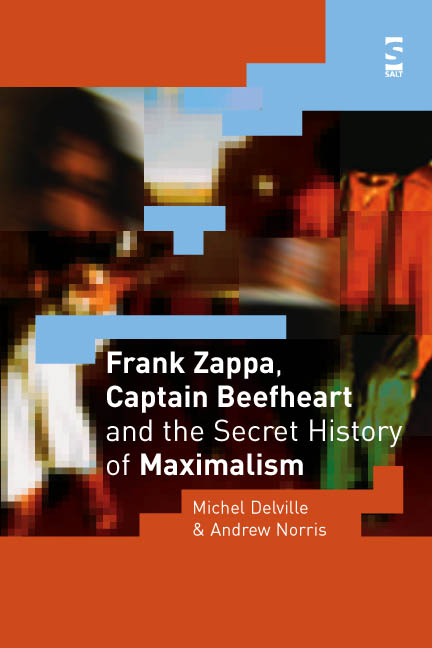
It is a complicated text. An early account says that maximalism is an art that exceeds its own historical context and represents more than the sum of all past and present compositional styles. The the maximalist approach in contemporary music “embraces heterogeneity and allows for complex systems of juxtapositions and collisions, in which all outside influences are viewed as potential raw material.”
In an extract they ccomment about Beefheart:
As a musician, Van Vliet lacked both the formal know–how of technique, and an interest in advanced musical technologies, and this may explain his unwillingness to extend the experiments he was making at the level of the group to the broader plane of conceptual and materialist manipulation, his failure to objectify his moments of transcendent insight into a project/object with a life of its own. Regularly, also, the Captain tried to conform to the norms of popular music, writing songs which seem to labour under a load of assumed sincerity while lending themselves to a perversely melancholic listening experience...This hesitation between modes of creativity, together with his eventual selection of a neo–primitive abstract–expressionist aesthetic for his painting contrasts interestingly with Zappa’s self–consuming commitment to the Big Note and its cosmic ramifications.
The extract notes that in spite of the differences between Zappa and Beefheart, many of Van Vliet’s texts are thematically consistent with Zappa’s concerns, and both hark back in various ways to the anti–art activities of Dada (perhaps the key maximalist movement of the modernist period):
Van Vliet drew on the paradox of ordered disorder exploited by Hugo Ball in his sound poetry, together with the “primitivism” of Tzara, rendered urgently audible in the free jazz of Ornette Coleman; while Zappa fell in love with the materiality of sound, and the theatrical extravagances of burlesque, key components in his self–recharging brand of social satire. While Van Vliet played with the paradox, evolving his own surrealist slant on those odd overdetermined objects so dear to Zappa, the latter branched out and out into parody, satire and beyond.
|


