|
February 21, 2007
Melbourne's public transport planning is supposed to be following a well-researched strategy based on sound economic principles. This damming account by Tony Cutcliffe in The Age about public transport in Victoria shows otherwise:
Victoria's chaotic public transport is symptomatic of poor planning, insufficient investment and short-term management. Train tracks and signals groan with neglect, rolling stock is short on back-up and capacity, and efficiencies are lost to network technology as old as the golf-ball typewriter. A motley tram fleet moves at the average speed of a bicycle, bursting at the seams. Buses are overcrowded or empty and AWOL on weekends.
This type of dysfunctionality exists even though the Brack's Government has had seven years and a war chest of money to fix the mess.
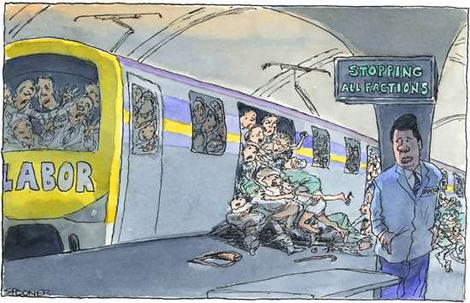
Spooner
John Legge in The Age says that:
On economic grounds it is trams first, trains second, and buses nowhere. On environmental grounds it is again trams first, trains second, and buses behind either. On popularity grounds trains slightly shade trams, while once again buses trail far in the rear. What has our economically rational, environmentally aware Government chosen to do?
Legge goes on to say that:
In spite of the huge success of the Box Hill and South Vermont extensions, the tramway network is to go 15 years without any further "significant" extensions. The rail system is to be the subject of some minor bottleneck reduction and some feasibility studies. Meanwhile, hundreds of millions of dollars is to be spent on running more unpopular, polluting and very expensive buses.
Legge says that if the Government is serious about its greenhouse targets and serious about increasing public transport patronage, it should start progressively replacing buses with trams and using trams and light rail connections to link Melbourne's developing suburbs to the train network and their local shops and schools. At the same time, it should start filling in the gaps in the tram network, especially where a minor extension can create a train/tram interchange, as at Box Hill.
|


