|
June 05, 2007
From a distance, looking across the water from Cape De Couedic, they look like Australia's version of Stonehenge. These rocks sit atop a remnant granite outcrop that juts out to sea.
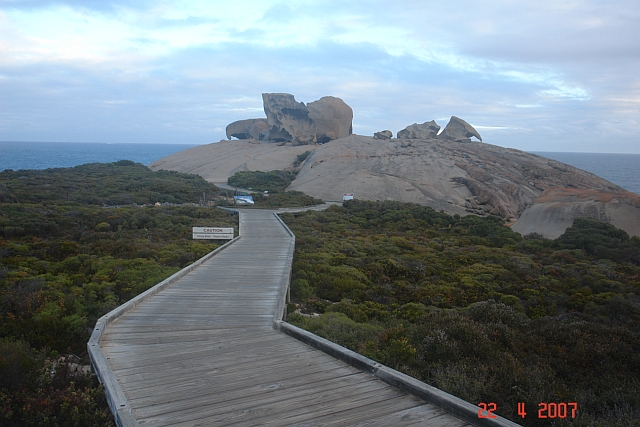
Gary Sauer-Thompson, Remarkable Rocks, Kangaroo Island, 2007
Upclose it is very different. It's the dramatic forms not the mystical or spiritual presence that is striking:

Gary Sauer-Thompson, Remarkable Rocks, Kangaroo Island, 2007
The weathering actions of water seeping into the cracks of the rocks weathered by the sandy wind which form unusual shapes.
Aboriginality is marked by its absence. In the early nineteenth century sealers kidnapped Tasmanian Aboriginal women to work and live with them on Kangaroo Island. During the past times of lower sea levels Kangaroo Island was connected to the mainland. Its most recent separation was probably at the end of the last ice age about 10,000 years ago.Aborigines had lived on the island until at least 4,000 years ago - long after the island was isolated from the mainland by rising sea levels. Stone tools have been found widely on the island and Aboriginal occupation may have persisted until about 2000 years ago.
The place was unoccupied when Matthew Flinders landed there in 1802 - he noticed there were no fires, and extraordinarily tame kangaroos.Rebe Taylor, author of Unearthed: The Aboriginal Tasmanians of Kangaroo Island, says:
As the two histories met, Kangaroo Island fell out of both of them. It is only a footnote to the narrative of the Aboriginal Tasmanian community of Bass Strait ... It was cordoned off, roped into the colonial narrative of South Australia. But it is only a footnote in that story as well.
|


the 2nd picture is amazing. The shadows and colors.