|
July 24, 2007
The centre of the nascent Western Desert art movement, Papunya Tula gave rise to one of the country's most gifted Aboriginal artists — the late Clifford Possum Tjapaltjarri. Like Albert Namatjira before him, Clifford Possum blazed a trail for future generations of Indigenous artists, bridging the gap between Aboriginal art and contemporary Australian art.
He is widely acknowledged as the first recognised star of the Western Desert artists and one of Australia’s most distinguished painters of the late twentieth century. By February 1999 when Clifford Possum was flown to Sydney to identify a wide range of suspect paintings exhibited under his name he was 66 years of age and universally recognised as the most famous living Aboriginal painter.
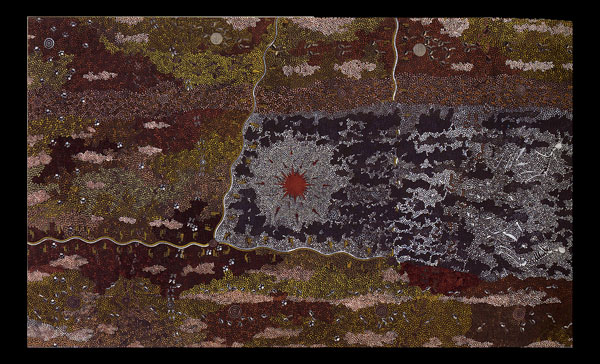
Clifford Possum Japaltjarri, Warlugulong, 1977
This is not the painting, which represents the ancestral Fire Dreaming, that will be auctioned in Melbourne, 24 July by Sothebys. That other painting is expected to fetch between $1.8 million and $2.5 million.
Clifford Possum was the first Indigenous Australian artist to be recognised by the international art world. When his major work, 'Man’s Love Story 1978' was purchased by the Art Gallery of South Australia in 1980 it became the first ‘dot’ painting to enter a major public art collection. The art institution set a trend by displaying the painting alongside contemporary Australian art, there by transgressing the ethnocentrism which had allowed Australian art experts to operate as though High Art and Aboriginal Art are mutually exclusive categories.
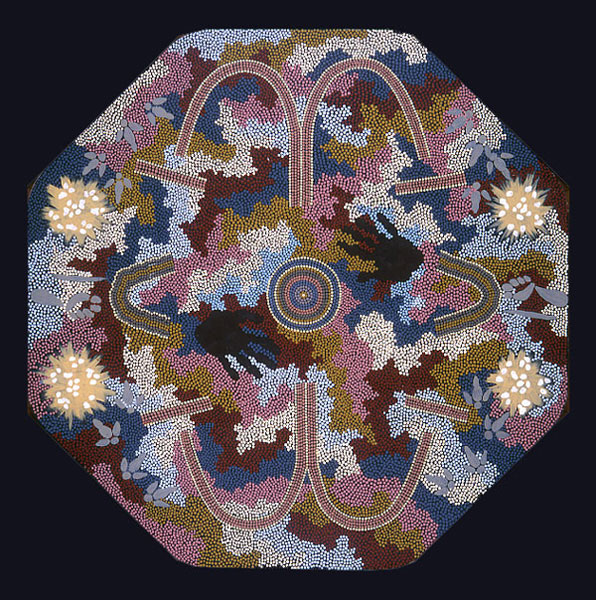
Clifford Possum Japaltjarri, Men's Dreaming, Acrylic on laminex tabletop, 1992
The art of Clifford Possum is notable for its brilliant manipulation of three-dimensional space. Many of his canvasses have strong figurative elements which stand out from the highly descriptive background dotting. In the late 70’s he expanded the scope of Papunya Tula painting by placing the trails of several ancestors on the same canvas in the fashion of a road map. Within this framework, he depicted the geographical features of the country by employing traditional Aboriginal iconography.
Andrew McNamara argues that Clifford Possum's work needs to be read in two different ways as there is a double-headed quality in the most elegantly composed of Clifford Possum’s work.
For this means staying alert to its productively unassimilable quality at the very same time that his great formal and compositional dexterity makes traditional knowledge and expression palpable for a non-traditional audience. As each innovative divergence in his work treaded precariously, their force was to negotiate overlapping, but disjunctive arenas without guarantee. To say these things, to make these qualifications about the critical framework for the evaluation of indigenous art, does not mean disparaging a genuine achievement. It is to herald Clifford Possum’s art as a genuine feat of engaged critical-cultural experimentation—the achievement of dealing with dislocating effects, and even producing them, in negotiating cultural re-assertion—rather than a superhuman achievement of self-definition.
There is a bi-cultural process happening here between the experimental modern paintings and traditional ceremonial forms.
previous
Update: 25 July
Warlugulong, which is one of the 20th century's most important Australian paintings, went for $2.4 million and it stays in AustraliaL
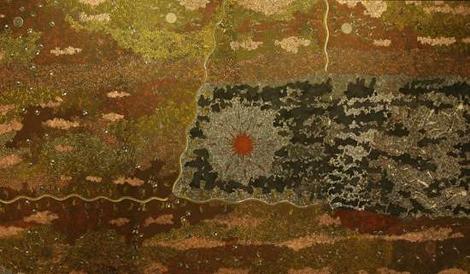
Clifford Possum Japaltjarri, Warlugulong, 1977
It was purchased by the National Gallery of Australia. A great result. It's Australia's version of Blue Poles.
|


